
Verify the contract text before you negotiate a moral-rights waiver#
When you see waiver of moral rights in a draft, treat it as a term that needs verification before you negotiate specifics.
What is confirmed here is limited to metadata and access state: the page shows “Rethinking the Compatibility of Moral Rights and Fair Use” by Dane Ciolino, shows 1997, and displays access controls such as “Sign up or log in to continue,” “download PDF,” and “See full PDF.” It also shows listing metrics (175 views, 46 downloads). None of that confirms substantive contract rules.
Use the framework below as a process for handling uncertainty, not as a statement of legal effect.
Diagnose before you negotiate price#
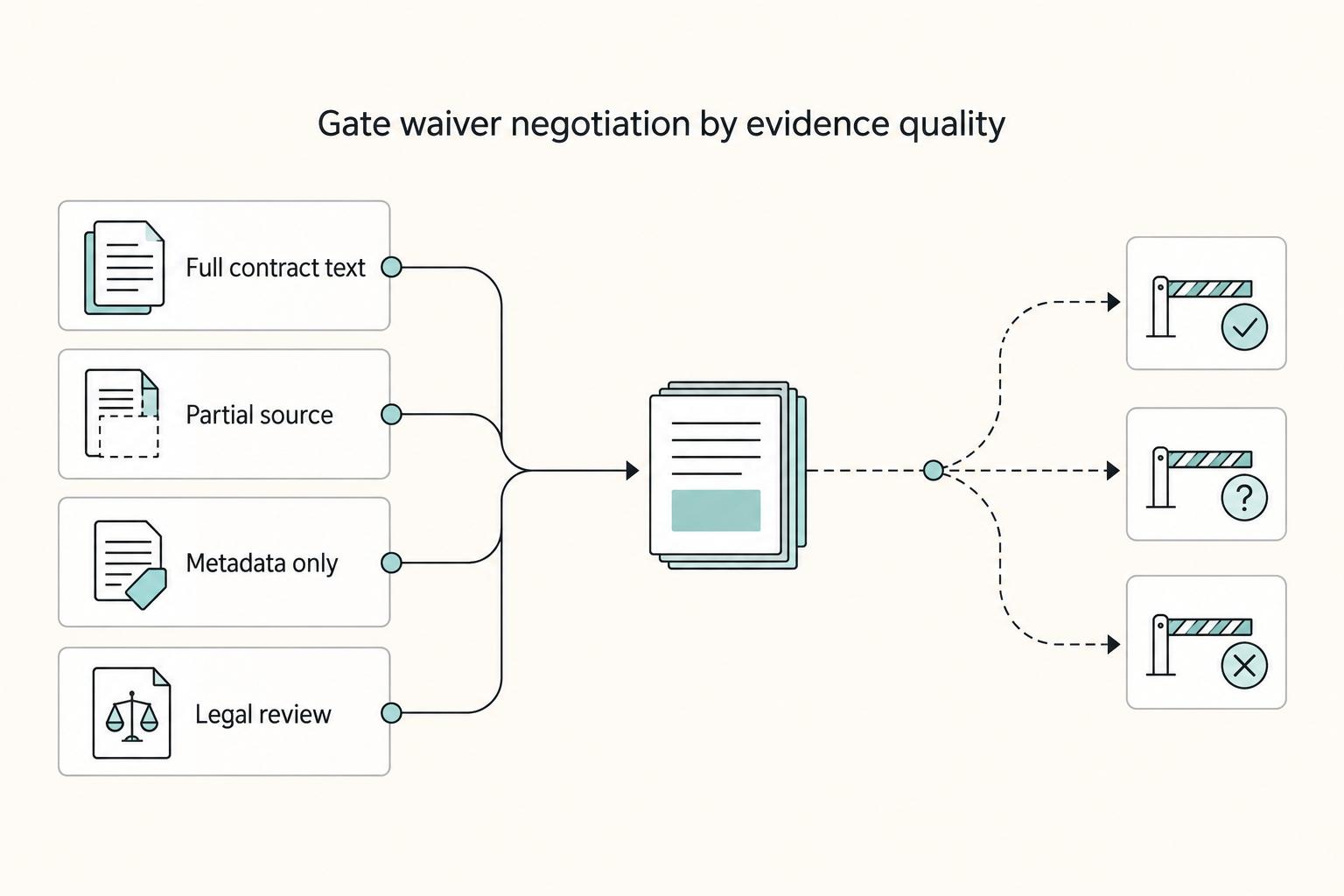
Do triage on source quality first. If substantive legal text or operative contract language is missing, pause conclusions and request complete materials.
| Triage | What you have | Immediate action |
|---|---|---|
| Go | Full, ungated operative contract text plus confirmable legal authority | Proceed to scoped negotiation with legal review as needed |
| Slow Down | Partial text, summaries, or gated materials | Request full text and narrow the issue before discussing price |
| No-Go (or legal review first) | Only metadata/title-level visibility | Do not treat this as enough support for legal or pricing conclusions |
A practical sequence is:
- Confirm what text is actually available and ungated.
- Separate verified facts from assumptions.
- Mark open legal questions as
[confirm under governing law]. - Ask for missing contract documents and operative clause versions.
- Discuss commercial terms only after scope is document-backed.
Check the whole contract stack, not one clause#
Confirm enforceability, waiver scope, and differences among legal mechanisms with qualified legal counsel.
Review the full document stack as one package and keep a short issue list with document name, version date, and clause location for relevant terms. If legal effect depends on jurisdiction, keep placeholders instead of assumptions (for example, [confirm effect and enforceability under governing law]).
If a source is access-gated or only partially visible, treat it as incomplete support, not a final basis for contract conclusions.
Price it as its own concession#
If you discuss commercial treatment, present it as provisional and tied to documented scope once full contract text is available.
| Option | Scope boundary (provisional) | Commercial note |
|---|---|---|
| Limited consent | Current SOW, named deliverables, defined edits | Quote assumes narrow, documented wording |
| Broader consent | Wider modification/reuse language | Reprice or trade for tighter limits after legal confirmation |
| No added consent | No expansion beyond baseline terms | Keep current pricing tied to baseline scope |
If billing must remain bundled, state in writing which wording assumptions the bundled price relies on.
Redline checklist and copy-ready talk tracks#
Before comments or a call, keep the checklist focused on verification:
- Confirm which sources are complete versus gated.
- Confirm governing law and mark legal-effect unknowns.
- Confirm the operative document set (main agreement, SOWs, appendices, amendments).
- Confirm clause versions and precedence order.
- Confirm named deliverables and stated use case in writing.
- Write fallback wording only after the above is complete.
Copy-ready talk tracks:
Email: “I can review this once we have the operative clause text and document set. The currently visible source material is gated/metadata-level and is not enough for a final legal or pricing conclusion.”
Call: “I can separate what is verified from what is still open. Let’s confirm the exact documents and wording first, then we can scope commercial treatment against the actual text.”
For deeper practical drafting context, read Work for Hire vs. Assignment of Rights: A Freelancer's Guide to Owning Your IP.
When your scope is verified and you are ready to draft, use the Freelance Contract Generator.
If you want contract terms and payment operations considered together, review Merchant of Record for Freelancers.
For legal context while reviewing clause language, start with Reference 1, Reference 2, and Reference 3.
| Clause Element | Why It Appears | Negotiation Handle |
|---|---|---|
| Scope of waiver | Defines which moral-rights claims are waived | Limit waiver to specific deliverables and uses |
| Attribution control | Addresses credit/removal rights | Specify where credit is required or optional |
| Modification rights | Allows edits, cropping, adaptation | Set approval rules for material edits |
| Risk Scenario | Contract Trigger | Mitigation |
|---|---|---|
| Broad waiver with no limits | Waiver applies to all future uses | Tie waiver to named project and channels |
| Portfolio conflict | Restriction blocks showcasing your work | Add portfolio-use carve-out |
| Jurisdiction mismatch | Clause ignores governing law context | Add governing-law and dispute-resolution alignment |
| Review Workflow | Action | Output |
|---|---|---|
| Clause read-through | Mark waiver scope and exceptions | Annotated draft |
| Counterproposal | Submit narrowed language | Tracked redline |
| Final sign-off | Confirm business and legal alignment | Execution-ready agreement |
What is the first check before accepting a moral-rights waiver?#
Check scope: confirm exactly which works, uses, and jurisdictions the waiver covers before agreeing to broad language.
Can you negotiate a waiver instead of rejecting it outright?#
Yes. You can narrow scope, add portfolio carve-outs, and require approval boundaries for sensitive modifications.
When should counsel review this clause?#
Use counsel review when the clause is broad, cross-border, or conflicts with attribution and portfolio goals.
Practical Negotiation Workflow Before You Sign#
Treat a moral-rights waiver like a scope-control problem instead of a yes-or-no decision. Your goal is to align business use rights with real project needs while avoiding open-ended language that follows you across unrelated future work. Start by isolating what the client actually needs to ship on time. Then translate those needs into precise contract language: named deliverables, named channels, named territories, and clear version-control boundaries. If a clause cannot be tested against those boundaries, it is probably too broad for a freelancer contract.
A strong first pass is to mark every sentence that changes how your work can be modified, credited, or reused. Next to each sentence, write a plain-language effect statement such as: allows silent edits, removes attribution requirement, or applies to all future campaigns. This side-by-side view helps you spot where risk is coming from. It also gives you a structured basis for redlines. You are not arguing abstract legal theory. You are mapping consequences and proposing narrower alternatives that still let the client execute.
When you draft a counterproposal, keep the language operational. For example, tie any waiver to a specific statement of work, delivery window, and publication set. If the client needs adaptation rights, define what kind of adaptation is expected in production and what changes still require notice or approval. If attribution is flexible, define where attribution can be omitted and where it remains required, such as portfolio pages, case studies, or product credits. Specificity reduces review cycles because both sides can evaluate concrete terms quickly.
Use a short internal checklist before every contract round so you do not miss hidden expansion of scope. Check whether the waiver text references future works, affiliates, sublicensing, or derivative use beyond the current project. Check whether your portfolio-use rights are preserved. Check whether governing law and dispute terms are aligned with the rest of the agreement. A waiver clause can look small and still change your leverage if these surrounding terms are inconsistent. Consistency is often where practical risk is decided.
If you work across jurisdictions, do not assume the same clause behavior everywhere. Keep your negotiation notes organized by project and legal context so you can avoid copy-paste mistakes from older templates. A useful pattern is to maintain a clause matrix with three columns: baseline client language, your proposed replacement, and agreed final language. That matrix becomes a reusable playbook for future deals and reduces cycle time on similar contracts. It also helps you explain your rationale clearly when procurement or legal asks why a change is needed.
After signature, capture execution rules in your delivery workflow. Document where edited versions are stored, who approves final variants, and which rights assumptions were agreed for attribution and modification. This reduces downstream disputes because operational teams can follow contract intent without reinterpreting the clause from scratch. For freelancers, post-signature discipline is part of risk management: if your delivery and archive process reflects negotiated terms, you are less exposed when reuse questions appear months later in a new campaign.
Use this implementation checklist before final sign-off:
- Confirm waiver scope is linked to named deliverables and project context.
- Confirm adaptation rights describe expected edits, not unlimited modification.
- Confirm attribution terms are explicit for publication, portfolio, and internal use.
- Confirm sublicensing and affiliate use are either limited or separately approved.
- Confirm governing-law and dispute clauses do not conflict with the waiver language.
- Confirm a retained-rights statement exists for rights not expressly waived.
- Confirm delivery and archiving workflow reflects the final negotiated wording.
This process keeps negotiations practical and business-forward. You preserve client usability while reducing ambiguous language that creates avoidable long-tail risk. In most freelance workflows, the win condition is not eliminating every waiver concept. The win condition is controlling scope, documenting expectations, and translating legal text into operational rules your client and your business can actually follow.
Frequently Asked Questions
What is the first check before accepting a moral-rights waiver?
Check scope: confirm exactly which works, uses, and jurisdictions the waiver covers before agreeing to broad language.
Can you negotiate a waiver instead of rejecting it outright?
Yes. You can narrow scope, add portfolio carve-outs, and require approval boundaries for sensitive modifications.
When should counsel review this clause?
Use counsel review when the clause is broad, cross-border, or conflicts with attribution and portfolio goals.
Researched and edited by the Gruv editorial team. Gruv builds cross-border billing, payouts, and finance-operations software for global businesses.
Sources
- academia.edu/2404103/Rethinking_the_Compatibility_of_Mora...trusted
- copyright.gov/reports/waiver-moral-rights-visual-artworks.pdftrusted
- cyber.harvard.edu/copyrightforlibrarians/Module_4:_Rights,_Exc...trusted
- pmc.ncbi.nlm.nih.gov/articles/PMC10297736trusted
- sec.gov/Archives/edgar/data/1360214/0001493152260085...trusted
Educational content only. Not legal, tax, or financial advice.
Related Posts

Work for Hire vs Assignment of Rights for Freelancers
A freelance agreement is not just about price and scope. It decides who controls the rights in the work. If the ownership language is loose, rights can move earlier than you expect, cutting down your control once the work is delivered or used.

Germany Freelance Visa Application Path for Freiberufler and Gewerbe
Choose your track before you collect documents. That first decision determines what your file needs to prove and which label should appear everywhere: `Freiberufler` for liberal-profession services, or `Selbständiger/Gewerbetreibender` for business and trade activity.

High-Earners vs. Low-Earners: A Breakdown of Platform Choices for Indian Freelancers
Stop searching for the "best platform" and build a two-rail system, with one primary rail and one backup, that protects cashflow, FX, and reversals. As a freelancer, you're running a business of one. Getting paid is a core ops system, not a preference.