
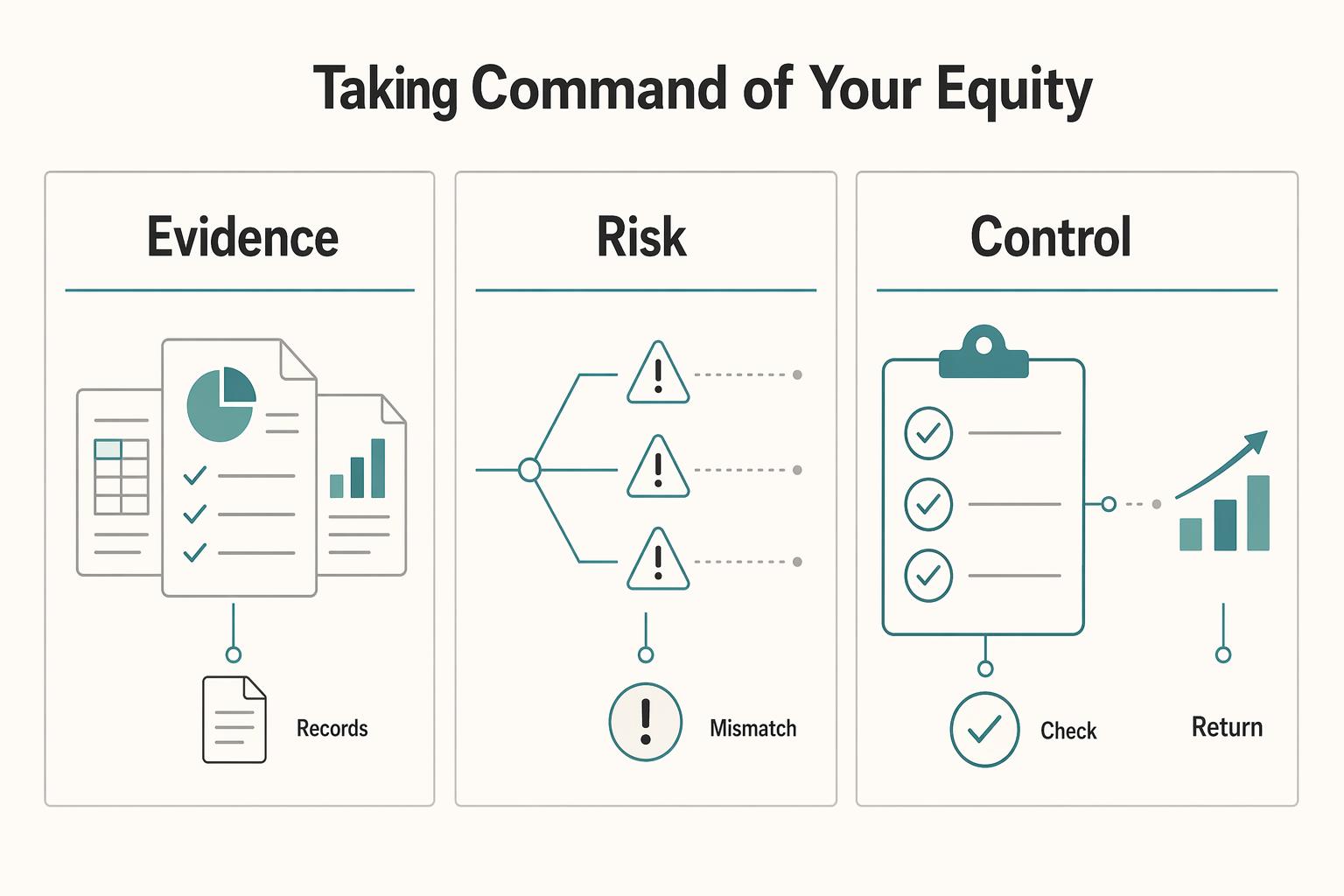
Quick Answer
Start by treating vesting schedule equity as an asset-management process, not an offer perk. Verify your vesting dates and cliff terms in the actual plan documents, map each vesting event, and test value with unknowns marked. Then negotiate the few terms that change downside most, including acceleration and post-termination exercise language. After signing, track triggers such as departure, change-of-control events, and any 83(b) decision point with written records and advisor review.
Your equity grant is not a perk. It is a high-stakes financial asset, and it may become a meaningful part of your net worth. Most guides explain what you were given. This one is about what to do with it.
Treat the grant with the same seriousness you would bring to any major investment. It comes with real risks, including tax exposure, dilution, and the possibility of forfeiting value if you leave at the wrong time. It also carries real upside. In practice, the gap between a weak outcome and a strong one usually comes down to whether you manage the grant actively instead of accepting it passively. That means treating your equity like an asset on your personal balance sheet.
This playbook is built around that approach. First, understand what the grant actually says. Then model the economics, negotiate the terms that matter most, and protect yourself when tax, departure, or acquisition issues show up. The point is not to remove every uncertainty. It is to replace guesswork with a process you can defend.
First, Understand the Battlefield: Decoding Your Equity Grant#
Read your equity like a contract, not like a benefit. The terms that matter are the ones in your grant paperwork and records, so verify everything against the actual documents you received.
The easiest way to do that is to stop thinking in abstractions and start thinking in dated events. One useful bookkeeping lens is a vesting event: a recordable unit of stock vesting that you can track with its own posting. It sounds dry, but it gives you a clean way to confirm what was recorded, when it was recorded, and whether your records line up.
Quick glossary you can actually use#
| Term | Document handling | Action |
|---|---|---|
| Vesting schedule | Use the issuer's definition in your documents, then extract each dated vesting event exactly as written. | Ask for exact dates and amounts, not a verbal summary. |
| Vesting period | Treat this as document language, not a guess. | Copy the stated start/end dates directly from paperwork. |
| Cliff | If this term appears, capture the clause text and date(s) verbatim. | Rely on the written clause, not assumptions. |
| Graded vesting | If this term appears, record each dated vesting event separately. | Keep each event as its own line item. |
| Options | This is a grant label you may see. | Confirm the exact mechanics in writing. |
| RSUs | This is another grant label you may see. | Confirm the exact mechanics in writing. |
- Vesting schedule
Use the issuer's definition in your documents, then extract each dated vesting event exactly as written. What this means for you: ask for exact dates and amounts, not a verbal summary.
- Vesting period
Treat this as document language, not a guess. What this means for you: copy the stated start/end dates directly from paperwork.
- Cliff
If this term appears, capture the clause text and date(s) verbatim. What this means for you: rely on the written clause, not assumptions.
- Graded vesting
If this term appears, record each dated vesting event separately. What this means for you: keep each event as its own line item.
- Options
This is a grant label you may see. What this means for you: confirm the exact mechanics in writing.
- RSUs
This is another grant label you may see. What this means for you: confirm the exact mechanics in writing.
The decision table that matters#
Do not rely on the label alone. Start with the dated event trail and documentation quality.
| Decision point | Why it matters operationally | What to verify in writing |
|---|---|---|
| Per-event recording | Separate postings make vesting records easier to track and reconcile. | A posting for each vesting event. |
| Date discipline | Missing effective dates can make delayed postings harder to represent correctly. | If two relevant dates exist, record both and keep account ledgers on proper dates. |
| Processing lag | Transfers or postings can land later than expected (for example, by a couple of days). | Which date each system uses when timing differs. |
| Metadata depth | Metadata can help, but it is not essential for a usable record. | The minimum fields needed to match event/date/amount across records. |
| Reconciliation trail | Inconsistent sequencing creates avoidable disputes and cleanup work. | A consistent event sequence across grant paperwork, statements, and ledger entries. |
For the math, use your actual documents, not a generic example. Start with total granted units, then map each dated vesting event and amount exactly as recorded.
A short risk screen before you sign#
- Event granularity
Ask whether each vesting event will be recorded as its own posting.
- Date handling
Ask how different relevant dates are recorded when they do not match.
- Record consistency
Ask which records are treated as the source of truth if timing or postings conflict.
One operator detail matters more than it sounds: keep one line of record for each vesting event, and if there are different relevant dates, keep both. A common bookkeeping failure mode is missing effective dates, which makes delayed postings much harder to reconcile later. Rich metadata is helpful, but it is not the priority. The priority is that your ledger, statements, and grant paperwork all reflect the same event sequence. If a clause is fuzzy on timing or documentation, that is the point to hand the document to a legal or tax advisor, not the point to improvise.
Once the grant terms are clear, the next step is to test what they are actually worth under conditions you can verify.
If you want a deeper dive, read Sole Proprietorship vs. LLC: The Definitive Guide for Global Freelancers.
How to Calculate the True Value (and Risk) of Your Equity Offer#
Treat this as a diligence workflow, not a headline-share exercise: mark unknowns first, then model only what you can verify.
Step 1: Collect inputs and keep unknowns visible#
If you are shown a Form S-1, treat it as a checkpoint, not a substitute for grant-specific terms. That filing is a registration statement under the Securities Act of 1933, filed June 3, 2019, so recency must be re-verified for a 2026 decision.
Use a fill-in model and leave blanks where evidence is missing:
| Model input | Fill-in value |
|---|---|
| Grant units | Enter the value from the grant document |
| Ownership denominator | Enter the fully-diluted capitalization from the source record |
| Valuation input (with date) | Enter a dated valuation from a verified source |
| Dilution assumption | Enter your dilution assumption and note how it was derived |
| Exercise cost | Enter the value from the grant document |
| Tax impact estimate | Enter an adviser-reviewed estimate or a documented method |
| Liquidity condition | Enter the liquidity terms from a verified source |
| Net outcome | Enter the computed model output |
Step 2: Separate gross from net before deciding#
| View | What it answers | What can break it |
|---|---|---|
| Gross outcome | Headline scenario value before costs | Uses assumptions that may not be verified |
| Net outcome | What you could actually keep after known costs and constraints | Exercise cost, tax treatment still under review, and uncertain liquidity timing |
For liquidity, sale timing is described only as "as soon as practicable after the effective date," so timeline certainty should be treated as unknown until confirmed.
Step 3: Use the cliff as a leave/stay checkpoint#
Ask one question: what do you forfeit if you leave before vs. after the first vesting event?
Forfeiture before first vesting event = vested_units_at_departure x scenario_value_per_unitForfeiture after first vesting event = unvested_units_remaining x scenario_value_per_unit
Mini-example with variables:
- If departure date =
D1andvested_units(D1)=0, forfeiture before first event is0 x V. - If departure date =
D2after first event, forfeiture isunvested_units(D2) x V.
This keeps the decision tied to your actual event timing, not assumptions.
Step 4: Run a diligence checklist with escalation triggers#
| Action | What to verify | Escalate when |
|---|---|---|
| Request | Current grant-specific inputs used in your model | Inputs stay verbal or undated |
| Verify | Whether the June 3, 2019 filing is still the right reference point | Updated filing status is unclear |
| Check | Whether Rule 415 delayed/continuous mechanics are relevant in your case | Liquidity is presented as guaranteed timing |
| Match | Issuer identity details across documents (for example, principal office data) | Entity details conflict |
| Escalate | Assumptions that control value, vesting, ownership, or sale timing | You cannot verify a model-critical input |
If a critical input is unknown, keep it labeled as unknown and decide whether that uncertainty is acceptable before comparing equity against cash compensation.
Related: Digital Nomad Health Insurance: A Comparison of Top Providers.
Architecting Your Upside: A Strategic Negotiation Framework#
Strong equity negotiation is a focused execution sequence: define your leverage with evidence, prioritize terms, then deliver a clear ask with documented follow-through.
Step 1: Define your leverage with evidence#
Build a one-page evidence pack before the call. Use three lanes, and attach proof for each one:
| Evidence lane | What to include | Proof to bring |
|---|---|---|
| Business impact | The specific outcomes you are expected to deliver in this role | Prior results you can verify (scope, metrics, shipped work, revenue/cost impact) |
| Market alternatives | Current compensation context for your role, location, and market | Dated benchmark snapshot/export; if relevant, include that one source shows 300 positions benchmarked and a 2026 Compensation Report |
| Forfeited value | What you give up by taking this offer | Current documents showing units, dates, and any value assumptions, with unknowns clearly marked |
Keep unknown inputs visible. If a number depends on assumptions you cannot verify, say so directly.
Step 2: Prioritize terms before you negotiate#
Do not push every term equally. Rank asks by impact, fill in a realistic approval view for this company, and pre-select your fallback.
| Term to negotiate | Impact to you | Likelihood in your case (fill this in) | Fallback if declined |
|---|---|---|---|
| Grant size | High if long-term upside is your goal | Pending company-specific rating | Cash adjustment or a scheduled compensation review |
| Vesting timing/structure | High if early-forfeiture risk is your main concern | Pending company-specific rating | Alternative vesting structure that reduces timing risk |
| Change-of-control protection | High if transaction risk matters in your role | Pending company-specific rating | Partial protection language |
| Cash-equity mix | High for monthly stability and downside control | Pending company-specific rating | Rebalance toward the side that solves your main constraint |
Use this salary-versus-equity rubric when deciding what to emphasize:
| Decision factor | Lean cash when... | Lean equity when... |
|---|---|---|
| Cash-flow needs | Monthly obligations are tight | You can absorb uncertainty |
| Risk capacity | You need lower downside | You accept a possible zero outcome |
| Time horizon | You may not stay long | You expect to stay long enough for terms to matter |
| Confidence in fundamentals | Your conviction is still developing | Your conviction is based on verified fundamentals |
Default if uncertain: favor cash and narrower downside.
Step 3: Script the ask, then close in writing#
Use a modular talk track with details from your evidence pack:
| Closeout item | What to confirm |
|---|---|
| Redline changes | The exact terms that changed. |
| Document match | The offer and equity documents match each other. |
| Written details | Final numbers, dates, triggers, and conditions in writing. |
| File storage | Keep the final approved version in one thread/folder for auditability. |
"I'm excited about this role and scope. Based on the business impact I can document, current market evidence for the role and location, and any forfeited value I can verify, I'd like to revisit the primary term. If that is hard to approve now, my second choice is the fallback term that best addresses cash flow, risk, timing, or retention needs."
Then run a short closeout checklist before signing:
- Redline the exact terms that changed.
- Confirm the offer and equity documents match each other.
- Verify final numbers, dates, triggers, and conditions in writing.
- Keep the final approved version in one thread/folder for auditability.
If a negotiated term is not in the controlling documents, treat it as not agreed.
Negotiation is only half the job. After signing, the real risk shifts to what happens when the company changes, your employment changes, or the tax clock starts.
We covered this in detail in Schedule B for US Expats: Form 1040 Disclosures vs. Form 1116 Carryovers.
Protecting Your Asset: Advanced Tactics for Tax and Acquisition Scenarios#
After you sign, your biggest risk is assuming a label protects you when only the written clause does. In any sale, resignation, or termination scenario, rely on the controlling documents, deadlines, and notice rules, not verbal summaries.
Sale scenarios: compare labels, then verify the clause#
| Structure label you may hear | Plain definition for this section | Who it protects (only if written clearly) | Common negotiation friction points | Contract-review checklist |
|---|---|---|---|---|
| Single-trigger | A label tied to transaction-related vesting treatment; the exact trigger is document-specific. | Depends on the exact event language, exclusions, and grant coverage. | Company preference for flexibility after a transaction. | Confirm the exact transaction event, covered grants, exclusions, and where this is defined. |
| Double-trigger | A label that usually implies more than one event; the exact sequence is document-specific. | Depends on how employment-related events are defined and timed in writing. | Disagreement on definitions, timing windows, and edge cases. | Confirm required events, timing period, controlling definitions, and conflict handling across documents. |
| No clear acceleration language | No reliable protection can be assumed from conversation alone. | No one by default; rights depend on later discretion or other documents. | "Case-by-case" handling instead of pre-agreed terms. | Check plan, award agreement, and any side letter for consistency and explicit treatment. |
Tax decisions: use an eligibility and decision framework before acting#
RSUs can align you with company performance and create upside, but they can also make tax season more complicated. Use a structured decision screen before filing anything:
| Decision item | What to confirm first | Favorable case | Risk case / pause signal |
|---|---|---|---|
| Equity type eligibility | The exact grant type named in your documents. | The election/action clearly applies to your grant type. | Grant type or applicability is unclear. |
| Timing requirement | What event starts the clock and the current filing deadline. | You can meet the verified deadline with proof. | Deadline trigger is uncertain or already tight. |
| Upside case | Your realistic upside scenario and loss tolerance. | You can absorb downside if outcomes disappoint. | Upside is speculative and downside is not affordable. |
| Downside case | Liquidity constraints, exit risk, and tax uncertainty. | You have enough buffer for adverse outcomes. | Liquidity is constrained or key assumptions are unstable. |
| Filing mechanics | Exact submission method, required records, and proof trail. | You can complete and archive everything cleanly. | Mechanics are unclear or advisor review is pending. |
Confirm the current filing deadline with the relevant authority or your adviser. If any item is unclear, pause and get advisor review before you act.
If termination happens, treat exercise timing as a cash-planning decision#
If your grant includes a post-termination exercise deadline, model this before leaving:
| Model input | What to model |
|---|---|
| Exercise cost | Model this before leaving. |
| Tax exposure | Current estimate pending adviser review. |
| Cash you can commit | Amount you can commit without near-term liquidity. |
| Value at risk | Value at risk if the deadline is missed. |
- exercise cost
- tax exposure, with the current estimate pending adviser review
- cash you can commit without near-term liquidity
- value at risk if the deadline is missed
Then confirm the controlling date and notice procedure in the plan, award agreement, and termination paperwork.
Before you sign or exit, confirm these in writing:
- acceleration language and exact triggering events
- termination definitions that change your rights
- exercise-window terms and any discretion language
- notice procedures, delivery method, and when receipt is deemed effective
Related reading: How to Structure an Employee Stock Option Plan (ESOP) for a US Startup
Run a repeatable process across the full grant lifecycle#
Taking command of your equity means running a repeatable process across the full grant lifecycle: evaluate terms before signing, choose negotiation priorities when leverage is highest, and manage post-sign triggers once vesting begins. You are not just accepting a grant; you are managing a financial asset with documented decisions over time.
Use this operating framework:
| Phase | Your key question | Primary risk if skipped | Next action |
|---|---|---|---|
| Before signing | What exactly is the vesting schedule, and which structure applies to this grant? | You accept terms you did not price correctly, including cliff language, a four-year timeline, milestone-based vesting, hybrid vesting, or different vesting context for options vs RSUs. | Review the plan and award documents line by line, then write a dated one-page summary of what vests, when, and under which conditions. |
| When leverage is highest | Which 2-3 terms change my risk profile the most? | You negotiate only quantity and miss higher-impact terms such as acceleration, vesting structure details, or the post-termination exercise window. | Prioritize your asks, tie each ask to a business rationale, and send proposed language in writing with fallback positions. |
| After vesting starts | What trigger would require immediate action from me? | You react late when a departure scenario, change-of-control event, or tax election choice appears. | Set calendar checkpoints, track vesting events, and maintain a complete file of grants, amendments, notices, and confirmations. |
When each term matters is straightforward: vesting schedule and cliff terms matter before you rely on ownership timing; acceleration matters when a corporate event or role change could affect vesting; the post-termination exercise window matters as soon as departure risk appears; and tax election choices matter the moment your grant type creates a filing decision.
Handoff checklist:
- Keep one current folder for grant documents, amendments, and negotiation records.
- Confirm critical terms in writing before signature.
- Re-review terms at vesting start and at each material role or company event.
- Coordinate early with legal and tax advisors when a trigger appears.
For a step-by-step walkthrough, see How to Manage a Global Equity Plan for a Remote Team.
Try a related tool
Researched and edited by the Gruv editorial team. Gruv builds cross-border billing, payouts, and finance-operations software for global businesses.
Sources
- acquisition.gov/gsam/part-552trusted
- bisbeeaz.gov/DocumentCenter/View/8472/City-Code-Updated-M...trusted
- dol.gov/sites/dolgov/files/ebsa/employers-and-advise...trusted
- ecfr.gov/current/title-26/chapter-I/subchapter-D/part-53trusted
- irs.gov/irb/2007-31_IRBtrusted
- irs.gov/pub/irs-pdf/p560.pdftrusted
- ndupress.ndu.edu/Portals/68/Documents/Books/AFO/Armed-Forces-...trusted
- review.law.stanford.edu/wp-content/uploads/sites/3/2022/06/Shugerman...trusted
Educational content only. Not legal, tax, or financial advice.
Related Posts

Sole Proprietorship vs LLC for Global Freelancers in 2026
For most freelancers in 2026, the practical default is still simple: use the simplest structure you can run cleanly, then formalize when risk actually rises. If your work is still in validation mode and the downside is contained, a sole proprietorship is often the practical starting point. When contract exposure, delivery stakes, or dispute risk starts climbing, forming an LLC deserves earlier attention.

Digital Nomad Health Insurance Comparison for Long-Stay Moves
Use focused time now to avoid expensive mistakes later. Start with a practical `digital nomad health insurance comparison`, then map your route in [Gruv's visa planner](/tools/visa-for-digital-nomads) so we anchor policy checks to your real plan before pricing pages pull you off course.
How to Structure an Employee Stock Option Plan (ESOP) for a US Startup
If you searched for **employee stock option plan esop**, stop and sort out the label first. In startup conversations, people often say "ESOP" when they mean a stock option plan or option pool. A formal **Employee Stock Ownership Plan (ESOP)** is different. It is often discussed as a business transition option for owners, while startup stock options are commonly used to give employees a stake in the business.