

Quick Answer
Yes. A SAFE is a contract for future equity that founders use to raise quickly through rolling closes instead of running a full priced round for each check. In practice, it works only if you confirm the 2018 YC post-money form, define conversion triggers like Equity Financing or Liquidity Event, and update one live cap table before every signature so ownership impact is visible.
What a SAFE is and when it fits an early raise#
A SAFE, short for Simple Agreement for Future Equity, is a contract where an investor gives you money now in exchange for a future ownership interest if a trigger event happens, often a later equity financing or an acquisition of the company. It usually fits an early raise when you need speed, simpler documents, and the ability to close investors one by one. It is a weaker fit when investors want negotiated control rights now, or when you need exact dilution certainty before taking money.
The core choice is simple: a SAFE buys speed and simplicity, but it pushes some of the tradeoffs into future equity outcomes. That is why you should look at it through two lenses from the start. First, how it helps you get money in quickly. Second, how it can quietly reshape your cap table later.
| Instrument | Speed | Legal complexity | Dilution visibility | Control terms | Repayment pressure |
|---|---|---|---|---|---|
| SAFE | High | Lower | Medium to high with post-money form | Usually lighter | None as debt |
| Convertible note | Medium | Higher | Medium | Usually lighter than priced round | Possible at maturity; interest accrues |
| Priced round | Lower | Higher | Higher upfront | Often more negotiated | None as debt |
One practical checkpoint matters early. If you are using a US YC form, confirm you are actually signing a post-money SAFE, introduced by YC in 2018, not an older pre-money version. YC says the post-money structure lets you calculate immediately and precisely how much ownership has been sold, and its documents page lists three versions for US companies. Even then, do not treat the estimate as perfect. YC also warns that in some valuation scenarios, the SAFEs may convert into more than the estimated ownership.
Use the next section if your main question is speed, timing, and rolling closes. Read the section after that if your real concern is dilution, conversion math, and term risk. Related: How to Price AI-Assisted Freelance Services. Want a quick next step for "safe agreement startup fundraising"? Try the free invoice generator.
Closing capital quickly with a SAFE, and what to settle first#
Use a SAFE when your priority is to close capital quickly without running a full priced-round process for every check. If investors need deep diligence, negotiated control rights, or a firm valuation now, a priced round is usually the better fit despite the extra process.
A SAFE was created by Y Combinator in 2013 to address founder pain points with convertible notes. In plain terms, the investor is not getting debt repayment or stock today; they are getting a contractual right to future equity, typically at a priced equity round or a liquidity event.
That structure changes daily fundraising operations. With no interest rate, no maturity date, and no repayment obligation, you are not managing accrued-interest math or a maturity deadline while raising. That can reduce timeline pressure compared with notes, especially when you are raising through rolling closes.
When speed helps and when structure is better#
Speed helps when your immediate problem is funding momentum and investors are aligned on backing you early without negotiating full control terms now.
Structure is worth the extra work when certainty is the real need. If ownership precision, negotiated rights, or full round discipline is already central to the discussion, forcing a "quick SAFE" often creates friction without giving you true speed.
Negotiate the terms that actually move outcomes#
Focus on the terms that drive real outcomes: valuation cap, discount, and MFN. Each one protects a different investor concern and limits a different part of your flexibility.
| Term | What it protects for investor | Flexibility it costs you | Future round friction risk | Market benchmark status | What founders over-negotiate |
|---|---|---|---|---|---|
| Valuation cap | Protection if the next priced round valuation is much higher | Less room to reset pricing narrative later | Medium to high | Current benchmark pending legal, finance, and source-record verification. | Small cap changes that do not materially change raise strategy |
| Discount | Better conversion pricing relative to new money in a later round | Cleaner than hard valuation now, but still changes conversion economics | Medium | Current benchmark pending legal, finance, and source-record verification. | Treating discount label as enough without checking conversion text |
| MFN | Ability to claim later better economic terms, depending on drafting | Less freedom to make one-off later concessions | Medium | Current benchmark pending legal, finance, and source-record verification. | Agreeing quickly without testing how later concessions may flow back |
Do not rely on labels alone. If a draft includes multiple economics terms, confirm how they interact in the actual conversion language.
What to confirm before you sign#
Before signing, confirm the mechanics in writing so speed does not create avoidable cleanup later.
| Check | What to confirm |
|---|---|
| Trigger events | the conversion or payout trigger events, including priced equity round and liquidity-event treatment |
| Economics terms | whether the draft includes cap, discount, MFN, or a combination, and how they interact |
| Document form | the exact document form and any edits from standard paper |
| Cap table | your updated cap table model and internal ownership estimate after adding this SAFE |
| Record set | draft, signature copy, side letters (if any), and a one-page term summary |
Use a SAFE offensively as speed with control, not speed with ambiguity. That discipline sets up the defensive work in the next section, where dilution and term-risk stacking matter most.
You might also find this useful: What are 'Blue Sky Laws' and How Do They Affect Startups Raising Capital?.
Control dilution and term risk before each SAFE signature#
Your best defense is to treat each SAFE as one line item in a single financing system, not as a standalone document. If you update one live model before every signature, dilution stays visible and negotiable.
The key choice is still pre-money vs post-money SAFE. YC introduced the post-money form in 2018 to make ownership sold more transparent at signing, while the older pre-money approach was harder to model precisely.
| What to compare | Pre-money SAFE | Post-money SAFE | Negotiation implication for you | What to do now |
|---|---|---|---|---|
| Ownership visibility at signing | Less certain until later financing math is finalized | Intended to be immediately transparent and calculable | You can negotiate with a clearer running ownership total | Keep a live "% sold" tracker and update before each new SAFE |
| Dilution path from additional SAFEs | Later SAFEs can dilute founders and earlier SAFE holders | Each incremental SAFE dollar dilutes current stockholders | Every new check can reduce your ownership directly | Price each new SAFE against your remaining ownership budget |
| Series A option-pool interaction | Older approach could interact with Series A pool increase | YC says post-money SAFE excludes the Series A option-pool increase used in the older approach | Pool planning still affects your final ownership even if base SAFE math is clearer | Model expected option issuance and pool top-up alongside SAFE conversion |
| Pro rata side letters | Optional, can add dilution at the equity round | Optional, can add dilution at the equity round | Side letters can change outcomes even when SAFE terms look standard | Track pro rata rights separately from base SAFE conversion |
| Form/version in circulation | Older forms may still appear | Introduced in 2018 and widely used | "Standard" labels do not guarantee identical economics | Verify exact form version and edits line by line |
| Current norm (2026) | Current norm pending legal, finance, and source-record verification. | Current norm pending legal, finance, and source-record verification. | Do not negotiate on assumptions about market default | Confirm current practice with counsel and current deal data |
YC's own example shows why this works in practice: $500k at a $10M post-money cap implies 5% sold; adding $1M at a $16M cap adds 6.25%, for 11.25% total. Use that logic as a running total, not a one-time calculation.
Model every new SAFE before signing#
Run the model before you sign, not after. Keep it simple, but complete.
| Model element | What to include |
|---|---|
| Inputs | investor, purchase amount, valuation cap, discount (if any), form version, and any side letter |
| Base logic | for cap-only post-money SAFEs, start with purchase amount / post-money valuation cap |
| Stack logic | sum all SAFE ownership estimates to see cumulative ownership sold pre-priced round |
| Round assumptions | include expected pre-Series A option issuance and post-Series A pool targets; YC examples use assumptions like 8% pre-Series A options, 25% new investors post-Series A, and 10% unissued pool post-Series A |
| Pro rata logic | model pro rata rights separately; they can add dilution at the equity financing |
| Decision checkpoint | if this SAFE pushes ownership past your pre-round limit, pause and renegotiate amount, cap, or structure |
- Inputs: investor, purchase amount, valuation cap, discount (if any), form version, and any side letter.
- Base logic: for cap-only post-money SAFEs, start with
purchase amount / post-money valuation cap. - Stack logic: sum all SAFE ownership estimates to see cumulative ownership sold pre-priced round.
- Round assumptions: include expected pre-Series A option issuance and post-Series A pool targets. YC examples use assumptions like
8%pre-Series A options,25%new investors post-Series A, and10%unissued pool post-Series A. - Pro rata logic: model pro rata rights separately; they can add dilution at the equity financing.
- Decision checkpoint: if this SAFE pushes ownership past your pre-round limit, pause and renegotiate amount, cap, or structure.
Also keep a margin for uncertainty: YC warns SAFEs can convert into more than estimated ownership in some scenarios.
Plan for stalled conversion early#
You should assume some SAFEs may stay outstanding longer than expected. If an Equity Financing occurs, conversion can trigger; if a Liquidity Event occurs, payout mechanics can trigger (including greater-of language and a purchase-amount floor in standard post-money forms); if neither happens, SAFEs can remain outstanding.
Set guardrails early so this does not become an execution problem.
- Keep one current SAFE register (terms, side letters, consent mechanics).
- Define internal approval rules for adding new SAFEs once cumulative dilution reaches your internal threshold.
- Pre-brief board and lead investors on how outstanding SAFEs are handled in financing and exit scenarios.
- Pressure-test downside outcomes: in dissolution, SAFE claims are junior to creditors and outstanding debt (including convertible notes).
Run a legal red-flag review before execution#
Treat "standard SAFE" as a starting point, not a conclusion. Before signing, run this review framework:
| Review item | What to check |
|---|---|
| Baseline form | compare the draft to the exact baseline form version |
| Non-standard edits | flag any non-standard edits, including conversion triggers, economic terms, and blocking/consent mechanics |
| Side letters | collect and review all side letters together with the SAFE |
| Amendment / waiver | confirm amendment/waiver mechanics and who must consent |
| Pro rata rights | confirm pro rata right scope and termination points |
| Counsel review | send the full packet to startup counsel licensed in the relevant country before execution |
If you want a deeper dive, read Digital Nomad Health Insurance: A Comparison of Top Providers.
Conclusion: Re-run these checks before every SAFE you sign#
Use a SAFE for speed only when you can explain, before signing, what it does to your cap table and how it fits the rest of your financing stack. If you cannot model the impact of one more agreement, you are not moving fast. You are adding uncertainty.
That is the real offense versus defense split. The upside is the ability to close with an investor as soon as both sides are ready, without waiting for a priced round. The defense is making sure each new instrument fits the job. It is a right to future equity, not current stock. It typically converts on a triggering event, usually the first priced financing round. In a post-money SAFE, each additional issuance can change founder ownership in a way you need to see immediately, not later.
Reuse the comparison test and the dilution-control checks before every signature, not just when you first learn the instrument. If the choice between a SAFE and a convertible note still feels close, or if the terms are drifting, stop and rerun both analyses on the exact documents in front of you. Before you sign the next one, confirm these four points:
- Instrument fit: why this instrument is better than a note or priced equity for this investor and this stage.
- Cap-table impact: model this SAFE together with every other SAFE and the expected priced round, including valuation cap, discount (if present), and any side letter terms.
- Term consistency: if you are using a Y Combinator form, confirm which post-money SAFE version you are issuing, and check that rights do not quietly vary across your stack.
- Legal review readiness: get legal review on the actual SAFE documents and terms before you rely on templates.
Tighten execution quality first, then compare your draft terms against current market practice before you circulate the next SAFE.
Frequently Asked Questions
What is the difference between a pre-money and a post-money SAFE?
The practical difference is how ownership gets modeled, not just what the document is called. The exact dilution outcome depends on the specific form and the rest of your cap table, so compare your draft against the exact version your counsel expects you to use before you rely on any rule of thumb. Ask counsel to mark the form version and rerun the cap table on that exact paper.
How do multiple SAFEs affect founder dilution?
The stack matters more than any single agreement. Each new SAFE can change your total committed ownership, which is why the safest checkpoint is modeling conversion and dilution while also issuing and tracking every SAFE. Keep one live cap table that includes every SAFE, every side letter, and every pending issuance.
What are the key risks of a SAFE for an investor?
SAFEs are often presented with both potential advantages and disadvantages, so risk should be evaluated on the exact terms and context of the round. The timing, economics, and final outcome can depend on future financing events and any edits or side letters outside the headline agreement. If you are on the company side, give investors a clean document packet and a plain-English summary of any side letters.
Does a SAFE expire or accrue interest?
This excerpt set does not provide enough detail to state a universal rule on interest or maturity terms. Confirm the exact paper, including amendments and side letters, before you assume how long the instrument can stay outstanding or how it will be handled in diligence. Ask your lawyer, “Are there any timing, economic-adjustment, or termination terms here that are not obvious from the cover page?”
When should you use a SAFE instead of a convertible note?
Use a SAFE only after a direct side-by-side comparison with a convertible note and your planned financing path. If the choice is close, review the actual pressure points in the paper rather than relying on market shorthand, and ask counsel to redline both options against the same investor ask. | Decision point | SAFE | Convertible note | What you should verify | |---|---|---|---| | Payment obligations | Check for any cash payout or event-driven payment language | Check for repayment, default, and remedy language | Ask what could require cash before conversion | | Timing terms | Confirm whether the form has any outside date or similar timing term | Confirm whether maturity or extension terms are present | Put any hard date on your financing calendar | | Investor rights before conversion | Do not assume rights from the label; review the agreement and side letters | Do not assume rights from the label; review note terms and side letters | Build a one-page rights summary | | Dilution visibility | Model conversion and dilution before each signature | Model note conversion together with all other convertibles | Update one cap table after every issuance |
Is a SAFE considered debt or equity?
The exact legal, tax, and accounting treatment can vary by document and jurisdiction, so avoid shorthand labels without review. Ask your lawyer and accountant to confirm how the instrument should be described in your financing records and data room.
Try a related tool
Researched and edited by the Gruv editorial team. Gruv builds cross-border billing, payouts, and finance-operations software for global businesses.
Sources
Includes 3 external sources outside the trusted-domain allowlist.
- investor.gov/introduction-investing/general-resources/new...trusted
- pmc.ncbi.nlm.nih.gov/articles/PMC12065100trusted
- polsky.uchicago.edu/wp-content/uploads/2024/03/Polsky-SAFE-FAQ-1...trusted
- scholarworks.waldenu.edu/cgi/viewcontent.cgitrusted
- sec.gov/resources-small-businesses/capital-raising-b...trusted
- bookface-static.ycombinator.com/assets/ycdc/Website%20User%20Guide%20Feb%202...external
- carta.com/learn/startups/fundraising/convertible-secur...external
- collective.firefly-innovations.org/c/resources-opportunities-public-health-entr...external
Educational content only. Not legal, tax, or financial advice.
Related Posts

Digital Nomad Health Insurance Comparison for Long-Stay Moves
Use focused time now to avoid expensive mistakes later. Start with a practical `digital nomad health insurance comparison`, then map your route in [Gruv's visa planner](/tools/visa-for-digital-nomads) so we anchor policy checks to your real plan before pricing pages pull you off course.

How to Price AI-Assisted Freelance Services
Protect cashflow first, then optimize upside. Late-payment risk rises when scope is unclear, approval ownership is loose, and payment terms are left until late in the process.
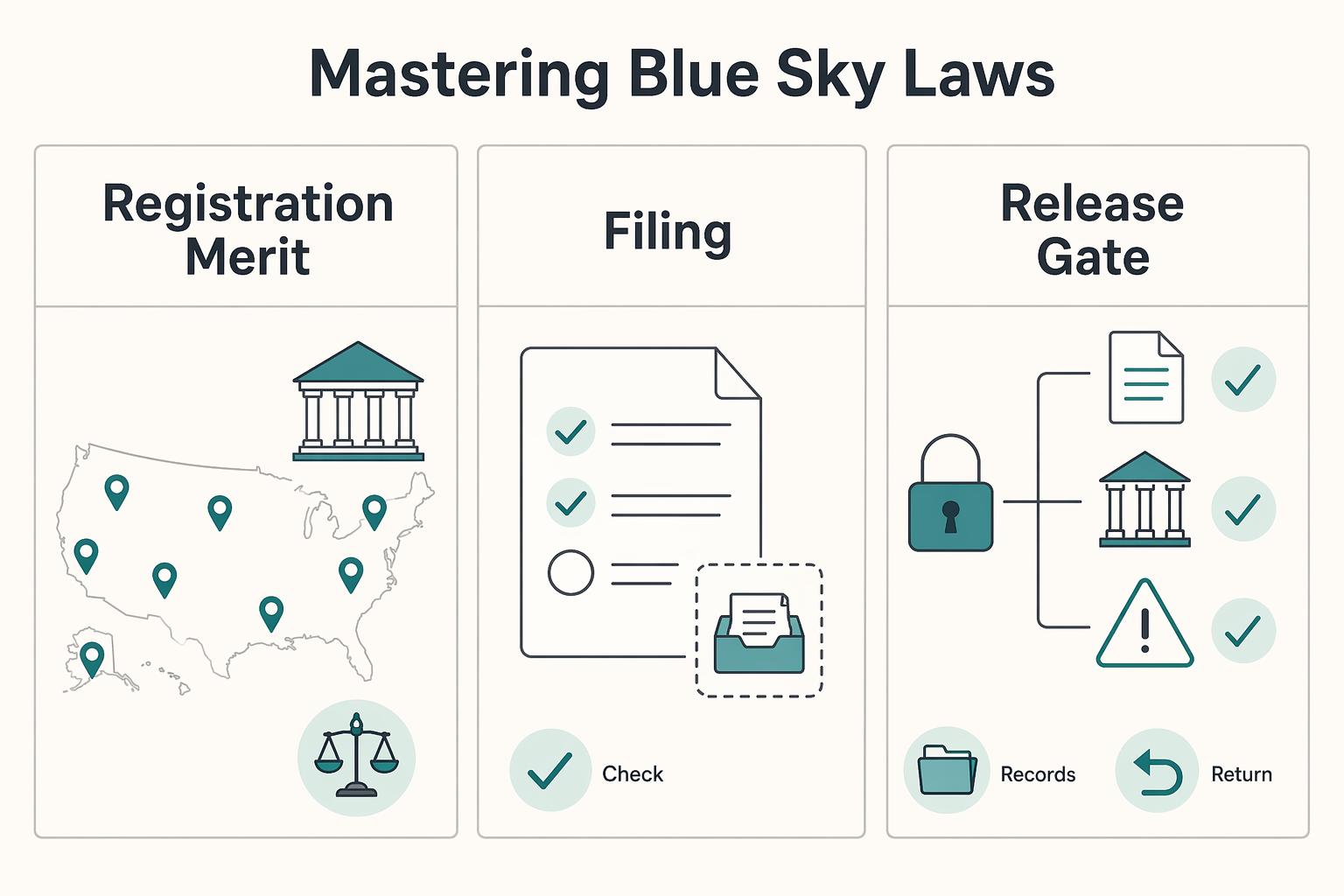
How Blue Sky Laws Affect Startups Raising Capital
If you are raising money, state securities law matters from the start. For most startups, **the [blue sky laws](https://www.investor.gov/introduction-investing/investing-basics/glossary/blue-sky-laws) that matter are the state securities rules that sit alongside federal securities law**. Even if your round fits a federal exemption, states may still require notice filings, fees, and compliance with anti-fraud rules as money comes in.