
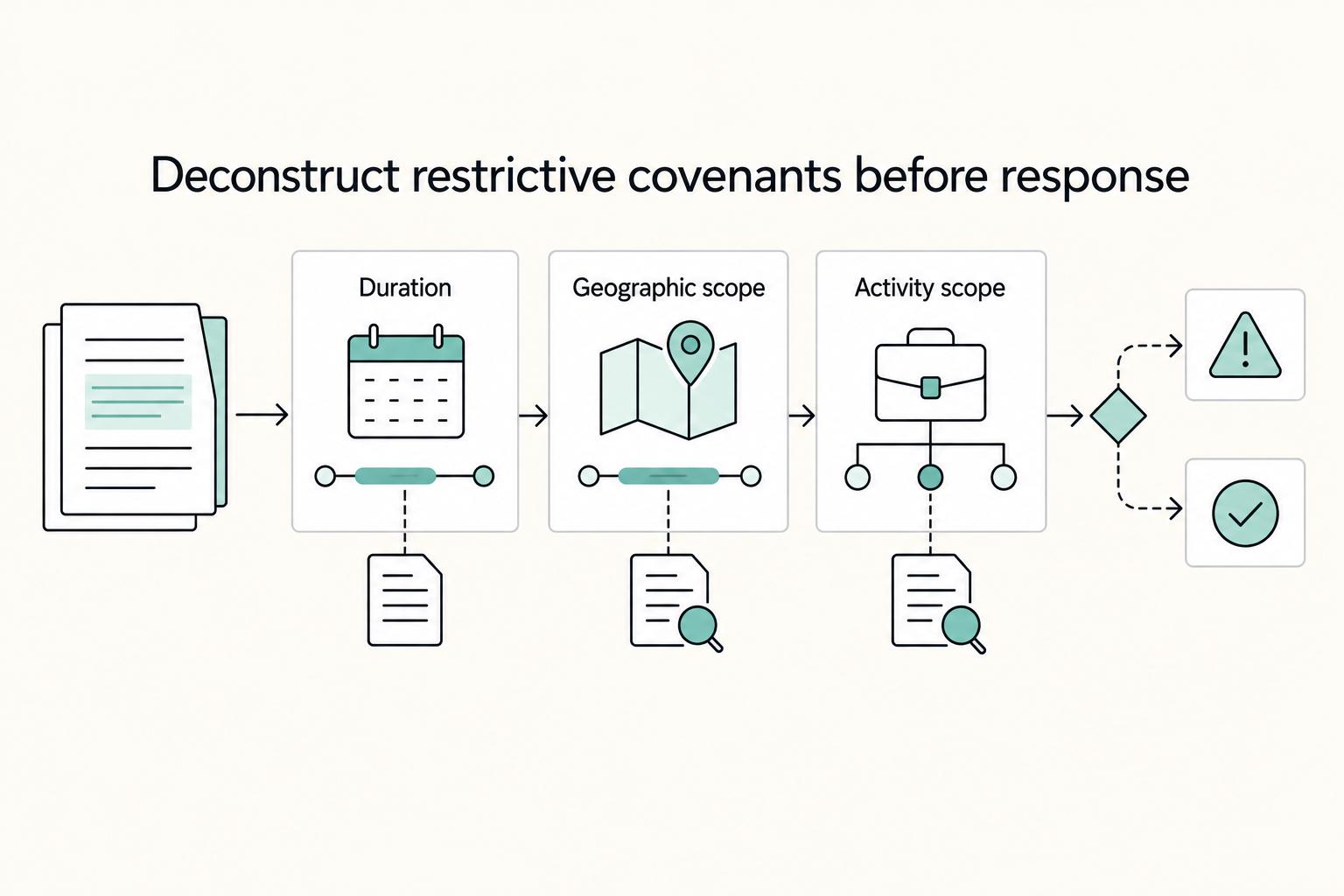
A restrictive covenant is a client-contract clause that can limit the work you take on next: the non-compete, the non-solicit, and the non-deal. Three steps follow: assess the cross-border risk, negotiate definitions and carve-outs, and neutralize what remains with a post-signing documentation trail.
Your Autonomy is Your Greatest Asset. Don't Sign It Away.#
For a global professional, autonomy isn't a benefit; it's the business model. It is the core asset—the very product—you offer to the market.
Yet, a single paragraph buried deep within a Master Services Agreement can put that entire enterprise at risk. A restrictive covenant is not just legal boilerplate to be skimmed; it is a direct and profound threat to your "Business-of-One." These clauses—the non-compete, the non-solicit, the non-deal—are designed to protect a client's interests, but when drafted without precision, they can ground your career before it ever reaches cruising altitude. They create a fog of compliance anxiety, forcing you to second-guess every new opportunity and question whether a new client relationship could trigger a costly legal battle with an old one. This uncertainty undermines the very freedom you have worked so hard to build.
The standard advice found online is dangerously misaligned with your reality. It is almost universally written for domestic, full-time employees, not for a global professional operating as a business. That guidance assumes a single country's employment law, a traditional employer-employee power dynamic, and a world where geographic boundaries still mean something. For you, that advice is irrelevant. Your clients are in London and Singapore, while you might be working from Lisbon. Whose laws even apply? A clause considered reasonable in Texas might be unenforceable in the European Union. Relying on generic, employee-centric advice is the equivalent of navigating international airspace with a local road map; it ignores the cross-border complexity that defines your work and exposes you to immense, unseen risk.
This article provides a different approach. We will move beyond simplistic definitions and arm you with a robust, three-step strategic framework built for the realities of your global business. It is a repeatable methodology designed to transform anxiety into empowerment, allowing you to proactively manage risk rather than react to threats. We will show you how to Assess, Negotiate, and Neutralize the danger that restrictive covenants pose. This isn't about just understanding the clauses; it's about taking control of them. It's about ensuring every contract you sign is a partnership that respects your autonomy, rather than a cage that limits your future. You are a business partner, not a subordinate, and it's time your contracts reflected that truth.
Step 1: Assess the Battlefield by Deconstructing the Covenants#
To move from anxiety to empowerment, you must first recognize the specific threats you're facing. These clauses are not monolithic; they are distinct tools designed to limit your future actions in different ways. A client’s legal team will often use vague, overreaching language, counting on the fact that you won’t invest the energy to dissect it. By understanding the precise function of each restrictive covenant, you can instantly identify where the real danger lies and focus your negotiating capital where it matters most.
Here are the five primary restrictive covenants you will encounter:
- The Non-Compete Clause: This is the most direct threat to your "Business-of-One." In its rawest form, a non-compete attempts to prevent you from providing your services to any company the client defines as a competitor. For a specialized global professional, the critical battleground is the "scope of activities." A clause restricting you from "providing any consulting services to any financial services company" is an unacceptable restraint on your ability to earn a living. Your goal is to narrow this scope to be laser-focused on the exact niche you were engaged for, not your entire skillset.
- The Non-Solicitation Clause (of Clients): This covenant prevents you from proactively approaching your client's customers to win their business. The primary risk here lies in the ambiguity of the word "solicit." What if a former client's customer sees your presentation at a conference and contacts you afterward? Does responding to their email constitute solicitation? A well-negotiated contract will clearly define solicitation as a direct and targeted outreach initiated by you, protecting you from liability when your reputation precedes you.
- The Non-Dealing Clause: Pay close attention when you see this one. A non-dealing clause is the more aggressive and dangerous sibling of non-solicitation. It forbids you from doing business with a client's customers even if they approach you directly. This is a major red flag in a contractor agreement because it fundamentally ignores the customer's own choice and agency. It is often an unreasonable and unenforceable overreach.
| Covenant Type | Primary Restriction | Key Difference |
|---|---|---|
| Non-Solicitation | Prevents you from proactively contacting the client's customers. | Focuses on your outbound actions and initiation of contact. |
| Non-Dealing | Prevents you from doing business with the client's customers. | Restricts engagement even if the customer approaches you directly. |
- The Non-Poaching Clause (of Colleagues): This clause is designed to stop you from hiring your client's employees or other contractors. For a solo "Business-of-One," this often feels like a low-stakes issue. However, it can become a strategic obstacle if you plan to scale your business or collaborate with trusted peers you met during the engagement. While generally less contentious, it's a detail worth clarifying to ensure it doesn’t apply to individuals who have long since left the client.
- The Confidentiality & Non-Disclosure Agreement (NDA): This is the most common and reasonable clause. Its purpose is to protect the client's legitimate trade secrets. Your focus here is not on eliminating the clause, but on refining it. The risk is an overly broad definition of "Confidential Information." If the definition is too vague, a client could later argue that the general skills and professional techniques you honed during the project are their property, effectively preventing you from using your own experience elsewhere. You must ensure the NDA protects their secrets, not your expertise.
Assess the Threat with the Cross-Border Risk Matrix#
Once you can dissect the anatomy of each clause, you must place it in a real-world context. A restrictive covenant's power to harm your business is a direct function of geography and jurisdiction. To turn this complexity in your favor, you must systematically assess the actual threat before you write a single redline. This is not legal advice; it is strategic business planning. We will use a simple framework: the Cross-Border Risk Matrix.
1. Map the Jurisdictions (Client vs. You vs. Future You)
First, document three locations that form your personal risk map:
- The Client's Registered Location: The legal home of the company paying you, often found in the agreement's preamble or signature block.
- Your Current Country of Residence: Where you live and operate your business.
- Your Target Markets: The primary countries where your ideal future clients are located. This is about protecting your growth.
The real danger lies where these three circles conflict. An American client can write a contract, but they must contend with the laws of your country of residence to enforce it against you. This cross-border enforcement is rarely simple and often prohibitively expensive.
2. Analyze the "Choice of Law" Clause
Hidden within the "Miscellaneous" or "General" section is the "Choice of Law" clause, which specifies which country's or state's laws will be used to interpret the agreement. A client will always choose a jurisdiction favorable to them. Your job is to understand what that choice means for you. For example, a non-compete governed by business-friendly Delaware law has vastly different implications for you in Lisbon than one governed by California law, where non-competes are nearly impossible to enforce. Many jurisdictions recognize an individual's right to earn a living as a matter of public policy and will refuse to enforce foreign laws that conflict with it. For a practical cross-border read, compare How Freelancers Should Choose Governing Law and Jurisdiction in International Contracts. If your agreement points to California, read SB 403; if it raises broader U.S. non-compete policy questions, keep the FTC's 2024 non-compete rule notice in the file you send to counsel.
3. Score the "Reasonableness" Pillars with a Global Lens
Finally, with your jurisdictional map in hand, you can properly evaluate the specific terms. Courts worldwide generally assess these clauses against three pillars of "reasonableness." Analyze them not just as written, but through the practical lens of your global business.
| Pillar | Client's Typical Starting Point (Overreach) | Your Reality (Global Professional) |
|---|---|---|
| Duration | 12-24 months post-contract | For a 3-month project, a 12-month ban in a fast-moving tech field is a career-killer. Information becomes stale quickly. |
| Geographical Scope | "North America" or "The European Union" | An absurd overreach for a remote consultant based in Asia. The scope should be limited to where you actually provided services. |
| Scope of Activities | "Any and all consulting services" | An attempt to lock down your entire skillset. The restriction must be narrowly tailored to the specific niche you were engaged for. |
By systematically mapping jurisdictions, identifying the governing law, and scoring the terms, you move from anxious uncertainty to empowered clarity. You stop seeing the contract as an intimidating monolith and start seeing it as a series of variables that you can analyze, question, and change.
Step 2: Negotiate from a Position of Power#
Armed with the clarity gained from the risk matrix, you can shift from analysis to action. This is where you transition the dynamic from passive acceptance to active negotiation. The goal is not to be adversarial, but to arrive at a fair agreement that protects both parties' legitimate interests. It begins with a critical mental shift.
Shift Your Mindset from "Employee" to "Business Partner"#
You are not asking for a favor; you are negotiating a business-to-business agreement. A prospective client is engaging your company—your "Business-of-One"—for its specialized expertise. An employee asks for permission. A business partner collaborates to define the terms for mutual success. Frame every redline from this perspective. You are not highlighting problems; you are proposing solutions that create clarity and prevent future disputes. This approach demonstrates foresight and professionalism, signaling that you are a serious partner who understands how to manage risk. If the paper still feels one-sided after your first pass, run it against 10 Freelance Contract Red Flags That Scream 'Run Away' before you sign.
Propose Strategic "Carve-Outs"#
This is your most effective tool. Instead of striking through an entire covenant, which can trigger a defensive reaction, you will surgically amend it. Proposing a "carve-out" shows that you respect their need for protection but require that protection to be reasonable. Your redlines should aim to explicitly exclude: Before you redline, compare your fallback language with Non-Solicitation vs Non-Compete for Freelancers and Consultants so each carve-out stays tied to a real business interest.
- Pre-existing clients or client categories: "The obligations under this Section X shall not apply to services provided to [Client Name 1], [Client Name 2], or any other clients for whom Consultant was engaged prior to the Effective Date of this Agreement."
- Work in unrelated verticals: If the client is in fintech, ensure the clause doesn't prevent you from working with your health-tech clients. "For the purposes of this Agreement, a 'Competitor' shall not include any entity whose primary business is in the healthcare technology or renewable energy sectors."
- Inbound leads: You should not be penalized if a client's customer seeks you out independently. "The non-solicitation provisions herein shall not apply to relationships initiated by the customer, provided the Consultant can provide written documentation (e.g., email, platform message) of the customer's initial outreach."
Narrow the Definitions#
Ambiguity in a contract serves the person who wrote it. Vague terms are a trap, allowing a client to interpret a restriction as broadly as possible. Your job is to replace ambiguity with precision. Scrutinize words like "competitor," "solicit," "affiliate," or "related business." Redline these terms with objective language.
| Client's Vague Term | Your Precise Redline |
|---|---|
| "...any company in the financial services industry." | "...the following list of direct competitors: [Competitor A], [Competitor B], [Competitor C]." |
| "...shall not solicit any customer..." | "...shall not initiate contact with any customer listed in Exhibit A for the purpose of..." |
By defining the boundaries of the agreement, you are not weakening it; you are making it fair and, frankly, more legally robust.
Quantify the Risk for the Client#
If a client resists your proposed changes, particularly to a broad non-compete, articulate the business reality professionally. This isn't an ultimatum; it is an explanation of the practical consequences of their proposed terms on your ability to operate. This reframes your request from a personal preference to a business necessity.
You might say, "As my business is currently structured, this clause as written would unfortunately prevent me from servicing my long-term clients in the healthcare tech space. Because those obligations pre-date this engagement, I must be able to continue that work. The carve-out I proposed is designed to ensure I can fully commit to our project while upholding my existing professional responsibilities. It allows us to work together without creating a conflict."
This approach transforms the negotiation. You are no longer just a contractor signing their paper; you are a strategic partner shaping a durable and transparent professional relationship.
Step 3: Neutralize Lingering Risk with a Post-Signing Strategy#
A well-negotiated contract is a monumental achievement, but your risk mitigation strategy must extend beyond the signature. It's about implementing a thoughtful offboarding process that protects your "Business-of-One" long after the work is done, ensuring your compliance and defending your future autonomy. This final step transforms diligence into a lasting defense.
Create an "Offboarding" Documentation Trail#
Your compliance efforts should conclude with a formal, documented sign-off. When a project concludes, your final action item should be to create an unambiguous record of the engagement's end. This isn't just a courtesy; it's a crucial piece of evidence.
Send a polite, professional email to your primary client contact that:
- Confirms the End Date: Clearly state the official conclusion of your services.
- Summarizes Key Deliverables: Briefly mention the completion of the core work.
- Reaffirms Your Commitment: Explicitly state your intention to honor the agreed-upon terms, especially regarding confidentiality.
This simple act creates a timestamped record of your good faith. It demonstrates a professional, proactive approach to compliance and serves as a powerful reference point should any questions arise months or even years later.
Build a "Clean Room" for New Business#
Even with carefully negotiated carve-outs, you may find yourself operating near the boundaries of a restrictive covenant. If you take on a new client in a similar industry, the burden of proof is often on you to show you did not improperly solicit them. This is where you build your "clean room"—a meticulous, documented history of how new business originates.
For every new client that could even remotely be considered a conflict, you must document and preserve the origin of the relationship.
- Save the Initial Outreach: Archive the LinkedIn message, the email from their "contact us" form, or the introduction from a mutual colleague.
- Document the "Why": If possible, get the new client to state in writing why they sought you out (e.g., "We were impressed with your presentation at the XYZ conference," or "We found your portfolio online and your expertise in [specific skill] is exactly what we need.").
This documentation is your single best defense against an unfounded claim of solicitation. It proves that the opportunity was inbound—that they came to you—and neuters any accusation that you violated your prior agreement.
Know Your Next Move#
Even with the best contract and perfect documentation, receiving a cease-and-desist letter can be a destabilizing experience. While these letters are often not legally enforceable on their own, they are designed to intimidate. The key to managing this anxiety is to have a plan before you need one.
Panic leads to poor decisions. Instead, build resilience into your business operations by identifying a legal professional who specializes in international contract law now. You don't need to put them on retainer, but you should have a name and contact number in your files. Knowing exactly who you would call provides immense peace of mind. It shifts your posture from one of potential victimhood to prepared CEO. You are no longer wondering what you would do; you know the first step of your response plan, and that confidence is a powerful asset. According to the FTC workshop transcript from January 27, 2026 is a useful briefing document.
Your Next Step: Assess, Negotiate, and Neutralize Restrictive Covenants#
Mastering the tactical details of a contract is only part of the equation. The true transformation happens when you stop seeing a restrictive covenant as a legal hurdle to be cleared, and instead recognize it for what it is: a direct strategic challenge to the viability and growth of your "Business-of-One." It is a test of your ability to operate not just as a talented professional, but as the CEO of your own career.
By systematically moving to Assess, Negotiate, and Neutralize these risks, you fundamentally alter the dynamic of your client engagements. You are no longer a passive signatory, anxiously scrolling through dense legal text hoping for the best. Instead, you become a proactive, strategic business partner who co-authors the rules of the engagement. This mindset shift is everything. It replaces vague fears with a precise, risk-assessed understanding of a contract's actual impact. It trades passive acceptance for proactive agency. It exchanges anxiety for the control that comes from having a plan.
Ultimately, this is about more than just contract negotiation. It’s about owning your position as a global professional. It's about building a sustainable, resilient business that isn't dependent on the whim of a single client's overly broad legal document. By mastering this framework, you protect your most valuable asset: your untethered freedom to operate, innovate, and thrive in the global market you choose.
Frequently Asked Questions
Is a US non-compete enforceable in the EU?
Enforcing a US-style non-compete in the European Union is exceptionally difficult. Most EU member states have strong public policies protecting an individual's right to work, viewing overly restrictive covenants as an unfair restraint of trade. Furthermore, many jurisdictions like France and Germany require the former employer to pay significant compensation to the individual during the non-compete period for it to be considered valid. Without this payment, the clause is often void from the start. While a US company might send a threatening letter, the practical reality of them successfully litigating across borders is very low.
How do I negotiate a non-solicitation clause?
Your goal is clarity. Start by demanding a precise definition of 'solicitation.' Propose redlines that narrow the scope from any 'employee or client' to only individuals you personally and substantially worked with. Always push to reduce the duration; a 6-month restriction is far more reasonable than 18 months. Frame your negotiation professionally: you are not trying to poach clients, but to ensure you are not unfairly restricted from accepting inbound opportunities.
What makes a non-compete unreasonable for a remote independent contractor?
For independent contractors, the very idea of a broad non-compete is problematic, as it undermines the nature of being an independent business. Courts apply strict scrutiny. Key factors that make a clause unreasonable include: an overly broad geographic scope (absurd for a remote professional), a vague scope of activities, excessive duration, and the lack of a legitimate business interest (like protecting genuine trade secrets) on the client's part.
What are the biggest red flags in an independent contractor agreement?
Beyond the 'unreasonableness' factors above, watch for these specific signs: a client pressuring you for an immediate signature without time to seek counsel; ambiguous language like 'competing business' or 'affiliated entities' that are not clearly defined; and employee-like restrictions that attempt to control your work hours, methods, or ability to work for other clients simultaneously.
Can a former client legally prevent me from working with their competitors?
They can only attempt to do so if you have signed a non-compete clause that is deemed legally enforceable. A company is not automatically entitled to stop you from competing; they must demonstrate that the restriction is reasonable and necessary to protect a legitimate business interest. If the clause is overly broad in scope, duration, or geography, a court will likely refuse to enforce it. Without an enforceable agreement, you are free to work with whomever you choose, provided you do not misuse the former client's confidential information.
How long is a 'reasonable' non-compete in a fast-moving field like software development?
In industries like technology, 'reasonable' is a very short time. A duration of 3-6 months is often considered standard and defensible. A restriction of 12 months or more is frequently seen as unreasonable because the technology and market information become outdated so quickly. The duration must not be longer than necessary to protect the client's specific confidential information from becoming stale.
What's the difference between a Master Service Agreement (MSA) and a Statement of Work (SOW)?
This is a crucial structural distinction. The Master Service Agreement (MSA) is the foundational contract governing the overall legal relationship. It contains the core, long-term provisions like confidentiality, liability, and the restrictive covenants. The Statement of Work (SOW) is a project-specific document under the MSA's umbrella, detailing deliverables and timelines for a single project. The restrictive covenants live in the MSA because they are meant to survive any individual project, so it is vital to negotiate those terms carefully upfront.
Researched and edited by the Gruv editorial team. Gruv builds cross-border billing, payouts, and finance-operations software for global businesses.
Sources
- courts.delaware.gov/Opinions/Download.aspxtrusted
- federalregister.gov/documents/2024/05/07/2024-09171/non-compete-...trusted
- federalregister.gov/documents/2023/01/19/2023-00414/non-compete-...trusted
- ftc.gov/system/files/ftc_gov/pdf/Transcript-Moving-F...trusted
- lawfilesext.leg.wa.gov/biennium/2023-24/Htm/Bills/Senate%20Passed%2...trusted
- leginfo.legislature.ca.gov/faces/billPdf.xhtmltrusted
Educational content only. Not legal, tax, or financial advice.
Related Posts

Germany Freelance Visa Application Path for Freiberufler and Gewerbe
Choose your track before you collect documents. That first decision determines what your file needs to prove and which label should appear everywhere: `Freiberufler` for liberal-profession services, or `Selbständiger/Gewerbetreibender` for business and trade activity.

Non-Solicitation vs Non-Compete for Freelancers and Consultants
Choose the narrowest restrictive covenant that protects a real risk and still lets you keep earning. For freelancers and consultants with multiple engagements, broad restrictions can cut off pipeline long before any dispute starts.
Best Nomad Cities for Women Planning a Long Stay
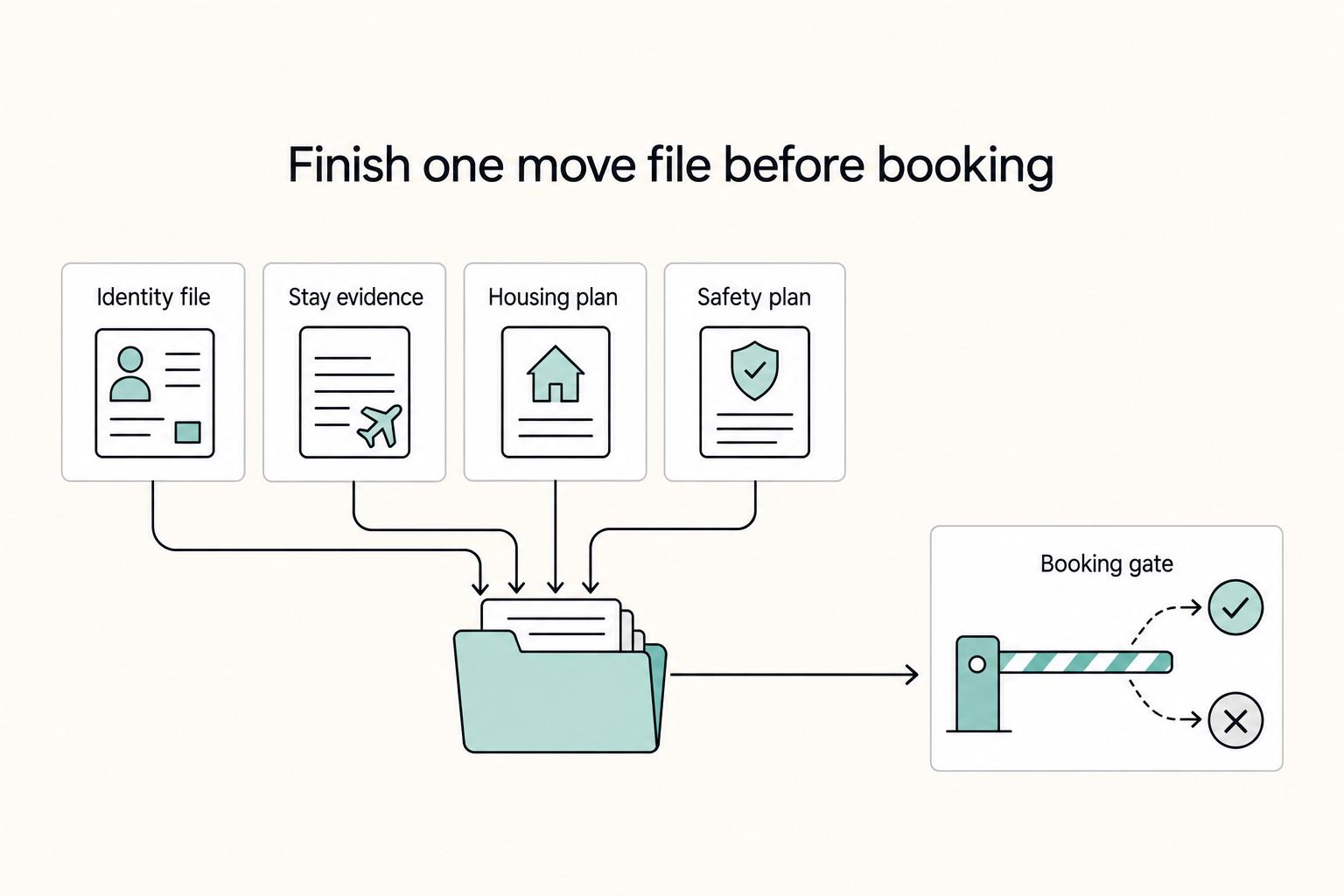
Treat this as a safety-first relocation guide, not a popularity contest. If you are looking for the best nomad cities for women, use rankings and roundup posts as an opening filter. The real work starts when you test each option against paperwork, housing, and how safe your everyday routine is likely to feel.