
Quick Answer
Start with a quality of earnings report to test whether your income is repeatable, collectible, and sustainable. Unlike a Form 1040 filing or a financial statement audit, this review centers on normalized earnings for decision-making. For a freelancer or small team, the output is a defensible baseline plus clear priorities around customer dependency, payment behavior, and cash reliability.
What a 'Personal' Quality of Earnings Report Checks#
A personal QoE is a repeatability and sustainability check, not a compliance document. It helps you answer a harder question than "what did I earn last year?" After you normalize one-time, unusual, or nonrecurring items, what earnings are likely to continue?
The idea comes from financial due diligence in M&A, where QoE analysis is used to understand earnings quality and risk for buyers, sellers, and lenders. In a freelancer or small-team business, you can apply the same logic: normalize results, test what is durable, and make decisions from that view instead of headline revenue alone.
| Analysis | What it tells you | Decision it supports | Risk it can miss |
|---|---|---|---|
| Form 1040 tax return | What you reported for annual income tax filing | Filing and paying taxes | Whether reported income reflects sustainable earning power |
| Financial statement audit | Whether statements are free of material misstatement | Assurance on financial statement presentation | One-time or nonrecurring items that are not adjusted out |
| Personal QoE | Your normalized view of sustainable earnings | Pricing decisions, lender discussions, and planning decisions | Weak conclusions if adjustments are not well supported |
This is most useful when you need to make real calls. It helps you judge whether your pricing is supported by more stable earnings, whether you can explain performance to a lender beyond a tax return, and whether your plan still works when production slows. The discipline matters as much as the number. If your adjustments are tied to clear records, the conclusion is easier to defend.
The next step is to look at what usually makes earnings look stronger than they are. If you want a deeper dive, read Hiring Your First Subcontractor: Legal and Financial Steps.
Beyond Profit: The Hidden Risks a Personal QoE Uncovers#
The main risk is not low profit on paper. It is earnings that are not sustainable, reliable, or collected in time to run the business. A personal QoE review helps you test that directly instead of relying on headline results.
That matters because statements mostly describe the past. Your decisions depend on forward-looking confidence: what income is repeatable, what margins were lifted by one-time items, and where cash pressure builds before payments arrive.
Client concentration#
Concentration can be an earnings-quality risk, not just a sales issue. Revenue can look healthy while still depending on a narrow client base.
Start with one simple question: if one client pauses, how much income disappears? Check concentration using your revenue-by-client view, then verify it against invoices and cash collected. If a client is moderate on billed work but dominant in actual collections, treat that as concentration risk.
| Risk tier | Verification checkpoint | What it means | What to do next |
|---|---|---|---|
| Low | Below your verified concentration threshold | No single relationship appears to dominate your earnings base | Keep tracking on a set cadence and document renewal or scope changes |
| Moderate | Near your verified concentration threshold | A small group of clients may be carrying more revenue than expected | Start diversification now through new outreach, service mix changes, or expansion with smaller accounts |
| High | Above your verified concentration threshold | Earnings depend heavily on one client or a connected client cluster | Treat this as a first 90 days priority before taking on larger fixed commitments |
Also check for hidden linkage. If separate entities are economically connected, assess them together when you evaluate dependency.
Revenue repeatability#
Recent revenue can still mislead if it came from work that will not repeat. A common diligence failure is revenue that looks durable but is actually driven by one-time work, with margins temporarily boosted by unusual items.
Use pro forma adjustments to normalize earnings. Separate recurring work from unusual spikes, and remove items that do not reflect normal operations. Keep each adjustment tied to records. If you cannot support an adjustment clearly, do not rely on it in your baseline.
The goal is not a better-looking number. It is a believable one you can defend in planning, pricing, and risk decisions.
Cash is not the same as booked revenue#
Booked revenue does not pay bills. You can be profitable and still feel cash strain, especially when invoiced revenue gets treated as if it were collected cash. Run a simple check:
- Review recent invoices and actual payment dates.
- Map when cash leaves the business for recurring and periodic obligations.
- Compare collection timing with expense timing to identify recurring gaps.
You are looking for structural working-capital pressure, not one-off delays. Reconcile invoices to bank deposits so you can see which clients pay on time, partially, or consistently late.
Documentation discipline for lender readiness#
Treat this analysis as documentation discipline, not as a promise of any approval outcome. A clear pack showing normalized earnings, revenue consistency, and payment reliability gives you a defensible way to explain income stability when asked.
The same documentation should support decisions on price, protections, and first-90-days priorities. Once those risks are visible, you can turn them into a simple review process you can repeat.
You might also find this useful: A M&A Consultant's Guide to Due Diligence Checklists.
Three Steps to Test Whether Your Earnings Are Recurring, Collectible, and Liquid#
Use this framework to answer one practical question: are your earnings recurring, collectible, and liquid enough to rely on? It is a DIY operating tool, not a universal template, and that is enough to make better decisions.
| Step | Focus | Key inputs |
|---|---|---|
| Step 1 | Build a normalized baseline | Recent results by month and documented adjustments for one-off revenue, owner-specific or personal expenses, non-recurring costs, and unsustainable workload effects |
| Step 2 | Score revenue quality | Revenue by client, cash collected by client, contract type, and payment timing |
| Step 3 | Turn revenue quality into a cash-buffer target | Invoice date, due date, payment date, fixed outflows by due date, and the worst credible period if seasonality is present |
Step 1. Build a normalized baseline#
Build a normalized baseline first. Until you do that, it is hard to tell how much of your profit is truly repeatable. Pull your recent results by month and adjust only items that do not reflect normal operations. Use this checklist and document each adjustment:
| Adjustment area | What to do | Guardrail |
|---|---|---|
| One-off revenue | Isolate unusual projects, catch-up payments, or windfalls | Do not let them inflate your normal run rate |
| Owner-specific or personal expenses | Add back only clearly personal items supported by records | Do not blur business and personal spending |
| Non-recurring costs | Separate unusual expenses from normal operating costs | Keep one period from understating recurring earnings |
| Unsustainable workload effects | Treat output that depended on a pace you likely cannot maintain cautiously | Do not treat that period as normal capacity |
Interpretation matters here. If your baseline drops materially after adjustments, reported profit was less durable than it looked. If it stays close, earnings are likely more recurring. If you cannot support an adjustment with records, leave it out.
Step 2. Score revenue quality with a client scorecard#
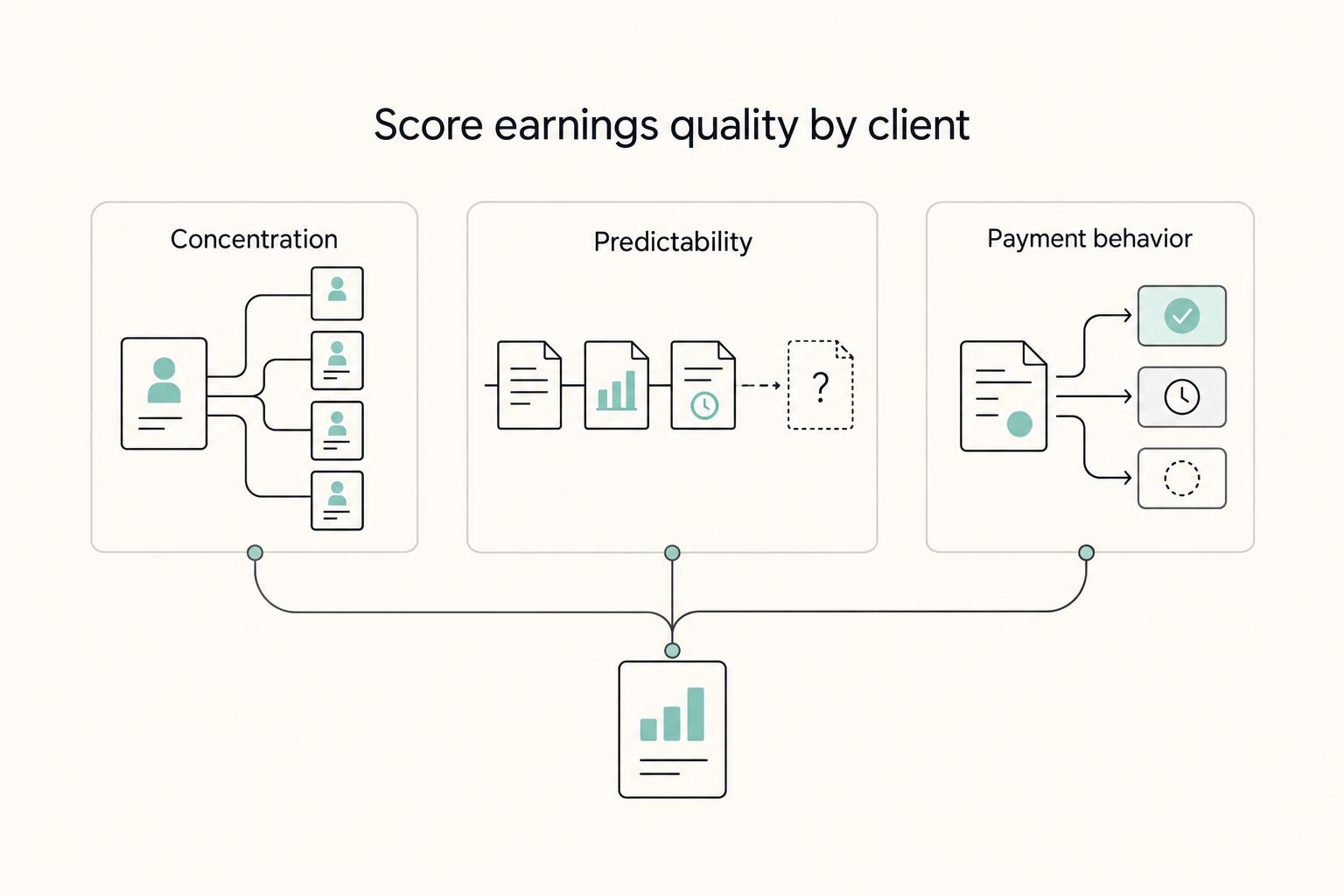
Next, score revenue quality so you can see where risk reduction is most urgent. Build a client scorecard from revenue by client, cash collected by client, contract type, and payment timing. Use this table to classify what you see:
| Check | Risk signal | What it means | Immediate mitigation move |
|---|---|---|---|
| Concentration | One client or connected client group exceeds your verified threshold of annual revenue or collected cash | Earnings depend on one budget or decision path | Reduce exposure before adding fixed costs. Prioritize new client acquisition or broaden service mix |
| Predictability | A large share of revenue comes from one-off or timing-driven work | Recent performance may not repeat | Separate recurring, repeat, and one-off work. Plan from recurring plus credible repeat work |
| Payment behavior | Payments consistently arrive after agreed terms | Revenue may be real, but cash conversion is weak | Tighten terms, invoice earlier, add deposits or milestones, and track days-to-pay monthly |
For context, public reporting standards flag a major customer at 10 per cent or more of revenue. Treat that as a reference point, not a universal legal cutoff for private freelance businesses.
Step 3. Turn revenue quality into a cash-buffer target#
Turn revenue quality into a cash-buffer target. Start with invoice-to-cash timing, map outflows, then measure the mismatch. Use this sequence:
| Task | What to track | Purpose |
|---|---|---|
| Invoice timing | Invoice date, due date, and payment date for paid invoices | See your real collection cycle |
| Outflow timing | Fixed outflows by due date, including core operating obligations and minimum owner draws funded by the business | Map when cash leaves |
| Timing comparison | Compare when cash leaves versus when it usually arrives | Find structural timing gaps |
| Buffer target | Cash needed to cover that gap, using the worst credible period if seasonality is present | Set a working-capital buffer target |
For this step, collected cash is the key signal. Invoiced revenue alone can hide timing stress.
Common mistakes to avoid#
Common errors in a DIY review are mixing categories or trusting the wrong number. Do not mix personal and business data. Do not treat invoiced revenue as collected cash. Do not ignore seasonality when one strong period is not representative of a full year.
Related: How to Perform a Business Valuation for a Small Agency. You can also use a reusable free invoice generator to support cleaner payment terms and collections.
Conclusion: Track Normalized Earnings, Revenue Quality, and Cash-Conversion Risk#
If you want owner-level control, use a QoE lens. Track normalized earnings, revenue quality, and cash-conversion risk together. The point is to judge whether earnings are sustainable and collectible, not just whether reported profit looked strong in one period.
Start by normalizing earnings so one-off items do not distort your baseline. Then assess revenue quality through client concentration, repeatability, and payment behavior. Finally, monitor collection speed with DSO. Use the full cycle when it helps clarify decisions: CCC = DIO + DSO - DPO.
Use this as a practical framing, not a formal due-diligence standard:
| Area | Freelancer mode | CEO mode |
|---|---|---|
| Pricing | Prices to keep work coming in | Prices from a normalized earnings baseline and cash-timing goals |
| Client mix | Accepts concentration risk | Monitors concentration risk and diversifies revenue sources |
| Payment terms | Defaults to client-preferred terms | Sets terms to support faster collection and steadier cash timing |
| Reserves | Treats extra cash as optional | Maintains a cash buffer for delays and surprises |
| Review cadence | Reviews only when pressure spikes | Uses a repeatable review cycle for earnings quality, client mix, and cash timing |
Use this sequence each cycle:
- Review current results and normalize earnings.
- Diagnose the main risk: concentration, non-repeatable revenue, or slow collections.
- Prioritize the risk most likely to pressure cash.
- Make one focused change in pricing, client mix, or payment terms.
- Re-check outcomes against collections, not only booked revenue.
That is the shift from operator to owner: a repeatable process that shows what is durable, what is risky, and what to fix next.
For a step-by-step walkthrough, see Working Capital in M&A for Small Service Businesses. If you want this risk-first workflow supported by traceable money movement and payout controls, review Gruv for freelancers.
Frequently Asked Questions
What is a simple example of why revenue quality matters?
Use this comparison: one business depends heavily on one client, while another earns from multiple repeat clients and gets paid close to agreed terms. Even with similar profit, the second setup is usually considered higher quality because earnings are more sustainable and more clearly backed by cash collections. In QoE work, a common question is not just how much you earned, but how repeatable and collectible those earnings are.
How can this help when you apply for a mortgage or other financing?
Treat this as a documentation exercise, not a guarantee. Prepare a normalized earnings summary, evidence of revenue consistency by client or contract type, and payment reliability support that shows invoice date, due date, and payment date patterns. Before you submit, confirm current requirements directly with the lender rather than relying on general rules.
What are the biggest red flags this review can uncover?
Common red flags include high customer concentration, a large share of one-off or timing-driven revenue, and cash collections that lag well behind invoice terms. Another warning sign is when adjusted or normalized earnings drop materially versus reported profit, which can indicate reliance on non-recurring items. If you cannot tie an adjustment or payment pattern to underlying records, treat it as unproven until verified.
Can you really do this yourself as a freelancer or small business owner?
Yes, you can do a practical internal version yourself for your own decision-making. Because there is no single universal QoE checklist, keep the DIY scope focused on earnings components, concentration, contract mix, and invoice-to-cash patterns. Escalate to an accountant or advisor when records are messy, personal and business items are mixed, lender-ready packaging is required, or you need an independent third-party review. For formal diligence, QoE reports are often prepared by independent third parties such as CPA firms.
Is this the same thing as an audit?
No. A QoE review is not an audit. It typically examines earnings components such as EBITDA, working-capital items, and concentration risk, but it does not provide audit assurance. Use it to improve decisions, documentation, and risk visibility.
Try a related tool
Researched and edited by the Gruv editorial team. Gruv builds cross-border billing, payouts, and finance-operations software for global businesses.
Sources
Includes 3 external sources outside the trusted-domain allowlist.
- comptroller.war.gov/Portals/45/documents/fmr/Volume_05.pdftrusted
- gsa.gov/buy-through-us/products-and-services/profess...trusted
- irs.gov/forms-pubs/about-form-1040trusted
- irs.gov/publications/p538trusted
- people.duke.edu/~charvey/Research/Working_Papers/W108_Earnin...trusted
- anderscpa.com/learn/blog/quality-of-earnings-report-analys...external
- bakertilly.com/insights/quality-of-earnings-reportexternal
- bdo.com/insights/advisory/bdo-knows-transaction-advi...external
Educational content only. Not legal, tax, or financial advice.
Related Posts

Hiring a Subcontractor for the First Time Without Costly Surprises
**Start with a risk-control sequence, not an ad hoc handoff.** As the Contractor, your goal is simple: deliver cleanly, control scope, and release payment only when the work and file are complete.
How to Perform a Business Valuation for a Small Agency
**Treat valuation for a small agency as a risk control system, not a headline multiple, and you are more likely to protect agency value before you ever start selling a business.**
A M&A Consultant's Guide to Due Diligence Checklists
Most mergers and acquisitions fail, not in the negotiation room, but in the months after closing. The deal buckles under operational confusion, cultural friction, and liabilities that were not understood early enough. A common cause is bad due diligence, treated as a defensive box-checking exercise instead of a decision tool. That is the strategic mistake.