
Quick Answer
Choose the qualified electing fund qef route only when you can obtain a PFIC Annual Information Statement and support the position on Form 8621 for each holding. If that statement is unavailable, reassess whether section 1296 mark-to-market is supportable or whether exit/escalation is safer. The practical target is a filing position you can document each year without rebuilding evidence at deadline time.
Step 1: The Diagnosis - Spotting Hidden PFIC Risk in Your Portfolio#
Start by listing every non-U.S. fund, wrapper, and pooled vehicle you own, then treat each one as potential PFIC risk until issuer documentation proves otherwise. That gives you an evidence-based path to the next move: QEF, section 1296 mark-to-market, or whether you should exit or escalate.
PFIC status is issuer-specific under IRC Section 1297. Many foreign pooled vehicles can fall into scope in practice. The legal test applies to the foreign corporation behind the holding, not the product label your broker shows you.
Triage the holdings first#
Start broad, then narrow only when the legal issuer and documents support it. Use this first-pass sort:
| Bucket | Examples | First-pass treatment |
|---|---|---|
| Likely PFIC risk | Foreign mutual funds, foreign ETFs, and similar pooled funds organized outside the United States | Treat each one as potential PFIC risk until issuer documentation proves otherwise |
| Review case | Investment-linked insurance products, offshore bond wrappers, and other structures where the legal issuer is not obvious from your statement | Start broad, then narrow only when the legal issuer and documents support it |
| Needs issuer testing | Direct shares of an operating company | Still need Section 1297 testing |
Apply the actual IRS tests#
Do not rely on product labels at this stage. A foreign corporation is a PFIC if it meets either IRC Section 1297 test:
| Test or issue | IRS standard | Practical use at diagnosis stage |
|---|---|---|
| Income test | 75 percent or more of gross income for the taxable year is passive income | Keep the holding in PFIC-risk status until issuer evidence says otherwise |
| Asset test | 50 percent or more of average assets produce, or are held to produce, passive income | Scrutinize wrappers and layered structures where asset mix is hard to see |
| Filing or election thresholds | Verify current thresholds or exceptions before relying on them | Do not rely on memory for any Form 8621 threshold or exception |
Run a confirmation sequence today#
Check the documents before you debate elections. Review each suspect holding's fund documents for references to PFIC status, PFIC Annual Information Statement, Form 8621, section 1295, and section 1296. If a PFIC Annual Information Statement is available, QEF may be administratively possible for that fund.
| Question to ask | What it helps confirm | Article follow-up |
|---|---|---|
| Is this fund treated as a Passive Foreign Investment Company for U.S. tax purposes? | PFIC status | Record the response date, contact details, legal fund name, ticker or ISIN, and country of domicile |
| Do you provide a PFIC Annual Information Statement for U.S. shareholders for each tax year? | Whether QEF may be administratively possible for that fund | Keep all reviewed documents and correspondence in your tax file |
| If not, is the stock regularly traded on a qualified exchange or other market for section 1296 purposes? | Whether section 1296 mark-to-market may be available | Verify exchange and regular-trading status before relying on MTM |
If the documents are unclear, ask the fund administrator or investor relations these questions:
- Is this fund treated as a Passive Foreign Investment Company for U.S. tax purposes?
- Do you provide a PFIC Annual Information Statement for U.S. shareholders for each tax year?
- If not, is the stock regularly traded on a qualified exchange or other market for section 1296 purposes?
Record the response date, contact details, legal fund name, ticker or ISIN, and country of domicile. Keep all reviewed documents and correspondence in your tax file. For section 1295 election years, IRS Form 8621 instructions require keeping Forms 8621, attachments, and PFIC Annual Information Statements. Also plan the filing at the PFIC level: Form 8621 is filed per PFIC, and chain structures can require multiple forms.
Map evidence to the next move#
Once you have the issuer evidence, choose the next move based on what you can actually support:
| Evidence outcome | Next move |
|---|---|
| PFIC Annual Information Statement is available | QEF-ready: preserve documentation and move to election timing and Form 8621 execution |
| No annual statement, but stock appears to be section 1296 marketable stock | MTM candidate: verify exchange and regular-trading status before relying on MTM |
| No annual statement, unclear marketability, opaque wrapper, or no issuer response | Exit or escalate: do not assume QEF is available without the required statement |
If issuer evidence is incomplete, treat that as a decision signal, not a paperwork delay. The goal of this step is to avoid carrying unverified PFIC exposure into the next tax year. If you want a deeper dive, read our guide to a defensible 2026 filing plan.
Step 2: The Strategic Choice - QEF vs. Mark-to-Market#
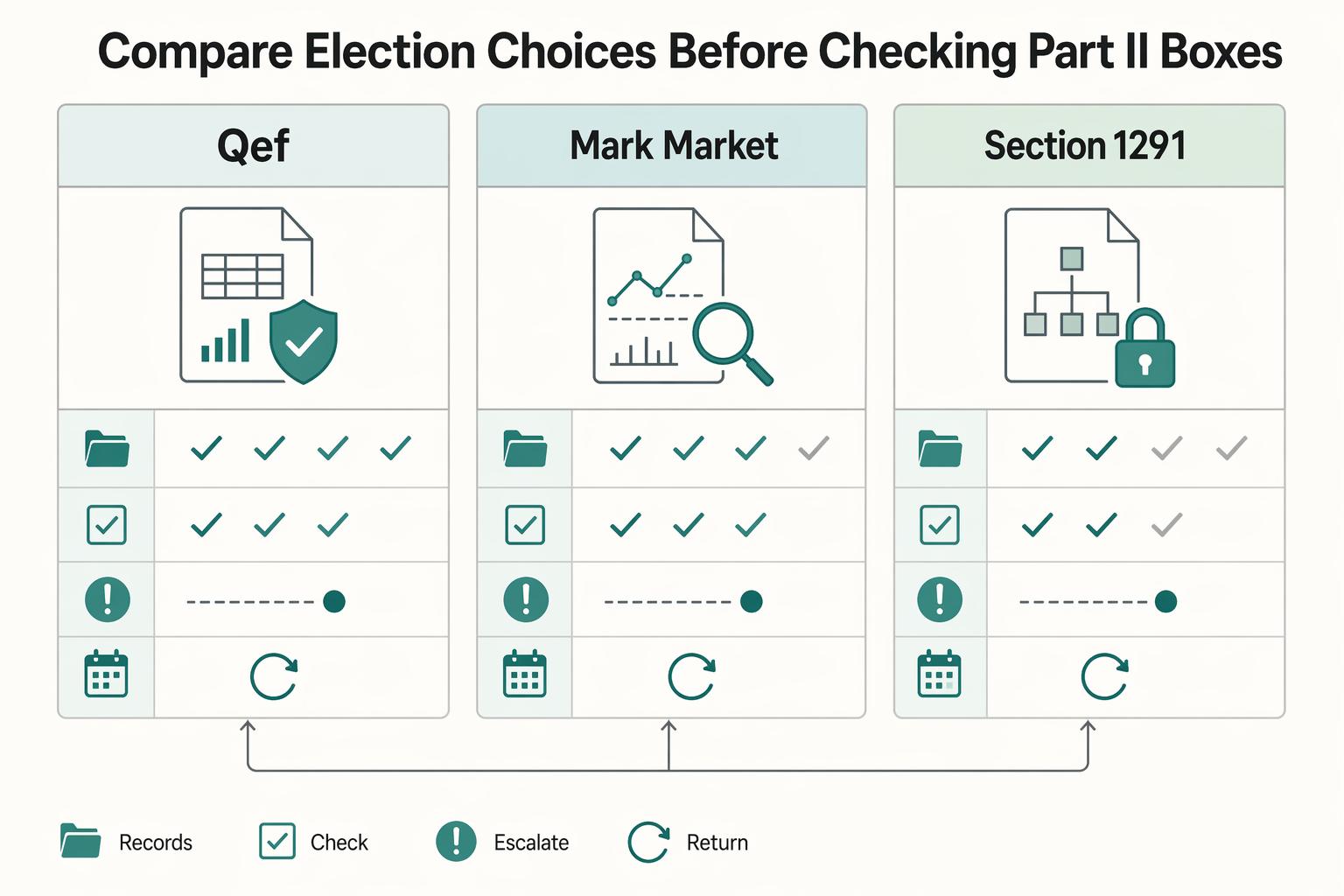
If Step 1 identified likely PFIC exposure, make an election you can defend now, or pause and escalate. In practice, this is a documentation decision first. Choose the path you can support on Form 8621 and maintain year after year.
Under T.D. 9806, IRS final regulations address PFIC ownership determination and certain annual reporting requirements, and Form 8621 is the information return for shareholders of a PFIC or QEF. Your election is only as strong as the file behind it.
Choose the route you can substantiate#
Pick the route that matches your evidence, not the one that looks better in a summary. This section does not establish the detailed tax outcomes of QEF versus MTM, so do not rely on generic summaries. If your facts are incomplete, pause before filing and escalate.
Decision table (practical, not theoretical)#
| Practical criterion | QEF route | MTM route | What to do if unclear |
|---|---|---|---|
| Ownership and records | Proceed only when ownership facts and filing records are complete | Proceed only when ownership facts and filing records are complete | If records are incomplete, pause and escalate |
| Form 8621 support | Make sure your position can be documented consistently on Form 8621 | Make sure your position can be documented consistently on Form 8621 | Confirm the filing position with your preparer before filing |
| Tax-treatment assumptions | Verify current rules in official IRS materials before relying on outcomes | Verify current rules in official IRS materials before relying on outcomes | Do not choose based on generic tax summaries |
| Source verification | Check official editions and IRS bulletin materials | Check official editions and IRS bulletin materials | Keep a clear file trail for review |
| Year-over-year operations | Choose only what you can support each filing year | Choose only what you can support each filing year | If sustainability is uncertain, escalate |
Verification checkpoint. Summary pages can mislead you. When you validate your filing position, rely on official sources, not summary pages alone. The FederalRegister.gov XML page states that it is not an official legal edition. Verify against the printed PDF or IRS bulletin materials, and keep your citation trail, for example 81 FR 95459, in your file.
Route the decision cleanly. Use the evidence from Step 1 this way:
- If your preparer confirms QEF is appropriate and your records support the position, route to QEF.
- If QEF is not supportable from your current records and your preparer confirms MTM is appropriate, route to MTM.
- If ownership facts or election details are still unclear, escalate to a tax professional before filing.
One guardrail applies either way. Verify election-specific details in current Form 8621 instructions and official IRS materials before you file. Related: A Deep Dive into PFIC Rules for US Expats Investing Abroad.
Step 3: File the QEF Election on Time and Support Every Input#
Once you choose QEF, execution is mostly about sequencing. Your goal is simple: file the election on time, support every input, and avoid a Form 8621 position you cannot defend later.
Your execution checklist#
Build the evidence file first, then complete the form.
- Confirm first applicable year and holding history.
Collect trade confirms, account statements, and records showing when you first held the PFIC directly or indirectly. This determines whether you have a first-year election path or an unpedigreed QEF that may require a purging election analysis.
- Get the PFIC Annual Information Statement for the year.
You need statement data supporting ordinary earnings and net capital gain. QEF shareholders must include their pro rata share of ordinary earnings in gross income and net capital gain as long-term capital gain each year.
- Prepare a separate Form 8621 for each PFIC.
File one Form 8621 for each PFIC held directly or indirectly. For QEF reporting, complete Part III, lines 6a-7c, and tie each number back to your statement and records.
- File by the return due date, including extensions, and keep proof.
Section 1295 election timing follows the return due date, including extensions under section 6081. Keep your filed return, extension proof, and filing workpapers.
Once validly made, the original QEF election continues to apply in later years when the corporation is treated as a PFIC again. That makes the initial filing and consistent annual reporting equally important.
Required inputs and what to do if missing#
Missing inputs are not a minor cleanup item here. They usually change the filing path. Use this table before you file, not after:
| Required input | Purpose | Where to get it | If missing |
|---|---|---|---|
| PFIC Annual Information Statement | Supports QEF ordinary earnings and net capital gain reporting; feeds Part III lines 6a-7c | Fund manager, administrator, or issuer tax contact | Request in writing, keep the response trail, and do not estimate unsupported numbers |
| Acquisition date and holding records | Establishes first applicable year; pedigreed versus unpedigreed analysis | Broker statements, trade confirms, prior returns, custodian history | Reconstruct before filing; escalate if first-year status is still unclear |
| Timely filing proof | Supports election timing under section 6081 extension framework | Filed return copy, extension confirmation, preparer records | Verify current timing and relief rules before relying on them; do not assume late-election relief |
| Valuation support for purging analysis | Needed if considering deemed sale for an unpedigreed QEF | Broker valuation records, issuer data, account statements | Pause until valuation support is documented |
| Marketability support for MTM fallback | Needed only if evaluating section 1296 route | Current IRS instructions and verified market data | Do not rely on app labels like "listed" or "traded" without rule-level verification |
Contingency decision path#
When the file is incomplete, use that as a decision checkpoint.
| Situation | What the article says to do | Why it changes the path |
|---|---|---|
| PFIC Annual Information Statement unavailable | Request it in writing and preserve correspondence; do not guess on QEF inputs | Reassess your election path, including whether section 1296 mark-to-market is available |
| Marketability unclear for MTM fallback | Confirm marketable-stock status under the current section 1296 standard before filing | If it is still unclear, escalate |
| PFIC status discovered late | Review whether retroactive-election conditions, including Protective Statement requirements where applicable, are met | If you are in unpedigreed QEF territory, assess deemed sale availability |
- PFIC Annual Information Statement unavailable
Treat this as a high-risk filing gap, not a detail to patch later. Request it in writing and preserve correspondence. If it is still unavailable, do not guess on QEF inputs. Reassess your election path, including whether section 1296 mark-to-market is available.
- Marketability unclear for MTM fallback
Do not assume eligibility from a ticker or platform label. Confirm marketable-stock status under the current section 1296 standard before filing. If it is still unclear, escalate.
- PFIC status discovered late
Treat retroactive election relief as conditional, not automatic. Review whether retroactive-election conditions, including Protective Statement requirements where applicable, are met. If you are in unpedigreed QEF territory, assess deemed sale availability. That election is filed on Form 8621, with gain or loss entered on Part V line 15f. Related section 1291 tax and interest mechanics can apply.
When to involve a cross-border tax professional. Bring in a specialist when the first holding year is uncertain, the annual statement does not reconcile to your ownership, retroactive election conditions may be in play, or you are considering a deemed sale election. Also escalate for indirect ownership structures or any Form 8621 position you cannot fully substantiate from your file.
You might also find this useful: A Deep Dive into Form 8621 (PFIC Reporting) for US Expats.
If you want to turn this checklist into a repeatable workflow, centralize your compliance artifacts and operational records, with clear status visibility where supported. Explore the Gruv docs
Keep Operational Control of Each Holding's Election Status#
What matters here is operational control. You know each holding's election status, file Form 8621 when a trigger applies, and can produce your records without rebuilding the story at filing time.
Annual tax treatment#
Consistency matters more than complexity here. Document one clear status for each PFIC holding: what reporting path applies this year, and what you will do if support is incomplete. If you are reporting a QEF position, keep supporting records and save the filed Form 8621 with your return records. If not, note whether you are reporting section 1296 mark-to-market information, a Part II election, or annual reporting under section 1298(f).
A common breakdown is inconsistency. That can mean using one reporting path in one year and a different one the next year without a documented reason and support.
| Area | Reactive PFIC handling | Early PFIC handling |
|---|---|---|
| Decision ownership | You decide only after a distribution, a disposition gain event, or a preparer question forces a response | You document election status before filing season and confirm it annually |
| Tax outcome visibility | You discover Form 8621 triggers late, when activity happens | You review in advance whether section 1298(f), Part II, or election reporting applies |
| Documentation quality | Forms and support records are scattered across accounts and emails | One holding file contains election notes, supporting records, and prior and current Form 8621 copies |
Exit timing#
Treat a planned sale as a compliance checkpoint, not just a portfolio move. Recognizing gain on PFIC stock disposition can trigger Form 8621, and certain PFIC distributions can as well. Before acting, check the holding file and confirm the reporting position already on record.
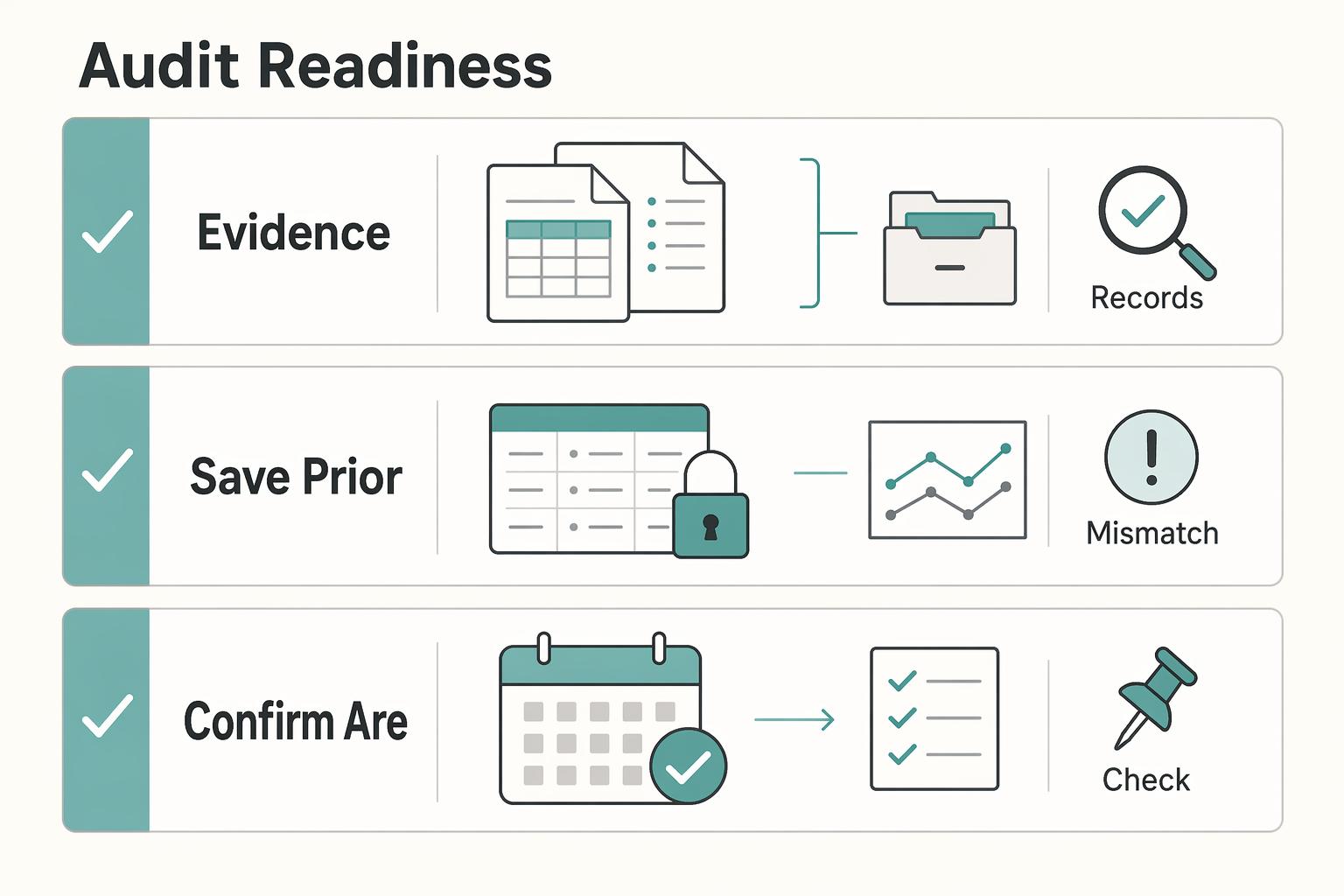
Audit readiness#
Use current IRS materials each year. The 12/2025 instructions note new Part V lines on page 3 of Form 8621, so confirm you are using the current form and instructions. Use this handoff checklist:
- Keep one evidence file per holding.
- Save prior-year and current-year Form 8621 copies.
- Record election status and fallback path in one note.
- Confirm you are using the current Form 8621 and 12/2025 instructions.
Bring in a cross-border tax pro when election history is unclear, support records are incomplete, or a distribution or disposition event is approaching before your file is clean.
For a step-by-step walkthrough, see What is the 'Mark-to-Market' Election for PFICs?.
If you want a low-stress setup for cross-border money movement with audit-ready records and policy gates where enabled, talk to Gruv.
Frequently Asked Questions
How do you tell whether a holding is a PFIC?
Use the PFIC tests first: a foreign corporation is generally a PFIC if 75% or more of gross income is passive, or 50% or more of assets produce, or are held to produce, passive income. Then check issuer documents or ask the fund administrator in writing, and keep that response in your records.
How should you choose between QEF and MTM?
Choose the path you can substantiate on Form 8621, not the one that only looks better in theory. Both a QEF position and a section 1296 MTM election run through Form 8621 reporting, so confirm your support package first and then elect the approach you can defend consistently.
What if you cannot get a PFIC Annual Information Statement?
Do not estimate missing issuer data. If you cannot obtain a PFIC Annual Information Statement or other key issuer information, document your requests, reassess whether your Form 8621 position is still supportable, and escalate to a qualified tax professional if material information remains unavailable.
What if you discovered the PFIC late, or you may have an Unpedigreed QEF?
Treat this as a technical cleanup issue, not a routine catch-up task. Certain late-election situations are handled separately, and the IRS has a separate Form 8621-A page for certain late elections to end PFIC treatment. Terms like Unpedigreed QEF are a strong signal to involve a qualified tax professional before choosing a correction path.
Do you need to file Form 8621 every year?
Assume you must file when an IRS trigger applies, including annual reporting under section 1298(f), reporting QEF or section 1296 MTM information, making a Part II election, receiving certain PFIC distributions, or recognizing gain on PFIC stock disposition. Verify any current exception criteria before you rely on them. As a practical step, run an annual PFIC review and maintain one evidence file per holding.
Try a related tool
Researched and edited by the Gruv editorial team. Gruv builds cross-border billing, payouts, and finance-operations software for global businesses.
Sources
Educational content only. Not legal, tax, or financial advice.
Related Posts

Digital Nomad Taxes in 2026 With a Defensible Filing Plan
With digital nomad taxes, the first move is not optimization. It is figuring out where you may be taxable, where filings may be required, and what proof supports that position.

PFIC Rules for US Expats Investing Abroad
Start with compliance, not optimization. Screen PFIC risk before you buy, rebalance, or add cash. A common costly mistake is buying a familiar local fund first and checking PFIC classification later.
Form 8621 PFIC Reporting for US Expats Without Guesswork
Form 8621 is hard because filing can turn on three moving parts at once: your ownership status, your election posture, and what happened during the year, even if you did not sell. If you treat this as only a sale-or-no-sale question, you can miss a real filing trigger.