
Quick Answer
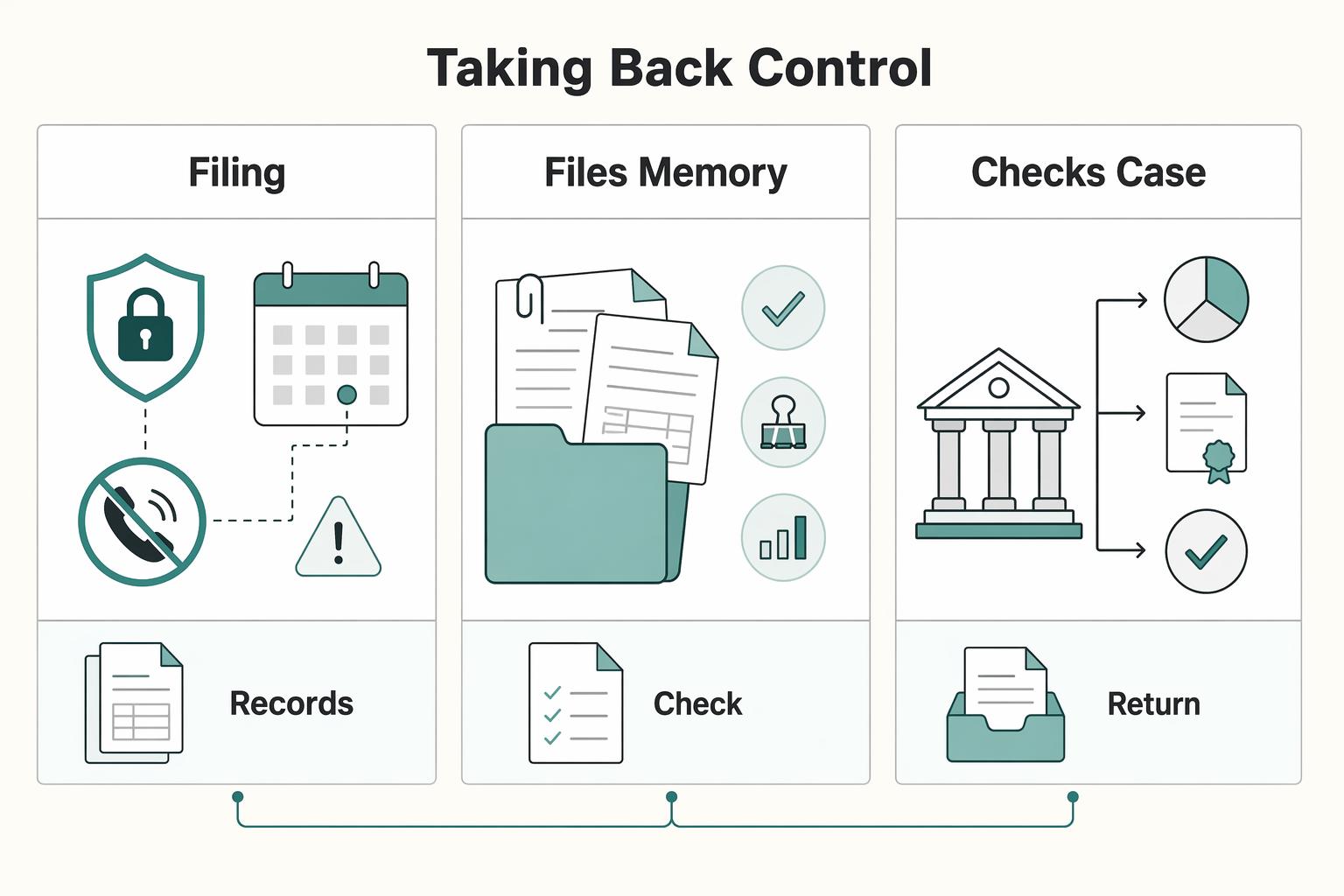
Stop collection pressure as soon as bankruptcy notice arrives, then prepare Official Form 410 for the pre-filing debt. Use the notice to copy the court, case number, chapter, and any proof-of-claim deadline exactly, and calculate the amount owed as of the filing date. Attach redacted support that ties contract and SOW terms to delivery proof, acceptance messages, invoices, and ledger entries. After submission, confirm the claim appears in the register and treat payout timing as uncertain.
The email subject line can stop you cold: "Notice of Bankruptcy Filing." When a client files, the immediate danger is not just the unpaid bill. It is making the wrong move after notice. That is when normal collections stop and a court-driven process takes over.
If that notice lands in your inbox, do four things first: stop collection activity, capture the case details exactly, preserve your support file, and make conservative business decisions while the case unfolds. This playbook walks through the moves that matter most when a client files for bankruptcy.
Step 1: Triage & Damage Control - Your First 24 Hours#
In the first 24 hours, keep it simple: stop collection activity, pull the key case details from the notice, and preserve your support file. Once you have notice, the automatic stay generally makes collection follow-up risky.
Stop collection, not your judgment#
The first move is simple. Stop pressure tactics immediately, then decide the next step with a clear head. Use this checklist right away:
- Do pause collection emails, calls, reminders, late-fee notices, and any agency activity tied to pre-filing debt.
- Do notify the person who controls billing automations first, whether that is your bookkeeper, AR owner, or billing admin.
- Do tell the account lead to stop discussing old balances until the notice is reviewed.
- Do preserve records now: contract, SOWs, change orders, unpaid invoices, delivery proof, and acceptance emails.
- Do not threaten suit, file suit, garnish, repossess, or otherwise pressure payment on pre-filing balances.
- Do not assume all ongoing work must end immediately. Collection on pre-filing debt must generally stop immediately, but future work decisions depend on the chapter and your risk review.
Keep pre-filing debt and post-filing work in separate lanes. Form 410 is for the pre-filing claim, not an administrative-expense payment request.
Pull the right fields from the notice#
Do not start strategy discussions until you have the notice details captured exactly as shown. Pull these fields from the notice:
| Notice field | What to capture | Key note |
|---|---|---|
| Court | Court name from the notice | Use with the case number to keep later filings tied to the right case. |
| Case number | Case number exactly as shown | Use with the court to keep later filings tied to the right case. |
| Chapter | Chapter listed in the notice | Helps frame future-work caution and recovery expectations. |
| Filing date | Filing date from the notice | Form 410 asks what was owed as of this date. |
| Trustee name/contact | Trustee name/contact if listed | Capture it exactly if the notice includes it. |
| Proof-of-claim deadline | Proof-of-claim deadline if listed | In Chapter 11, the court sets the deadline, and some notices say it is not yet set. |
Two details drive much of what follows. The court + case number keep later filings tied to the right case, and Form 410 asks what was owed as of the filing date on the notice.
For deadlines, use the notice if it gives one. In Chapter 11, the court sets the deadline, and some notices say it is not yet set. If that is the case, calendar a follow-up instead of guessing. Baseline timing rules: voluntary Chapter 7 and Chapter 12/13 are generally 70 days after the order for relief, and involuntary Chapter 7 is generally 90 days.
Read the chapter for business impact#
The chapter tells you how cautious to be about future work and how realistic recovery may be. Read it as an operating signal, not just a legal label.
| Chapter | Recovery posture | Ongoing work now? | If new work happens after filing |
|---|---|---|---|
| Chapter 7 | Liquidation; recovery depends on available assets for distribution. | Case-specific; proceed only with a clear, reviewed reason. | Keep separate from old debt; do not fold into the pre-filing claim. |
| Chapter 11 | Reorganization; operations may continue during the case. | Sometimes, with tighter approval and controls. | Treat as post-petition work; do not put it into Form 410. |
| Chapter 13 | Individual repayment plan over three to five years. | Sometimes, if the engagement still makes business sense. | Keep post-filing charges separate from the pre-filing claim. |
A workable rule of thumb: in Chapter 7, preserve evidence and be ready to file your claim on the court's schedule. In Chapter 11 or 13, add tighter controls before you do any future work.
Know when to escalate for professional review#
Escalate early when the risk justifies it. If balances, credits, or ledger history are messy, bring in accounting help. If the claim is material, the facts are cross-border, the debt is disputed, or the case is in Chapter 11 where claim status can be contested, get bankruptcy counsel involved early.
At the same time, assemble your claim package: the signed contract, SOWs, invoices, acceptance records, and a clean ledger showing what was due on the filing date. That file protects your position later. Related: Charging Order LLC Rules for Freelancers and Consultants.
Step 2: Build an Irrefutable Claim#
Once triage is done, the next job is credibility. You want a claim record that a stranger can verify quickly and that the debtor will have a hard time picking apart. A proof of claim can be objected to. In one Chapter 11 case, the debtor challenged the claim for lack of support, and the court allowed it only in part.
Build an evidence chain, not a document dump#
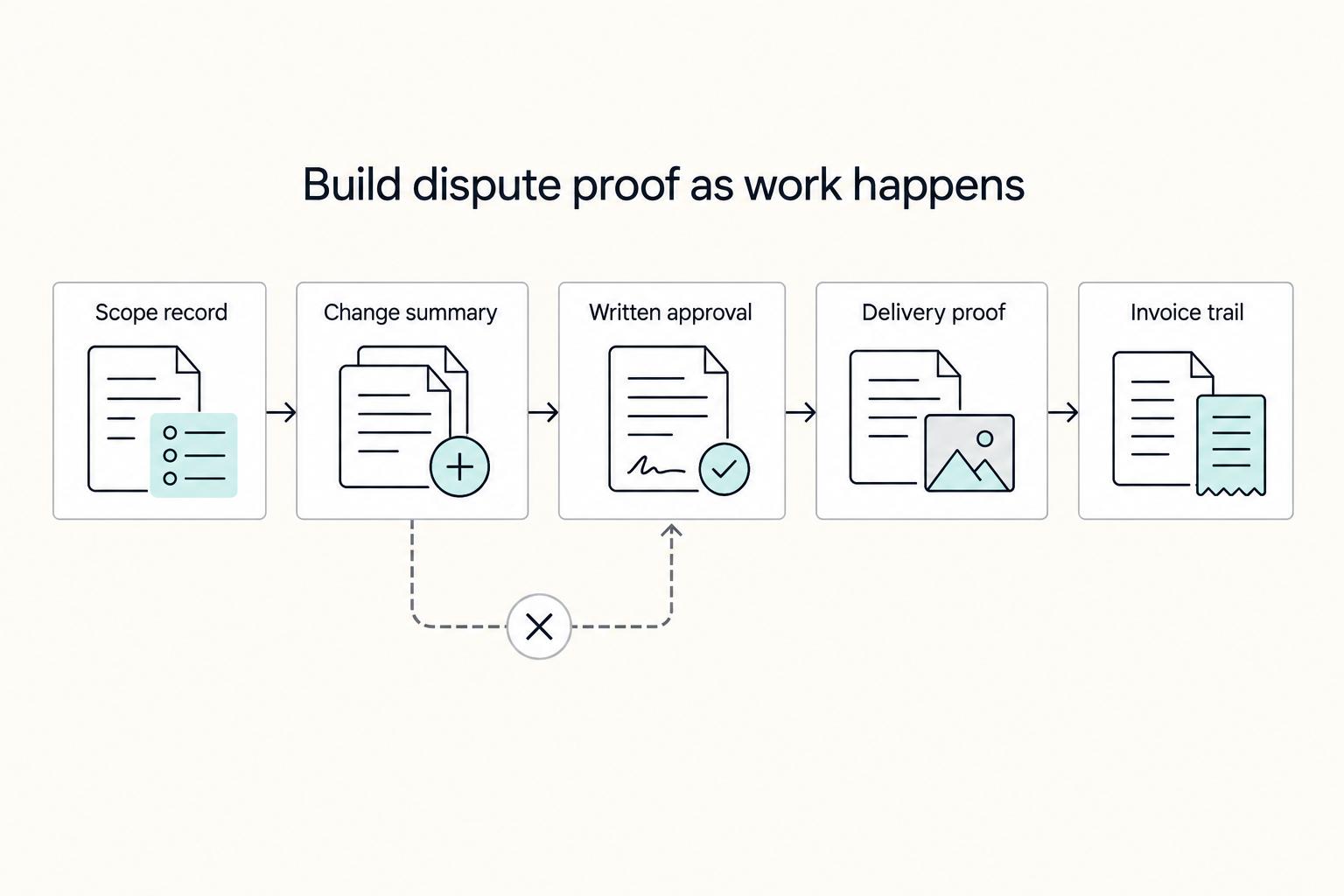
Do not file a pile of PDFs and hope the record speaks for itself. A practical way to organize support is this chain: agreement to scope, scope to delivery, delivery to acceptance, acceptance to unpaid balance.
Start with the agreement that identifies the contracting parties and payment terms. Then pair each billed item with the matching scope record, whether that is an SOW, approved proposal, or approved written scope. From there, tie it to delivery proof, then acceptance proof, then the unpaid invoice and ledger entry. If one invoice line cannot be traced both backward to scope and forward to delivery and acceptance, fix that gap before filing.
Pre-file verification checklist#
Before you attach anything, pressure-test the record for consistency. Even small mismatches can make the filing easier to challenge. Verify each record for:
| Verification area | What to confirm | Key note |
|---|---|---|
| Party names and governing entity | Debtor name and contracting entity are consistent across documents | Small mismatches can make the filing easier to challenge. |
| Deliverable references | Invoice descriptions, scope language, and delivery labels refer to the same work | Supports traceability across the record. |
| Invoice-status alignment | Billed amounts match unpaid status and any credits or partial payments are reflected | Helps keep the claim amount consistent. |
| Attachment readability | Exports are complete and readable, with key context visible | Incomplete or unreadable attachments weaken review. |
| Timeline consistency | Scope, delivery, acceptance, and billing appear in a coherent sequence | Helps show a clear evidence chain. |
Strong vs weak support (service work)#
For service work, the difference between a strong claim and a vulnerable one is usually traceability.
| Evidence area | Strong support | Weak support | Likely objection risk |
|---|---|---|---|
| Agreement and scope | Signed agreement plus matching written scope | Vague or incomplete scope record | Can increase scope/price dispute risk |
| Delivery | Dated delivery records or submission confirmations | Internal-only notes | Can increase performance dispute risk |
| Acceptance | Client approval/signoff messages | Your unsupported summary of acceptance | Can increase completion/quality dispute risk |
| Balance due | Unpaid invoices tied to a clean ledger trail | Lumped totals without document links | Can increase amount-reduction challenge risk |
That case is a useful warning about how little support can become a problem. Support described as a one-page explanation with four bullet points became a focal point in the objection process.
Prepare edge-case records early#
Edge cases get harder to sort out under deadline, so separate them now while the record is still manageable. If your work involved change orders, partial acceptances, platform messages, or mixed-language records, label those items clearly now. Map each change to scope, delivery, acceptance, and unpaid amount so it does not disappear inside a blended invoice.
For cross-border matters, keep originals and translations together. Flag open procedural points with placeholders such as [verify translation/certification requirements in this court] and [verify filing/authentication expectations for platform exports in this court]. If Chapter 15 cross-border issues appear, treat that as an early escalation signal, not a last-minute fix.
You might also find this useful: How to claim 'copyright' for your self-published book. Before you file, tighten your future documentation process with the Freelance Contract Generator.
Step 3: File Form 410 with Strategic Precision#
This is where paperwork discipline matters most. Use Official Form 410 to turn your record into a clear, defensible filing. Complete every field based on the case filing date, and reconcile every amount to your attachments. Stop if you are trying to request payment of an administrative expense, because this form is not for that request.
Field-by-field completion checklist#
Work from the bankruptcy notice or docket and your evidence pack at the same time so the form and attachments stay in sync.
| Form 410 item | What to enter | Key note |
|---|---|---|
| Court and case details | Court name, debtor name, and case number exactly as shown in the notice or docket | Keep the bar date visible while you prepare. |
| Current creditor | The legal name of the creditor actually owed the debt | Complete the notice/payment address fields you want used for future communications. |
| Basis for claim | Tie the claim to the controlling writing, such as the contract and SOW | If the claim is based on a writing, file a copy with the claim. |
| Amount of claim | The amount owed as of the bankruptcy filing date | Make sure the form total matches the attached support. |
| Itemization (when required) | In individual-debtor cases, the prepetition itemized breakdown of principal, interest, fees, expenses, and other charges | Include it when required. |
| Priority question | Any portion that may qualify under 11 U.S.C. § 507(a) | Identify that portion carefully instead of guessing. |
If your Form 410 total does not reconcile to the attachments, expect scrutiny. Also take the form warning seriously: fraudulent filings can carry penalties up to $500,000 and up to 5 years imprisonment.
Claim classification check#
Do not overreach on classification. A weak priority claim creates unnecessary risk, and priority can apply to all or part of an unsecured claim.
| Situation | Classification approach | What you should do |
|---|---|---|
| Unpaid prepetition services with no clear §507(a) fit | General unsecured | Mark as unsecured and support with contract, scope, delivery, acceptance, invoices, and ledger. |
| A specific portion may fit §507(a) | Split priority and nonpriority portions | Identify the exact priority amount and support it separately. |
| Facts are mixed or unclear | Do not force a label | Verify classification with counsel before filing. |
Priority unsecured claims are paid before other unsecured claims, so it is worth getting this right. It is not worth guessing.
Evidence-pack standard#
Make the attachment set easy to review in one pass. A clean exhibit package does real work for you. Use a consistent attachment order, for example: contract, scope or SOW approval, delivery proof, acceptance proof, invoices, ledger, then any required itemized breakdown.
Use clear file names such as Exhibit_A_MSA_2024-01-15.pdf, and cross-reference exhibits from the relevant form entries or addenda. Run a redaction check on the form and every attachment. If you are filing by mail, send copies only, not originals.
Filing workflow by venue#
The filing route varies by case, so confirm the mechanics before you hit submit or send anything.
- Confirm route: Check whether this case uses court e-filing or ePOC, a claims and noticing agent, or a paper path.
- File before the bar date: Use the route required for that case. Do not assume ePOC is always available.
- Capture confirmation: Save the portal receipt or submitted PDF, or include a stamped self-addressed envelope and copy if filing by mail.
- Verify posting: Confirm the claim appears correctly in the claims register, for example via PACER or the court's stated confirmation method, then correct issues quickly if details are missing or incorrect.
If you want a deeper dive, read What to Expect in Small Business Litigation as a Freelancer.
Step 4: Maintain Surveillance and Manage Expectations#
After filing, the work changes, but it does not stop. Your main jobs now are monitoring the case and planning for uncertainty. Treat your claim as unchanged unless the docket or a court notice shows otherwise.
This process is rule-driven. The Bankruptcy Code, the Federal Rules of Bankruptcy Procedure, and local court rules govern what happens next. Follow filings and notices, not informal updates.
Run a repeatable monitoring routine#
Keep one case log and update it every time something happens. At minimum, track your filing confirmation date, notice dates, and any docket item that could affect your claim.
| What to watch | What it can mean for your claim | When to escalate to counsel |
|---|---|---|
| Your filed claim and related case entries | Helps confirm your filed name, amount, and status are reflected as expected | Any mismatch you cannot resolve quickly using your filed PDF and receipt |
| Any filing or notice that mentions your claim, claims procedures, or objections | Your claim status or handling may change | You are unsure how the filing changes your rights or required response |
| Major case-status changes or other major procedural shifts | Recovery posture may change even if your claim document stays the same | You cannot tell how the change affects your practical recovery path |
| In Chapter 15 matters: recognition petition, notice/hearing activity, and recognition order | Recognition milestones can change how the U.S. side of the case proceeds | U.S. assets look complex enough that a full U.S. Chapter 7 or 11 route may be in play |
Prepare your objection response before one arrives#
If an objection comes, treat it as a records test, not a debate. Build your response from the filed record and the governing rules. Use this mini playbook:
- Read the objection and mark each issue it raises.
- Match each challenged point to the filed record.
- Confirm creditor identity and amounts are consistent across your claim, exhibits, and response draft.
- Check local rules and court instructions before taking any procedural step.
- Escalate early if the dispute involves cross-border recognition, entity or assignment complexity, or unclear claim status.
Do not treat general educational summaries as legal authority. Use the objection itself, your filed record, the governing rules, and local practice.
Plan business decisions while the case is pending#
While the case is open, conservatism is usually the right operating posture. Recovery may happen, but outcomes and timing can remain uncertain.
| Claim posture in the case record | Recovery planning posture | Timeline posture |
|---|---|---|
| Claim appears clear on the current record | Do not assume outcome without court-driven confirmation in this case | Treat timing as uncertain |
| Claim is questioned or partially disputed | Plan conservatively until status is clarified | Treat timing as uncertain |
| Claim is disputed or unclear | Use worst-case planning until status is clarified | Treat timing as uncertain |
| Cross-border complexity (including Chapter 15 activity) | Plan for additional procedural steps and counsel review | Treat timing as uncertain |
Use three rules while you wait:
- Do not budget this receivable as operating cash.
- Set your write-down posture early so forecasts stay realistic.
- Keep strict client boundaries: no new work or new credit without a deliberate decision and clean documentation. If this exposure reveals a broader margin problem, address that directly, as discussed in The Silent Profit Killer: How to Stop Margin Erosion in Your Freelance Business.
Handle the Claim as a Process, Then Prevent the Next One#
Control here means process, not optimism. The key moves are practical: stop collection activity that the automatic stay generally blocks for prepetition claims, protect your filing rights by tracking the live bar date, document the claim carefully, and set recovery expectations by claim priority, not hope.
From here, the debt is handled inside a rule-bound court process. Your proof of claim works only if the fundamentals are right: the debt is tied to what was owed on the filing date, the correct form is used, and the support file is clean. In U.S. cases, that usually means Official Form 410 with redacted attachments, then confirming the filing is reflected in court records and monitoring the docket through PACER.
A common breakdown is procedural, not factual. It can be using Form 410 for something it does not cover, such as an ordinary administrative-expense request, or filing exhibits with unredacted private data.
| Reactive freelancer behavior | Operator/CEO behavior |
|---|---|
| Keeps emailing for payment after notice of filing | Stops collection activity and works from the court notice and docket |
| Files from memory or invoice totals alone | Reconciles the amount to the petition-date debt and attaches supporting documents |
| Assumes filing means payment is coming | Plans for uncertainty, especially with general unsecured status |
| Checks the case only when a new email arrives | Verifies claim status in court records, tracks objections, and calendars notice deadlines |
What changes in your business now#
The point of this experience is not just to handle one bad receivable. It is to tighten how you prevent the next one and how you respond when warning signs show up. Use this as a repeatable control list:
- Run intake risk checks before work starts, including legal entity name, billing contact, and distress signals.
- Tighten contract and payment safeguards, including deposits, milestone billing, and written acceptance of deliverables.
- Keep documentation hygiene strict: contract, SOW, invoices, approvals, and payment records in one file.
- Set escalation triggers early: missed payments, restructuring signals, bounced payments, or any bankruptcy notice.
- Verify live case details every time: [chapter], [court], [bar date], [local rule], [notice language], and whether a no-asset Chapter 7 notice later changes.
Use this script at the next warning sign: pause new work, stop informal collection pressure, pull the signed contract and acceptance record, confirm the exact debtor entity, and check the current court notice before taking the next step. If the notice, deadline, or claim classification is unclear in your jurisdiction, verify it before you act.
For a step-by-step walkthrough, see How to Create a Lindy-Proof Freelance Career.
If you want fewer payment-recovery fire drills next year, move to a cleaner cross-border payment flow with Gruv for Freelancers.
Try a related tool
Researched and edited by the Gruv editorial team. Gruv builds cross-border billing, payouts, and finance-operations software for global businesses.
Sources
- canb.uscourts.gov/faq/general-bankruptcy/there-deadline-filing...trusted
- cob.uscourts.gov/proof-claimtrusted
- njb.uscourts.gov/sites/njb/files/13-14348%20Allen%2C%20Stacy%...trusted
- nysb.uscourts.gov/electronic-filing-proof-claimtrusted
- uscode.house.gov/view.xhtmltrusted
- uscode.house.gov/view.xhtmltrusted
- uscourts.gov/sites/default/files/2025-02/form-410.pdftrusted
- uscourts.gov/forms-rules/forms/proof-claim-0trusted
Educational content only. Not legal, tax, or financial advice.
Related Posts

Stop Freelance Profit Margin Erosion Before It Hits Cashflow
Revenue can hold steady while the business underneath it gets weaker. What comes in matters, but what you keep after the work is delivered is the clearer signal of health.
What to Expect in Small Business Litigation as a Freelancer
If you want to reduce avoidable disputes, separate the relationship terms from the project terms. Use an MSA for the standing legal framework and an SOW for the specific work.

The Freelance Payment Penalty: A Modeled Audit of Platform Fees, FX Spreads, and Payout Delays
The money rarely disappears through a single, easy-to-spot fee. The real loss is stacked. A marketplace takes its commission, a processor adds a charge for international cards, a bank or payment company converts the currency at a spread, a platform holds the funds before release, and a wire sheds a little to intermediaries on the way in. Each layer looks defensible on its own, but the worker feels the combined result as a smaller deposit and a later payday.