
Quick Answer
Yes, a mechanic's lien for freelancers can work in limited cases where your services are tied to a real-property improvement and jurisdiction rules still allow filing. Treat it as a late-stage enforcement option after prevention terms and formal written escalation have failed. Before proceeding, check three gates: legal eligibility, cost-versus-recovery logic, and readiness to continue into post-recording enforcement. If one gate fails, use lower-friction routes such as small claims or contract litigation.
Stop Chasing Invoices. Start Commanding Your Revenue.#
Unpaid invoices are an operating cash-flow risk, not just an annoyance. They force repeated decisions about follow-up and escalation, and payment friction is common. A February 13, 2025 Boston Fed summary reported that 80% of respondents in a 4,920-employer small-business dataset faced payment-related challenges.
| California step | Timing | Article detail |
|---|---|---|
| Preliminary Notice | 20 days after starting work or delivering materials | A subcontractor or material supplier has 20 days to serve a Preliminary Notice |
| Mechanics lien | Within 90 days of completion | A mechanics lien generally must be recorded within 90 days of completion |
| Lien foreclosure action | Within 90 days after recording | A lien foreclosure action must be filed within 90 days after recording |
Much of that friction is procedural. Which step comes first? Which deadline matters? When do you escalate? The cleanest path is tiered. Lock in payment protection before work starts, apply formal collection pressure when an invoice goes overdue, and move to asset-backed enforcement only if the work and the jurisdiction support it.
Set this boundary early: for freelancers, a mechanic's lien is a specialized tool, not a universal fix. A mechanic's lien is a statutory security interest tied to work that improves property. Lien rights come from statute, not contract wording alone. If your work did not improve property, or you have not confirmed local eligibility rules, do not assume this remedy is available.
Deadlines and notice rules are often where lien strategies break down. California shows the pattern. In California, a subcontractor or material supplier has 20 days after starting work or delivering materials to serve a Preliminary Notice. In California, a mechanics lien generally must be recorded within 90 days of completion, and a lien foreclosure action must be filed within 90 days after recording. Miss a required step and you can lose the remedy. Record an invalid lien and you can create a cloud on title that interferes with a sale or refinance.
The rest of this guide follows the sequence in order: contract controls, escalation steps, and a clear go or no-go test for lien use.
If you want a deeper dive, read The Silent Profit Killer: How to Stop Margin Erosion in Your Freelance Business.
Tier 1: Proactive Defense - Your First and Best Line of Security#
Tier 1 is prevention. Before kickoff, set terms that make payment expectations clear, reviewable, and easier to document later. Vague contracts and vague billing create room for delay and dispute. Clear terms reduce collection risk before an invoice is overdue.
This guide does not establish mechanic's-lien rules or contract-clause enforceability, so treat lien and legal specifics as verify-first items.
Put the contract to work before there is a problem#
Use your agreement as an operating document, not just a project summary. Make core items explicit: scope and acceptance criteria, milestone-triggered invoicing, and dispute-handling terms you will verify before relying on them.
| Contract area | Weak pattern | Clearer pattern | What this clarifies |
|---|---|---|---|
| Scope | "Design and build new site." | "Phase 1 deliverables are listed in Exhibit A." | What is included. |
| Acceptance | "Client will review deliverables." | "Client accepts or sends one written list of unmet criteria from Exhibit A within the agreed number of business days." | When a deliverable is treated as accepted. |
| Milestone invoicing | "Balance due at completion." | "Invoices are issued at signing and at defined phase handoffs." | When payment is triggered. |
| Late payment | "Late fees may apply." | "Overdue amounts follow contract terms and applicable law, as confirmed for this project." | What happens if payment is late. |
| Disputes and fees | "Disputes handled in court." | "Dispute process, governing law, and fee language are stated in the contract and verified before signing." | How disputes are routed and how cost risk is addressed. |
Keep the signed contract, scope exhibits, change approvals, and delivery or acceptance messages together from day one. If those records are scattered, follow-up gets harder once payment slips.
Bill by phase so one missed payment does not sink the project#
Phase billing limits how far unpaid work runs ahead of cleared payments.
Avoid back-loaded structures where most revenue lands at the end. Tie invoices to concrete phase outputs, and define when the next phase pauses if a milestone invoice is overdue.
Set your upfront protection amount before you send the proposal. Verify any minimum threshold you plan to use before you lock terms.
Decide at intake whether a Preliminary Notice needs verification#
If a project may involve lien-related rights, address the Preliminary Notice question at intake, not after nonpayment. This guide does not confirm whether notice is required, who must receive it, what format applies, or what timing rules control.
Treat this as a verify-first decision. Confirm those requirements through the appropriate jurisdiction-specific guidance before relying on lien rights, and keep proof of any notice activity.
Run this now#
Start with the basics that prevent avoidable collection problems later. Confirm core contract terms, attach the scope, and verify the correct paying entity before work begins. Then set the billing schedule around clear phase triggers, define your upfront protection, and decide exactly when work pauses if an invoice goes overdue. If lien-related rights may matter, verify notice requirements before kickoff and keep proof of any notice activity.
For a step-by-step walkthrough, see Fair Use Decisions for Freelancers in Paid Client Work.
Tier 2: Professional Escalation - The Warning Shot That Gets Results#
Once an invoice is overdue and reminders are producing excuses, silence, or broken payment promises, stop treating it as a routine delay. This is where you shift from chasing to building an enforcement-ready record. If the client starts disputing scope, acceptance, or even the paying entity, formalize now. Waiting rarely improves the facts.
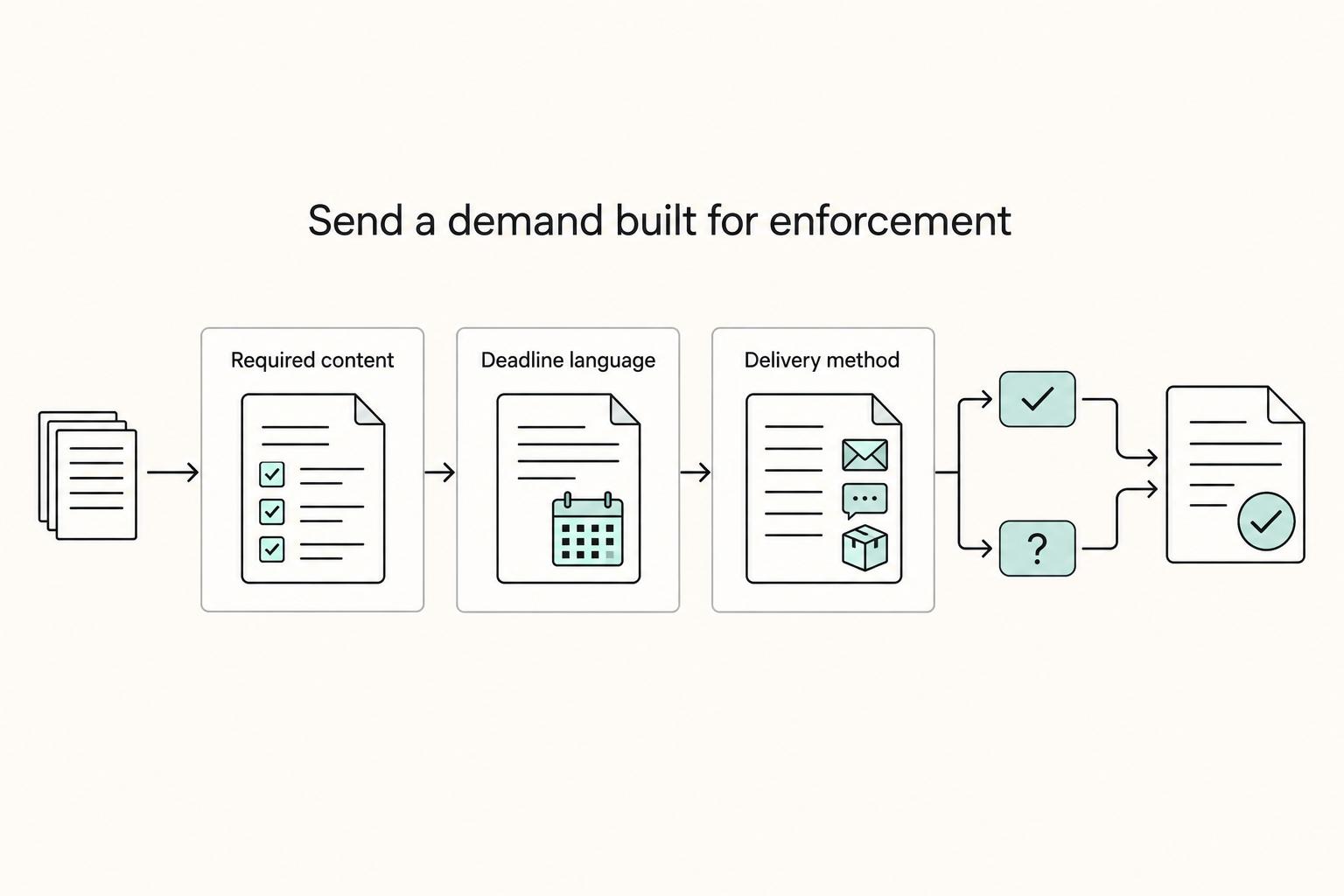
Send a demand letter that reads like evidence, not emotion#
A demand letter should read like a factual enforcement document. In some forums, making a demand is a required pre-filing step, so this is not just a tone change. It can be process-critical. Include these five items:
- Facts: exact amount due, invoice number(s), issue date(s), due date(s), and what you delivered.
- Contract basis: the signed agreement or SOW terms that make payment due, including milestone triggers, acceptance language, and approved changes.
- Payment cure window: a clear deadline by date, aligned with your contract and forum rather than a guessed universal timeline.
- Delivery with proof: send it in a method you can prove later, such as certified mail with return receipt plus regular mail, and keep copies.
- Next-step notice: state what you will do if the deadline passes, such as small claims, arbitration, mediation, or other lawful enforcement. If lien rights might apply, do not threaten them until eligibility and notice requirements are verified.
| Escalation option | Cost/effort | Pressure level | Best used when |
|---|---|---|---|
| Self-sent demand | Low cost, moderate prep | Moderate | The debt is clear, documents are clean, and the client is still reachable |
| Lawyer-sent demand | Higher cost, less drafting burden for you | High | Facts are disputed, responses have stopped, or enforceability risk is rising |
| Mediation | Moderate coordination | Variable | There is a real dispute to resolve, not just refusal to pay |
Decide when a lawyer letter is worth it#
A lawyer-sent demand makes sense when the file is becoming legally complex, not just overdue. Escalate to counsel when claim complexity is high, the client is no longer responsive, or enforceability risk is rising. This matters most in cross-border structures, clause conflicts, or an uncertain lien path.
If the debt is straightforward and the client is still engaging, send your own demand first. Save counsel spend for the point where legal framing and enforcement risk justify it.
Use mediation only when there is something to negotiate#
Mediation helps when both sides are still trying to resolve a real dispute, such as acceptance, partial delivery, credits, or staged payment. The mediator can help the parties settle, but does not impose a decision.
It is less useful when the client is simply using process to stall. Follow your contract's dispute-resolution clause first, because covered arbitration agreements are generally enforced according to their terms. If mediation does resolve the issue, get the settlement in writing so it is binding.
Before Tier 3, lock down the record. Keep a communication log with dates, names, commitments, and missed deadlines. Save proof of delivery for each formal notice. Then assemble the evidence packet: contract, scope exhibits, invoices, acceptance and delivery records, reminder trail, demand letter, and delivery receipts. If payment still does not arrive, that file lets you escalate quickly instead of rebuilding the story from memory.
We covered record-building in more detail in IR35 for UK Freelancers: Records, Self Assessment, and Pre-Signing Checks.
Tier 3: Asset-Backed Enforcement - The Mechanic's Lien#
Use this tier only after you have documented nonpayment, sent a formal escalation, and still have no cure. At that point, you are evaluating a legal filing path, not sending another collection reminder. This is a last resort. You are moving from invoice pressure to a procedural process, with both legal-process risk and relationship risk.
What it does and what it does not do#
A lien filing is a legal procedure, not instant cash. It may affect negotiation leverage, but outcomes depend on jurisdiction, facts, and execution.
It does not guarantee payment, and it will not rescue a weak file. If your record, party naming, or filing sequence is wrong, the effort can fail.
Treat the relationship impact as real. This is a high-friction move, so file only when your documentation and legal path are solid.
First-pass screen for your file (intake only)#
Treat the table below as intake triage for counsel, not a legal conclusion. Local law controls.
| Intake check | What to confirm | Intake status |
|---|---|---|
| Filing path | Which authority and filing path apply in this jurisdiction? | Confirm with counsel |
| Name accuracy | Legal names are consistent across contract, invoices, and draft filing records (including trade names, LLC/partnership naming, and name changes). | Required before filing |
| Form/workflow readiness | Required filing artifacts and preparation path are identified before drafting. | Required before filing |
| Record completeness | Contract, scope history, invoices, and delivery/approval timeline are assembled and internally consistent. | Required before filing |
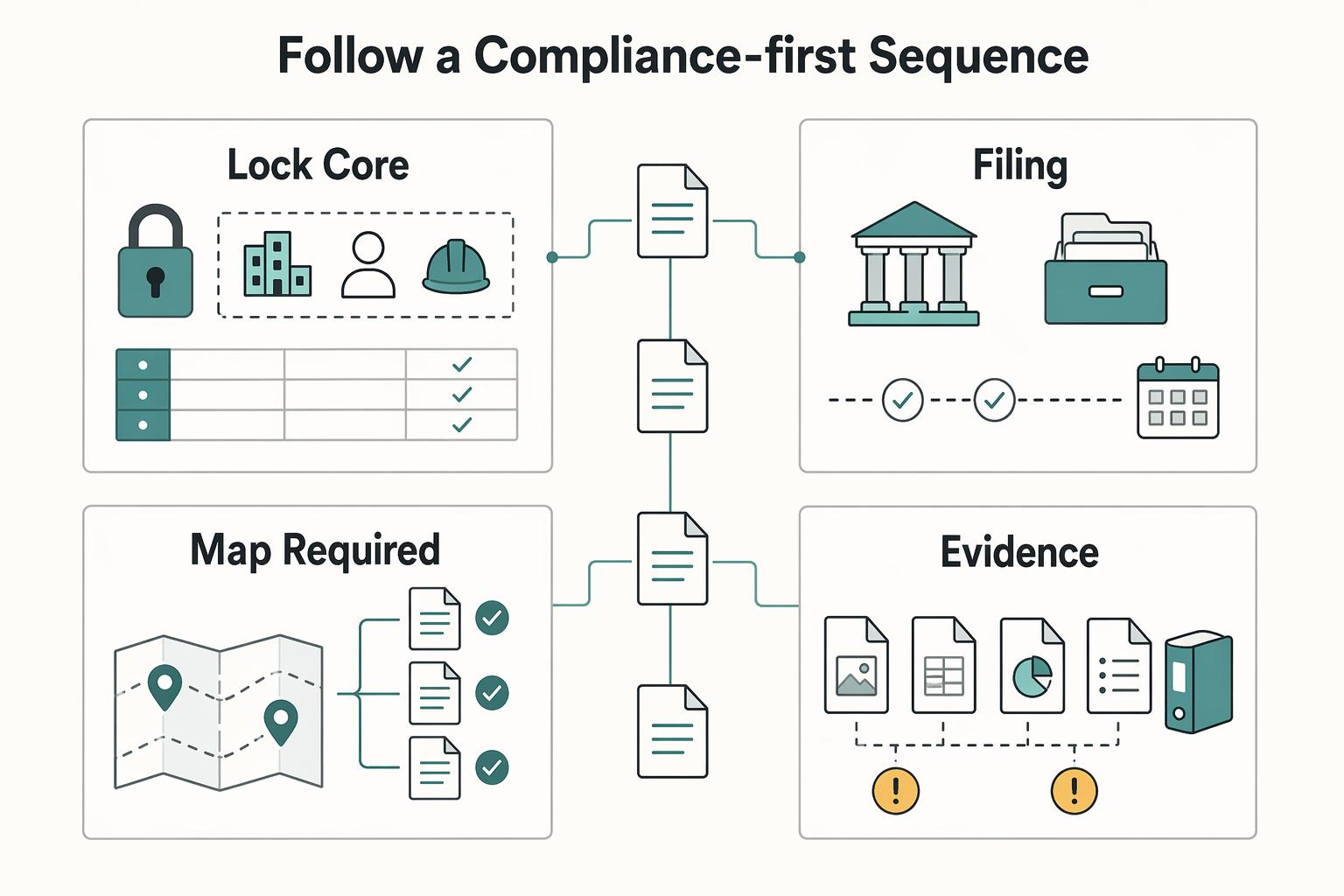
Follow a compliance-first sequence#
Lien processes are document-sensitive. Filing systems depend on exact documents, exact names, and exact steps, so your file has to be just as precise.
| Step | Action | Checkpoint |
|---|---|---|
| Lock the core file | Confirm property/project details, contracting party, and legal names exactly as shown in your signed agreement | The contract and scope file is complete and naming is consistent, including entity suffixes, trade names, and name changes |
| Verify current filing instructions before drafting | Use current official instructions and counsel review for your jurisdiction | Governing instructions and filing path are confirmed |
| Map required forms and preparation path | Identify required filing artifacts and preparation path before drafting | Required artifacts are identified and prepared in the right sequence |
| Assemble the evidence packet | Build a clean, review-ready record before filing | The proof-of-work set is complete, including the contract, scope changes, invoices, delivery/approval records, and timeline |
| File and preserve filing proof | File through the correct channel and keep the official record | Filing confirmation is stored and ready for the next legal decision |
Use that table as your working sequence. Two cautions matter. If you reference eCFR text, treat it as authoritative but unofficial, and do not use OFR feedback channels for content interpretation. If your project is cross-border, do not assume one jurisdiction's process applies to another. Confirm governing jurisdiction and process with counsel before filing.
Before you execute, confirm handoff readiness on four points:
- Counsel review complete: forum/process and naming validated.
- Document packet complete: contract, work proof, and identifiers assembled.
- Filing instructions confirmed: current forms and channels are clear.
- Post-filing decision trigger set: you know what the next legal step is if payment still does not arrive.
You might also find this useful: Collection Agency vs Small Claims for Freelancers.
Your Go/No-Go Checklist: Is a Mechanic's Lien Your Best Move?#
Use a lien only if your work clearly ties to property improvement, the recovery is worth the cost and friction, and you are ready to enforce after recording. If any one of those is weak, skip the lien path and start with the lowest-friction option that still creates real payment pressure.
A mechanic's lien is not a general nonpayment tool. It is a property-linked remedy, and it works only when your facts, timing, and follow-through are solid.
Cost vs. recovery checkpoint#
Do not decide from invoice size alone. A recorded lien can create leverage, but it does not guarantee payment, and in some jurisdictions you may need a foreclosure lawsuit after recording to enforce it. Check these four items before you proceed:
| Checkpoint | What to review |
|---|---|
| Legal and admin spend | Filing, notice, recording, and possible counsel costs; verify current local filing and counsel costs before you decide |
| Time drain | Property details, notice steps, and potential challenge response |
| Collectability risk | Whether title pressure is likely to matter in practice |
| Relationship fallout | This is a high-friction move that can end the commercial relationship |
Practical eligibility screen#
You need a clear work-to-property link tied to a permanent improvement. Nonpayment alone is not enough.
- Usually stronger fit: design work clearly used in the actual build, or labor and materials installed into the property.
- Usually gray zone: remote drafting without a clean usage trail, services tied to operations but not clearly to the improvement itself, and general digital services.
- Pause for legal review: if you cannot prove use on the specific property, or if eligibility is unclear under the property's jurisdiction rules.
Local rules can materially change outcomes. For example, some jurisdictions expressly include certain design-professional work in their improvement definitions, while others are narrower. Notice timing can also be decisive. In California, a late Preliminary Notice can cut off lien rights for earlier work, so a missed notice step is a stop-and-reassess signal.
| Path | Speed | Cost and complexity | Leverage | Best fit |
|---|---|---|---|---|
| Demand-letter escalation | Often fast | Lowest-friction | Moderate pressure; can resolve without court | First move when debt is clear and you want a practical off-ramp |
| Small-claims path | Often faster than full civil litigation | Lower cost and simpler process, but you still prove your case and collect if you win | Court order, not title pressure | When amount fits local limits and property-link strength is weak or uncertain |
| Lien path | Can be slower when notice, recording, and enforcement steps apply | Higher document sensitivity and procedural risk | Title pressure if valid | When work clearly improved the property and lien rights are intact |
| Contract lawsuit/judgment path | Often slower than small claims | Higher complexity and often costlier than small claims | Money judgment; collection is still your responsibility | When lien is unavailable or the claim size or facts do not fit lower-friction routes |
Go/no-go action checklist#
Proceed only if all three are true:
- Eligibility: your work fits the property-improvement standard in the property's jurisdiction.
- Economics: expected recovery justifies the spend, effort, and high friction.
- Enforcement readiness: your notice and deadline posture is still valid, and you are prepared for any required post-recording enforcement.
If any one fails, do not force the lien path. Start with demand-letter escalation, use small claims when local limits fit (limits vary by jurisdiction), and move to contract litigation only when lower-friction options do not fit the amount or the facts. For judgment-stage collection, see A Freelancer's Guide to Collecting on a Judgment.
If your checklist says "not yet," lock in stronger payment terms on your next project with this freelance contract generator.
Decide the escalation path before an invoice goes late#
You take control of receivables by deciding the escalation path before an invoice goes late. The three-tier approach works because it replaces improvisation, delay, and empty threats with a documented sequence.
Tier 1 helps prevent collection problems. Before work starts, lock down scope, price, payment timing, change-approval method, and exact client identity in your agreement records. If a project may touch real property, confirm names, roles, and project details early so your file can clearly connect your work, your counterparty, and the project.
Tier 2 starts when an invoice is overdue and you stop being informal. Send one professional, documented demand. State what is due, what was delivered, what remains unpaid, and the deadline under your verified process. Build the same evidence packet you would hand to counsel or a filing office: agreement records, approved changes, invoices, delivery proof, payment history, and complete party details.
Tier 3 is enforcement only when your go or no-go review supports it. Treat a mechanic's lien as a conditional endpoint, not a default tactic. If eligibility is unclear, the property link is weak, or recovery likely does not justify the friction, do not bluff. Consider a lower-friction path instead.
Formal documents matter because they create hard response checkpoints. If a matter reaches court papers, terms like Summons and notice of appearance require action. In one cited New York summons, the response checkpoint was 20 days after service or 30 days if served outside New York. Failure to appear could lead to default judgment. That is not a universal debt-collection rule, but it is a practical reminder to treat service documents as time-sensitive.
Operating rhythm#
Keep the process consistent with three habits:
- Maintain a live evidence file for each client and project.
- Track invoice status in one place, with escalation triggers you define only after verifying your contract and local rules.
- Move accounts forward when triggers are hit instead of restarting the clock on vague payment promises.
That is how you protect cash flow and keep autonomy: document clearly, escalate on time, and choose enforcement only when the file supports it.
This pairs well with our guide on Small Claims Court for Freelancers With Unpaid Invoices.
If you want clearer payout status as you scale, explore Gruv for freelancers.
Frequently Asked Questions
How do you tell if your work is even the kind that might support a lien?
Treat eligibility as unresolved until you confirm current local law with qualified counsel.
Can you file if you did the work remotely or from another country?
Do not assume remote or cross-border facts settle eligibility; confirm with local counsel whether filing is available and what process applies.
What should you gather before you ask a lawyer or filing office about this?
Bring an organized record set: agreement terms, scope/change history, invoices, payment history, delivery evidence, and complete party/property identifiers. This supports review, but it does not establish lien rights by itself.
What does it cost to file?
Verify current filing, service, and legal costs directly with the local filing office and counsel.
What is the first step if you want to preserve the option?
Confirm whether any pre-filing notice or other prerequisite applies in your jurisdiction before you rely on a template.
Can you proceed without a written contract?
If documentation is thin, treat your position as uncertain and get local legal advice before escalating.
What happens after you file?
Confirm whether any enforcement requirements or timing rules apply before you file.
How do you verify local rules without guessing?
Use current primary local law and local counsel, not recycled summaries. If what you have is a broken link or a broad omnibus law excerpt that does not explain lien procedure, treat your rule check as incomplete.
Try a related tool
Researched and edited by the Gruv editorial team. Gruv builds cross-border billing, payouts, and finance-operations software for global businesses.
Sources
- ag.ny.gov/sites/default/files/court-filings/oag-pleadi...trusted
- assets.eurofound.europa.eu/f/279033/bd2948158a/ef18001en.pdftrusted
- cadc.uscourts.gov/usca-mediation-faqstrusted
- courts.ca.gov/sites/default/files/courts/default/2024-11/s...trusted
- cslb.ca.gov/Consumers/Legal_Issues_For_Consumers/Mechani...trusted
- cslb.ca.gov/consumers/legal_issues_for_consumers/mechani...trusted
- ecfr.gov/current/title-13/chapter-V/part-500trusted
- irs.gov/businesses/small-businesses-self-employed/se...trusted
Educational content only. Not legal, tax, or financial advice.
Related Posts

Stop Freelance Profit Margin Erosion Before It Hits Cashflow
Revenue can hold steady while the business underneath it gets weaker. What comes in matters, but what you keep after the work is delivered is the clearer signal of health.
A Freelancer's Guide to Collecting on a Judgment
Winning the case is only part of the job. Getting paid is a separate enforcement process, and [the court does not collect for you](https://selfhelp.courts.ca.gov/civil-lawsuit/judgment/how-collect). At this point, you are the judgment creditor and the other side is the judgment debtor. Your next decisions are about cash flow, time, and risk.

The Freelance Payment Penalty: A Modeled Audit of Platform Fees, FX Spreads, and Payout Delays
The money rarely disappears through a single, easy-to-spot fee. The real loss is stacked. A marketplace takes its commission, a processor adds a charge for international cards, a bank or payment company converts the currency at a spread, a platform holds the funds before release, and a wire sheds a little to intermediaries on the way in. Each layer looks defensible on its own, but the worker feels the combined result as a smaller deposit and a later payday.