
Quick Answer
A limitation of consequential damages clause limits exposure to secondary, downstream losses after a breach while leaving some direct remedies in place. In freelance contracts, it works best as part of the full liability package, alongside the cap, indemnification, carve-outs, and termination terms. A mutual, balanced waiver with clear surrounding language is usually easier to defend and negotiate than broad or one-sided wording.
Start Here and Protect Your Downside Without Slowing the Deal#
Treat the limitation of consequential damages clause as a risk-allocation term, not boilerplate. Consequential loss is a recognized breach-related category in contract damages analysis, but the practical goal here is simpler: set predictable boundaries around higher-uncertainty claims without creating avoidable deal friction.
This article covers contract logic, redlining choices, and negotiation language for service contracts. It is not jurisdiction-specific legal advice. Outcomes are not automatic, and clause disputes can turn on remoteness or foreseeability, uncertainty, avoidability, and the exact remedy wording.
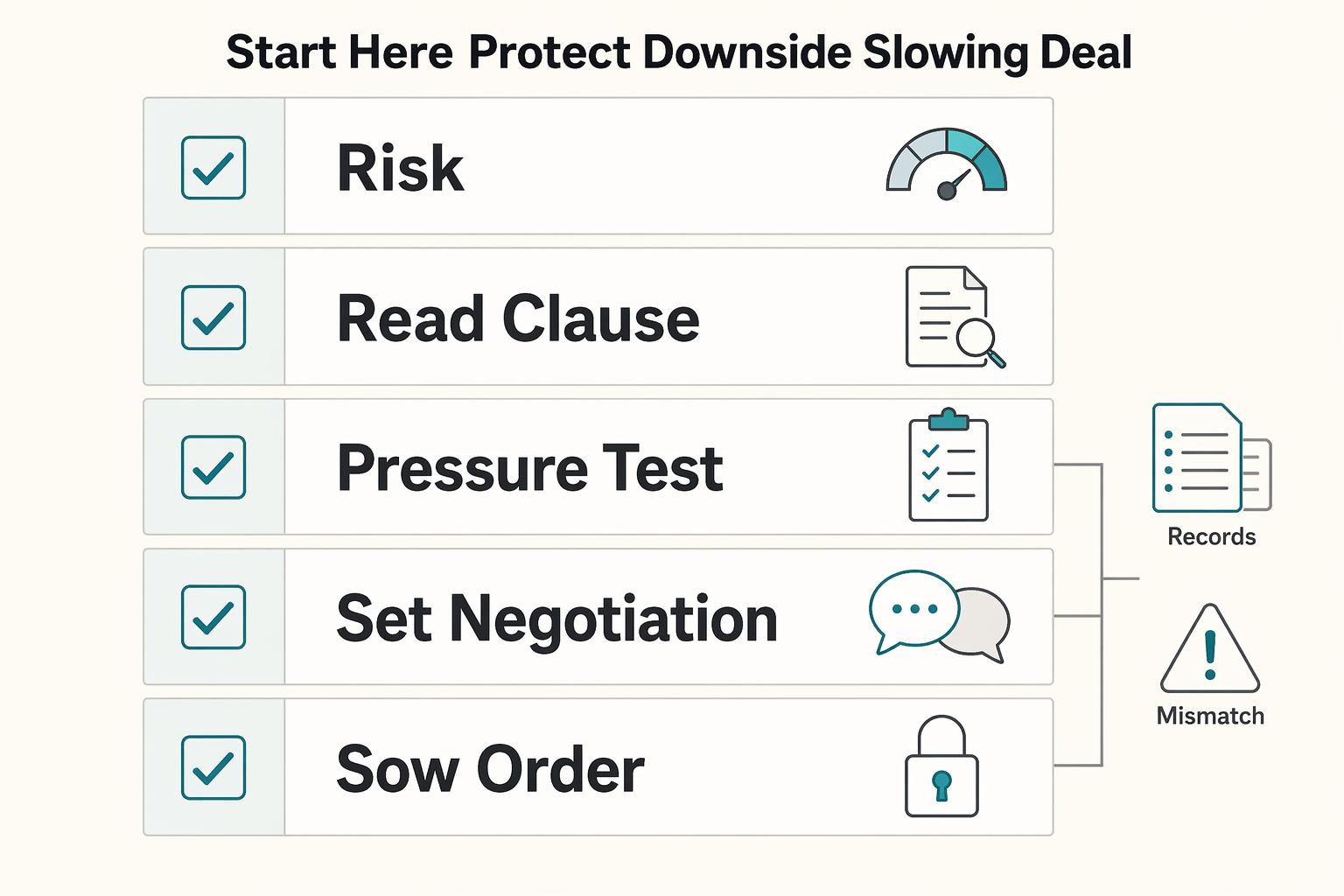
Use this decision sequence.
- Start with the project's risk profile.
Ask which loss theories are direct service-delivery issues and which are downstream business-impact theories. Treat second-order loss theories as a sign that you need clear allocation language.
- Read the clause as part of one remedy package.
Do not review the waiver in isolation. Check whether nearby liability and remedy terms keep exposure balanced or quietly reopen paths the waiver was supposed to narrow.
- Pressure-test the likely claim story.
Before redlining, run a simple checkpoint: does the potential claim look remote, assumption-heavy, or avoidable with reasonable mitigation? If yes, that is where waiver language does real work. If not, solve the issue in the direct-remedy terms instead of relying on the waiver alone.
- Set negotiation posture early.
A mutual waiver can be a clean starting position for service work. If the other side pushes one-sided language or broad carve-outs, rebalance by narrowing those carve-outs and aligning the rest of the liability structure.
Gather these before you touch the redline. Pull the project record together first so the damages discussion stays tied to the real deal file and so potential risk shifting is easier to spot.
- SOW or order form
- delivery assumptions and dependency notes
- acceptance criteria or approval mechanics
- written scope, timing, and outcome communications
Keep your first ask short. Use a clear opener: "We can agree to a mutual waiver of consequential damages if the liability structure stays balanced." That frames you as practical, not oppositional, and gives the other side a workable path.
By the end, you should have a decision tree, a red-flag checklist, copy-paste language, and a pre-signature sanity check.
Related reading: What is the 'Limitation on Benefits' (LOB) Clause in a US Tax Treaty?.
What This Clause Actually Does in Real Contracts#
A limitation of consequential damages clause reallocates risk by trying to bar secondary-loss claims after a breach while leaving some direct-damages remedies in place. Treat it as a pricing term, not boilerplate.
You may see it inside broad "in no event" language within a Limitation of liability clause, excluding indirect, incidental, consequential, special, or punitive damages. Read that sentence as one part of the full remedy package, not the whole story.
Use this reading test#
Read the clause in three passes:
- Identify which losses the waiver targets.
Direct damages arise from the breach itself. Consequential damages are secondary to it. Claims like lost profits, downstream customer fallout, or business interruption fit here only when the contract text actually reaches them.
- Confirm what survives the exclusion.
The waiver does not automatically erase every remedy. Direct-damages paths may remain, but the practical result can narrow to something closer to refund or replacement than full business-impact recovery.
- Verify surrounding clauses before you price the risk.
Check the waiver with the liability cap, related claim-allocation terms, and carve-outs. Because courts can read these provisions differently, evaluate the waiver alongside other contract terms rather than in isolation.
These clauses are meant to reduce uncertainty and allocate risk, but interpretation can vary. If the waiver is broad or one-sided, or the remaining direct remedies are thin, either price for that risk or push for mutual language.
You might also find this useful: How to Structure a 'Limitation of Liability' Clause when using OpenAI's API in a Client Project.
Direct Damages vs Consequential Damages in Service Work#
Classify the loss by function, not by label. The line can shift with contract wording and jurisdiction, but losses tied to the promised service value are often treated as direct, while losses that depend on what happened later in the client's business are often treated as consequential.
That distinction matters because a consequential-damages waiver can leave direct damages as the only practical recovery path. In service work, refund, rework, and replacement-style loss sit closer to the contract's core bargain. Lost profits, loss of use, lost rental income, and other delay-driven knock-on costs are more often treated as collateral.
| Function in service disputes | Trigger event | Typical examples | Proof burden | Usually blocked by a consequential-damages waiver? |
|---|---|---|---|---|
| Immediate performance-value loss | Deliverable is missing, unusable, or materially nonconforming | Refund of fees, cost to redo work, cost to hire a replacement provider | Contract terms, invoices, defect evidence, replacement quotes | Usually no |
| Delay-related replacement loss close to performance | Delivery delay forces extra spend to obtain the promised work | Substitute-performance costs incurred to complete the promised work | Timeline records, substitute invoices, scope comparison | Depends on wording and context |
| Downstream business-impact loss | Breach affects later operations or market results | Lost profits, loss of use, lost rental income | Higher uncertainty and valuation work, plus causation and projection assumptions | Usually yes |
Function test before you respond to a claim#
Use this quick screen before you react to a demand. The split usually becomes clearer once you tie the claim to the actual project story.
- What is the money replacing?
If it replaces the promised performance value, such as curing or replacing broken work, treat it as potentially direct.
- Does the number depend on downstream revenue assumptions?
If the claim relies on projected sales or other later business outcomes, treat it as likely consequential until counsel confirms otherwise.
- How assumption-heavy is the proof?
The more the claim depends on causation and valuation assumptions, the more likely it is being framed as consequential.
Freelancer scenarios can look similar but still depend on contract wording and governing law. With a missed launch, a claim for replacement development cost may be framed as closer to direct loss. A claim for subscription or other revenue the client says they would have earned from that launch may be framed as a lost-profits theory.
Delayed deliverables can follow the same pattern. Cure or replacement cost may be easier to anchor to promised performance value, while weak quarter results or similar downstream outcomes may be framed as consequential.
Verification checkpoint before redlines. Check whether the waiver also defines or lists consequential-damages examples. Broad waiver language without examples often sets up categorization fights later.
For a step-by-step walkthrough, see How to Handle a 'Liquidated Damages' Clause in a Contract.
How This Clause Interacts With Limitation of Liability, Indemnification, and Termination#
A consequential-damages waiver only works if related clauses do not reopen the same risk through different wording. Read Limitation of Liability, Indemnification, and Termination together, because risk is allocated across the full set, not one clause at a time.
Review order that catches conflicts fast#
Use this review sequence to catch common problems early:
| Review step | What to check | Why it matters |
|---|---|---|
| Definitions | Terms like Losses, Damages, Claims, and Liabilities | Broad related claim-allocation language with a narrow cap can create an exposure gap |
| Remedies | Read the waiver and the liability cap together | Shows what remains claimable after the waiver, and at what amount |
| Exceptions | Review carve-outs and exceptions in both the waiver and the cap | Some paths may sit outside one or both limits |
| Survival after termination | Check what survives termination | Identifies which obligations continue after the contract ends |
- Definitions
Check terms like "Losses," "Damages," "Claims," and "Liabilities." If related claim-allocation language is broad but the cap is narrow, you may already have an exposure gap.
- Remedies
Read the waiver and the liability cap together. A cap tells you how much can be claimed. The key question is what remains claimable after the waiver, and at what amount.
- Exceptions
Review carve-outs and exceptions in both the waiver and the cap. Depending on wording and governing law, some paths may sit outside one or both limits, so mark them as potential reopened paths.
- Survival after termination
Check what survives termination. Survival language does not automatically expand liability, but it tells you which obligations continue after the contract ends.
The main exposure check. If general liability is capped but related claim obligations are uncapped, your practical exposure can still be uncapped. Those obligations are often paired with warranties and limitation or exclusion terms, so the outcome depends on exact drafting and how recoverable losses are framed. If wording is silent or unclear, flag it instead of assuming the cap controls.
If the client has a specific high-risk concern, a higher stated cap for that risk can be cleaner than a fully open obligation. Multi-tier cap structures, sometimes called liability ladders or super caps, are usually better handled when designed early, not added as a late patch.
Build a max exposure map. Before redlines, make a one-page map: for each likely claim path, is it waived, capped, carved out, or open? If two claim paths can reach the same event, mark both. That is where stacking risk shows up.
| Claim path | What to compare | What to mark |
|---|---|---|
| Ordinary service breach | Consequential-damages waiver + general cap | Waived, capped, or open |
| Indemnity claim | Trigger + loss definition + cap linkage | Capped, higher-capped, silent, or open |
| Exception claim | Exceptions in waiver and cap | Potentially outside waiver or cap, or unclear |
| Post-termination claim | Survival + termination remedies | Survives or expires, and whether caps still apply |
Red flags to act on. Three patterns deserve immediate attention:
- Cap language is narrow, but related claim-allocation language is broad.
- Exceptions appear in multiple sections and are not aligned.
- Termination language looks clean, but survival language keeps broad obligations alive without clear cap linkage.
If you spot a broad uncapped obligation, do not assume the consequential-damages waiver will save you. Typical fixes are to narrow the trigger, tie it expressly to a cap, or set a higher but finite cap for that specific risk.
Related: A Deep Dive into the 'Limitation of Liability' Clause for Freelance Software Developers.
Risk Triage Before You Redline#
Triage first, then redline. Classify risk as acceptable, negotiable, or non-negotiable before you edit the consequential-damages clause. That keeps you out of slow, one-off clause debates and makes your concessions more consistent.
Start with intake facts, not wording alone#
Start with the deal facts that actually drive exposure:
- Project value
Is the contract value high enough that a dispute would be commercially serious for you?
- Dependency risk
Is your work on a critical path where delay could raise downstream claim risk?
- Non-standard terms
Are there one-sided or non-standard requests that need consistent routing instead of one-off debate?
- Dispute mechanics
Are remedies and dispute terms clear enough that claim paths are predictable?
If clause ambiguity looks high, treat broad carve-outs and loose related claim-allocation language as higher-priority issues.
Use a 3-band call you can apply consistently#
Apply one standard call each time based on your risk appetite and delegated authority:
| Band | When it applies |
|---|---|
| Acceptable | Waiver is reasonably mutual, carve-outs are narrow, and related triggers are clear |
| Negotiable | The structure is mostly workable, but symmetry is off or carve-outs are too broad |
| Non-negotiable | You are being asked to accept a one-sided waiver plus broad Indemnification and cap pressure at the same time |
- Acceptable
Waiver is reasonably Mutual, carve-outs are narrow, and related triggers are clear.
- Negotiable
The structure is mostly workable, but symmetry is off or carve-outs are too broad.
- Non-negotiable
You are being asked to accept a one-sided waiver plus broad Indemnification and cap pressure at the same time.
If the client wants a broad waiver plus broad related claim obligations, do not negotiate the waiver alone. Ask for one structural fix: either narrower scope there or less pressure on the liability cap. If neither moves, treat it as a real red flag.
Checkpoint: read carve-outs, the trigger, and the cap together. If one event can be framed as both breach and a separate claim path, mark it at least negotiable, and often non-negotiable.
Build the evidence pack before the first redline. Assemble this before negotiations:
- SOW with deliverables, exclusions, and dependencies
- Delivery assumptions covering client inputs, approvals, and access
- Acceptance criteria with objective tests, deadlines, or sign-off steps
- Communications confirming scope limits, expected outcomes, and client responsibilities
If acceptance criteria are vague, fix that before you spend time on liability wording. Also check early for unlimited liability or missing caps so they do not surface late in review.
After banding and evidence collection, send a tracked-changes redline file instead of loose comments so the negotiation stays concrete and auditable.
If you want a deeper dive, read Germany Freelance Visa: A Step-by-Step Application Guide.
Redline Checklist for the Consequential-Damages Block#
After triage, the goal is simple: produce a damages block that is balanced, clear, and consistent with the rest of the contract so the other side can evaluate it quickly.
Work through this checklist in order.
1. Fix balance first#
If the waiver is one-sided, confirm that the asymmetry matches the transaction's risk profile. If it does not, redline toward more balanced terms or request balancing changes in related liability language.
2. Tighten broad "In no event" wording#
If "In no event" language is broad, tighten it so the allocation is clear and internally consistent. Read the waiver with related remedies and liability language so you do not leave internal conflicts.
3. Keep carve-outs explicit and limited#
If the parties want carve-outs, use a closed Carve-out list and include only exceptions both sides clearly intend to preserve for this deal. Avoid open-ended additions that blur the edge of the waiver.
4. Check cross-clause consistency#
Do not finalize this clause in isolation. Compare it against Indemnification and other liability provisions. Key checkpoint: liability limits should not conflict with or undermine indemnification obligations.
5. Send an approval-ready package#
Send two things:
- a clean redline
- a one-paragraph rationale
In that rationale, say the edits make risk allocation more balanced for this transaction and align the waiver with related liability and indemnification language so the contract reads consistently as a whole.
Want a clean starting draft before redlining this clause? Build one with the Freelance Contract Generator.
Carve-Outs to Accept, Push Back, or Redraft#
Commercial parties use limitation-of-liability terms to allocate risk. Use a carve-out list only when each exception is clearly defined and tied to the cap structure. A practical default is to avoid silent uncapped exposure and decide early whether a general cap plus elevated caps for named high-risk contingencies fits the deal.
| Carve-out pattern | Practical read | Recommended move |
|---|---|---|
| Fraud or willful misconduct language | High-stakes exception where scope and trigger control exposure | Define the trigger and state whether it is uncapped, under an elevated cap, or within the general cap |
| Gross negligence without definition or boundary | Unclear scope can destabilize the risk-allocation framework | Define the boundary, or map it to a separate cap tier |
| Broad confidentiality exception | Clause interaction can change exposure depending on waiver and cap language | Review confidentiality, waiver, and cap language together and state cap treatment explicitly |
| Any carve-out left uncapped by silence | Exposure can exceed deal value | Add corresponding cap language, including an elevated cap for the named risk where appropriate |
Keep misconduct carve-outs precise and explicit#
If the other side asks for Fraud or Willful Misconduct exceptions, focus on clear triggers and explicit cap treatment rather than labels alone. The key drafting question is whether the exception is uncapped or assigned to a specific cap tier.
Treat undefined fault labels as a drafting checkpoint#
If Gross Negligence remains undefined, clarify what conduct it covers and how claims in that bucket are capped. If that boundary stays unclear, move from broad labels to specific obligations and explicit cap tiers.
Read confidentiality against the waiver line by line#
A broad confidentiality exception can change risk allocation depending on how the clauses interact. Review the waiver, the Confidentiality clause, and the Limitation of Liability clause together, and mark:
- what is excluded from the waiver
- what is excluded from the cap
- what survives after termination
If confidentiality appears as an exception in multiple places, confirm the combined effect and align cap language accordingly.
If carve-outs broaden, adjust cap structure early#
The practical lever is the Limitation of Liability clause. Instead of "uncapped or nothing," use a general damages cap for ordinary contingencies and elevated caps for named high-risk contingencies. Those are often called super caps, or a multi-tier structure, sometimes called a liability ladder. Raise that structure early, since it is usually easier to address than as a last-minute patch.
Negotiation Language That Protects You and Keeps Momentum#
Treat this as one package, not a set of separate clause fights. Tie any Mutual waiver of Consequential damages to the Limitation of Liability clause and clear scope carve-outs so your exposure stays predictable.
Start with one package, not three separate fights#
Use a short script: "We can agree to a Mutual waiver of Consequential damages if the cap structure and carve-outs stay balanced."
If the client says the clause is "standard," bring the discussion back to three checks:
- what is waived
- what is capped
- what is carved out
That keeps the negotiation focused on risk allocation instead of isolated wording.
Answer "standard terms" with one practical ask. Use one clear response: "I can work with standard terms if the waiver, the cap, and carve-outs align so exposure is predictable."
Then run a single-page review of:
- the waiver
- the Limitation of Liability clause and cap structure
- the client entity designation
- included services and explicit exclusions in the SOW
Change emphasis based on project shape. Different project types call for different pressure points.
For short fixed-fee projects, prioritize clear carve-outs so ordinary delivery risk does not become open-ended exposure.
For longer, dependency-heavy work, raise cap structure early. These deals often create tension between uncapped exposure and a single general cap. Structured cap options, including elevated caps for named high-risk contingencies, can be easier to discuss early than at a late-stage deadlock.
Give bounded fallback options. If the first proposal stalls, offer bounded choices:
- Mutual waiver plus one general cap for ordinary claims.
- Mutual waiver plus a higher cap for one named risk category.
- Narrower waiver only if scope exclusions stay explicit and cap tiers stay clear.
If the package still combines broad waiver language and broad scope obligations without matching caps, pause and redraw it before negotiating wording line by line.
We covered this in detail in What is a 'Force Majeure' Clause and Do You Need One?.
Governing Law, Jurisdiction, and Dispute Resolution Change the Real Risk#
Your waiver only protects you if the selected forum applies it the way you expect. If governing law, jurisdiction, or dispute forum is unfamiliar, simplify the waiver language, keep carve-outs narrow, and remove wording that creates scope fights.
A limitation of consequential damages clause can look balanced and still become expensive to defend when forum terms are unclear. Put forum terms into the same risk review as the waiver and cap, not at the end of markup.
Use four checks before you accept the forum clause#
Run these checks before you agree to the forum language:
- Name governing law and forum clearly.
Do not leave governing law implied. In cross-border contracts, the practical baseline is to address language and governing law so dispute handling is not uncertain.
- Confirm who decides threshold issues first.
Courts traditionally handled validity and coverage questions before compelling arbitration. A delegation clause can shift those threshold questions to arbitrators, including fights about scope and enforceability.
- Price the forum, not just the claim.
Do not assume arbitration is cheaper or faster. Some arbitration provisions require parties to pay part of arbitrator fees, so cost exposure can start before the merits are decided.
- Check document consistency across the deal.
Keep the core set aligned: main contract or framework agreement, purchase orders or order confirmations, and invoices or packing lists where used. Conflicts across documents can trigger later disputes over risk and transport-cost allocation.
Compare litigation and arbitration by what you need to verify#
| Criterion | Litigation check | Arbitration check |
|---|---|---|
| Speed | Confirm filing venue and likely front-end motion work. | Confirm rules, tribunal selection, and any extra threshold steps. |
| Cost | Estimate counsel, filing, travel, and discovery burden. | Check filing fees, arbitrator-fee sharing, admin fees, and hearing-location cost. |
| Confidentiality | Verify whether rules or contract terms actually protect filings and evidence. | Verify whether the clause or arbitral rules actually impose confidentiality. |
| Appeal rights | Confirm what review path exists in the chosen court structure. | Confirm what review or challenge path the clause and applicable rules allow. |
| Predictability | Prefer a court and law you can evaluate for contract interpretation. | Prefer drafting and seat or rules that reduce scope and enforceability fights. |
A hidden issue can be who decides gateway issues. If delegation language is present, treat it as risk allocation, not just procedure.
Cross-border deals need simpler drafting, not cleverer drafting#
In cross-border work, the contract is a primary tool for controlling legal, commercial, and compliance risk. If the counterparty wants a foreign law, foreign forum, or unfamiliar arbitration body, reduce interpretation risk instead of adding complexity.
Before signing, make three edits: keep the waiver truly mutual, remove vague carve-outs that can swallow it, and state exactly where and under what law disputes are resolved. Then verify those terms are consistent across the full document set.
On case references, treat forum-specific authority as context and do not treat any single case as a universal rule for your clause language.
This pairs well with our guide on How to Write a 'Force Majeure' Clause That Covers Pandemics and Geopolitical Events.
Sanity Checks Before Signature#
Before you sign, confirm your liability terms and key deal terms work together across the full deal set, not just the main agreement.
- Check the core risk clauses together.
Read Limitation of Liability and related risk-allocation language as one package. If the drafting is inconsistent or one-sided, review can slow and practical exposure can become harder to assess.
- Tighten definitions and carve-outs.
Verify key terms used in the Carve-out list and related liability language are defined and used consistently. Clear definitions help both sides interpret contract terminology the same way.
- Review exhibits and order documents for conflicts.
Compare the main agreement with order forms, SOWs, and exhibits so variable deal terms are easy to find. If variable terms are scattered, move them into an upfront schedule so review and editing are faster.
- Avoid hardball drafting.
If the draft reads as hardball, expect slower legal review. Fair and balanced language is more likely to move to signature faster.
- Run one plain-English claim test.
In plain English, write what is capped and how key liability terms apply across documents. If you cannot explain that path quickly and consistently, the drafting still needs cleanup.
What to Document After Signing So You Can Defend Your Position#
After signing, keep a tight evidence pack that shows intent, performance, and acceptance so you can defend how a later claim should be treated.
Keep the execution set that shows intent. Save the final agreement, last tracked redline, and the approval trail for the waiver and each Carve-out term. Courts can read waiver language inconsistently, usually starting with the exact wording and then reading it alongside other contract provisions, so your record should preserve that full context.
Create a one-page extract with the exact consequential-damages waiver sentence, the matching limitation-of-liability language, and the survival language. Keep the signed text verbatim, including any "claims, disputes, or other matters in question" phrasing.
Prepare a dispute file before there is a dispute. Even with a waiver, disputes can turn on whether losses are direct or consequential. Keep a ready folder for Arbitration or Litigation with the core proof set:
- Final SOW or order document tied to the agreement
- Delivery evidence, such as submission emails, transfer logs, or dated handoff messages
- Acceptance records, such as sign-off messages or clear evidence the work was used
- Key communications on assumptions, dependencies, delays, and change requests
Track renewals and post-termination changes. Treat renewals, amendments, and Termination documents with the same rigor as the original deal. Compare each update against prior survival and liability language so you can spot shifts in obligations.
When remedy, survival, or related claim-allocation terms change, update your evidence pack promptly. The goal is a clean contract history that helps you explain waiver intent and how losses should be characterized if a dispute arises.
Conclusion#
A defensible limitation of consequential damages clause is a contract structure, not a single sentence. Treat your waiver, limitation-of-liability language, remedies, and related terms as one package.
Courts do not read these clauses uniformly. They usually start with the exact waiver text and then read related provisions to interpret intent, so broad waiver wording can be narrowed by surrounding language.
Fast closing checklist. Before signing, run these four passes in order:
- Classify the real risk
Focus on the losses most likely to be argued after a breach. If the claim turns on downstream revenue, delay impacts, or lost profits, treat it as likely consequential unless your contract clearly says otherwise.
- Redline for symmetry and precision
Use a mutual waiver as a common starting point when possible. If the draft uses broad "in no event" language, confirm which categories are excluded and how direct damages are handled.
- Test the clause package together
Read the waiver text, remedy limits, related claim language, and other connected terms together. A waiver that looks broad can still be narrowed or undermined by surrounding language.
- Archive the final language
Keep the signed agreement and key redlines so the final waiver language and revisions are easy to trace later.
If the client insists on one-sided risk. Negotiate structure, not emotion. Ask which risk they are trying to control, then trade on mechanics: waiver scope, limit design, and dispute-term clarity.
Red flag to remember. A mutual waiver does not eliminate risk by itself. A common failure mode is assuming the issue is closed, then discovering the real dispute is about wording, classification, or interaction with another clause.
Far East Aluminum Works Co. Ltd. v. Viracon, Inc. (8th Cir., Mar. 9, 2022) is a useful reminder: the exclusion was paired with a limited remedy (refund or replacement), and the appellate court rejected challenges to the exclusion. It is not a universal rule for service contracts, but it shows why coordinated drafting is usually more defensible than waiver language alone.
If you apply one rule, use this: align waiver scope and any liability limits with the rest of the contract text. Sign only when you can state in one paragraph what is waived, what is limited, and what remains open.
If this still feels high-stakes before signature, request a practical review path at Contact.
Frequently Asked Questions
What is a limitation of consequential damages clause in plain English?
It is a risk-allocation term that can block claims for certain knock-on losses if the contract is breached. It is generally aimed at losses like lost profits, lost income, and loss of use rather than immediate fix-or-rework costs. The goal is to narrow uncertain downstream exposure, not remove all liability.
What is the difference between direct damages and consequential damages?
Direct damages are the immediate losses caused by a breach, such as repair costs or additional work costs. Consequential damages are losses that result naturally but not directly from the breach, often tied to downstream effects. The exact line can be disputed, so the contract wording matters.
Are consequential damages waivers always enforceable?
No. Enforcement is not uniform, and outcomes often turn on the clause text, applicable law, and the surrounding contract language. Ordinary negligence and intentional wrongful conduct may be treated differently depending on the jurisdiction.
Can lost profits be waived in a freelancer contract?
Often, yes. Lost profits are commonly treated as consequential damages and may be waived when the contract language is explicit. But classification can still depend on the facts, jurisdiction, and exact wording of the agreement.
Should a consequential damages waiver be mutual?
A mutual waiver is often a practical starting point because it allocates risk on both sides. One-sided allocation can increase dispute risk. The wording still needs to fit the specific contract.
What carve-outs are most common in these clauses?
There is no single carve-out set that works everywhere. Carve-outs should be drafted precisely and checked against the rest of the agreement. If they are broad or vague, they may undercut the waiver's effect.
Which should I negotiate first: consequential damages waiver, limitation of liability, or indemnification?
Negotiate these together, not as isolated clauses. The waiver's real effect depends on how indemnification and limitation-of-liability terms are drafted and how other provisions interact with them. After alignment, tighten the waiver wording and confirm the package is consistent.
Try a related tool
Researched and edited by the Gruv editorial team. Gruv builds cross-border billing, payouts, and finance-operations software for global businesses.
Sources
- cms.gov/medicare-coverage-database/view/article.aspxtrusted
- cms.gov/medicare-coverage-database/view/lcd.aspxtrusted
- coloradojudicial.gov/sites/default/files/2026-02/Chapter%2030.pdftrusted
- courts.delaware.gov/Opinions/Download.aspxtrusted
- documents.fresno.gov/WebLink/DocView.aspxtrusted
- jcl.law.uiowa.edu/sites/jcl.law.uiowa.edu/files/2025-08/Stanto...trusted
- jud.ct.gov/external/supapp/Cases/AROap/AP171/171AP467.pdftrusted
- law.gwu.edu/sites/g/files/zaxdzs5421/files/downloads/DE%...trusted
Educational content only. Not legal, tax, or financial advice.
Related Posts

Germany Freelance Visa Application Path for Freiberufler and Gewerbe
Choose your track before you collect documents. That first decision determines what your file needs to prove and which label should appear everywhere: `Freiberufler` for liberal-profession services, or `Selbständiger/Gewerbetreibender` for business and trade activity.

Limitation of Liability Clause for Freelance Software Developers
Start by setting the structure, not just a number. Liability terms allocate risk, so your first move is to define how risk is organized before you negotiate the cap amount. Use these terms consistently from round one:
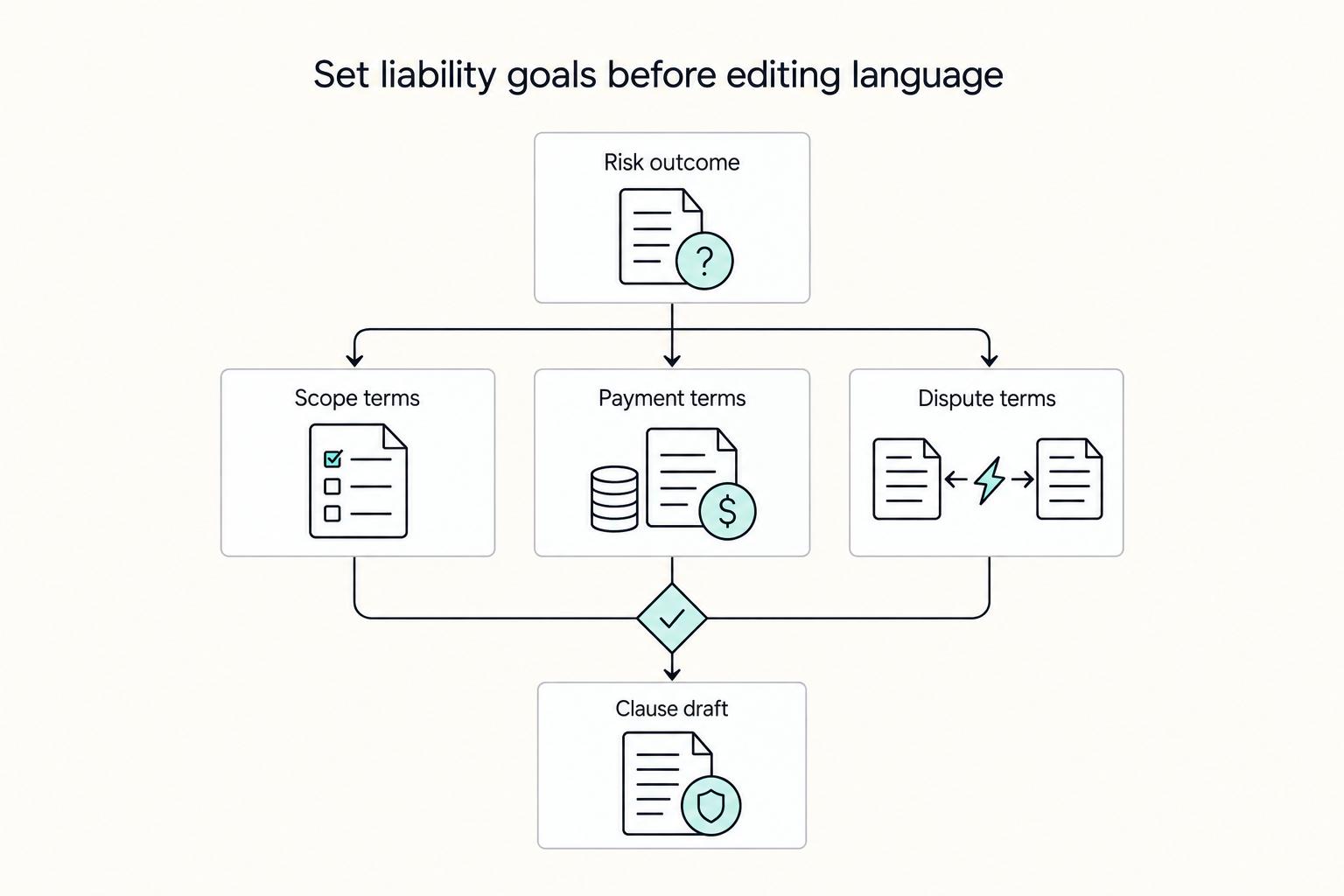
How to Write a Limitation of Liability Clause for a Freelance Contract
A strong limitation-of-liability clause should first put a clear ceiling on your downside without making the deal unworkable for either side. A practical starting point is a liability cap tied to the project fee instead of open-ended exposure.