
Quick Answer
Issue preservation instructions as soon as litigation is reasonably anticipated, not only after filing. In plain terms, what is a legal hold: a written directive telling custodians to keep potentially relevant ESI and physical records and stop deletion or alteration. Start by freezing high-risk sources, logging who received notice, and recording unknowns you still need counsel to resolve. That sequence is what makes your response defensible under pressure.
Why the duty to preserve begins before any lawsuit is filed and what a defensible legal hold looks like#
A legal hold works best when the process is defensible: spot the trigger early, pause ordinary deletion, and document what was preserved and by whom.
In practice, a legal hold is a notice telling the right people to preserve potentially relevant evidence. You may also hear it called a litigation hold or preservation order. Its purpose is to prevent spoliation, meaning evidence is destroyed, altered, or lost, whether intentionally or negligently.
This usually starts earlier than people expect. The duty to preserve can begin before any lawsuit is filed. It can arise when litigation is reasonably anticipated or when you receive a demand letter or other notice of possible legal action.
Your first response should be practical. Suspend routine deletion or retention policies that could remove relevant records. Tell affected people to preserve relevant materials. Record when the issue arose, what is in scope, and what is still unknown.
For small teams, the goal is defensibility, not perfection. You should be able to show that recipients got the hold, acknowledged it, and were reminded or escalated when needed. That helps show the hold was actually implemented across both physical evidence and electronically stored information, not just announced once.
Getting this wrong carries real risk. Failing to preserve relevant evidence can lead to sanctions, adverse judgments, and a weaker position in the dispute. This article explains when to issue a hold, what to freeze first, and how to show you acted reasonably.
What a legal hold means for a freelancer#
For a freelancer, a legal hold is a written preservation directive, not a judgment about who is right. Its job is to stop deletion or alteration of potentially relevant records once litigation is reasonably anticipated, so the evidence is still available for e-discovery.
You may see the same concept labeled a litigation hold, litigation hold letter, or litigation hold notice. The label matters less than the function. You need to instruct the people who control relevant records to preserve information that may matter to anticipated litigation, including ESI such as emails, documents, databases, social posts, and other digital records. A legal hold exists to prevent spoliation, and the duty to preserve can start before a lawsuit is filed.
For a solo operator, a hold is more defensible when you can show:
- when preservation started
- what you preserved
- which people and systems were in scope
The practical checkpoint is simple: suspend routine retention or destruction once the duty to preserve is triggered. Then keep a basic proof trail, such as the written notice and dated records of what data sources were placed on hold.
For another freelancer guide, read Germany Freelance Visa: A Step-by-Step Application Guide.
When the duty to preserve actually begins#
The duty to preserve begins when litigation is reasonably anticipated, not only when a lawsuit is filed. In practice, the trigger is when you knew or should have known that evidence could matter to current or future litigation.
Reasonable anticipation is the real trigger#
Do not wait for a case number. Ask the practical question: would a reasonable person expect this dispute to become litigation?
Clear trigger events can include receipt of a Demand letter, a formal complaint, or a records subpoena. If U.S. civil procedure may apply, FRCP Rule 37(e) is often the reference point when electronically stored information was not reasonably preserved.
When a trigger appears, suspend routine deletion or destruction and move into preservation mode.
What should count as hold day one#
If you receive a demand letter, treat that day as a potential hold-day-one trigger. Once litigation is reasonably anticipated, suspend routine deletion or destruction and issue a written preservation directive to the relevant people.
Because the test for reasonable anticipation can vary by jurisdiction, make a defensible call in close cases and preserve first when litigation risk is concrete.
Internal investigations need an honest risk call#
Internal investigations do not change the rule: the duty still turns on whether litigation is reasonably anticipated. If that threshold is met, issue a written Legal hold notice.
Keep the notice simple and defensible. Instruct relevant custodians to preserve potentially relevant documents and ESI and not delete or alter them. Delay can turn routine deletion into Spoliation risk and potential sanctions.
For a related guide, see What is an Enrolled Agent (EA) and When Should You Hire One?.
Trigger events and what to do in each one#
At each dispute signal, make and document a decision: Issue hold now or Monitor only. The rationale should tie directly to the duty to preserve and what was known at that moment.
| Event type | Confidence level | Decision checkpoint | Immediate action | Owner | Escalation path | Consequence if delayed |
|---|---|---|---|---|---|---|
| Demand letter | High | Issue hold now | Preserve the letter as received, with attachments and available metadata, and suspend routine deletion for obviously relevant records. | You or legal-notice owner | Outside counsel if claims or exposure are unclear | Delay can create spoliation risk and sanctions exposure, including monetary penalties, adverse jury instructions, or even judgment against the spoliating party. |
| Request for production (active matter) | High (usually a checkpoint, not the first trigger) | Confirm hold is active; if not, Issue hold now and document why preservation did not start earlier | Preserve requested categories immediately, and document whether preservation should have started earlier. | You and matter counsel | Discovery counsel | Late action is difficult to defend once relevance is explicit. |
| Regulatory investigation | High | Issue hold now | Preserve records tied to the investigation scope and suspend ordinary destruction for those sources. Keep the initiating notice. | You, compliance lead, or counsel | Regulatory counsel | Delay increases sanctions risk and weakens defensibility. |
| Internal investigation | Medium | Issue hold now if legal exposure is reasonably anticipated; otherwise Monitor only | Record why the investigation began, what exposure is currently expected, and which people or systems may matter. If uncertain, escalate quickly and document the basis for your decision. | Investigation lead and legal decision-maker | Outside counsel for serious or disputed facts | Waiting too long can let relevant data be lost through normal retention cycles. |
| Credible threat from counsel | Medium to high | Usually Issue hold now when the threat is specific and tied to a real dispute; otherwise Monitor only | Preserve the communication, whether email, letter, or call notes, and document why you treated it as credible or not credible. | Recipient plus legal decision-maker | Outside counsel if scope or exposure is uncertain | If litigation was foreseeable, delay can look negligent. |
| Cross-border facts with uncertain jurisdiction | High uncertainty | Issue hold now while jurisdiction is clarified | Preserve broadly first and avoid narrowing scope until jurisdiction is clear. | You | Call outside/local counsel | Early missteps can lead to avoidable evidence loss and harder-to-defend preservation decisions. |
The checkpoint that makes this defensible#
If you choose Monitor only, that is still a legal decision, not a placeholder. Document the trigger event, the date learned, the known facts, who decided, and the next review point. That keeps your process tied to a fact-based trigger assessment and to what was known or should have been known at the time.
If you choose Issue hold now, your first proof point is operational: when did normal deletion stop for relevant information? The duty to preserve overrides ordinary destruction when relevant ESI must be kept. Capture the trigger document, decision date, and first affected people and systems immediately.
For a step-by-step walkthrough, see What is a 'Force Majeure' Clause and Do You Need One?.
What to freeze now and what can wait#
When preservation starts, the early risk is simple: relevant data disappears while you are still deciding scope. Freeze fragile sources first, then narrow by matter, date range, and record holder as facts become clearer.
Build a scope map first#
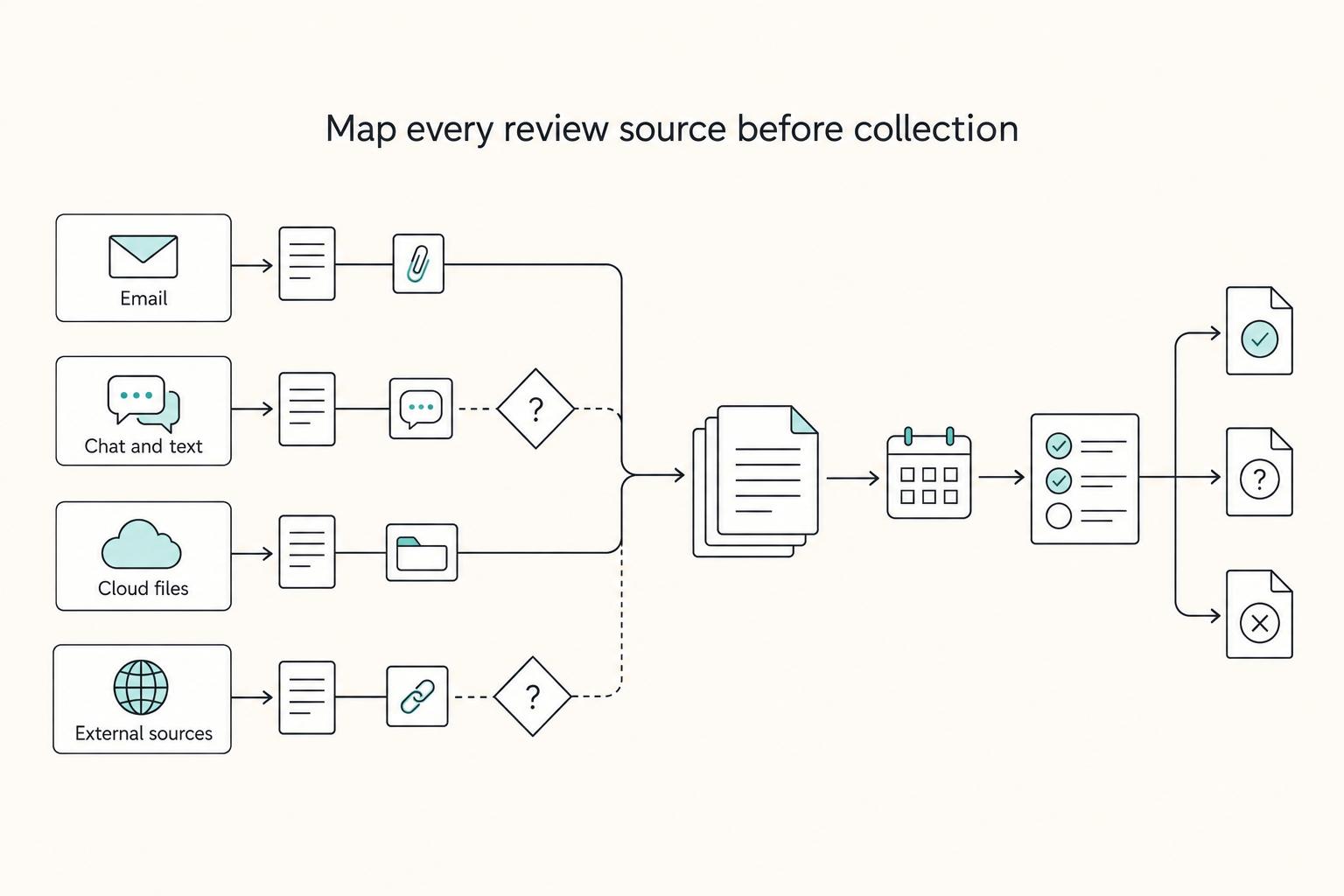
Before collecting anything, make a quick map of where relevant records could disappear if you wait. A simple table can name each source, likely record holders, and whether it is likely ESI for e-discovery.
| Source system or record type | Typical records | Likely record holders | Likely ESI | Freeze now |
|---|---|---|---|---|
| Threads, attachments, calendar items | You, assistants, account leads | Yes | Suspend deletion for relevant mailboxes and preserve in usable formats | |
| Chat and text | Slack/Teams channels, SMS, DMs | You, project leads, key contacts | Yes | Suspend timed auto-delete and identify dispute-related channels |
| Cloud and local files | Proposals, SOWs, drafts, deliverables, version history | You, collaborators, contractors | Yes | Preserve relevant folders and document who controls access |
| External sources under your control | Contractor or cloud-provider data | You, contractors, providers | Often | Include these sources in preservation review based on possession, custody, and control |
Also map by control, not just location. If data sits with a contractor or cloud provider but is still within your possession, custody, and control, include it in preservation review.
Verify the settings that can erase data#
Before you start narrowing, check the settings most likely to erase relevant material:
| Setting | What to confirm |
|---|---|
| Auto-delete | Email, chat, and mobile message expiration settings are suspended |
| Retention/destruction policies | Routine purge steps for relevant datasets are paused |
| Format preservation | Keep ESI in usable formats where available so metadata is not stripped by conversion |
Narrow later, with recorded reasons#
Once the freeze step is done, narrow in a documented sequence: limit to the matter, tighten the date window, then remove uninvolved people only when the facts support it. If a source is still uncertain, keep it preserved until that uncertainty is resolved.
Document each narrowing decision so you can explain not only what you preserved, but why that scope was reasonable at the time.
First 24 hours after issuing a hold#
In the first 24 hours, the job is straightforward: preserve defensibly. Send the legal hold notice as soon as litigation is reasonably anticipated, pause routine deletion or destruction, and keep a clear record of what you did.
Send the notice, then stop data loss paths#
Send the notice without delay. It should clearly instruct recipients not to delete relevant ESI or discard relevant paper records.
Right after sending, suspend routine retention or destruction steps that could remove relevant material. Confirm each pause took effect and document it.
Track acknowledgments so the hold is actually implemented#
If your process uses acknowledgments, treat them as an implementation control, not paperwork. Ask recipients to confirm receipt and understanding, and follow up on gaps.
This matters because a hold depends on the people who control records across the organization, not just the person who sends the notice. Keep follow-up notes in the same log so the process remains auditable.
Keep a simple evidence register#
One practical way to track preservation is a lightweight register for both ESI and physical evidence.
| Item | What to record |
|---|---|
| System or evidence name | The source you are preserving |
| Owner or holder | Who has possession, custody, or control |
| Preservation method | How preservation was applied |
| Status | Preserved, pending verification, or access issue |
A register only works if the status is real. Mark items unverified until preservation is confirmed.
Record assumptions and unknowns while they are fresh#
Write down what you know, what you do not know yet, and why you acted when you did. Include open points such as scope boundaries and uncertainty about who may hold relevant records.
That record is what makes the process defensible later: prompt action, preserved evidence, and a clear decision history that can stand up to scrutiny and help reduce sanctions risk.
Drafting a legal hold notice people actually follow#
A good notice is direct and usable. It should tell people what must be preserved, what must stop, and where to send questions.
The notice is a written directive to custodians to preserve potentially relevant documents and ESI when litigation is reasonably anticipated. "Litigation Hold Letter" and "Litigation Hold Notice" are often used interchangeably, so clarity matters more than the label.
Put the scope where people can act on it#
Start with a short matter summary, then give one clear preservation command. For example: preserve potentially relevant documents and electronically stored information, and do not delete, destroy, or make them unavailable.
Define scope in practical terms for the matter so recipients can apply it to the records and systems they control. A clear contact point for scope questions can help people avoid guessing.
Translate preservation into plain prohibitions#
State the non-negotiables in plain language:
- Do not delete relevant documents or ESI.
- Do not destroy relevant records.
- Do not make relevant information unavailable.
- When litigation is reasonably anticipated, suspend routine document retention or destruction steps that would remove relevant material.
Track acknowledgment and keep the record#
Consider requesting acknowledgment confirming receipt and understanding of the preservation obligation, and track follow-up where needed. Keep the notice version, recipients, send time, acknowledgments, and reminder history together.
That internal record can help if preservation is later challenged. Failure to preserve has been treated as gross negligence, and courts can impose severe sanctions, including monetary fines and default judgment. If you need to communicate externally, keep the message narrow and factual, and route wording through counsel when involved.
Mistakes that create sanctions risk#
Sanctions risk usually comes from execution failure, not wording failure. The usual problem is that a trigger existed, but prompt and effective preservation steps did not follow.
Delay after a clear trigger#
In the case summary referenced here, the core failure was not putting a litigation hold in place to stop deletion of potentially relevant emails after notice had arrived. That kind of delay can be treated as spoliation, not as an innocent process mistake.
The practical rule is simple: once a trigger arrives, pause obvious deletion paths first, then refine scope. In this example, EEOC notices arrived on May 4, 2012, several weeks before scheduled deletion, but the automated deletion process was not suspended.
Auto-deletion can outrun your hold#
If your systems keep deleting data, the hold is not working. In the case summary, former-employee emails were slated for deletion within 24 hours of a termination notice and, without a hold, were automatically deleted after thirty (30) days.
Use a concrete checkpoint:
- Identify each deletion or overwrite rule that could affect relevant ESI.
- Confirm the owner of that system paused the rule.
- Record when it was paused and by whom.
Scope and proof are what make a hold defensible#
The sanctions example here centers on email, but the lesson is broader: preserve potentially relevant information first, then narrow with written reasoning. If your scope choices are later challenged, your records should show what you preserved, what you excluded, and why.
Keep a lightweight implementation record:
- Hold notice version and send time
- In-scope people and systems
- Systems checked for deletion or overwrite behavior
- Preservation actions taken, with owner and timestamp
- Notes on disputed or excluded sources
The case-summary consequences were concrete: a $25,000 fine against the party, a $10,000 fine on counsel, plus costs and attorney fees tied to spoliation. There was also added recovery expense, such as backup-tape email retrieval and extra IT deposition work.
Cross-border rules and how to stay defensible#
In cross-border matters, the contract can help you plan the hold process, but it does not by itself settle data-transfer or privacy limits. Start with the Governing Law, Jurisdiction, and Dispute Resolution clauses, then map where the relevant data and people are located.
Those clauses can help you anticipate whether a dispute may move through court, mediation, or arbitration. But cross-border discovery is not uniform, and many jurisdictions do not permit U.S.-style pretrial discovery in the same manner. Local privacy laws and blocking statutes may still limit review, transfer, or production even when the contract points to a different forum.
When venue and data location conflict#
If forum and data location conflict, preserve first and narrow with local counsel. Issue the hold notice, adjust retention settings to suspend routine deletion, and document the conflict before making cross-border transfer decisions.
Keep a one-page location map:
- each in-scope data source and its country location
- system owner and affected custodians
- whether personal data is likely involved
- whether retention settings were changed, when, and by whom
If EU personal data may be involved, flag GDPR Articles 5 and 6 for counsel review before export or broad collection. Preserve in place while that review happens.
What you need local counsel to confirm#
Be explicit about what remains unknown in that jurisdiction. Ask local counsel whether data-protection or blocking rules restrict review, transfer, or production. Ask whether the dispute-resolution clause affects preservation steps, and how far you can narrow by person, date, or source without increasing spoliation risk.
| Issue | What to ask local counsel |
|---|---|
| Data-protection or blocking rules | Whether they restrict review, transfer, or production |
| Dispute-resolution clause | Whether it affects preservation steps |
| Narrowing by person | How far you can narrow without increasing spoliation risk |
| Narrowing by date | How far you can narrow without increasing spoliation risk |
| Narrowing by source | How far you can narrow without increasing spoliation risk |
Treat hold execution as ongoing, not a one-time step. A single hold notice may be insufficient on its own, so maintain follow-up, acknowledgment tracking, and written notes on counsel guidance while preservation duties continue.
Related: Canada's Digital Nomad Stream: How to Live and Work in Canada.
Contract clauses that reduce legal hold chaos#
The most useful contract clauses are the ones that make forum terms consistent and record control clear before a dispute starts.
Start with Dispute Resolution, Governing Law, and Jurisdiction. If those clauses point in different directions, early procedural confusion follows. The cited decision Yegre EB Ltd. v. Seguin, 2024 BCCA 365 is described as clarifying forum-selection interpretation and enforcement in commercial contracts, with broad drafting implications for jurisdictional provisions, including cross-border contexts. The practical takeaway is to make sure your forum-related clauses fit together cleanly before you sign.
Next, reduce contract-management gaps that create document chaos. Manual, dispersed follow-up is a known failure pattern, and weak record control raises the chance of missed deadlines, lost documents, and compliance trouble. Keep a single, findable contract record and verify that obligations are tracked against quality, quantity, and timing commitments.
Where money clauses fit#
Keep Limitation of Liability and Indemnification drafting decisions separate from record-control workflow decisions. Keep record-control operations explicit elsewhere in the agreement and in practice. Spell out who controls repositories and who confirms handoff steps when access or ownership changes.
Mini contract checklist#
| Verify before signing | What to check | Why it matters in a dispute |
|---|---|---|
| Forum consistency | Do Dispute Resolution, Governing Law, and Jurisdiction align? | Reduces early procedural confusion |
| Contract record control | Can you quickly locate the signed contract and amendments in one place? | Reduces confusion over which terms control |
| Repository ownership | Is each key data source tied to a named owner or contact? | Helps keep follow-up from becoming dispersed |
| Access-change handoff | Are access and record handoff steps documented when ownership changes? | Reduces information gaps during transitions |
| Performance evidence | Are delivery and changes documented against quality, quantity, and timing commitments? | Produces usable records if facts are contested |
If you make only one improvement, align forum-related clauses and lock down record ownership and handoff checkpoints before the dispute arrives.
Related reading: How to Conduct Legal Research for Your Freelance Business.
Before a dispute starts, lock scope, deliverables, and dispute terms in writing with this freelance contract generator.
Releasing a hold and closing the file#
A universal rule for exactly when a litigation hold should be released is not established. Preservation duties can begin before filing, are judged by reasonableness under the circumstances, and scope can vary by jurisdiction, so release should be a legal decision made with counsel.
| Close-out step | What to record or check |
|---|---|
| Written release | Consider sending a written release to the people in scope |
| Matter details | Document the matter, release date, approver, and whether ordinary retention or deletion rules are resuming under your policy |
| Repositories still preserved | Call out any repositories that remain preserved for other matters so the release is not read as a blanket reset |
| Distribution reconciliation | Reconcile the release list against your original hold distribution and acknowledgment tracker |
| Notice and settings | Record when notice was sent, where it was stored, and whether paused deletion settings were restored or intentionally left suspended |
| Final defensibility file | Keep the timeline, hold and release notices, acknowledgments, scope decisions, and preservation actions |
Use those close-out steps as an internal control, not a universal legal rule.
Before you archive, consider keeping a final defensibility file with the timeline, hold and release notices, acknowledgments, scope decisions, and preservation actions. If a later e-discovery dispute asks why records were preserved, narrowed, or released, this can help show your process was deliberate.
Do not close a hold with only informal messages like "we're done here." Courts can issue serious preservation sanctions, including adverse jury instructions and monetary sanctions. One cited case gives the example of $212,320.
Conclusion#
A defensible legal hold is simple: recognize the trigger early, preserve the right information, and document what you did.
When litigation, a regulatory inquiry, or an investigation is pending or anticipated, move into preservation mode right away. Send a clear hold notice, identify the custodians in scope, and give explicit do and do-not instructions. Preserve both ESI and physical records in scope, and take reasonable steps to prevent deletion, alteration, or loss.
Keep a small defensibility file so you can show your process under pressure:
- Trigger date and matter summary
- In-scope custodians
- Systems and records in scope
- Hold notice and distribution record
- Preservation actions taken and when
One checkpoint matters more than most: can you show that no relevant data was deleted after the triggering event? Delayed trigger recognition is a common failure mode, and it creates avoidable preservation risk.
Also, do not treat the notice as the finish line. Follow up with custodians, verify that preservation is happening, and keep your log current. When preservation is no longer required, issue a formal release and record when normal retention resumes.
Your advantage is disciplined execution. If you trigger early, preserve relevant records, track preservation steps, and document each decision, your process is more likely to hold up in e-discovery.
If you want payment and payout operations with clearer audit trails when preservation questions come up, see Gruv for freelancers here.
Frequently Asked Questions
What is a legal hold in plain English for a freelancer or consultant?
A legal hold is a formal instruction to preserve records that could matter in a legal dispute or investigation. It is about preserving potentially relevant evidence. For a solo or small service business, that usually means preserving relevant emails, chats, files, invoices, notes, and any physical items tied to the matter.
Is a legal hold required only after a lawsuit is filed?
No. The duty to preserve can begin when litigation is reasonably anticipated, not only after a case is filed. If a real dispute is taking shape, start preserving first and then refine scope with counsel.
Does a demand letter automatically trigger the duty to preserve?
Not automatically in every jurisdiction or scenario. But demand letters and cease-and-desist notices are common trigger events for hold action. The practical move is to treat them as a prompt to begin preservation while you confirm scope with counsel.
What records count as ESI and what counts as physical evidence?
ESI, or Electronically Stored Information, includes potentially relevant emails, chats, documents, and other digital assets. Physical evidence covers non-digital records or tangible items relevant to the dispute. Preserve both when they are potentially relevant.
Who should receive a legal hold notice in a small business?
Send the notice to the people who control records in scope. In a small business, that can include you and anyone else holding relevant email, chat, files, backups, or paper records. Require acknowledgment, then use reminders or escalation if someone does not respond.
What can happen if I ignore or delay a legal hold?
The main risk is court penalties or sanctions if your preservation process is not defensible. Risk increases when evidence is destroyed, altered, or lost through intentional or negligent spoliation. When preservation is required for relevant ESI, that duty overrides normal destruction-oriented records policies.
When should I involve local counsel because jurisdiction rules are unclear?
Involve local counsel early when jurisdiction or forum rules are unclear, especially in cross-border matters. Escalate if the trigger is uncertain or if scope decisions could vary under local rules. The safer move is to preserve first, document what you did, and narrow with counsel afterward.
Try a related tool
Researched and edited by the Gruv editorial team. Gruv builds cross-border billing, payouts, and finance-operations software for global businesses.
Sources
Includes 1 external source outside the trusted-domain allowlist.
- id.uscourts.gov/Content_Fetcher/index.cfml/ESI_Background_an...trusted
- judicature.duke.edu/articles/cross-border-discovery-at-a-crossroadstrusted
- ned.uscourts.gov/internetDocs/cle/2010-07/LitigationHoldTopTe...trusted
- sosmt.gov/wp-content/uploads/attachments/C%20-%20Legal...trusted
- supremecourt.ohio.gov/docs/LegalResources/Rules/civil/CivilProcedu...trusted
- cloudficient.com/blog/what-is-a-legal-hold-best-practices-for...external
Educational content only. Not legal, tax, or financial advice.
Related Posts

Germany Freelance Visa Application Path for Freiberufler and Gewerbe
Choose your track before you collect documents. That first decision determines what your file needs to prove and which label should appear everywhere: `Freiberufler` for liberal-profession services, or `Selbständiger/Gewerbetreibender` for business and trade activity.
Canada Digital Nomad Visa Planning for Visitor Status and Work Permits
The phrase `canada digital nomad visa` is useful for search, but misleading if you treat it like a legal category. It is shorthand for existing Canadian status options, mainly visitor status and work permit rules, not a standalone visa stream with its own fixed process. That difference is not just technical. It changes how you should plan the trip, describe your purpose at entry, and organize your records before you leave.
E-Discovery for Small Businesses Under Real-World Pressure
You do not need to treat e-discovery as a crisis. If you run a solo practice or a very small team, the job is operational: know where business data lives, preserve potentially relevant material when a dispute appears, and deliver it in a usable format.