
Quick Answer
Start with the treaty sequence: habitual abode is where you customarily live when earlier tests do not settle dual residence. It is judged by the pattern of your stays, not by the highest day count alone. Use records that show one ordinary base over time, such as travel and entry/exit history, housing continuity, and recurring local administration. If those signals remain split between two countries, the analysis can move to nationality and then competent-authority procedures; U.S. filers taking a treaty position may also need Form 8833.
What is a 'Habitual Abode' and Why is it Your Most Critical Compliance Risk?#
A habitual abode is where you live regularly, normally, or customarily when a treaty is used to resolve dual residence. The risk is practical: if your facts do not clearly point to one country, the tie-breaker can remain inconclusive and move to later tests.
Where it sits in the tie-breaker sequence#
In many treaties, tie-breaker tests are applied in sequence, and you stop once one test gives a clear answer. A common order is permanent home, centre of vital interests, habitual abode, nationality, and then competent-authority agreement if the tests still do not resolve residence.
| Order | Test | Role |
|---|---|---|
| 1 | Permanent home | A common first test |
| 2 | Centre of vital interests | Comes after permanent home in a common order |
| 3 | Habitual abode | Matters when earlier tests do not clearly favor one state |
| 4 | Nationality | Comes after habitual abode in a common order |
| 5 | Competent-authority agreement | Used if the tests still do not resolve residence |
That means habitual abode is usually not the first question. It matters most when earlier tests do not settle the result, such as when home availability or personal and economic relations do not clearly favor one state.
Do not assume every treaty uses identical wording or the same full sequence. Check the exact text of the relevant DTA before you rely on any framework.
Why day counts are not enough#
Day totals matter, but they do not decide the issue on their own. HMRC guidance describes habitual abode through the frequency, duration, and regularity of stays as part of your settled routine.
So two people with similar day counts can still look very different under treaty analysis. The practical question is where your presence looks ordinary and repeatable across the year, not simply where the highest raw total appears.
A useful self-audit is to review your travel and stay records and ask where your pattern keeps returning as normal life. That is not standalone treaty language, but it is often how frequency and regularity show up in practice.
Permanent home and habitual abode are not the same thing#
Permanent home is about availability of accommodation, while habitual abode is about your actual lived pattern.
| Concept | What is being tested | Core question | Typical evidence |
|---|---|---|---|
| Permanent home | Availability of accommodation | Is accommodation continuously available for your personal use? | Lease or occupancy rights, ownership records, ongoing access to a dwelling |
| Centre of vital interests | Closer personal and economic relations | Where are your personal and economic relations closer? | Family, business and financial ties, contracts, social connections |
| Habitual abode | Pattern of ordinary presence | Where do you live regularly, normally, or customarily? | Travel history, entry/exit records, recurring stays, accommodation timeline |
If you document only housing access, you may support permanent home while still leaving your lived pattern unclear. If your case may reach habitual abode, keep records that show repeated routine presence, not just property access.
Quick self check#
If several points below are true, treat your position as potentially ambiguous and work through the next sections carefully:
- You have accommodation continuously available in more than one country.
- Your personal and economic ties point in different directions.
- Your stays are close between two countries or fragmented across many trips.
- Your records do not show a clear, repeatable pattern of ordinary presence.
- You have not checked the exact DTA wording for your country pair.
For more on that test, see What is a 'Permanent Home' in the Context of a Tax Treaty?.
The Strategic Declaration: How to Proactively Define Your Abode#
If you want a treaty residence position to hold up, state it clearly early and make sure your behavior matches it. A short memo helps only if your housing, movement, and economic life are moving in the same direction.
Treat this as part of the tie-breaker sequence, not a shortcut around it. Tie-breaker tests apply only after dual residence exists under domestic law. They are used in order, and they stop once one test is conclusive. Draft your memo with the exact treaty text in front of you.
Write a memo you can actually operate from#
A statement of intent is not a treaty criterion by itself. Its value is operational. It helps keep your later decisions consistent, so use this fill-in structure:
| Memo part | What to state |
|---|---|
| Chosen base | Expected primary country of residence and start date |
| Why this country | Regular living pattern and main personal and economic ties are centered there |
| Temporary travel rule | Travel to other country or countries is temporary, with recurring return to the chosen country |
| Expected alignment | Housing, spending, registrations, contracts, and ordinary presence should increasingly align with the chosen country |
- Chosen base: I expect my primary country of residence to be your chosen country from the start date.
- Why this country: My regular living pattern and my main personal and economic ties are centered there.
- Temporary travel rule: Travel to [other country/countries] is temporary for [work/family/projects], with recurring return to [chosen country].
- Expected alignment: Housing, spending, registrations, contracts, and ordinary presence should increasingly align with [chosen country].
Then test the memo against your actual records, including your calendar, travel pattern, housing use, and banking activity. If the records do not match the memo, either update the memo or change the behavior. Do not keep both stories alive.
Audit centre of vital interests before new commitments#
Before you make new commitments, check whether your centre of vital interests is actually moving. If your case reaches this stage, authorities will look broadly at personal and economic relations. No single lease, account, or membership settles the issue by itself.
| Tie type | Supports one-country narrative | Conflict pattern to flag |
|---|---|---|
| Personal ties | Family life, social routines, and day-to-day personal admin cluster in one country | Personal life is centered in one country while economic life is centered in another |
| Economic ties | Main income flows, recurring bills, contracts, and business admin run through one country | Revenue, contracts, and administration remain materially split |
| Living pattern (habitual abode lens) | Frequency, duration, and regularity of stays show one settled routine | Similar regularity across both countries, or no clear routine |
| Housing availability | One country is your clear lived base | Accommodation remains continuously available in both countries |
If ties stay split, do not assume the answer is obvious. The analysis can move further down the sequence, including habitual abode, then nationality, and potentially competent-authority resolution if the case is still unresolved.
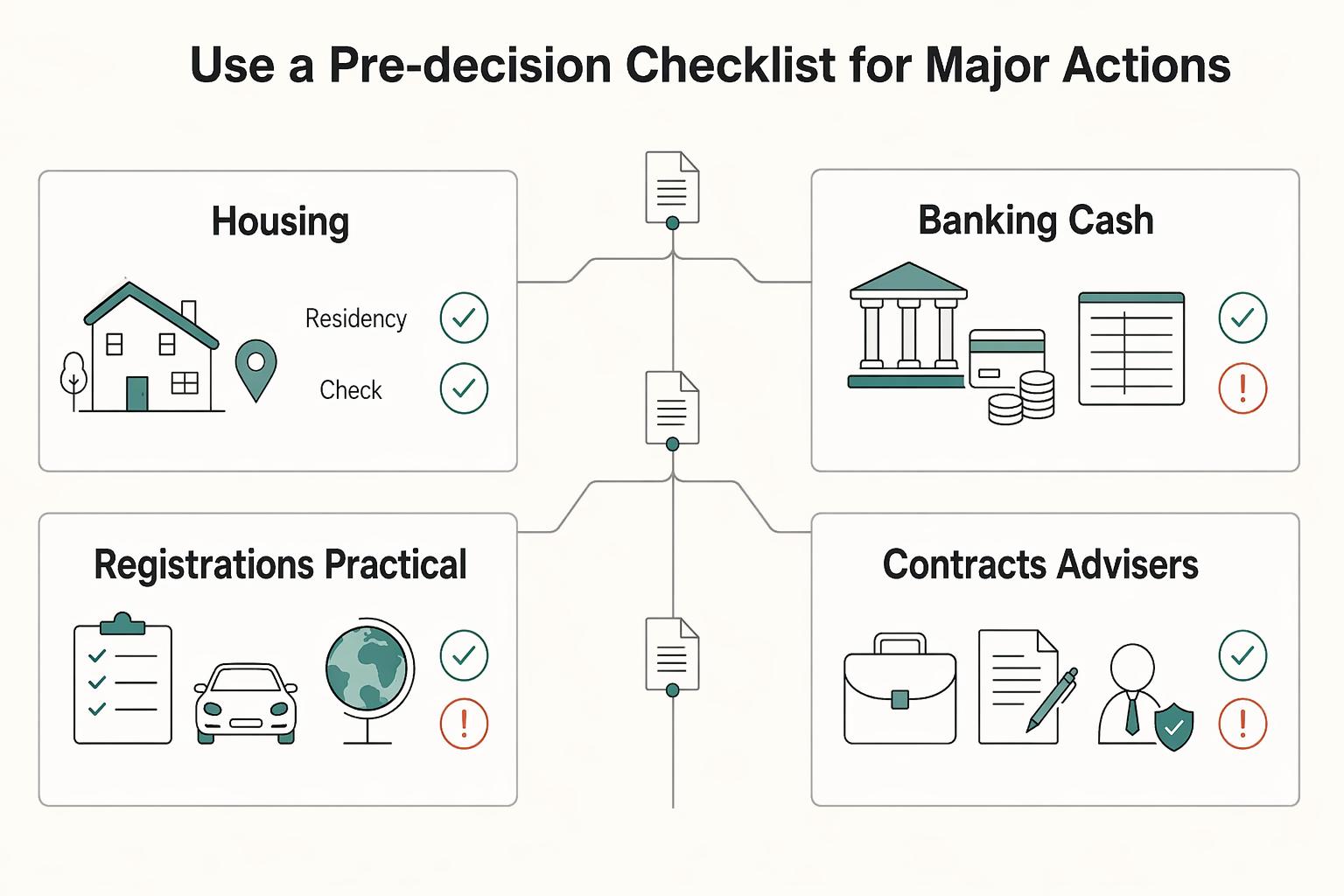
Use a pre-decision checklist for major actions#
Major actions can either strengthen one ordinary base or create a competing narrative. Use that as your filter before you sign, register, move money, or take on a new commitment.
| Action area | Supports if | Weakens if |
|---|---|---|
| Housing | It reinforces one clear lived base | You maintain both homes with similar regularity |
| Banking and cash flow | Income, bills, and daily spending shift to one country | Activity remains centered elsewhere |
| Registrations and practical admin | Core registrations and routine admin align to one country | Primary admin remains split |
| Contracts and advisers | New contracts and business support are anchored in one country | Key commitments keep pointing to the other |
If this checklist still shows material split ties, pause and get cross-border tax advice before locking in more commitments. If you are a U.S. dual-resident taxpayer taking a treaty position, Form 8833 disclosure can be required, and unresolved cases can proceed through competent-authority channels.
Building Your Compliance Dossier: The Three Tiers of Evidence#
Once you have a position, build the file that supports it. When habitual abode matters, what counts is a consistent record of one settled routine over time, not a pile of disconnected documents.
Use your exact treaty text as the frame for what you collect. Treaties do not all use the same tests in the same order.
Tier 1 core proof of settled life#
Start with records that place you, by name, at one lived address over a continuous period in one jurisdiction. Your core file can include housing and formal status records for the claim period. That can include residence certificates and permits where relevant.
Document quality is the main control here. Prioritize records with your name, the matching address, the correct jurisdiction, and dates that connect into one timeline. Mixed jurisdictions or date gaps weaken the file instead of strengthening it.
Tier 1 should answer the first reviewer question: do you have a real, functioning base in one country, rather than accommodation that exists only on paper?
Tier 2 integration signals that support the story#
After the base is clear, add integration records that are hard to fake and easy to verify over time. Focus on recurring, third-party records showing that your social and domestic life actually operates in the same country as the Tier 1 base.
Be selective. Repeated-use, externally verifiable records are stronger than one-time signups or isolated lifestyle artifacts. Keep weaker items only if they reinforce an already consistent core file.
Tier 2 should answer the next question: does your day-to-day life genuinely align with your claimed country, or is the story still split?
Tier 3 corroboration over time#
The last layer is what turns a file into a real defense. You need to show routine, not snapshots.
Maintain a live travel record across the full period, including entry and exit dates and how those stays form a regular routine. Reconcile it against your calendar and transaction or accommodation history. This matters because formal claim workflows can require time-series day calculations for covered years. Your strongest Tier 3 file is internally consistent across sources and shows a stable pattern of presence.
If you are a U.S. dual-resident taxpayer taking a treaty position, Form 8833 requires a factual summary and amount information tied to the claimed benefit. Missing a required disclosure can trigger a $1,000 penalty ($10,000 for a C corporation).
| Evidence tier | Reviewer question | Typical weakness | How to close the gap |
|---|---|---|---|
| Tier 1 | Where is your settled base? | Mixed addresses, date gaps, non-matching jurisdiction | Build one continuous named-party address timeline in one jurisdiction |
| Tier 2 | Are your personal ties actually centered there? | One-off or weakly verifiable lifestyle records | Prefer recurring, third-party records that show sustained integration |
| Tier 3 | Does your movement pattern support your claim? | Snapshot evidence, weak day tracking, no regular pattern across stays | Keep a continuous travel log and reconcile it to independent records |
Before you treat the dossier as filing-ready, confirm these points:
- One continuous address timeline with no unexplained overlaps
- Administrative activity and other recurring records centered in the same country as your claimed base
- Integration records that show repeated, verifiable use
- Travel history that shows a regular pattern consistent with that base
- No contradictions across your memo, filings, and supporting records
If evidence remains split across jurisdictions or internally inconsistent, pause and get professional review before filing, especially if the case may need competent-authority resolution.
For a step-by-step walkthrough, see What is the 'Center of Vital Interests' in a Tax Treaty?.
Keep your travel timeline and supporting records in one place with the Tax Residency Tracker so your habitual-abode position stays consistent.
From Documents to Defense: Weaving Your Evidence into a Coherent Narrative#
Even a good dossier can fail if it reads like a document dump. You need one coherent pattern of life that holds together across the treaty tests. In habitual abode analysis, reviewers look at the frequency, duration, and regularity of your stays as part of a settled routine. Your job is to organize the records into that story.
Build the narrative in treaty order. Once one test is conclusive, later tests are not used. Use your actual treaty text as the frame.
Turn the tiers into one dated story#
Create one timeline for the full claim period, then build the story on that backbone.
Use Tier 1, Tier 2, and Tier 3 as working labels for organizing evidence, not as treaty-defined legal categories. Start with Tier 1 records to show where your lived base existed, and when. Then layer in Tier 2 records to show that day-to-day personal and economic life operated in that same country. Finally, add Tier 3 travel records to show trips as temporary departures from that base, with regular return.
For each trip, record three points: where you left from, where you returned to, and why you traveled. Diaries, timesheets, calendars, and travel confirmations can help show whether a stay was purpose-specific, such as work delivery or a family visit. They can also show whether it looked more like a real shift in where life was being lived.
Before you file, do a basic sanity check. Major movements should reconcile across independent records. Date gaps, overlapping address periods, or activity centered in a different country are common failure points.
What the reviewer is actually testing#
| Evidence category | Reviewer question | Likely objection | Records that resolve it |
|---|---|---|---|
| Tier 1 base records | Did you have a real lived base in one country? | "This is just accommodation on paper." | Lease or housing records, utilities, permits or registrations, residence certificate where relevant |
| Tier 2 integration records | Was your personal and economic life actually centered there? | "These are one-off signups." | Recurring local banking activity, repeated service use, ordinary admin records, ongoing local transactions |
| Tier 3 movement records | Did your travel pattern support one customary home? | "You were living in both places." | Travel log, calendar, entry/exit history, accommodation trail, return-to-base pattern |
| Filing narrative | Does your written position match your evidence? | "Your filing says one thing, records show another." | Treaty memo, return disclosures, and for U.S. filers, Form 8833 factual summary |
If you are taking a U.S. treaty position, draft this chronology before return preparation. Form 8833 asks for a brief factual summary, so narrative consistency is part of the filing work, not something you try to fix after an audit starts.
Same facts, weak vs strong framing#
- Weak: "I traveled a lot but had an apartment in Country A."
Stronger: "Trips were purpose-specific and repeatedly returned to Country A, where address, utility, and banking records run continuously through the period."
- Weak: "I split time between two places and both mattered."
Stronger: "Country B stays were limited and purpose-driven. Country A remained the place I customarily returned to, with continuous day-to-day records."
Contradiction-management checklist before filing#
The key discipline here is to treat contradictions as the real problem, not missing paperwork. HMRC explicitly notes treaty-resident claims should not be accepted uncritically. Use that as your pre-filing standard.
- List every conflicting signal, including address use, work presence, local financial activity, and family-location indicators.
- Add a short context note for each conflict and attach supporting records.
- Reconcile dates and facts across your timeline, treaty memo, and return disclosures.
- If habitual abode appears in both states or neither, move to the next treaty test, often nationality, depending on treaty text.
- If the case still does not resolve cleanly, get professional review before filing and assess whether competent-authority relief may be needed, since delays can reduce effective relief options.
If your facts remain genuinely split after this pass, treat it as a technical dual-residency case, not a filing-assembly issue. Review next-step tie-breaker strategy in Using DTA Tie-Breaker Clauses to Resolve Dual Tax Residency.
Declare, Document, and Defend Your Treaty Residency Position#
A habitual abode treaty case is won or lost on process. You need a supportable treaty residency position, evidence that matches your physical presence pattern, and a clear explanation that holds together under review.
Declare#
Write one position statement that names both countries, the treaty article you are relying on, where the tie-breaker sequence stops, and why. Tie-breaker rules run as a series of tests in order, so if an earlier test such as permanent home resolves your case, you do not continue to habitual abode.
The checkpoint is simple: does your filing position match your real pattern of presence, including the frequency, duration, and regularity of your stays?
Document#
Build your compliance dossier to support the position you declared, not to invent a second story. Reconcile key dates across independent records, such as travel logs, border history, housing records, bank activity, calendars, and return travel.
If your records point in different directions, fix that before filing. If you are taking a U.S. dual-resident treaty position, check whether Form 8833 applies. Where required, include formal residence evidence from the other country's tax authority.
Defend#
Prepare a plain-English explanation now, before any authority asks for it. You should be able to explain why your treaty residency may differ from your domestic-law residency and why the specific treaty text supports your result. You should also be able to point to the document that supports each step. The OECD Model can help with interpretation, but your treaty text controls.
For your next review cycle, run this checklist:
- Refresh your position statement
- Update your dossier and reconcile dates
- Scan for contradictions between your statement and your records
- Escalate when treaty text, evidence alignment, or disclosure requirements are unclear
If both countries can credibly support regular living patterns, or your case may require formal disclosure or competent-authority negotiation, involve a cross-border tax advisor before filing.
If you want a deeper dive, read Digital Nomad Taxes in 2026 With a Defensible Filing Plan. Before your next filing cycle, you can organize your cross-border tax paperwork with the W-8 Form Generator.
Frequently Asked Questions
How do you prove your habitual abode?
Habitual abode is usually shown with records of where you customarily live as a settled routine, not just where accommodation is available. A practical way to build the file is with three tiers: Tier 1 for base records such as continuous housing or availability records, Tier 2 for routine records such as recurring banking, utilities, or similar administrative activity, and Tier 3 for movement records such as a dated travel log, entry and exit records, calendars or diaries, and return-to-base confirmations. For a UK HS302 claim, include documents relevant to your route, for example a residence certificate, and for the U.S. route a separate day-calculation sheet. Reconcile key dates across independent records.
What is the difference between permanent home and habitual abode?
Permanent home asks whether accommodation is continuously available to you during the year. Habitual abode asks where your regular living pattern actually occurs. You should test them separately, because satisfying one does not automatically satisfy the other. | Test | Legal function | What authorities examine | Common misreading | | --- | --- | --- | --- | | Permanent home | Whether a dwelling is continuously available for your personal use | Ongoing availability of accommodation, not ownership alone | "I own property there, so this is settled." | | Habitual abode | Where you customarily live | Frequency, duration, and regularity of stays within your settled routine | "A higher day total once decides it." |
Does day counting decide the issue?
No. Day counts are supporting evidence, not a standalone decision rule. The question is whether your recurring presence pattern, continuity of routine, and records across housing, spending, and return travel all point in the same direction. Keep one travel log that matches tickets, border history, calendars, and card activity so your timeline stays consistent.
Can you have a habitual abode in two countries, and what happens next?
Yes. If your life pattern is genuinely split, habitual abode may not resolve treaty residence. Tie-breaker tests run in sequence under your specific treaty text, and treaties do not all use the same tests or order. If habitual abode is in both countries or neither, nationality is often next, and unresolved cases can move to competent-authority mutual agreement.
When should you escalate to a cross-border tax advisor?
Escalate when your case is a technical tie-breaker issue, not just a paperwork gap. That usually means both countries can show continuous accommodation or regular living patterns, your filing position conflicts with your family, work, banking, or address facts, or the double-taxation risk suggests a MAP request may be needed.
Try a related tool
Researched and edited by the Gruv editorial team. Gruv builds cross-border billing, payouts, and finance-operations software for global businesses.
Sources
Includes 1 external source outside the trusted-domain allowlist.
- assets.publishing.service.gov.uk/media/65f01605ff117000116158f0/HS302-claim-f...trusted
- assets.publishing.service.gov.uk/media/67dc422ecb8c6838d74b5003/HS302-claim-f...trusted
- ato.gov.au/law/view/view.htmtrusted
- irs.gov/individuals/international-taxpayers/tax-trea...trusted
- irs.gov/businesses/international-businesses/united-s...trusted
- oecd.org/en/publications/the-2025-update-to-the-oecd-...trusted
- oecd.org/en/publications/model-tax-convention-on-inco...trusted
- gov.uk/government/publications/dual-residents-hs302...external
Educational content only. Not legal, tax, or financial advice.
Related Posts

Digital Nomad Taxes in 2026 With a Defensible Filing Plan
With digital nomad taxes, the first move is not optimization. It is figuring out where you may be taxable, where filings may be required, and what proof supports that position.

Tbilisi Digital Nomad Guide for 2026 Long Stays in Georgia
Start with sequence, not excitement. If your income depends on delivering work on schedule, secure your legal footing, assemble your documents, and keep month one reversible before you optimize comfort.

Using DTA Tie-Breaker Clauses to Resolve Dual Tax Residency
If two countries can both claim you as a tax resident, the safer move is a treaty position you can prove and keep consistent across filings, not a one-year optimization that may fall apart later. DTA tie-breaker rules help allocate treaty residence, but only after you confirm that dual-residency risk is real under domestic law on both sides.