
Quick Answer
Yes: a garden leave clause usually means you stay employed during notice, keep salary and contractual benefits, and can be directed not to work. Your first move is to get documented confirmation of the legal end date, reachability expectations, and any limits on outside work or client contact. UK guidance in the article supports that employment continues through this period, so treat early launch steps as restricted unless your contract clearly permits them.
What a garden leave clause is and what it changes#
A garden leave clause keeps you employed through notice, usually with pay and contractual benefits, while your employer can tell you not to work. If you are moving from employment into freelance or consulting work, first confirm what still applies, what is restricted, and when your employment legally ends.
In plain language, it means your employer tells you not to work during some or all of your notice period, but you are still employed. That makes it different from a clean break. Your employment status stays live even if your day-to-day work stops.
What changes for you right away#
The main risk at this stage is ambiguity. As soon as notice is given or accepted, get these points confirmed in writing:
| Item | What to confirm |
|---|---|
| Pay status | whether salary and contractual benefits continue through the notice period |
| Work status | whether you are barred from normal duties, systems access, or client-facing activity |
| Outside work risk | whether taking paid work before employment ends would breach contract terms |
| Availability | whether you must remain reachable for handover or employer requests |
| End date | the exact legal end of employment, not just your last active working day |
If you are planning a consulting launch, anchor your timeline to the legal end date of employment. Keep a document trail that includes the signed contract, your resignation, the employer response, and any HR status letter.
Why employers enforce it#
Employers often use garden leave to manage departure risk. In practice, they are usually trying to protect:
- Confidential information: limiting access to sensitive information near departure.
- Client relationships: reducing immediate client movement during transition.
- Workforce stability: supporting non-disclosure and anti-poaching controls after exit.
That risk map tells you where enforcement pressure is most likely to land. When disputes happen, friction often shows up around access, client contact, and team movement.
Compare the three common positions#
| Arrangement | Pay status | Work restrictions | Practical impact for your next move |
|---|---|---|---|
| Garden leave | Paid during notice while employment continues | You remain employed and can be directed not to work during some or all of notice | Income continuity is stronger, but launch timing can be constrained until employment ends |
| Non-compete (restrictive covenant) | Contract- and jurisdiction-dependent | Can restrict joining a competitor or starting a competing business after leaving | Post-employment market options may be limited for a period |
| Notice period only | Typically paid while you keep working | You usually continue normal work duties through notice | Cash flow continues, but transition prep is often tighter while you are still in role |
Validity depends on jurisdiction#
Do not assume enforceability is universal. Whether restrictions hold up depends on the contract terms and local law.
In the UK, non-competes remain largely common-law governed, with reform still in policy-development territory. In the U.S., the FTC federal noncompete rule is not in effect or enforceable, and litigation has shaped that status. If you need a hard legal cutoff for duration, geography, compensation, or scope, verify it under the governing law before you rely on it.
The next sections follow the sequence that matters in practice. First, what to negotiate before signing. Then, how to manage the exit cleanly. Finally, how to prepare your next move without avoidable breach risk.
You might also find this useful: What Is an 'Evergreen' Clause in a Retainer Agreement?.
Phase 1: The Pre-Emptive Strike - Negotiating Before You Sign#
If you can negotiate before signing, use that window to request clearer wording. After signing, the text may be harder to change.
One caution: the grounding material available for this section is not garden-leave law; it is Massachusetts economic-development legislation. It does not provide garden-leave-specific definitions, duration limits, or enforceability thresholds, so treat the points below as negotiation prompts to verify under your governing law.
The goal is not to win every point. It is to reduce ambiguity so you can predict what happens if you leave.
Four terms worth redlining now#
The most useful edits here narrow open-ended language and create a clearer release process.
- Duration
Ask for: a fixed period with clear start and end triggers, not open-ended language. Why it protects you: clearer timing for your next move. Risk reduced: a longer restricted period than you expected.
- Competitor definition
Ask for: a narrower definition tied to specific services, markets, client segments, or named competitors, where possible. Why it protects you: reduces ambiguity when future work only partly overlaps. Risk reduced: broad interpretation that treats most future work as competitive.
- Early-release mechanics
Ask for: a written release process, for example a mutual written waiver or a defined notice-based request process, if the employer agrees. Why it protects you: it gives you a documented route to certainty if plans change. Risk reduced: uncertainty about whether release is available.
- Preparatory-activity clarification
Ask for: written clarification on whether preparatory activity is allowed, and under what limits. Why it protects you: it sets expectations before a dispute. Risk reduced: later disagreement over what preparation is prohibited.
| Issue | Broad wording red flag | Narrower wording to ask for |
|---|---|---|
| Duration | Open-ended or maximum-only restriction | Fixed period with clear start and end trigger |
| Competitor scope | "Any competing business" | Specific services, markets, client segments, or named competitors |
| Release options | No release language or informal discretion only | Written release mechanism with a defined process |
| Preparation activity | Silence or blanket outside-activity ban | Written clarification on whether preparatory activity is allowed, and under what limits |
Before you sign, do one final document check. Make sure each negotiated point appears in the signed contract text, not just in email or call notes. If defined terms like "Competitor," "Notice," or "Release" appear in multiple documents, make sure they match. Use this pre-sign script or checklist:
- "Please narrow the competitor definition to the services and markets you actually need to protect."
- "Please set a fixed duration with clear start and end triggers."
- "Please add a written release-request mechanism so both sides know the process."
- "Please clarify in writing whether preparatory activity is allowed, and under what limits."
- Verify every agreed edit is in the final signed contract, not only in side emails.
- Verify governing law and dispute clauses with local counsel before relying on any interpretation.
For a step-by-step walkthrough, see A Deep Dive into the 'Assignment' Clause in a Freelance Contract.
Phase 2: The Professional Exit - A Tactical Checklist for Managing Your Transition#
Once notice is in, your priority is to reduce ambiguity and build a defensible record. If you are placed on garden leave, treat it as controlled offboarding. UK guidance says you remain employed during notice and should receive normal pay and contractual benefits, but your contract wording and governing law control your actual availability and restrictions.
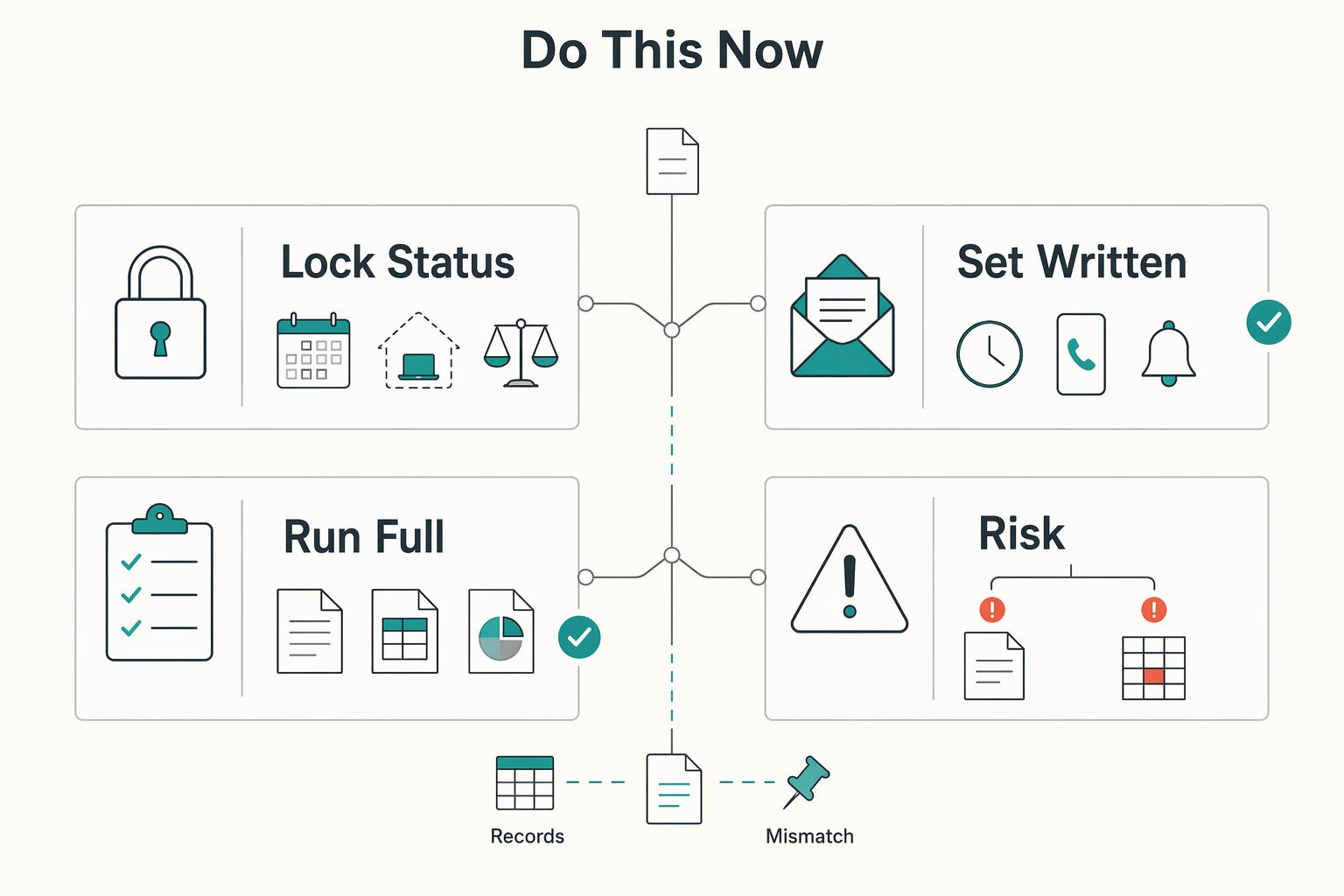
Do this now#
| Step | What to do |
|---|---|
| Lock status and process in one email | Confirm notice start and end dates, whether you are not required to attend work or are expected to work from home or another location, whether your exit is garden leave during notice or PILON, and ask for one named transition contact |
| Set written availability boundaries | Send a written proposal tied to your contract review, such as primary channel = email, response window = agreed in writing, and call notice = agreed minimum notice |
| Run a full handover and access audit | Record every company asset, repository, account, and live matter you handle; note what you handed over, to whom, and on what date; request written receipt for physical items and written confirmation that credentials, authenticators, VPN, email, CRM, and cloud access were revoked or disabled |
| Keep network behavior low risk | Before public profile updates, confirm your effective employment end date and any notice-period restrictions in writing; keep public updates neutral and forward-looking; avoid outreach to clients about future work during this phase if your notice terms or restrictive covenants could cover that contact |
- Lock status and process in one email.
Ask HR or your manager to confirm your notice start and end dates, whether you are not required to attend work or are expected to work from home or another location, and whether your exit is garden leave during notice or PILON. Ask for one named transition contact. This gives you one reference point if expectations shift.
- Set written availability boundaries.
Do not rely on vague "stay available" language. Send a written proposal tied to your contract review, such as: primary channel = email, response window = agreed in writing, call notice = agreed minimum notice. If your contract or local rules say otherwise, those control.
- Run a full handover and access audit.
List every company asset, repository, account, and live matter you handle. For each item, record what you handed over, to whom, and on what date. Then request written receipt for physical items and written confirmation that credentials, authenticators, VPN, email, CRM, and cloud access were revoked or disabled.
- Keep network behavior low risk.
Before public profile updates, confirm your effective employment end date and any notice-period restrictions in writing. Keep public updates neutral and forward-looking. Avoid outreach to clients about future work during this phase if your notice terms or restrictive covenants could cover that contact.
Keep this documentation pack#
Keep this file for one reason: if there is a disagreement later, you want a clean record of what you were told, what you returned, and how you responded.
| Record | What to capture | Why it matters |
|---|---|---|
| Communications log | Date and time, sender, request, your response, channel used | Shows you followed agreed protocols |
| Handover record | Asset or work item, recipient, transfer date, receipt status | Reduces later disputes about missing handover |
| Access revocation confirmations | System or account, revocation date, confirmation owner | Proves access closure was completed |
Use that pack to judge day-to-day decisions as well.
| Exit action | Risk read | Why |
|---|---|---|
| Returning devices and getting written receipt | Clearly safe | Shows cooperation and closes asset disputes |
| Answering handover questions through the agreed channel | Clearly safe | Matches written protocol and preserves the record |
| Updating LinkedIn with a neutral note and confirmed end date | Needs caution | Check timing and wording against your notice terms and any restrictive covenants |
| Leaving notice early without written agreement | Likely breach | Leaving early without agreement can create breach risk |
| Contacting clients about your next move during notice | Needs caution | Can trigger restrictive terms and dispute risk depending on your contract |
If your contract is not UK-governed, confirm the local legal position before you reuse UK notice assumptions. For example, Massachusetts uses "garden leave" differently in its noncompete statute.
Related: How to Offboard an Employee from a Remote Company. Before you sign or exit, pressure-test your clauses and handover terms with the Freelance Contract Generator.
Phase 3: The Strategic Launchpad - A Risk-Mitigated Framework for Building What's Next#
Preparation is one thing. Creating evidence that you have already launched is another. In this phase, use a conservative decision screen and avoid treating generic or irrelevant sources as legal authority. The available source here is a civic "News Flash" archive, so verify every meaningful step against your signed documents and counsel advice.
Run this pre-action test before you do anything#
Before each task, ask these questions. If any answer is "yes" or "not sure," pause and verify. If your records could be read as "active trading" instead of "private preparation," treat the task as higher risk until reviewed.
- Could this look like selling, delivering, or getting paid for services?
- Could this be read as outreach into a market, relationship, or audience your current employer may treat as competitive?
- Does this rely on anything that is not clearly your own and public, such as data, templates, notes, pricing logic, or contact lists?
Green, yellow, and red in real launch work#
The traffic-light model is useful, but here it should be applied as an evidence-confidence tool first, not a legal conclusion.
| Build-next action | Evidence status now | Why the status is limited | Safer alternative |
|---|---|---|---|
| Form a company, reserve a name, buy a domain | Red (unsupported) | The available source is a civic archive page, not contract guidance | Verify contract wording and counsel advice before acting |
| Build a website and brand assets | Red (unsupported) | Confirm market-facing rules with the relevant authority | Keep drafts private and verify terms before any public release |
| Engage a lawyer, accountant, or tax adviser | Red (unsupported) | Nothing here establishes what is allowed or restricted | Define scope with counsel and confirm contract fit first |
| Reconnect with industry contacts or attend events | Red (unsupported) | Nothing here defines solicitation or networking boundaries | Avoid commercial outreach until terms are reviewed |
| Sign client work, invoice, or accept payment | Red (unsupported) | No provided excerpt sets any revenue-trigger rule | Pause and get contract-specific advice before proceeding |
Safe launchpad workflow#
Once you know what is unsupported, build in a way that preserves your record.
| Step | Application |
|---|---|
| Document intent | Keep dated notes that each task is preparatory and non-commercial |
| Separate data completely | Use personal systems and materials you can clearly identify as yours |
| Confirm contract wording before public steps | Re-check any terms tied to confidentiality, competition, outreach, announcements, or paid work |
| Escalate ambiguity early | If a task is public, relationship-facing, or revenue-adjacent, pause and get counsel review |
| Reject weak source fit | Do not rely on generic or irrelevant pages; a civic "News Flash" archive, for example, is not a basis for contract decisions |
If you want related background, What is a 'Restrictive Covenant' in an Employment Agreement? is the right companion piece. If you want a deeper dive, read Germany Freelance Visa: A Step-by-Step Application Guide.
Conclusion: Master Your Exit, Master Your Future#
Treat garden leave as a contract-control issue, not dead time. The safest sequence is simple. Negotiate key terms before signing, run a clean documented exit when notice starts, and keep your next-step preparation low risk until restrictions clearly end.
During notice, you may still be employed, still paid, and still bound by duties like loyalty and fidelity. So "away from work" does not automatically mean "free to compete." In practice, your risk turns on contract wording, employer instructions, and the records you keep.
Negotiate early where you can, especially on competitor scope and potential contact restrictions. Then execute the exit carefully. Confirm pay, benefits, availability expectations, and handover requirements in writing, and keep proof of returned company property. Details matter in disputes, and poor handling can create arguments about whether the contract was managed or ended properly.
What to do now#
- Gather your contract, notice letter, HR emails, payslips, benefits records, and handover confirmations in one file.
- Mark the clauses that control competitor work, outside business activity, client contact, confidentiality, and release conditions.
- Request written confirmation of leave dates, pay, benefits, availability expectations, and asset-return requirements.
- Get jurisdiction-specific legal review before any potentially competitive step.
- Keep preparation internal where possible: planning, research, drafting, training, and setup without launch activity.
Use leave to prepare, not to test boundaries. You can plan and organize, but depending on your contract and employer instructions, revenue-generating work, solicitation, and other market-facing competitive activity may need to wait until your restrictions are reviewed and cleared.
We covered this in detail in A deep dive into the 'Waiver of Jury Trial' clause in contracts.
When your restrictions end and you are ready to operate as an independent, review Payouts to design a traceable payment workflow with policy gates where supported.
Frequently Asked Questions
Can you set up a company while you are on garden leave?
Sometimes, but only if your contract language supports it. Check whether your terms bar competitor work or starting a competing business, and whether other obligations stay active during leave. Start by reviewing those clauses line by line before any launch, outreach, or paid work.
How should you negotiate a garden leave clause before signing?
Push for wording that is clear, specific, and time-limited, because enforceability often turns on precise drafting. Ask to narrow competitor scope, define restricted activity, and clarify whether PILON can be used instead of leave. The practical next step is to mark up the draft and send redlines before you sign.
What if your employer stops paying you during leave?
Do not assume non-payment automatically frees you to work elsewhere, because your contract terms still control your risk. In the UK, guidance states that you remain employed during garden leave and should receive usual pay and contractual benefits during notice, while Massachusetts has its own noncompetition framework that includes a 50 percent garden-leave reference in Section 24L. Compile your contract, notice, payslips, and benefits records, then request a written explanation and legal review before taking new work.
What counts as competitive activity?
Use the exact verbs in your contract, not your own shorthand. If your terms restrict competitor work, starting a competing business, or customer contact, then paid delivery, outreach, or public market-facing steps may be treated as breach. A practical way to check yourself is to list your next five tasks and map each one to the exact restriction wording before you do it.
Is there a practical first-week checklist you should follow?
Yes. Confirm dates, pay, benefits, and any availability duties in writing; build a compliance file with your contract, notice, HR emails, payslips, and approvals; and get early-release terms in writing before changing your end date. If you leave early without agreement, you can create breach-of-contract risk. Open that file now and keep every document that proves compliance.
Can you take a vacation during leave?
You might be able to, but you are still employed and some clauses require availability during normal working hours. Travel risk rises if you are unreachable or if your contract requires you to remain available. Share your dates, confirm how you will stay reachable, and confirm the contract process before booking.
Try a related tool
Researched and edited by the Gruv editorial team. Gruv builds cross-border billing, payouts, and finance-operations software for global businesses.
Sources
- assets.publishing.service.gov.uk/media/645e27612c06a30013c05c57/non-compete-g...trusted
- azmag.gov/Portals/0/Documents/MagContent/2021_MAG_Unif...trusted
- chapman.edu/law/_files/events-publications/chapman-law-r...trusted
- congress.gov/crs-product/LSB11159trusted
- eda.gov/sites/default/files/files/tools/research-rep...trusted
- federalregister.gov/documents/2024/05/07/2024-09171/non-compete-...trusted
- ftc.gov/legal-library/browse/rules/noncompete-ruletrusted
- ftc.gov/system/files/documents/public_events/1556256...trusted
Educational content only. Not legal, tax, or financial advice.
Related Posts

Germany Freelance Visa Application Path for Freiberufler and Gewerbe
Choose your track before you collect documents. That first decision determines what your file needs to prove and which label should appear everywhere: `Freiberufler` for liberal-profession services, or `Selbständiger/Gewerbetreibender` for business and trade activity.
What is a 'Restrictive Covenant' in an Employment Agreement?
For a global professional, autonomy isn't a benefit; it's the business model. It is the core asset—the very product—you offer to the market.
Remote Employee Offboarding Without Compliance Gaps
**A common offboarding failure pattern is doing the right tasks in the wrong order.** Treat compliance as a hard sequence: classify the relationship, route the owner path, send written notice, and close only when the evidence file is complete.