
Quick Answer
Use a covenant not to sue when you need conditional settlement peace without giving up your position too early. It is a contractual promise not to bring specified claims, while a release can extinguish covered rights. The practical move is to tie that promise to verifiable milestones such as payment receipt, return or deletion of assets, and access revocation before broader closure steps. For filed U.S. federal matters, dismissal wording also matters because Rule 41 defaults to without prejudice if prejudice is not specified.
Work the Dispute in the Same Order Every Time#
Use the same order every time: build your evidence file, define the exact open issues, and close only when your record matches signed terms you can verify.
If a draft uses broad closure labels, treat those labels as review triggers, not shortcuts. Keep legal interpretation with counsel and keep this playbook focused on execution evidence.
The practical risk is sequencing: teams may sign before the completion record is clear. Keep the paper aligned to an operating sequence already agreed, including who does what, what comes next, and what record shows completion.
Build the file in dispute order, not inbox order#
Start with the story of the deal, not the chronology of your inbox. Organize the file from promise to problem so gaps show up fast: signed agreement, approved changes, records tied to disputed events, and the communications that explain each disagreement. Use an issue checklist so each topic has evidence and a clear completion marker:
- Scope record: controlling agreement text and approved updates.
Completion check: the exact record both sides accept as current scope.
- Performance record: requests, responses, and status for each open issue.
Completion check: the artifact that confirms the step is complete.
- Closure record: the final status note for each issue and the file location of supporting proof.
Completion check: a reviewer can verify closure without reconstructing the full message history.
If you cannot point to the exact approval, rejection, or transfer record, your position is harder to verify.
The practical move is to build each issue as a mini file, not a general folder of "everything related." Put the controlling document first. Then add the relevant proof and communications for that issue only. This keeps review focused on four basics: what was promised, what was done, what remains open, and what would close it.
Keep the file clean enough that someone new to the matter can follow it in minutes. A dispute file should be an execution record, not a memory dump.
A useful internal test is simple: for each issue, can your team state the missing step in one sentence and name the proof that would close it? If not, the file still needs work.
Treat draft labels as review triggers#
Do not let headline wording do the legal work for you. Run a short screen before signing so wording does not outrun execution.
| Draft wording you see | What to verify in your draft package | Pause signal |
|---|---|---|
| broad closure wording | Which specific issues are in scope and what completion events are required | Broad wording appears while key steps are unfinished |
| undefined "all issues" phrasing | Whether the phrase matches the documented dispute scope | Phrase is wider than your evidence file |
| closure notice language | Who sends it, when, and what proof is saved in the file | Draft assumes closure happens automatically |
Once you know what the draft is trying to close, you can tie the paper to actual performance instead of assumptions.
A good review habit is to translate headline phrases into operational questions: what exact issue does this line cover, what step must happen first, and what record proves completion? That check catches mismatches between broad wording and incomplete execution steps.
Trade standstill language for performance you can verify#
Settlement wording is only as strong as the completion steps behind it. Before finalizing terms, map every obligation with four fields:
- Owner: named person or role.
- Trigger: event that starts the step.
- Proof artifact: record that confirms completion.
- Escalation owner: who handles status disputes if completion is unclear.
If a promise has no owner and no proof artifact, it is not ready to execute.
The goal is not a longer draft. The goal is unmistakable completion. A settlement often fails operationally when parties sign the same page but track different finish lines.
A simple discipline helps: every promise should answer four questions in one pass. Who does it? When does it start? What proves it is done? Who resolves status disputes if the record is unclear?
In cross-border matters, separate legal track from operating track#
For cross-border disputes, keep two parallel workstreams:
- Legal track: legal interpretation points reserved for counsel review.
- Operating track: verifiable execution steps and proof artifacts.
Be strict about source reliability while you build that plan. In this research set, at least one listed legal source was blocked by a WAF ("Your access has been denied"), so blocked or partial material should be treated as unverified until replaced.
One verified checkpoint here comes from the DOJ page. The document is available in two formats (web page and PDF). It also states, "For an official copy, please contact the Antitrust Documents Group." Apply that same discipline to your dispute file: save the exact version reviewed, note the format, and request an official copy when provenance matters.
Run both tracks in parallel and reconcile them before signature. If source access is blocked or partial, mark those points clearly and avoid treating them as settled inputs.
If you want a deeper dispute-resolution companion, read A Guide to Mediation for Resolving Freelance Disputes. Before you finalize settlement language, draft your baseline terms in the Freelance Contract Generator.
A 48-Hour Settlement Closing Checklist#
The last 48 hours before signature should feel procedural, not emotional. Treat the file as an operating handoff: confirm money, assets, access, and filing steps in the order they must actually happen. A useful internal rule is simple: if you cannot point to the next record that proves completion, the draft is not ready.
| Time window | What you verify | Why it matters |
|---|---|---|
| 48 to 24 hours before signing | Outstanding balance, banking instructions, tax details, and who sends the payment confirmation | Settlement peace should not move faster than the money trail. |
| 24 to 12 hours before signing | File return, credential shutdown, repository or document access changes, and 1 owner for each handoff | Teams often think an asset is "returned" when only 1 system was updated. |
| 12 to 2 hours before signing | Exact dismissal or notice sequence, who files it, and which record is saved to the file | You need a named operator and proof artifact before any release takes effect. |
| After signature | Reminder date, breach escalation owner, and where the final proof package is stored | The settlement is only operationally complete when the proof file is complete. |
Use a short checklist that your commercial lead, finance lead, and counsel can all read the same way. If money is still moving, generate or confirm the exact payment artifact first, whether that is an invoice, receipt, or settlement transfer note from the Free Invoice Generator. If the relationship is ending completely, keep the commercial close aligned with the legal close by using the same discipline as How to Fire a Client Professionally.
- Reconcile the amount due against the signed contract set and mark the exact proof that shows funds were sent or received.
- Match the settlement sequence to the governing deal documents in the Freelance Contract Generator or your signed contract package so release language does not outrun the baseline bargain.
- Verify where a negotiated pause, mediation step, or pre-filing notice would sit by reviewing A Guide to Mediation for Resolving Freelance Disputes.
- Check whether any payout, refund, or credential transfer depends on platform controls that your ops team handles in Payouts.
- If payment is staged, point each stage to 1 owner, 1 trigger, and 1 proof artifact before anyone uses "full and final" wording.
- Pause the close if the payment proof is still expected later.
- Pause the close if the file-return or credential-shutdown owner is still unclear.
- Pause the close if the dismissal or notice step is being released before the performance record is complete.
For cross-border files, distinguish a 2005 Hague choice-of-court question from a 1958 New York Convention enforcement question before you give up your position. Those are different routes with different proof needs, and your operating file should show which path your counsel is actually testing. That extra checklist work is not ceremony. It is how you stop broad closure language from getting signed while 2 or 3 operational tasks are still open.
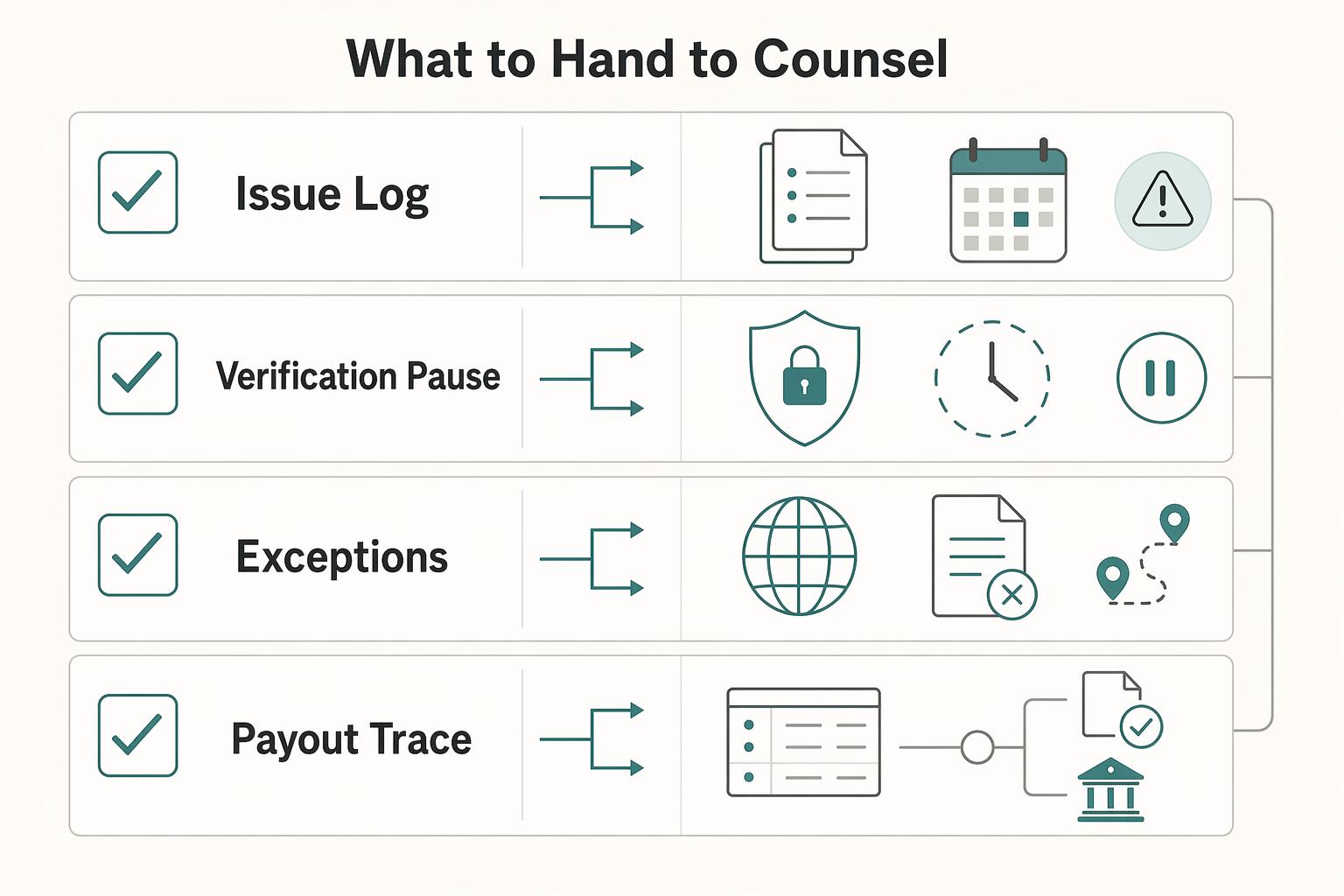
Log the Issue, Verify the Facts, Then Sequence the Terms#
Confidence comes from rhythm, not bravado: log the issue, verify the facts, then sequence settlement terms so performance is completed before any broad closure. If you use a covenant not to sue, tie it to clear conditions precedent instead of assuming the other side will perform later.
Start before the dispute turns personal. For each issue, record what the contract or statement of work required, what happened, who owns the next step, and what proof you have. During the verification pause, confirm invoice status, delivery records, acceptance or rejection messages, access change records, and change request threads before anyone proposes “full and final” language.
This is what makes leaders look calm in hard conversations. They are not relying on confidence as a personality trait. They are relying on a repeatable sequence. The issue log tells you what is open. The verification pause tells you what is proved. The settlement sequence tells you what can safely be offered now and what should wait until performance is complete. When those pieces are in order, you can negotiate firmly without bluffing and without overcommitting.
That rhythm also lowers the internal temperature. Teams argue less when the file shows the next step, the owner, and the proof expected at completion. It becomes easier to separate hurt feelings from operating facts. The dispute may still be tense, but the company does not have to sound scattered.
What to hand to counsel#
Bring counsel in on risk triggers, not frustration. Pull them in when there is a threatened claim, refusal to pay after documented delivery, a cross-border enforcement question, or draft language that asks for a release before payment, file return, credential shutdown, or dismissal steps are complete. Send a complete handoff bundle:
- signed contract, statement of work, amendments, and key email approvals
- issue log with dates, current status, and missing performance
- damages summary or amount in dispute
- draft settlement sequence showing what must happen before broader peace applies
- open issue summary with one decision owner per escalation step
Two common errors can cause avoidable damage: sending unstructured email chains with no chronology, and filing dismissal too early. If litigation is already in U.S. federal court, review FRCP 41: a stipulation signed by all parties who have appeared can dismiss an action, and unless the filing states otherwise the dismissal is without prejudice. Also decide enforcement mechanics before dismissal, because under Kokkonen, federal courts do not automatically retain settlement enforcement power unless the order incorporates the settlement or retains jurisdiction.
| Control now | Owner | Done standard |
|---|---|---|
| Issue log | Ops or founder | One entry per issue, linked proof, and a named next step owner |
| Verification pause | Commercial lead | Facts checked against contract, invoice, delivery, and access records |
| Escalation path | Founder + counsel | Trigger conditions named, handoff bundle complete |
| Settlement review gate | Legal reviewer | No broad release or dismissal until payment and other conditions are verified |
For cross-border disputes, run one final gate before signature. Confirm whether enforcement depends on an exclusive court clause in a civil or commercial matter that may fall under the Hague 2005 Choice of Court Convention, or an arbitration path that may rely on New York Convention recognition. If that path is unclear, pause the paper and get local advice before giving up your position.
The quality of the handoff matters as much as the timing. Counsel should receive a file that lets them see the dispute in operating order, not just a collection of emotional correspondence. Put the signed deal documents first, then the issue log, then the proof tied to each open issue, then the proposed settlement sequence. That makes it easier for counsel to spot the real risks: mismatch between the evidence and the draft, overbroad closure language, unclear completion steps, or dismissal timing that could strip away your negotiating room too early.
You also want your internal owner to stay engaged after the handoff. Counsel can draft and advise, but someone on your side still needs to confirm invoice status, delivery completion, access changes, and whether each required record has actually been captured. The strongest legal review still depends on a clean operating file.
If you remember one rule, make it this: do not let closure language outrun verified performance. That single discipline improves negotiation, drafting, escalation, and enforcement at the same time.
Related: A Guide to Mediation for Resolving Freelance Disputes. If cross-border payment execution is part of your dispute-risk plan, review how compliance-gated flows work in Payouts.
Frequently Asked Questions
When should you use a covenant not to sue?
Use it when closure should be conditional, not immediate. If payment or other required corrective action still has to happen after signature, broad peace should not run ahead of verified completion. Tie the promise to defined conditions, consideration, and termination terms, and keep terms clear because enforceability depends on state law, consideration, and clarity. If your team cannot identify the condition that unlocks broader closure or the record that proves it happened, stop and fix that first.
What is the practical difference between a covenant and a release?
Decide this by scope, timing, breach handling, and carve-outs, not by label alone. A covenant not to sue is used in settlement contexts to avoid litigation under specified conditions and is treated as different from a general release. | Decision point | Covenant not to sue (practical use) | Release (practical review check) | | --- | --- | --- | | Scope now | Define exactly which claims are covered now | Confirm wording does not exceed documented dispute scope | | Timing | Keep your position while performance is still pending | Pause if broad closure is drafted before completion steps | | Breach handling | State what happens if required action is not completed | Confirm rights or remedies are still clear if obligations fail | | Carve-outs | Preserve unfinished obligations explicitly | Verify exclusions are written, not implied | Use the table as a review checklist. Ask what is covered now, what remains open, what happens if performance fails, and where the exclusions are written. If those answers are clear, the draft is easier to operate. If they are missing, the label will not save you.
What happens if the other side violates the settlement?
Start by rebuilding the record in dispute order: signed settlement, records tied to each required step, and written notices tied to the missed step. If litigation already exists, keep the case number, case title, and court documents in the same file. Then map each missed obligation to one owner, one trigger, and one missing proof artifact.
What should your lawyer include instead of copying a long sample clause?
Ask for a short draft that names the parties, defines claim scope, states consideration, sets termination conditions, and clearly states any carve-outs plus what happens if required action is not completed. Pause on phrases like "all claims" or "full and final" when performance is still pending. Then check whether a non-lawyer can explain what is covered, what is excluded, and what must happen before broader peace applies. If they cannot, the draft is not ready.
In a cross-border settlement, which law and forum should you pin down first?
Pin down both governing law and forum before you sign when key performance steps still need to happen. A forum selection clause sets where related litigation must proceed, and ambiguous wording can force courts to rely on interpretive rules. Run one execution checklist that aligns chosen law, chosen forum, payment confirmation method, file or IP handoff, credential transfer, owner for each step, and any forum-specific filing or notice procedure. Before signing, test the sequence from both sides so you know what record resolves a challenged handoff or a missed filing step.
Try a related tool
Researched and edited by the Gruv editorial team. Gruv builds cross-border billing, payouts, and finance-operations software for global businesses.
Sources
- cit.uscourts.gov/sites/cit/files/COMPLETE%20RULES%20AND%20FOR...trusted
- justice.gov/atr/competitive-processes-anticompetitive-pr...trusted
- law.cornell.edu/rules/frcp/rule_41trusted
- law.cornell.edu/wex/releasetrusted
- twc.texas.gov/sites/default/files/commissioners/docs/texas...trusted
- txcourts.gov/media/1444170/scac19-05-03-transcript.pdftrusted
- uncitral.un.org/en/texts/arbitration/conventions/foreign_arb...trusted
- uscourts.gov/sites/default/files/mcl4.pdftrusted
Educational content only. Not legal, tax, or financial advice.
Related Posts

Germany Freelance Visa Application Path for Freiberufler and Gewerbe
Choose your track before you collect documents. That first decision determines what your file needs to prove and which label should appear everywhere: `Freiberufler` for liberal-profession services, or `Selbständiger/Gewerbetreibender` for business and trade activity.
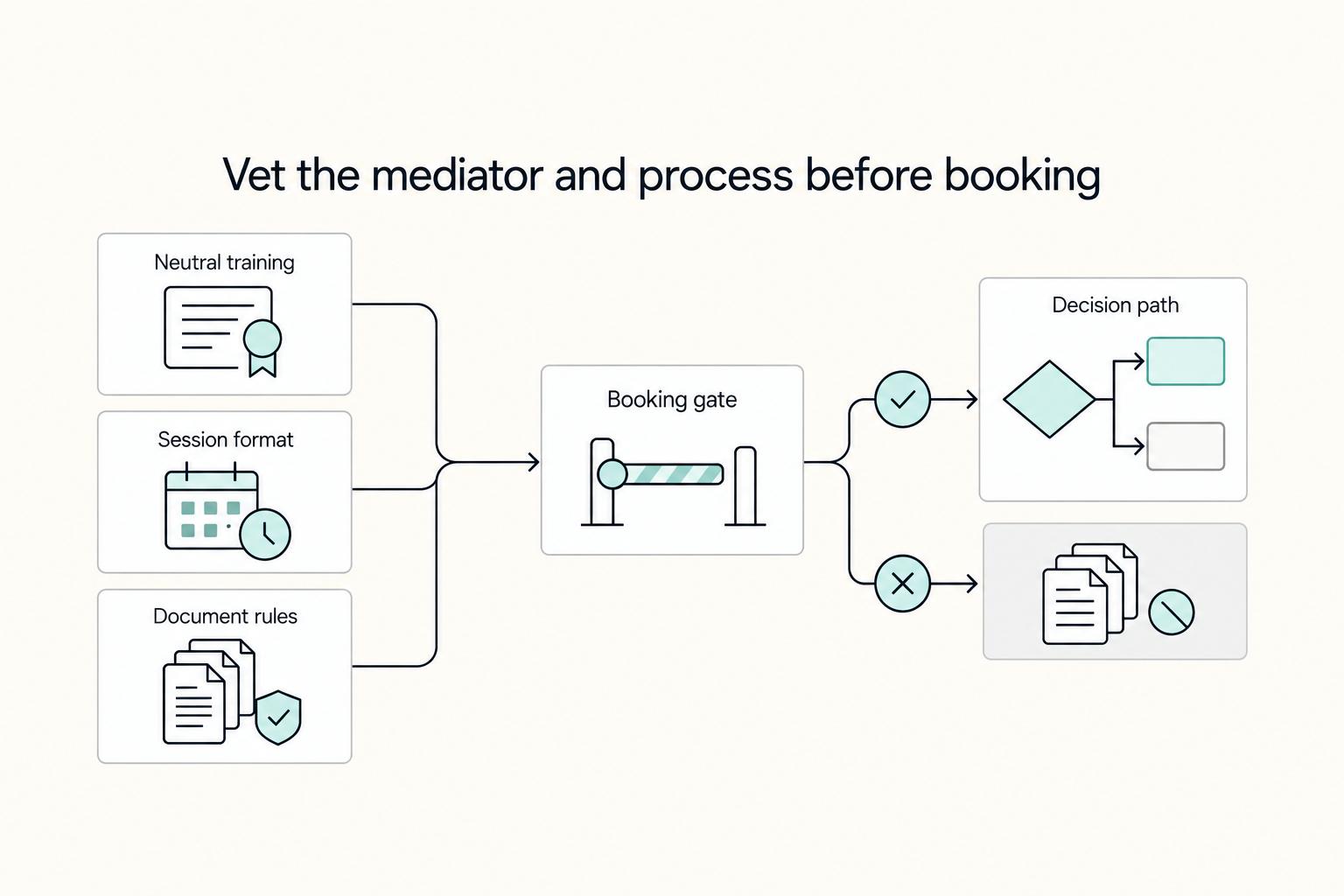
Freelance Mediation for Client Disputes That Need a Clear Outcome
When direct negotiation stalls, move to a structured settlement process while both sides are still exchanging facts in writing. The point is to keep control: settle if you can, then move to the next option if cooperation or evidence breaks down.

The Freelance Payment Penalty: A Modeled Audit of Platform Fees, FX Spreads, and Payout Delays
The money rarely disappears through a single, easy-to-spot fee. The real loss is stacked. A marketplace takes its commission, a processor adds a charge for international cards, a bank or payment company converts the currency at a spread, a platform holds the funds before release, and a wire sheds a little to intermediaries on the way in. Each layer looks defensible on its own, but the worker feels the combined result as a smaller deposit and a later payday.