
Quick Answer
Yes - treat it as a documented sequencing issue, not a guess. First confirm how your foreign entity is treated for U.S. tax review and whether ownership/control facts support a CFC conclusion. Then review income with records before labeling items, including any Subpart F or GILTI questions. If a filing obligation is confirmed, prepare Form 5471 using a complete handoff file with financials, ledger detail, bank support, related-party documents, and a written advisor conclusion tied to your current-year facts.
Confirm the structure first, then income, then any filing#
If your foreign company might raise a CFC question for U.S. tax purposes, do not guess. Get to a documented yes or no with a qualified advisor. In practice, that means confirming three things in order: how the entity is being treated for the U.S. tax review, how ownership and control are being analyzed, and what compliance or filing steps, if any, apply this year. Keep those frameworks separate, too. NYSE "controlled company" language in SEC materials is not the same as U.S. tax CFC analysis, and mixing them creates false confidence fast.
The goal is not to become your own technical reviewer. It is to build a record that lets your advisor answer the right question in the right order. According to IRS Form 5471 instructions, ownership and filing facts drive what gets reported, so sequence matters. If you skip that sequence, you can waste time debating income treatment before the structure is confirmed. Or you can scramble for forms before anyone has nailed down whether any filing is required.
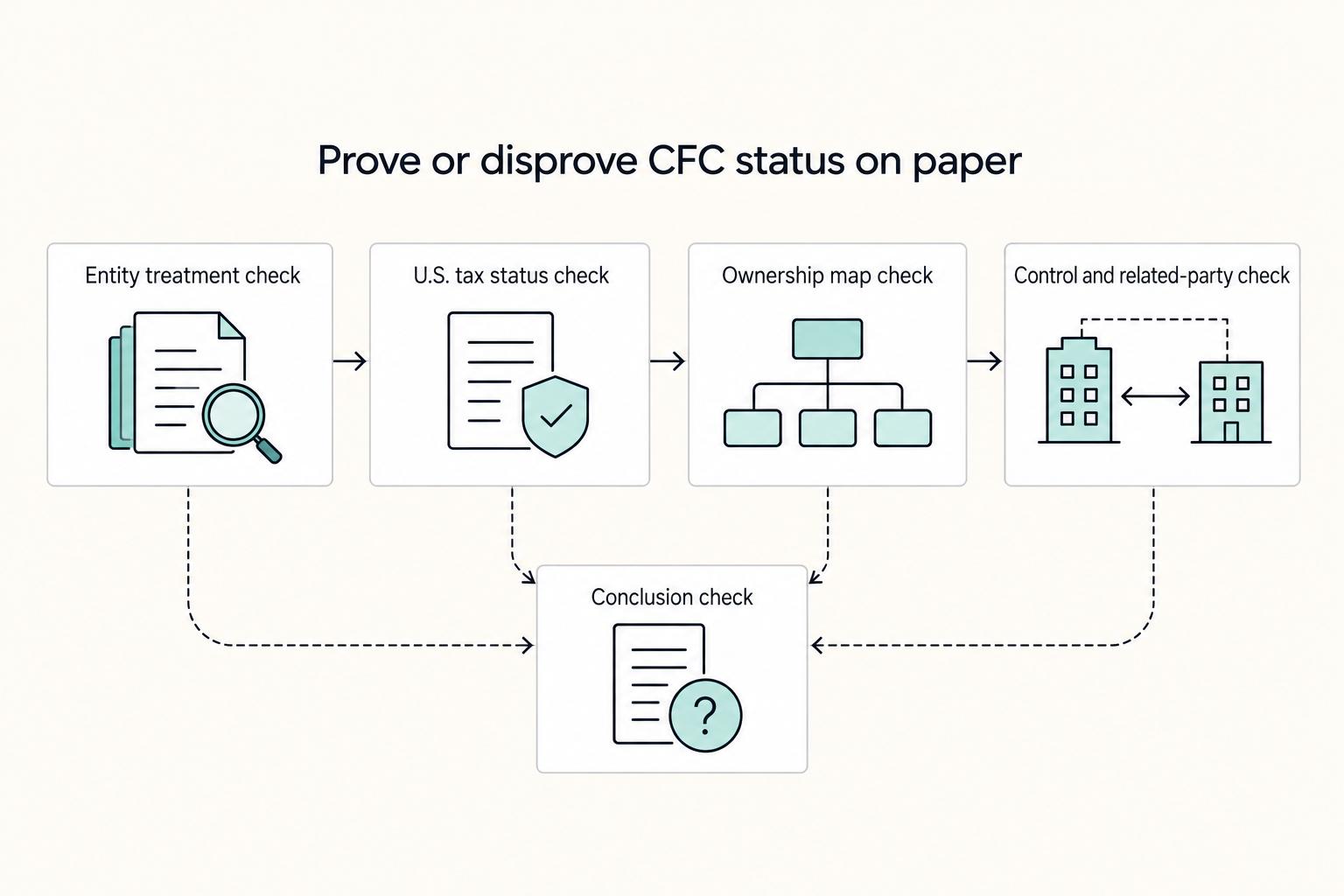
Step 1. Prove or disprove CFC status on paper#
Start by proving or disproving the structural issue on paper before you worry about forms or income labels. Use this pass/fail checklist first. If any item is unclear, treat it as not passed yet.
| Check | Pass | Fail or verify |
|---|---|---|
| Entity treatment check | Written confirmation of how the foreign entity is being treated for the U.S. tax review | Formed a foreign entity but have not confirmed whether the U.S. tax treatment matches your assumption |
| U.S. tax status check | U.S. tax status is confirmed for the current year | Residency or timing facts could change your status |
| Ownership map check | Direct ownership and other relevant ownership facts are documented and reviewed | Relying only on legal title or an informal understanding of who owns what |
| Control and related-party check | Relevant control and related-party facts have been gathered and reviewed | Related parties, other entities, or year-of-change facts have not been mapped |
| Conclusion check | Written yes or no conclusion or a clear list of open issues | Only a verbal impression or an unfinished review |
For a solo cross-border business, get this reviewed early and in writing. That written record matters more than most owners expect. A verbal "you should be fine" is not a useful answer six months later when return prep starts and the facts get revisited.
Ask for a short memo, email, or advisor note that ties the conclusion to your entity, your ownership, and the current year. If there is any unresolved fact, that should be stated clearly rather than glossed over.
A clean Step 1 file usually starts with a simple document pack:
- formation documents
- current ownership records
- any ownership transfer history during the year
- prior U.S. tax treatment or advisor notes, if any
- a short list of related parties or entities whose ownership could matter
- your current-year U.S. tax status facts
If your facts changed during the year, build the timeline before asking for the conclusion. That includes ownership shifts, a related party becoming involved, another entity entering the picture, a move into or out of U.S. tax residency, or a change in who legally holds the interests. Even when the final answer stays the same, the review still has to follow the timeline rather than assume the year was static.
The most common Step 1 mistake is reviewing only the cap table and ignoring everything around it. A cap table alone may not be enough for an advisor to finish the review. If related parties or other entities are part of the picture, capture that in the file and let your advisor decide whether they matter. If that has not been done, you do not have a completed ownership analysis yet.
Another common failure point is assuming local-country terminology settles the U.S. question. It usually does not. The point of the entity-treatment check is to confirm how the structure is being handled for the U.S. tax review, not how it is described in local formation documents or in day-to-day business conversation.
If your current assumption came from a formation agent, a local accountant, or your own reading of the entity documents, that is a reason to verify. It is not a reason to mark the item passed.
A good working habit here is to create a one-page ownership map. Keep it plain and mechanical. Show who owns what directly, list any related parties or other entities that need review, and note any transfers or status changes by date. If your advisor can understand the structure in one page, you are already ahead of most tax-season scrambles. If you need a template for organizing assumptions and scenarios, adapt a clean freelance financial model framework to your ownership timeline.
When you review your own checklist, be strict about what counts as "confirmed." These are not the same:
- "I think the entity is treated the way I intended."
- "My advisor confirmed the entity treatment in writing."
They may end up with the same answer, but they are not the same level of reliability. The same is true for ownership. "I only own part of it on paper" is not the same as "my ownership and control facts were reviewed and documented."
If one item fails, stop there and fix that gap before moving on. Step 1 is not a place to average uncertainty into a maybe. You do not need every downstream answer before you can act. You need a clean enough structural answer to know what should be reviewed next.
Step 2. Review income only after the structure is mapped#
Do not jump from an ownership result to an income conclusion. Once the structure is mapped, review income using the categories your advisor wants to test, and tie every item back to records before you call it anything.
| Review lens | What to prepare first | What to avoid |
|---|---|---|
| Income characterization | Transaction-level detail for unusual or non-routine items and related-party flows | Self-classifying items without document support |
| Business activity review | Full operating P&L, balance sheet, revenue by client, and cash movement support | Treating a broad business description as automatically resolving every tax question |
| Related-party overlay | Intercompany agreements, invoices, ledger mappings, and who performed work and where | Ignoring management fees, loans, or shared-cost allocations |
The sequence is simple: start with complete records, then let your advisor decide which items need technical review first. If classification is unclear, hold the item as "needs technical review" instead of forcing an answer.
That saves time. Owners often feel pressure to pre-sort every line item before the advisor sees it. Usually that creates more cleanup, not less. Your job is to provide complete records, clear descriptions, and support that ties amounts back to actual activity. If an item is ambiguous, label it clearly and keep the support attached. Do not "solve" it by changing the description in the ledger or by dropping it into whatever category feels closest.
The strongest Step 2 package is organized around traceability. For each material item or unusual transaction, your advisor should be able to move from the financial statements to the general ledger, then to invoices, agreements, bank support, and a short explanation of what actually happened. That is what allows real screening. Without that chain, the review turns into guesswork.
A practical way to build the file is to sort records into four groups:
- core financial statements and ledger exports
- bank activity and cash support
- customer and vendor support
- related-party support
For core financials, send the year-end P&L and balance sheet, plus the detailed general ledger. If the books changed after local filing or after year-end cleanup, say so. If there are multiple versions of the books, label the final set clearly. Version confusion is one of the fastest ways to lose time in international return prep.
For bank support, do not send only ending balances. The review often depends on understanding movement, not just totals. If cash came in from a related party, say so. If it went out as a loan or moved between owner and entity accounts, that matters operationally even when the books look tidy on the surface. Your records should let someone trace major inflows and outflows without having to reconstruct the year from scratch.
For customer and vendor support, focus on how revenue was earned and where work was actually performed. A revenue summary by client can be much more useful than a broad annual total with no context. If one person performed all services, say that. If work was split across people or locations, note that. If contracts exist, include them. If the actual working arrangement differs from the contract language, flag that too instead of assuming the paper controls the whole story.
For related-party support, assume that informal arrangements still need to be surfaced. Common trouble spots include charges that were never invoiced formally, owner-paid expenses booked later, and intercompany balances carried forward without explanation. Costs shared across entities with no clear method can create the same problem. Even if the amount is not large, unexplained related-party activity slows the review because it raises questions about what was really happening economically.
A useful working method is to annotate rather than rewrite. Add a short note where needed:
- what the item was
- who the counterparty was
- whether the counterparty was related
- what documents support it
- whether there is any uncertainty
That note can sit in a spreadsheet, the ledger export, or a separate summary. The point is to preserve the original record while making the review efficient. If you recode entries aggressively before your advisor sees them, you can accidentally erase useful context.
Watch for these Step 2 failure modes:
- netting transactions that should be shown separately
- combining owner and company activity in ways that hide the actual flow
- sending financial statements without the supporting ledger detail
- leaving intercompany balances unexplained
- assuming the business model answers the review on its own
- omitting where work was performed or who performed it
- treating bank movement as irrelevant if the P&L already looks clean
If your books are not perfect, do not wait for perfection before starting the review. Instead, identify the known weak spots. Say where the numbers are final, where they are still being cleaned up, and which items may need technical review. That lets your advisor triage instead of discovering problems one by one.
The core discipline in Step 2 is simple: labels come after records. Not before. Once you let documents, cash support, and transaction detail drive the analysis, the technical review gets more accurate and the filing step becomes much less chaotic.
Step 3. Treat filing as an execution job#
Once your advisor confirms that a U.S. international filing obligation or other reporting step applies, treat the rest as an execution job, not a tax-season scramble. Gather these items before kickoff:
- Year-end financials, or a clean P&L and balance sheet
- Entity formation documents and ownership records
- Ownership map that includes related-party review notes
- General ledger export and bank statements
- Related-party transaction list and supporting contracts
- Prior-year U.S. return package and prior international filings, if any
- Local-country return and workpapers used to prepare local filings
Send one advisor handoff packet with a one-page brief covering the entity setup, where work is performed, ownership history, related-party activity, and open questions. Common failure points are incomplete ownership mapping, books that do not tie to cash activity, and discovering missed prior-year filings late. If prior-year filings may be missing, ask about corrective-path options early and what the consequences could be.
Escalate to a specialist immediately when there is prior-year nonfiling risk, multi-country ownership, unclear classification, or material related-party activity.
The difference between a smooth filing and a painful one is usually not tax software. It is intake quality. If the advisor receives fragmented records over several weeks, changing explanations, or partial ownership facts, the return will slow down and the risk of avoidable mistakes goes up. If the advisor receives one coherent packet with a short summary, the work starts from a stable base.
Think of your handoff packet as an execution file, not just a document dump. Good packets are consistent, labeled, and easy to handle. That means:
- one folder structure
- clear file names
- one final version of key financials
- one ownership map
- one short issue list
If a document is missing, say it is missing. If a figure is provisional, mark it provisional. Hidden uncertainty causes more delay than visible uncertainty because it surfaces late, after forms have already been drafted.
Your one-page brief does a lot of work. Keep it concise, but make it useful. It should answer the questions an advisor will ask first anyway:
- What is the entity and when was it formed?
- Who owns it directly?
- Were there any ownership changes during the year?
- Where was work actually performed?
- Were there any related-party transactions?
- Were prior-year international forms filed?
- What do you already know is uncertain?
That brief should not try to argue the law. It should frame the facts cleanly. The more precise you are about facts, the less time gets wasted on back-and-forth clarification.
Before the filing work begins, do a tie-out pass. This is simple but valuable. Make sure the financials you are sending tie to the ledger you are sending. Make sure major cash activity can be matched to bank support. Make sure the local-country return package ties back to the financials used for U.S. preparation, or at least that any differences are identified. If your advisor has to discover these mismatches from scratch, that is where deadlines begin to slip.
Also, bring prior-year information forward early. Even if the current year is your immediate concern, past filings often shape the current-year workflow. If prior-year forms were filed, include them with the current package rather than waiting to be asked. If prior-year forms may have been missed, raise that immediately rather than hoping the current return can be handled in isolation. Late discovery is one of the most expensive kinds of friction because it can change both the work scope and the timing.
If you use local bookkeeping support, ask for the workpapers behind the local filing, not just the filed return. The filed return alone may not answer the questions needed for U.S. reporting. Workpapers, ledger detail, and reconciliation notes are often what make the difference between a fast handoff and a long chain of follow-up requests.
When a specialist is needed, do not treat that as overkill. It is usually the efficient path. Prior-year nonfiling risk, unclear classification, multi-country ownership, and material related-party activity are exactly the situations where a general intake process can stall or produce half-answers. Escalating early is often what keeps the current-year filing on track.
Your role in Step 3 is straightforward: get the facts, records, and open issues into one complete packet early enough that technical decisions and form preparation happen in that order. That is how you reduce rework, limit deadline pressure, and improve the odds that the return is complete on first submission.
Controlled foreign corporation (CFC) quick triage table#
Use this as an answer-first screen before your advisor call: map ownership first, then classify records, then filing steps. According to IRS practice guidance, missing ownership and related-party facts are a major source of rework.
| Triage checkpoint | Practical threshold or trigger | What to do next |
|---|---|---|
| U.S. shareholder test | Direct or indirect ownership at or above 10% | Document ownership evidence and flag for advisor review |
| Control profile | More than 50% vote/value held by relevant U.S. shareholders | Escalate controlled foreign corporation (CFC) review immediately |
| Records readiness | Financials, ledger, and bank support tied for the same year | Prepare one handoff packet before technical analysis |
| Filing workflow | Form 5471 or other international filing confirmed | Lock timeline, owner, and checklist in writing |
For solo founders, this triage table reduces deadline risk because it forces a yes/no sequence. Use your Tax Residency Tracker and ownership map together so residency shifts and ownership shifts are reviewed in the same timeline.
FAQ: Controlled foreign corporation (CFC) for U.S. shareholders#
These are the most common execution questions once you suspect a controlled foreign corporation (CFC) issue.
I own the company with my non-U.S. spouse. Am I automatically outside the issue?#
Not necessarily. A cap table alone may not answer the question, and the result depends on your exact structure and how an advisor reviews the full set of ownership facts. Ask for a written conclusion tied to your ownership structure. When you discuss this with an advisor, bring the actual ownership record, explain whether anything changed during the year, and ask which ownership and related-party facts were reviewed.
My foreign business is small. Does size alone remove the filing risk?#
Not on its own. Start with a review of the structure and ownership, then determine the filing impact, if any. "Small" is not a substitute for a documented conclusion. Small books are easier to review, but they still need to be reviewed.
Can I wait until tax season to sort this out?#
Usually not. Waiting creates avoidable errors and time pressure. Do the ownership and entity-treatment review first, then build the filing package around that result. If you wait, you are asking your advisor to resolve structure, income review, and filing prep at the same time.
If I cross the 10% ownership mark late in the year, does that matter?#
Yes, timing can matter. Keep dated ownership records and document when the change happened so your advisor can determine how the year should be analyzed and what filing workflow applies.
Do I still need records if my advisor thinks no Form 5471 is required this year?#
Yes. Keep a complete record file anyway. Even a no-filing-year conclusion should be tied to support documents so future-year reviews are faster and prior assumptions are verifiable.
What should I prepare before my first controlled foreign corporation (CFC) advisor meeting?#
Bring your ownership map, current financials, ledger export, bank support, related-party summary, and unresolved questions in one packet. If your residency facts changed, include your Tax Residency Tracker output and key travel dates.
If you want one clean next step, bring these questions to your next advisor call:
- Is my entity treatment for the U.S. tax review documented and current?
- Which ownership or related-party facts did you review, and what was the conclusion?
- Which parts of my income or transaction history do you want reviewed first?
- What exact filing workflow and timeline should I follow so the return is complete on first submission?
Bring those questions with your ownership map, your current financials, and a list of anything you know is unclear. That changes the conversation from abstract worry to a concrete work plan. It is how an accidental CFC issue stops feeling like a mystery and starts becoming manageable.
If you want a deeper dive, read the digital nomad tax guide. Before you speak with a tax specialist, organize your residency and travel evidence so your CFC status review is faster and cleaner: Use the Tax Residency Tracker. If you want cleaner cross-border operations after you fix compliance, review the freelancer setup for invoicing, payouts, and traceable records where supported: See Merchant of Record for Freelancers. If your records are still messy, normalize your advisor handoff packet with a lightweight financial-modeling workflow.
Frequently Asked Questions
I own the company with my non-U.S. spouse. Am I automatically outside the issue?
Not automatically. The result depends on the full ownership and related-party facts for the year, and should be documented in writing by your advisor.
My foreign business is small. Does size alone remove the filing risk?
No. Business size alone does not settle filing obligations; structure, ownership facts, and supporting records still need review.
Can I wait until tax season to sort this out?
Usually no. Early ownership and entity-treatment review prevents avoidable filing pressure and late-stage errors.
If I cross the 10% ownership mark late in the year, does that matter?
It can. Keep dated ownership evidence so your advisor can evaluate timing and determine the correct year-specific workflow.
Do I still need records if my advisor thinks no Form 5471 is required this year?
Yes. A no-filing conclusion should still be supported by records so future-year reviews and follow-up analysis remain defensible.
What should I prepare before my first controlled foreign corporation (CFC) advisor meeting?
Prepare one packet with ownership map, financials, ledger, bank support, related-party summary, and unresolved questions so the review can start immediately.
Try a related tool
Researched and edited by the Gruv editorial team. Gruv builds cross-border billing, payouts, and finance-operations software for global businesses.
Sources
Educational content only. Not legal, tax, or financial advice.
Related Posts

Digital Nomad Taxes in 2026 With a Defensible Filing Plan
With digital nomad taxes, the first move is not optimization. It is figuring out where you may be taxable, where filings may be required, and what proof supports that position.
How to Build a Freelance Financial Model That Protects Cash Flow
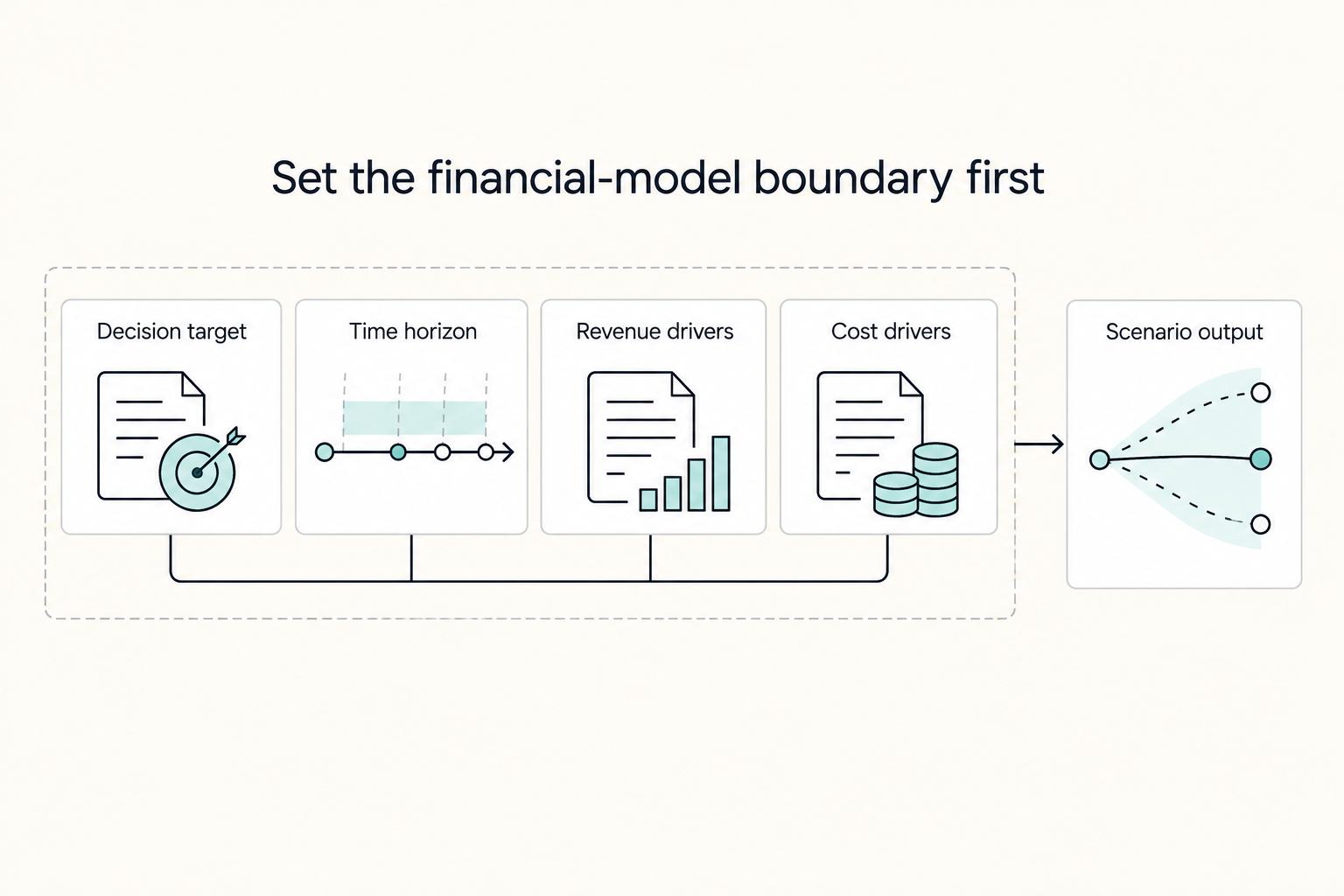
A model like this only matters if it changes a live decision before you commit. If it does not affect whether you take the work, how you set terms, or when you release money, it is just spreadsheet decoration. The goal is usable cash, not neat tabs.

The Freelance Payment Penalty: A Modeled Audit of Platform Fees, FX Spreads, and Payout Delays
The money rarely disappears through a single, easy-to-spot fee. The real loss is stacked. A marketplace takes its commission, a processor adds a charge for international cards, a bank or payment company converts the currency at a spread, a platform holds the funds before release, and a wire sheds a little to intermediaries on the way in. Each layer looks defensible on its own, but the worker feels the combined result as a smaller deposit and a later payday.