

Quick Answer
If you overstay the Schengen 90/180 day rule, treat it as a documentation and decision-control problem immediately. Recalculate your day count using the backward method, verify visa validity and entry permissions, and prepare a clean evidence file before exit. Do not rely on anecdotal penalty claims. Use official guidance at your exit point, since outcomes and handling can vary by country and case.
You are not trying to game Schengen rules you are trying to run a zero-surprise travel plan#
If you are worried about a Schengen overstay issue, treat it as an operations problem and run a documented timeline. Think of yourself as running a business of one, with mobility as part of the system. A small counting error can disrupt more than a trip. It can affect relocation timing, client delivery, and re-entry plans at the same time. For remote professionals, travel in Europe rarely sits in isolation. Flights, housing, contracts, and immigration steps usually lock together.
This guide has one job: fewer surprises. Verify what is true right now. Act early when overstay risk appears. Exit with a clean document trail. Then plan the next move with fewer unknowns. If your records conflict, pause new commitments and resolve status first.
Use these scope rules from the start:
- Focus on decisions you control before and during travel.
- Track where member state practice can differ in enforcement.
- Avoid unsupported visa penalty numbers and guessed travel ban durations.
- Treat forum stories as context, not policy.
In practical terms, overstay risk turns on the Schengen 90 days within 180 days limit, timely departure, and clean evidence. One Germany-specific legal commentary describes overstay as conduct authorities may prosecute there as an administrative or criminal offence. That matters for planning. Do not assume every Schengen country will handle risk the same way.
If you extend a client engagement, shift your return plan, and then notice your stamp timeline no longer matches your calendar, this playbook is for that moment. The goal is to switch from stress to controlled execution.
| Timeline stage | Core question | Decision output |
|---|---|---|
| Before travel | Do planned dates fit the 90/180 rule and visa conditions? | Approve plan or redesign itinerary |
| During stay | Does each change increase overstay risk? | Continue or trigger incident response |
| Risk signal | What facts can I prove right now? | Evidence pack plus immediate action |
| Exit handling | Can I show a consistent travel record fast? | Lower-friction border interaction |
| Next-cycle planning | How do I reduce repeat risk next time? | Updated calendar and control checklist |
Keep A Guide to the Schengen 90/180 Day Rule as your baseline, then apply this timeline system through each section. Want a quick next step? Try the visa planner.
What counts as an overstay under the Schengen 90/180 Day Rule?#
A Schengen overstay issue starts when your authorized short stay no longer matches your actual days or entry permissions. This is the definition set you can use as an operating check, so you catch problems early instead of at a border desk.
Under the Schengen 90/180 Day Rule, a short stay is limited to a maximum of 90 days within any rolling 180-day period across the Schengen Area. You count back 180 days from each day of stay and keep the total at 90 or less. Also note scope: if you hold an EU residence permit or a long-stay visa, this specific 90/180 framework does not govern your stay.
The three failure modes you must track#
| Failure mode | What you check | Why it creates overstay risk |
|---|---|---|
| You exceed stay days | Your rolling 180-day count against the 90-day limit | You cross the short-stay threshold even if plans felt reasonable |
| You stay past sticker validity | The period of authorized stay printed on the visa sticker, and whether the visa's validity period has expired | Your sticker no longer supports your presence |
| You exceed allowed entries | Whether you have exceeded the number of allowed entries on your visa | A new entry can become invalid even when days remain |
Treat this as status control, not a debate. Border checks may review your recent travel history, your sticker terms, and your entry pattern. Intent does not replace records.
If stamps or itinerary records conflict, treat your status as uncertain and verify it before you make new plans. Freeze new Europe travel commitments until you do. Rebuild entry and exit dates in one timeline. Run a formal day-count check for your control date. If you cannot clearly confirm compliant status, move to incident response steps.
Prepare documentation before you think about enforcement outcomes, since outcomes can vary by country and case. If one stamp is unclear after a change to your route, do not guess. Rebuild the timeline, run the count, validate entry rights, then decide your next move from evidence.
Build your pre-trip control system before tickets and housing are locked#
Build a pre-trip control sheet before you pay for flights or housing, and you will catch most overstay risk while changes still cost less. This is where the rules turn into a repeatable workflow. Your job is to answer border questions fast, using proof you already have.
| Evidence item | What to keep |
|---|---|
| Passport identity page | Plus scanned stamp pages |
| Booking confirmations | Include all carrier change notices |
| Lodging confirmations | Include date-change records |
| Single travel timeline | Make sure it matches your document terms and itinerary |
Start with your travel documents (and your visa, if you have one) and copy every printed detail exactly into one control sheet. Then map your planned route against the entry permissions and limits shown on those documents, including the number of permitted entries where it applies. Use this sheet as your go/no-go gate before every booking change.
| Control point | What you record | Decision gate |
|---|---|---|
| Document data | All printed visa/travel-document details exactly as issued | Stop if any booking conflicts with document limits |
| Entry pattern | Planned border crossings by sequence | Stop if the plan exceeds permitted entries (if applicable) |
| Stay baseline | Your running count against the applicable stay limits | Stop if the plan risks exceeding allowed stay |
Build one evidence folder and keep it current from booking to exit. Border control procedures include checks at border crossing points and stamping of travel documents. Depending on what comes up at the border, checks can also involve special rules for certain categories of persons, and officers can escalate to refusal of entry or visa actions like annulment or revocation when records do not line up. A current file helps when timing pressure hits.
Keep these items ready:
- Passport identity page plus scanned stamp pages.
- Booking confirmations and all carrier change notices.
- Lodging confirmations and date-change records.
- A single travel timeline that matches your document terms and itinerary.
Add jurisdiction guardrails in your notes for each destination. Member states follow a common framework, but local practice can still vary in how officers sequence checks. Do not guess your visa penalty or travel ban exposure from anecdotes. Use records first, then escalate quickly when facts conflict.
How do you apply the Backward Calculation Method without mistakes?#
Use the Backward Calculation Method on every planned entry date and every current-stay date, then act on the result right away. This is the control step that keeps your plan clean. You are not trying to predict outcomes. You are trying to prevent a counting error before it turns into immigration friction.
Backward Calculation Method means you look back across the prior 180 days from a control date and total all qualifying days in the Schengen Area. This matches the official idea of a moving 180-day reference period, checked by looking backwards at each day of the stay. The limit stays the same: no more than 90 days in any rolling 180-day period.
Count the entry date as a stay day and the exit date as a stay day. If you hold a residence permit or long-stay visa for a period, exclude that period from this short-stay count.
Run the check in the same sequence each time so you do not miss a control.
| Step | What you do | Decision output |
|---|---|---|
| Pick control date | Use intended entry date or today if already inside Schengen | Defines the exact 180-day lookback window |
| Rebuild travel history | List every entry and exit inside that window | Creates one defensible timeline |
| Count qualifying days | Include entry and exit days in the total | Confirms remaining day capacity |
| Check entry conditions | Match your plan to your visa or travel authorisation conditions (as applicable) | Confirms whether the next crossing stays valid |
| Decide action | Continue, delay entry, or schedule exit | Lowers Schengen overstay risk before border contact |
If the total sits near the limit, stop adding discretionary Schengen travel and protect core work travel first.
When stamps are unclear or itinerary segments conflict, use conservative defaults and prepare proof before any border interaction. Count uncertain days as days spent in Schengen until records clarify. Freeze nonessential booking changes until the count stabilizes. Keep passport scans and booking updates in one file. Do not guess visa penalty or travel ban outcomes by country.
If you need a baseline refresher before you finalize a plan, review A Guide to the Schengen 90/180 Day Rule.
What should you do immediately if you think you overstayed by a day?#
Assume risk, lock your timeline, and build objective proof before you contact anyone. The moment you suspect an overstay issue, your priority is to stabilize the facts. Clear records protect your position better than long explanations.
Start with a hard verification pass against your Schengen visa sticker and travel history. You need one clean fact set before you call a carrier or local authorities.
| Checkpoint | What to verify now | Evidence to collect |
|---|---|---|
| Stay duration | Whether your Schengen Visa C stay exceeded 90 days in 6 months (180 days) | Rebuilt entry and exit timeline |
| Sticker validity | Whether the validity period has expired, or whether the latest date by which you had to enter (as shown on the sticker) has passed | Clear image of the Schengen visa sticker |
| Entry permissions | Whether you exceeded allowed entries on your visa type | Prior crossings and current entry count |
| Travel record integrity | Whether stamps, tickets, and itinerary agree | Passport stamp photos, boarding records, booking changes |
Then execute this sequence:
- Freeze assumptions and stop adding optional Schengen-area travel legs.
- Reconstruct dates from primary documents, not memory.
- Gather airline or carrier evidence for delays, reroutes, or missed departures.
- Prepare one incident file you can show quickly at exit.
Use a short factual script when you communicate. State dates, sticker details, and entry pattern. Ask what to do next at your likely exit point. Do not speculate about intent, and do not debate visa penalty or travel ban outcomes from forum anecdotes.
Escalate to qualified immigration counsel if any of these triggers appear:
- Your records still conflict after reconstruction.
- You cannot confirm compliance under the Schengen 90/180-day limit.
- Your sticker validity or allowed entries appear exhausted.
- Border guidance and carrier records point in different directions.
If a last-minute routing change pushes your exit plan and one stamp is hard to read, do not guess. Lock the file, present verifiable facts, and pause onward commitments until status is clear.
What happens at exit and why your document trail matters#
At exit, protect yourself by presenting a clean, verifiable timeline that matches your entry conditions and your allowed stay. Departure is not the moment to reconstruct history. It is the moment to hand over a coherent record.
| Source type | How to treat it |
|---|---|
| Forum posts and Q&A threads | Low-confidence signals; user anecdotes, not official rulings |
| Travel-blog stories | Context, not policy, including anecdotal accounts of being flagged at departure |
| Non-official explainers | Planning context, not decision-grade guidance |
| Local border authority instructions at your actual exit point | Decision-grade guidance |
Expect document review, timeline questions, and officer discretion. Border staff may compare your passport, any visa or entry documentation you were issued, and your travel pattern. If your record conflicts, they can escalate scrutiny. If your record is consistent, you reduce friction and move faster through control.
Use this practical rule: do not explain first, prove first.
| Exit packet item | Why it matters | Ready standard |
|---|---|---|
| Passport pages and stamp scans | Confirms movement history | Clear, chronological images |
| Visa or entry permission copy (if issued) | Anchors validity and entry conditions | Legible copy with key fields visible |
| Stay-length worksheet | Shows your day-count logic | One-page timeline with entry and exit dates |
| Carrier notices and booking changes | Explains schedule disruptions | Time-stamped records in one folder |
Some materials online discuss overstay outcomes, penalty risk, or travel ban scenarios. Use them carefully. They can shape your questions, but they cannot decide your case. If you are sorting conflicting guidance, use the hierarchy above: local border authority instructions at your actual exit point are decision-grade; everything else is context.
If an officer questions a date gap after a route change, open your packet, show the timeline, and match every change to written records. Stay factual, avoid speculation, and follow the next instruction.
Rules, penalties, and handling can vary by jurisdiction, so avoid confident predictions about travel outcomes. Keep your focus narrow: present evidence, stay consistent, and close the exit process cleanly under the applicable border rules.
How should remote professionals plan the next 12 months after an overstay risk?#
For the next 12 months, keep your records current across both travel and finance, then make filing decisions from a clean file. Treat foreign-asset reporting as a calendar habit, not a once-a-year scramble, and keep every next step tied to something you can prove.
Run one calendar with two lanes so you do not mix recordkeeping with filing.
| Time lane | Primary objective | Actions you run |
|---|---|---|
| Ongoing recordkeeping | Reduce uncertainty later | Keep a live inventory of your specified foreign financial assets and account statements, track value changes as a running log, and maintain an evidence folder you can reconcile quickly. |
| Annual filing decisions | File what applies, with your return | If you are a United States taxpayer, build a cross-border reporting check into your annual tax return workflow: under FATCA, certain taxpayers with foreign financial assets report those assets to the IRS, generally using Form 8938, and Form 8938 (when required) must be attached to your annual tax return. If you do not have to file an income tax return for the year, you do not file Form 8938. |
You may also have to file FinCEN Form 114 (FBAR), and the IRS provides a comparison resource to help you determine whether Form 8938, FBAR, or both apply. Use conservative reminders because thresholds vary by filer profile. IRS notes a general $50,000 reportability level in some situations, and Form 8938 instructions also reference that some specified domestic entities use $50,000 at year-end or $75,000 at any time.
Missed Form 8938 reporting can trigger a $10,000 penalty, with potential increases up to $50,000 after IRS notification. Check the latest Form 8938 instructions each cycle because IRS maintains them on a continuous-use basis.
Keep a decision log with date, assumption, evidence, and next review trigger. Add monthly admin hygiene: invoice archive, location-tagged work records, and account statements, plus a tax return review note for filing consistency. If you are also mapping relocation paths, compare options in our digital nomad visa index for 50+ countries.
Run the same loop before every booking and log each decision#
Predictable mobility comes from early checks, fast evidence handling, and decisions you can prove later. The advantage is not confidence. It is traceability. Run the same loop before every booking so you catch eligibility surprises in planning, not at the border.
| Loop step | Action |
|---|---|
| Recalculate your current Schengen day count | Use the relevant short-stay rules |
| Confirm your visa and entry conditions | Check your remaining validity window |
| If your count or records conflict | Pause Schengen plans and choose a lower-risk route |
| Log the decision | Record the decision date, your assumption, and the evidence file you relied on |
| Set the next review trigger | Keep the plan current |
Use the loop above each time you plan Schengen travel, especially if a client request would force a tight return to the Schengen Area. If the count is uncertain, shift delivery to a non-Schengen stop and keep the work moving.
Build a compact packet that supports your timeline:
- Passport and stamp scans in date order.
- Booking-change records.
- A day-count worksheet tied to your travel dates.
- A flight reservation record that shows planned entry and exit dates.
For visa processing, embassies may accept a verifiable reservation with a real PNR instead of a fully paid ticket. Use that as practical proof of onward planning, but do not treat it as a stand-alone fix for a Schengen overstay dispute.
Close every cycle with two next steps. Refresh the counting logic in Schengen short-stay day-count guide. Then compare longer-term bases in The 2026 Global Digital Nomad Visa Index for 50+ Countries. If you earn across borders, pair travel planning with finance workflows that keep your records consistent when advisors or border officers ask questions.
Frequently Asked Questions
What counts as overstaying a Schengen visa in practical terms?
An overstay schengen visa issue starts when your stay goes beyond 90 days in any 180-day period in the Schengen Area. It can also apply if your visa is no longer valid while you remain, for example if the validity period has expired or if you have exceeded the number of allowed entries. In practical terms, your physical presence no longer matches the permissions you can prove.
How is the Schengen 90/180 rule calculated with the backward method?
It is a rolling limit: on any control date, you look at the relevant 180-day period and make sure your time in the Schengen Area inside that window does not exceed 90 days. If your total goes over 90, you have schengen overstay risk. For the counting walkthrough you can reuse each trip, use A Guide to the Schengen 90/180 Day Rule.
What should I do first if I think I overstayed by one day?
Freeze new bookings and stop stacking changes. Rebuild your timeline from passport stamps, tickets, and your visa sticker details until you have a single version of events. Then use that file when you seek official guidance, instead of trying to reason it out at exit.
Are overstay penalties the same across all Schengen countries?
No single visa penalty outcome fits every case, and handling can vary by country and by situation. Plan and respond as a document-driven review. Follow instructions from the authority handling your exit or next entry, not fixed fine or travel ban numbers pulled from random examples.
Does exceeding allowed entries count as overstay even if days are remaining?
Yes, it can still create a status problem. If your visa allows a limited number of entries, exceeding that limit can invalidate the visa even when you still have days left in your 90/180 count. Track both controls: stay days and entry count.
What documents should I carry to exit if my stay count is disputed?
Carry a tight packet you can open fast. Include your passport, your visa sticker details (including the latest date by which you must enter), chronological stamp scans, a one-page 180-day day-count worksheet, and booking changes or carrier notices that explain gaps. This keeps the conversation factual and reduces confusion.
Can I safely re-enter later after a possible overstay incident?
You cannot treat re-entry as guaranteed after a possible overstay event. Re-enter only after you recalculate the live 90/180 window, confirm your visa conditions (including entries and validity), and close evidence gaps in your file. Conservative operators start with a lower-risk plan, then scale travel when the record supports it.
Try a related tool
Researched and edited by the Gruv editorial team. Gruv builds cross-border billing, payouts, and finance-operations software for global businesses.
Sources
Educational content only. Not legal, tax, or financial advice.
Related Posts

The 2026 Global Digital Nomad Visa Index for 50+ Countries
Start with legal fit, not lifestyle filters. The practical order is simple: choose a route you can actually document, then decide where you want to live. That single change cuts a lot of wasted comparison work and stops you from falling in love with places that were never a real filing option.
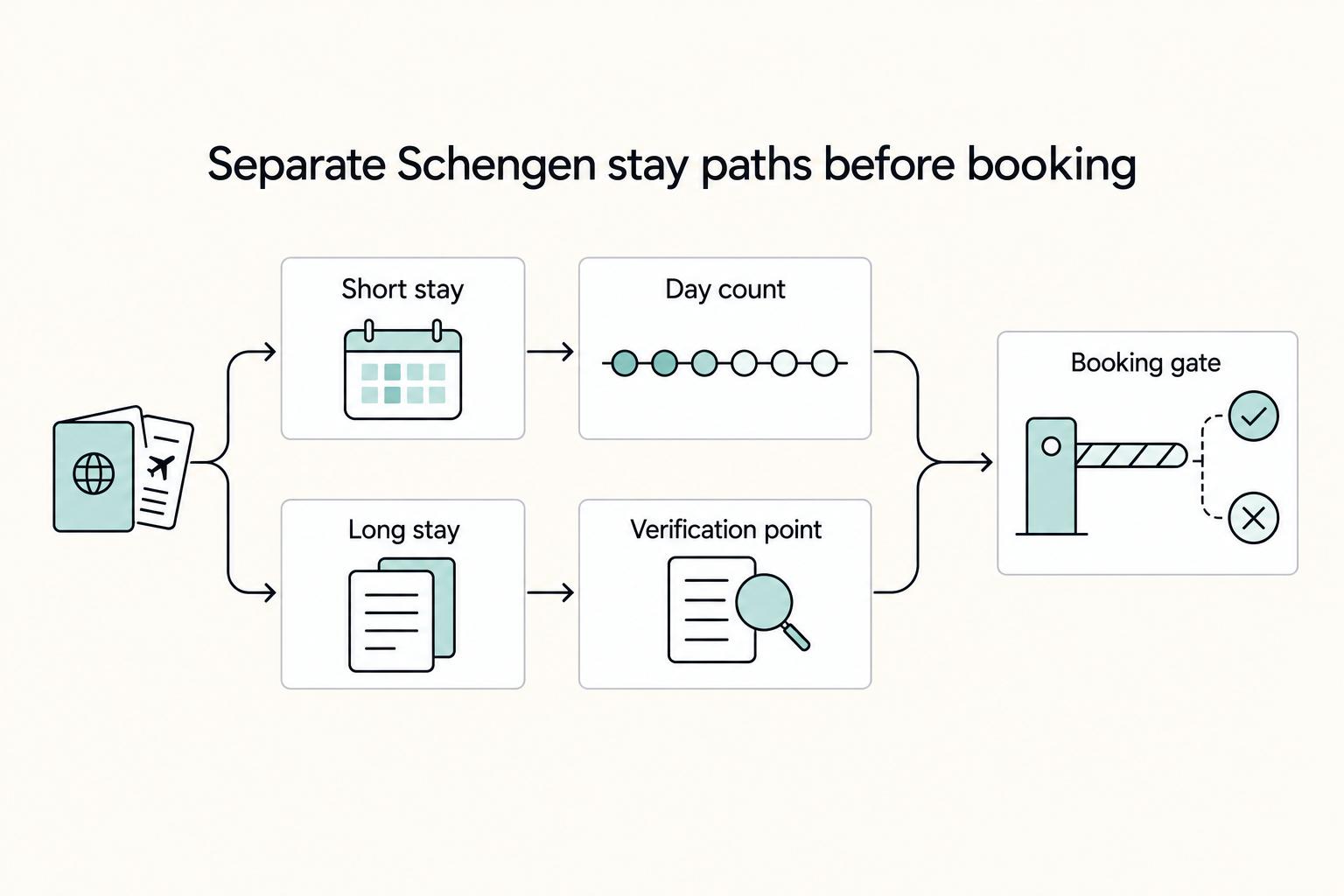
A Guide to the Schengen 90/180 Day Rule
**Treat Schengen short-stay limits as an operating constraint, then run every movement decision through one repeatable system.** If you treat Europe travel like a chain of bookings, you create avoidable risk. Run it like operations, and you protect flexibility, reduce stress, and keep your visa compliance posture clean across the Schengen Area.

The Freelance Payment Penalty: A Modeled Audit of Platform Fees, FX Spreads, and Payout Delays
The money rarely disappears through a single, easy-to-spot fee. The real loss is stacked. A marketplace takes its commission, a processor adds a charge for international cards, a bank or payment company converts the currency at a spread, a platform holds the funds before release, and a wire sheds a little to intermediaries on the way in. Each layer looks defensible on its own, but the worker feels the combined result as a smaller deposit and a later payday.