
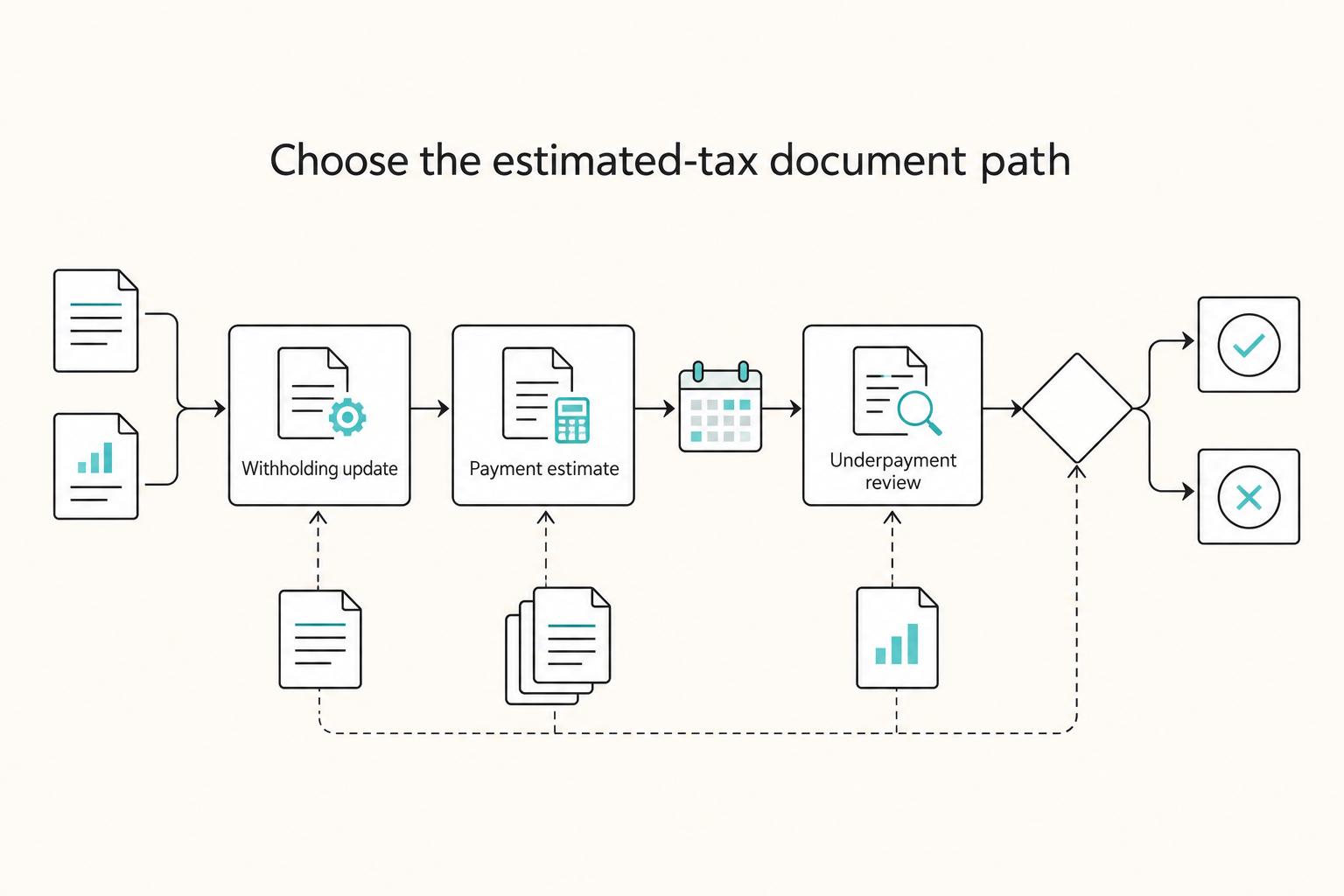
Quick Answer
Yes. Missing required estimated payments can trigger the IRS Underpayment of Estimated Tax by Individuals Penalty, and interest keeps accruing until the balance is paid. Late timing can still create a penalty even when your return later shows a refund. Pay immediately, even partially, then update your Form 1040-ES plan so the next due date is funded.
You missed a quarterly tax payment and now what#
Missing a quarterly payment can trigger the IRS Underpayment of Estimated Tax by Individuals Penalty, and interest can keep increasing what you owe until paid in full. In the IRS pay-as-you-go model, timing matters as much as totals. If you are searching for what happens if you do not pay quarterly taxes, treat this as a timing problem first, then a planning problem.
Start with two immediate objectives: reduce the open underpaid amount and lock down your records while details are fresh. You do not need perfect year-end projections today. You need a dated, defensible timeline of what was due, what cleared, and what you can pay now.
You can still face underpayment exposure even when your final return later shows a refund. The IRS says it sends a notice if you owe the underpayment penalty, but waiting for a notice is the slow path. The faster path is to document what happened, reduce the underpaid amount now, and reset your next due date before the same gap repeats.
Start with triage in the next 24 hours, then convert that triage into a repeatable monthly check. You are not trying to predict the year perfectly. You are trying to reduce avoidable cost and keep a record trail that is easy to explain.
What starts immediately after a miss#
The due date you missed matters immediately because penalty calculation includes the period when tax was due and underpaid. For individuals, due dates are:
- April 15 for income earned January 1 to March 31
- June 15 for income earned April 1 to May 31
- September 15 for income earned June 1 to August 31
- January 15 of the following year for income earned September 1 to December 31
Three inputs drive the penalty mechanics:
- amount underpaid
- how long it stayed underpaid
- published quarterly underpayment interest rates
Once a due date passes, any uncovered required amount can begin an underpaid period. A catch-up payment later can reduce additional exposure from that payment date forward, but it does not rewrite the period that already passed.
That means delay has a compounding effect on stress. The longer you wait to verify and act, the harder it is to reconstruct timing and the longer the underpaid amount can remain exposed. In practice, a missed payment and a messy record trail usually arrive together, so solve both in the same pass.
What to do in the next 24 hours#
Use a same-day triage sequence:
- Confirm the quarter and exact due date you missed.
- Verify what actually cleared using payment confirmations and bank records.
- Pay what you can now, even if you cannot close the full gap today.
- Label the payment record with intended quarter and actual payment date.
- Re-estimate the rest of the year so the same gap does not repeat.
Two execution rules keep this practical. First, separate facts from assumptions. Facts are cleared payments and dated records. Assumptions are income projections and remaining payment plans. Second, do not postpone recalculation until filing season. If this quarter was off, next quarter is where you can still control outcomes.
A small process detail prevents future confusion: keep one running note for this missed quarter with only dated entries. Add each action in plain language, such as payment initiated, payment posted, quarter tag updated, and next review date. This lets you recover context quickly when you revisit the file later.
If full catch-up is not available, a partial payment can still help by reducing how much remains underpaid and for how long.
Scope for globally mobile freelancers#
This guide covers U.S. federal in-year payment mechanics through the IRS. If you work across countries, run this as the U.S. track and handle non-U.S. obligations on a separate track. IRS compliance here does not automatically satisfy non-U.S. tax or reporting requirements.
Keep IRS Publication 505 in your working documents for current withholding and estimated-tax guidance, plus special-rule references. For globally mobile situations, the safest posture is clean separation: U.S. estimated-tax timing on one side, cross-border reporting decisions on the other.
Treat separation as a calendar habit, not just a conceptual rule. Review both tracks in the same planning window, but make each track answer its own question. That keeps one filing channel from creating false confidence about the other.
The terms that matter before you act#
Fast action only helps if the terms are clear. In the IRS pay-as-you-go approach, most federal tax is paid during the year through withholding and quarterly payments. Confusing those channels is one of the fastest ways to make a correct intention produce the wrong result.
Start with the two payment channels#
| Term | What it means in practice | Common mix-up |
|---|---|---|
| Estimated tax payments | Payments you send during the year, usually each quarter, to cover tax as income is earned | Treating them as optional until filing season |
| Tax withholding | Tax taken from wages, pension, or certain government payments before you receive the money | Assuming withholding updates happen automatically when income changes |
These payments can cover more than income tax, including self-employment tax and alternative minimum tax. If your income mix changes during the year, revisit both channels. Many freelancers check estimated payments but forget to check withholding after a compensation change in wage income.
A practical distinction helps under stress. Estimated-tax payments are usually discrete actions you initiate. Withholding is usually driven by payroll settings you must update when circumstances change. Both can support the same goal, but they fail in different ways.
A quick diagnostic can save time: if the payment requires you to initiate a transfer, treat it as an estimated-tax control; if it depends on payroll setup, treat it as a withholding control. Audit both controls when income shifts.
The penalty label you will actually see#
The IRS label is Underpayment of Estimated Tax by Individuals Penalty. It can apply when required payments are too low, late, or both. Late quarterly payments can still create exposure even when your final return is balanced or shows a refund.
The IRS says it sends a notice if you owe this penalty. Do not treat that notice as your first checkpoint. By the time a notice arrives, you have already lost time you could have used to reduce exposure and clean up your records.
Use the exact penalty name in your notes and internal checklist. Clear labeling keeps research, advisor discussions, and filing preparation aligned. It also helps you avoid mixing this issue with separate failure-to-pay or failure-to-file paths that use different mechanics.
The documents that control your next move#
Use Publication 505 for withholding and in-year payment guidance, and use the Form 1040-ES worksheet to test whether estimated payments are required.
Two anchors from IRS guidance shape the first decision:
- You generally must make quarterly payments if you expect to owe at least $1,000 when you file.
- Ordinarily, paying at least 90 percent of your tax during the year can avoid the underpayment penalty.
Keep document roles separate:
- Form W-4 is for changing employer withholding.
- Form 1040-ES is for estimating what you need to pay during the year.
- Form 2210 is where underpayment questions are evaluated at filing.
This separation prevents a common error where a freelancer updates one channel and assumes the other channel adjusted itself.
A practical working order keeps decisions clean: confirm your assumptions in Publication 505, update your Form 1040-ES worksheet, then adjust withholding with Form W-4 if you have wage income. Keep Form 2210 questions parked in your filing notes so quarter-level timing issues are easy to evaluate later.
What actually happens after a missed quarterly payment#
A missed quarterly payment can start underpayment exposure for that period. Cost can rise with time, and an IRS notice may come later. In a pay-as-you-go structure, late timing itself creates risk, separate from how your final return looks.
Timeline after the due date passes#
The sequence is straightforward:
- A quarterly due date passes.
- If enough was not paid for that period, an underpaid period begins for that amount.
- A later payment can reduce future exposure, but it does not erase earlier underpaid time.
- If the IRS assesses a penalty, a notice or letter can arrive after the fact.
No notice yet does not mean no exposure. It usually means you still have a chance to reduce the open balance and improve your file before communications catch up.
For planning purposes, tie each missed due date to one dated action list. The list should include what was due, what was paid, what date payment cleared, and what still needs to be paid. This creates a clear handoff into filing season.
If you are behind on more than one quarter, keep each quarter on its own line in your tracker. Combined totals are useful for cash planning, but quarter-level lines are what prevent timing mistakes and duplicate payments.
Why the balance can keep growing#
The Underpayment of Estimated Tax by Individuals Penalty depends on amount, time, and published quarterly underpayment rates. Because time is one input, delay can increase total cost. IRS guidance also says interest increases what you owe until the balance is fully paid.
The practical point is simple. Waiting usually does not make any part of this cheaper. It only shifts more months into the calculation and makes records harder to reconstruct.
This is why even an imperfect payment today can still be the better move. You are not solving everything at once. You are reducing the amount and duration that remain exposed while you clean up the rest of the plan.
The non-intuitive refund trap and what not to do#
A refund on your filed return does not automatically erase late-payment timing issues. You can still have underpayment exposure because the IRS model evaluates when required amounts were paid, not only where the annual balance ends.
Do not rely on forum posts that push one flat penalty percentage for every case. Underpayment calculations depend on period timing and published quarterly rates. A frequently repeated number online may belong to a different penalty type.
The commonly quoted 0.5 percent monthly rate and 25 percent cap are tied to failure-to-pay on unpaid tax shown on a return. That is separate from underpayment timing mechanics during the year.
The fix is to keep penalty paths distinct in your notes. If you merge them, you can misprice risk, delay payment decisions, or optimize for the wrong number.
How the IRS penalty is generally calculated#
The IRS underpayment penalty is not a flat fee. It is built from moving inputs, so the date of payment can matter as much as the annual amount paid.
The core calculation model#
At a high level, the result is driven by:
- the amount underpaid
- the period that amount was due and underpaid
- the IRS published quarterly interest rates for underpayments
A late catch-up payment can reduce additional accrual after payment, but it does not erase earlier underpaid periods. This is why two freelancers with the same annual tax can see different outcomes if their payment timing differs.
When you review your own case, think in periods, not just totals. A year-end total can look reasonable while one quarter still carries avoidable exposure.
A practical way to reason through the model is to ask four questions in order: what amount was required for the period, what amount was paid on time, how long any gap remained, and what quarterly rate applied during that time. That sequence prevents most spreadsheet confusion.
Where the numbers come from in practice#
Start with the tax shown on your return, defined in this context as total tax minus refundable credits. IRS guidance ties underpayment checks to that tax amount and to payment timing by period.
For operational work, keep three records aligned:
- payment confirmations with dates and amounts
- bank posting evidence for those payments
- the Form 1040-ES assumptions used when amounts were chosen
You do not need to memorize every penalty line item to avoid preventable mistakes. You do need accurate records that prove what was due, what was paid, and when payment happened.
When records conflict, do not guess. Flag the conflict, preserve both documents, and note which date you are using for interim planning until you resolve it. Clean assumptions beat silent assumptions.
Why freelancers often misread this#
A common mistake is optimizing only the annual balance. In pay-as-you-go rules, you can finish close to fully paid and still have exposure from one or more late or short periods.
Another mistake is importing one penalty percentage from social posts or old threads. Underpayment rates are published quarterly, and period timing matters. Reusing one number across every quarter hides risk instead of reducing it.
A third mistake is mixing channels. Some freelancers assume a withholding adjustment automatically solves a previously missed quarter. Withholding can improve future coverage, but it does not rewrite the fact pattern of a missed due date that already passed.
A fourth mistake is weak documentation discipline. You may have made the right payment decision but still struggle later if quarter tags, posting dates, and assumption notes are missing.
Entity scope and practical boundaries#
This discussion is about individual rules, including many sole proprietors, partners, and S corporation shareholders. It is not a corporate penalty guide.
As a practical boundary check, individuals often start with:
- expected balance due when filing
- the $1,000 expected balance-due trigger
- the 90 percent in-year payment benchmark
If your situation includes special-rule categories, move quickly to advisor review rather than forcing an individual-template answer onto a nonstandard case.
If you are unsure whether your fact pattern still fits the individual path, pause and escalate early. The cost of a fast scope check is usually lower than the cost of fixing a bad assumption late.
Decide your next move in the next 24 hours#
Act now: pay immediately if possible, or make a partial payment today and document the remainder. Waiting does not improve an underpaid period, and interest can continue increasing what you owe until the balance is paid in full.
Your goal in this window is to reduce ongoing exposure and prevent a repeat miss. Late quarterly payments can still trigger penalty exposure even if you later get a refund. The IRS may send a notice if you owe an underpayment penalty, but you can still improve your position before any notice arrives.
Treat the first day as a containment window. You are containing cost, containing uncertainty, and containing rework during filing season.
Start with payment and quarter verification#
First, confirm which due date you missed so your payment and notes map to the right period. For most individuals, due dates are April 15, June 15, September 15, and January 15 of the following year. Then pay as soon as possible because duration of underpayment affects cost.
Build a same-day triage file:
- latest Form 1040-ES worksheet
- year-to-date income totals
- prior-year return
- planned payment dates for the rest of the year
- proof of any payment you make today
Before ending the day, reconcile each confirmation to the bank outflow and tag each item with intended quarter and actual payment date. If a confirmation exists but no bank movement appears, mark it as unresolved and recheck immediately.
A small discipline improves accuracy later: keep one short note describing why you chose the payment amount you made today. That note protects you from guessing your own reasoning months from now.
If multiple payments are in flight, avoid mental tracking. Keep one visible checklist and mark each item only after confirmation and posting are both captured.
If full payment is not possible#
If full payment is not realistic today, partial payment is usually better than waiting. It can reduce how much remains underpaid and how long that amount stays exposed.
Then check whether an IRS payment plan is relevant if you already have unpaid tax shown on a filed return. In that context, failure-to-pay exposure is linked to how long tax remains unpaid, and an approved payment plan can reduce the monthly failure-to-pay rate for eligible individuals who filed on time.
Keep one boundary clear: a payment plan is a cash-flow tool, not a reset button. It does not erase earlier underpayment timing exposure, and it does not stop interest from accruing.
If your income changed this quarter, recalculate using current Form 1040-ES assumptions instead of copying the prior quarter amount. Apply the same rule to withholding and adjust when your situation changes.
When cash is constrained, define the next payment date before ending the day and record it in the same file as today's action. A dated next step prevents indefinite deferral.
Partial payment now or wait until filing season#
If you are behind, partial payment now usually beats waiting for filing season. In pay-as-you-go rules, delay extends underpayment exposure, and interest can keep increasing what you owe until paid in full.
Waiting for one later payment often feels cleaner, but clean does not always mean cheaper. A payment today can cut the amount exposed to the time-based part of the calculation.
Why partial payment usually wins#
Use this decision rule: if you can pay part of the gap now, pay now and record the quarter and payment date. Waiting for one perfect payment later usually leaves more dollars exposed for longer.
If you already have unpaid tax shown on a filed return, timing matters there too. Failure-to-pay is generally 0.5 percent per month or part of a month, with full monthly charges applied even if you pay before month-end, and it can reach 25 percent. For eligible individuals in an approved payment plan who filed on time, that rate can be reduced to 0.25 percent per month.
This does not mean partial payment solves every penalty path. It means delay can stack costs across different timing-based rules, so earlier reduction is usually safer.
The operational takeaway is simple: pay what you can, document it clearly, and schedule the next reduction. That sequence turns an open-ended problem into a managed one.
Two common cashflow scenarios#
| Situation | Better move now | Main tradeoff |
|---|---|---|
| Irregular contractor income | Send a partial quarterly payment now, then recalculate upcoming installments with current income | Less short-term cash flexibility, lower time-based exposure |
| Stable wages plus side income | Increase tax withholding to reduce future quarterly-payment pressure | Smaller paychecks now, fewer quarter-end surprises |
When cash flow is unpredictable, small scheduled payments can be easier to execute than one large catch-up transfer. The key is dated execution, not perfect forecasting.
For either scenario, keep the same evidence standard: confirmation, posting evidence, quarter tag, and assumption note. Consistency is what makes later penalty analysis manageable.
Withholding pivot if you have wage income#
If you have wage income, review withholding whenever income mix changes. A withholding adjustment can help you cover more tax during the year so quarterly payments are not carrying the full load.
Treat this as a forward-looking control. It can lower repeat risk in upcoming periods, especially if freelance income rises while payroll settings stay stale.
Keep expectations realistic. A withholding update can reduce future pressure, but it does not reverse timing for a missed due date that already happened.
What partial payment does not solve#
Partial payment reduces exposure but does not complete the job. You still need accurate filing, clear records, and a Form 2210 check to determine whether an underpayment penalty applies.
If income is uneven, installment amounts may need to change by quarter. If records are messy, solve that before filing season. A smaller balance with weak records can still become a slow and expensive cleanup.
The clean finish is always the same: corrected assumptions, documented payments, and a filing package that explains timing without guesswork.
How to stop the problem from repeating this tax year#
Prevent repeat misses by using the same sequence every check-in: project annual net income, isolate self-employment tax, then map what still needs to be paid during the year.
Consistency beats intensity here. One disciplined update each month usually outperforms a large correction after two missed checkpoints.
Start with net income, then isolate self-employment tax#
Base your projection on year-to-date profit plus realistic remaining income, not a copied prior estimate. Then calculate self-employment tax on Schedule SE, which the IRS uses to figure tax due on net earnings from self-employment.
Keep scope clear. Self-employment tax covers Social Security and Medicare taxes only. Other federal tax items can still change what you should pay during the year.
A practical habit is to update one number at a time. First update income assumptions, then update tax assumptions, then update payment dates. Mixing all three at once can hide errors.
If income is lumpy, write down what changed before changing any figures. A short change note helps you explain why projected payments moved between checkpoints.
Pick a checkpoint style you can actually maintain#
Choose the style that matches your income pattern:
- Volatile income: recalculate regularly and remap remaining payments.
- Stable income: set recurring reminders and a standing transfer, then run variance checks.
After each payment, save confirmation with amount and date. If a payment fails or posts late, fix it immediately while records are fresh.
Keep checkpoints short. A 20 to 30 minute pass with clear notes is more reliable than a long quarterly marathon you postpone.
The right style is the one you will still follow when work gets busy. Reliability beats sophistication.
Check the rest of your tax picture before finalizing#
Do not treat Schedule SE as the full picture. It handles Social Security and Medicare components, so other federal tax items may still change what should be paid during the year.
Before locking assumptions, confirm you are using current Schedule SE instructions. If you are a U.S. citizen or resident alien living abroad, review the Schedule SE instruction category for taxpayers outside the United States.
This final check is where many repeat misses are prevented. Small assumption errors caught now are cheaper than quarter-end surprises.
When in doubt, mark uncertainty explicitly and set a review date. Open uncertainty is manageable. Hidden uncertainty is what creates last-minute penalties and rushed decisions.
Build an evidence pack before filing season#
Build this pack as payments happen, not only at year end. In pay-as-you-go rules, both amount and timing can affect underpayment exposure. A clean file lets you verify timing quickly and respond clearly if the IRS sends a notice.
Think of this as risk control for your future self. The value is speed and clarity when questions appear.
What to keep in one folder#
Use one folder, with quarterly subfolders if helpful, and keep the same record types each period:
- payment confirmations for estimated-tax payments, including date and amount
- related bank posting evidence when available
- the Form 1040-ES worksheet version used for each estimate
- prior-year return, since underpayment checks are based on tax shown on the original return
- Form 2210 notes if you flagged timing questions or adjustments
This is a defensible record approach, not an IRS-required folder format. The point is consistency, not perfect naming rules.
A simple naming convention helps later review. Include date, amount, and quarter in each filename so you can sort records quickly. Keep naming stable across the year so search and filtering stay predictable.
Keep a dated assumptions log#
When assumptions change, log it on that date: what changed, why, and which payment decision changed. Tie each entry to the due dates you are managing: April 15, June 15, September 15, and January 15 of the following year.
If your plan targets penalty avoidance, note whether you are still tracking toward at least 90 percent of expected annual tax paid during the year. If that target slips, record the correction you plan to make and when.
Short logs beat long narratives. One to three lines per change is enough if the note includes date, trigger, and action.
Keep the log in the same location as payment records. Splitting assumptions and evidence into separate places adds friction when you need a fast explanation.
Add checkpoints and an unknowns list#
Use recurring checks to catch errors early:
- compare planned payments to bank postings
- confirm each payment has a dated confirmation
- review whether next-quarter amount still fits current income
Keep an unknowns list for issues that need advisor review, such as disputed income timing, incomplete withholding data, or uncertainty about Form 2210 treatment.
Also flag late-payment risk clearly. A late estimated-tax payment can still trigger penalty treatment even if a return later shows a refund. Underpayment checks consider how long tax was due and underpaid, use published quarterly underpayment rates, and interest can continue until the balance is fully paid.
Unknowns should have owners and follow-up dates, not just labels. A short unresolved list with dates is easier to close than a long list of vague concerns.
Where globally mobile freelancers get tripped up#
The common mistake is combining U.S. estimated-tax payments, FATCA reporting, and FBAR into one blended task. They can happen in the same planning window, but they are separate obligations with different filings and different failure risk.
Keep the tracks separate#
| Track | Core question | Main form or filing channel |
|---|---|---|
| Estimated tax | Are estimated-tax payments on track for the year? | Estimated-tax payment process and year-end return support |
| FATCA asset reporting | Do specified foreign financial assets require IRS reporting? | Form 8938 attached to your annual return |
| FBAR reporting | Do foreign financial accounts require separate reporting? | FinCEN Form 114 FBAR channel |
Form 8938 and FBAR are not substitutes. Some taxpayers must file both. Keeping separate checklists prevents one filing from masking the other.
A useful control is one owner per track. Even if one person does all work, define separate review moments so each track receives explicit attention.
Keep the evidence for each track in separate folders with separate checklists. Separation reduces cross-track assumptions and makes advisor review faster.
Know the Form 8938 risk levers#
Form 8938 is for specified foreign financial assets and is filed with your annual return by that return due date, including extensions. Do not assume one universal threshold. $50,000 is a common reference point, and higher thresholds can apply for other filers.
Penalty exposure can escalate when required filings are missed, especially after IRS notification. If threshold treatment is unclear, mark it for advisor review instead of guessing.
Also keep one exception visible in your notes: if no income-tax return is required for the year, Form 8938 is not required.
The goal is not to memorize every threshold variant from memory. The goal is to avoid unsupported assumptions and escalate promptly when facts do not clearly fit your filing profile.
Use change triggers so nothing is missed#
If account locations, residency pattern, or foreign balances changed this year, review payment timing and foreign-asset reporting scope in the same week.
Log each change in your evidence pack:
- what changed
- which track it affects
- whether advisor input is pending
- what date you will revisit if data is incomplete
This approach turns uncertainty into scheduled decisions instead of last-minute surprises. Missing data is manageable when it is documented early.
When a trigger appears, do not wait for quarter end. Make the note, assign next action, and put the review date on your calendar immediately.
When to bring in a CPA or EA immediately#
Bring in a CPA or EA when you cannot clearly explain your calculations and payment timing from your own records. In pay-as-you-go rules, delays can raise total cost because penalties and interest depend on timing as well as amount.
You are not escalating because you failed. You are escalating because the cost of being wrong is usually higher than the cost of getting fast clarification.
Escalation triggers that should not wait#
Escalate now if any of these apply:
- you missed estimated-tax payments or records are inconsistent
- you cannot walk through your calculation trail in one sitting
- you are unsure how to evaluate underpayment risk using Form 2210
- you may fall into special-rule categories such as farmers and fishermen, certain household employers, or certain higher income taxpayers
The underpayment penalty is driven by amount underpaid, duration underpaid, and quarterly underpayment rates. If any of those inputs are unclear in your records, delay is expensive.
A practical escalation trigger is repeated confusion. If you have already reworked the same quarter more than once and still cannot explain it cleanly, hand it off.
Escalate before filing pressure peaks. Early advisor input usually means cleaner options and less rushed documentation.
Threshold and penalty checks that signal complexity#
If you cannot test core benchmarks quickly from your documents, stop guessing and escalate. Key checks include:
- whether you are on track for at least 90 percent of current-year tax
- whether 100 percent of prior-year tax is the better test
- whether expected balance due after withholding and refundable credits is below $1,000
Penalty exposure can grow quickly when filing and payment issues stack:
- Failure-to-pay is generally 0.5 percent per month, up to 25 percent.
- That rate can increase to 1 percent if tax remains unpaid 10 days after an IRS notice of intent to levy.
- During a qualifying installment agreement, failure-to-pay can drop to 0.25 percent per month.
- Failure-to-file is typically 5 percent per month, up to 25 percent.
- For returns required in 2026, the minimum late-filing penalty can be $525 or 100 percent of the tax owed, whichever is less.
Also keep IRS payment application order in mind: tax first, then penalty, then interest.
Complexity also rises when penalties overlap and records are incomplete. If you cannot produce clean quarter-by-quarter support quickly, that alone is a reason to escalate.
Prepare a clean packet before the first call#
Prepare a focused packet so your advisor can make decisions quickly:
- Form 1040-ES workpapers used for each payment decision
- payment history with dates, amounts, and confirmations
- prior-year return and current-year income summary
- Form 2210 support notes, including quarter-timing assumptions
- any IRS notices received
- your assumptions log with dated changes
This is a practical handoff format, not an IRS-mandated one. The goal is to shorten diagnostic time and reduce back-and-forth.
Add a brief case summary at the top of the packet with your open questions and deadlines. Clear questions help your advisor focus on decisions, not document archaeology.
A 30-minute monthly checklist that keeps this boring#
A short monthly pass keeps this manageable and reduces quarter-end surprises. Use a timer and follow the same order every month.
Minute 1 to 10: income and variance check
- reconcile month-to-date income
- separate unpaid invoices from collected cash
- compare actuals to the assumptions you used for recent payments
Use this first block to identify change signals early. If collected cash is trending away from assumptions, flag it now so payment decisions change before the next due date.
Minute 11 to 20: payment and record check
- confirm any tax payment made this month has both confirmation and bank posting evidence
- store records in the current quarter folder with clear filenames
- note any unresolved payment item that needs follow-up
Do not end this block with unresolved ambiguity. If a confirmation is missing or posting evidence is unclear, assign follow-up immediately and add a review date.
Minute 21 to 30: cross-border and assumptions check
- keep cross-border reporting in a separate lane: FBAR tracking through FinCEN Form 114 and Form 8938 data capture
- log one sentence on what changed, what you adjusted, and where support files live
- add unresolved items to your unknowns list with a review date
For global freelancers, keep one rule visible: Form 8938 and FBAR are separate obligations. Form 8938 is attached to the annual return and due with that return, including extensions. Filing Form 8938 does not replace FBAR.
If you discover a missed FBAR item late, do not assume late filing is automatically clean. Delinquent FBAR procedures require selecting a late-filing reason on the electronic cover page and including a statement explaining the late filing. Non-penalty treatment is conditional on properly reporting and paying U.S. tax on income from those accounts. Late FBARs are not automatically audited, but they can still be selected for audit.
Keep one monthly evidence pack instead of a year-end scramble: payment confirmations, FBAR tracking notes, and Form 8938 support details. If there is no income-tax-return filing requirement for the year, note that Form 8938 is not required and record that conclusion in your monthly note.
The main takeaway for a low-stress tax year#
Missing one quarter is recoverable. Waiting is what usually raises cost. In pay-as-you-go rules, late or low quarterly payments can trigger the Underpayment of Estimated Tax by Individuals Penalty, and interest can keep increasing what you owe until paid in full.
Recovery does not require perfection. It requires quick action, realistic recalculation, and dated records. Underpayment checks depend on amount underpaid, duration underpaid, and published quarterly rates. That is why speed matters even when a later return may show a refund.
Use this order after a miss:
- Immediate payment triage: Pay what you can now through an IRS payment channel and save confirmation records. If underpayment penalty is owed, the IRS says it sends a notice.
- Quarter-by-quarter reset: Recalculate upcoming payments instead of repeating the last amount. Check whether you are tracking near 90 percent paid during the year and whether you generally expect to owe $1,000 or more at filing.
- Evidence-pack discipline: Keep dated notes on assumptions, payment dates, and withholding changes so decisions are easy to explain and update.
- Escalate early when unclear: If records do not reconcile or penalty tests are unclear, involve a CPA or EA before filing season pressure builds.
If cash flow is tight, the direction stays the same: reduce time unpaid. Partial payment now can still help, and failure-to-pay charges are a separate path from underpayment penalties. Failure-to-pay is generally 0.5 percent per month up to 25 percent, can drop to 0.25 percent per month during an approved payment plan for eligible on-time individual filers, and can rise to 1 percent per month after intent-to-levy notice conditions are met.
Keep your next step concrete: run today's triage, schedule the next monthly check, and keep records updated as payments happen. That combination turns a stressful miss into a controlled process.
Frequently Asked Questions
Do you get penalized if you skip quarterly taxes?
Yes. You can be penalized if required payments are late or not high enough. The IRS can assess the Underpayment of Estimated Tax by Individuals Penalty, and the amount depends on how much was underpaid, how long it stayed underpaid, and published quarterly underpayment interest rates.
Can you still owe a penalty if your final tax return shows a refund?
Yes. You can still owe an underpayment penalty even if your return shows a refund. IRS pay-as-you-go timing still matters, so check whether your in-year payments align with IRS benchmarks.
How does the IRS generally calculate underpayment penalties?
The IRS generally uses three inputs: the underpaid amount, the period it was underpaid, and published quarterly underpayment interest rates. If you owe the penalty, the IRS says it sends a notice. Interest can continue increasing what you owe until the balance is paid in full.
What should you do first if you already missed a quarterly due date?
Pay as soon as possible using an IRS payment channel you can complete today, including online, phone, or IRS2Go. Delay can increase cost because the underpayment period continues. Then reset your payment calendar for April 15, June 15, September 15, and January 15 of the following year.
Is partial payment now better than waiting until filing season?
Usually, yes. A partial payment now can reduce additional exposure because underpayment calculations depend on both amount and time underpaid, but it does not erase exposure from periods that were already underpaid. If you still expect a balance at filing, remember failure-to-pay charges are separate and can continue monthly.
Do freelancers abroad still need to handle U.S. estimated tax payments?
Possibly, so do not assume living abroad means you are exempt. The IRS lists nonresident aliens as a special-rule group for these rules, so status matters before skipping payments. For cross-border situations, confirm which rule set applies to you and then align payments and withholding.
Try a related tool
Researched and edited by the Gruv editorial team. Gruv builds cross-border billing, payouts, and finance-operations software for global businesses.
Sources
Educational content only. Not legal, tax, or financial advice.
Related Posts
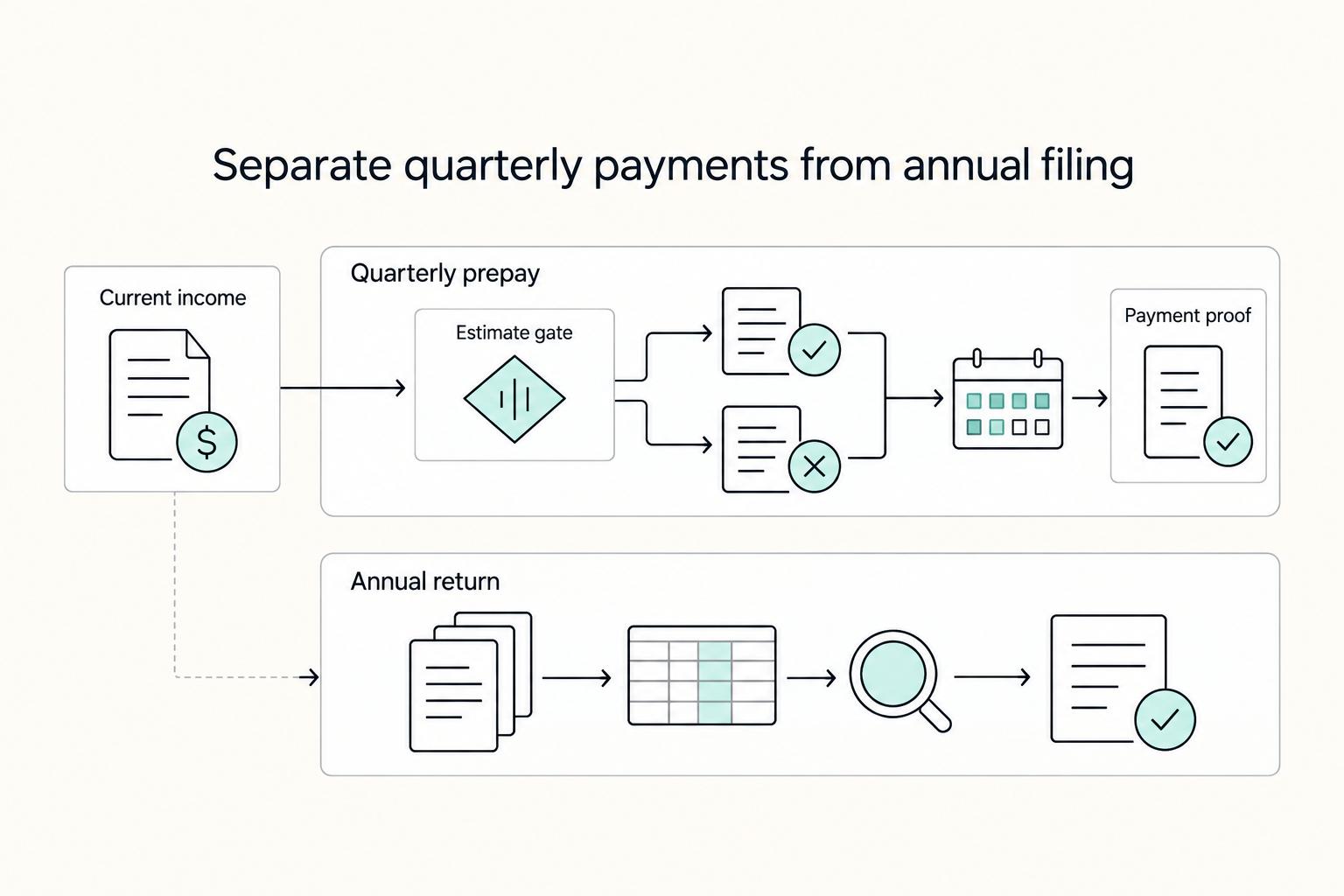
Quarterly Estimated Taxes for Freelancers Without Guesswork
Use this as your start-of-quarter routine: separate the tax tracks, verify the facts, then calculate and pay. That replaces stale assumptions with a routine that cuts surprise balances. At the start of each quarter, define two things first:

How Much Should a Freelancer Save for Taxes? A Monthly Reserve Rule and Quarterly True-Ups
Use one monthly reserve rule, then adjust it with your actual filings and estimated-payment results. If you are asking **how much to save for taxes freelancer** income creates, the practical answer is not one fixed percentage. It is a repeatable process: move money monthly, check it quarterly, and correct course before a shortfall turns into a problem.

How to Set Up an IRS Payment Plan and Keep It Active
Start as soon as you know you cannot pay in full. Waiting usually makes this harder and more expensive because interest and a monthly late-payment penalty can keep accruing, and filing late can add a failure-to-file penalty.