
Quick Answer
Yes, bartering tax implications are real: when you exchange services through your business, you generally include the fair market value you receive as income in the year received. For many freelancers, that amount is typically reported with business earnings, often on Schedule C, even if invoices offset to a $0.00 balance. If the swap runs through an exchange, reconcile any Form 1099-B to your own records; for direct trades, verify current Form 1099-NEC instructions before filing.
Barter can be a smart way to get important work done while protecting cash. It can also go sideways fast when both sides treat it like an informal favor instead of a real business deal. That is when scope creep, strained relationships, and tax trouble show up.
The fix is not to avoid barter. It is to handle it with the same discipline you would use for any paid engagement. This three-pillar framework helps you decide whether a swap is worth doing, document it cleanly, and report it without drama.
Pillar 1: The Strategic Go/No-Go#
Use this gate before you agree: if the deal does not preserve cash, pass your opportunity-cost test, and clear basic partner diligence, decline it. A barter is still a business transaction, and you should treat it that way.
| Decision criterion | Barter | Cash purchase | Walk away |
|---|---|---|---|
| Cash-flow pressure | Best fit when cash is tight and you still need the service | Better when cash is available and simplicity matters more than liquidity | Best when the service is not important enough to fund |
| Delivery risk | Can be higher, because value may be uneven or delayed across both sides | Easier to control with normal vendor options | No counterparty risk |
| Time cost | Often higher, because you add valuation and admin to delivery work | Lower admin burden and less coordination overhead | No execution time |
| Expected business upside | Worth it only when upside is clear (revenue, savings, or risk reduction) | Works for priority work even when swap logistics are awkward | Right move when upside is vague or marginal |
Cash first, not barter first#
Choose barter when cash-flow pressure would otherwise block a service you genuinely need. If you can pay cash and the provider is a normal fit, cash is usually the cleaner move because you avoid extra valuation work and coordination overhead.
If the service is optional, non-urgent, or hard to connect to business results, walk away. Keep the tax side in view. The fair market value of what you receive is included in gross income in the year received, and business barter income is generally reported on Schedule C.
Run the opportunity-cost check#
Before you say yes, run the same check every time. Gather three inputs:
- Your realistic billable rate
- Estimated project hours
- Admin buffer, including revisions, meetings, and coordination
Then use this quick calculation: (Estimated barter hours + admin buffer) x your normal rate = revenue you are giving up
Compare that figure with the fair market value of what you will receive. Use willing-buyer, willing-seller value, not an aspirational list price. If the trade displaces paid work, or if the value you are giving up exceeds what you would pay in cash, decline it. If you use internal limits, apply them here, for example [max barter hours per month] or [minimum expected business upside multiple].
Vet the other freelancer like a paid vendor#
Treat your labor like payment and vet the other side the way you would a paid vendor. Ask for a written scope or estimate, examples of similar work, and proof of recent comparable delivery. Ask directly how many similar projects they completed in the last year. Then check references for timing and on-time completion.
| Check | What to confirm |
|---|---|
| Written scope or estimate | Ask for a written scope or estimate. |
| Similar work | Ask for examples of similar work. |
| Recent comparable delivery | Ask for proof of recent comparable delivery. |
| Project volume | Ask directly how many similar projects they completed in the last year. |
| References | Check references for timing and on-time completion. |
| Dispute setup | Confirm the point of contact, acceptance criteria, and what happens if either side says the work is incomplete. |
Set dispute expectations before work starts. Confirm the point of contact, acceptance criteria, and what happens if either side says the work is incomplete.
A practical rule: if scope, timing, fair market value, or dispute terms are still unclear after clarification, decline the deal. If the work matters, pay cash. If it is not important enough to buy cleanly, it usually is not worth trading your time for it.
Final check: if you use a barter exchange, expect Form 1099-B and IRS matching visibility. In direct service-for-service trades, Form 1099-B is not automatic, and Form 1099-MISC obligations may still apply, but the deal is still reportable income when applicable.
Related: What Are the Tax Implications of an Honorarium Payment?.
Pillar 2: The Execution Protocol - Creating an Unshakeable Audit Trail#
If a trade clears the first gate, stop before delivery and set up the records. A practical order is agreement first, invoicing second, fair market value support third. That sequence helps keep your books clear on gross income, deductions, and credits. It also aligns with IRS recordkeeping guidance, including invoices and supporting records with payee, amount, proof of payment, and date.
Start with a written agreement you can actually defend#
A written agreement is the safest default, even if it is not universally required in every freelancer barter. It can reduce delivery disputes and gives you a clear base for bookkeeping. Before work starts, make sure the agreement covers:
| Agreement item | What to include |
|---|---|
| Parties | Legal/business names and contact details for both parties. |
| Deliverables | Clear deliverables from each side. |
| Scope | Scope boundaries, including out-of-scope items. |
| Acceptance | Acceptance criteria for completion. |
| Revisions | Revision limits, if revisions are included. |
| Timeline | Timeline, milestones, and who owns dependencies such as access, feedback, and approvals. |
| FMV | Agreed FMV for each side's service, plus a short valuation note. |
| Late, partial, or missing delivery | What happens if delivery is late, partial, or missing. |
| Signature evidence | Dated signatures or dated electronic acceptance. |
Also remove these common failure points up front:
- Vague deliverables, for example "branding package," with no clear completion test
- Dates with no ownership for delays like feedback, files, approvals, or access
If you use e-signatures, U.S. federal law generally says a contract cannot be denied legal effect only because the signature or record is electronic.
Know what level of documentation you are choosing#
| Documentation level | Dispute risk | Bookkeeping clarity | Audit defensibility |
|---|---|---|---|
| Handshake only | Usually highest. Scope and timing disagreements are hard to resolve. | Weak. Value and completion details are often incomplete. | Weakest. Little contemporaneous support for entries. |
| Basic written terms | Often moderate. Better, but gaps in acceptance/revisions still cause disputes. | Usable. You can book it, but follow-up questions are common. | Fair. Better than memory, weaker if valuation support is thin. |
| Full audit-trail packet | Usually lowest. Agreement, acceptance, invoices, and valuation support align. | Strong. Gross income and related expense are easier to track consistently. | Strongest. You can show what happened, when, and how value was set. |
Issue invoices like a normal business transaction#
If you would invoice a cash client, invoice a barter the same way. A "zero-dollar invoice" is not a special IRS form, but it can be a strong recordkeeping habit. Use this repeatable flow:
- Issue your invoice when you would normally bill a cash client, whether that is at a milestone or final acceptance.
- Include service description, date, quantity or hours if relevant, unit price, and total FMV.
- Add a line such as
Payment in kind,Barter credit, orOffset by services receivedso net due is$0.00. - Store it with the signed agreement, the counterparty's matching invoice, acceptance proof, and valuation support.
A practical storage rule is to keep one folder per barter with the full packet, then tie your bookkeeping entry to that folder.
Support fair market value before you need it#
Do not wait until tax time to defend value. FMV is the open-market price benchmark. For bartering, you include in gross income in the year of receipt the FMV of goods or services received, even if both sides consider the exchange equal in value. For services, keep documented market evidence you can stand behind. Use one or more defensible methods (practical guidance, not a mandated hierarchy):
- Your normal documented rate for that same service
- A recent invoice or quote for a similar cash engagement
- A written agreed value backed by current market evidence
If the evidence is weak, use the most defensible documented rate you have, then mark the valuation method as pending until it is verified against source records or qualified tax adviser guidance.
Get a tax professional involved when value is highly subjective, services are bundled, a barter exchange is involved, or you are unsure about information returns. Topic 420 says barter exchanges generally file Form 1099-B, and you should receive one through an exchange. For direct service trades outside an exchange, Topic 420 says Form 1099-B is generally not required. Topic 420 says Form 1099-MISC may apply, and IRS contractor guidance says NEC reporting uses Form 1099-NEC, so confirm current instructions before filing.
For record retention, keep the packet at least 3 years in routine cases. If omitted income exceeds 25% of gross income shown on the return, exposure can extend to 6 years.
Before you exchange deliverables, lock scope, ownership, and acceptance criteria in writing so your barter records hold up later. Start with the freelance contract generator.
Pillar 3: The Reporting Workflow - Making Tax Time a Non-Event#
Once the documentation packet is complete, reporting should be routine. Record every barter as gross non-cash income. If the received side is business-related, record the related business expense separately rather than netting entries to zero and skipping the income entry.
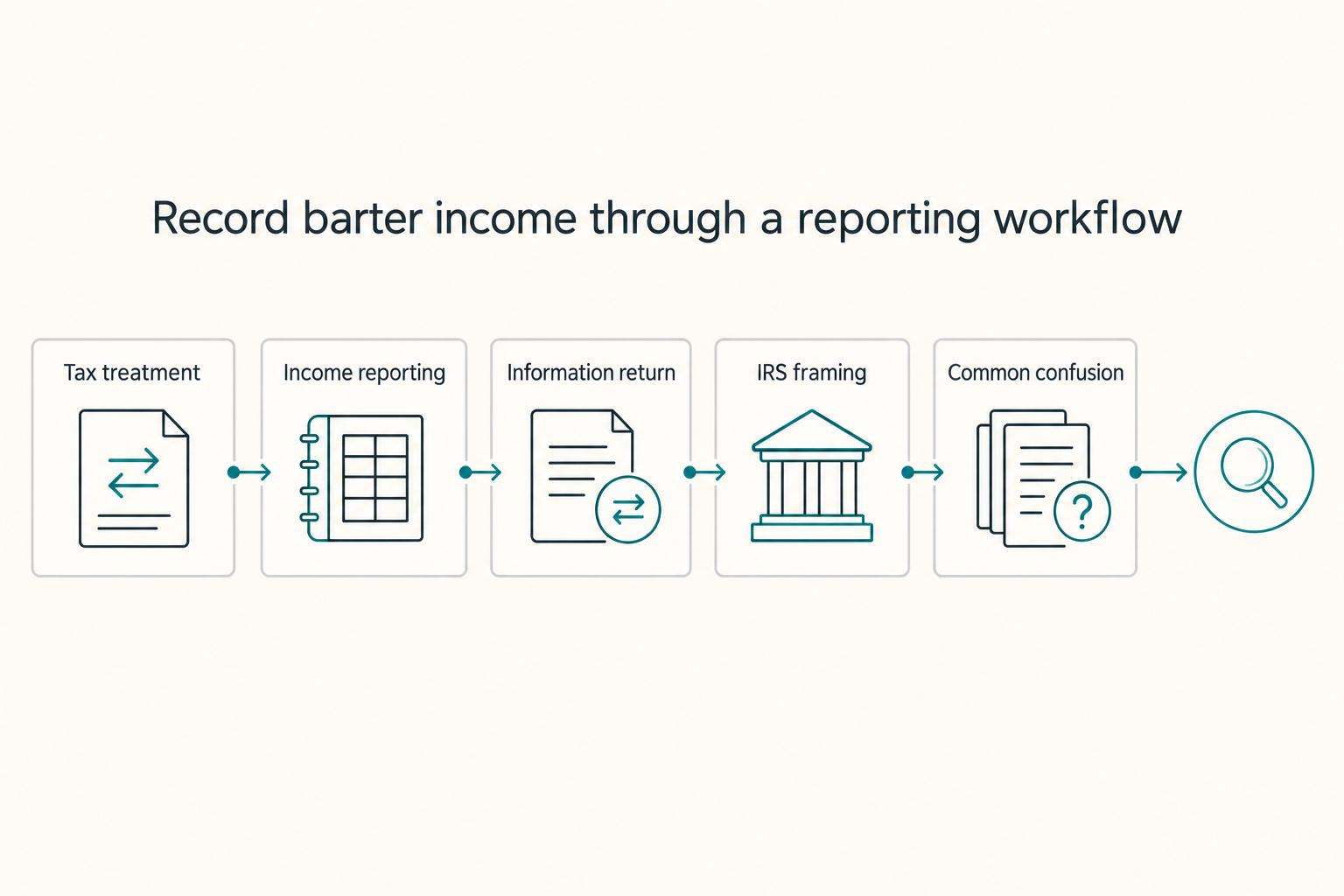
IRS Topic 420's core rule is straightforward: include the fair market value of what you received in gross income in the year of receipt. If you normally report business income on Schedule C (Form 1040), barter income generally belongs there too. Treat barter like any other business transaction.
Use the same sequence every time#
| Step | What to do | Key detail |
|---|---|---|
| Classify the transaction | Label it as either direct freelancer-to-freelancer barter or barter exchange platform barter. | Also label the received service as business, mixed-use, or personal-use. |
| Post the income entry | Record gross income at supportable fair market value in the year of receipt. | In most cases, use your written agreement and invoice records to support that value. |
| Post the expense entry | Record the received service as a business expense only to the extent it is business-related. | Use the correct expense category. |
| Reconcile documentation | Tie entries to the agreement, invoices, and valuation support. | Values, dates, parties, and service descriptions should match, or include a short explanation. |
| Prepare filing | Route income to the proper return. | Confirm whether an information return is required under current instructions. |
Two common errors to avoid are posting one net "barter zero effect" entry that hides gross receipts, and posting income without keeping related records aligned when both sides were completed in the same period.
Route forms by transaction type#
| Reporting point | Direct freelancer-to-freelancer barter | Barter exchange platform |
|---|---|---|
| Core treatment | Taxable; include fair market value received in income | Taxable; include fair market value received in income |
| Income reporting | Generally reported with business income, often on Schedule C (Form 1040) | Still reported on your return |
| 1099-B handling | Direct traders are not required to file Form 1099-B just because it is barter | Barter exchange files Form 1099-B |
| IRS framing | Topic 420 says direct traders are not required to file 1099-B and may have an information-return obligation | Topic 420 says you should receive Form 1099-B and IRS receives the same info |
| Common confusion | Using 1099-B for private trades, or relying on outdated 1099-MISC assumptions without checking current rules | Treating received 1099-B as a substitute for your own books and records |
For direct service trades, do not rely on old templates. IRS contractor-payment guidance routes nonemployee compensation reporting to Form 1099-NEC, so verify current instructions before filing.
Is an information return required?#
Use this as a last pass before filing:
- Was this a direct trade outside a barter exchange? If no, confirm platform reporting and any Form 1099-B received.
- Was the payment in the course of your trade or business?
- Is the payee a U.S. recipient type for nonemployee compensation reporting?
- Does the annual total meet the current threshold under Form 1099-NEC guidance? Current threshold pending official IRS/source/adviser verification.
- Is the payee a nonresident alien? If yes, check Form 1042-S and withholding rules instead of default domestic 1099 logic.
Final risk-control note: do not treat service-for-service barter as a Section 1031 like-kind exchange. For 2018 and later years, Section 1031 applies only to exchanges of real property. Freelancer service swaps are generally taxable. If entity structure, cross-border facts, or mixed personal/business use are involved, consult a tax professional before filing. If you want a deeper dive, read our guide to a defensible 2026 filing plan.
From Liability to Asset: Adopting the Barter Framework#
Treat every business barter like paid client work. That is how you stay in control of the tax implications and reduce avoidable reporting problems.
Assess#
Decide first whether the trade belongs in your business records. If you are exchanging services through your freelance business, each transaction is taxable to both parties. Include fair market value in gross income in the year you receive it.
Use one decision gate: if you cannot support the value with your normal pricing, a recent comparable invoice, or another clear market reference, pause and document the valuation before you proceed. The payoff is simple: you start with a defensible fair market value instead of a guess.
Execute#
Build the transaction file before work starts. Keep records that clearly show income and expenses, including scope, transaction date, fair market value at the time of the trade, and other pertinent details (such as proof the work was delivered and accepted).
Use one execution standard: keep records your bookkeeping system can tie to the same trade. The payoff is that you have the documentation needed to support what you report.
| Dimension | Informal barter | Framework-based barter |
|---|---|---|
| Risk exposure | Valuation and reporting gaps are common | Lower exposure because value and timing are documented |
| Documentation quality | Scattered messages and memory | Scope, dates, FMV records, delivery/acceptance proof |
| Tax-readiness | Hard to reconcile at filing time | Ready for Schedule C reporting or 1099-B reconciliation |
| Strategic business value | One-off convenience | Repeatable operating process |
Report#
Report based on transaction type. Direct business barter is generally reported on Schedule C, while barter exchange activity typically comes with Form 1099-B that you should reconcile to your own records.
Use one reporting workflow: classify, report in the correct year of receipt, and reconcile to your records. If income was missed, correct it with Form 1040-X, and remember barter income may require estimated tax payments. Run this way, barter is not a workaround. It is a managed process you can repeat with your existing checklist. Related: Do I Have to Pay State Taxes While Living Abroad as a Digital Nomad?.
If you want this framework to stay practical year-round, track your tax-residency and compliance milestones in one place with the tax residency tracker.
Frequently Asked Questions
What if the IRS questions the fair market value I used?
Use a fair market value you can support when you file, and include it in gross income in the year you received the goods or services. Keep clear records of what was exchanged and how you determined value. If your records conflict or the valuation is unusual, ask a tax professional to review it before filing.
Which form applies for direct barter, a barter exchange, or neither?
Start by classifying the transaction as direct barter or barter exchange. That choice drives information reporting and helps you avoid using the wrong form. Then report barter income in the right place on your return and reconcile it to your records. | Situation | Main IRS reporting signal | What you do next | |---|---|---| | Direct business barter outside an exchange | Direct traders generally are not required to file Form 1099-B just because it is barter; Form 1099-MISC may be required | Report business barter income, generally on Schedule C (Form 1040), and keep complete transaction records | | Barter exchange transaction | The exchange files Form 1099-B; you should receive it and the IRS receives the same information | Reconcile the 1099-B to your records and still maintain your own documentation | | Nonbusiness barter income | Barter income not connected to a business is generally reported on Schedule 1 (Form 1040) | Confirm the correct placement on your return |
Can you barter with someone in another country?
You can, but cross-border barter specifics are outside the scope of this section. Verify country-specific reporting and tax treatment with a qualified tax professional before filing. Keep complete transaction records.
What is the most common compliance mistake, and how do you fix it?
A common compliance mistake is failing to report fair market value barter income in the year of receipt. If you already missed income, correct the return with Form 1040-X and make sure the amended amounts tie back to your transaction records. If the file is incomplete, get professional help before you amend.
Try a related tool
Researched and edited by the Gruv editorial team. Gruv builds cross-border billing, payouts, and finance-operations software for global businesses.
Sources
- bulkorder.ftc.gov/system/files/publications/pdf-0057-hiring-co...trusted
- ecfr.gov/current/title-26/chapter-I/subchapter-B/part...trusted
- irs.gov/taxtopics/tc420trusted
- irs.gov/pub/irs-utl/OC-Barteringandtrading-eachtrans...trusted
- michigan.gov/taxes/-/media/Project/Websites/treasury/Rule...trusted
- uscode.house.gov/view.xhtmltrusted
Educational content only. Not legal, tax, or financial advice.
Related Posts

Digital Nomad Taxes in 2026 With a Defensible Filing Plan
With digital nomad taxes, the first move is not optimization. It is figuring out where you may be taxable, where filings may be required, and what proof supports that position.

Do I Have to Pay State Taxes While Living Abroad as a Digital Nomad?
Living abroad does not end `state income tax` exposure by itself. The first decision is practical: choose a filing position your facts can support, then build records that support the same story all year.

The Freelance Payment Penalty: A Modeled Audit of Platform Fees, FX Spreads, and Payout Delays
The money rarely disappears through a single, easy-to-spot fee. The real loss is stacked. A marketplace takes its commission, a processor adds a charge for international cards, a bank or payment company converts the currency at a spread, a platform holds the funds before release, and a wire sheds a little to intermediaries on the way in. Each layer looks defensible on its own, but the worker feels the combined result as a smaller deposit and a later payday.