
Quick Answer
Choose your exemption first: match outreach to Rule 506(b) or Rule 506(c), map each investor’s state, then file Form D in EDGAR after the first irrevocable contractual commitment. Next, complete required state notices and fees, using EFD where available and confirming any non-EFD path directly. Keep subscription documents, submission confirmations, and payment receipts together so later diligence is faster and less disputed.
Why State Securities Law Matters From the Start of Your Raise#
If you are raising money, state securities law matters from the start. For most startups, the blue sky laws that matter are the state securities rules that sit alongside federal securities law. Even if your round fits a federal exemption, states may still require notice filings, fees, and compliance with anti-fraud rules as money comes in.
Blue sky laws exist to protect investors from fraudulent sales practices, and each state has its own securities regulator. That is where founders often get tripped up. A Rule 506 offering can avoid state registration and review, but that does not wipe out state authority. States still retain anti-fraud enforcement power, and they can require notice filings based on documents you already filed with the SEC.
| Issue | Federal exemption effect | State authority |
|---|---|---|
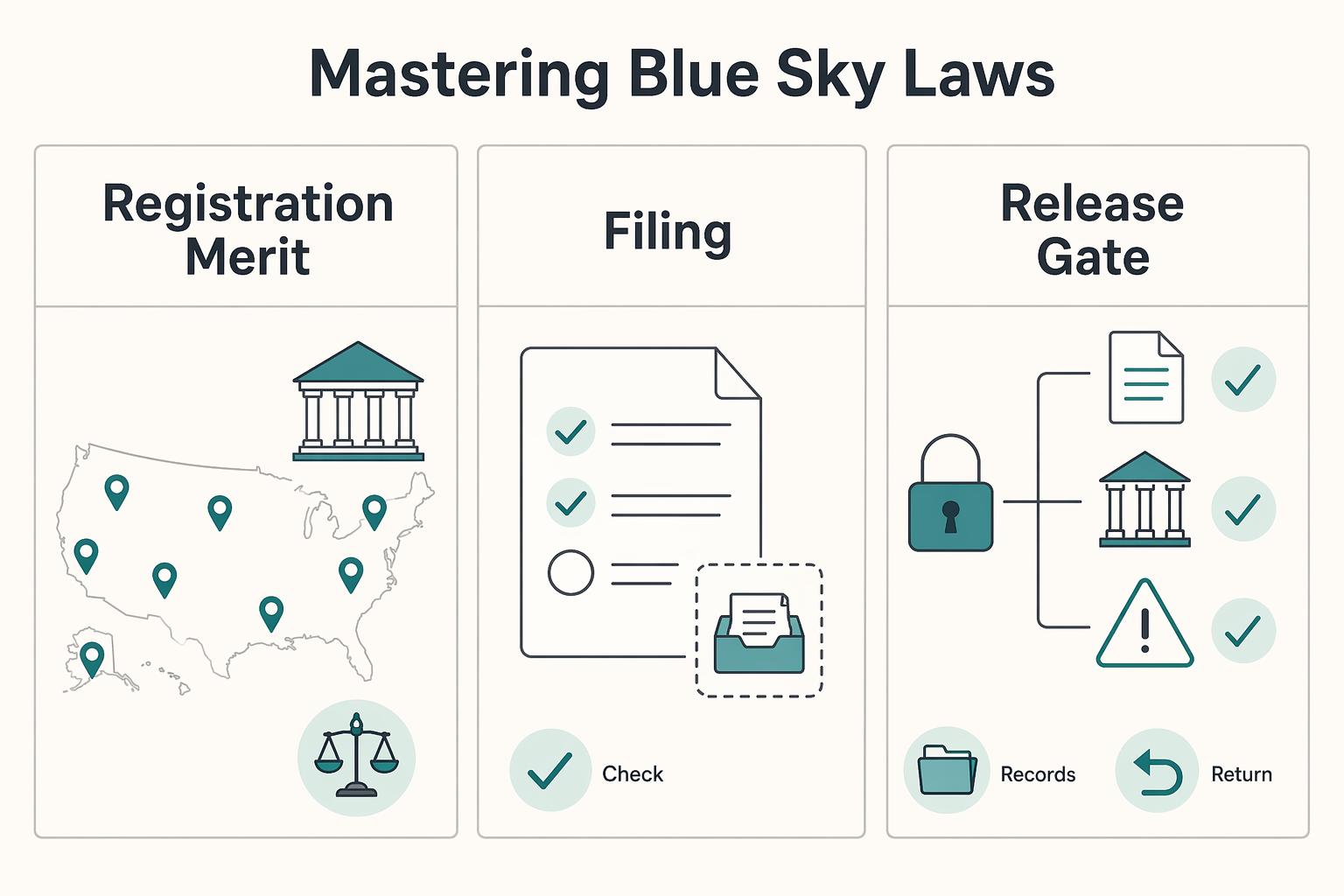
| Registration and merit review | Rule 506(b) and 506(c) offerings are not subject to state registration and review | Registration is generally preempted for covered securities; confirm the current state notice requirement with the state securities regulator |
| Notice filings | Form D is the SEC notice for certain exempt offerings | States may require notice filings using SEC-filed documents; confirm the current filing requirement with the state securities regulator |
| Fees | No federal preemption of state fee collection for notice filings | State-specific fees apply; confirm the current fee requirement with the state securities regulator |
| Anti-fraud enforcement | Exempt offerings still face federal anti-fraud rules | States retain authority to investigate and bring fraud actions |
Before you accept any money, lock down three things: your exemption choice, your investor-state map, and your evidence pack. If you plan to avoid public marketing, Rule 506(b) bars general solicitation. If you plan to advertise, Rule 506(c) permits it, but you must take reasonable steps to verify accredited investor status.
Your first compliance checkpoint is Form D. For applicable exempt offerings, file it within 15 days after the first sale, and the first sale is when the first investor is irrevocably contractually committed. Then confirm each investor's state notice path, because state laws are not identical and EFD is useful for certain Rule 506 state filings, not a universal answer.
Keep the signed subscription documents, Form D, state submissions, fee receipts, and investor verification records together. That makes your compliance record cleaner and diligence responses easier.
For another legal compliance topic, see A Guide to California's Meal and Rest Break Laws.
Part 1: The Strategic Framework (Before You Raise a Dollar)#
Before outreach, lock down three decisions: your investor map, your exemption path, and your execution owner. If you start conversations before those are set, you risk inconsistent behavior that can weaken your securities compliance position later.
Start with the threshold question: are you offering a security? Federal and state securities rules apply only when the instrument is a security, and for startup fundraising, anything beyond a simple bank or personal loan is generally treated that way. Under Section 5 of the Securities Act, offers and sales of securities must be registered unless an exemption applies, so your job is to choose and follow the exemption path before momentum takes over.
Build the investor map before outreach#
Create the map before you send a deck. Treat it as your live control sheet for scope, consistency, and record ownership.
| Map field | Why it matters |
|---|---|
| Full legal name | Keep one row for each prospective investor |
| Residence jurisdiction | Helps identify where state-level obligations may arise |
| Investor type | Helps confirm that planned offering behavior still matches the chosen exemption path |
| Relationship context | Helps confirm that planned offering behavior still matches the chosen exemption path |
| Documentation owner | Prevents record drift across inboxes and spreadsheets |
Use one row per prospective investor with these fields:
- full legal name
- residence jurisdiction
- investor type
- relationship context
- documentation owner
Use the map to pressure-test execution early. Residence jurisdiction helps you identify where state-level obligations may arise. Investor type and relationship context help you confirm that your planned offering behavior still matches your chosen exemption path. Documentation owner prevents record drift across inboxes and spreadsheets.
Practical rule: if residence jurisdiction or relationship context is missing, pause outreach to that person until it is complete.
Choose the exemption that matches how you will raise#
For most startups, this is an operating decision between Rule 506(b) and Rule 506(c). Regulation D can reduce the registration burden, but only if your real-world conduct matches the rule you selected.
| Decision point | Rule 506(b) | Rule 506(c) |
|---|---|---|
| Solicitation | No general solicitation | General solicitation permitted |
| Investor eligibility | Confirm current eligibility conditions, including any non-accredited participation limits, before launch | Accredited investors only; confirm current standard before launch |
| Verification burden | Lower process burden than 506(c), but keep a reasonable basis for investor-status assumptions and records | Must take reasonable steps to verify accredited investor status |
| Operational tradeoff | Better fit for private outreach within a defined network | Better fit when you need public reach and can run stricter verification operations |
Stay consistent after you choose. A common failure point is public-facing 506(c)-style outreach followed by a later attempt to close as 506(b). Integration risk is real. For example, when a 506(c) offering with general solicitation ends and a 506(b) offering starts 30 days later, you need a reasonable belief that investors in the new offering were not solicited in the earlier public effort.
Decide who owns execution#
Assign ownership before outreach starts. If nobody owns records, tracking, and proof assembly, even a sound legal strategy can fail in execution.
Use this triage to decide how much counsel leadership you need:
| Scenario | What it usually looks like | Ownership approach |
|---|---|---|
| Simple | One instrument, one exemption path, no public marketing, short known investor list | Internal admin can track execution; have counsel confirm exemption fit and documents |
| Mixed | Investor list expanding through introductions, terms evolving, or data quality still uneven | Bring counsel in early to validate path and controls before outreach widens |
| Complex | Public promotion, 506(c) posture, or overlapping offerings that raise integration questions | Put securities counsel in the lead from the start |
What to avoid before you raise
- Starting outreach before choosing the exemption path.
- Letting investor data stay inconsistent across systems.
- Assuming a federal exemption removes state-law obligations.
Related reading: Taxes in Germany for Freelancers and Expats. If you want a quick next step, Try the SOW generator.
Part 2: The Filing Checklist (Form D First, Then State Notices)#
Treat execution as a checklist: validate your data, file Form D in EDGAR, submit state notices, and preserve proof for renewals and diligence.
Validate before you submit anything#
Do this before you open EDGAR. Form D is the SEC notice for a Regulation D exempt offering. It must be filed online in EDGAR, paper filings are not accepted, and the SEC does not charge a Form D filing fee. You also have only one hour after your last keystroke to complete a Form D filing, so resolve mismatches first.
| Form D detail | Rule |
|---|---|
| Filing channel | It must be filed online in EDGAR |
| Paper filing | Paper filings are not accepted |
| SEC fee | The SEC does not charge a Form D filing fee |
| Session limit | You have only one hour after your last keystroke to complete a Form D filing |
| Filing deadline | File within 15 days after the first sale; if day 15 is a weekend or holiday, the due date rolls to the next business day |
Run a pre-submit reconciliation across:
- your offering documents
- your investor roster
- your draft state notice tracker
Check for inconsistencies in issuer naming, related persons, offering amount language, investor counts, and the first-sale date. For Form D timing, first sale is when the first investor is irrevocably contractually committed, not just when money lands in your account. File within 15 days after that trigger; if day 15 is a weekend or holiday, the due date rolls to the next business day.
If you cannot point to the exact signed record supporting the first-sale date, pause and resolve it first.
File federally first, then push state notices#
File in EDGAR first, then use that accepted filing to drive state notices. Submit during the SEC processing window (6:00 a.m. to 10:00 p.m. ET, weekdays, excluding federal holidays), and keep the EDGAR accession number ready for EFD lookup.
Use this operating flow:
- Set up or confirm your EFD account before deadline week.
- In EFD, locate the offering using the EDGAR accession number.
- Select the jurisdictions that require notice.
- Confirm fee calculations.
- Pay by ACH where available.
- Save confirmations, payment receipts, and the EFD ID.
Track costs correctly: state filing fees plus EFD system-use fees, including the $160 initial Form D notice system-use fee. Also plan for exceptions. EFD status varies by jurisdiction and filing type (required, available, or unavailable), and configurations can change. If a process is not available in EFD, mark it as Current state process pending official verification and keep direct regulator confirmation in your records.
| Jurisdiction | Filing path | Fee logic | Renewal trigger | Status |
|---|---|---|---|---|
| Investor state 1 | Confirm the current state process with the state securities regulator | Confirm the current fee requirement with the state securities regulator; include EFD system-use fee if applicable | Confirm the current renewal requirement with the state securities regulator | Draft / Filed / Confirmed / Renewal due |
| Investor state 2 | Confirm the current state process with the state securities regulator | Confirm the current fee requirement with the state securities regulator; include EFD system-use fee if applicable | Confirm the current renewal requirement with the state securities regulator | Draft / Filed / Confirmed / Renewal due |
| Investor state 3 | Confirm the current state process with the state securities regulator | Confirm the current fee requirement with the state securities regulator; include EFD system-use fee if applicable | Confirm the current renewal requirement with the state securities regulator | Draft / Filed / Confirmed / Renewal due |
Prevent the avoidable failures#
Most failures come from timing mistakes, inconsistent disclosures, missed renewals, or weak records, not from complex legal theory.
- Do not misread the trigger date. If contractual commitment happened before cash receipt, your deadline likely started earlier.
- Keep disclosures aligned across every document. Form D, subscription documents, and state notices should match.
- Track ongoing obligations. If the offering continues for more than 12 months, file the required annual Form D amendment, and monitor state-specific renewal rules.
- Maintain a complete audit trail. Keep Form D, EDGAR acceptance, accession number, EFD ID, payment records, state confirmations, and first-sale support documents together.
Escalate to securities counsel immediately for edge cases, especially unavailable EFD paths, unclear first-sale timing, potential late filings, or multi-issuer offerings with possible extra state requirements.
For another comparison-heavy walkthrough, see Digital Nomad Health Insurance: A Comparison of Top Providers.
Part 3: Post-Filing Governance (Maintaining a "Clean Room" for Future Rounds)#
After the initial filings are done, your edge is operational discipline: keep records current, traceable, and easy to retrieve. Treat every post-filing change as a potential amendment question until it is reviewed and logged.
Use a trigger rule for amendments#
Use one default rule: if a new fact could change something you already filed, open an amendment review ticket immediately. In practice, that can include updated financing documents, changed terms, corrected transaction facts, changes in related people, or new security mechanics tied to future dates.
| Potential trigger | Default action |
|---|---|
| Updated financing documents | Open an amendment review ticket immediately |
| Changed terms | Open an amendment review ticket immediately |
| Corrected transaction facts | Open an amendment review ticket immediately |
| Changes in related people | Open an amendment review ticket immediately |
| New security mechanics tied to future dates | Open an amendment review ticket immediately |
Your job is not to guess legal materiality on the fly. Capture the change, route it to your reviewer, and preserve the source document and decision trail. For jurisdiction-specific rules, verify the current amendment trigger from official legal or source records before use.
Track each review with:
- date identified
- source document
- filing potentially affected
- assigned reviewer
- decision and follow-up action
If your instruments have lifecycle dates, track those as governance triggers. One SEC filing, for example, states public warrants become exercisable 30 days after the closing of the Business Combination and expire five years from the closing of the Business Combination.
Build a clean room that survives diligence#
Your clean room should let a third party verify what happened without email archaeology. Keep the filed record, submission proof, and stable identifiers together every time.
A practical structure:
| Category | What to save | Naming convention |
|---|---|---|
| Core filings | Final filed document set and submission proof | YYYY-MM-DD_Filing_[type]_[issuer]_FINAL |
| Confirmations | Acceptance records, IDs, payment records | YYYY-MM-DD_Confirmation_[jurisdiction]_[id] |
| Trigger docs | Signed docs, approvals, and change records | YYYY-MM-DD_Trigger_[topic]_v01 |
| Source copies | Official legal copies used for decisions | YYYY-MM-DD_OfficialSource_[topic] |
| Amendment log | Issue date, owner, decision, next step | YYYY-MM-DD_AmendmentLog |
Where available, store filing markers exactly as shown in the record (for example, Registration No. 333-293179 and Filed Pursuant to 424(b)(3)). Assign one owner, one backup owner, and use version labels (draft, signed, submitted, final) consistently.
Keep a short governance cadence#
Run a recurring review to reconcile your filing records against current company records and your amendment watchlist. The goal is simple: every filing reference should still have a complete proof package, and every new change should be either closed or escalated.
Also pay attention to source reliability. FederalRegister.gov states it is not an official legal edition and says legal research should be verified against an official edition; pages can also return a 500 Server Error, and agency sites can be unavailable during scheduled maintenance. Save official copies when you make decisions so diligence is not blocked by outages later.
In practice, this means faster diligence cycles, fewer follow-up questions, and fewer avoidable compliance surprises in the next round.
For a step-by-step walkthrough, see How to Create a Financial Forecast for a Funding Round.
Conclusion: Transform Compliance from a Hurdle into a Strategic Advantage#
The point of all this recordkeeping is simple: good compliance work gives you a cleaner raise to defend later. If you map investors by state, choose the right Rule 506 path, file cleanly, and keep post-filing records current, you are not just checking boxes. You are building a traceable process that gives you better visibility into whether the offering is being run in line with the rules.
The decisions that matter most are concrete. Pick Rule 506(b) if you will not use general solicitation or advertising. Pick Rule 506(c) only if broad marketing fits the raise and you are prepared to verify accredited investor status. File Form D on EDGAR within 15 days after the first sale, and do not guess at that date. The SEC ties it to when the first investor is irrevocably contractually committed. Then complete the required state notice filings and fees, remembering that state obligations continue alongside the federal exemption and that EFD is useful but not universal.
What to do next#
- Build your investor-by-state map before money comes in.
- Confirm whether your raise fits Rule 506(b) or Rule 506(c).
- Mark the first sale date based on when the first investor is irrevocably contractually committed.
- Prepare and file Form D within 15 days after first sale.
- Check each investor state for notice filings, fees, and filing method.
- Verify and record the current filing trigger from official legal or source records.
- Verify and record the current amendment trigger from official legal or source records.
- If the offering stays open more than 12 months, review the annual Form D amendment requirement.
- Save your proof package: filed forms, confirmations, receipts, accession numbers, EFD IDs, and the document supporting the first-sale date.
- Escalate any edge case or unclear state issue to qualified counsel.
That is the practical value of blue sky compliance in a startup raise: not a one-time paperwork task, but part of professional fundraising operations.
You might also find this useful: How to Price AI-Assisted Freelance Services.
Frequently Asked Questions
How should you budget for compliance?
Budget by investor state, not by a generic national estimate. Because blue sky laws are state-level securities laws, your cost depends on where your investors are and what each state currently requires. Separate filing costs from legal review costs, and verify the current fee and filing window from official state source records before any closing.
How do you choose between Rule 506(b) and Rule 506(c)?
Choose based on outreach first, then filing. The Rule 506 paths have different conditions, and details can change the compliance outcome, so confirm fit with securities counsel before launch. If you are unsure, freeze the outreach plan before anyone posts, pitches publicly, or shares broad marketing materials.
What happens if you get this wrong?
The risk is concrete, not theoretical. If exemption conditions are not met, purchasers may be able to return their securities and obtain a refund, and even exempt offerings remain subject to federal antifraud rules and possible civil, administrative, or criminal proceedings, as well as private actions. Future investors may also treat messy filings or missing notices as a diligence problem.
Do you need a lawyer, or can you file yourself?
You should involve securities counsel when you are choosing the exemption, judging whether communications count as advertising, handling unusual investor profiles, or interpreting a state-specific rule. Uploading forms may be administrative, but deciding what exemption you are claiming is legal judgment. A practical split is "counsel must decide" versus "team can submit," with the legal calls cleared before filing.
What should you confirm for each investor state before filing?
Do not assume every state accepts the same documents, timing, or fee logic. For each investor state, verify the current filing type, filing method, fee basis, filing window, and whether a state-specific exemption notice is required instead of, or alongside, your federal filing. California shows why this matters: if you are relying on Corporations Code section 25102(f), a Limited Offering Exemption Notice is required, and DFPI says the FRANSES portal can be used to file and pay online.
Try a related tool
Researched and edited by the Gruv editorial team. Gruv builds cross-border billing, payouts, and finance-operations software for global businesses.
Sources
- dfpi.ca.gov/rules-enforcement/laws-and-regulations/law-a...trusted
- dfpi.ca.gov/rules-enforcement/laws-and-regulations/law-a...trusted
- dfr.vermont.gov/securities/corporate-finance/notice-filingtrusted
- federalregister.gov/documents/2015/04/20/2015-07305/amendments-f...trusted
- investor.gov/introduction-investing/investing-basics/glos...trusted
- investor.gov/introduction-investing/investing-basics/glos...trusted
- sec.gov/resources-small-businesses/exempt-offerings/...trusted
- sec.gov/about/divisions-offices/division-corporation...trusted
Educational content only. Not legal, tax, or financial advice.
Related Posts
Taxes in Germany for Freelancers and Expats
Low-stress compliance in Germany comes from decision order, not tax tricks. Use this sequence: confirm core facts, apply conservative temporary assumptions, verify the few points that can break invoices or filings, and keep one evidence file that explains each decision.

Digital Nomad Health Insurance Comparison for Long-Stay Moves
Use focused time now to avoid expensive mistakes later. Start with a practical `digital nomad health insurance comparison`, then map your route in [Gruv's visa planner](/tools/visa-for-digital-nomads) so we anchor policy checks to your real plan before pricing pages pull you off course.

How to Price AI-Assisted Freelance Services
Protect cashflow first, then optimize upside. Late-payment risk rises when scope is unclear, approval ownership is loose, and payment terms are left until late in the process.