
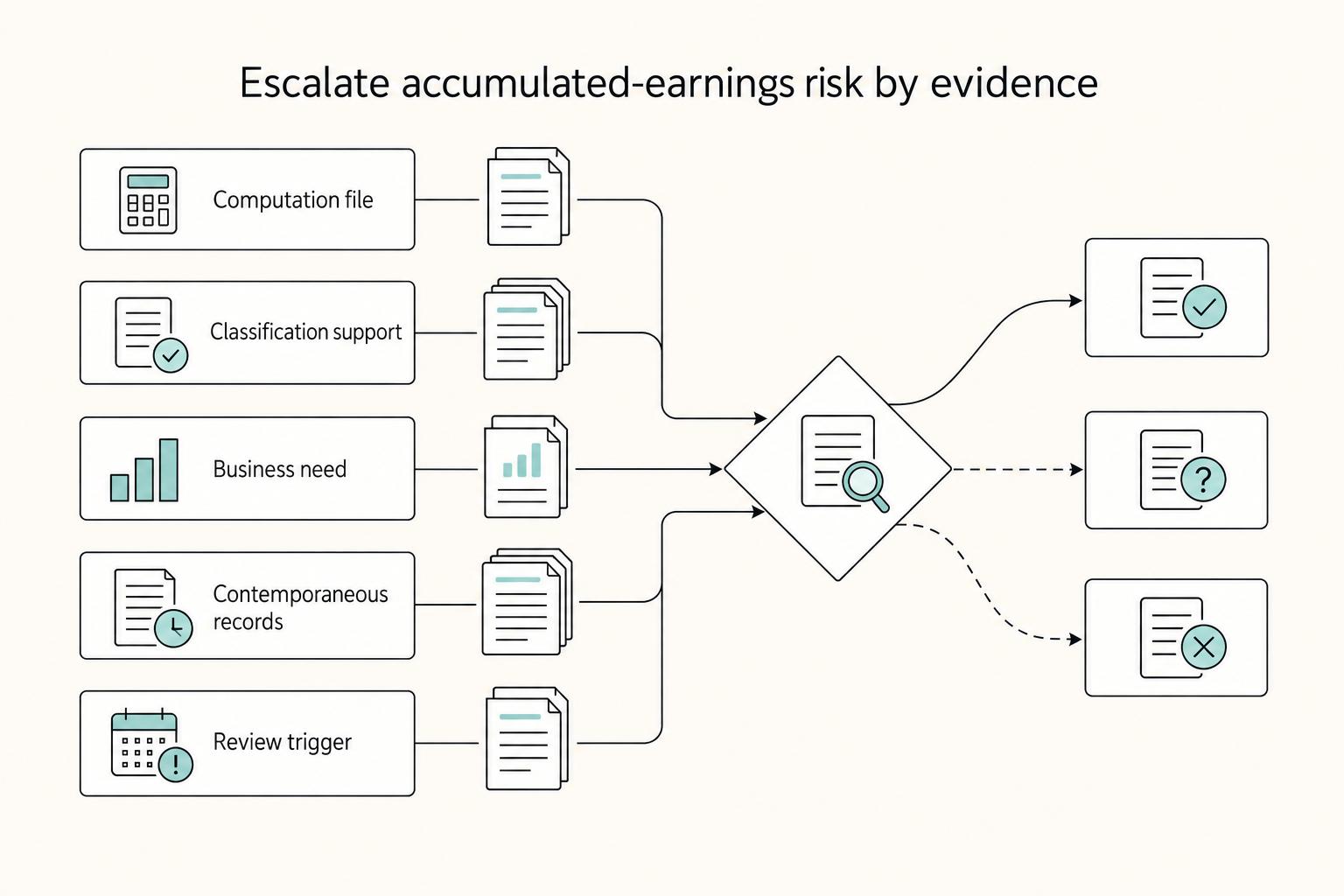
Quick Answer
The accumulated earnings tax is a separate corporate-level tax under IRC 531 that can apply when a C-corp retains profits without a defensible business reason. The IRS review focuses on whether retained amounts match the reasonable needs of the business and whether your records clearly show intent, business purpose, and support for each material retained balance.
Why accumulated earnings tax turns on documented business need, not the size of your retained balance#
Retaining earnings in a corporation can raise accumulated earnings tax questions, so you need a defensible business reason for the accumulation. The review turns on whether retained profits match the reasonable needs of the business and whether your records support that position.
This is a U.S. federal tax issue with a defined IRS review lens, not blog folklore. The Internal Revenue Manual includes a dedicated section for Accumulated Earnings Tax under IRC 531 at IRM 4.10.13.2. It separates "Indicators of Intent" from "Reasonable Needs of the Business." That is the mental model for this guide. The question is not just how much cash you retained, but why you retained it and how clearly the file shows that.
Risk rises when retained earnings stop looking tied to business needs and start looking like passive cash build. The same IRM section also includes a "Holding or Investment Company" lens within the AET review.
If your position is challenged, you may need to show your work in a file that stands on its own. The IRM section includes "Data to be Furnished When Application of IRC 531 is Recommended." It also includes checkpoints for "Notification of Unreasonable Accumulation of Earnings" in 4.10.13.2.8 and "Rebuttal Statement by Taxpayer" in 4.10.13.2.9.
This guide focuses on decision quality and evidence within that IRS framework. Scope note: this covers the U.S. federal concept under IRC 531.
For a step-by-step walkthrough, see Delaware C-Corp Franchise Tax: Filing Methods, Deadline, and Annual Checklist.
Build the core mental model first#
Start with this: IRM 4.10.13.2 treats Accumulated Earnings Tax (IRC 531) as its own review topic. The IRS framework is explicit about what gets reviewed under AET:
- Considerations in Computing Accumulated Earnings and Profits
- Indicators of Intent
- Reasonable Needs of the Business
- Holding or Investment Company
So the practical standard is not just the size of the retained balance. It is whether your records clearly connect retained amounts to business needs and show intent in a way an outside reviewer can follow.
Use this checkpoint: could someone open your file today and match each major retained balance to a dated business rationale? If an examiner recommends applying IRC 531, IRM 4.10.13.2.7 points to data to be furnished. The process can then move through 4.10.13.2.8, notification of unreasonable accumulation, and 4.10.13.2.9, taxpayer rebuttal.
Know when retained cash becomes an AET risk#
A key risk signal is not simply a large cash balance. It is a growing retained balance that your file cannot tie to the reasonable needs of the business.
Under an IRC 531 review, the IRM points examiners to multiple lenses. It explicitly includes "Indicators of Intent," "Reasonable Needs of the Business," and "Holding or Investment Company." A growing retained earnings balance becomes more vulnerable when there is no contemporaneous operating rationale an examiner can follow on paper.
Use a blunt test: if you cannot explain each major retained tranche in one sentence tied to operations, treat that as a current audit vulnerability.
You also need to watch how retained cash is positioned. Because "Holding or Investment Company" is a named review area, asset mix and use of funds can affect how your posture is read. That does not make every non-operating position a problem automatically, but it can raise risk when the business link is unclear.
If IRC 531 application is recommended, IRM 4.10.13.2.7 covers the data-furnishing step. If there is a finding of unreasonable accumulation, IRM 4.10.13.2.8 covers notification, and IRM 4.10.13.2.9 covers taxpayer rebuttal. In practice, your support should exist before that sequence starts.
Do this now:
- Map each material retained balance to a dated business need.
- Flag balances or asset positions where the operating link is weak.
- Create a short corrective memo for weak spots instead of relying on verbal explanation later.
Read thresholds and credits correctly#
Treat commonly cited baseline amounts, including PSC shorthand, as screening markers only. They tell you when to look harder. They do not decide AET exposure.
Being near a threshold can create false comfort. Under the Section 531 framework, this is still an additional corporate-level tax layer, and threshold references alone do not resolve exposure. If your file cannot show a dated business reason for the retained amount, a threshold talking point is not much of a defense.
Where the credit actually fits#
The accumulated earnings credit under Section 535(c) belongs inside the accumulated taxable income computation, not as a separate afterthought. It reduces taxable income in that computation.
For a corporation that is not a mere holding or investment company, the credit is determined under 26 CFR § 1.535-3(b) and tied to amounts retained for reasonable business needs, reduced by the Section 535(b)(6) deduction. The credit also cannot be less than the minimum credit under Section 535(c)(2). The dividends paid deduction fits into the same computation, so your workpapers should clearly bridge taxable income, credit, deductions, and retained amounts.
Decision checkpoints#
| Signal | What it may mean | Documentation to support the position | When to escalate to a tax professional |
|---|---|---|---|
| You are relying on a commonly cited baseline amount for a regular C corporation | You are screening, not proving retained earnings were justified | A year-specific workpaper that bridges taxable income to accumulated taxable income, plus contemporaneous support for business need | Escalate if retained balances are material and the defense is mostly verbal |
| PSC treatment may apply | Shorthand assumptions may not fit your facts | Classification support and the same computation-and-business-need workpapers | Escalate early if PSC status is uncertain or central to your position |
| You tracked book retained earnings but not the Section 535(c) credit mechanics | You may be using the wrong base for risk decisions | Computation support showing credit treatment, Section 535(b)(6) deduction treatment, and dividends paid deduction treatment | Escalate if the file cannot stand on its own without oral explanation |
| You retained cash for operations and are not a mere holding or investment company | Credit treatment may depend on what was retained for reasonable business needs | Dated, contemporaneous records linking retained amounts to business use | Escalate if the business-use link is weak or can only be reconstructed after the fact |
| False comfort: you are near a threshold and assume that is enough | "Near the line" does not replace the underlying factual analysis | A concise memo showing why the retained amount was needed in the business at that time | Escalate if your lead argument is the threshold, not the documented need |
If your position starts with a threshold and only later tries to explain business need, reverse that order now.
Use a quarterly retain distribute or consult decision sequence#
Use a quarterly retain, distribute, or consult decision as an internal control. The point is to document intent and business need while decisions are being made, not rebuild the story at year end.
Step 1. Quantify amounts before dividend discussions#
At each quarter close, quantify accumulated earnings and profits, planned business cash uses, and expected owner cash needs before deciding on shareholder dividends. Your workpapers should bridge retained amounts to stated business use and include a date for the next review.
Step 2. Classify retained dollars by business need#
Then sort retained cash into practical buckets, such as operating buffer, committed reinvestment, and discretionary surplus. This keeps your file aligned with the IRS review focus on intent and reasonable business needs, including working-capital treatment.
Step 3. Apply an explicit year-end rule#
Set a written rule now: if discretionary surplus is material and support is thin, distribute or consult before year end. If you cannot explain a retained bucket clearly from contemporaneous records, treat that as a decision trigger rather than a drafting problem.
Step 4. Document the rationale in board-style notes#
Record the decision in a short memo tied to your accumulated-earnings position, then keep it with tax workpapers. If the facts are later questioned, your file should stand on dated records, not oral reconstruction.
The IRM sequence is the practical warning here. If IRC 531 application is being considered, there is a data-to-be-furnished step, then notification of unreasonable accumulation, and then a taxpayer rebuttal step. Build your file so it is ready for that level of review.
Quarterly decision table#
| Quarter | Retain amount | Business purpose | Evidence on file | Decision owner | Next review date |
|---|---|---|---|---|---|
| Q__ | $___ | Operating buffer / committed reinvestment / discretionary surplus | Dated support in workpapers | ___ | ___ |
Use the table as a live control, not something you fill in at year end. If you want your quarterly retain-or-distribute decisions backed by a clean operational record, review Gruv docs.
Build an evidence file the IRS can follow in minutes#
After each quarterly decision, build a dated file that an outsider can follow quickly. The standard is traceability. Each retained amount should tie from your books to a clear business purpose.
That matches how the IRS frames this area in IRM 4.10.13.2, including "Indicators of Intent," "Reasonable Needs of the Business," and "Data to be Furnished When Application of IRC 531 is Recommended" in 4.10.13.2.7. If support is scattered across tools and memory, the intent story gets harder to defend.
Keep one dated file, not a pile of explanations#
Use one file structure for the year, organized by quarter or retained pool. Format matters less than traceability. Each item should show date, amount, and business use tied to retained earnings.
| File item | What it should show | What to verify before filing |
|---|---|---|
| Retained-cash memo | Amount retained and business reason | Amount ties to current books and is dated |
| Spending or reinvestment plan | Planned business use of cash | Timing and amount still make sense at year end |
| Forecast or operating outlook | Why cash needs remain active | Assumptions are current, not stale |
| Meeting or board-style notes | Why profits were retained and how that supports business needs | Notes were made near decision dates |
| Reconciliation sheet | Bridge from books and records to tax return amounts used in the analysis | Totals agree with return workpapers |
The reconciliation step matters. IRM 4.10.4.2.3.5 highlights reconciling books-and-records income to income reported on the return, so your retained-earnings analysis should tie to those same workpapers.
Make each retained pool stand on its own#
Do not leave retained cash as one broad line like "for growth." Break it into distinct pools and attach support to each one so purpose and amount are easy to test.
Your notes should also say why cash was retained. Keep it plain and dated: why profits were retained, and what identified business uses outweighed distribution at that time.
Keep a red-flag log for intent problems#
Some issues need their own log because they can distort the intent story. Track unusual or intent-sensitive transactions your adviser flags in a separate log.
For each item, log the date, amount, account, approver, stated business reason, and outcome, such as repaid, reclassified, reimbursed, or outstanding. Then attach the supporting entry or document. This helps if the review path reaches "Notification of Unreasonable Accumulation of Earnings" in 4.10.13.2.8 and "Rebuttal Statement by Taxpayer" in 4.10.13.2.9.
Use an outsider test before filing#
Before filing, do a cold-read check: can someone else map each retained pool to a dated business purpose without verbal explanation from you? If not, fix the file first and confirm that:
- Each retained amount ties to books, workpapers, and the return.
- Each amount has a dated purpose with a matching support document.
- Notes explain why profits were retained and how that supported business needs.
- Red-flag items are separately logged, documented, and resolved or escalated.
For an AET file, the target is traceability, not perfection. If the money, purpose, and support are easy to follow on paper, your position is stronger.
Eliminate high-risk patterns before they compound#
Once the file is in place, clean up patterns that weaken the story. In an AET review, unresolved behavior can increase risk because the IRS lens includes "Indicators of Intent" and "Holding or Investment Company" posture.
Pull unclear-use spending out of the company now#
If company cash is covering spending that is not clearly business-related, stop that now and document the cleanup. Mixed-use activity can make it harder to show why funds were retained.
Do not leave these items open until year end. Identify each charge, classify it, post the correction, and attach a dated memo. If an item cannot be clearly classified, escalate it instead of letting it age.
Recheck investment activity against operating reality#
Investment positions that do not connect to operations can create holding-company optics. That does not make every investment balance a problem, but it does mean you need a clear, dated business purpose for retained funds.
Keep a short non-operating asset schedule so review is fast and the balance can be checked against operating support:
- asset or account
- amount at period end
- stated business purpose
- link to a dated operating plan, cash forecast, or board-style note
If that schedule reads more like passive wealth management than operating support, reassess the position, or whether retention still makes sense, before the next quarter close.
Fix old gaps honestly and escalate early#
If prior periods are weak, do not backfill a story that did not exist at the time. Use a transparent corrective memo that states what is contemporaneous, what cannot be verified, and what process changes now apply going forward.
That is the safer approach because the IRM lays out a formal path when IRC 531 application is considered. It includes the data package stage in 4.10.13.2.7 and later notification and rebuttal steps in 4.10.13.2.8 and 4.10.13.2.9. If the facts suggest an unreasonable-accumulation dispute, move from cleanup to professional review before filing.
Related: A Guide to the 'Reasonable Compensation' Test for C-Corps.
Coordinate AET with owner pay and entity decisions#
Treat this as one governance decision, not three separate ones. Owner pay, distributions, and retained earnings should tell the same business story.
Keep one story across pay, dividends, and retained cash#
The key is coordination across records. The IRM's AET section under IRC 531 includes 4.10.13.2.6, "Relationship to Other IRC Sections," which frames IRC 531 review alongside related code provisions.
Make your annual file read as one narrative. When you review retained-earnings support, owner-pay support, and distribution notes together, they should describe the same operating reality. If they conflict, fix the decision while it is current rather than trying to explain the mismatch later.
Do not solve one tax risk by creating another#
Compensation governance and AET governance should be aligned, but one review does not replace the other. Do not assume a pay change by itself resolves an accumulation issue, and do not force compensation decisions only to preserve retained cash.
Run a consistency pass before year end with the documents side by side: compensation rationale, distribution notes, and retained-cash support. If those items point in different directions, close the gap before filing season.
Match the entity to the business you actually run#
If accumulation concerns keep repeating, schedule an entity review as part of your annual tax governance cycle. This is a planning step, not a reactive switch.
The IRM sequence is the practical point. It includes 4.10.13.2.7, data to be furnished when IRC 531 application is recommended, and then 4.10.13.2.8 and 4.10.13.2.9, notification of unreasonable accumulation and taxpayer rebuttal. A stronger annual review helps you make cleaner decisions early instead of defending weak records later.
If this tension keeps returning, compare your current structure against alternatives in How to Choose the Right Business Structure for Your Freelance Business.
Separate AET from cross-border tax reporting duties#
Keep this boundary explicit: IRC 531 addresses accumulated-earnings tax analysis. It does not determine whether offshore reporting filings are required.
| Item | Scope in article | Separate-filing note |
|---|---|---|
| IRC 531 / AET | Addresses accumulated-earnings tax analysis | Does not determine whether offshore reporting filings are required |
| FinCEN Form 114 (FBAR) | Offshore reporting is reviewed separately from IRC 531 retained-earnings support | Filing Form 8938 does not remove any separate requirement to file FBAR |
| Form 8938 | Applies only when the relevant filing status or entity status and reporting thresholds are met | Attach it to the annual return and file by that return due date including extensions; for certain specified domestic entities, the threshold is more than $50,000 on the last day of the tax year or more than $75,000 at any time during the year; if no income tax return is required for the year, Form 8938 is not required |
AET analysis is separate from FBAR (FinCEN Form 114) and Form 8938 reporting duties. These rules run on different tests and can apply to different filers. Form 8938 applies only when the relevant filing status or entity status and reporting thresholds are met, and filing Form 8938 does not remove any separate requirement to file FinCEN Form 114 (FBAR).
One checklist line to keep#
- Separate annual check: "IRC 531 retained-earnings support is complete; personal and entity offshore reporting, including FBAR and Form 8938 where applicable, is reviewed separately."
If Form 8938 is in scope, use a simple filing checkpoint: attach it to the annual return, file by that return due date including extensions, and identify the applicable calendar year or tax year. For certain specified domestic entities, the threshold is stated as more than $50,000 on the last day of the tax year or more than $75,000 at any time during the year. If no income tax return is required for the year, Form 8938 is not required.
Execute a 90-day cleanup if your current setup is weak#
If your support is scattered, run a 90-day internal cleanup before filing so the retained-cash story is document-backed and easy to review. This is a conservative internal process, not an IRS-prescribed AET procedure.
| Window | Main action | Key details |
|---|---|---|
| Days 1-30 | Rebuild the retained-cash narrative from records | Tie each material retained balance to dated support, flag anything still mostly verbal as weak, and consider deferring non-routine moves that could blur purpose until the file is cleaned up |
| Days 31-60 | Turn the rebuild into a quarterly memo process | Track amount, purpose, evidence on file, owner, and next review date; set clear evidence standards; before finalizing Form 1120, check IRS.gov/Form1120 for post-publication instruction updates; for returns required to be filed in 2026, filing more than 60 days late can trigger a minimum failure-to-file penalty of the smaller of the tax due or $525 |
| Days 61-90 | Run a mock challenge review | Test what the purpose was, when it was decided, and what evidence proves it; if material balances are still uncertain or unsupported, escalate before filing |
Days 1-30#
Start by rebuilding the retained-cash narrative from records, not memory. For each material retained balance, tie it to dated support and flag anything that is still mostly verbal as weak. Consider deferring non-routine moves that could blur purpose until the file is cleaned up.
Days 31-60#
Next, turn the rebuild into a repeatable quarterly memo process: amount, purpose, evidence on file, owner, and next review date. Set clear evidence standards for the files that support your retained-earnings position before filing season.
Before finalizing Form 1120, check IRS.gov/Form1120 for post-publication instruction updates. If timing is slipping, treat filing risk as real. For returns required to be filed in 2026, filing more than 60 days late can trigger a minimum failure-to-file penalty of the smaller of the tax due or $525.
Days 61-90#
Then run a mock challenge review on each material retained balance: what the purpose was, when it was decided, and what evidence proves it. If your team uses a formal internal framework, apply it consistently in this pass rather than assumptions.
If material balances are still uncertain or unsupported, escalate before filing. Do not rely on threshold folklore when the documentation is weak.
Related reading: What are the Tax Implications of 'Bartering' Services with another Freelancer?.
Conclusion#
The right move is neither "never distribute" nor "always retain." Retain earnings only when you can tie the balance to a clear business purpose, with records that show what the cash is for and when you expect to use it.
That standard matters because retaining profits mainly to defer shareholder-level tax can create AET exposure. Some practitioner guidance describes a 20% AET layer on top of the 21% corporate rate, which can push federal tax on undistributed income to 41% when the facts look tax-driven.
If your file cannot clearly support the reasonable needs of the business, treat that as a decision trigger, not a paperwork cleanup task. A practical test is whether an outside reviewer can match each material retained balance to purpose, timing, and support without relying on your verbal explanation.
Keep the support simple and specific: formal records, such as board minutes, explaining why profits were retained, plus detailed plans and budgets when you are supporting a larger accumulation. The goal is not formality for its own sake. It is a dated record of intended use and timing.
Do not rely on two common shortcuts. Threshold references like $250,000 and $150,000, including in some personal service corporation discussions, are not a substitute for facts-and-circumstances support. And "my tax pro handles it" is not a blanket fallback. The IRS says reasonable cause is case-by-case, and reliance on a tax professional is generally not a valid reason in the failure-to-file or failure-to-pay context.
Run one review now and set a repeatable internal cadence: for each retained amount, document purpose, current evidence, decision owner, and revisit date. If a material retained balance has thin support, reduce the accumulation or escalate to a qualified adviser while you still have time to act.
If your setup spans multiple countries and you need to confirm which compliance workflows are enabled for your case, talk to Gruv.
Frequently Asked Questions
What is the accumulated earnings tax for a C-corp?
It is a separate corporate-level tax under IRC 531. It focuses on whether retained profits are tied to reasonable business needs, not just whether cash was retained. The analysis usually centers on earnings and profits, which is a tax concept similar to retained earnings.
What triggers accumulated earnings tax risk in a solo consulting business?
Risk rises when earnings keep accumulating, dividends stay low, and the company cannot show a business-purpose record for the retained cash. IRS exam guidance looks at indicators of intent and whether the company has holding or investment company posture. Weak documentation can create risk even without extreme conduct.
Is the AET rate 20%, and does that tell me my full exposure?
The article states a 20% AET rate. That rate does not show full exposure because regular corporate tax and shareholder-level tax on later distributions are separate layers. The process burden can also matter because IRS guidance includes notification and taxpayer rebuttal stages.
Can a C-corp retain earnings without paying AET?
Yes, if the corporation can show an economic need for the accumulation and support it with business evidence. The core question is purpose. Document the business use when decisions are made, not only after review starts.
What does “reasonable needs of the business” mean in practice for a business-of-one?
It means the business can explain what the retained cash is for, when it expects to use it, and what records support that decision. Specific, dated support is easier to defend than hindsight explanations. Strong files connect retained balances to real operating plans.
What do the common C-corp and PSC threshold references not guarantee?
They do not guarantee a safe harbor or resolve AET exposure by themselves. Commonly cited amounts, including $250,000 and $150,000 in PSC discussions, are screening markers only. The real test is the facts and circumstances around business purpose and economic need.
What documents should I keep to support retained earnings if the IRS asks questions?
Keep records that let a reviewer map each material retained balance to a dated business purpose and supporting evidence. Useful items include decision notes, forecasts, support for planned business uses, dividend records, and reconciliation workpapers. Organize the file so it can support both data-furnishing and rebuttal stages if needed.
Researched and edited by the Gruv editorial team. Gruv builds cross-border billing, payouts, and finance-operations software for global businesses.
Sources
Educational content only. Not legal, tax, or financial advice.
Related Posts

Digital Nomad Taxes in 2026 With a Defensible Filing Plan
With digital nomad taxes, the first move is not optimization. It is figuring out where you may be taxable, where filings may be required, and what proof supports that position.
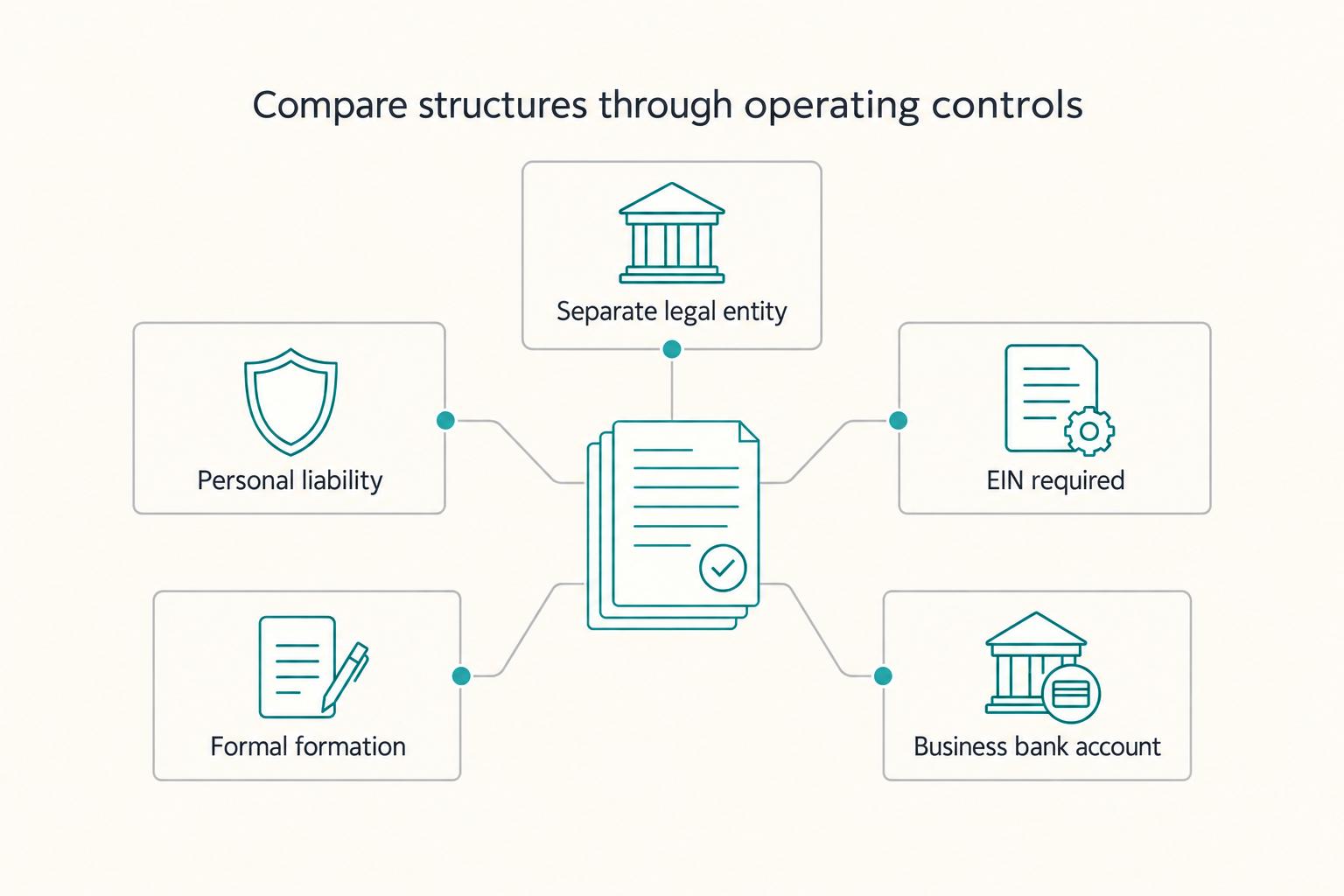
How to Choose the Right Business Structure for Your Freelance Business
Most freelancers end up in a business structure by default rather than by design, but that accidental choice shapes taxes, personal liability, and payment operations in ways that compound over time. This guide walks independent professionals through four entity types — Sole Proprietorship, Single-Member LLC, S-Corp election, and Corporation — covering the tax treatment, liability exposure, and operational overhead of each. Rather than prescribing a single best answer, it provides a trigger-based framework: start with the structure that fits today, then upgrade when specific signals — indemnification clauses, enterprise KYB requirements, a first hire, or material net profit — make the switch worthwhile. The result is a deliberate, revisable foundation that keeps records clean, reduces onboarding friction, and avoids the expensive mismatches that come from letting structure lag behind business growth.
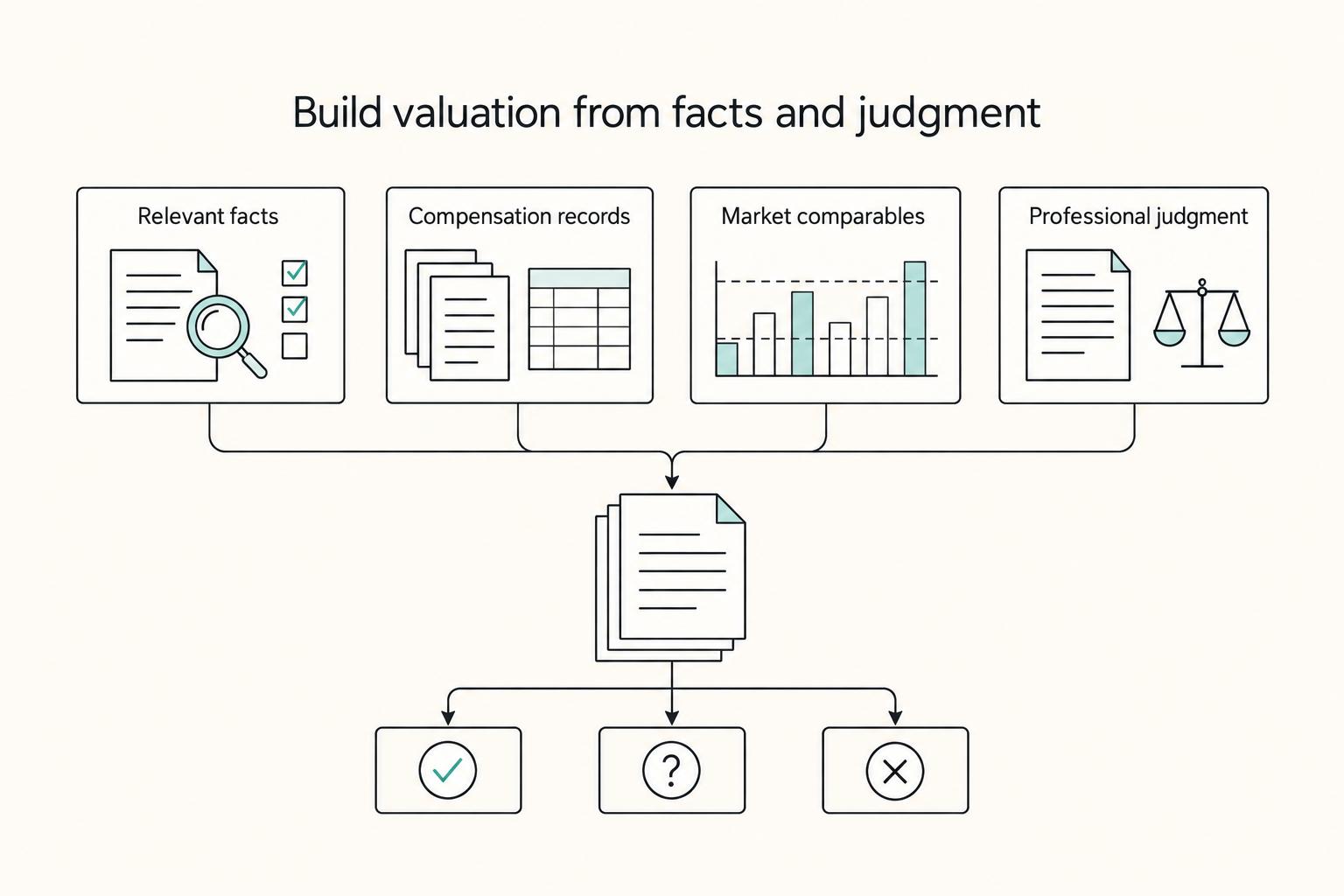
Setting Defensible Owner Pay Under the C-Corp Reasonable Compensation Test
For a C corporation owner who works in the business, the issue is simple. Salary for services and dividends for ownership are not treated the same, so your pay structure needs to be defensible.