
Quick Answer
Yes: for a uk mortgage for freelancer with international clients, use a Stability Report to make variable and multi-currency income auditable before submission. Pair it with filing-readiness checks (Self Assessment status, UTR, reactivation if needed) and reconcile SA302 or printed tax calculation figures to invoices, bank inflows, and bookkeeping. Then have your broker submit with a written document order so underwriters review a coherent case instead of disconnected files.
Why a Standard Mortgage Application Fails the Global Professional#
A standard application can fail when income is hard to trace, even if the income itself is solid. In a case like this, the real job is to make income traceable from end to end. Start with what you can verify now, and treat lender interpretation as a separate step.
What you can lock down today is mostly HMRC readiness and record integrity. That means checking whether you are registered for Self Assessment if required, whether you can actually access the filing service, whether your UTR is available, and whether your records match what you plan to declare. What you should not treat as fixed is lender-specific treatment of foreign currency, variable income, and current contracts.
| Checkpoint | What to verify now | What can go wrong if you skip it |
|---|---|---|
| Self Assessment status | Notify HMRC by the applicable deadline if you need to file for the previous year, using Self Assessment registration | Late notification can create penalty risk |
| Filing access | Confirm your HMRC login works, your UTR is available, and reactivate an old account if needed | HMRC says a return may be delayed if you file without reactivating an existing account |
| Record integrity | Keep bank statements or receipts and make sure they support the income you plan to declare | If figures cannot be matched back to records, your filing evidence is less reliable |
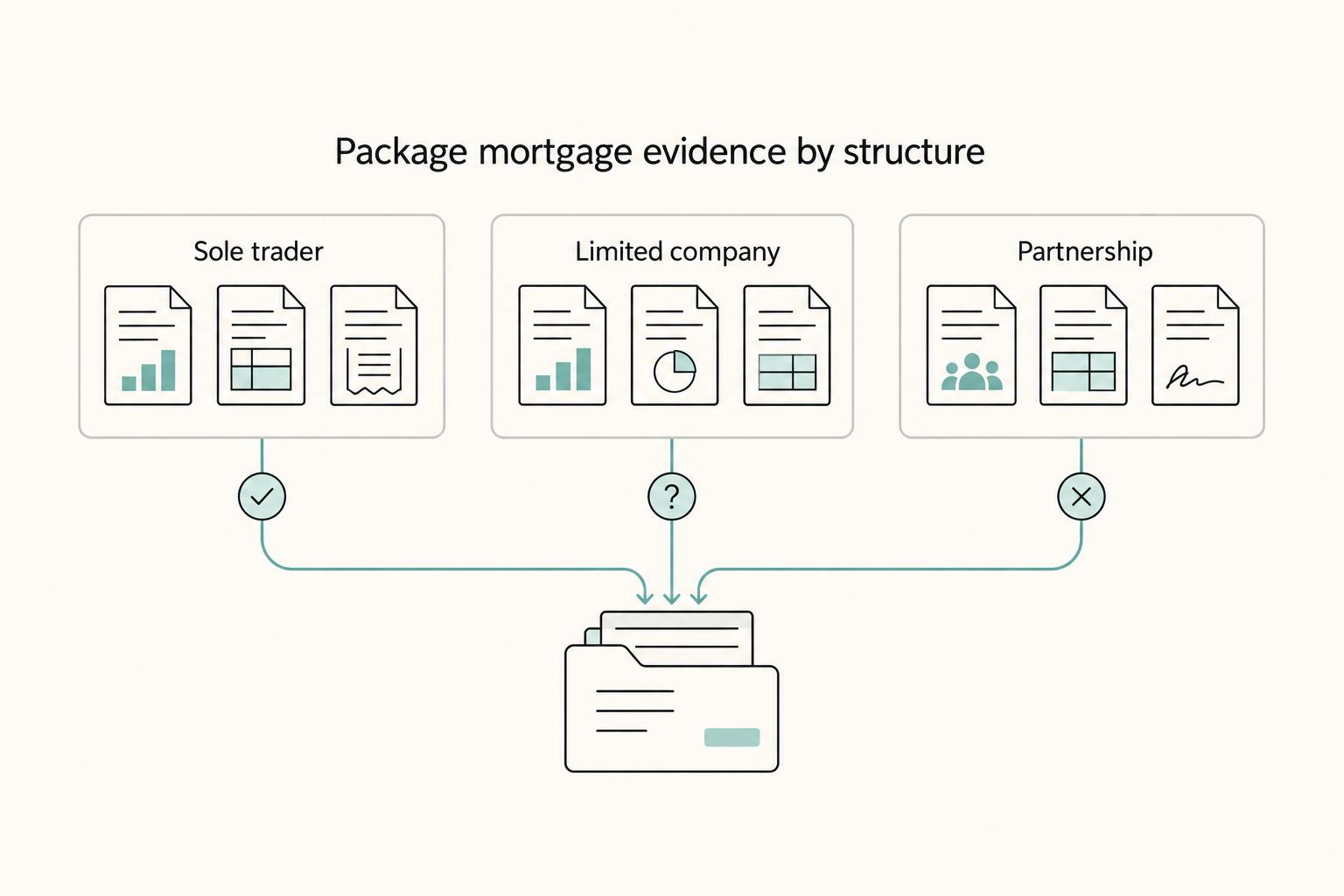
Your business structure changes how you package evidence. It does not by itself decide whether you are mortgageable. A sole trader is one person running the business. A private limited company is a separate legal entity and must register with Companies House and file annual accounts and statements published online. If your status recently changed, first make sure your HMRC position is in order. Then confirm with the lender or broker whether they want personal filings, company filings, or both.
One easy point to miss is that standard online filing does not cover every case. HMRC notes that if you lived abroad as a non-resident, the usual online service may not apply. Before you chase lenders, build the evidence chain they will be able to follow. If you want the wider process map first, see our guide to getting a mortgage as a freelancer. You might also find this useful: A Freelancer's Guide to Negotiating with Enterprise Clients.
Phase 1: Building Your 'Mortgageability Case' 24 Months in Advance#
Use this phase to make your income traceable end to end, not just well described. If you have this lead time, focus on three things: a structure you can package cleanly, one documented pay policy, and a single evidence path from client work to tax records.
Start with HMRC readiness so admin issues do not break the file later. Check first whether you need to send a tax return. If you do, current HMRC guidance says to tell HMRC by 5 October 2025 for the 6 April 2024 to 5 April 2025 tax year example; first-time filers must register before online filing, and you need your UTR to sign in. If you were registered before, confirm whether your account needs reactivation, because HMRC says filing can be delayed if you skip that step.
Choose the structure you can package cleanly#
Your structure is a packaging tradeoff, not a shortcut. It affects tax, control, record-keeping, and debt exposure, so pick the one you can evidence without gaps.
| Packaging choice | Grounded UK fact | What goes in your file | Lender-treatment note | Operator action |
|---|---|---|---|---|
| Sole trader | A sole trader is owned and run by one person, and personal responsibility for business debts can apply | Invoices, bookkeeping records, bank evidence, tax filing support | Verify current lender treatment | Keep a clean line from client payment to personal tax position |
| Limited company | A limited company is a separate legal entity with stricter rules for running the company, managing money, and keeping records | Company records, director pay records, dividend/draw records, explanation of how business revenue becomes personal income | Verify current lender treatment | Keep company and personal records clearly separated |
| Partnership or other case outside standard online filing | HMRC says standard online Self Assessment cannot be used for a partnership | Alternative filing-route evidence and role-by-role filing notes | Verify current lender treatment | Flag early so packaging does not assume the standard online route |
Do not switch entity based on unverified lender preference. Write a one-paragraph packaging note: your current setup, which records prove income, and which lender points still need confirmation.
Set one pay policy and document exceptions#
A consistent pay method makes variable freelance income easier to assess. Choose one compensation approach you can maintain and tie to your bookkeeping and tax outputs, then document it once and follow it.
Keep two short records from now on. First, an exception log with date, amount, and reason for unusual draws or gaps. Second, a broker-ready note that explains material changes in plain language without claiming fixed lender rules on salary, dividends, or retained profits.
Build one traceable evidence path#
Your file should let someone follow the same payment through every stage without guesswork. HMRC already requires record-keeping, for example bank statements or receipts, so use one repeatable path for each meaningful payment:
- Client agreement, proposal, or statement of work
- Invoice issued
- Matching bank inflow
- Bookkeeping entry using the same amount/date logic
- Tax filing support generated from those records
This is where many files weaken: bank inflow with no clear link back to agreement or invoice, or bookkeeping totals that do not clearly match what was filed. Keep the chain current around on or after 6 April when online filing opens, and before the 31 January tax payment deadline, when inconsistencies are harder to fix quickly.
Once this chain is in place, broker packaging is much cleaner. To turn it into a lender-facing narrative, use a Stability Report. To strengthen the same traceability discipline across your operations, see What is a 'Financial Identity' and Why Do Nomads Need One?.
Phase 2: Forging Your Documentation Arsenal - Beyond the Basic Checklist#
In this phase, the goal is not to collect more documents. It is to build a pack that can be verified quickly and consistently. Your Stability Report is the packaging layer: it helps a broker or underwriter follow one income story across tax outputs, accounts, invoices, and bank inflows, but it does not replace core tax and account records.
Keep the report short and factual, and use it to answer likely objections before review starts. For structure, see There Is No Official Stability Report: How Freelancers Build a Mortgage-Ready Underwriting Package.
| Report component | What to show | What it proves | What must be verified |
|---|---|---|---|
| Income normalization | A consistent period view of earnings, with uneven periods explained plainly | Variability is explainable, not arbitrary | Verify current lender expectations |
| Contracted pipeline | Signed contracts, renewals, or statements of work, separated from unsigned opportunities | Forward income is evidence-backed | Keep signed work clearly separate from projections |
| Client concentration | Major-client share and relationship duration | Concentration risk is disclosed, not hidden | Verify current lender expectations |
| Risk notes | Dips, late payments, or exceptional costs with dates and matching records | Negative movements have cause, timing, and status | Check that each note maps to invoice, receipt, or account evidence |
| FX presentation | Original currency, GBP figure used in-pack, and one conversion basis | Foreign income is handled consistently | Verify current lender expectations |
Run a pre-submission reconciliation workflow#
Before submission, run the pack in the same order a skeptical reviewer would:
| Workflow check | Grounded detail |
|---|---|
| Confirm Self Assessment readiness and filing path | First-time filers must register before using online filing, you need a UTR to sign in, and older accounts may need reactivation. |
| Confirm timing details | Online filing is available on or after 6 April after the tax year ends; in HMRC's cited example cycle, notification is by 5 October 2025 for the 6 April 2024 to 5 April 2025 tax year. |
| Generate the online tax calculation (if available) | Then reconcile it to your bookkeeping totals. |
| Trace sample items end-to-end | Contract or invoice -> bank inflow -> bookkeeping entry -> tax-record support, for example bank statements or receipts. |
| Record which alternative path was used | If online filing was unavailable in your case, for example certain non-resident routes, record whether commercial software or other forms were used. |
| Confirm tax-bill timing is understood | HMRC states payment is due by 31 January. |
If invoice totals, banked receipts, and tax outputs do not reconcile, pause and fix that before a broker submits anything.
Make FX and objections easy to answer#
For foreign-currency income, use one conversion method across the full pack and add a short currency-control note, for example whether you convert on receipt or hold source currency before conversion.
| Objection or control point | What to show | Objection-ready phrasing |
|---|---|---|
| FX consistency | Original currency, one GBP basis used throughout, and matching records | "All GBP figures in this report use one conversion method applied consistently across invoices, bank records, and tax support." |
| Volatility | Period swings with dated operational explanations | "Variation reflects timing and payment cycles, with supporting contracts and receipts included." |
| Client dependency | Concentration view plus relationship duration | "Concentration is disclosed directly, with history and contracted work shown clearly." |
| One-off anomaly | Dated receipt and note separating one-off from recurring cost | "This item is documented as a specific non-recurring event, not a baseline trading change." |
For broader mortgage prep context, see Getting a Mortgage as a Freelancer Without Guesswork. If you also need cleaner invoicing records before packaging, try the free invoice generator.
Phase 3: The Engagement Strategy - How to Partner with a Broker and Win Over Underwriters#
Once your pack reconciles cleanly, the next step is broker screening, not more documents. For this kind of case, run it as a controlled comparison: same case brief, same evidence request, and written packaging responses you can compare side by side.
Send each shortlisted broker the same one-page brief before the first call. Keep it factual: business structure, how you are paid, currencies received, filing status, first-time filer status, UTR status, possible Self Assessment reactivation, and known weak points such as uneven months or delayed payments. Ask for a written response covering packaging order, evidence priorities, and how they would handle questions on variable income, foreign-currency figures, and missing records.
| Decision point | What a useful written response includes | Red flag |
|---|---|---|
| Document-order logic | A clear submission sequence and why that order helps the file read coherently | "Send everything and we'll sort it later" |
| Variable-income handling | The summary view they want and the underlying records needed to reconcile it | Only asks for annual totals |
| Foreign-currency handling | Original currency figures, GBP figures used in the report, and the conversion basis applied | Treats FX as a side note with no reconciliation step |
| Objection escalation | What added evidence or explanation they would provide if filing readiness, record support, or currency treatment is questioned | No plan beyond "we'll see what happens" |
Run the first meeting to produce outputs#
A useful first meeting should end with named outputs and owners, not reassurance.
- Readiness status: confirm registration status, UTR availability, whether Self Assessment account reactivation is needed, and whether the standard online filing route applies. If you lived abroad as a non-resident, record whether commercial software or other forms were used.
- Required records: agree the exact evidence set, including a printed tax calculation if available and the records used to complete the return correctly, such as bank statements or receipts.
- Packaging sequence: get the proposed submission order in writing, with a short reason for each section.
- Gap log and owner: list each missing item or mismatch, who fixes it, and by when.
Pre-answer the questions that slow a file down#
Map likely objections to evidence and one reconciliation check before anything is submitted.
| Likely concern | Evidence to provide | Reconciliation check |
|---|---|---|
| Filing readiness | Registration status, UTR status, and any reactivation note | Filing route in the report matches your actual HMRC route |
| Variable income | Stability Report, printed tax calculation, and supporting records | Sample payments trace from invoice to bank inflow to filed figure |
| FX treatment | Original currency, GBP figures used across the report, and one conversion basis | Same conversion basis appears in invoices, summaries, and records |
| Record support | Bank statements or receipts for key figures and exception notes | Each exception note has a dated supporting record |
The common failure mode is not broker choice; it is submission before filing readiness, account status, and evidence checks are aligned in one place. If your brief still feels fragmented, tighten the identity layer first with What is a 'Financial Identity' and Why Do Nomads Need One?. Related: How to Handle Cross-Cultural Communication with International Clients.
Conclusion: Make your income, tax position, and records easy to verify#
The throughline here is simple: your job is not to make your case sound impressive. It is to make your income, tax position, and records easy to verify when you file and if questions come up later.
The "CEO" label only helps if you use it as a reminder to manage the basics with discipline. That means knowing whether you need to register for Self Assessment, whether an old account needs reactivation, and whether you still have the records HMRC expects you to keep, such as bank statements or receipts. It also means understanding the tradeoffs in your setup. The business structure you choose affects tax, control, and what happens to business debts. If you operate as a sole trader, your business is owned and run by one person.
| Standard filing approach | Filing-ready approach |
|---|---|
| Keeps documents in separate places | Packages records so figures can be checked across the same tax year |
| Assumes filing access is already set | Verifies Self Assessment status, UTR access, and whether reactivation is needed |
| Leaves records disconnected | Aligns return figures with bank statements and receipts |
| Plans deadlines late | Confirms filing, payment, and notification deadlines in advance |
Before you submit, do four things:
- Align records: tax calculation output, tax-year records, and evidence like bank statements or receipts should tell the same story. If you file online, use the HMRC service output and print your tax calculation.
- Confirm registration and access: check whether you need to register for Self Assessment, whether an existing account needs reactivation, and whether your UTR is ready.
- Check filing timing early: if you are filing online for the first time, register before using the service, and plan your filing on or after 6 April.
- Prepare for deadlines: plan to pay by 31 January, and if you need to notify HMRC for the previous tax year, do it by 5 October. Missing the filing deadline can lead to a penalty, and filing without reactivating an existing account may delay your return.
If you use an internal summary pack, we covered one approach in How to use a 'Stability Report' from your financial data to get a freelance mortgage. If you want a deeper dive, read Should Your Freelance Business Accept Credit Cards?.
Frequently Asked Questions
How do UK lenders assess freelance income paid in USD, EUR, or another currency?
There is no single rule that applies across all lenders. Ask your broker to confirm the lender's current policy on foreign-currency income, the conversion basis they want reflected in the case, and whether they want original-currency evidence attached up front. In your Stability Report, keep source-currency figures visible alongside GBP figures and include clear invoice-to-payment record trails. | FX checkpoint | What you show in the Stability Report | What to confirm with your broker or lender | | --- | --- | --- | | Source income | Invoice totals and payment records in original currency | Whether that income can be used in the case | | GBP treatment | The conversion basis used in your summary | The lender's current policy | | Record trail | Matching invoice, receipt, and bank inflow for sample payments | What evidence they want included up front | | Final summary | GBP income figure used in the report | Which figure is being assessed |
What is an SA302, and what needs to match before you submit?
If your broker or lender asks for an SA302 or printed tax calculation, treat it as a consistency check, not a box to tick. Verify that the same tax-year figures appear across the tax calculation, any Tax Year Overview requested, your accounts, and the bank statements or receipts you kept to complete the return correctly. Your Stability Report should point to the exact annual figure used in the mortgage summary and note any exception clearly.
Can you still get approved if most or all of your income comes from one international client?
It depends on the lender's current policy, so confirm that policy directly through your broker before submission. In your Stability Report, state the client concentration clearly and provide documented continuity where available (for example, ongoing work evidence). Avoid assuming any guaranteed outcome based on one factor alone.
How much trading history do you need as a freelancer?
There is no universal number you should quote from memory. Get the expectation for the actual target lenders in writing. What you can control is whether your filing status is current, your records reconcile, and your income story is stable enough to explain without special pleading. In the Stability Report, show when trading began, whether your business structure has changed, and which income is contracted versus merely expected. If you recently moved into a limited company, flag it early because business structure affects tax treatment, control, and what happens to business debts. For a wider view of how brokers usually read self-employed cases, see Getting a Mortgage as a Freelancer Without Guesswork.
What HMRC checkpoints are easy to miss before a mortgage application?
Check the filing mechanics before you talk about affordability. First-time filers must register for Self Assessment before using the online filing service, and you need your UTR to sign in and file. If you registered before but stopped filing, you may need to reactivate the account. HMRC says your return may be delayed if you file without reactivating an existing account. Your Stability Report should record whether registration is complete, whether a UTR is already available, and which filing route applies. This matters even more if you lived abroad as a non-resident, because some cases cannot use the standard online service and must use commercial software or other forms instead. If you are not sure whether your activity counts as trading, contact HMRC before your mortgage application starts.
Try a related tool
Researched and edited by the Gruv editorial team. Gruv builds cross-border billing, payouts, and finance-operations software for global businesses.
Sources
Includes 2 external sources outside the trusted-domain allowlist.
Educational content only. Not legal, tax, or financial advice.
Related Posts
Should Your Freelance Business Accept Credit Cards?
Offer card payments, but stay in control of how money reaches you. The goal is not a smoother checkout screen. It is predictable cash you can use to run the business.

Getting a Mortgage as a Freelancer Without Guesswork
Start by reconciling your income file before you compare rates. For a **mortgage for freelancers**, the first gate is simple: can an underwriter read your documents cold and see one consistent income story?
What is a 'Financial Identity' and Why Do Nomads Need One?
Your financial identity should function as portable proof. It can help you get paid across borders, clear reviews faster, and control risk when your life does not fit the one-address, one-employer, one-country model many institutions still assume.