
Quick Answer
Yes, us llc for indian citizens is feasible, but execution works best in a fixed sequence: choose a state with written criteria, complete formation, document federal tax classification (including any Form 8832 intent), obtain an EIN, and verify BOI status under current FinCEN rules. Before taking client payments, keep one evidence archive for ownership records, IRS notes, and reconciliation logs so banking and filing decisions remain consistent.
Start Here and Avoid Expensive Rework#
Avoiding rework is mostly about sequence. In many states, foreign entities can be LLC members, but costly mistakes can happen when formation, tax setup, and recordkeeping are treated as one task.
- Set expectations early.
A Limited Liability Company (LLC) is created under state statute, and state rules are not uniform. Most states allow broad ownership, including foreign entities, but filing and ongoing obligations still vary by state.
- Separate formation from ongoing compliance.
Formation approval is the starting line. Keep one checklist for getting formed and a second checklist for what must continue after formation.
- Lock your tax starting point before filing.
Default federal tax treatment depends on elections and member count. A one-member LLC is generally disregarded for federal income tax, and an LLC with at least two members is generally treated as a partnership. A single-member LLC can still be separate for employment tax and certain excise taxes.
- Plan for stricter bank review.
Non-US resident onboarding can involve tighter review. Keep legal name, ownership, and address data consistent across your records.
Use each section as a decision gate tied to ownership, income flow, and tax elections. This is operational guidance, not legal advice.
Decide if an LLC Fits Your Next 24 Months#
Choose your structure for the next 24 months, not for this week. If you expect a solo or small service model, an LLC may be worth evaluating. If institutional fundraising is a near-term goal, compare the LLC path with a C-Corp before filing.
- Step 1: Write a one-page decision note.
Define your likely path: solo services, partner-led firm, or investor-backed growth. If you are leaning toward an LLC, write down your expected member structure and tax treatment assumptions now. If fundraising is likely soon, evaluate C-Corp fit now so you do not restructure under deadline pressure.
- Step 2: Decide member structure first.
LLC owners are members, and member count affects default federal tax treatment. Most states permit single-member LLCs, do not cap the number of members, and allow foreign ownership. Confirm initial member count before formation and note likely ownership changes.
- Step 3: Map IRS treatment before filing.
A one-member LLC is generally disregarded for federal income tax unless it elects corporate treatment. An LLC with at least two members is generally treated as a partnership unless it elects corporate treatment. Even with one member, the LLC is still separate for employment tax and certain excise taxes.
- Step 4: Apply a clear not-yet rule.
If you cannot clearly define your initial member count and intended tax treatment, delay formation. Move forward when those decisions are clear enough to document.
Prepare Your Document Pack Before Any Filing#
Once your structure choice is clear, reduce preventable delays by building one consistent document pack before the first filing. This is less about collecting more files and more about keeping core details identical across every submission.
Treat this as a working standard, not a claim that every item is mandatory in every state. Requirements vary by state, and state instructions control. If pricing structure is part of your model, see How to Use Performance-Based Pricing for Your Freelance Services.
- Step 1: Assemble a practical minimum packet.
Gather identity records, a business purpose summary, member details, and address information you will reuse. The goal is consistency across state and IRS paperwork.
- Step 2: Create one master data sheet.
Use one source for legal entity name, member names, ownership details, phone, email, addresses, and registered agent details. Do not file until names, ownership details, and contact details match across drafts.
- Step 3: Prepare EIN inputs early.
Prepare tax identity inputs before submission so EIN work does not stall later. Reuse the same legal name format and member details in IRS paperwork. If SSN requirements are unclear for your case, flag that in your prep file to prevent conflicting entries.
- Step 4: Set up records folders before submission.
Create a simple structure such as 01_Formation, 02_EIN_IRS, 03_State_Filings, and 04_IRS_Notices. Save submitted copies and confirmations as you go, and pause if any record shows mismatched names, ownership details, or contact details.
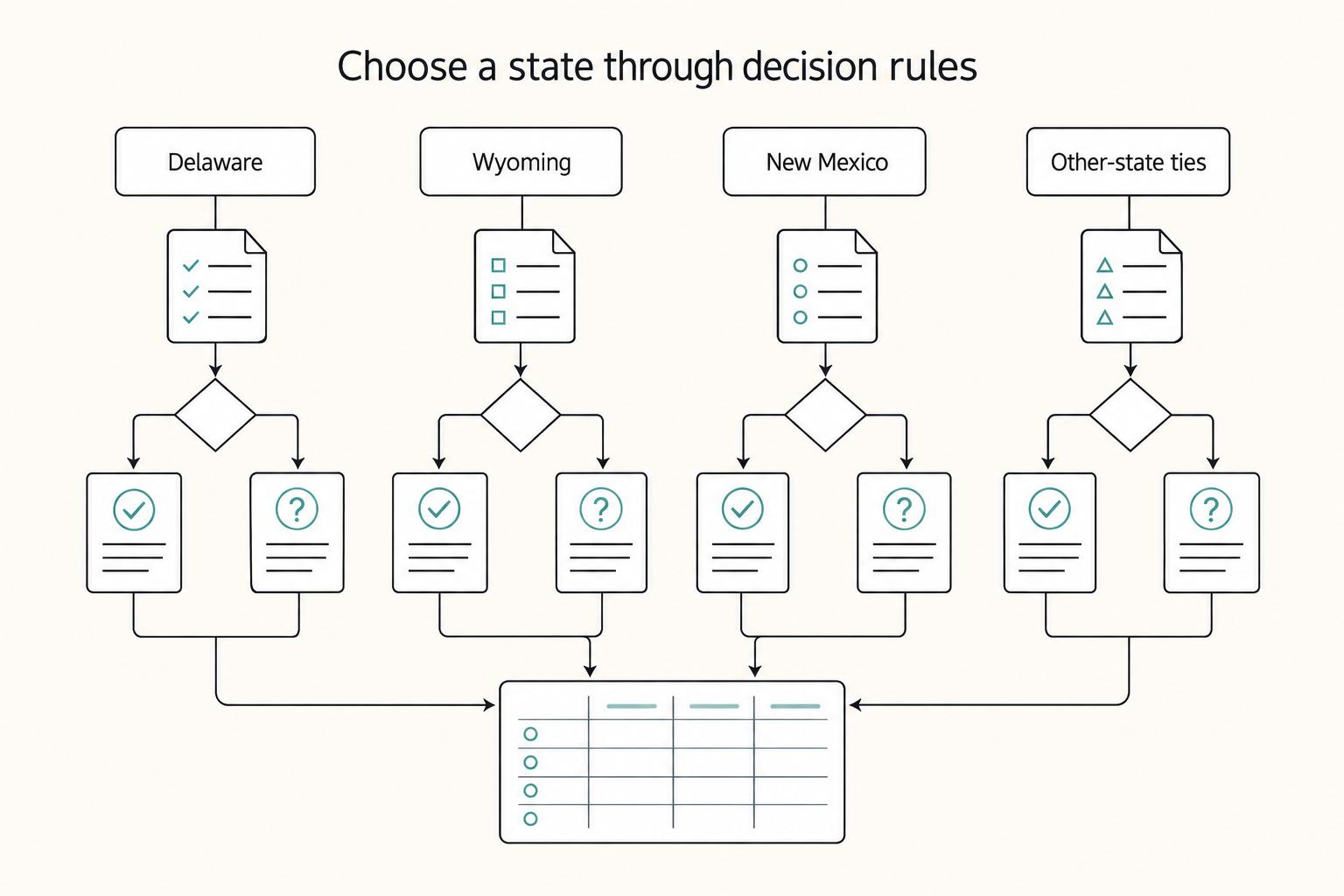
Choose the State Using Decision Rules, Not Hype#
With your document pack ready, the next high-impact decision is state selection. Use written criteria, not social proof, and treat one-size-fits-all advice cautiously.
- Step 1: Define the decision driver first.
Pick one primary driver before comparing options: lowest ongoing admin load, strongest investor-facing signal, or easiest day-to-day operations. If your driver is vague, pause and clarify it before you proceed.
- Step 2: Stress-test where business activity will actually land.
Map where clients, banking, and delivery activity are likely to occur. If your pattern creates practical ties to another state, get state-specific guidance before filing elsewhere. This can help reduce dual-state filing exposure.
- Step 3: Ignore vanity location bias.
Do not pick a state for image. A business-hub label alone may not reduce compliance work. Choose the option that best matches how the company will actually run.
- Step 4: Build a one-page comparison and require sign-off.
Complete this sheet before submission:
| State option | State fees and annual burden (verified, dated) | Legal network (what you verified) | Founder-fit recommendation |
|---|---|---|---|
| Delaware | |||
| Wyoming | |||
| New Mexico | |||
| Potential other-state tie risk |
Do not file until this table is complete, dated, and saved with assumptions clearly stated.
Form the LLC in the Correct Order#
Once your foreign-account records are documented, execution order matters more than speed. Use one sequence and keep the same details across each step: identify foreign financial accounts, check the filing threshold, prepare value reporting, then finalize deadlines before banking.
| FBAR step | Key rule | Keep with records |
|---|---|---|
| Identify accounts | A foreign financial account is generally at a financial institution located outside the United States. | Account statements, ownership or signature-authority details, and exact account identifiers |
| Threshold check | An FBAR filing obligation generally applies when a U.S. person, including an LLC, has a financial interest in or signature authority over foreign financial accounts and the aggregate value exceeds $10,000 at any time during the calendar year. | Threshold calculation |
| Value conversion | For non-U.S.-currency accounts, use the Treasury rate for the last day of the calendar year and round U.S. dollar amounts up to the next whole dollar. | Conversion worksheet |
| Filing timing | FBAR is filed on FinCEN Form 114 and is generally due April 15 following the reported year, with an automatic extension to October 15. | Due-date note for filer-category exceptions |
- Step 1: Identify foreign financial accounts and wait for complete records.
Generally, an account at a financial institution located outside the United States is a foreign financial account. Save account statements, ownership or signature-authority details, and exact account identifiers in one folder.
- Step 2: Check whether FBAR filing is triggered.
A U.S. person, including an LLC, generally has an FBAR filing obligation when it has a financial interest in or signature authority over foreign financial accounts and the aggregate value exceeds $10,000 at any time during the calendar year. Keep the threshold calculation with your records.
- Step 3: Prepare FBAR values using FinCEN rules.
For non-U.S.-currency accounts, convert using the Treasury rate for the last day of the calendar year, then record U.S. dollar amounts rounded up to the next whole dollar.
- Step 4: Move to banking only after records and deadline tracking are organized.
FBAR is filed on FinCEN Form 114 and is generally due April 15 following the reported year, with an automatic extension to October 15. Keep a separate due-date note for filer-category exceptions instead of assuming one universal deadline.
Red flags that should stop the process:
- Unclear account classification (foreign vs. non-foreign)
- Missing ownership or signature-authority records
- No documented aggregate check against the $10,000 threshold
- Non-U.S.-currency balances converted without the year-end Treasury rate
- A single FBAR due date applied without checking filer-category exceptions
Do not start bank applications until you can produce one dated archive with account records, threshold calculations, conversion worksheets, and FBAR deadline notes. If any item is missing, pause and fix the archive first. For a deeper dive, read Sole Proprietorship vs. LLC: The Definitive Guide for Global Freelancers.
Get an EIN Without an SSN and Keep Evidence#
After the formation sequence is set, keep EIN work disciplined. This section does not settle a universal SSN or EIN-eligibility rule. The practical objective is clean evidence, controlled assumptions, and fast retrieval.
- Step 1: Confirm your LLC tax posture first.
Before EIN work, lock the facts IRS treatment depends on: member count, default classification, and whether a Form 8832 election is planned. A domestic one-member LLC is generally disregarded for income tax. A domestic LLC with at least two members is generally treated as a partnership unless it elects corporate treatment. The expected outcome is one dated note with member count, default classification, and election intent.
- Step 2: Build a single draft-input log.
EIN field requirements, SSN outcomes, or processing timelines are not established. Instead of guessing, keep one draft log of intended inputs and the source document for each value, with a clearly marked line for unresolved SSN assumptions. Verification checkpoint: every draft value maps to a saved document in your formation records.
- Step 3: Set a delay rule before external commitments.
If EIN status is unresolved, keep external timelines tentative and freeze legal name, address, and ownership details across drafts. Use one canonical record set and avoid parallel versions.
Red flags that should pause you:
- Multiple versions of entity name or address are circulating
- Member count differs across internal records
- SSN assumptions are not documented
- Team members are editing different draft files
- Step 4: Keep artifacts together for future review.
Archive EIN-related correspondence and draft history with formation and classification records in one dated folder. The control point here is evidence quality, not speed. Final checkpoint: you can produce your classification note, EIN draft history, and related correspondence from one place within minutes.
File BOI and Set a Compliance Clock on Day One#
With EIN evidence organized, keep compliance records active from day one. Use one ownership record across compliance documents and keep BOI work separate from FBAR reporting.
- Step 1: Lock one ownership record before filing.
Create one dated ownership sheet and treat it as your single source. If multiple versions exist, reconcile them before anything is filed or shared.
- Step 2: If BOI applies, handle it from that single source and log what was submitted.
Verify current BOI requirements at filing time and record exactly which ownership version was used. Keep a short submission note with filing date, responsible person, legal entity name, and unresolved assumptions. The expected outcome is one traceable filing package you can reproduce quickly.
- Step 3: Run a separate FBAR track with exact reporting mechanics.
Do not merge BOI and FBAR into one calendar assumption. For FBAR reporting, convert non-U.S. currency values to U.S. dollars, round up to the next whole dollar, and enter 0 if a computed value is negative. Track dates carefully. April 15, 2026 remains the due date for all other individuals with an FBAR filing obligation, while April 15, 2027 applies only to the specified signature-authority group.
- Step 4: Review filing status when material facts change.
When material entity facts change, review filing status and supporting records so records stay aligned across compliance, banking, and tax files.
Verification checkpoint: keep filing submission proof in the same archive as LLC formation and EIN records so one complete evidence pack is always ready.
Open and Run US Banking Without Operational Fragility#
Once compliance records are organized, keep entity and tax-classification details consistent across your files.
- Step 1: Align entity facts before you apply.
Lock one master profile and reuse the same facts everywhere: legal name, formation state, member details, ownership, and authorized signers. Keep your tax-status note in the same file set.
For federal income tax, a domestic one-member LLC is generally treated as an entity disregarded as separate from its owner unless corporate treatment is elected. A domestic LLC with at least two members is generally treated as a partnership unless it elects corporate treatment. State requirements can still differ.
- Step 2: Use one consistent submission packet.
Use one repeatable packet and avoid rewriting details across forms and follow-ups. Keep ownership details and tax classification language consistent, including any Form 8832 election status.
- Step 3: Confirm ownership and member structure details.
Most states do not restrict LLC ownership, so members may include individuals, corporations, other LLCs, and foreign entities. IRS guidance also states there is no maximum number of members, and special rules exist for foreign LLCs.
- Step 4: Keep one-member LLC tax nuance visible.
For income tax, one-member LLC treatment is generally disregarded by default unless corporate treatment is elected. Even then, for employment tax and certain excise taxes, a one-member LLC is still considered a separate entity.
Verification checkpoint: one folder contains your current master profile, member and ownership summary, state-rule notes, and tax-status note including any Form 8832 election.
Build Your Tax and Reporting Baseline Before First Revenue#
Before first revenue, convert tax uncertainty into a dated filing map. The objective is simple: every major form in scope is either confirmed, ruled out, or escalated for advisor review.
Step 1 Build a form map tied to ownership and activity. Create a one-page register for Form 8938 and FBAR, plus any other forms your tax advisor identifies. Then mark each as confirmed, not applicable, or needs advisor review based on written facts.
Use these fields:
- Form name and filing channel
- Why it is on your list
- Current status and supporting fact
- Owner for follow-up
- Next decision date before deadlines
Step 2 Keep Form 8938 analysis separate from FBAR analysis. Form 8938 is threshold-based and attached to an income tax return. If no income tax return is required for the year, Form 8938 is not required. Higher Form 8938 thresholds can apply for some filer categories, including joint filers and taxpayers residing abroad, so avoid applying one threshold to every case.
For tax years beginning after December 31, 2015, certain domestic corporations, partnerships, and trusts can be in Form 8938 scope. Record whether the specified domestic entity test is relevant to your facts, including the referenced $50,000 year-end and $75,000 anytime thresholds.
Step 3 Treat FATCA and FBAR as parallel obligations, not substitutes. FATCA underpins Form 8938, and FBAR is FinCEN Form 114. Filing Form 8938 does not remove an FBAR filing requirement when FBAR otherwise applies. Use a red-flag rule: if ownership or account structure is cross-border or unclear, verify both tracks before filing season.
Step 4 Add a treaty and escalation gate before deadlines. Review potential positions under any applicable tax treaty before assuming outcomes. If foreign ownership is complex or filing duty is unclear, escalate to a qualified cross-border tax advisor before deadlines.
Verification checkpoint: your archive includes the form map, Form 8938 threshold note, separate FBAR determination memo, treaty review note, and advisor decisions with dates.
Set Up Money Movement and Audit-Ready Records from Day One#
With the tax map in place, your next control is transaction traceability. If each transaction can be traced end to end, filing and review stay manageable as volume grows.
The 2024 National Money Laundering Risk Assessment highlights vulnerabilities in financial products and services. It lists peer-to-peer payments, legal entities, beneficial ownership information, inconsistent compliance with domestic obligations, and AML/CFT compliance deficiencies as relevant risk areas. Build your record process for that reality, not for a best-case month.
- Step 1: Capture every event with one traceable record pattern.
Use one record pattern for collections and payouts so evidence stays consistent across tools. Where Gruv modules are enabled, keep invoice collection, status tracking, and payout events linked by stable references. Where coverage varies by market or program, mirror the same fields in your fallback process.
Use these minimum fields for each event:
- Event ID and timestamp
- Counterparty legal name
- Linked invoice or payout reference
- Current status and approver
- Bank movement reference
- Document link for supporting evidence
The expected outcome is that each payout can be traced from request to approval to bank movement without manual reconstruction.
- Step 2: Apply compliance and approval gates before release.
Put identity and approval checks before funds leave your account. Do not release payouts from informal chat or email confirmation, and do not bypass checks for urgent exceptions.
Tradeoff: tighter gates can slow first-time payouts, but they reduce reconciliation noise later. If identity or ownership details are incomplete, hold the transaction until records are complete.
- Step 3: Reconcile ledger, bank movement, and tax documentation every cycle.
Before each filing cycle, run a three-way match across ledger records, bank movement, and tax documentation. You do not need complex tooling at the start; a practical baseline is one owner, a dated review note, and documented exceptions.
Keep unresolved items in an exception log and close them before approving new outbound payouts. This checkpoint turns recordkeeping into filing readiness.
- Step 4: Confirm coverage boundaries before relying on one flow.
Assume coverage can vary by market or program, and confirm availability before relying on any single collection or payout path. If coverage is partial, define fallback steps immediately and keep the same event IDs and approval references across both paths.
Verification checkpoint: for a selected period, produce one packet with ledger exports, bank statement matches, approval logs, and linked tax documentation. Every sampled transaction should resolve end to end.
Fix the Mistakes That Usually Hurt Indian Founders#
After records are traceable, execution order can become a major risk. This section focuses on four avoidable mistakes: state choice from hype, delayed EIN and BOI handling, guesswork on tax forms, and mixed personal and business money.
| Risk area | What to do | Checkpoint |
|---|---|---|
| State choice from hype | Rerun the decision with written criteria: ongoing filing burden, banking fit, and a near-term plan to stay independent or move toward a C-Corp. | One-page memo with the chosen state, two rejected options, and why each was rejected |
| Delayed EIN and BOI handling | Complete EIN, archive confirmation, then determine whether BOI reporting applies under current FinCEN language. | Store either BOI submission proof or a dated written determination explaining why the entity is exempt |
| Guesswork on tax forms | Review IRS Form 5472 and IRS Form 8833 with a cross-border specialist and ask for a written filing map with trigger conditions. | Written filing map with trigger conditions |
| Mixed personal and business money | Rebuild transaction history month by month, move business activity into a dedicated company account, and tag historical items consistently. | Each material transaction is traceable from invoice or contract to bank movement and ledger entry |
- Step 1 Re-run the state decision and document it.
If your state choice came from social posts or founder threads, rerun it with written criteria you can defend. Compare your operating reality, not someone else's context.
Use three criteria:
- Ongoing filing burden you can realistically manage from India
- Banking fit for expected payment profile
- Near-term plan to stay independent or move toward a C-Corp
Expected outcome: a one-page memo with your chosen state, two rejected options, and why each was rejected.
- Step 2 Complete EIN, then resolve BOI status before banking.
Treat EIN as a prerequisite, not a later task. Complete it, archive confirmation, then determine whether BOI reporting applies under current FinCEN language.
FinCEN says it published an interim final rule on March 26, 2025 that revised the reporting-company definition. In the cited FAQ excerpt, U.S.-created entities are described as exempt from BOI reporting to FinCEN. Foreign-formed entities registered to do business in a U.S. state may still be in scope, with timing tied to registration date. The cited timing is April 25, 2025 for covered entities registered before March 26, 2025, and 30 calendar days after effective registration notice for those registered on or after that date. FinCEN also says parts of older FAQ guidance are not fully updated, so avoid stale summaries.
Verification checkpoint: before full invoicing, store either BOI submission proof or a dated written determination explaining why your entity is exempt.
- Step 3 Review IRS Form 5472 and IRS Form 8833 with a cross-border specialist.
Do not assume these filings are automatic or irrelevant. Applicability is fact-specific, so confirm with a cross-border specialist before deadlines become a problem.
Bring a concise packet: ownership table, related-party payments, service contracts, and monthly transaction totals. Ask for a written filing map with trigger conditions. If your advisor cannot clearly explain when 5472 or 8833 applies, pause and get a second review.
- Step 4 Separate personal and business money before any filing submission.
If personal and company transactions are mixed, fix that before filing. Rebuild transaction history month by month, move business activity into a dedicated company account, and tag historical items consistently.
Expected outcome: each material transaction is traceable from invoice or contract to bank movement and ledger entry. If you cannot trace a sample month end to end, continue cleanup before submitting filings. Missing deadlines or unpaid taxes can lead to fines or LLC closure.
Copy-Paste 30-Day Setup Checklist#
Use this 30-day plan as a monthly cadence, not a legal deadline. The target is clean sequence and complete evidence before first revenue.
| Timing | Primary action | Grounded note |
|---|---|---|
| Week 1 | Decide entity path, choose state, and finalize your document packet. | Validate requirements for the selected state and keep one master packet with consistent legal names, member details, addresses, and ownership information. |
| Week 2 | Complete formation and capture federal-filing notes. | Record which federal steps apply and what is still unknown, and confirm current IRS and FinCEN requirements before proceeding. |
| Week 3 | Set up recordkeeping for account activity. | Keep business and personal flows separated in your records and use fixed labels for invoice ID, counterparty, purpose, and owner transfer type. |
| Week 4 | Document your IRS tax-classification decision and timing. | By default, a domestic LLC with at least two members is treated as a partnership unless Form 8832 is filed; a single-member LLC is disregarded for income tax but still separate for employment tax and certain excise taxes. |
| Before first client payment | Run a go or no-go compliance check. | Verify formation proof, tax-classification notes, monthly reconciliation ownership, and any relevant FBAR threshold and due-date checks. |
- Week 1: Decide entity path, choose state, and finalize your document packet.
Confirm whether you are forming an LLC now or planning a near-term C-Corp path. LLC rules vary by state, so validate requirements for your selected state before filing. Keep one master packet with consistent legal names, member details, addresses, and ownership information.
- Week 2: Complete formation and capture federal-filing notes.
Once formation is accepted, document which federal steps apply to your case and record what is still unknown. Confirm current IRS and FinCEN requirements for EIN process details and BOI requirements before proceeding.
- Week 3: Set up recordkeeping for account activity.
If you open business accounts, keep business and personal flows separated in your records. Use fixed labels for invoice ID, counterparty, purpose, and owner transfer type so every entry is traceable. If flows were mixed, clean that history before transaction volume grows.
- Week 4: Document your IRS tax-classification decision and timing.
By default, a domestic LLC with at least two members is treated as a partnership unless Form 8832 is filed; a single-member LLC is disregarded for income tax but still separate for employment tax and certain excise taxes. If filing Form 8832, mark the timing window clearly: no more than 75 days before filing and no later than 12 months after filing.
- Before first client payment: run a go or no-go compliance check.
Verify formation proof, tax-classification notes, and monthly reconciliation ownership. Add an FBAR check when relevant to U.S. person status and account facts: value each account separately, use periodic statements when they fairly reflect the annual maximum, and apply the $10,000 threshold test. For filers covered by the cited FinCEN notice, the general due date is April 15, 2026, with an April 15, 2027 extension only for the specific signature-authority group described there.
Frequently Asked Questions
Can an Indian citizen form a US LLC without visiting the United States?
Most states allow foreign individuals or entities to be LLC members, but this section cannot treat travel requirements as universal. A US LLC is created under state law, and rules vary by state, so verify filing requirements for your chosen state before proceeding. Treat any travel or in-person step as a case-specific requirement to confirm.
Do I need an SSN to get an EIN for my LLC?
There is no safe universal yes or no answer in this section alone. Confirm the current IRS application path that matches your owner profile and entity details before applying. Keep submission details and confirmation records together for later compliance steps.
Which state is usually best for a non-resident founder: Delaware, Wyoming, Nevada, or New Mexico?
There is no single best state for every non-resident founder. IRS guidance is explicit that LLC rules vary by state, so compare options using your operating needs and compliance capacity. Include state-source tax exposure in your review; for example, California nonresidents are taxed on taxable income from California sources.
What filings are mandatory right after formation, including BOI and IRS requirements?
Start by confirming federal tax classification. By default, a domestic LLC with at least two members is treated as a partnership, while a single-member LLC is disregarded for income tax unless corporate treatment is elected on Form 8832. BOI obligations should be checked separately against current official guidance before assuming a requirement.
When do IRS forms like 5472, 1065, 8805, or 8833 become relevant?
These forms are fact-dependent, not automatic for every cross-border LLC. Relevance depends on ownership structure, transaction profile, and tax position. Use a written filing map from a qualified cross-border advisor and update it when structure or flows change.
What are the biggest mistakes Indian founders make in the first year?
Two avoidable risks are treating LLC setup as one-size-fits-all and overlooking state-source tax exposure. State rules differ, and federal tax treatment depends on member count and elections, so assumptions can create avoidable cleanup later.
How can I keep banking, payouts, and records clean for tax season?
Keep one consistent audit trail across invoices, payouts, bank movements, and ledger entries so each transaction is traceable. Review records on a fixed monthly cadence instead of waiting for filing season. For account-structure ideas, see The 'Profit First' Method Part 2: Setting Up Your Bank Accounts.
Try a related tool
Researched and edited by the Gruv editorial team. Gruv builds cross-border billing, payouts, and finance-operations software for global businesses.
Sources
- fincen.gov/system/files/2025-12/FBAR-FBAR-Filing-Requir...trusted
- fincen.gov/system/files/shared/BOI-FAQs-QA-508C.pdftrusted
- home.treasury.gov/system/files/136/2024-National-Money-Launder...trusted
- irs.gov/businesses/corporations/do-i-need-to-file-fo...trusted
- irs.gov/businesses/small-businesses-self-employed/li...trusted
Educational content only. Not legal, tax, or financial advice.
Related Posts

Sole Proprietorship vs LLC for Global Freelancers in 2026
For most freelancers in 2026, the practical default is still simple: use the simplest structure you can run cleanly, then formalize when risk actually rises. If your work is still in validation mode and the downside is contained, a sole proprietorship is often the practical starting point. When contract exposure, delivery stakes, or dispute risk starts climbing, forming an LLC deserves earlier attention.
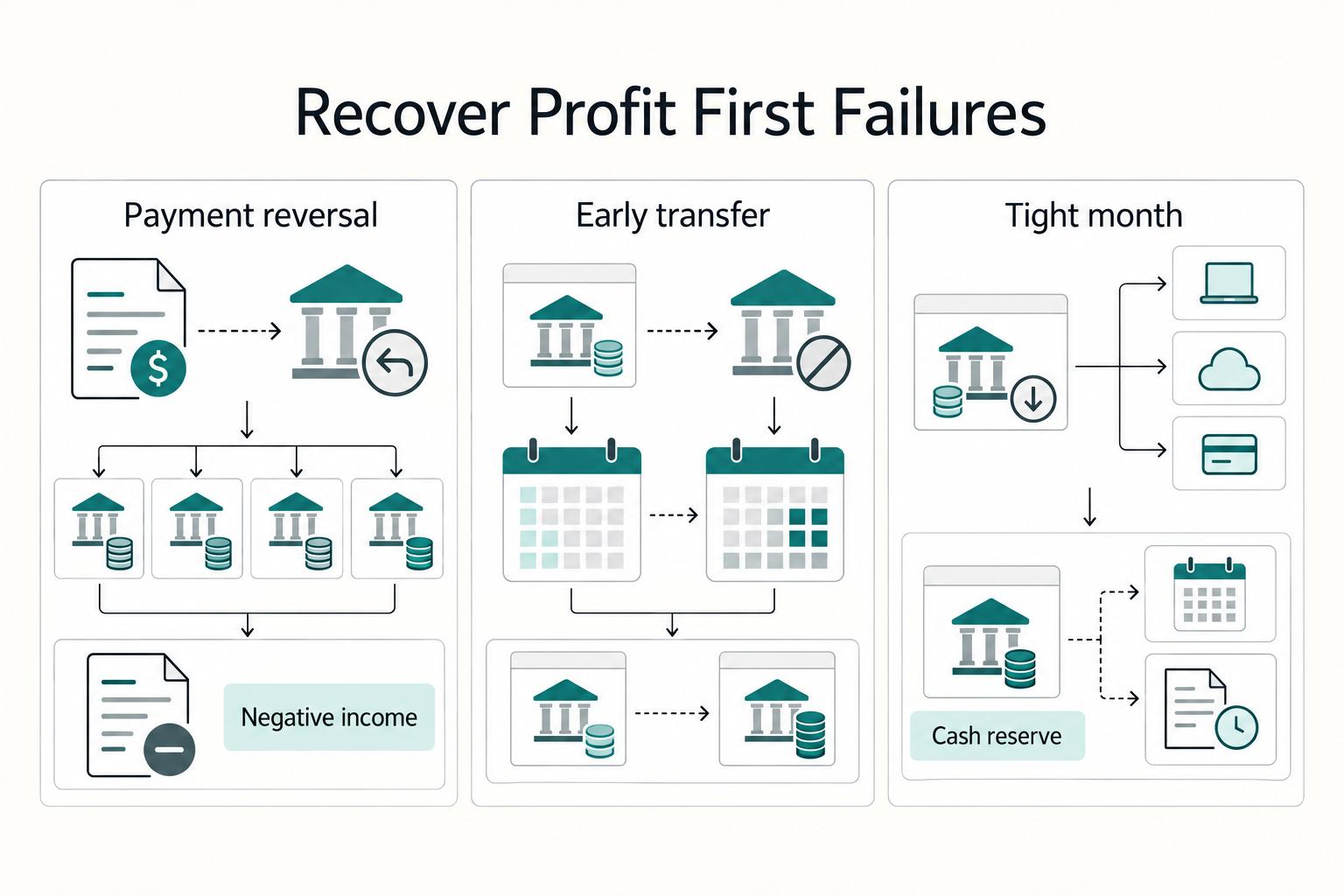
The 'Profit First' Method Part 2: Setting Up Your Bank Accounts
Most freelancers who try Profit First open a few extra bank accounts and call it done. That's the wrong move.
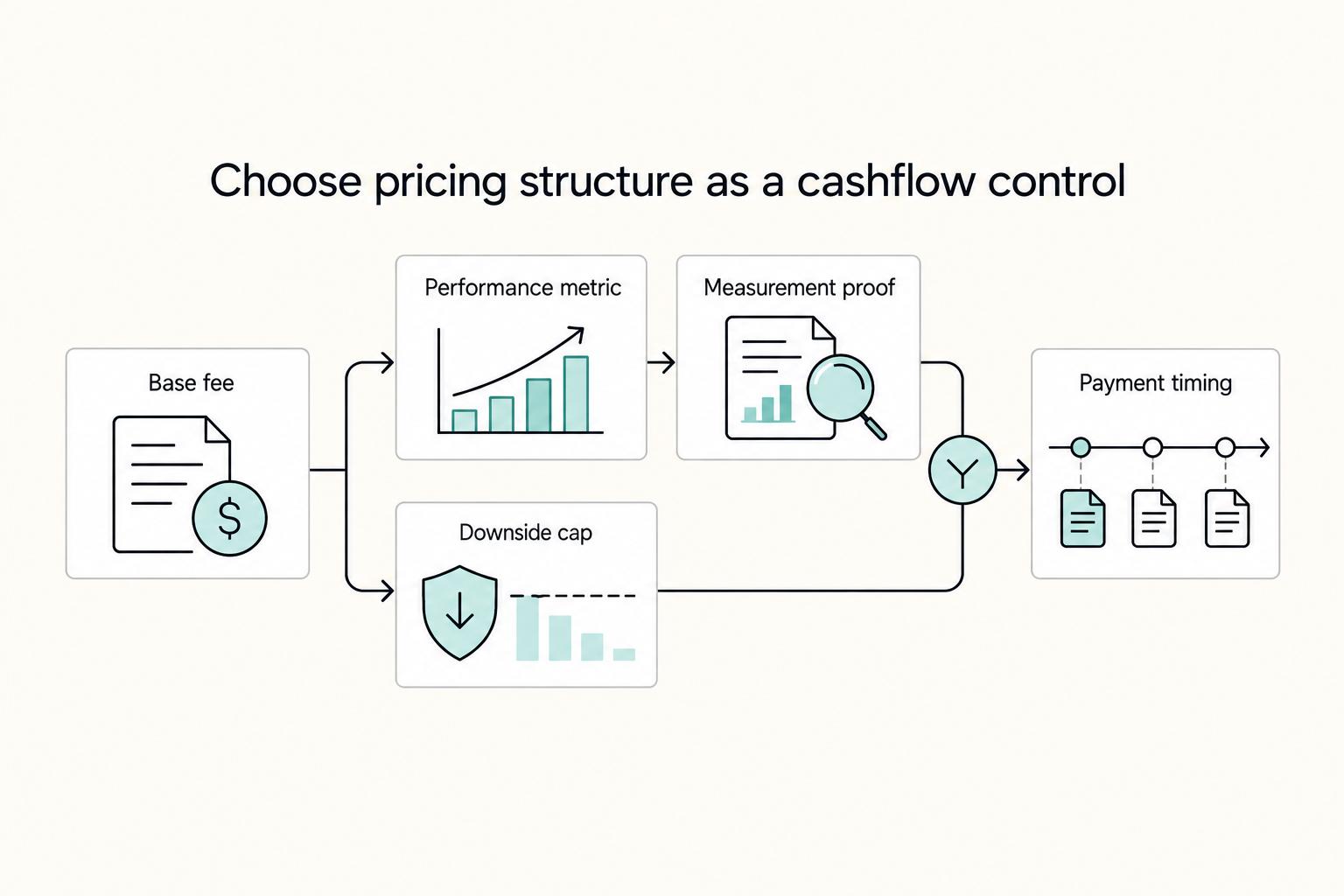
How to Use Performance-Based Pricing for Your Freelance Services
Performance-based pricing can offer upside, but cashflow protection should come first. In performance based pricing freelance work, the first question is not how much upside you might win. It is how much downside you can carry if project conditions or payment timing go sideways.