
Quick Answer
Re-establishing U.S. residency without creating avoidable tax problems requires a staged plan before, during, and just after your move. The safest approach is to review asset sales early, complete your final FBAR and foreign compliance tasks, rebuild U.S. credit before returning, formally wind down any foreign entity, establish clear domicile evidence on arrival, and prepare for a complex hybrid tax return in your repatriation year.
The tax decisions behind your move back, phase by phase#
Your move back is a tax timing and documentation project first, and a logistics project second. Make the key tax decisions before you book the flight so your move year stays compliant and predictable. For U.S. citizens, the baseline does not change: worldwide income remains in scope.
In this blueprint:
- Tax residency is the tax law status that determines how income is taxed.
- Domicile is your intended permanent home, which is central to state tax outcomes.
- Compliance exposure is penalty risk from missed required filings, not just admin cleanup.
- Repatriation-year return is your move-year filing, where federal rules, state part-year treatment, and foreign account reporting can overlap.
You will make decisions in three phases:
- Phase 1 (well before the move): Decide timing and documentation strategy before departure.
Risk prevented: avoidable filing conflicts and weak records.
- Phase 2 (months before departure): Decide which foreign reporting and entity obligations continue after departure.
Risk prevented: missed filings and penalty exposure.
- Phase 3 (arrival and early filing period): Establish new state domicile and reduce dual residency risk.
Risk prevented: being taxed as a resident in the wrong state, or in more than one state.
Before You Start#
Start by pulling together your last two federal returns, FBAR filings, Form 8938 filings if any, a travel calendar, and year-high foreign account balances. If you cannot support dates, balances, and where you actually lived, your move-year return can turn into estimates and added audit friction.
| Issue | Safe default | Risky assumption |
|---|---|---|
| State residency | Document when you establish domicile and when you cut prior ties | Assume day count alone decides residency |
| Foreign accounts | Track aggregate maximum value and test FBAR over $10,000 | Assume moving back ends reporting |
| FATCA reporting | Test Form 8938 separately from FBAR | Assume Form 8938 replaces FBAR |
Step 1. Decide federal timing. Confirm how your move affects section 911 analysis and filing deadlines. One FEIE path uses 330 full days in a 12 month period. Another requires bona fide foreign residence that includes an entire taxable year.
Step 2. Decide what still must be reported after departure. Foreign accounts and specified foreign assets do not disappear when your address changes. FBAR is triggered when aggregate foreign account value exceeds $10,000 at any point in the year, due April 15 with an automatic extension to October 15. Form 8938 may also apply, starting at $50,000 for certain taxpayers, with higher thresholds in other cases. Use the IRS pages on FBAR reporting and Form 8938 as your rule check.
Step 3. Decide which state can claim you. Domicile is the core issue. New York can treat you as a resident if you are domiciled there, or if you maintain a permanent place of abode and spend 184 days or more there. California uses domicile and temporary or transitory purpose tests, and your move year may be part-year resident treatment.
If you may trigger international information returns, face dual residency risk across states, or have a filing threshold question that affects your move date, involve a cross-border tax professional before you lock in the move. Related: Moving From Hourly to Project-Based Rates.
Phase 1: The Strategic Lookback (12-18 Months Out) - Fortify Your Finances Before You Pack a Box#
This phase is where you can prevent many expensive mistakes. Use the 12 to 18 month window to identify exposure, choose a treatment path, and document the reasoning while the records are still easy to get. If you skip it, you may end up rebuilding basis records, account histories, and ownership facts during the move year, when errors are harder to fix.
Step 1. Audit major foreign assets and choose a treatment path#
Start with a plain English asset register for every major holding:
- What it is and where it sits
- Who owns it
- Whether it produces income
- Whether there is unrealized gain
- Which U.S. filings it may affect
For each line item, keep proof: purchase records, a current statement or valuation, and basis support such as improvement invoices or depreciation schedules. Basis is record-driven, so missing documents create avoidable risk.
Then choose one path per asset:
- Sell before the move: use when timing with local country residency matters, basis support is clean, and you want fewer moving parts in the repatriation year.
- Hold through the move: use when the business case is stronger than tax timing, or when you still need move-year facts to assess residency, treaty interaction, and foreign tax credit treatment.
- Restructure ownership: use only when structure is the core problem, because unwinding entities or trust-like setups can create new tax and reporting consequences.
Do not assume a treaty fixes everything. Most treaties include a saving clause that preserves each country’s right to tax its own citizens and treaty residents, with limited exceptions.
If the asset is a home, test main home relief before you rely on it. The exclusion can be up to $250,000, or $500,000 on a joint return in most cases. Ownership and use tests apply within the 5-year window before sale, including at least 2 years owned and at least 2 years used as your main home. Depreciation claimed for rental or business use can reduce excluded gain. Verify current exclusion and eligibility rules before you file.
Step 2. Map ownership structure before it turns into a filing problem#
Ownership structure is where a manageable asset can become a filing problem. Direct ownership is often simpler from a reporting perspective. Entities and trust-like arrangements can create heavier U.S. reporting and more timing friction, so sort that out before you move money or change title.
| Ownership setup | Likely U.S. reporting friction | Double-tax or timing trigger |
|---|---|---|
| Individual ownership | Basis tracking, sale reporting, and possible FBAR/Form 8938 exposure through related foreign financial accounts | Gain on sale and foreign tax paid can require foreign tax credit analysis |
| Local entity ownership | Form 5471 may apply for certain foreign corporations; Form 8865 may apply for qualifying foreign partnership filers; entity interests may also matter for Form 8938 | Mismatch between local treatment, entity earnings, and U.S. timing on distributions |
| Trust-like arrangement | Form 3520 may apply to certain foreign trust transactions, ownership, or certain large foreign gifts; failures can carry significant penalties and longer assessment windows | U.S. and local timing can diverge, especially around distributions or ownership changes |
Apply this distinction early. Directly held foreign real estate is not itself a Form 8938 asset, but an interest in a foreign entity that holds that real estate can be reportable.
If anything points toward Form 5471, Form 8865, or Form 3520, involve a cross-border tax professional before moving funds, dissolving entities, or changing ownership.
Step 3. Build your FBAR and Form 8938 evidence pack#
Do not stop at a reminder note. Finish your account review with an evidence pack you can actually file from:
- Inventory every non-U.S. financial account.
- Classify each as owned, jointly owned, or signature authority only.
- Reconcile against prior FBARs, prior Form 8938 filings, payroll accounts, dormant accounts, and accounts likely to receive sale proceeds during the move.
- Capture high-balance evidence from statements or bank records.
- Retain FBAR support for 5 years from the due date.
- File FBAR electronically through BSA E-Filing, not with your income tax return.
FBAR generally turns on whether aggregate foreign account value exceeded $10,000 at any point in the calendar year. The due date is April 15 with an automatic extension to October 15. For jointly owned accounts, each owner generally reports the full account value. If account ownership or signature authority is unclear, escalate early instead of guessing. Test Form 8938 separately. It does not replace FBAR, and FBAR does not replace it.
Step 4. Reopen U.S. credit and fund your landing cash#
Give yourself enough room that tax decisions stay deliberate instead of rushed. For credit re-entry, stick to the basics:
- Pull your U.S. credit reports now. Checking your own report does not hurt your score.
- If your file is thin or dormant, consider a secured card to help re-establish credit history.
- Use any new credit line conservatively and monitor whether activity is being reported.
At the same time, build cash runway in three buckets:
- Fixed costs: rent, insurance, debt payments, core living costs.
- Transition costs: deposits, flights, shipping, temporary housing, setup fees.
- Contingency reserve: tax prep, filing cleanup, delayed client payments, longer income gap.
Bring in a cross-border tax professional during this phase if your move year may combine asset sales, foreign entities, trust-like arrangements, treaty positions, or both FEIE and foreign tax credit decisions. The foreign tax credit is designed to reduce double taxation, but you cannot claim it for taxes tied to income excluded under FEIE. You might also find this useful: The US Expat's Financial Offboarding Checklist: 15 Things to do Before Repatriating.
Phase 2: The Operational Wind-Down (3-6 Months Out) - Are You Closing Your Business or Relocating It?#
Make one branch decision now: close the foreign setup, relocate operations, or run a short dual-entity bridge. The tradeoff is straightforward. Closure can reduce future compliance burden sooner. Relocation can protect delivery continuity. A dual-entity overlap can preserve cash flow, but it raises filing and operational risk while both structures are live.
Step 1. Choose the operating path before you touch contracts or payment rails#
This decision should be driven by your actual delivery constraints, not your best case scenario. You are still in U.S. worldwide income filing scope during this phase, so the cleanest path is the one you can document and fully execute.
| Path | Cash-flow effect | Compliance effect | Safe-use condition |
|---|---|---|---|
| Close foreign entity | Higher short-term transition risk if clients pause | Can be a faster path to fewer ongoing obligations | Work can pause or restart cleanly |
| Relocate operating setup | Better continuity for active clients | More moving parts during transition | Contracts and payer onboarding must stay continuous |
| Temporary dual-entity bridge | Can smooth collections during handoff | Highest overlap risk while both sides run | Use as a time-boxed bridge with a clear end date |
The main risk to avoid is a half-closed foreign company. Stopping trade alone does not end legal obligations. For example, dormant UK companies still file annual accounts, and Australian obligations continue until deregistration. If the entity stays active, U.S. reporting exposure may also continue, including possible Form 5471 duties for certain foreign corporations.
Step 2. Sequence the client handoff so payments do not break#
Once you know the operating path, make the payer transition boring and verifiable:
- Send client notice based on contract timing or your own internal deadline before the move.
- Refresh contracts with the correct payee legal name, address, entity, and effective date.
- Switch payer tax forms when status changes: U.S. persons provide Form W-9 with the correct TIN to the payer. Do not use Form W-8BEN as a U.S. person.
- Move invoicing and payment rails to the account that should receive U.S. side payments.
- Run a live continuity test, such as one invoice or small payment, before shutting legacy rails.
Use one control check before the first U.S. status invoice: confirm the payer has your signed W-9 and correct TIN. If payer records are wrong or incomplete, backup withholding can apply at 24%, which becomes an immediate cash-flow hit. Keep the IRS references for Form W-9 and backup withholding in the handoff packet.
Step 3. Wind down the foreign entity in risk order#
Close the entity in legal order, not in the order that feels convenient. The common failure mode is canceling tools and bank access while leaving the entity alive on the registry or leaving final tax filings unresolved.
| Item | Ghost-entity exposure if missed | Priority |
|---|---|---|
| Legal deregistration / strike-off / formal closure filing | Entity can remain active in law after you stop trading | Highest |
| Final local tax filings and required closure clearances | Notices and unresolved balances can keep the entity open | Highest |
| Required notices to affected parties | Closure process can be challenged or delayed, for example UK strike-off notice steps | High |
| Close financial and commercial rails (bank, merchant, lease, vendors) | Ongoing fees and stale obligations continue | Medium |
| Administrative cleanup (site, directory listings, stationery, minor tools) | Mostly hygiene, not legal closure | Lower |
Escalate to in-country legal or tax counsel if employees, local registrations, shareholder approvals, or the closure method are unclear. On the U.S. side, file the final return for the year you close, and remember that EINs are deactivated, not canceled.
Step 4. Build a minimum evidence pack and run logistics by dependency#
This pack needs to do three jobs later: audit defense, bank onboarding, and domicile or residency proof. Keep searchable PDFs in one folder tree:
/Identity/Entity/Tax/Bank/Clients/Move
Use YYYY-MM-DD_document-name naming. Keep records by IRS retention rules: 3 years as the baseline, 6 years in specified omitted income cases, 7 years for certain loss claims, and indefinitely if no return is filed. Keep FBAR timing in view during the transition year if aggregate foreign accounts exceeded $10,000. It is due April 15 with an automatic extension to October 15.
Then run the move itself as a dependency plan, not a loose to-do list:
| Critical path item | Owner | Due state | Blocker |
|---|---|---|---|
| USPS change process | You | Ready to submit | If moving from outside the U.S., USPS may require in-person request |
| Unaccompanied household goods entry | You + mover | Pre-shipment complete | CBP Form 3299 not prepared |
| IRS mailing address update | You | Submit after U.S. address stabilizes | No stable U.S. mailing address yet, Form 8822 |
This is where execution quality matters most: a clear branch choice, controlled payer handoff, formal entity closure, and records you can defend later. For a step-by-step walkthrough, see The Tax-Efficient Repatriation Blueprint for US Expats Returning Home.
Phase 3: The U.S. Relaunch (Arrival to 90 Days) - What Does "Home" Mean to the IRS and Your State?#
Arrival is the start of your legal and financial setup, not the end of the move. Work the first 90 days in this order: 1) domicile evidence, 2) business structure, 3) repatriation-year tax mapping, 4) health coverage.
Step 1. Establish your new state ties and cut old-state ties in parallel#
Treat this as a proof project, not an errand list. Federal tax residency and state domicile are not the same thing. For federal purposes, U.S. citizens and resident aliens are generally taxed on worldwide income whether abroad or in the U.S. Domicile is your intended permanent home, and New York’s rule is explicit: domicile does not change until you abandon the old one and establish the new one. Build an evidence trail in your first 30 to 90 days that shows both sides of that change.
| Area | New-state tie to add | Old-state tie to sever | Evidence strength |
|---|---|---|---|
| ID and vehicle records | Get new-state driver license or government ID; register vehicle if relevant | Stop using old-state ID or registration as primary records | Strong when records align |
| Voting records | Register to vote in new state | Remove or update prior-state voting status where required | Supportive, not conclusive alone |
| Address consistency | Update bank, brokerage, insurance, tax, and client records to new residential address | Stop using old-state address as the default home mailing address | Strong when used consistently |
| Residence pattern | Use long-term lease or home purchase records where applicable | Stop presenting old residence as your fixed base | Strong with dated documents |
| Utility bills | Keep only as supporting context | Do not rely on them as primary proof | Weak; NY STAR guidance says they are not proof of residence |
Common audit risks include thin proof, inconsistent addresses across accounts, and ignoring New York’s 184-day statutory residency threshold when New York is in scope.
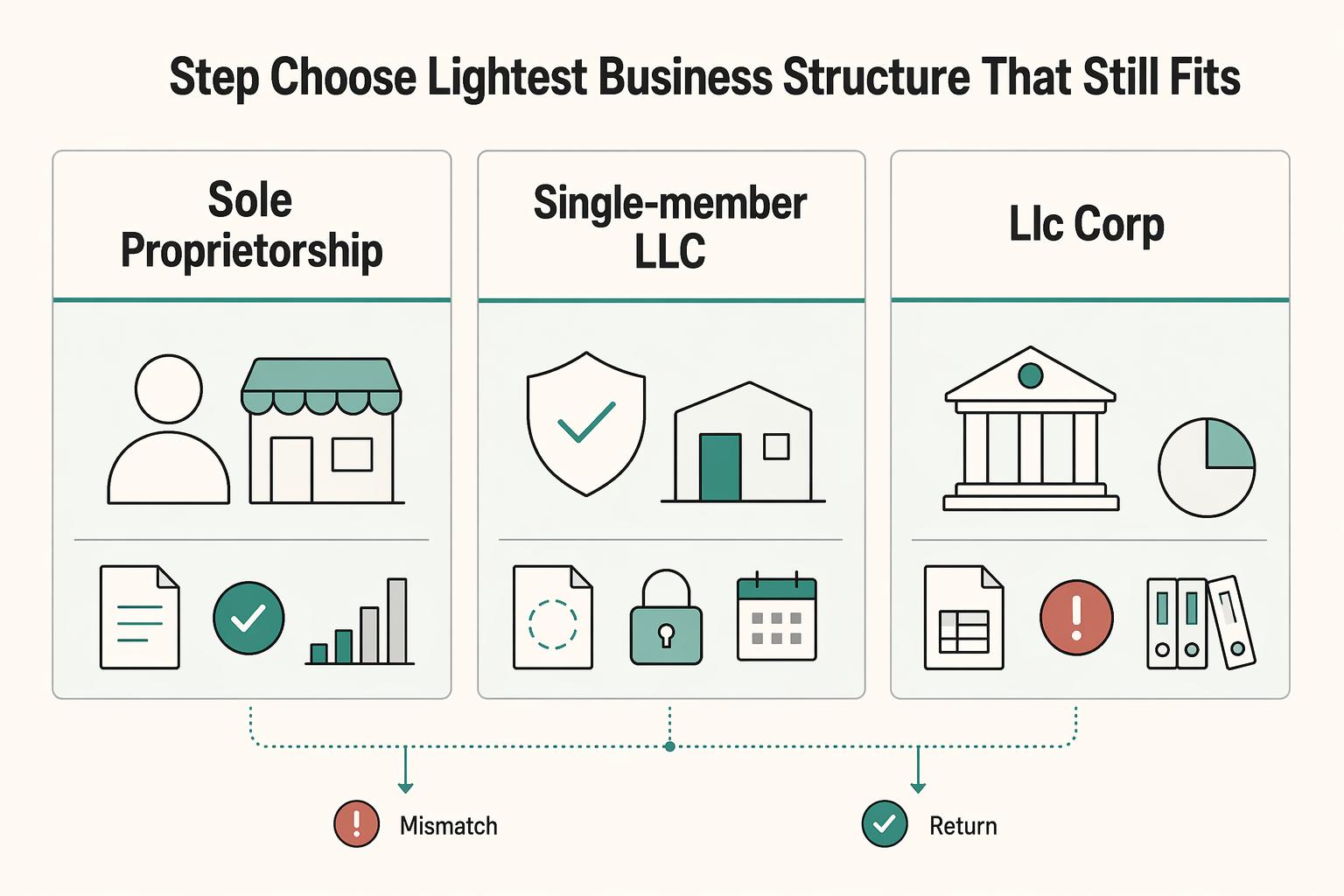
Step 2. Choose the lightest U.S. business structure that still fits your risk and income#
Keep this decision practical. Pick the simplest structure that protects you appropriately and does not create avoidable admin overhead. Structure choice affects taxes and personal asset risk, so treat it as an operating decision, not a branding decision.
| Structure path | Liability protection | Admin burden | Payroll complexity | Tax treatment notes |
|---|---|---|---|---|
| Sole proprietorship | Compare personal-asset exposure against entity options | Case-specific | Case-specific | Confirm fit under current federal and state rules |
| Single-member LLC | Compare personal-asset exposure against operating as an individual | Case-specific | Case-specific | Confirm treatment based on elections and state rules |
| LLC with S-corp election | Compare personal-asset exposure and compliance load | Case-specific | If an officer performs services and is entitled to payment, those payments are wages | Run current-year payroll/tax math before electing |
Use current break-even criteria only after verification, especially if you are comparing a simple restart path against added payroll and filing overhead.
Step 3. Run a repatriation-year filing workflow before year-end#
Do not wait until tax prep season to sort out the move year. Map income first, then apply forms and coordination rules.
- Bucket income and accounts:
- Foreign earned income during the qualifying abroad period
- U.S. earned income after return
- Passive or investment income from any country
- Foreign accounts or entities still open during the year
- Apply FEIE on Form 2555:
- Use the current-year maximum exclusion per qualifying person
- If qualification is only part-year, adjust by qualifying days
- Physical presence test benchmark:
330 full days in 12 consecutive months
- Apply FTC on Form 1116:
- Do not claim FTC on income excluded under FEIE or the foreign housing exclusion
- Track FBAR, FinCEN Form 114, if aggregate foreign accounts exceeded
$10,000at any time:
- Due
April 15- Automatic extension to
October 15
- Automatic extension to
- Handle state part-year treatment state by state:
- Example: California taxes worldwide income during the resident period, plus California source income while nonresident
Escalate to a cross-border CPA if your return combines FEIE and FTC allocation, part-year state residency, especially CA or NY, and foreign account or entity closeout in the same year.
Step 4. Secure health coverage immediately to avoid a usable-coverage gap#
Handle health coverage in week one. A Special Enrollment Period, or SEP, allows enrollment or plan changes outside Open Enrollment after qualifying life events. Moving from a foreign country can qualify, and that move category has a prior-coverage proof exception. Verify the current enrollment window and eligibility conditions before you rely on it.
Do not stop at plan selection. If SEP verification is requested, you must submit documents before coverage can be used. Keep move-date and any coverage-loss records ready, since deadlines can include selecting a plan within 60 days after coverage loss and document submission within 30 days after plan selection.
If you want a deeper dive, read 183-Day Rule Explained: Stop the Tax Myths Before They Cost You. Before you file anything, map your move timeline and domicile evidence in one place with the Tax Residency Tracker.
Conclusion: A documented sequence for your move year#
You do not need a flawless return to repatriate well. You need a documented sequence, clear decision rules, and enough execution discipline to make the move feel like your next operating phase, not a tax scramble.
Step 1. De-risk before you move#
Decide early what gets closed, kept, or reported. Arrive with your foreign account list, highest balances, closure dates, prior tax records, and move documents organized in one place. If aggregate foreign accounts exceeded $10,000 at any point in the year, treat FBAR as a required filing track even if those accounts produced no taxable income.
Step 2. Align operations with your filing story#
Your move year is simpler when your records and filings tell the same story. Update addresses consistently, and use Form 8822 when you need to notify the IRS of an address change. Separate federal filing questions from state residency questions immediately. If FEIE is in scope through the physical presence path, rebuild the 330 full days record before filing, and remember that you generally cannot claim FTC on income excluded under FEIE.
Step 3. Build domicile evidence on arrival#
For state tax, domicile is your one permanent home, so your proof must show that you abandoned the old one and established the new one. Your records and day-to-day facts should point to the same state. If New York is relevant, maintaining a permanent place of abode plus 184 days can still trigger resident treatment even if you argue domicile elsewhere.
Step 4. Use safe defaults, then escalate on complexity#
Proceed with safe defaults when the facts are clean: one clear new state, consistent records, no old-state housing tie, and a filing path you can explain end to end. Escalate to a qualified cross-border tax professional when California or New York is involved, when FEIE and Form 1116 FTC choices overlap, or when Form 8938 may apply because specified foreign financial assets cross the $50,000 base threshold.
Good execution looks like this:
- Documentation ready and dated
- Old-state ties severed and new-state ties rebuilt
- Federal, FBAR, and possible Form 8938 checks handled separately
- FEIE day count and FTC treatment reviewed together
- If Marketplace coverage is relevant, SEP timing checked within the 60-day window
- Escalation points identified before filing
Start now: open one folder, name your target state, list every foreign account and open filing question, and work the plan like the person responsible for the outcome.
We covered this in detail in How to Handle Tax on US Partnership Income as an Expat.
If your repatriation year includes cross-border income, foreign accounts, and state-residency ambiguity, contact Gruv to confirm the right operational setup for your case.
Frequently Asked Questions
When do I become a US resident for tax purposes when I repatriate?
For federal purposes, the article says you generally become a U.S. resident for tax purposes on the first day you are physically present in the U.S. during your repatriation year if you meet the Substantial Presence Test. For state purposes, the bigger issue is domicile, which depends on your actions and intent. That is what usually drives state income tax liability.
Do I have to file an FBAR in the year I return to the US?
Yes. If the combined value of your foreign financial accounts exceeded $10,000 at any point during the calendar year, you must file an FBAR for that full year. Living in the U.S. for part of the year does not remove that requirement.
How do I rebuild my US credit score before repatriating?
Start at least 12 months before your move. The article recommends becoming an authorized user on a trusted family member's U.S. card or opening a secured credit card with a major U.S. bank. Use a U.S. mailing address, make small regular purchases, and pay the balance in full each month.
Can I still use the Foreign Earned Income Exclusion (FEIE) in my repatriation year?
Yes, but only for the portion of the year when you still met the Physical Presence Test. The exclusion must be prorated based on your qualifying days abroad. The article gives an example of calculating the limit using 180/365 if you qualified for 180 days.
What's the biggest tax mistake expats make when establishing state residency?
The biggest mistake is assuming a driver's license alone is enough to establish domicile. The article says you need clear evidence that you intended to leave your old state permanently and build lasting ties in the new one. That means cutting old ties and creating new financial, legal, and community connections right away.
Researched and edited by the Gruv editorial team. Gruv builds cross-border billing, payouts, and finance-operations software for global businesses.
Sources
Educational content only. Not legal, tax, or financial advice.
Related Posts

183-Day Rule Tax Myths That Trigger Residency Filing Mistakes
If you are a mobile freelancer or consultant, start here: the "183 day rule tax" idea is not a single universal test. It is a shortcut phrase people use for different residency rules that do not ask the same question. If you mix federal and non-federal residency logic, you can create filing risk even when your travel calendar looks clean.
Moving From Hourly to Project Rates Without Hurting Cashflow
The right pricing model matches uncertainty and cashflow risk. It should fit how clearly the work can be defined, approved, and defended, not just what you are used to selling. Hourly billing gives you room to work while requirements are still moving. Fixed project pricing gives the client stronger budget clarity once deliverables are stable enough to pin down.
U.S. Expat Repatriation Financial Checklist: Foreign Wind-Down, Compliance Cut-Over, and U.S. Relaunch
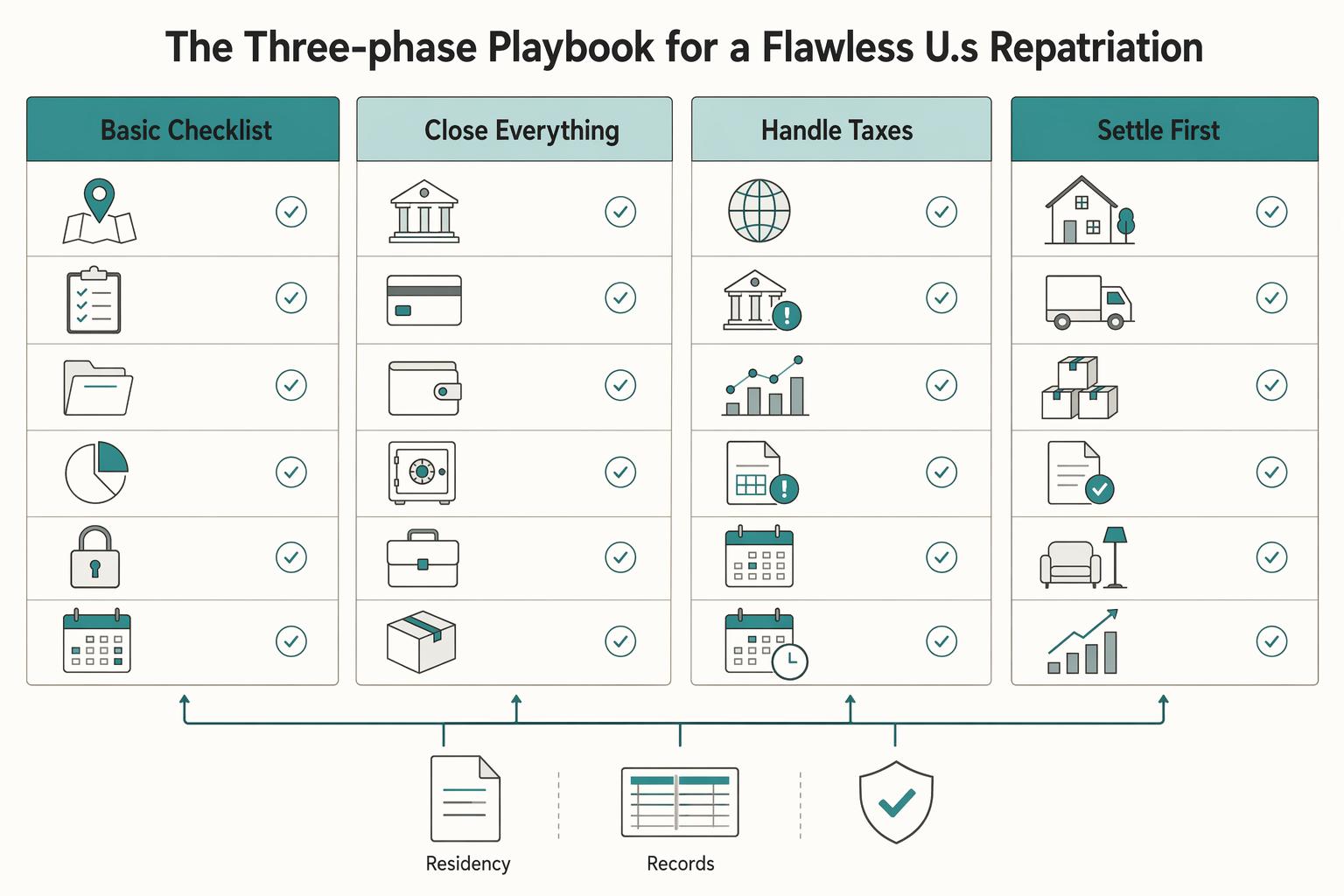
Use a phased checklist, not a flat one. The order of decisions can change your tax filings, account reporting, and cash-flow continuity. A move back to the U.S. affects how you handle worldwide income, which foreign accounts still need reporting, and how you sequence your U.S. relaunch to avoid gaps.