
Quick Answer
Effective time management for freelancers requires a deliberate system built on three layers: a Time Budget Framework that pre-allocates weekly hours across billable work, business development, operations/admin, and recovery; a Weekly Operating Template that maps those categories to named calendar blocks; and a monthly Admin Audit Checklist that closes the loop on invoicing, bookkeeping, and compliance. Without this structure, schedule flexibility becomes financial risk—misallocated hours translate directly to missed revenue, delayed invoices, and tax-season scrambles.
How to Manage Your Time Effectively as a Freelancer#
Freelance freedom is real, but without a deliberate structure for your week, that freedom turns into risk.
You chose this path for flexibility. That instinct is sound. Schedule autonomy is one of the main reasons people go independent. But flexibility without structure is just unscheduled risk. More than 60% of new freelancers fail to earn a sustainable income in their first year, and poor time management is one of the main reasons why.
As the operator of a business-of-one, your calendar is not a personal preference. It is the control panel for revenue, delivery quality, and recovery.
The math is simple. When you are the person selling the work, managing the work, and delivering the work, time stops being a soft concern. It becomes a business input. Every hour that lands in the wrong place is either revenue you did not capture or recovery you did not get.
This guide is built to be used, not admired. You will leave with a Time Budget Framework, a Weekly Operating Template, and clear operating rules for client load, time tracking, and the procrastination patterns that quietly drain productive capacity.
- Know your billable hour target. Decide how many client-facing hours per week your income goal requires. That number anchors every other decision.
- Separate your roles on paper. You wear multiple hats. Name them clearly: producer, operator, administrator. Each role needs protected time.
- Accept that structure creates flexibility. A defined setup gives you permission to stop working because the work is contained instead of sprawling.
The sections ahead build on each other. Start with the hour budget, then map it onto a real week, then add the operating checks that keep it stable when clients, admin, and tax obligations all compete for the same hours.
Your Time Has a Ledger: Why Most Freelance Advice Fails You#
Most freelancers do not have a motivation problem. They have an allocation problem.
Late invoices, unbilled work, and tax-season scrambles are usually not character flaws. They are predictable downstream effects of treating time as infinite and recoverable instead of what it actually is: a finite input with a real cost per hour.
If you command professional rates, you are running a high-value operation. Every hour spent on unplanned admin, scope creep, or chasing a payment that should have been invoiced last week is a direct deduction from that value.
That is why generic productivity advice often falls flat. It treats your week like a pile of tasks to get through. Freelance work is not just a task problem. It is an operating problem. If you do not decide where your hours go ahead of time, client work will absorb everything and leave the rest of the business unfunded.
Time Is a Balance Sheet Item#
Think about your week the way you think about cash. Unplanned time behaves like an unreconciled account. When it goes untracked or unallocated, the business is running a deficit it cannot see.
That reframe changes what good time management looks like. It is not about squeezing more tasks into a day. It is about deciding, in advance, where your working hours go: billable client work, business development, administration, and intentional recovery. Then you reconcile that plan against reality every week.
Freelancing also adds financial responsibilities that are inseparable from time decisions. Keeping your books current, tracking billable time in useful detail, and staying on top of invoicing are not back-office nuisances. They are part of the job. Treat them like interruptions and they turn into emergencies. For the financial side, see How to Manage Bookkeeping for Your Freelance Business.
Here is how the rest of this article fits together:
- A Time Budget Framework that allocates hours before you even open your calendar
- A Weekly Operating Template that gives those hours a repeatable home in the week
- Practical rules for multi-client work, tax-ready time tracking, and breaking procrastination cycles before they turn into backlog
You can jump to the section that is breaking your week right now, but the full sequence works best because each layer reinforces the next.
What Makes Freelance Time Management Structurally Different?#
This is where most standard advice breaks. Productivity systems built for employees do not solve an operator problem.
Most mainstream advice assumes a manager, a schedule, and one main queue of work. As a freelancer, none of those defaults exist. Accountability is self-generated, deadlines are partly self-enforced, and the structure that keeps your week coherent has to be designed by you.
That is not a willpower problem. It is a structural one.
The Structural Gaps That Break Standard Advice#
Five differences matter here.
1. No imposed structure. Employee productivity frameworks assume an external scaffold: a boss, a meeting rhythm, a ticket queue, a standard workday. Without that scaffold, open calendar space fills with reactive work or with nothing at all. The discipline required to structure your own day is different from the discipline required to show up to a structure someone else already built.
2. The feast-or-famine cycle. The feast-or-famine cycle is the pattern of alternating overcommitment and idle periods that breaks your week at both extremes. During busy stretches, you overbook and under-deliver. During slow ones, you drift. A simple to-do list does not solve either problem because it does not protect capacity when work is heavy or create useful motion when work is light.
3. Misallocated hours have a direct income cost. For employees, a wasted afternoon may be annoying. For you, it can mean a missed billable block, a delayed invoice, or a quarterly tax estimate built on incomplete numbers. Time and money are tied together much more tightly when your work is the product.
4. Multi-client context-switching. Context-switching is the mental cost of moving between different client projects, each with its own communication style, scope of work (SOW), and deliverable cadence. Running several live client contexts at once is cognitively expensive. Without deliberate boundaries, that cost compounds across the week and quietly reduces the amount of deep, high-value work you can actually do.
5. Admin is real work with real time costs. Invoicing, bookkeeping reconciliation, Form 1099 tracking, and quarterly tax estimates do not schedule themselves. Treating them like background noise is exactly how they become urgent. Each one takes time, and that time belongs on the calendar like any client deadline.
Most freelancer stress comes from some combination of these five gaps. Once you see them clearly, the fix becomes practical. You stop asking how to do more and start deciding what must be funded first.
What the Numbers Say#
More than 60% of new freelancers fail to earn a sustainable income in their first year, and poor time management is consistently cited as a primary cause. Separately, nearly 60% of freelancers went independent specifically for work-life balance. The gap between that expectation and the operating reality is where most of the trouble lives.
The answer is not to work harder or hunt for more discipline. It is to build a setup that matches the reality of independent work: variable income, multiple clients, and no guardrails unless you create them. That starts before the calendar, not inside it.
Build Your Time Budget Framework Before You Touch a Calendar#
Do not start with a color-coded week. Start with an hour budget.
Most freelancers open the calendar and fill it with client work first. Everything else then fights for whatever time remains. That is how invoicing slips, business development disappears, and mental bandwidth gets compressed week after week.
The better move is to pre-commit your hours by category, not by client, and protect those categories like obligations.
Step 1: Define Your Four Categories#
Before you schedule anything, divide your working hours into four buckets:
| Category | What Goes Here | Why It Matters |
|---|---|---|
| Billable client work | Deliverables, client calls, revisions, SOW execution | Your direct revenue engine |
| Business development | Proposals, outreach, SOW negotiations, relationship maintenance | Prevents the feast-or-famine cycle |
| Operations and admin | Invoicing, bookkeeping, quarterly tax estimates, payment reconciliation | Keeps you compliant and cash-flow positive |
| Recovery and margins | Scope creep buffers, unexpected client requests, mental reset | Prevents overcommitment from collapsing the rest of the week |
This breakdown matters because each category solves a different failure mode.
Billable client work pays the bills. Business development keeps future work from disappearing. Operations and admin keep the business legally and financially current. Recovery and margins stop small overruns from turning into full-week spillover.
Billable hours are the hours worked directly for a client that can be invoiced. Tracking them accurately is foundational for invoicing and reporting. But treating billable time as the only category worth protecting is one of the fastest ways to destabilize your week. The other categories are not optional. They simply bill later, indirectly, or defensively.
Step 2: Block Each Category Before Accepting New Work#
The category most freelancers cut first is recovery and margins. That is usually where the problem starts.
Scope creep is not unusual. It is a normal feature of client work. A buffer category absorbs that pressure without forcing admin, outreach, business development, or recovery to disappear every time a project expands.
Treat your admin block the same way you would treat a client retainer. Block the time, protect the block, and do not make it contingent on how the week feels. Invoicing, bookkeeping reconciliation, and quarterly tax estimates do not happen because you meant to get to them. They happen because the time was reserved before the week got noisy.
If your records are already behind, How to Manage Bookkeeping for Your Freelance Business can help you get them current.
Time blocking works because it stops one category from silently expanding into unprotected time. Pair it with basic time tracking, and you get something more useful than good intentions: evidence about how long each category actually takes versus how long you planned. Review that weekly and tighten the numbers over time.
The output of this step is not yet a schedule. It is a weekly hour map by category, a clear commitment about where your time goes before clients start trying to claim it.
What Does a Strong Weekly Operating Template Actually Look Like?#
Once the hour budget exists, give each category a home in the week. A Weekly Operating Template is a repeatable schedule structure, not a vague intention to "try time blocking."
With your four categories defined and your hour allocations set, map them onto real days and real windows. The exact days can change. The logic should not.
A Sample Five-Day Template#
| Day | Primary Focus | What Gets Done |
|---|---|---|
| Monday | Weekly planning ritual (60 min) + Client A deep work | Set priorities, review outstanding invoices, open your first deep work block |
| Tuesday and Wednesday | Deep work: primary deliverables | High-concentration client work, with one defined async communication window |
| Thursday | Business development + admin | Proposals, outreach, invoicing run, bookkeeping check-in |
| Friday | Wrap, review, buffer | Weekly review, Admin Audit Checklist run, absorb scope overruns |
Use this as a starting point, not a rigid contract. The value is that you stop re-deciding the shape of your week every Monday morning. When the categories already have a home, you spend less energy negotiating with yourself and more energy doing the actual work.
A strong template also makes tradeoffs visible. If a client asks for more, you can see exactly which block it would displace. That is much better than accepting the work and discovering the cost later.
Protect Deep Work Like a Client Deliverable#
If email, Slack, and client messages leak into your production blocks, your template becomes decorative. Deep work needs the same protection you would give a client call.
Deep work is focused, high-concentration output scheduled during your highest-energy window, protected from async interruptions. That means messages do not belong inside the block. Set a defined response window. Once per day is usually enough, and hold it.
The Pomodoro Technique is a time management method that uses short, focused work intervals followed by brief breaks. It can fit neatly inside a deep work block when you need help getting traction on a difficult task. What it should not do is replace the larger category structure. A timer can help you start, but it cannot decide what type of work belongs in your day.
A useful rule here is simple: block the category first, then choose the task. If you reverse that sequence, the calendar may look full while the week still starves key categories like business development or admin.
Before You Build This Template#
Do not build a weekly template blind. You need three inputs first:
- Billable hour target: know the weekly number you need to hit based on your rate and income goal
- Active client count: this shapes how many deep work blocks you need and how you split them across the week
- A bookkeeping system with weekly visibility: you need to see paid versus outstanding invoices before your Thursday admin block can do its job. If that is not in place yet, How to Manage Bookkeeping for Your Freelance Business is a practical next step
Without those three inputs, your template may look neat but still leave you operationally blind. Once they are in place, the schedule stops being aspirational and starts becoming usable.
How Do Freelancers Manage Multiple Clients Without Burning Out?#
Burnout usually starts before your calendar looks full. The real risk is unmanaged client load: too many active engagements, too much context-switching, and no decision rule before you say yes.
Once your weekly template exists, the next layer is client orchestration. If your calendar does not account for how many live client obligations you are carrying, it will eventually collapse under interruption and spillover.
The Three Rules#
Three rules do most of the heavy lifting here.
Rule 1: Set a WIP Limit.
A Work in Progress (WIP) limit is a cap on the number of active client engagements you carry at one time. Its purpose is straightforward: context-switching has a real cognitive cost. Every time you move from one client's requirements, tone, and deliverables to another's, you pay a productivity tax.
That tax compounds quickly. What matters is not just the total number of hours on paper, but the number of parallel contexts you are trying to hold in your head.
Identify your personal threshold, the point where output quality starts dropping before your calendar fully reflects the problem. Once you hit that cap, new work either waits or replaces something already on the books.
Rule 2: Assign Dedicated Client Windows.
Each active client needs a named home in your Weekly Operating Template. Not a generic block labeled "client work," but a specific window. Client A on Tuesday morning. Client B on Wednesday afternoon. Client C on Thursday after admin.
That structure matters because it gives you a containment line. When a client expands their requests, they expand inside their window, not across the entire week.
In practice, this is one of the few defenses against scope creep that consistently holds up.
Write down every task for each client instead of carrying it in memory. This is not a minor productivity trick. It is cognitive load management. The mental overhead of remembering obligations competes directly with the concentration that makes your work valuable. Project management tools such as Trello, Asana, or Monday.com, with a separate board or project space per client, can reduce the risk of missed deadlines when several engagements are active at once.
Rule 3: Build a Capacity Decision Rule.
Before you accept a new engagement, run a simple check:
- Calculate available billable hours after existing client commitments.
- Subtract your admin and recovery categories from the Time Budget Framework.
- Confirm the residual covers the new SOW's scope, realistically rather than optimistically.
If the hours do not fit, you have two legitimate options: negotiate the timeline or negotiate the scope. Cutting admin or buffer time is not a real option. Those categories exist to absorb the friction every engagement creates.
This is the part many freelancers skip because the work sounds exciting or the opportunity feels urgent. That is exactly when the rule matters most. If you do not decide in advance what counts as full, every attractive project will look possible right up until the week breaks.
The Operational Check#
A simple diagnostic tells you whether your client-load setup is actually working: if you cannot point to a protected calendar window for each active client right now, you are managing from memory and interruption.
A healthy multi-client practice looks almost boring from the outside. Each client knows when to expect output. Deliverables have a named home on the schedule. New work goes through a capacity check before it gets a yes.
58% of freelancers report that managing their time is genuinely challenging, and most of that difficulty is structural rather than motivational. Get the structure right and the day becomes less dramatic, which is exactly what you want.
Once client load is under control, the next question is documentation. If your hours are not logged clearly, invoicing and tax prep will eventually expose the gap.
How Should Freelancers Track Time for Taxes and Compliance?#
Thin records create expensive problems later. Time tracking is not just a billing habit. It is a compliance and evidence habit.
Every hour you log can support an invoice, explain a deduction, or help you reconcile income when tax season arrives. The freelancers who have the least friction at filing time are not necessarily better at math. They keep cleaner records while the work is still fresh.
Step 1: Build a Minimum Viable Time Log#
Start small, but do it weekly. Log hours at the project and category level each week, not monthly and definitely not quarterly.
The split that matters most looks like this:
| Category | Why It's Tracked |
|---|---|
| Billable (by client) | Ties directly to invoices and Form 1099 reconciliation |
| Non-billable (admin, ops) | Quantifies overhead and informs your effective rate |
| Business development | Supports deduction documentation for marketing expenses |
A minimum viable log does not need to be fancy. It does need to be current. Reconstructing a year of hours from memory in April is not a process. It is a risk.
This weekly habit also gives you feedback on whether your Time Budget Framework matches reality. If admin consistently eats more time than you budgeted, the answer is not to ignore it. The answer is to update the budget so the business is funded honestly.
Step 2: Connect Time Logs to Invoices and Tax Estimates#
Logged hours should line up with the way you bill. Every billable block ought to correspond to a line item on an invoice. If logged hours and invoiced hours do not match, that gap is revenue leakage: work you delivered but did not bill clearly or completely.
Good weekly hour data also improves quarterly tax estimates. When you know your billable hours, your effective rate, and your income to date, your estimate is grounded in actual production instead of a rough guess pulled from bank statements right before a payment deadline.
Your bookkeeping records and your time logs should tell the same story. If they do not, treat that as an operations issue you need to fix before the next filing period rather than during it. How to Manage Bookkeeping for Your Freelance Business walks through how to structure that reconciliation.
Step 3: Layer in Compliance Tracking for International Income#
Cross-border work raises the stakes because your records may need to prove more than what you earned.
If you work with international clients or earn income across borders, your time records carry additional weight. Freelancers pursuing the Foreign Earned Income Exclusion (FEIE) through the Physical Presence Test need documented proof of where they were and when.
The Physical Presence Test requires 330 full days of physical presence in a foreign country or countries during any period of 12 consecutive months. Those 330 days do not need to be consecutive, and the 12-month window does not need to align with a calendar year. For tax year 2026, the maximum FEIE exclusion is $132,900 per qualifying person.
Your time log, paired with travel records such as entry and exit dates, passport stamps, and flight records, helps build the day-count documentation that supports Form 2555.
FBAR and FATCA thresholds create separate reporting requirements for foreign financial accounts. Your payment records and time logs help establish the income side of that picture, though the specific filing thresholds should be reviewed separately.
Use one simple check here: if your time log, your invoices, and your bookkeeping do not reconcile to the same income figure, fix that gap before your next filing deadline. Records are hardest to repair when you wait.
Why Do Freelancers Procrastinate, and How Do You Break the Pattern?#
Once the calendar and records are under control, the biggest remaining failure mode is drift. Freelance procrastination is usually a workload-cycle problem, not a character flaw.
That distinction matters. If you label every low-output period as laziness, you will reach for guilt instead of diagnosis. If you look for the pattern driving the drift, the fix gets much more practical.
Identify Which Cycle Is Driving the Drift#
Two moments trigger procrastination more than any others:
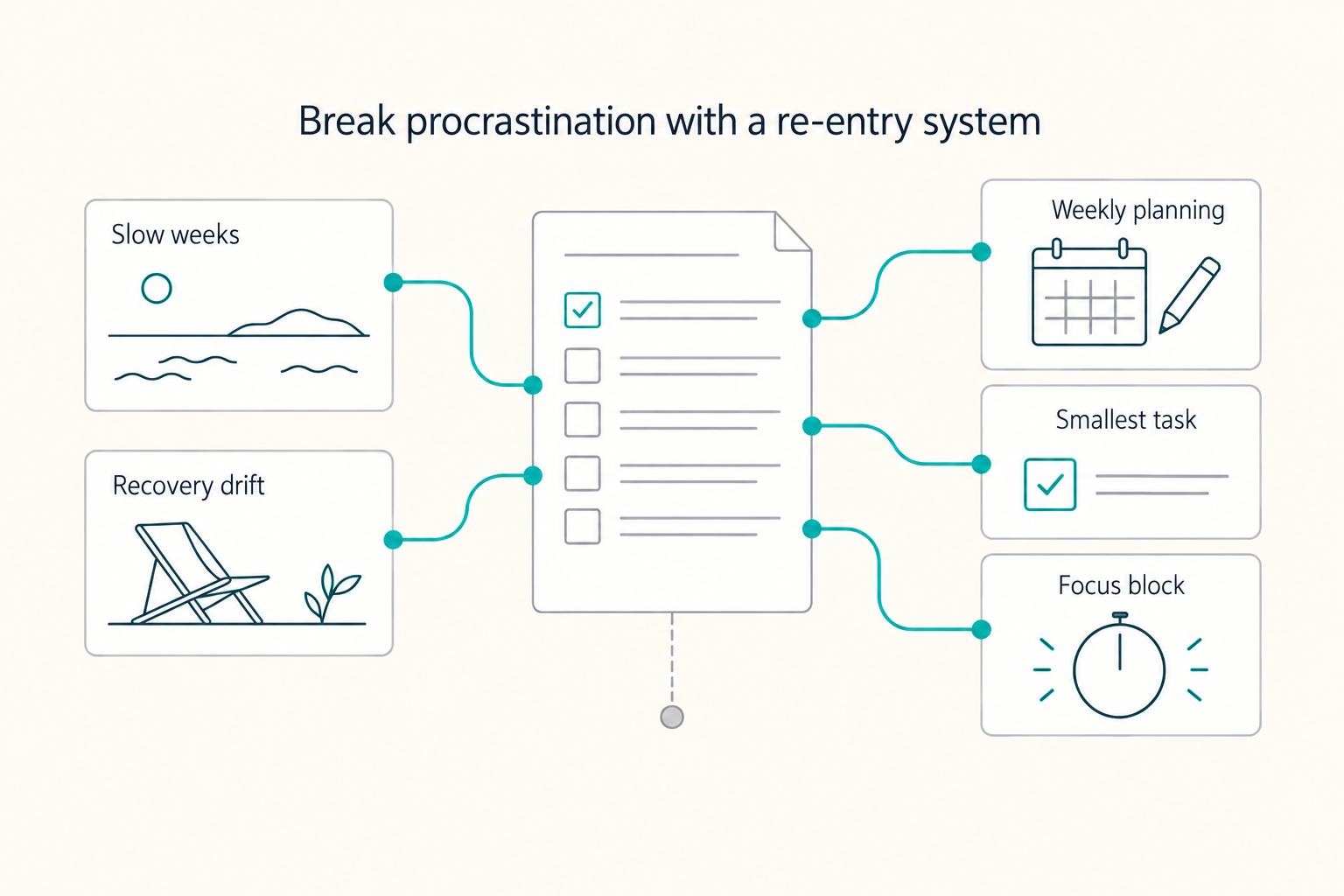
- Slow weeks: low external urgency creates a vacuum where self-imposed structure has to carry the whole load. What feels like freedom at first can turn into drift if the week is not populated deliberately.
- Post-delivery recovery: after an intense project closes, some recovery is legitimate. The problem starts when that recovery stretches beyond a day or two and quietly becomes a period with no re-entry plan.
The useful question is not, "Why am I so lazy?" It is, "Which cycle am I in right now?"
That small change in language matters because the action changes with it. If you are in a slow-period drift, the next move is usually business development. If you are in post-delivery drift, the next move is often to re-anchor the week before the empty space spreads.
Precision produces action. Vague self-criticism just produces guilt.
Run the Pattern-Interrupt System#
When drift shows up, interrupt it in this order:
- Run your weekly planning ritual even if the calendar looks empty. An empty calendar is exactly when planning matters most. Block the time, populate the template, and identify the smallest concrete deliverable in front of you.
- Anchor to the smallest task, not the most important one. Momentum usually comes before motivation. Starting with the biggest, highest-stakes item when you are already drifting is a reliable way to extend the stall.
- Use a short, timed focus block as a re-entry tool. Commit to one focused block, then decide whether to continue. The point is not productivity theater. The point is lowering the activation cost of starting.
This is where simple time blocking earns its keep. A dedicated window for a task type can substitute for some of the external accountability a traditional job would otherwise provide.
In practice, the first ten minutes matter more than the perfect plan. If you can get yourself into one real block of work, the day often becomes salvageable very quickly.
Treat the Slow Period as a Business Development Signal#
If procrastination shows up during a slow week, look at your business development block before you blame your focus.
Slow periods are rarely random. More often, they are the delayed result of skipping outreach during the last busy stretch. Drift in downtime is usually a lagging indicator of a business development gap, not a motivation defect.
Populate that business development window in your Weekly Operating Template while you still have the capacity. Busy weeks will not create that time for you later.
Administrative avoidance has the same pattern. Delayed invoices, uncategorized expenses, and deferred compliance reviews do not stay neutral. They compound into errors, missed deductions, and filing-period scrambles. That is why the monthly close matters, and it is also why the practical questions below tend to repeat across almost every freelance practice.
Your Monthly Admin Audit Checklist: Close the Loop on Operations#
Weekly structure keeps execution moving. The Admin Audit Checklist is the monthly close that keeps the whole operation from drifting into backlog and surprise.
Most freelancers end up in an April panic because they run this review once instead of repeatedly. The goal here is simple: close the month while the details are still easy to verify.
Work through each step in order. Each one should end in a clear completion state.
Step 1: Close Invoicing and Payments#
Start with money in and money owed.
- Log all billable hours from the period and confirm invoices sent
- Flag any outstanding invoices and send a follow-up (don't let aging receivables slide past 30 days)
- Reconcile payments received against invoiced amounts
- Update payment records in your bookkeeping system
Outcome: Every hour you worked this month has a corresponding invoice. No unbilled time is sitting in a spreadsheet, your inbox, or your memory.
Step 2: Reconcile Bookkeeping and Tax Prep#
Now bring the books into line with the work you actually did.
- Complete monthly bookkeeping reconciliation
- Calculate your quarterly estimated tax payment and confirm it's filed if the quarter has closed
- Update tracking for any contractor income received
- File and categorize all business expense documentation
Keep this tightly linked to your invoicing records. If those two sets of numbers do not align, fix that before the next deadline puts you under pressure. For a deeper look at keeping the records clean, see How to Manage Bookkeeping for Your Freelance Business.
Outcome: Your books match your bank. Your quarterly tax position is current instead of reconstructed from memory.
Step 3: Review Compliance and Records#
This is the step where avoidable risk usually hides, especially if your work or payments cross borders.
- Back up time logs and tie them to active Statements of Work (SOWs)
- Confirm NDA and contract files are current for every active engagement
- Review any cross-border payment records for FBAR or FATCA relevance
On FATCA specifically: If the aggregate value of your specified foreign financial assets exceeds $50,000, Form 8938 must be attached to your annual tax return. Note that higher thresholds may apply in some cases. Also note that FBAR (FinCEN Form 114) is a separate filing requirement. Submitting Form 8938 does not replace it.
Failure to file Form 8938 when required carries an initial IRS penalty of $10,000. It can escalate to $50,000 for continued non-compliance after IRS notification, plus a 40% understatement penalty on any underpaid tax tied to undisclosed foreign assets.
Outcome: Your contracts, logs, and cross-border records are current enough to support the work you did and the income you reported.
Step 4: Run a Capacity Check#
Finish by looking forward, not just backward.
- Count your current active SOWs against your WIP limit
- Assess any admin backlog before accepting new work
- Review and update your Weekly Operating Template for the next period
Outcome: You start the next month with a clean template, a known WIP position, and no deferred admin quietly accumulating in the background.
Treat this as a hard monthly close, not an aspirational quarterly intention. The freelancers who avoid tax-season chaos are the ones who run this review twelve times a year. Put it on the calendar as a recurring block and let repetition do the heavy lifting.
Run Your Business Like a Business: The System That Compounds#
This is the real point of all of this. Good time management as a freelancer is not about squeezing more hours out of the day. It is about allocating the hours you have across the right categories, then protecting those categories every week.
The Time Budget Framework sets the allocation across billable work, business development, operations, and recovery before client commitments land. The Weekly Operating Template gives those categories a visible home. The Admin Audit Checklist closes the month so nothing rolls forward into a preventable crisis.
Each layer depends on the others. A polished weekly template built on a broken hour budget only makes you efficient at the wrong things. A monthly close with poor records underneath it becomes a stress ritual instead of a control point.
Put the System in Motion This Week#
Do not wait for a perfect setup. Start with a first workable version.
- Draft your Time Budget Framework. Assign a rough share of your available hours to the four categories: billable work, business development, operations and admin, and recovery.
- Build your first Weekly Operating Template. Put each category into real calendar windows. Label the blocks by function and protect your deep work time the way you would protect a client meeting.
- Schedule your Admin Audit Checklist. Put a recurring monthly block on the calendar now. Same day, same time. This is the review that keeps the rest honest.
Run the process for one month, then review where your time actually went versus where you planned for it to go. That gap is not a moral verdict. It is operating data, and it tells you what to adjust next.
The Infrastructure Underneath It All#
None of this works well if the records feeding it are unreliable.
If you do not have weekly visibility into paid versus outstanding invoices, your capacity checks are guesswork. If your bookkeeping is months behind, your quarterly tax position is a fiction you will have to reconcile under pressure. If your time logs do not match your invoices, you cannot tell whether the week was profitable or merely busy.
Clean records are not administrative busywork. They are what make the whole setup runnable. Most freelancers do not burn out because they cannot do the work. They burn out because the work, the admin, and the financial obligations all stay reactive at the same time.
Get the structure in place, keep the records current, and the business gets calmer. That calm is not accidental. It is what well-run operations feel like.
For a practical way to keep those records current, How to Manage Bookkeeping for Your Freelance Business is the logical next step.
Your time has a ledger. Start treating it like one.
If you want help with payment visibility and audit-ready records, Talk to Gruv.
Frequently Asked Questions
How many hours should a freelancer work per day?
A principled daily target is six to seven hours of structured work, with four to five of those hours reserved for billable output. The rest covers admin, communication, and recovery buffer. Pushing past eight hours without labeled categories typically compresses admin and recovery time — which surfaces later as missed invoices and burnout, not more completed work.
How much time should a freelancer spend on admin work?
Reserve 15–20% of your total working hours for admin. On a 40-hour week, that's six to eight hours dedicated to invoicing, bookkeeping, quarterly tax estimates, and compliance reviews. Protect this block in your Time Budget Framework as a fixed category — not time you squeeze in after client work ends. For a deeper look at keeping those records clean, see How to Manage Bookkeeping for Your Freelance Business.
What is the best schedule for a freelancer?
The best schedule is one anchored to a Weekly Operating Template with four labeled categories: billable work, business development, operations and admin, and recovery. No universal daily structure exists. What matters is that deep work lands in your highest-energy window and admin lands in a consistent, recurring block — not "whenever I get to it."
How do freelancers manage multiple clients without burning out?
Apply a Multi-Client Orchestration Protocol: set a Work in Progress (WIP) limit of three to four active SOWs, assign dedicated client windows in your weekly template, and run a capacity decision rule before accepting any new engagement. The WIP limit prevents one client from colonizing time that belongs to another — or to your admin category.
How do freelancers track time for taxes?
Log hours at the project and category level weekly, tied directly to your invoices. Accurate weekly records support Form 1099 income reconciliation and Schedule SE calculations, and document business expense deductions. For cross-border freelancers, those same time logs can support Physical Presence Test documentation. The Physical Presence Test is an IRS requirement: you must be physically present in a foreign country or countries for at least 330 full days during any period of 12 consecutive months to qualify for the Foreign Earned Income Exclusion (FEIE). The 330 days do not need to be consecutive.
How do I stop procrastinating as a freelancer?
Match your intervention to the pattern. Post-delivery drift calls for re-anchoring with a weekly planning ritual. Slow-period drift usually signals an underpopulated business development pipeline — not a motivation problem. Admin avoidance calls for a non-negotiable weekly checklist. Use the Pomodoro Technique (25-minute focused work intervals) as a low-cost re-entry tool when starting feels like the hardest part.
How do I know when to say no to a new client?
Apply the capacity decision rule: subtract existing billable commitments, admin time, and recovery buffer from your available hours. If the residual doesn't fit the new SOW's scope without compressing a protected category, the answer is no — or negotiate scope and timeline before signing. Protecting your existing categories is not caution; it's the operating discipline that keeps delivery quality consistent across every engagement.
Try a related tool
Researched and edited by the Gruv editorial team. Gruv builds cross-border billing, payouts, and finance-operations software for global businesses.
Sources
Includes 4 external sources outside the trusted-domain allowlist.
- irs.gov/individuals/international-taxpayers/foreign-...trusted
- irs.gov/instructions/i2555trusted
- pmc.ncbi.nlm.nih.gov/articles/PMC7075496trusted
- apa.org/topics/research/multitaskingexternal
- clockify.me/time-management-techniquesexternal
- todoist.com/productivity-methods/pomodoro-techniqueexternal
- todoist.com/productivity-methods/eisenhower-matrixexternal
Educational content only. Not legal, tax, or financial advice.
Related Posts

Freelance Bookkeeping for Faster, Safer Client Payments
Control over cash starts with records you trust. When entries are current, categorized, and easy to trace, you spot risk earlier and make calmer decisions about follow-up, spending, and month close.

Child Tax Credit for U.S. Expats: Eligibility, FEIE, and Filing Checks
Claiming the Child Tax Credit from abroad is manageable when you treat filing as a sequence of gates, not a refund chase. Prove eligibility first, build support documents second, file third, and escalate as soon as one gate is unclear.

The Freelance Payment Penalty: A Modeled Audit of Platform Fees, FX Spreads, and Payout Delays
The money rarely disappears through a single, easy-to-spot fee. The real loss is stacked. A marketplace takes its commission, a processor adds a charge for international cards, a bank or payment company converts the currency at a spread, a platform holds the funds before release, and a wire sheds a little to intermediaries on the way in. Each layer looks defensible on its own, but the worker feels the combined result as a smaller deposit and a later payday.