
Quick Answer
Use war of art for creatives as a weekly operating standard, not a motivation hit. In Steven Pressfield’s terms, Resistance is the force that delays meaningful work, so the practical move is to enforce fixed creation and admin blocks, then verify outward progress each week: draft sent, invoice issued, and next deadline confirmed. Add a lightweight evidence pack so scope changes, approvals, and payments are traceable when questions come up.
The War of Art for creatives in 2026#
If you want The War of Art to matter in 2026, use it as a reliability standard, not a motivational boost. Its practical value is simple: take Steven Pressfield's idea of Resistance seriously, then turn it into weekly habits that protect output and make your work more dependable.
That is where the book is most useful. It works well as a lens for the inner fight. Pressfield frames creativity as a battle with Resistance, the force that gets in the way of meaningful work. Across the reviews and summaries this piece draws on, the takeaway is similar: self-discipline is the way through it, and one review frames the shift as moving from hobbyist behavior to professional behavior. For independent work, that leads to a better question: not "How do I feel inspired today?" but "What will I finish, send, confirm, and bill this week?"
This article is for independent professionals who cannot afford avoidable chaos. If you write, design, consult, edit, illustrate, produce content, or run a one-person studio, the real problem is often not talent alone. It is delayed starts, half-finished drafts, late proposals, skipped follow-ups, messy records, and preventable surprises right before a deadline. That is where Resistance usually shows up first, long before you call it procrastination or creative block.
The tradeoff is blunt: treat this book like inspiration, and you may get a short productive burst. Treat it like a professional standard, and you can build steadier delivery over time. The first path protects your mood. The second protects your business.
This guide aims to give you three practical outcomes:
- a repeatable weekly structure for creative work and admin
- clear decision rules for moments when avoidance spikes
- a short checklist you can run each week without overthinking it
The simplest test is visible movement. Did you send the draft? Did the invoice go out? Did you confirm the next deadline? If not, the problem is not a lack of ideas. Resistance won in operational form.
Just as important, this article does not treat The War of Art like a business manual. The book is about the inner creative struggle and the discipline needed to face it. It does not give you contracts, invoice controls, or compliance procedures. So the goal here is to keep the useful core, then add the missing operator detail: what to do on a normal Tuesday, what to check on Friday, and what red flags mean you need to change how you work.
That is the standard for the rest of this guide: not feeling more creative for a day, but becoming more dependable over time.
What Resistance looks like in a real freelance week#
In a real freelance week, Resistance usually looks like reasonable avoidance, not a dramatic breakdown. In Pressfield's framing, it is an internal barrier to meaningful work, so the practical test is simple: what important action did you avoid?
Most summaries of The War of Art treat Resistance as the main obstacle to creativity and productivity. They describe procrastination as its easiest form to rationalize, and fear often shows up as self-doubt, especially around work that matters. In practice, starting feels harder than doing.
The daily signals that matter#
Most weeks, the pattern looks ordinary:
| Pattern | What it looks like | Action being avoided |
|---|---|---|
| Polishing a ready draft | Keep polishing a draft that is ready to send | Send the draft |
| Research mode | Delay outreach by staying in research mode | Contact people |
| Planning and reorganizing | Keep planning, sorting notes, or reorganizing tasks | Ship something |
- You keep polishing a draft that is ready to send because sending invites feedback.
- You delay outreach by staying in "research mode" instead of contacting people.
- You keep planning, sorting notes, or reorganizing tasks when the next move is to ship something.
If this feels familiar, use a behavioral check: did anything important move outward today? If not, you were busy, but you likely fed avoidance.
Where freelancers misread the pattern#
The common mistake is confusing preparation with progress. Perfectionism can feel responsible, and research can feel professional, but repeatedly choosing lower-risk tasks when action is clear is usually Resistance in work clothes.
That is also where quick summaries have limits: they help name the concept, but they do not run your week for you. As Pressfield puts it, "Between the two is resistance." Use that as a practical cue. If you keep reopening work without shipping, assume avoidance first and act on the next concrete step.
Inspiration or discipline is the wrong question for paid creative work#
For paid creative work, discipline is the baseline and inspiration is a bonus. If delivery is part of the agreement, the useful question is not how you feel, but whether you shipped the next concrete step.
In The War of Art, Resistance is framed as the internal force behind self-sabotage, self-deception, and delay, and the foreword makes the deadline point plainly: eventually, you do the work. The practical stance often tied to Do the Work lands in the same place for client work: action first, confidence after. Start the draft, send the version, make the call, or send the invoice.
The tradeoff is straightforward. Waiting for "perfect clarity" can feel safer in the short term, but it usually extends procrastination, tightens your revision window, and increases deadline and trust risk over time.
Use a behavioral checkpoint, not a mood checkpoint. By the end of your first real work block, produce one outward artifact:
- a draft sent
- a decision note shared
- a rough concept uploaded
- a client question answered
If the block ends with only more notes, more tabs, or more polishing, treat that as Resistance and move to shipment.
Related: The Best Digital Nomad Cities for Creatives and Artists.
Build a weekly system that protects output and cash flow#
A weekly system beats daily willpower: set fixed blocks, define outcomes up front, and review what actually moved. The goal is simple: fewer open loops and clearer execution.
Use a consistent structure each week:
- Planning block: name top priorities, define the next concrete deliverable for each live project, and note visible risks.
- Deep creation blocks: protect focused work time and end each block with an outward artifact (sent draft, delivered revision, shared concept, or requested decision).
- Admin block: handle operational tasks in one place so proposals, invoices, follow-ups, and records do not drift.
- Review block: close the week by confirming next deadlines, documenting open risks, and carrying forward unresolved items.
| Area | Ad hoc week | Scheduled week |
|---|---|---|
| Work timing | Decided day by day | Set in advance |
| Definition of done | Changes during the week | Defined before each block starts |
| Admin handling | Done when time appears | Handled in a dedicated block |
| Week close | Informal carryover | Explicit review and handoff |
For money operations, keep the process explicit and repeatable: track what was sent, what is pending, and what still needs follow-up. The goal is not a perfect week; it is consistent visibility and fewer surprises at close.
If you use a War of Art mini-course or Writing Wednesdays, treat them as reinforcement for your routine, not a substitute for execution. Your weekly checkpoint is still concrete: sent invoices, confirmed next deadlines, and documented open risks.
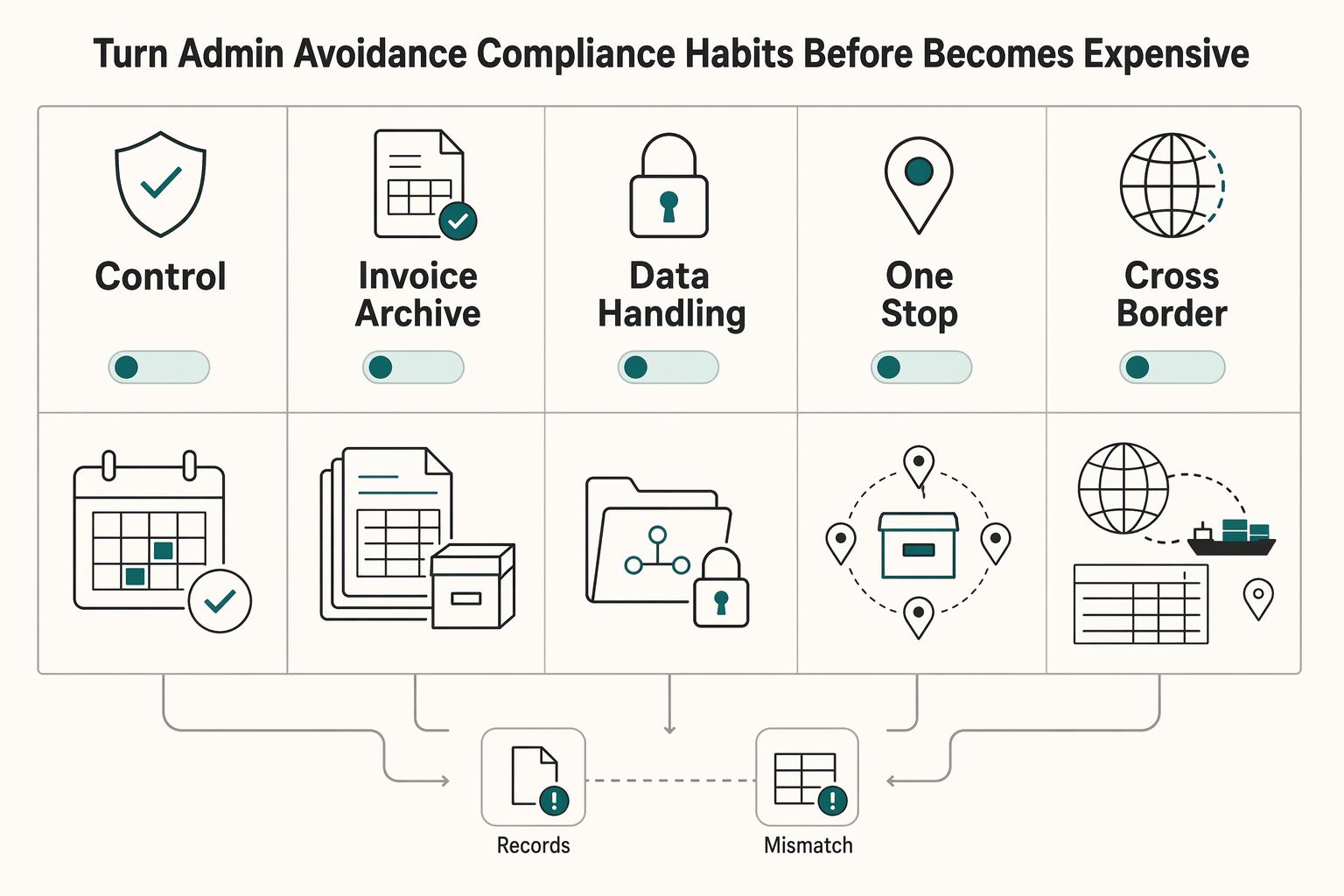
Turn admin avoidance into compliance habits before it becomes expensive#
A weekly admin block helps only if it leaves records you can defend later. Strong creative work does not offset weak paperwork when scope is disputed, payment status is unclear, or cross-border tax questions come up.
| Habit | What to keep | Check or outcome |
|---|---|---|
| Contract version control | Each signed agreement and each approved scope change with a clear date or version label | The current terms are obvious without reconstructing email threads |
| Invoice archive | Invoices, related credit notes, and payment confirmations in one place | Match each completed milestone to a status: sent, paid, overdue, or intentionally held |
| Data-handling notes for EU client work | Documented notes on data handling and any consent decisions relevant to your services | Confirm local GDPR requirements before standardizing templates |
Start with three minimum habits and run them the same way every week:
- Contract version control
Store each signed agreement and each approved scope change with a clear date or version label, so the current terms are obvious without reconstructing email threads.
- Invoice archive
Keep invoices, related credit notes, and payment confirmations in one place. At review time, match each completed milestone to a status: sent, paid, overdue, or intentionally held.
- Data-handling notes for EU client work
If you serve EU clients, keep documented notes on data handling and any consent decisions relevant to your services. Then confirm local GDPR requirements before standardizing templates. Use a practical checklist where needed, such as GDPR for Freelancers: A Step-by-Step Compliance Checklist for EU Clients.
For EU-facing VAT admin, do not merge different programs into one generic "EU compliance" bucket:
| Program | What it does | Key limit or condition |
|---|---|---|
| One Stop Shop (OSS) | VAT simplification for covered supplies: register in one Member State of identification for VAT declaration and payment | Includes scheme-specific registration, declaration/payment, record-keeping, and audit rules |
| Cross-border SME scheme | Route for eligible small enterprises to apply VAT exemption across borders | Prior notification in Member State of establishment; Union turnover must not exceed EUR 100 000; process should not take longer than 35 working days after receipt |
| VAT Cross-border Rulings (CBR) | Advance ruling path for complex cross-border VAT treatment | Request must follow national VAT-ruling conditions in the country where you file |
The operating rule is simple: obligations vary by country and by program, so confirm the route before you lock templates.
A fast close with weak paperwork feels efficient until questions start. A slightly slower close with clean documentation scales better because each project adds evidence instead of ambiguity. For a communication framework that supports this discipline, see How to Use the Pyramid Principle for Client Communication.
Use decision rules when Resistance spikes#
When Resistance spikes, use pre-decided rules so you act fast instead of negotiating with the stall. These are practical operating choices, not verbatim doctrine from Steven Pressfield.
| Trigger | Rule | Concrete end point |
|---|---|---|
| Procrastinating on a client deliverable | Do a 25-minute ugly first pass before any research or tool-switching | End with a real file, page, or draft link with new work |
| Perfectionism is the block | Ship the agreed-scope draft and open a revision window instead of rewriting from scratch | Send the version that answers the agreed brief and define what feedback is in scope |
| Admin keeps slipping | Run one non-negotiable weekly admin hour before new creative starts | Use it for invoices, contract filing, payment follow-ups, and deadline confirmation only |
| Backlog exceeds one week | Pause intake and finish outstanding commitments before accepting new work | Treat this as a trust-protection line |
- If you are procrastinating on a client deliverable, do a 25-minute ugly first pass before any research or tool-switching.
Set a timer and produce visible output: a rough outline, first draft, wireframe, sketch set, or edit pass. At the end, there should be a real file, page, or draft link with new work. Avoid fake progress like opening tabs, comparing tools, or reorganizing notes while the deliverable stays blank.
- If perfectionism is the block, ship the agreed-scope draft and open a revision window instead of rewriting from scratch.
Send the version that answers the agreed brief, then invite focused feedback. Label it clearly (for example, "Draft v1") and define what feedback is in scope. Rewriting before review usually adds churn and burns margin on work the client did not request.
- If admin keeps slipping, run one non-negotiable weekly admin hour before new creative starts.
Put it on your calendar at a fixed time and protect it like a client meeting. Use it for invoices, contract filing, payment follow-ups, and deadline confirmation only. Start creative work after admin is cleared or intentionally deferred in writing.
- If backlog exceeds one week, pause intake and finish outstanding commitments before accepting new work.
Treat this as a trust-protection line. When you are already behind, new sales can feel like momentum but often deepen delivery risk for current clients.
Keep an evidence pack so your business is defensible#
Keep a lightweight evidence pack for every project so you can prove what was promised, changed, approved, delivered, and paid without relying on memory. Decision rules help you act in the moment; this pack protects you later when details are questioned.
Store the core record in one place: contract or proposal, scope-change notes, written approvals, invoices, payment confirmations, and key decisions that changed timing, cost, or deliverables. If a decision happens in a call or chat, confirm it in writing the same day and save it with the project files.
What the pack should contain#
Use one reference table and keep it current:
| Document type | Owner | Storage location | Update trigger | Verification cadence |
|---|---|---|---|---|
| Contract or proposal | You | Client folder in your drive | Signed, revised, or renewed | Check at project start and before major work begins |
| Scope change record | You | Same client folder, linked from project notes | Any change to deliverables, timeline, or price | Review whenever work expands beyond the original brief |
| Approval record | Client provides approval, you store it | Email thread, comment export, or approval PDF in client folder | Draft approval, milestone signoff, final approval | Confirm before moving to the next stage or invoicing |
| Invoice | You | Accounting app plus exported PDF in client folder | Invoice sent, corrected, or credited | Check during weekly admin hour |
| Payment confirmation | You | Accounting app export or bank confirmation saved with invoice | Payment received, failed, or partially paid | Reconcile after receipt and at month end |
| Key decision log | You | Project notes or dated decision file in client folder | Any decision that affects scope, deadline, dependencies, or ownership | Review before status calls and at month end |
Verify references before you repeat them#
Apply the same discipline to book references: verify title, author, edition, and identifiers against reliable records before publishing or quoting. Compare metadata across sources and confirm it against a catalog record when available.
Outside discussions can help you spot patterns, but they do not replace your own records. Run a monthly checkpoint: can a third party reconstruct what was promised, changed, delivered, approved, and paid using only this pack? If not, fix the missing link that month.
Run a 30-day implementation checklist#
Run this for 30 days to make your system reliable under real project pressure, not just on a clean planning day.
| Week | Focus | What to do | Verification checkpoint |
|---|---|---|---|
| 1 | Stop avoidance at the source | List your Resistance triggers, lock fixed creation blocks and one admin block, and publish one-page operating rules | By week's end, your calendar is fixed and your rules are visible where you work |
| 2 | Clean the active pipeline | Clean active client folders, standardize invoice cadence, and set reminders to review GDPR handling and EU client obligations where relevant | You can find contract, approval, invoice, and payment proof for every live project in under 2 minutes |
| 3 | Rehearse disruption | Simulate one failure mode (late feedback, scope change, or delayed payment) and document your response steps | You have a dated note showing who gets contacted, what pauses, and what evidence supports your position |
| 4 | Keep what works | Review output quality, cash-flow timing, and adherence to your process | Remove one friction point that caused avoidable delay or admin drift |
Week 2 is where vagueness usually creates risk. If EU cross-border VAT could apply, confirm the route instead of guessing: OSS uses one single Member State (your Member State of identification). If the cross-border SME scheme may fit your case, check the EUR 100 000 Union turnover cap, the prior notification in your Member State of establishment, and the stated 35 working day registration window. If treatment is complex, check whether a VAT Cross-border Ruling is appropriate.
Your pass/fail test after 30 days is simple: invoices went out on time, approvals were stored, and one disruption did not break the week. Then keep the weekly cadence and use What It Takes as reinforcement, not a substitute for execution.
The main takeaway for creative professionals#
The core takeaway is to work like a professional every week, not wait for motivation. In The War of Art framing, Resistance is internal, shows up as patterns like procrastination, and has to be managed as a daily practice rather than solved once.
What to keep from the book#
Keep the professional-identity shift: treat your work as a professional, not an amateur. In practice, that means you show up consistently and finish agreed work even when you do not feel fully ready.
This is the practical value of the book for working creatives. It is mindset guidance, not a complete operating manual for contracts, tax, invoicing, or GDPR.
What to add so it works in business#
Use that mindset as your base, then attach simple operating structure:
- clear decision rules for common stalls
- basic documentation for client decisions and delivery steps
- one weekly checkpoint to confirm what was delivered, billed, and queued next
This is how you keep Resistance from turning into polite operational drift while staying busy.
How to use it for the next 30 days#
Start small and run the checklist for 30 days. Keep the habits that measurably improve delivery reliability and reduce operational risk; remove the ones that only feel productive.
That is the grounded approach: mindset first, consistency in daily practice, and proof in what gets delivered.
Frequently Asked Questions
What is Resistance in *The War of Art* for freelancers?
Resistance is the inner self-sabotage that blocks meaningful work. In freelance terms, it rarely looks dramatic. It can look like delaying a proposal, polishing a draft past scope, avoiding an invoice, or hiding in research when a client needs a clear next step.
How do I apply *The War of Art* without becoming rigid or robotic?
Keep the structure firm and the execution human. A simple repeatable routine is enough: protect focused creation time, reserve time for admin, and review weekly. If the routine protects delivery and cash flow, keep it. If it creates quality problems or makes you slower to respond to clients, adjust the structure rather than abandoning the habit.
What should I do first when I keep procrastinating on paid client work?
Start before you feel ready. Do an ugly first pass on the actual deliverable before you open more tabs, switch tools, or do extra research. By the end of that session, you should have a dated draft, outline, or concept file saved in the client folder, not just notes about working.
Does discipline matter more than inspiration for creative professionals?
For paid work, yes. Inspiration can improve the work, but discipline is what gets you to start, and starting is usually the hard part. In practice, that means sitting down and beginning before you feel fully ready.
What does *The War of Art* not cover for business operations and compliance?
It does not give you legal, tax, or GDPR instructions. It is a mindset book about doing important work despite Resistance, not an operator-grade guide to contracts, records, or compliance. If you serve EU clients, treat data-handling checks, invoice storage, and client documentation as separate work. Use a dedicated guide such as GDPR for Freelancers: A Step-by-Step Compliance Checklist for EU Clients.
How can I stay consistent when client deadlines and admin work collide?
Treat admin as scheduled work, not work you “catch up on later.” One practical approach is to put a non-negotiable admin hour on the calendar before new creative work starts for the week, and use it for invoices, approvals, file cleanup, and deadline confirmation. The weekly check is whether invoices were sent, next deadlines were confirmed, and open risks were written down.
Is this enough to close the creative-business reality gap?
Not by itself. The book helps with attitude and action, but freelancers still face a steep learning curve between creative expectations and business realities. Use the mindset to show up, then back it with client records and weekly checks so your business stays defensible when work gets messy.
Try a related tool
Researched and edited by the Gruv editorial team. Gruv builds cross-border billing, payouts, and finance-operations software for global businesses.
Sources
- aaa.si.edu/collections/interviews/oral-history-intervie...trusted
- comptroller.war.gov/Portals/45/Documents/defbudget/fy2023/budget...trusted
- copyright.gov/comp3/docs/compendium.pdftrusted
- courts.ca.gov/system/files/solicitation-request-document/a...trusted
- dau.edu/sites/default/files/2025-12/Online_NovDec202...trusted
- interactive.cornish.edu/uploaded-files/Y7AQER/1pA645/TheWarOrArt.pdftrusted
- lowercolumbia.edu/publications/catalog/courses/index.pdftrusted
- news.lib.wvu.edu/author/jcmetterswvu-ad-wvu-edu/page/2trusted
Educational content only. Not legal, tax, or financial advice.
Related Posts

GDPR Compliance Checklist for Freelancers Working With EU Clients
Start by separating the decisions you are actually making. For a workable **GDPR setup**, run three distinct tracks and record each one in writing before the first invoice goes out: VAT treatment, GDPR scope and role, and daily privacy operations.
How to Overcome Writer's Block: Diagnose Strategy, Process, Resource, or Confidence Problems
Treat a stall as a delivery risk, not a personality verdict. Your first job is to find the point of failure in the work, because the fix only helps if you route the problem to the right SOP.

The Freelance Payment Penalty: A Modeled Audit of Platform Fees, FX Spreads, and Payout Delays
The money rarely disappears through a single, easy-to-spot fee. The real loss is stacked. A marketplace takes its commission, a processor adds a charge for international cards, a bank or payment company converts the currency at a spread, a platform holds the funds before release, and a wire sheds a little to intermediaries on the way in. Each layer looks defensible on its own, but the worker feels the combined result as a smaller deposit and a later payday.