
Quick Answer
Start with verification, then run the meeting, then lock the record. For german business etiquette, confirm the legal entity from a published-by block, note responsible representatives listed under § 55(3), and use the official contact route when details conflict. In the meeting, clarify scope in plain language and capture decisions live in a Protokoll. Afterward, send a structured recap, ask for corrections, and keep communication boundaries explicit, including how urgent items are handled around Feierabend.
German business etiquette is mostly about reducing ambiguity. For a high-stakes business-of-one, entering the German market is not just about closing one deal. It is about managing risk across the whole engagement. A cultural misunderstanding is not merely awkward. It can create scope creep, delay payment, and damage your reputation.
German business culture tends to reward precision, planning, and visible control. That is the useful frame for this guide. Think of etiquette less as a list of social rules and more as a three-phase way to reduce ambiguity, protect your margin, and build relationships that hold up over time. When you understand the logic behind the formalities, you can use them to signal stability, foresight, and reliability.
Phase 1: Verify Entity, Names, and Logistics Before the First Meeting#
Your first proof that you are a low-risk counterpart is not your pitch. It is how little uncertainty you leave hanging before the first meeting. In practice, the sequence is straightforward: verify the exact entity and names from official metadata, capture a direct contact route, and confirm open items before the meeting.
Verify the company from official metadata#
Start with an official source, not a social profile. A company publication, legal notice, or published-by block often gives you the core facts you need to avoid sloppy outreach. In one January 2025 publication, the masthead listed: "Published by: Orrick, Herrington & Sutcliffe LLP, Heinrich-Heine-Allee 12, 40213 Düsseldorf, Germany," named "Dr. Stefan Schultes-Schnitzlein and Dr. Christoph Brenner" as responsible representatives under § 55(3), and gave a direct contact route: "duesseldorf@orrick.com" and "+49 (0)211/367870." Use that kind of metadata as a quick verification checklist:
| Metadata item | How to use it | Limit |
|---|---|---|
| Legal entity and address | Extract it so your notes, CRM, and draft proposal refer to the right organization | It does not prove who can sign a contract |
| Named representatives | Extract them so you know which names appear in official materials | They are not necessarily the commercial approvers for your project |
| Official contact route | Extract it so you have a fallback if a calendar link breaks, a title looks wrong, or attendee details are unclear | Use the official email or phone route if official records and social profiles do not match |
- Extract the legal entity and address so your notes, CRM, and draft proposal do not drift across different names.
- Extract named representatives so you can match official materials to the people you are dealing with, even if they are not the commercial approvers for your project.
- Extract an official contact route so you have a fallback if a calendar link breaks, a title looks wrong, or attendee details are unclear.
Two cautions matter. First, do not treat a publication masthead as proof of who can sign a contract. It helps you identify the entity and responsible names, but it does not replace direct confirmation of commercial authority. Second, many publications explicitly say they are for "general informational purposes only" and "not intended as a substitute" for legal or tax advice. Take that as a clear warning not to over-read the document.
If official records and social profiles do not match, treat that as unresolved and confirm via the official email or phone route before you send anything formal.
Get the name, title, and meeting shape right#
Use publication metadata for what it can confirm, and stop there. It can help validate entity details and listed representatives; it does not by itself establish project ownership or signing authority.
| Weak setup | Better setup | Likely outcome |
|---|---|---|
| Relying on a profile alone | Capture legal entity and address from an official published-by block | Fewer entity/identity mismatches |
| Treating listed representatives as final approvers | Record them as responsible names, then confirm commercial authority directly | Clearer stakeholder mapping |
| Reading a publication like case-specific guidance | Treat it as general information and escalate legal/tax questions to advisers | Lower risk of over-reading the source |
A short agenda can still help, but keep it practical: what you need to confirm, who needs to be present, and what decision or next step you want by the end.
Confirm logistics so punctuality is not left to chance#
Treat logistics as an operations issue, not a personality trait. Use the official contact route from the publication metadata as your fallback when details are unclear. That gives you a direct way to confirm attendee names, access details, or last-minute changes instead of relying on assumptions.
The common failure mode is simple: partial data gets treated as final data. A stale title, wrong office detail, or broken handoff can make you look less reliable than you are.
If one item is still unclear the day before the meeting, send a short confirmation note. That small step often prevents the larger problem: a meeting that starts with confusion instead of confidence.
If you are also working through adjacent cross-border issues, see Tax Implications of a Canadian Owning a US LLC.
Phase 2: Turn the Meeting into Clear, Executable Commitments#
Your goal in the meeting is simple: turn discussion into clear, executable commitments. You do that by handling critique calmly, confirming scope in plain language, and documenting decisions before the call ends.
A meeting can feel productive and still leave ambiguity on scope, ownership, or next steps. So run the conversation for clarity, not comfort.
Run the conversation for clarity, not comfort#
When you get pushback, treat it as signal. Acknowledge it, ask a narrow clarifying question, then restate the point in plain language before moving on.
Use prompts like: "Which part creates the main risk for your team?" or "Let me confirm scope: phase one includes X and Y, and excludes Z. Correct?" That keeps assumptions from becoming unpaid work later.
If discussion drifts, reset the process rules in the room: who decides, what is confidential, and whether this meeting is deciding or narrowing options. When those mechanics stay implicit, people leave with different interpretations.
| In-meeting pattern | Clarity-first response | Result |
|---|---|---|
| Defensive reaction | "Thanks. Which exact assumption should we change?" | Friction becomes a usable correction |
| Abstract agreement | "To confirm: we are approving option B, limited to these three items." | Wording becomes decision-ready |
| Verbal alignment only | "I'm recording this in the Protokoll with owner, deliverable, and dependency." | Commitment becomes verifiable |
Before you close any major topic, state what is in scope and what is out of scope. That one step prevents "yes, roughly" from turning into a dispute.
Keep a live Protokoll, not loose notes#
Keep a live Protokoll during the call so everyone can validate it in real time. Use this structure consistently:
| Protokoll field | What to record |
|---|---|
| Decision | What was agreed, in plain terms |
| Owner | Who is responsible next |
| Deliverable | What will be produced or sent |
| Dependency | What must happen first |
| Unresolved item | What is still open and how follow-up will happen |
Before the meeting ends, read back the key entries: "I have three decisions and two open items; let me confirm." That quickly surfaces hidden mismatches while details are still fresh.
Verify cited documents before relying on them#
If scope, timing, liability, or price depends on a document, confirm the exact version and source in the meeting record. Informational copies can be useful, but if reliance matters, verify against the official version.
A practical rule: if a clause or policy changes delivery or risk, treat it as unresolved until the exact document is confirmed.
If you regularly work across languages and expectations, this is where cross-cultural communication becomes operational.
For address form, use a simple rule when you are unsure: default to formal, mirror clear counterpart cues, and confirm preference if the relationship context changes. The goal is to avoid avoidable friction while you finalize the agreement.
We covered this in detail in The Legal Considerations of Expanding a SaaS Business to the EU.
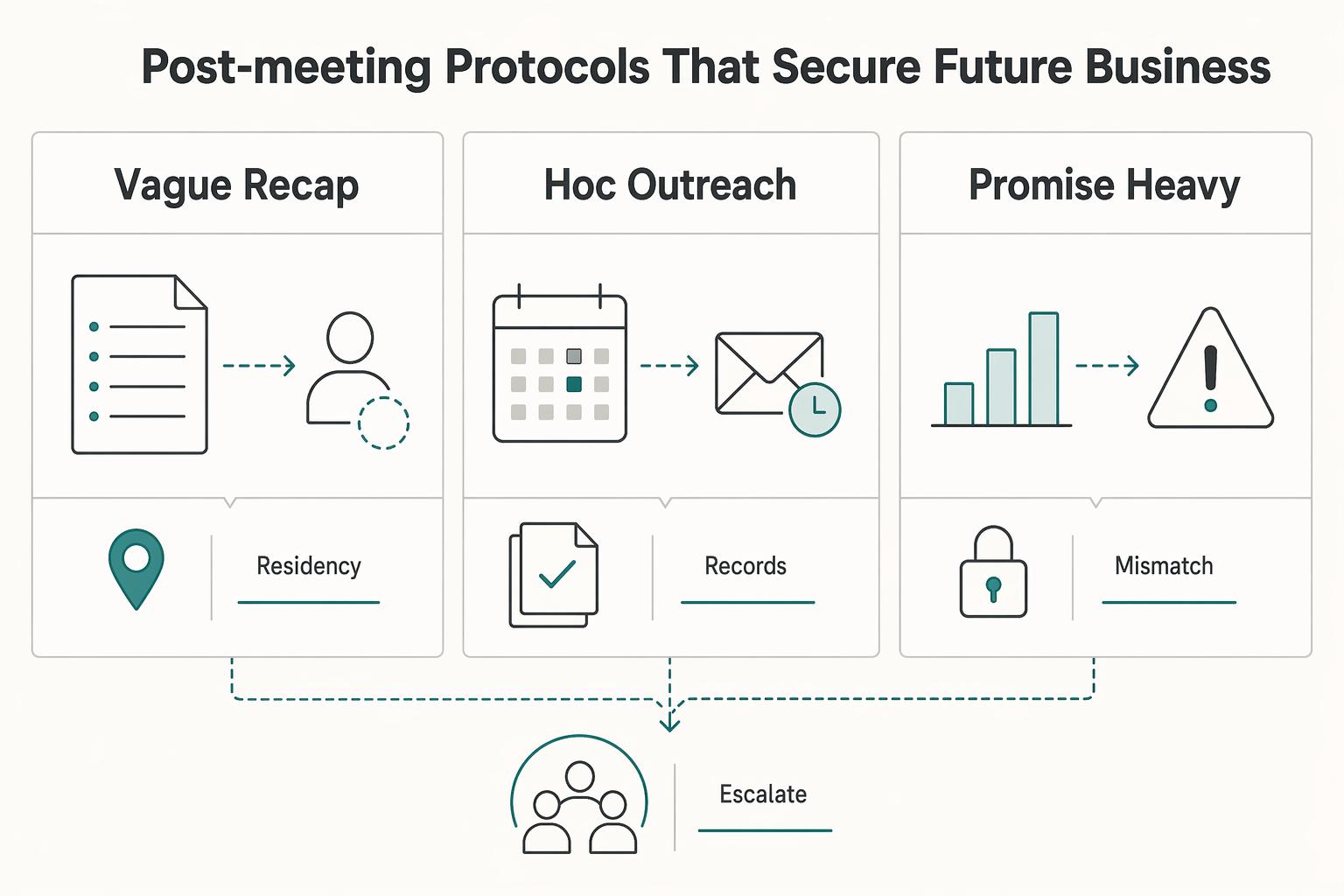
Phase 3: Post-Meeting Protocols That Secure Future Business#
After the meeting, run a simple accountability routine: write the record, confirm boundaries, and execute against what was agreed.
Start with your Protokoll. Send it in the agreed follow-up window, and if no window was set, ask instead of assuming a deadline. Before sending, confirm it includes decisions, named owners, agreed deliverables, open questions, and a direct request for counterparts to confirm or correct the record.
Make the record easy to verify: clear date, correct names, exact scope items, and specific next actions. The usual risk is not no response, but a polite response that leaves key points unconfirmed.
| Weak post-meeting behavior | Strong post-meeting behavior |
|---|---|
| Vague recap email | Structured Protokoll with decisions, owners, deliverables, open points, and explicit confirmation request |
| Ad hoc outreach at any hour | Boundary-aware communication with agreed channels and default to the next business window when not urgent |
| Promise-heavy messaging | Delivery-first update with completed items, current status, and early risk flags |
On communication boundaries (including Feierabend), do not assume a fixed rule unless it has been explicitly agreed. Set an exception protocol in advance: escalation path, urgency criteria, and default handling for non-urgent items in the next business window. If something cannot wait, state why it is urgent, who is affected, and what decision is needed now.
Then repeat the same loop each cycle: confirm what you delivered, share timeline status, and flag budget or scope deviation early.
You might also find this useful: How to Set Up a Business Bank Account in the UK as a Non-Resident.
Assess the Company First, Then Adapt Your Style#
Use this section as a context check, not a stereotype checklist: assess the company first, then adapt your style without dropping professionalism.
Before the meeting, pressure-test three variables: communication style, decision process, and document expectations. A common comparison frame is directness vs diplomatic positivity, consensus vs speed, and contract depth (for example, 50 pages vs 5 pages). Treat these as signals to test, not fixed rules for every team.
Read the signals before you mirror them#
Build a short pre-meeting context note from public materials and the meeting format. Review the website, leadership profiles, and the session type (formal review vs working call), then pick a presentation style that fits that specific room.
For attire, keep it polished, neutral, and professional unless the company clearly signals otherwise. Avoid rigid assumptions by role, industry, or gender. Verify current practice instead of guessing.
| Presentation risk | Better choice | Why it helps |
|---|---|---|
| Overdressed look | Aligned, polished formality | Shows preparation without looking disconnected |
| Underprepared casual | Context-aware baseline | Reduces the chance of misreading meeting stakes |
| Generic global style | Industry-matched style | Improves fit with the team and format |
Keep language formal until preferences are explicit#
Default to formal address in email, invites, and live discussion. Mirror the other side only after a clear invitation to switch, and keep formal language if signals are mixed. Verify current practice rather than assuming a universal norm.
Protect scope during informal moments#
Use informal time to build rapport, not to lock scope, price, or timeline commitments from memory. If business terms come up casually, acknowledge the point, avoid final commitments on the spot, and capture it in written follow-up so both sides confirm the same understanding. If there is any doubt, treat the point as unconfirmed until it is written down.
For a step-by-step walkthrough, see A Guide to Functional Currency for Your Business.
Conclusion: From Etiquette to Advantage#
The defaults in the FAQ all point to the same operating mindset. You do not need to perform a stereotype. You need to show that you are reliable, clear, and efficient with other people's time. That is the practical value here, and it shows up in what you prepare, what you say, and what you document.
| Phase | What to do | Why it reduces risk |
|---|---|---|
| Phase 1 before the meeting | Use formal address such as Sie and surname until the company signals otherwise; send a clear agenda; bring written material detailed enough to support your proposal | Meetings often follow a set agenda, and detailed documentation is typically viewed as professional |
| Phase 2 in the meeting | State your capabilities and limits plainly; ask direct questions; treat blunt feedback as input on the work | Clear, issue-focused discussion is preferred over vague promises, and friction often starts when direct communication is read as a personal attack |
| Phase 3 after the meeting | Consider sending a written recap with decisions, owners, open points, and deadlines, then flag changes early instead of introducing them late | Sudden changes in a transaction are often unwelcome, and consistent follow-through matters in organizations where approvals can take time |
- Phase 1 before the meeting. Use formal address such as
Sieand surname until the company signals otherwise, send a clear agenda, and bring written material detailed enough to support your proposal. - Phase 2 in the meeting. State your capabilities and limits plainly, ask direct questions, and treat blunt feedback as input on the work.
- Phase 3 after the meeting. Consider sending a written recap with decisions, owners, open points, and deadlines, then flag changes early instead of introducing them late.
If you apply this next week, keep it simple. Before the call, confirm names, form of address, and the agenda, then arrive ready to start on time. During the call, align explicitly on scope, responsibilities, and what is still undecided. After the call, send the recap and keep your delivery matched to the written record.
Do that consistently and you make collaboration easier to predict. That is what usually earns trust, lowers avoidable friction, and turns a first project into a working relationship that can last.
Frequently Asked Questions
How should you address a German executive in an email?
Start formal: use Herr or Frau plus surname, and keep Sie until the other side clearly switches. Formal address is still the safer default with people you do not know well, though some workplaces use first names and du from the outset. If you are unsure, copy the form they use with you or ask your internal contact which form of address is preferred.
Is it rude to discuss money in a German business meeting?
There is no single hard-and-fast rule that applies in every company. If commercial terms are in scope, discuss them clearly and directly, and ask if now is the right time to cover pricing and terms if you are unsure.
What mistake causes the most friction?
Ignoring hierarchy and local interaction cues is a common way to create avoidable friction. Small misunderstandings can hinder cross-border work, so confirm roles, expectations, and ownership early.
How should you follow up after a meeting?
Use the team’s preferred follow-up format to confirm decisions, open points, owners, and deadlines. This helps prevent small misunderstandings from carrying into the next step.
What does punctuality signal?
Show up on time and ready to start, because timeliness is widely read as respect for the other person’s time and commitment. Lateness can be read as unprofessional even when the rest of your work is strong. If you are unsure how early to arrive, do not rely on a fixed rule. Treat the specific punctuality expectation as pending until you verify it against the current counterpart, meeting, company, or source context; only then use it for planning and build in a buffer.
Try a related tool
Researched and edited by the Gruv editorial team. Gruv builds cross-border billing, payouts, and finance-operations software for global businesses.
Sources
- checkout.columbiacollege.edu/virtual-library/wLoHto/1FE027/in__germany__b...trusted
- checkout.columbiacollege.edu/book-search/wLoHto/1FE027/in__germany_busine...trusted
- federalregister.gov/documents/2013/07/26/2013-17958/interpretive...trusted
- history.state.gov/historicaldocuments/frus1919Parisv13/ch17subch1trusted
- irs.gov/individuals/international-taxpayers/foreign-...trusted
- irs.gov/individuals/international-taxpayers/figuring...trusted
- laborcenter.berkeley.edu/wp-content/uploads/2021/05/Turning-the-Table...trusted
- library.tamu.edu/indextrusted
Educational content only. Not legal, tax, or financial advice.
Related Posts

Thailand's Long-Term Resident (LTR) Visa for Professionals
For a long stay in Thailand, the biggest avoidable risk is doing the right steps in the wrong order. Pick the LTR track first, build the evidence pack that matches it second, and verify live official checkpoints right before every submission or payment. That extra day of discipline usually saves far more time than it costs.

How to Handle Cross-Cultural Communication with International Clients
Freelance cross-cultural communication is less about polite phrasing and more about shared meaning before work starts. Cross-cultural communication is how people from different cultural backgrounds adjust interactions to improve mutual understanding.
Tax Implications of a Canadian Owning a US LLC
A U.S. Limited Liability Company (LLC) can look simple for a Canadian freelancer, but the tax treatment is usually not simple. Canadians, including individuals and corporations, can face U.S. tax liability if they carry on a U.S. trade or business.