
Quick Answer
Use the three-act structure to guide client decisions in order: define the decision problem, walk through your method, then ask for one explicit next action. In practice, this means shaping proposals, pitches, and updates so each section has one job instead of mixing context, process, and CTA together. A reliable checkpoint is whether the middle section shows a true cause-and-effect path with a visible review artifact.
Why a three-act message is easier to follow and approve#
If your proposals, pitches, or client updates keep stalling with risk-aware buyers, the problem is often not charisma. It can be sequencing. The three-act structure helps because it gives one message three clear jobs: set up the problem, work through the tension, and land on a resolution or decision, instead of cramming facts, claims, and asks into one block.
The first benefit is clarity. When you define the situation, move through the challenge, and land on a clear resolution, it is easier to follow the logic. In practice, that changes the message from "here is everything we know" to "here is the issue, here is the path, here is the decision." A good checkpoint is the middle section. If it does not raise the stakes or move the decision forward, you probably do not have a persuasive case yet. You have a pile of detail.
The second benefit is shared understanding across stakeholders. A founder, project lead, and finance contact will read the same page differently. A structured message helps each of them find the same core points: what is wrong, what you will do, and what happens next. That can reduce interpretation drift, which often slows approval.
The third benefit is smoother persuasion. Not because the pattern guarantees results, but because ordered messages are usually easier to absorb, compare, and act on. The main red flag is over-rigidity. Not every business message needs three perfectly even chunks, and vague complaints about the "middle" do not tell you what to fix.
| Unstructured message | Three-act message |
|---|---|
| Client reaction | "I'm not sure what you want from us." |
| Clarity | Problem, method, and outcome blur together |
| Decision readiness | Often needs more clarification |
With that payoff in view, the next step is translating the storytelling labels into practical business use. If you want a deeper dive, read The 1% Tax Regime for Entrepreneurs in Georgia.
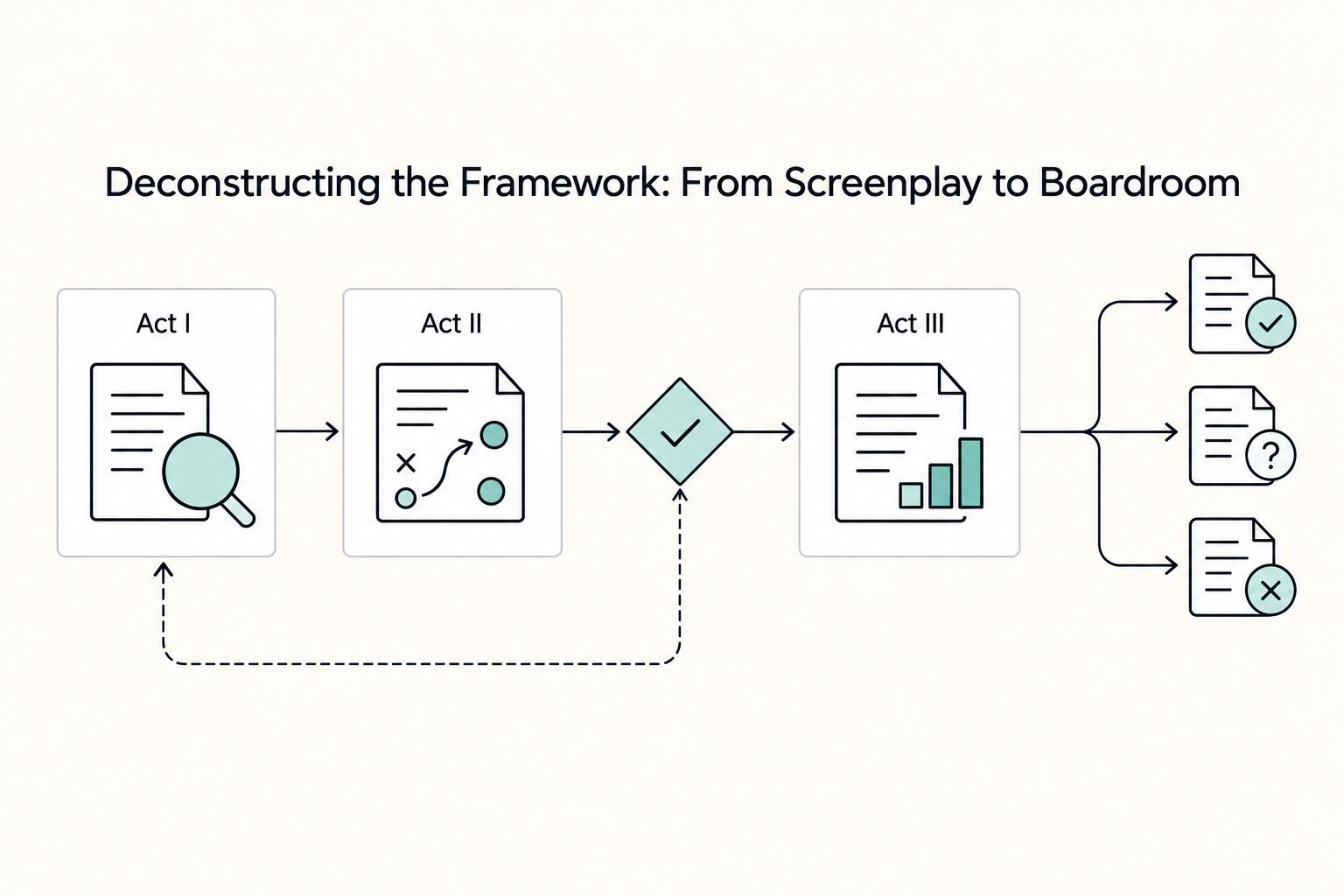
Deconstructing the Framework: From Screenplay to Boardroom#
If your proposal, pitch, or stakeholder update keeps attracting clarifying questions, tighten the sequence before you add more detail. Use this structure as a drafting workflow for clear prose and well-supported claims: first define the situation, then show the method, then state the decision.
The screenplay labels are practical shorthand, not rules. Keep each part focused on one job so a reader can scan quickly and understand what to decide.
| Screenwriting term | Business translation | What to include | What to avoid | Decision clarity you are aiming for |
|---|---|---|---|---|
| Act I: The Setup | Current situation and problem framing | Relevant context, specific issue, why it matters now, one checkable proof point, and accepted constraints | Generic pain, jargon, long backstory, unsupported claims | "Yes, this is the problem we are deciding on." |
| Inciting Incident | Triggering event or forcing change | The event, deadline, risk, request, or shift that makes timing explicit | Manufactured urgency or vague "market changes" language | "This needs a decision now, not later." |
| Act II: The Confrontation | Method sequence and delivery path | Phases, milestones, responsibilities, dependencies, review points, and required client inputs | Process detail with no order, no owner, and no checkpoints | "I can evaluate this approach." |
| Rising Action | Step-by-step execution | The sequence of work and how each step leads to the next | Jumping from diagnosis to final recommendation with no bridge | "I can follow the path from issue to outcome." |
| Midpoint | Key insight or strategic choice | The turning point, decision rule, or principle behind the chosen route | Hidden assumptions or unexplained recommendations | "I understand why this path is being chosen." |
| Act III: The Resolution | Outcome framing and next-step ask | Expected result, scope boundaries, timing signal, required decision, and immediate next action | Polished ending with no ask, no owner, or no timing | "I know what response is needed." |
| Climax | Decision point | Explicit ask: approve, sign off, choose an option, or fund next phase | Soft endings like "let me know your thoughts" | "I can respond without ambiguity." |
| Denouement | What happens after approval | Implementation start, reporting rhythm, handoff, or success review plan | Ending before operational next steps are clear | "I can see what happens after yes." |
Act I#
Start with the reader's reality, not your service description. Name the problem, explain why it matters now, and anchor it in something checkable. Use prompts like: What is happening? Who is affected? What supports this claim? Why is this the right time to decide?
If impact is not yet verified, mark the proof point as verified business-impact metric pending source-record verification before sharing. Common failure mode: vague pain that could apply to any client.
Act II#
Show the path as a sequence, not a pile of activities. Clarify what happens first, what depends on what, where review points sit, and what the client must provide at each stage. Connect each deliverable to a milestone or decision so the process is easy to assess.
Use inspectable artifacts where needed, such as a scope table, assumptions list, timeline, or responsibility split. Common failure mode: process without milestones.
Act III#
Close by removing ambiguity: state the expected outcome, what is in scope, what is out of scope, and the next decision required. If outcomes are still being validated, state validated outcome indicator pending source-record verification before final delivery.
Make the ask explicit with a clear verb: approve, select, confirm, schedule, or sign. Common failure mode: outcome language with no next-step ask.
Next, we will look at examples where this structure is applied to real decision moments, not just described in theory. You might also find this useful: How to write a 'Script' for a marketing video.
The Three-Act Structure in Action: Two High-Stakes Examples#
Use the three-act structure as a practical scaffold for decisions, not a rigid formula. In both examples, the sequence is the same: diagnose the stakes, present a staged method, then close with a specific low-friction next step.
The quality check is simple: each act should do one job. If one section tries to frame the problem, explain delivery, and ask for approval at once, the message feels episodic instead of connected.
Example 1: a major product launch#
You can see this clearly in a well-known smartphone launch: the message moved the audience from frustration, to understanding, to adoption intent.
In Act I, the setup framed the category problem before introducing features. The audience first heard why current tools felt difficult or limiting, so they had a reason to care. Your checkpoint: can someone restate the problem in one sentence?
In Act II, the presentation shifted from problem to method in sequence. Familiar use cases were introduced step by step, then a beat redirected understanding toward one integrated product. That turn is what made the narrative feel causal, not like disconnected feature episodes.
In Act III, the close reduced uncertainty with concrete proof and a clear next move. The resolution made the offer feel understandable and practical, not abstract. The transferable cue is the order: stakes first, staged proof second, next step third.
Example 2: your next client proposal#
This is the direct reader use case: most proposals fail when they ask for confidence before establishing logic.
In Act I, state the client's current condition in their language and anchor it with one checkable proof point. If the proof is not validated yet, mark it as verified impact metric pending source-record verification before sending. Your opening should identify one decision problem, not generic pain.
In Act II, lay out a staged method with review points, required inputs, and boundaries. Each stage should answer a decision question: what you will learn, what you will deliver, and what the client must provide. Include one inspectable artifact, such as an assumptions list, sample deliverable, scope table, or approval checkpoint.
In Act III, translate the work into a specific outcome and a direct ask. Keep unresolved details explicit with validated implementation window pending source-record verification and validated outcome indicator pending source-record verification until those details are verified. End with a clear verb: approve, confirm, schedule, or select.
| Act | What was said | Why it worked | How to adapt this in your next proposal or pitch |
|---|---|---|---|
| Act I | Product launch: the category problem was framed before features | It created shared stakes before solution details | Open with the decision problem the audience already feels |
| Act II | Product launch: use cases were sequenced, then reframed as one integrated product | The beat redirected understanding and kept the narrative causal | Sequence your method so each step changes what the reader can conclude |
| Act III | Product launch: proof reduced uncertainty and pointed to a clear next move | It closed the gap between promise and belief | Show concrete proof, then make the next action easy |
| Act I | Proposal: "Here is the issue, supported by verified impact metric pending source-record verification" | It anchors the decision context in something checkable | Use one verifiable fact, quote, or appendix reference |
| Act II | Proposal: "Here is the staged approach, review points, and required inputs" | It makes delivery understandable and easier to evaluate | Add milestones, dependencies, and one inspectable artifact |
| Act III | Proposal: "Here is the expected result and exact next action" | It removes response ambiguity | End with a specific approval action, not an open-ended signoff |
Keep those three jobs separate, and your message becomes easier to trust and easier to act on. The next section turns this logic into reusable implementation frameworks for your proposals, pitches, and memos. For a step-by-step walkthrough, see How a YouTuber should structure their business for tax efficiency.
Your Persuasion Toolkit: Three Frameworks to Implement Today#
Use these three tools to make client decisions clearer: a one-page proposal, a slide checklist, and a discovery script. Each one maps to Act I (problem), Act II (method), and Act III (next move).
| Tool | Use | Focus | Common mistake |
|---|---|---|---|
| One-page proposal | Decision document, not a brochure | Problem in the client's language + one checkable proof point; method with stages, owner, client inputs, and one checkpoint artifact; expected result + exact ask | Vague problem, method without ownership, ask without a next step |
| Five-slide presentation | Live pitches | Problem, why it matters now, the path from issue to outcome, the resolved state, and the specific decision or meeting needed | Turning the middle into a feature dump instead of a sequence the client can follow |
| Discovery script | Gather Act I and Act III material before you pitch your offer | Operational pain, stakeholder constraints, and success criteria in the client's own words | Leading questions that force pain language instead of surfacing the real obstacle |
One-page proposal#
Use a one-page Act I/II/III scaffold when the client needs a decision document, not a brochure. Keep each act to one job.
| Act | Include | Examples |
|---|---|---|
| Act I | Name the client's problem in their language and add one checkable proof point | verified impact metric pending source-record verification; stakeholder quote pending source-record verification; current process failure note pending source-record verification |
| Act II | Lay out your method from general to particular with stages, owner, client inputs, and one checkpoint artifact | assumptions list; sample deliverable; approval review |
| Act III | State the expected result and the exact ask | validated implementation milestone pending source-record verification; validated outcome indicator pending source-record verification |
In Act I, name the client's problem in their language and add one checkable proof point. If the proof point is unresolved, mark it as verified impact metric pending source-record verification, stakeholder quote pending source-record verification, or current process failure note pending source-record verification.
In Act II, lay out your method from general to particular. Include stages, owner, client inputs, and one checkpoint artifact such as assumptions list, sample deliverable, or approval review.
In Act III, state the expected result and the exact ask. If those details are unresolved, mark them as validated implementation milestone pending source-record verification and validated outcome indicator pending source-record verification until verified.
Quick self-check: can a skim reader answer three questions fast? What is wrong, how will this work, and what am I being asked to do? Common mistake: vague problem, method without ownership, ask without a next step.
Five-slide presentation#
For live pitches, require each slide to do one clear job. Keep it specific enough to use and broad enough to apply.
| Slide | Slide goal | Key message | Decision signal |
|---|---|---|---|
| 1 | Establish the problem | Here is the challenge the audience is facing now | The audience recognizes itself as the hero dealing with a real constraint |
| 2 | Make the stakes concrete | Here is why this matters now, not later | The cost of delay becomes discussable |
| 3 | Explain the method | Here is the path from issue to outcome | Your approach feels inspectable, not improvised |
| 4 | Show the resolved state | Here is what success looks like in practical terms | The outcome feels credible enough to evaluate |
| 5 | Ask for the next action | Here is the specific decision or meeting needed | Approval, selection, or scheduling becomes the logical next move |
Before you present, confirm the deck includes logos, ethos, and pathos together. Common mistake: turning the middle into a feature dump instead of a sequence the client can follow.
Discovery script#
Use discovery questions to gather Act I and Act III material before you pitch your offer. Aim to capture operational pain, stakeholder constraints, and success criteria in the client's own words.
| Question | Focus |
|---|---|
| What is happening in the work right now that made this worth discussing? | What is happening in the work right now |
| Where does this show up operationally: delays, rework, missed targets, handoff issues, client complaints? | Delays, rework, missed targets, handoff issues, client complaints |
| Who else is affected by this decision, and what constraints do they care about? | Who else is affected and what constraints they care about |
| What would need to be true for you to call this successful? | What would need to be true for you to call this successful |
| What has already been tried, and where did it stall? | What has already been tried and where it stalled |
Reuse exact wording later, especially around constraints, timing, and success criteria. Verify anything measurable before it enters your proposal or slides. Common mistake: leading questions that force pain language instead of surfacing the real obstacle.
Next, pressure-test these tools in realistic scenarios where decisions stall or messaging gets messy. Related: How to Write a Book to Establish Your Freelance Expertise.
Putting the Framework into Practice#
Use the same three-act structure each time, then adapt depth, proof, and CTA to the format you are using.
| Format | Act I | Act II | Act III | Done well looks like |
|---|---|---|---|---|
| Presentation | Name the audience's problem and stakes in their terms | Walk through your method in a clear sequence | Show the practical end state and ask for a specific decision | People can repeat the problem, path, and next step after a quick skim |
| Case study | State the starting context and core constraint | Explain what you did and why, step by step | Show outcome metrics as pending source-record verification, then state the key takeaway | The reader can track before, process, and after without filling gaps |
| Pitch | Open on the buyer's problem, not your credentials | Show your approach with one proof point or checkpoint | Ask for one concrete next action | Your plan feels inspectable, not improvised |
| Cold email | Name one relevant issue or trigger | Connect your offer to that issue in one line | Ask for one low-friction reply or meeting | The email is short, specific, and easy to answer |
How do you use it in a presentation?#
Use each act for one job. In Act I, frame the audience as the hero and define the conflict in their language; in Act II, show sequence, owner, and checkpoint artifact; in Act III, ask for a specific approval, decision, or meeting. Avoid this mistake: vague problem framing, feature-heavy process, and a CTA with no concrete next step.
How should you adapt it for a case study?#
Run it as a before-process-after document so the reader can follow what changed. Include client context, what you executed, and unresolved-state notes such as "validated timeline pending source-record verification" and "confirmed outcome metric pending source-record verification." Avoid this mistake: describing a win without a clear starting problem or proof trail.
What is the practical version for a sales pitch?#
Lead with what is wrong, why it matters now, and who is affected. Then show how your method moves from setup to confrontation to resolution, anchored by one checkpoint artifact (for example, assumptions list or sample deliverable), and close with a specific next step. Avoid this mistake: presenting your process as a black box and asking for trust upfront.
How does this help you build trust?#
You build trust when each act has a distinct purpose and clear business context. Act I should stay focused on their situation, not your background, and Act II should make your reasoning visible. Avoid this mistake: spending the opening on credentials while the buyer still lacks a clear problem frame.
Can you use it in a cold email?#
Yes, if you compress it: one sentence for the issue, one for your fit, one for the ask. Keep timing and results in unresolved-state language until verified, such as "validated timeline pending source-record verification" and "confirmed outcome metric pending source-record verification." Avoid this mistake: jumping to "book a call" before the problem is concrete.
Once you can run this structure consistently across formats, you can move from tactical message design to long-term narrative control. We covered this in detail in How to Choose the Right Business Structure for Your Freelance Business.
From Storyteller to Strategist: Owning Your Narrative#
Use the three-act structure to lead decisions, not just explain your work. Your goal is to help the client see their problem clearly, follow your reasoning, and choose a next step without avoidable ambiguity.
The shift is practical: explanation tells what happened, while strategy orders information the way a decision gets made. In your client conversations, Act I should frame the client's world, goal, and obstacle. Act II should show a cause-and-effect sequence, not disconnected points. Act III should define the intended outcome and ask for a specific decision now.
| Mode | Message focus | Client perception | Decision impact |
|---|---|---|---|
| Storyteller mode | Background, context, polished explanation | "They explain clearly" | The client may still be unsure what to approve |
| Strategist mode | Problem framing, linked process, clear end state | "They understand my situation and have a plan" | The client can evaluate logic, scope, and next action |
A quick analogy: think less like a narrator and more like a guide. Keep the audience as the hero. In Setup, name their current state, goal, and conflict in their terms. In Confrontation, present your process as linked steps and include one visible checkpoint artifact (for example, an assumptions list, draft outline, or sample deliverable) so your method is inspectable. In Resolution, state the practical result you are aiming for and the exact approval, reply, or meeting you want. Labels can vary across sources, so focus on giving each act a distinct purpose.
Apply this on your next proposal or pitch:
- Act I: Can the client recognize their world, goal, and obstacle in two to three lines?
- Act II: Does each step lead to the next, with one clear checkpoint artifact?
- Act III: Have you named the intended outcome and asked for one specific next decision?
This pairs well with our guide on A guide to creating a 'character profile' for a novel.
Frequently Asked Questions
How do you use it in a presentation?
Use each act for one job. In Act I, frame the audience as the hero and define the conflict in their language; in Act II, show sequence, owner, and checkpoint artifact; in Act III, ask for a specific approval, decision, or meeting. Avoid this mistake: vague problem framing, feature-heavy process, and a CTA with no concrete next step.
How should you adapt it for a case study?
Run it as a before-process-after document so the reader can follow what changed. Include client context, what you executed, and unresolved-state notes such as "validated timeline pending source-record verification" and "confirmed outcome metric pending source-record verification." Avoid this mistake: describing a win without a clear starting problem or proof trail.
What is the practical version for a sales pitch?
Lead with what is wrong, why it matters now, and who is affected. Then show how your method moves from setup to confrontation to resolution, anchored by one checkpoint artifact (for example, assumptions list or sample deliverable), and close with a specific next step. Avoid this mistake: presenting your process as a black box and asking for trust upfront.
How does this help you build trust?
You build trust when each act has a distinct purpose and clear business context. Act I should stay focused on their situation, not your background, and Act II should make your reasoning visible. Avoid this mistake: spending the opening on credentials while the buyer still lacks a clear problem frame.
Can you use it in a cold email?
Yes, if you compress it: one sentence for the issue, one for your fit, one for the ask. Keep timing and results in unresolved-state language until verified, such as "validated timeline pending source-record verification" and "confirmed outcome metric pending source-record verification." Avoid this mistake: jumping to "book a call" before the problem is concrete. Once you can run this structure consistently across formats, you can move from tactical message design to long-term narrative control. We covered this in detail in How to Choose the Right Business Structure for Your Freelance Business.
Try a related tool
Researched and edited by the Gruv editorial team. Gruv builds cross-border billing, payouts, and finance-operations software for global businesses.
Sources
- acquisition.gov/far/2.101trusted
- courses.cornell.edu/courses/pmatrusted
- dot.ga.gov/PartnerSmart/Business/Source/specs/2021Stand...trusted
- gao.gov/assets/gao-20-195g.pdftrusted
- grants.nih.gov/grants-process/write-application/advice-on-a...trusted
- hep.fsu.edu/~wahl/phy3091/docs/CommunicatingScience.pdftrusted
- michigan.gov/mdot/-/media/Project/Websites/MDOT/Business/...trusted
- pmc.ncbi.nlm.nih.gov/articles/PMC10174354trusted
Educational content only. Not legal, tax, or financial advice.
Related Posts

Georgia 1% Tax for Entrepreneurs Without Filing Surprises
Treat Georgia's 1% tax path as a compliance question first and a rate discussion second. The goal is a setup you can defend under review, not a shortcut that fails at filing time.

How to Write a Book as a Freelancer Without Scope Drift
The book needs a defined job and a defined boundary before you draft. In this cycle, give it one job: either support your client book services, or strengthen your own authority book so your niche, offer, and sales conversations become clearer.
How to Write a Script for a Marketing Video That Wins Client Trust
If you want a marketing video to do real business work, treat the script as a working asset first and a creative expression second. The script is the planning document for what is said and shown. The creative brief is the pre-production input that tells you what the video needs to accomplish.