
Quick Answer
Start by turning your solo agency blueprint into documents and checkpoints, not branding. Package one offer with a clear scope of work, attach a statement of work (SOW) and payment terms, then add subcontractors only after quality is reviewable against written acceptance criteria. Use a signed subcontractor agreement before any client handoff, and treat timeline, deliverable, or revision changes as formal scope decisions.
Start here with a compliance-first solo agency plan#
If you came here looking for reviews of platform tutorials or creator content using the phrase solo agency blueprint, this is not that. This is an independent operating guide for building a durable service business that can hold up under real client work, real revisions, and real subcontractor handoffs.
A solo agency usually works best when you sell one clear package, define scope in writing, and add subcontractors only after delivery is repeatable.
Step 1 Choose the model before you polish the brand#
Start by naming what you are actually building: not a loose freelance practice, but a structured one-person agency. That matters because pricing, scope, delivery promises, and staffing choices all get tighter once clients are buying an agency outcome instead of your personal availability.
A useful starting principle is to simplify decisions, choose a clear business model, and focus on a narrow audience you can serve well. In practice, pick one buyer, one problem, and one offer shape before you worry about logos, content, or audience growth. A polished presence can help later, but it will not fix a vague service.
Verification checkpoint: if you cannot write your offer in four lines, you are not ready to scale it. You should be able to state:
- who the package is for
- what result the client gets
- what is included
- what is explicitly not included
Step 2 Start with a small, testable offer#
Take the services-first path. Launch quickly with a small, testable offer instead of overplanning. Your first goal is not a broad agency menu. It is one offer you can explain clearly, sell repeatedly, and deliver without rebuilding the process from scratch every time.
That is the real promise of the model. Productize your services, make delivery easier to repeat, and create cleaner edges for future subcontractors. If every proposal is custom, you are still freelancing in practice, even if your website says "agency."
A good early test is whether a prospect can say yes without a long education sequence. Client acquisition is already a major challenge for agency leaders, which is another reason to avoid overcomplicated offers. At the start, clear beats clever.
Step 3 Set subcontractor rules before you hire anyone#
You do not need a bench of helpers on day one. You do need enough structure that bringing in support later will not create chaos. If you cannot define what a subcontractor would deliver, how you would review it, and what "done" means, stay solo until your offer is tighter.
Hiring too early into a messy service creates revision churn, margin leaks, and awkward client conversations because nobody shares a clear definition of the deliverable. The tradeoff is simple: custom work feels flexible, but repeatable packages are easier to staff, review, and protect.
If this guide fits where you are, the path is straightforward: move from an informal freelance setup to a cleaner business model with sharper offers and fewer surprises. The next step is to understand the model well enough to know when the agency label fits and when it does not.
For a step-by-step walkthrough, see The Solo Creator's Financial Blueprint: From Side Hustle to Sustainable Business.
Understand the solo agency model before you copy anyone#
Choose your operating model before you copy anyone else's pricing page or content style. If you cannot protect margin after subcontractor cost and rework risk, do not position yourself as an agency yet.
Step 1 Compare the three models honestly#
The key difference is what you sell and what limits delivery. In a freelance model, pricing is often tied to personal output, so income is still constrained by your available hours, and hourly billing can penalize speed. A one-person design agency shifts toward outcome-focused packages or ongoing management, while a traditional web design agency increases capacity by distributing delivery across a team and accepting more coordination risk.
| Model | Pricing posture | Capacity and delivery control | Main risk |
|---|---|---|---|
| Freelancer | Hourly or custom project fee | Limited to your hours with high direct control | Capacity ceiling and underpricing |
| One-person design agency | Package, retainer, or outcome-based fee | Moderate capacity with owner review and selective subcontractors | Margin erosion from rework and contractor costs |
| Traditional web design agency | Team-based project or retainer pricing | Higher capacity with shared delivery control | Overhead, coordination errors, quality drift |
Step 2 Test margin before you use the agency label#
Pressure-test one real package before you call it an agency offer. Subtract subcontractor pay, your review time, admin time, and one likely rework round from the quoted price; if margin only works in a perfect run, stay closer to a freelance model for now.
Agency-style pricing examples include fixed monthly retainers (for example, $2,500+) and base-fee-plus-performance hybrids. The number is not the point. Your pricing has to absorb delivery friction.
Step 3 Separate brand from operations#
A polished presence on YouTube can help with marketing, but it does not replace operating discipline. Promotional pages and video descriptions are built to drive enrollment and clicks, so treat them as marketing inputs, not operating templates.
You still need a written statement of work (SOW), a clear scope of work, and delivery terms that match how you actually deliver. Make this model decision now so your scope, staffing, and handoff process do not conflict later.
You might also find this useful: The Agency Scaling Blueprint: From Solo Freelancer to Hiring Your First 5 Global Contractors.
Prepare your core documents before client acquisition#
Before you sell harder, lock your document system so scope, payment, and ownership are clear from day one.
| Document | What it covers | Timing/use |
|---|---|---|
| Client services agreement | Relationship rules | Use for every offer |
| Statement of work (SOW) | Deliverables, exclusions, timeline, approvals, and revision limits | Use for every offer |
| Payment terms | Billing expectations aligned to how you deliver | Use for every offer; match a retainer model for ongoing support |
| NDA | Confidentiality | Add before sensitive material or deliverables are exchanged |
| IP assignment clause | What the client can use and the ownership outcome | Add before sensitive material or deliverables are exchanged |
| Subcontractor agreement | Confidentiality terms, handoff standards, and revision limits | Use with subcontractors |
| Quality control checklist | Consistent review and delivery control | Pair with the subcontractor agreement |
- Build a minimum client document pack
Use three core documents for every offer: a client services agreement, a statement of work (SOW), and payment terms aligned to how you actually deliver. Your agreement sets relationship rules, your SOW defines deliverables, exclusions, timeline, approvals, and revision limits, and payment terms set billing expectations.
If you sell ongoing support, write payment terms that match a retainer model instead of reusing a one-off project template. Retainer agreements can help stabilize revenue before expansion.
- Add confidentiality and ownership terms early
Add an NDA and an IP assignment clause before sensitive material or deliverables are exchanged. This reduces avoidable disputes around confidentiality, content use, brand assets, and ownership rights.
Keep it practical: define what the client can use and what ownership outcome the engagement is meant to produce.
- Set subcontractor controls in a separate subcontractor agreement
Use a separate subcontractor agreement with confidentiality terms, handoff standards, and revision limits. Define what an acceptable handoff includes so reviews stay consistent and rework stays controlled.
Pair that agreement with a simple quality control checklist to keep delivery consistent as you build a repeatable, compliant acquisition and delivery process.
- Verify every offer has one reusable scope path
Treat this as a foundation step in your first Months 1-3. Every active offer should map to one reusable scope of work template and one signed agreement path.
Quick checkpoint: if someone buys Package A today, can you name the exact SOW, agreement version, and subcontractor agreement in under a minute? If not, that offer is not ready to sell as a repeatable agency package.
If you want a deeper dive, read How to Create a Productized Service for Your Freelance Business.
Productize services into clear packages clients can buy fast#
Once each offer has a reusable agreement path, stop selling it as custom every time. Packages convert faster when they match how you already deliver, with clear price and process up front. Productization starts inside delivery, not with rigid labels.
Step 1 Define one core package before adding variety#
Start with one package for one client type and one clear problem. In the scope of work, name the outcome, list included deliverables, and state exclusions in plain language.
Build this first package around the work you can deliver with the least rework. Then add one premium tier with a bigger outcome, faster handling, or more hands-on support. Delay custom bundles until your quality checklist shows the core offer runs cleanly without constant exceptions.
Step 2 Write service boundaries into a basic SLA#
Your SLA should make two things explicit: response windows and acceptance criteria. Put those boundaries in writing next to the package.
| SLA element | What to define |
|---|---|
| Response windows | Windows for messages and approvals |
| Client inputs | What the client must provide before work starts |
| Acceptance | What counts as acceptance for each deliverable |
| Late or out-of-scope feedback | What happens when feedback is late or outside scope |
At minimum, define:
- response windows for messages and approvals
- what the client must provide before work starts
- what counts as acceptance for each deliverable
- what happens when feedback is late or outside scope
If this is not in the SOW/SLA, a "fixed" package often turns into unlimited replies, extra calls, and rolling stakeholder feedback.
Step 3 Price around tradeoffs, not effort guesses#
Use prewritten add-ons in the SOW when scope drivers change: faster turnaround, extra review rounds, additional pages, or broader implementation support. This protects margin better than vague customization.
Be careful with usage-based pricing logic, which can misalign price and value as larger accounts scale. Case examples like $3,500, $7,500, or $1,500 to $2,500 monthly can help you frame tiers, but they are references, not targets.
Step 4 Verify the package against your QA checklist#
Before publishing a package, test whether it can be delivered consistently and reviewed against explicit acceptance criteria. Also confirm finance can tell when an add-on should be invoiced.
If those checks fail, the offer is still too custom. Start with one core package and one premium tier, then use revision patterns, delays, and client confusion to guide the next version. For examples, see How to Create a Freelance Service Package.
Decide when to hire subcontractors and when to stay solo#
Use this rule: stay solo while delivery is still uneven, and add subcontractors only when part of your work is repeatable enough to brief and review consistently. In a one-person agency model, contractors can extend capacity without becoming employees, but the shift still adds financial and energy demands, so timing matters.
Step 1 Test whether your delivery is stable enough to delegate#
Do not hire on short-term busyness. Hire when the same delivery pattern keeps repeating across clients.
A practical check:
- If demand is inconsistent and each project needs fresh scoping, stay solo.
- If the same tasks recur in a stable sequence and you can review outputs clearly, bring in a subcontractor with a signed subcontractor agreement.
Before you delegate, confirm your package is already defined in a statement of work (SOW) and can be reviewed with a quality assurance checklist. In this blueprint, that is an operating readiness check so delegated work is judged against clear expectations, not moving targets.
Step 2 Screen for misclassification risk before onboarding#
Treat role design as a risk check, not a paperwork afterthought. If a contractor arrangement starts to look like an employee-style setup, your exposure increases even if the label says "contractor."
Use a short pre-hire check:
- Is the work tied to defined outputs instead of an open-ended "handle everything" role?
- Can you brief and manage by scope and deliverables, not constant control of how every task is done?
- Can quality be reviewed against agreed acceptance criteria?
If those answers are weak, redesign before onboarding and validate your local requirements. For background, see What to Do If You've Been Misclassified as an Independent Contractor.
Step 3 Start with a specialist role, not a mini-employee role#
Your first subcontractor is usually safer as a specialist with a defined output than as a generalist for whatever appears that week.
| Better first hire pattern | Higher-risk pattern |
|---|---|
| Specialist tied to a clear deliverable and review standard | Generalist "mini-employee" handling undefined, ongoing tasks |
| Scope-led handoff with explicit acceptance checks | Open-ended support that blurs role boundaries |
| Easier to approve, reject, and revise consistently | Harder to measure quality and accountability |
Final checkpoint: if a subcontractor finished the task tomorrow, could you approve or reject it using your SOW and QA checklist without debating what "done" means? If not, stay solo a bit longer and tighten the package first. Related reading: How to Build a Client Acquisition System for Your Agency.
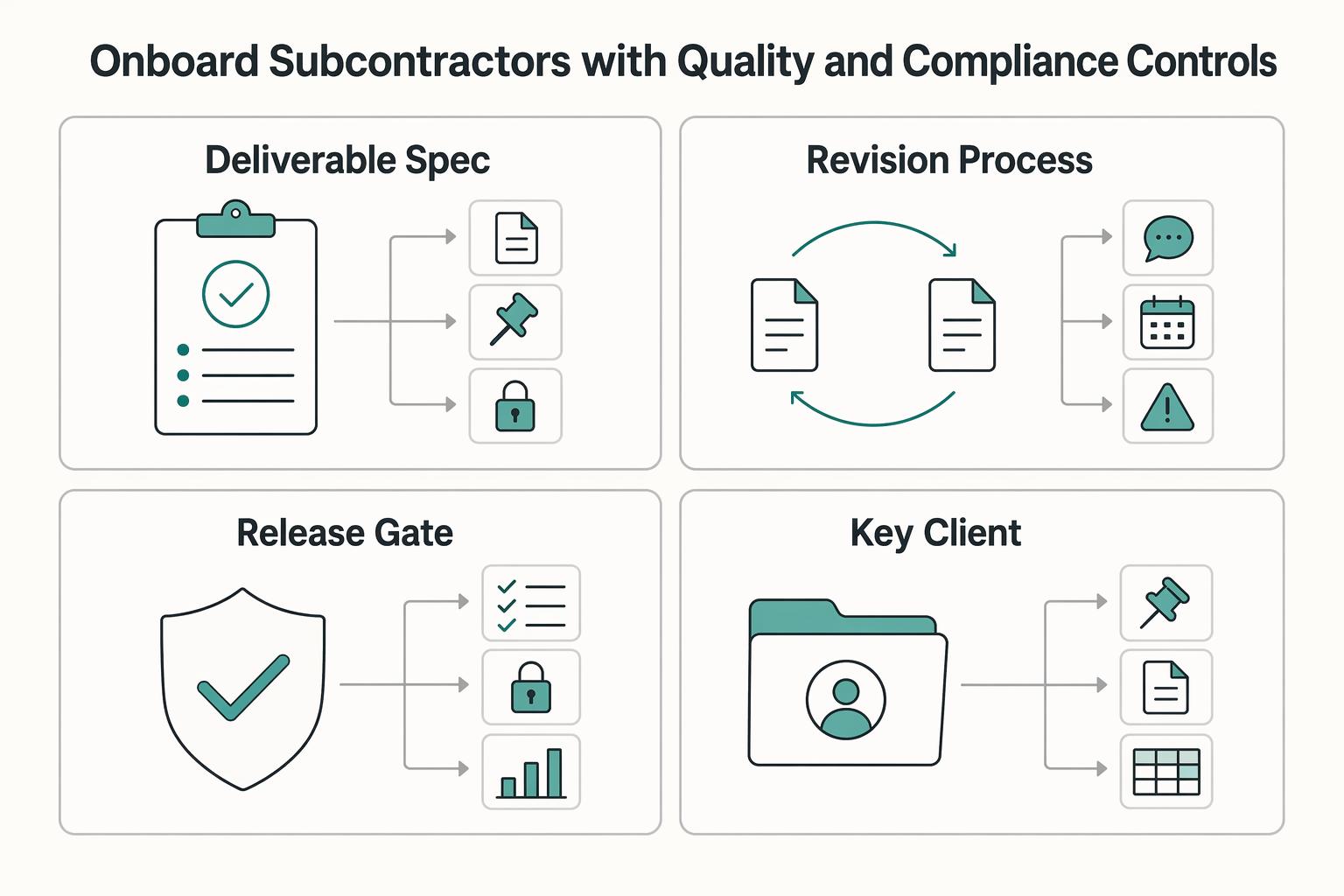
Onboard subcontractors with quality and compliance controls#
Once you delegate, prioritize control over speed. Use onboarding to create a clear written record of scope, access, payment expectations, ownership terms, and contractor status before delivery starts.
Step 1. Set the documents and role boundaries first. Before you share live client work, make sure your core agreement set is signed and stored so you can retrieve it quickly if quality, timing, or payment questions come up. Keep the role tied to defined outputs, not an open-ended "help with everything" function, so the contractor setup does not drift into an employee-like arrangement.
Step 2. Keep access narrow and tie the brief to acceptance. Grant only the access needed for the current task, then send a task brief that maps to the sold scope and clear acceptance checks. If "done" is not explicit in writing, you are handing off a guess instead of a repeatable deliverable.
A clean handoff bundle should include:
- deliverable spec (what files or outputs are required)
- revision process (how feedback is submitted and closed)
- acceptance checks (how approval is decided)
- due date, reviewer, and approval method
- key client constraints (tone, format, exclusions)
Step 3. Define payment logic before work begins. Set payment milestones and dispute handling in writing up front, then keep evidence for each milestone (brief, submission, revisions, approval, invoice). This keeps finance conversations from derailing delivery.
Step 4. Confirm ownership at closeout. Do not leave ownership terms implicit. At task close, confirm final deliverables and required source materials were handed over under the agreement, then record completion in writing.
Done well, these controls keep quality review objective, reduce compliance surprises, and give you a usable audit trail when delivery gets busy.
Run client delivery with predictable checkpoints and audit trail#
The safest way to prevent delivery drift is to run one repeatable path and let the statement of work (SOW) control scope, acceptance, and change decisions.
Step 1 Use one fixed client path every time#
Use one fixed client path every time: intake, proposal, signed client services agreement, approved SOW, production, QA, acceptance, and closeout. These stage names are not a legal requirement, but they keep approvals and files in a predictable order.
| Stage | Approval owner | Evidence to store | Rework trigger |
|---|---|---|---|
| Intake | You | discovery notes, goals, constraints | unclear goals or missing dependencies |
| Proposal | Client | sent proposal, pricing version | change in requested outcome or budget |
| Client services agreement | Client | signed agreement copy | legal or commercial terms changed |
| Approved SOW | Client and you | final SOW, scope of work, acceptance criteria, timeline | deliverables, timeline, rounds, or stakeholders changed |
| Production | You or assigned reviewer | draft files, status notes, task handoffs | work no longer matches SOW |
| QA | You | completed QA checklist, defect notes | failed acceptance checks |
| Acceptance | Client | approval email or signoff note, revision list | requested work exceeds agreed revisions |
| Closeout | You | final files, source materials promised, invoice, handoff note | missing assets or unresolved approvals |
Checkpoint test: someone else should be able to open the client folder and see what was approved, by whom, and when.
Step 2 Define SOW-change triggers before production starts#
Define SOW-change triggers before production starts. If a request changes the deliverable, timeline, review rounds, stakeholder count, or dependency, treat it as a scope decision and tie it back to the written scope of work and payment terms clause.
Silent scope creep usually starts in casual channels. If a "small" request changes effort or acceptance criteria, pause, restate it in writing, and issue an SOW update or change order before work continues.
Step 3 Keep client and internal updates on two cadences#
Keep communication on two cadences: one owner-facing cadence for client updates, and one internal cadence for subcontractors aligned to your service-level agreement (SLA). Client updates should track milestones, blockers, and approvals; internal updates should track handoffs, QA findings, and due dates.
This matters even more as you move from one or two accounts toward five, ten, or twenty clients. Without a repeatable system, consistency and control break down first.
Step 4 Close each job with stored evidence#
Close each job with evidence, not just delivery. Store the accepted deliverable, final approval note, revision history, and closeout package together so disputes, invoicing, and future package improvements are easier to handle.
This pairs well with our guide on The Future of the Agency Model in the Age of AI.
Fix common mistakes before they become expensive#
Fix these four mistakes early, in writing, so scope, revisions, and contractor setup stay controllable as you grow.
Step 1 Make the SOW specific enough to verify#
Make the statement of work (SOW) specific enough to verify. If you sell outcomes like "better brand presence" or "ongoing support," your scope of work should clearly define deliverables, review rounds, acceptance criteria, and exclusions.
Use this check: can a third party read the SOW and confirm what is included, what counts as complete, and what is out of scope?
Step 2 Set subcontractor terms before work starts#
Set subcontractor terms before work starts, not after. Put the subcontractor agreement and non-disclosure agreement (NDA) in place before sharing briefs, access, or client files.
The practical checkpoint is simple: signature date first, client material access second.
Step 3 Protect package boundaries with change-order terms#
Protect package boundaries with your service-level agreement (SLA) and change-order terms. If a request changes deliverables, adds stakeholder rounds, or compresses turnaround, treat it as a written scope decision instead of absorbing it informally.
That is usually where margins are either protected or quietly eroded.
Step 4 Review each engagement for misclassification risk before scaling#
Review each engagement for independent contractor misclassification risk before scaling subcontractor use. Contract labels alone are not enough.
A U.S. Department of Labor report published in February 2000, based on a 1998-99 study, notes that federal and state agencies use different tests to classify independent contractors and includes profiles of misclassified workers. Use that as a warning to assess the real working relationship before adding volume.
Apply this in 30 days with a copy-paste execution checklist#
Use this as an execution template, not a legal standard: the goal is to prove your process works once before you add volume.
-
Week 1: lock your core document set. Finalize your client services agreement, statement of work (SOW), payment terms clause, and baseline scope of work templates for each offer. Keep each template specific on deliverables, review rounds, exclusions, timing assumptions, and approval points.
-
Week 2: publish 2-3 productized packages. Ship a small set of offers with clear exclusions and a light service-level agreement (SLA). Make it easy to see what is included, what is out of scope, how revisions work, and how delays are handled.
-
Week 3: onboard one pilot subcontractor. Use a signed subcontractor agreement, signed non-disclosure agreement (NDA), and a task-level quality assurance checklist before live delivery. Keep handoff expectations clear so work can be completed without constant clarification.
-
Week 4: run one full client cycle and patch weak points. Take one engagement from agreement and SOW through production, QA, approvals, and closeout. Then fix the exact bottlenecks you see first: handoff quality, revision control, or approval timing.
If your documents, package boundaries, and QA checkpoints hold through that cycle, scale carefully. If they do not, close those gaps before adding clients or subcontractors.
Need the full breakdown? Read The US Solopreneur's First-Year Blueprint: From Wyoming LLC Formation to Filing Your First Expat Tax Return.
Frequently Asked Questions
What is a solo agency, and how is it different from freelancing?
A solo agency is still run by one person, but the offer is packaged and sold more like a business than a personal craft service. In practice, freelancing often sells time or custom deliverables, while a solo-agency model sells a defined outcome, process, or monthly service. One source describes the shift as moving away from selling deliverables and toward repeatable systems tied to outcomes.
When should I switch from solo delivery to using subcontractors?
A practical trigger is when the work is recurring, the handoff is documented, and subcontractor costs still leave healthy margin. If demand is irregular or every project is custom, staying solo longer is usually lower risk.
Which documents are mandatory before I hire my first subcontractor?
Legal requirements vary by jurisdiction. Before sharing briefs, access, or client files, use signed written agreements with clear confidentiality, scope, payment, and deliverable terms. Getting signatures before work starts is generally safer than trying to paper it afterward.
How do I productize services without boxing myself into bad-fit clients?
Keep packages narrow, but not vague: define deliverables, review rounds, exclusions, response windows, and acceptance criteria. The goal is to standardize most of delivery and route true exceptions into paid add-ons or a separate custom scope. If a prospect needs heavy stakeholder rounds, unclear strategy work, or urgent timelines, do not force-fit them into a fixed package.
How do I prevent scope creep when clients ask for "small extras"?
Treat every "small extra" as a scope check against the SOW and SLA, not as a relationship test. If the request changes deliverables, adds revision rounds, or compresses turnaround, confirm the change in writing and route it through a change order. A few "tiny" asks can still erode margin quickly.
What are the most common legal and operational mistakes in a solo agency setup?
The clearest risks are vague scope, informal subcontractor arrangements, and treating promotional outcomes as guaranteed results. Another recurring mistake is assuming polished branding or course presence can replace signed agreements, SOWs, and enforceable terms. For a deeper legal context on classification issues, read What to Do If You've Been Misclassified as an Independent Contractor.
How should I answer questions about course pricing claims around Solo Agency Blueprint offers when details vary across Pait Pro and Teachable listings?
Do not repeat one fixed price as if it is universally current. The Pait Pro page has shown multiple numbers and discount framings. These include $997, $498, "3 payments of $166" with "$332" shown alongside, a "Start Today" price of $169, and "Enroll Now + Save 50%." If someone asks, say the current price and terms should be verified on the live checkout page for the specific platform. Then save a dated screenshot and confirm what is included, access length, and refund terms before buying.
Try a related tool
Researched and edited by the Gruv editorial team. Gruv builds cross-border billing, payouts, and finance-operations software for global businesses.
Sources
- calbar.ca.gov/portals/0/documents/admissions/examinations/...trusted
- catc.ca.gov/-/media/ctc-media/documents/programs/baselin...trusted
- chipola.edu/media/chipola/student-life/student-services/...trusted
- faa.gov/documentLibrary/media/Order/2150.3%20B%20wit...trusted
- jlc.law.pitt.edu/ojs/jlc/article/download/19/19/37trusted
- oregon.gov/odot/Business/Procurement/SiteAssets/Lists/C...trusted
- oui.doleta.gov/dmstree/op/op2k/op_05-00.pdftrusted
- pbgc.gov/documents/enterprisearchitectureblueprint.pdftrusted
Educational content only. Not legal, tax, or financial advice.
Related Posts

What to Do If You've Been Misclassified as an Independent Contractor
Treat this as a protection problem first, not a label debate. If your work was treated as an independent contractor arrangement even though the relationship functioned differently, your first goal is to protect pay, rights, and records while you choose the least risky escalation path. You can do that without making accusations on day one, which often keeps communication open while you document what happened.

How to Create a Productized Service for Your Freelance Business
If your recent client work produces similar results from similar inputs, you may be ready to turn it into a defined offer. The shift is operational, not cosmetic. You are deciding what you sell, what the client gets, what it costs, and how delivery happens, instead of rebuilding every job from scratch.
How to Create a Freelance Service Package
How you start a project shapes the rest of the engagement. Packages work best when you treat them as written delivery terms, not just a pricing format. If scope, change handling, and payment timing are clear early, you reduce late-stage confusion and stalled invoices.