
Quick Answer
Start by treating single client dependency as an operating risk instead of a client-acquisition sprint. Stabilize cash through an Autonomy Fund, reclaim capacity with a Time & Value Audit, and improve boundaries with outcome-led communication on your primary account. Then package one repeatable offer, validate it through warm conversations, and refine proposal language around included work and exclusions. Finish by managing your client mix with a written concentration cap and predefined review triggers.
The 'Single Client' Dependency Trap: A Strategic Framework for the High-Earning Consultant#
You landed the marquee client that fills your calendar and drives most of your revenue. It feels like the kind of win that validates years of work. But inside that success is a quiet vulnerability. The biggest account on your roster can slowly erode the autonomy you worked to build. That is the paradox of independent consulting: your biggest win can become your biggest risk.
This state of single client dependency shifts you from strategic partner to de facto employee, but without the protections. When one client drives most of your revenue, you lose room to maneuver. You start making decisions from a place of fear instead of strength. You hesitate to push back on scope creep, accept bad timelines, or avoid rate negotiations just to protect that one income stream. This is not only a financial issue. It weakens your position as an independent business owner.
This article will not tell you to "just get more clients." Instead, it lays out a clear three-phase path to move from dependency to a more resilient client portfolio. The sequence matters. First build financial and time capacity, then turn repeatable expertise into a fixed-price offer, then set portfolio limits. That is how you reduce concentration risk while protecting the high-value relationship you worked hard to build.
For a step-by-step walkthrough, see Using Maslow's Hierarchy to Unblock Client Decisions.
The 'Golden Handcuffs': Why Your Biggest Success Is Your Biggest Risk#
A major client can strengthen revenue and still weaken your business. When too much of your cash flow, leverage, and growth path depends on one company's decisions, you have concentration risk.
Financial Fragility#
When one client drives most of your income, their internal delays can quickly become your cash-flow problem. Budget pauses, approval bottlenecks, or payment delays can disrupt your operations even when your work is strong.
Review your last 12 months of revenue and calculate your largest client's share. As a practical checkpoint, treat client concentration above 50% as a warning sign. At 70%, the exposure is especially dangerous. Those are practical risk checkpoints, not legal thresholds.
The business impact is straightforward. One renewal decision, stakeholder change, or invoice dispute can force reactive operating decisions.
The Erosion of Control#
Heavy dependence on one account can weaken your bargaining position before any formal problem appears. You may start protecting the relationship by absorbing scope creep, delaying rate conversations, or accepting timelines that disrupt the rest of your work.
Over time, that pattern pulls you away from independent operator behavior. The warning sign is not just feeling overworked. It is losing autonomy in pricing, scope, and boundaries.
Strategic Stagnation#
A single large client can also stall your market position. The workload feels productive, so business development slips: fewer new conversations, fewer offer tests, and less visible positioning in the market.
Over time, your expertise can become tightly tuned to one buyer context. That can increase your value to that client while reducing your options elsewhere, which raises the risk if the relationship changes.
For practical next moves, see Gruv's companion guide on the best ways to diversify your income as a freelancer.
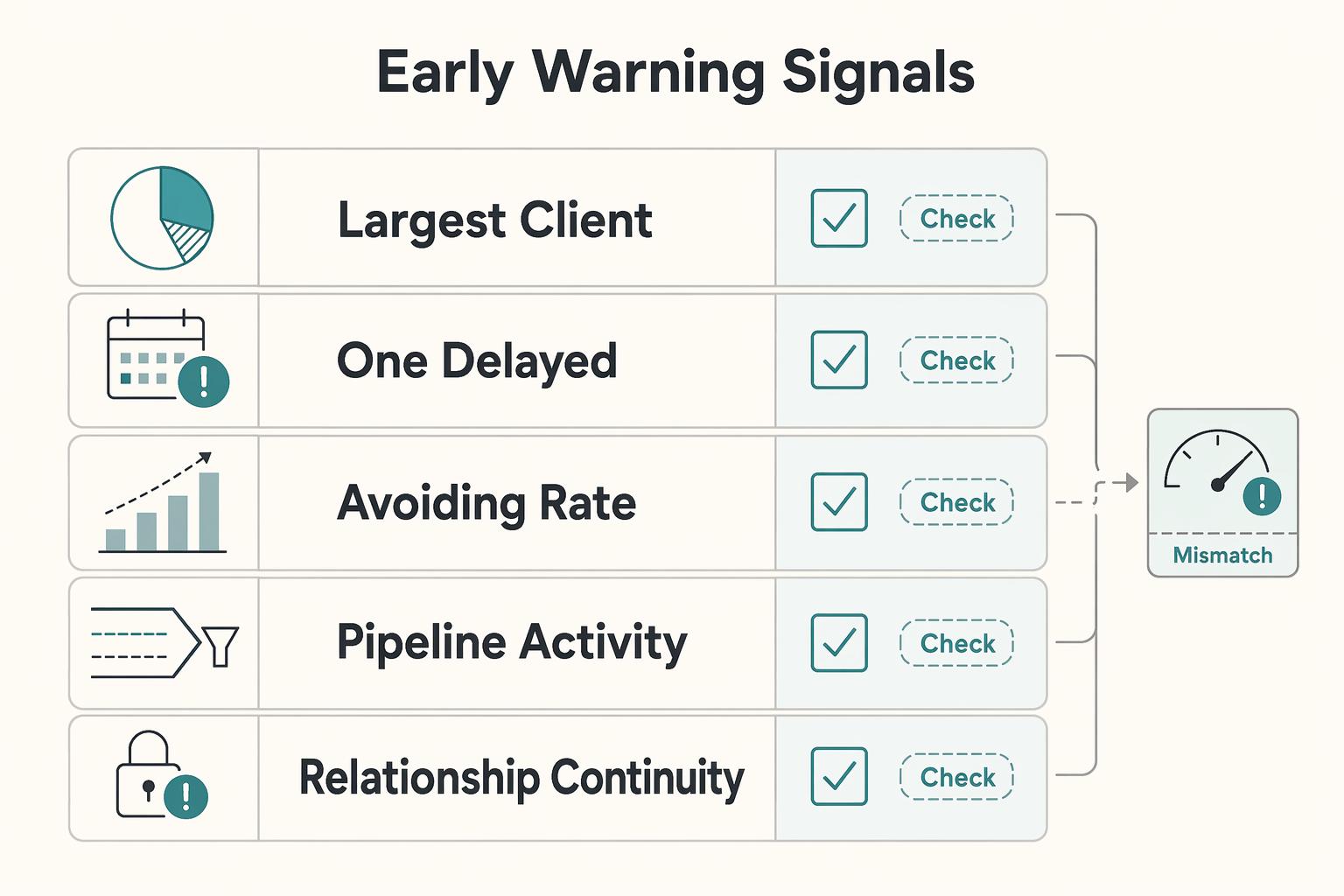
Early Warning Signals#
Before you move into the phase plan, run this quick check.
| Warning sign | Related risk |
|---|---|
| Largest client above 50% of annual revenue, or trending that way | Client concentration risk |
| One delayed invoice could materially disrupt operating cash | Cash-flow problem |
| Avoiding rate, scope, or timeline discussions because the account feels too important | Loss of autonomy in pricing, scope, and boundaries |
| Pipeline activity has slowed because client acquisition work keeps getting postponed | Strategic stagnation |
| Relationship continuity depends on one decision-maker on the client side | Stakeholder change could force reactive operating decisions |
| Offer is hard to explain without referencing that client's internal setup | Expertise is tightly tuned to one buyer context |
If you check more than one or two, you likely have client concentration risk, not just a strong anchor relationship.
Related: How Freelancers Can Use Cialdini's Influence as a Client Decision System.
Phase 1: Stabilize cash, reclaim time, and tighten the relationship#
If these warning signs sound familiar, do not start with prospecting yet. First stabilize cash, reclaim time, and tighten how the current relationship operates. Then add growth work.
Concentration risk usually shows up as a cash problem, a calendar problem, and a positioning problem at the same time.
Autonomy Fund#
Liquidity comes first. If one delayed invoice creates immediate pressure, it can become much harder to hold boundaries on scope, timelines, and pricing.
Start by calculating essential monthly business and household costs from recent statements, then set your reserve target. Keep that reserve separate from operating and tax money, and automate transfers into the reserve account as client payments arrive.
You are aiming for a simple setup: the target is documented, the account is separate, transfers happen automatically, and a payment delay does not force short-term credit or tax-money tradeoffs.
Time & Value Audit#
Do not try to diversify on top of a packed week. Create capacity first, then use that capacity to build the next revenue stream. Track one representative workweek, then sort recurring work by decision type so your best hours stay on judgment-heavy work.
| Decision | Keep this with you when | Typical examples | What "done" looks like |
|---|---|---|---|
| Keep personally | It needs your judgment, trust, or client-facing expertise | strategy calls, core recommendations, sensitive stakeholder conversations | Protected calendar blocks for deep work |
| Delegate | Someone else can execute with a clear brief and review point | research prep, slide cleanup, meeting notes | Brief + quality checklist in use |
| Automate | It follows a repeatable trigger or rule | scheduling, reminders, invoice follow-ups, form collection | Tool is live and tested end to end |
| Batch | It is small work that becomes costly when scattered | inbox triage, approvals, recurring reporting, file admin | Handled in planned blocks, not all day |
You are looking for visible capacity recovery. Recurring low-value work should stop consuming your prime hours, and reclaimed time should get redirected to pipeline building. Use that recovered time on focused business-development moves, such as a simple newsletter or LinkedIn rhythm, and on tactics from The Best Ways to Diversify Your Income as a Freelancer.
Re-anchor the Relationship#
You do not need distance from the client. You need a cleaner operating rhythm. The goal is to protect trust while reducing reactive work.
Start by sending concise, outcome-based updates, flagging risks early, and clarifying response and availability norms. If communication is noisy, add a short recurring alignment touchpoint.
You should see fewer ad hoc pings, fewer ambiguous asks, and more conversations about priorities and results. Keep the tone collaborative. Frame each change as better visibility, faster decisions, and fewer surprises.
First-week execution checklist#
Use the first week to put the basics in place, so Phase 2 becomes execution instead of firefighting.
- Pull recent business and household statements and document your reserve target.
- Set up or label a separate Autonomy Fund account and automate transfer rules.
- Track one full workweek and classify recurring tasks into keep, delegate, automate, or batch.
- Remove one low-value recurring task from prime hours and define a quality check.
- Send your first outcome-led weekly update to the primary client and set a recurring alignment rhythm.
- Set one simple business-development rhythm (for example, a newsletter or LinkedIn cadence) to keep new conversations moving.
We covered this in detail in Build a Freelance Content Calendar That Survives Client Work.
Phase 2: Systematize & Scale - Create New Revenue Streams in Just 5 Hours a Week#
You will not reduce concentration risk by layering random prospecting onto a full calendar. Scaling is a systems problem, not an effort-hours problem. The practical move is to package one proven slice of your expertise into a clear offer, test it with warm buyers, and formalize delivery after you see market signal.
That order matters. Sell one clear thing first, then tighten the operating side once the offer is working.
Pick one repeatable offer concept#
Start with your core expertise, then narrow it to one concept using three filters:
- Repeatability: You solve the problem through a similar process each time.
- Outcome clarity: The buyer can name the result in plain language, such as an audit, roadmap, decision memo, workshop, or prioritized action plan.
- Buyer urgency: The problem is tied to an active cost, risk, or decision.
If it is expert-led but not urgent, it often stalls. If it is urgent but not repeatable, you may still be trapped in founder dependency.
Use a one-page offer brief as your checkpoint: buyer, problem, trigger event, deliverable, out-of-scope items, and the decision your work supports. If that takes pages of caveats, the offer is likely still too broad.
Build a minimum viable offer and validate it lean#
Your minimum viable offer should be the smallest version that still creates a credible business result. Keep it realistic for your current capacity.
Keep the structure simple: one audience, one problem, one deliverable, one pricing logic. Then run a lean loop. Share the brief with warm contacts, tighten the wording based on real reactions, and send a short proposal when interest is concrete.
Validation is not praise. It is buyer comprehension plus intent. A useful proposal line is: "This offer is designed to help you decide, prioritize, and act on X within a defined scope." Spell out what is included and excluded. That makes scope more defensible from the start.
Run warm outreach for signal before volume#
Warm outreach can produce useful early feedback because trust may already exist. Start with former clients, trusted current contacts, and peers who can challenge your positioning or refer you.
Track five fields: contact, relevance, response, objection, next step. The objection column matters most. Repeated objections often mean your scope or outcome language is unclear.
Do not depend on one channel. More durable revenue comes from multiple paths, so combine direct outreach, inbound content such as a short article or LinkedIn post, and partner or referral conversations. For additional options, see The Best Ways to Diversify Your Income as a Freelancer.
Price for outcomes and protect boundaries#
Pricing gets cleaner when outcomes are clear and scope is controlled. If the problem is still undefined, a paid discovery phase or hourly diagnostic is often the better first step.
| Pricing approach | Buyer focus | Scope boundary | Proposal language |
|---|---|---|---|
| Hourly | Time spent | Flexible, but often drifts | "Estimated hours at X rate" |
| Fixed fee without outcome framing | Deliverable only | Better than hourly, but can still invite add-ons | "You will receive A, B, and C" |
| Value-led fixed fee | Decision, risk reduction, or business result | Can be strongest when exclusions are explicit | "This engagement is intended to help you achieve or decide X through A, B, and C. It excludes D and E." |
The tradeoff is practical. Stronger outcome framing usually requires stronger scope discipline. If the result language is vague, disputes can rise. If pricing stays anchored to hours, the conversation often drifts back to cost instead of impact.
At this point, you should have one scoped offer brief, warm-market feedback, tracked objections, and proposal language that clearly separates included work from exclusions. Once that same offer sells repeatedly and the delivery steps repeat, you can systematize with confidence.
You might also find this useful: How to Build a Two-Sided Marketplace by Balancing Client and Contractor Acquisition.
As you turn your expertise into a repeatable offer, pressure-test your pricing before outreach with the Freelance Rate Calculator.
Phase 3: Rebalance & Lead - Manage Your Client Portfolio Like a Pro#
Once the offer has traction, stop treating your client book as a pile of separate projects. Manage it like a portfolio. The aim is operating resilience: keep strong relationships, but reduce single-account exposure before stress forces reactive decisions.
Treat client concentration as a governance issue. Set a clear policy, follow a repeatable rhythm, and decide in advance what will trigger a review.
| Control | Risk objective | Policy | Execution rhythm | Review trigger |
|---|---|---|---|---|
| Client concentration caps | Limit exposure concentration in one account | Record a per-client ceiling in your portfolio tracker | Keep actual revenue, committed work, open opportunities, and upcoming decision points updated in one view | Reassess when one client nears the cap, non-core pipeline weakens, or a renewal or expansion could materially shift concentration |
| Value-Add Reframe | Protect relationship quality while you diversify | Frame outside work as improving outcomes, strategic fit, and partnership quality | Reuse the same message in scope resets, review calls, and availability discussions | Revisit when bandwidth concerns, exclusivity pressure, or unagreed priority expectations appear |
| Leveraged marketing system | Maintain pipeline optionality | Commit to one repeatable visibility channel tied to your offer and buyer problems | Publish on a sustainable rhythm and reuse strong ideas in direct outreach | Rework when publishing slips, inbound stalls, or response quality drops |
Client concentration caps#
Write down your exposure policy before you need it. Good intentions are not enough. Use one portfolio view to track concentration across closed revenue, contracted work, active opportunities, and upcoming renewal decisions.
Run this as simple portfolio governance:
Policy: Define your cap and document what counts toward exposure.Execution: Keep the tracker current and separate confirmed work from possible work.Review trigger: If concentration risk rises, respond in measured steps: tighten scope on add-ons, accelerate qualified outreach, and launch one additional offer motion instead of making abrupt client changes.
If your engagements involve legal or compliance review, keep a lightweight evidence pack ready with active accounts, renewal timing, capacity constraints, and any conflict notes. That supports cleaner conversations with legal or compliance as embedded partners, not blockers.
Value-Add Reframe#
How you explain diversification matters. A clear message can protect trust by framing outside work as a quality and strategy decision, not only a financial one. Use reusable language anchored to outcomes and partnership quality:
- "I keep my client mix intentional so I can bring clear outside perspective and stronger recommendations to this work."
- "I choose engagements for strategic fit, so the work I do elsewhere sharpens the expertise you hire me for."
- "Clear scope, priorities, and availability protect delivery quality and keep this partnership strong."
Use the same message consistently when priorities shift or scope expands. If expectations start drifting toward informal exclusivity, reset the terms early and directly. For additional ideas on diversification, see The Best Ways to Diversify Your Income as a Freelancer.
Leveraged marketing system#
Your marketing should preserve future options, not create more noise. Pick one channel you can actually sustain, and tie each piece to the recurring buyer problems your offer solves.
Keep it operational:
Policy: One repeatable channel, one clear audience, one offer-aligned theme.Execution: Publish consistently, then reuse proven messages in outreach.Review trigger: Adjust when delivery load suppresses output, inbound quality drops, or topics drift away from your target work.
For practical tactics on building your first pipeline, see How to Find Your First Freelance Client.
A deliberate shift away from overreliance on one client#
Moving away from overreliance on one client is not a panicked search for more work. It is a deliberate shift from reactive operator to owner of a more resilient business.
The path is simpler than it looks:
- First, Fortify. Build your Autonomy Fund, reclaim time through the audit, and tighten the operating rhythm with your primary client.
- Next, Systematize. Turn one proven slice of expertise into a repeatable offer, validate it with warm buyers, and clarify pricing and scope.
- Finally, Rebalance. Set concentration caps, explain your client mix as a quality decision, and keep one leveraged marketing system running so optionality does not disappear.
That is where real professional freedom comes from. Not from the apparent safety of one great client, but from a business that can absorb change without forcing desperate decisions.
This pairs well with our guide on How to Use the Pyramid Principle for Client Communication.
If you want your multi-client setup to stay operationally clean as you grow, review Merchant of Record for Freelancers.
Frequently Asked Questions
What is a safe client concentration percentage?
Use a business-specific threshold, not a universal one. Pressure-test it against a 20% reduction and a total client loss. The real issue is structural dependency, where cash flow, margin, hiring, and delivery design all hinge on one buyer. Document the threshold and calculate breakeven revenue without that client.
How do I find new clients when I'm already fully booked?
If you're fully booked, prioritize keeping delivery stable while reducing structural dependency over time. Use The Best Ways to Diversify Your Income as a Freelancer as a starting framework.
What are the very first steps to reduce dependency?
Start with scenario modeling. Test what happens to cash flow if your main client cuts orders by 20%, then model a total client loss and calculate breakeven revenue without that client. Use those scenarios to identify where cost cuts would be required and how much response time you would have.
How can I diversify without upsetting my primary client?
The core principle is reducing structural dependency so hiring, spending, and process design are not tethered to one client's continued commitment. For a structured system, see How to Build a Client Acquisition System for Your Agency.
Is single client dependency always a bad thing?
No, but it becomes a structural risk when too many business decisions depend on one account continuing unchanged. A major client can provide trust, scale, and recurring revenue, but outside shocks can still reduce volume, delay payments, force supplier changes, or end the relationship. Run scenario models now so you know where cost cuts would be needed and how much response time you actually have.
Try a related tool
Researched and edited by the Gruv editorial team. Gruv builds cross-border billing, payouts, and finance-operations software for global businesses.
Sources
Includes 1 external source outside the trusted-domain allowlist.
- acquisition.gov/dfars/part-252-solicitation-provisions-and-c...trusted
- atsdr.cdc.gov/toxprofiles/tp132.pdftrusted
- cisa.gov/resources-tools/resources/system-owneroperat...trusted
- fairfaxcounty.gov/publicworks/sites/publicworks/files/Assets/d...trusted
- idfg.idaho.gov/sites/default/files/fisheriesmanagementplan2...trusted
- ofac.treasury.gov/faqs/addedtrusted
- wida.wisc.edu/sites/default/files/resource/WIDA-ELD-Standa...trusted
- danmartell.com/how-to-scale-your-business-the-six-phase-sys...external
Educational content only. Not legal, tax, or financial advice.
Related Posts
Canada Digital Nomad Visa Planning for Visitor Status and Work Permits
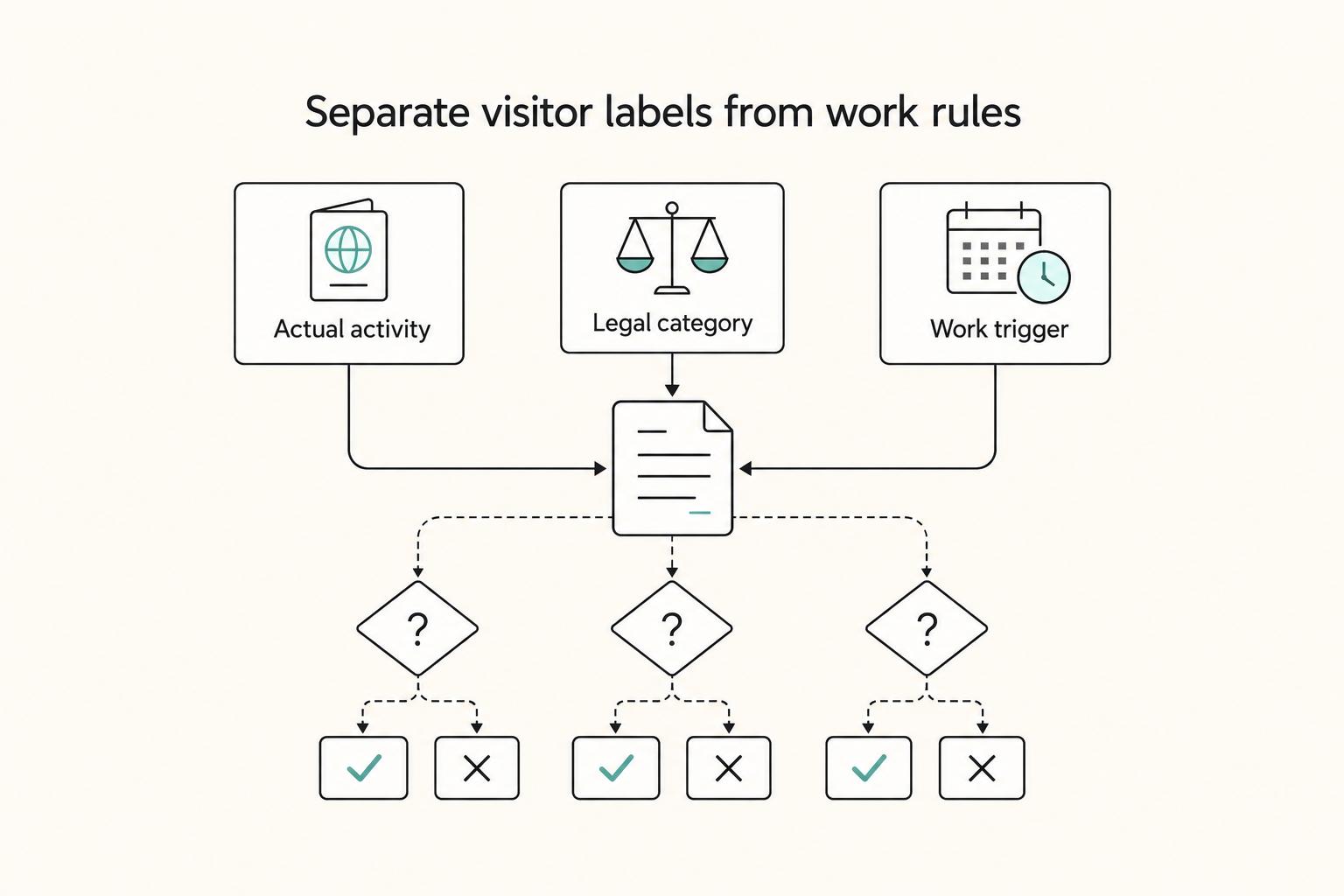
The phrase `canada digital nomad visa` is useful for search, but misleading if you treat it like a legal category. It is shorthand for existing Canadian status options, mainly visitor status and work permit rules, not a standalone visa stream with its own fixed process. That difference is not just technical. It changes how you should plan the trip, describe your purpose at entry, and organize your records before you leave.
The Best Ways to Diversify Your Freelance Income: A Risk-First Framework
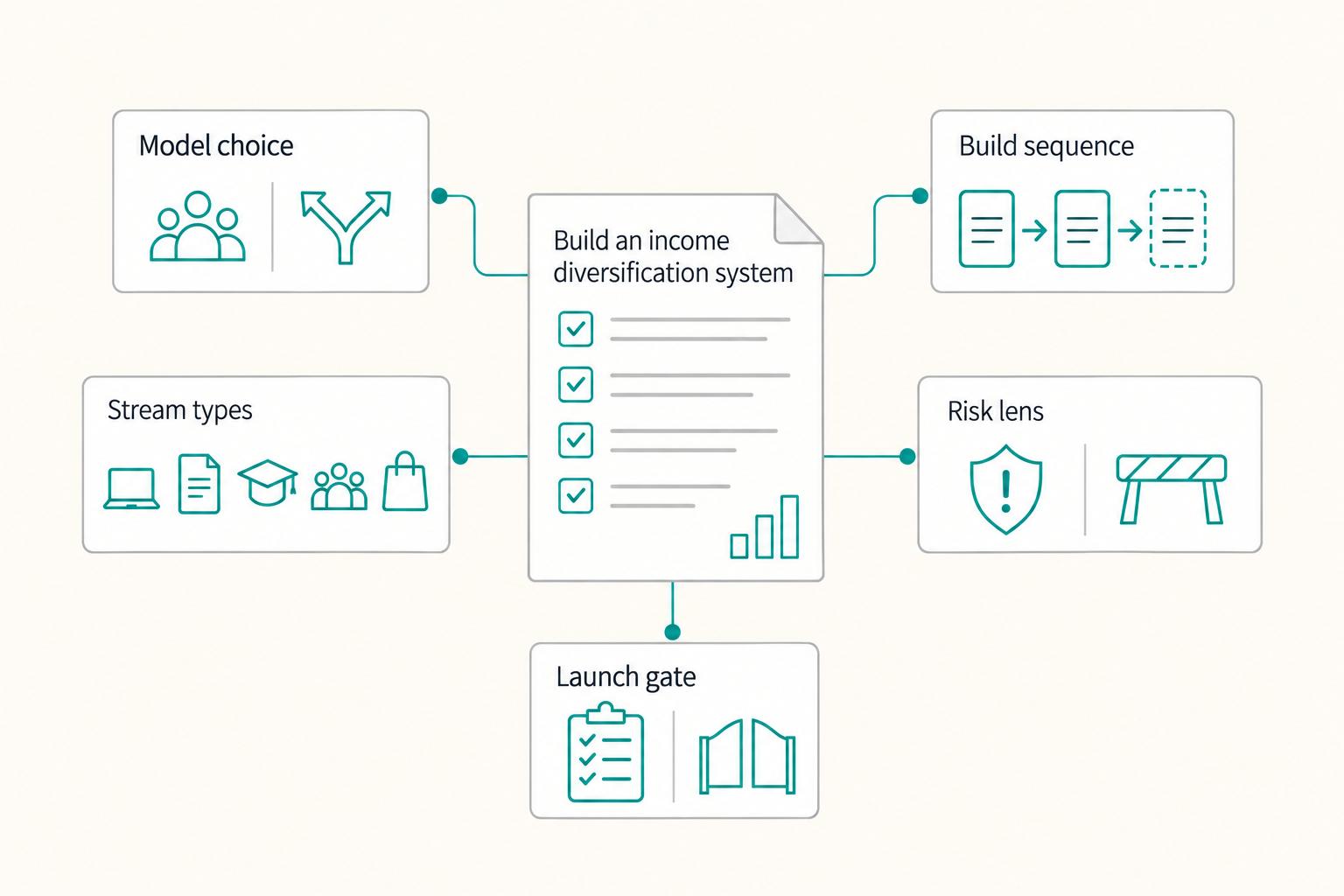
Most freelancers add new revenue lines reactively: a course after a slow month, an affiliate link because someone else said it works, a consulting offer because one client asked for it once. The result is usually the same: more moving parts, unclear priorities, and no real protection when one major client or platform wobbles.

The Freelance Payment Penalty: A Modeled Audit of Platform Fees, FX Spreads, and Payout Delays
The money rarely disappears through a single, easy-to-spot fee. The real loss is stacked. A marketplace takes its commission, a processor adds a charge for international cards, a bank or payment company converts the currency at a spread, a platform holds the funds before release, and a wire sheds a little to intermediaries on the way in. Each layer looks defensible on its own, but the worker feels the combined result as a smaller deposit and a later payday.