
Quick Answer
Start by managing three timelines in one operating calendar: Schengen short-stay limits, your base-country residence test, and your FEIE qualifying window. Select a country only after you can map visa steps, local filing obligations, and renewal evidence requirements. Log every border crossing on the same day, and pair each movement with records for income, accounts, housing, and tax filings. If your facts suggest conflicting residence positions or treaty disclosure, involve a cross-border advisor before filing.
--- For an American professional in Europe, the appeal of a global career often runs straight into a harder reality. The freedom you want sits inside a web of compliance rules, where visas, local taxes, and US tax obligations run on overlapping timelines and do not forgive sloppy recordkeeping.
That complexity is not just paperwork. It is the central challenge of building a career abroad. The shift that makes this manageable is simple. Stop treating the move like a temporary experiment and start treating it like a business you run. You are operating a business of one.
This playbook lays out that work in three phases. It starts with the decisions you need to make before you leave, moves into the day-to-day discipline that keeps you compliant on the ground, and ends with the long-term habits that turn a fragile setup into a durable international career.
Phase 1: The Pre-Launch Audit - Choosing a Market, Not a Vacation Spot#
Pick your base like a business decision, not a lifestyle guess. Before you move, you should be able to explain how you will legally stay, invoice, file, renew, and document your activity in that country.
As a US citizen abroad, you are still taxed on worldwide income and still file a US return. The basic filing framework is the same even when you live overseas. FEIE or FTC relief is not automatic; you must file to claim it. For calendar-year filers, April 15 is the regular due date. Taxpayers abroad can get an automatic extension to June 15, but unpaid tax can still accrue interest from the regular due date. If the aggregate value of your foreign accounts exceeds $10,000 at any point in the year, FBAR filing may apply even if those accounts produced no taxable income.
Use that as an early filter on your shortlist. If local compliance is still unclear before you move, treat that as a risk signal, not something to sort out later.
Build a consulate-proof dossier#
Treat your visa or permit application as an evidence file, not a form-filling exercise. EU-level immigration pages stay general, country implementation differs, and Schengen guidance says to confirm details with the embassy or consulate of your main destination country.
| Category | Examples in the article |
|---|---|
| Identity and travel status | Passport validity, prior visas or permits, and relevant travel history |
| Income continuity and business activity | Recent invoices, contracts or engagement letters, bank statements, a recent profit snapshot, and a short description of your work and client locations |
| Tax and business compliance history | Recent US returns, estimated-tax records if applicable, and current business registration documents if you operate through an entity or as a sole proprietor |
| Local living and support evidence | Accommodation plan, health coverage, savings buffer, and any local sponsor, address, or registration item requested |
Start with this checklist, then include country-specific requirements only after official verification. If your income is variable, present the pattern clearly so a reviewer can see continuity without guessing.
- Identity and travel status - Passport validity, prior visas or permits, and relevant travel history. Confirm the current document requirement with the relevant embassy or consulate.
- Income continuity and business activity - Recent invoices, contracts or engagement letters, bank statements, a recent profit snapshot, and a short description of your work and client locations. Confirm the required evidence period with the relevant embassy or consulate.
- Tax and business compliance history - Recent US returns, estimated-tax records if applicable, and current business registration documents if you operate through an entity or as a sole proprietor. Confirm any legalization, translation, or apostille requirement with the relevant embassy or consulate.
- Local living and support evidence - Accommodation plan, health coverage, savings buffer, and any local sponsor, address, or registration item requested. Confirm the current document requirement with the relevant embassy or consulate.
Compare the full compliance load#
Do not rank countries on headline income tax alone. In practice, what matters is the full compliance load: tax regime fit, social contributions, indirect tax exposure, filing burden, and rule stability.
In the EU, Member States set VAT rates within an EU framework, and the standard rate floor is 15%. VAT and invoicing obligations still vary by country and transaction type. For self-employed work under EU coordination rules, contributions are typically paid where the work is performed. In covered situations, US totalization agreements can prevent dual Social Security taxation, but you need to verify that your facts qualify.
| Shortlist market | Tax regime fit | Social contributions | Indirect tax exposure | Filing burden | Rule stability |
|---|---|---|---|---|---|
| Country A | Confirm resident and nonresident treatment with the national tax authority | Confirm the contribution basis and exceptions with the national social-security authority | Confirm VAT exposure and invoice rules with the national tax authority | Confirm return frequency, registration steps, and deadlines with the national tax authority | Confirm recent rule changes from the official source |
| Country B | Confirm resident and nonresident treatment with the national tax authority | Confirm the contribution basis and exceptions with the national social-security authority | Confirm VAT exposure and invoice rules with the national tax authority | Confirm return frequency, registration steps, and deadlines with the national tax authority | Confirm recent rule changes from the official source |
| Country C | Confirm resident and nonresident treatment with the national tax authority | Confirm the contribution basis and exceptions with the national social-security authority | Confirm VAT exposure and invoice rules with the national tax authority | Confirm return frequency, registration steps, and deadlines with the national tax authority | Confirm recent rule changes from the official source |
If you sell eligible cross-border goods or services in the EU, OSS can materially reduce VAT administration, but confirm eligibility against your transaction type and establishment facts.
Test the bureaucratic system before you commit#
Before you commit, test how the local system actually works. You want to know what happens between arrival and legal operation, not just what the marketing page promises. Run this pre-move due-diligence sequence before relocation:
| Check | What to verify | Specific note |
|---|---|---|
| Registration friction | Which IDs, registrations, and appointments are required before legal invoicing and tax or social filings | Including what must be done in person |
| Invoicing and compliance workflow | A sample compliant invoice for your business type and a concrete list of returns and deadlines you would actually handle | Ask a local accountant |
| Professional support availability | A named accountant or adviser in advance | Clear fees, response expectations, and cross-border scope |
| Renewal predictability | What is reviewed at renewal | Start collecting that evidence from day one |
- Registration friction
Confirm which IDs, registrations, and appointments are required before legal invoicing and tax or social filings, including what must be done in person.
- Invoicing and compliance workflow
Ask a local accountant for a sample compliant invoice for your business type and a concrete list of returns and deadlines you would actually handle.
- Professional support availability
Identify a named accountant or adviser in advance, with clear fees, response expectations, and cross-border scope.
- Renewal predictability
Ask what is reviewed at renewal and start collecting that evidence from day one.
As a practical default, run this sequence for more than one country before you book a one-way move. If key authorities or advisers cannot give you clear written guidance, treat that uncertainty as a real operating cost. For a deeper dive, read the digital nomad tax guide.
Phase 2: Run One Sheet and Track Each Clock Separately#
Run one dashboard, but treat each clock as its own control system. only the VAT checkpoints below are source-verified; keep travel, host-country personal tax, and US filing items as placeholders until you verify them separately.
| Clock | Purpose | Main authority | Counting method | Reset window | Consequence of error |
|---|---|---|---|---|---|
| Travel presence clock | Confirms whether your stay and movement fit your travel or immigration permission | Confirm the applicable immigration authority from the official source | Confirm the current counting method from the official source | Confirm the current reset window from the official source | Permission or status disruption if unverified |
| Host-country personal tax clock | Determines when local personal tax filing or treatment may apply | Confirm the applicable tax authority from the official source | Confirm the current residency threshold with the national tax authority | Confirm the current counting period with the national tax authority | Local filing or assessment risk if unverified |
| US expat filing clock | Tracks US filing duties and any relief position you plan to claim | Confirm the applicable filing authority from the official source | Confirm the current test or limit from the official source | Confirm the current tax-year or 12-month frame from the official source | Filing or claim support risk if unverified |
The key mistake is mixing clocks, not forgetting to count. Log each trip once, then map it to all three rows with separate notes and proof.
Keep the US row at placeholder level until you verify current rules. That includes the filing timeline, extension status, day-count fields, estimated-tax tracking if relevant, and foreign-account reporting checks.
Add the VAT calendar to the same sheet#
VAT is not a personal residency clock, but it belongs on the same sheet because it brings its own deadlines and exposure.
| VAT route | What the article says | Cadence or checkpoint |
|---|---|---|
| OSS non-Union scheme | Register in one Member State, your Member State of identification, and file through that state's web portal; if you opt into a scheme, you must declare all supplies that fall under that scheme through OSS; OSS returns are additional to domestic VAT returns | Quarterly |
| OSS Union scheme | Register in one Member State, your Member State of identification, and file through that state's web portal; if you opt into a scheme, you must declare all supplies that fall under that scheme through OSS; OSS returns are additional to domestic VAT returns | Quarterly |
| OSS import scheme | Register in one Member State, your Member State of identification, and file through that state's web portal; if you opt into a scheme, you must declare all supplies that fall under that scheme through OSS; OSS returns are additional to domestic VAT returns | Monthly |
| Cross-border SME scheme | Prior notification goes through your Member State of establishment, and you can apply exemption from the date that state grants your EX number | Union turnover cap of EUR 100 000 in the current and previous calendar year; standard processing should not exceed 35 working days, but it can take longer where anti-evasion or anti-avoidance checks are required |
If you use OSS, you register in one Member State, your Member State of identification, and file through that state's web portal. OSS covers three schemes: non-Union, Union, and import. If you opt into a scheme, you must declare all supplies that fall under that scheme through OSS. OSS returns are additional to domestic VAT returns. Filing cadence is quarterly for non-Union and Union schemes, and monthly for the import scheme.
If you use the cross-border SME scheme, keep the operational checkpoints explicit. Eligibility includes a Union turnover cap of EUR 100 000 in the current and previous calendar year. Prior notification goes through your Member State of establishment, and you can apply exemption from the date that state grants your EX number. Standard processing should not exceed 35 working days, but it can take longer where anti-evasion or anti-avoidance checks are required.
Ongoing maintenance checklist#
Once the dashboard exists, the job is keeping it current enough to defend later. Use a simple maintenance routine:
- Log border crossings and overnight stays the same day, then reconcile on a fixed cadence against your own travel and payment records.
- Keep a quarterly proof folder for each clock so evidence is easy to retrieve during reviews.
- For VAT, retain OSS receipts, domestic VAT return records, EX number confirmation if applicable, and turnover tracking against the
EUR 100 000SME checkpoint plus theEUR 10 000OSS threshold where relevant. - Escalate early to a cross-border tax professional when facts overlap across countries, evidence is incomplete, VAT classification is unclear, or you are assessing OSS, SME, or CBR use.
- For complex VAT treatment, note that a CBR request is filed in the participating EU country where you are VAT-registered and must follow that country's national VAT ruling conditions.
For background on travel counting, see A Guide to the Schengen 90/180 Day Rule. If you want one place to manage the travel and tax clocks, set up one operational dashboard with the Tax Residency Tracker.
Phase 3: The Long-Term Moat - Building a Career, Not a Vacation#
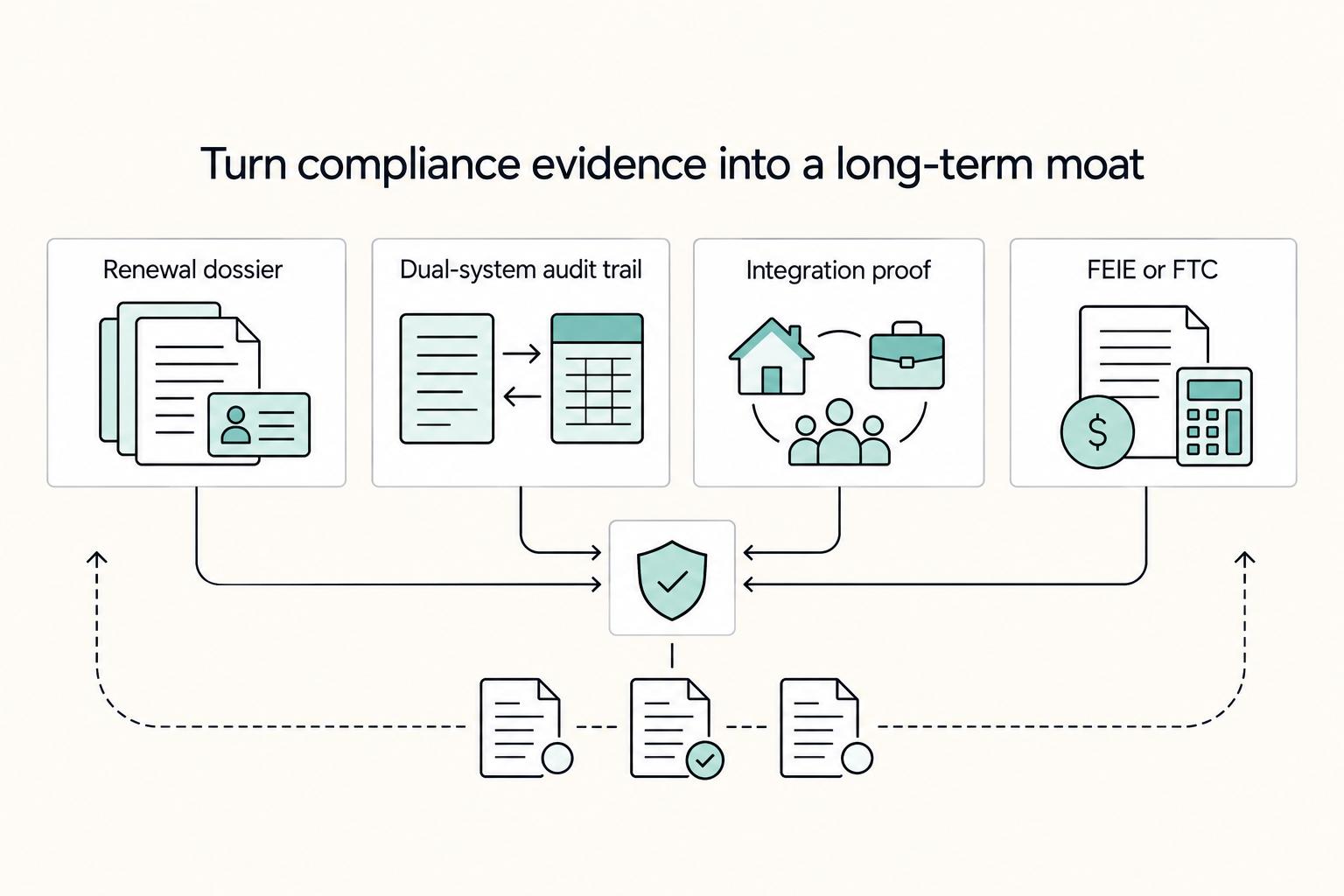
Treat renewal as a repeatable process, not an emotional event. The goal is a standing dossier that proves lawful stay, real economic activity, and continuity without forcing you to rebuild your story from memory.
Turn the renewal dossier into a standing file#
Set this up once and maintain it all year. Use one folder per calendar year with recurring subfolders: 01_status, 02_housing, 03_income_clients, 04_tax, 05_insurance, 06_integration, 07_travel. Name files YYYY-MM-source-document, for example 2026-04-bank-main-statement.pdf and 2026-02-lease-extension-signed.pdf. This is your internal file structure, not a country-specific legal checklist.
Collect continuously. Keep the documents commonly reviewed in residence and tax processes. That includes residence-status records, housing rights documents such as ownership, lease or sublet records, or owner consent where relevant, plus health insurance evidence, invoices, bank records, tax filings, and official receipts.
Review monthly for gaps, then run a pre-renewal check well before permit or registration expiry (for example, around 90 days). In some systems, action is required before legal stay expires, and some temporary residence registrations must be renewed before validity ends.
Keep a dual-system audit trail#
Your records need to hold up in two directions at once: host-country compliance and US filing. The simplest control is keeping business and personal money flows separate from the start.
- Use dedicated accounts for business activity and personal spending.
- Label transfers consistently, such as
owner_draw,reimbursement, andcapital_contribution, and keep matching support. - For income, keep the invoice and the payment record.
- For expenses, keep the receipt and the business purpose.
- Reconcile monthly across invoices, bank or card records, and travel logs.
Escalate quickly when anomalies stop being explainable in one sentence. That includes mixed spending patterns, missing source documents, unexplained transfers, or residency indicators that conflict with your movement records.
Build proof of integration, not lifestyle theater#
Do not try to prove a lifestyle. Prove continuity with evidence that matches the actual tests and reviews you may face. Use evidence categories tied to continuity, not broad personal claims:
- Housing continuity: lease or ownership timeline and related records.
- Work and economic ties: client or work records and other economic ties.
- Personal and social ties: family, partner, social, and related ties where they are real and documentable.
- Integration requirements: evidence of compliance where the local system requires it.
This is the practical standard behind a centre-of-vital-interests analysis: show where your life is actually anchored with documents. If your plan includes long-term EU residence pathways, continuity and supporting income, insurance, and integration evidence matter more over time.
FEIE or FTC#
Choose a primary path early, then validate the details before filing.
| Path | Usually fits when | Key limits and interactions | Filing mechanics |
|---|---|---|---|
| FEIE | You qualify under the physical presence route and want to exclude foreign earned income | Physical presence test: 330 full days in 12 consecutive months; 2026 max exclusion: $132,900 per qualifying person | Claim with Form 2555 |
| FTC | You pay foreign income tax and want to credit those taxes | No credit on income already excluded under FEIE or foreign housing exclusion; unused credits may carry back 1 year and forward 10 years | Claim with Form 1116 |
If your outcome depends on treaty tie-breaker analysis, treat it as a professional handoff. Treaty-based return positions may require Form 8833 disclosure, and disclosure failures can trigger penalties.
Bring in a pro when any of these appear:
- Mid-year country moves.
- Entity, payroll, or contracting-structure changes.
- Treaty-dependent filing positions or dual-residency conflicts.
- Indicators pulling in different directions across countries.
Related: 183-Day Rule Explained: Stop the Tax Myths Before They Cost You.
Conclusion: From Tightrope Walker to Architect#
You stop walking a tightrope when you do three things deliberately: choose a real base, run all clocks in one calendar, and document decisions as you make them. The goal is simple: keep your immigration, tax, and account records aligned.
Your calendar is the control point. Track the Schengen short-stay clock (90 days in any 180-day period) for short stays, your local residence test in your base country, and your FEIE window if you are targeting 330 full days in foreign countries over 12 consecutive months. Log travel in real time. Schengen counts both entry and departure days, and Form 2555 requires exact qualifying-period start and end dates. Use these practical defaults:
- Choose country first on legal-stay basis, then sort lifestyle and tax marketing.
- Record every border crossing the same day and reconcile monthly against stamps, tickets, and the EU short-stay calculator.
- Keep one evidence folder for lease or registration records, invoices or contracts, bank statements, tax filings, and travel proof.
- If foreign accounts cross the FBAR
$10,000aggregate threshold at any point in the year, keep the records that support that filing. - Review quarterly, then repeat before renewals and filing season.
Pause and get cross-border tax or legal advice if your facts support two residence claims, if a UK pattern approaches 183+ days or moves into the ties test, or if you may need a treaty-based return position on Form 8833. Do the same if your outcome depends on a country-specific trigger that is not yet verified.
Control comes from counted days, dated decisions, and records that agree. Use this system, then apply it in the guide and country deep dives. For a step-by-step walkthrough, see A Deep Dive into the UK's Statutory Residence Test for Nomads. Turn this framework into a repeatable monthly routine with Gruv's Tools.
Frequently Asked Questions
What is the difference between the Schengen 90/180 rule and the 183-day tax rule?
Treat travel permission and tax-residency analysis as separate issues, and verify the current rules for each country before relying on a day-count assumption.
How do I prove income for a digital nomad visa as a freelancer?
Requirements are country- and consulate-specific. Use the official requirements for your target country and provide consistent, traceable records of your freelance income and business activity.
Can I completely avoid dual taxation as a US nomad in Europe?
Do not assume that living abroad ends US tax duties, because US citizens and resident aliens abroad are still taxed on worldwide income. In practice, FEIE, FTC, and in some cases treaty analysis may reduce double taxation, but you still file and report the income. If your result depends on dual residency or treaty positions across jurisdictions, confirm your filing approach with a cross-border tax advisor.
Does a digital nomad visa grant me total freedom of movement in the EU?
Do not assume one country's permit settles immigration or tax exposure in every other country; verify each country separately for stay, registration, and tax risk.
Is it better to use the FEIE or the FTC?
Use FEIE when you qualify on the core tests: foreign earned income from personal services, a foreign tax home, and a qualifying test such as 330 full days in a 12-consecutive-month period, with full days counted as 24 consecutive midnight-to-midnight hours. If you claim FTC, handle Form 1116 carefully by income category, with one category box per form, generally reported in U.S. dollars except where Part II says otherwise. For 2026, FEIE can exclude up to $132,900 per qualifying person, but it is sensitive to day counting. If your 12-month window crosses tax years, spans multiple countries, or may require treaty analysis, confirm the choice with an advisor before filing.
What is the biggest mistake US nomads make with this whole setup?
A common error is assuming substantial time abroad automatically qualifies you for FEIE physical presence. You can spend substantial time abroad and still fail FEIE physical presence if you miss the 330 full-day minimum. Another costly miss is assuming common disruptions excuse a shortfall, even though failure to meet 330 days generally fails the test except limited adverse-country waiver situations. If your facts include mixed residency signals, mid-year moves, or treaty-dependent positions, escalate early to a cross-border professional.
Try a related tool
Researched and edited by the Gruv editorial team. Gruv builds cross-border billing, payouts, and finance-operations software for global businesses.
Sources
Includes 1 external source outside the trusted-domain allowlist.
- home-affairs.ec.europa.eu/policies/migration-and-asylum/legal-migratio...trusted
- irs.gov/individuals/international-taxpayers/us-citiz...trusted
- irs.gov/businesses/small-businesses-self-employed/re...trusted
- sme-vat-rules.ec.europa.eu/sme-scheme/cross-border-sme-scheme_entrusted
- gov.uk/government/publications/rdr3-statutory-resid...external
Educational content only. Not legal, tax, or financial advice.
Related Posts

Digital Nomad Taxes in 2026 With a Defensible Filing Plan
With digital nomad taxes, the first move is not optimization. It is figuring out where you may be taxable, where filings may be required, and what proof supports that position.

183-Day Rule Tax Myths That Trigger Residency Filing Mistakes
If you are a mobile freelancer or consultant, start here: the "183 day rule tax" idea is not a single universal test. It is a shortcut phrase people use for different residency rules that do not ask the same question. If you mix federal and non-federal residency logic, you can create filing risk even when your travel calendar looks clean.
A Guide to the Schengen 90/180 Day Rule
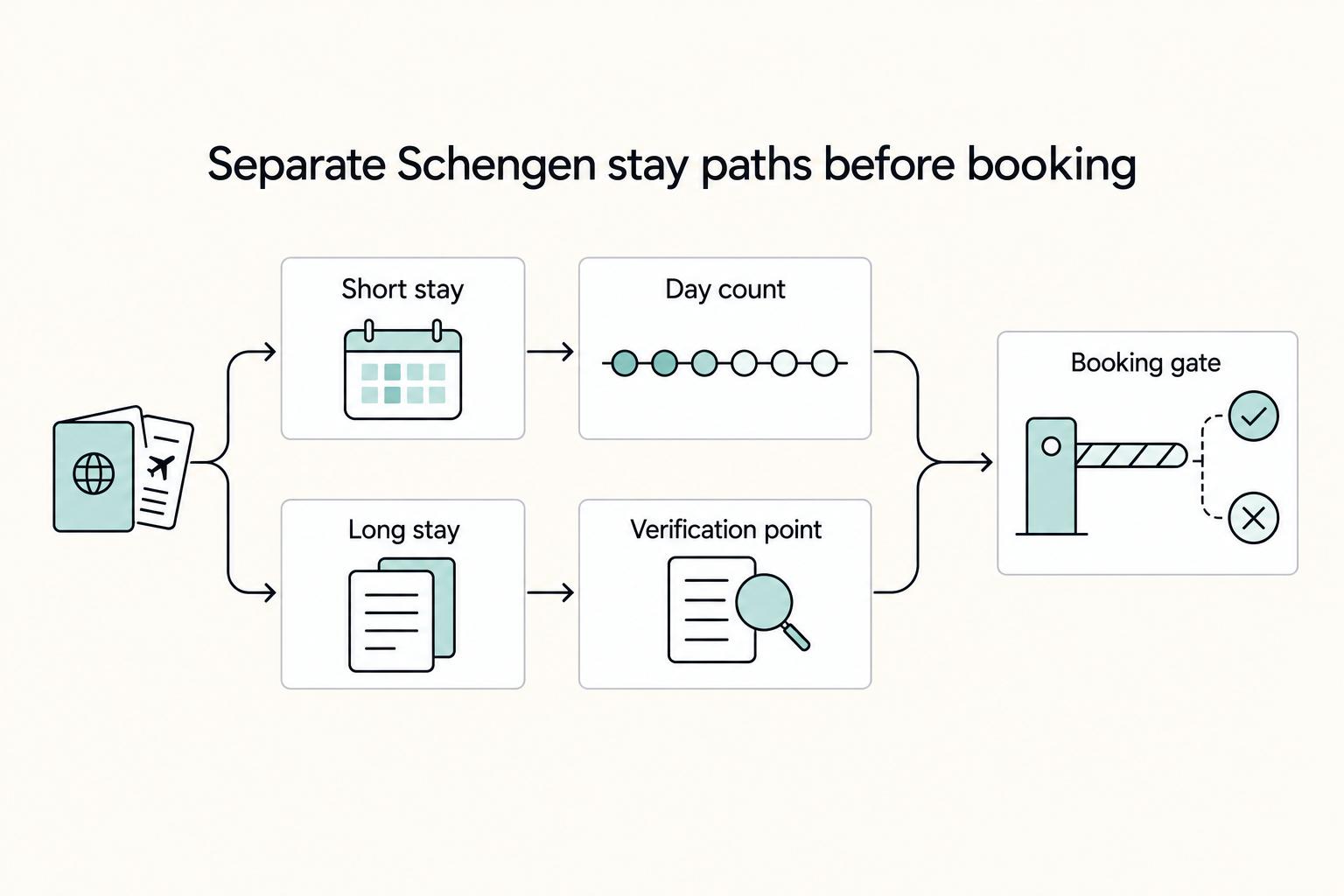
**Treat Schengen short-stay limits as an operating constraint, then run every movement decision through one repeatable system.** If you treat Europe travel like a chain of bookings, you create avoidable risk. Run it like operations, and you protect flexibility, reduce stress, and keep your visa compliance posture clean across the Schengen Area.