
Quick Answer
Yes, purple cow for freelancers works when you turn it into operating choices, not just branding. Pick a narrow niche, build a service package with explicit boundaries, and run onboarding that creates an early verifiable checkpoint. Then collect proof artifacts clients can retell by word of mouth. Keep your freelance contract and invoice flow aligned with what you sold so differentiation survives delivery, not just sales calls.
How to apply purple cow thinking to freelance positioning clients can actually verify#
For freelancers, purple cow for freelancers matters only if it changes how clients choose you. "Be remarkable" is a useful prompt, but it is weak as a business decision unless you turn it into a narrower niche, a clearer offer, firmer scope, and a client experience people can describe without your help.
That gap is easy to understand. A May 28, 2015 review titled Striving to Be Remarkable - A Review of Purple Cow by Seth Godin described the book as dense. Dense ideas often get repeated more than applied. Freelancers can borrow the language, refresh the homepage, and still find prospects comparing them on price, speed, or vague "fit."
The more useful move is to treat Purple Cow as a test of what is actually different in your business, not as permission to be louder. In practice, check four places where differentiation either holds up or falls apart: your niche, your service package, your delivery method, and the moments in the client experience that make your work easy to repeat, refer, or remember. If the difference only shows up in your brand voice or portfolio styling, that is a red flag.
This article is built for execution. You will work from concrete checkpoints, not abstract branding advice. Can a prospect restate your value in one plain sentence? Does your offer have visible boundaries, success criteria, and a reason it fits a specific buyer? Does your onboarding create an early proof point instead of a long silent stretch? Those checks expose where "remarkable" is real and where it is just better wording.
You will also get a practical sequence you can use without rebuilding your whole business at once. The order matters. First, choose a problem and buyer narrow enough to prove. Then package the work so it can be bought and delivered consistently. Then make sure the experience supports referrals instead of relying on clever promotion. Skip that order, and the usual result is predictable: stronger messaging attached to an ordinary offer.
What Purple Cow means for freelancers in 2026#
For freelancers, Purple Cow is useful when it makes your work easier to notice, remember, and choose, not just easier to admire. If it stays at the level of style, voice, or a sharper homepage, you can look more polished without becoming easier to hire.
A Medium post from New Writers Welcome (Aug 19, 2025) is titled "Be a Purple Cow: Simple Tricks to Stand Out Online." That framing is appealing, but "stand out online" can drift into brighter visuals, more content, or louder promotion. A better test is whether what is different about hiring you is clear before the project starts and still clear after it ends.
In practice, make your distinction visible in the work:
- a narrower problem you solve
- clearer scope and boundaries
- an earlier proof point
- a deliverable clients can compare
Branding helps as a signal, but it cannot carry a generic offer for long.
To check your positioning, review your last three inquiry emails, proposal replies, or referral intros. If each person describes your value differently, your positioning is likely too loose. If they repeat the same outcome, buyer type, or reason you are easier to hire, your differentiation is getting stronger.
A common failure pattern is praise without traction: prospects like your site or content but still default to price comparisons or ask for a custom explanation each time. When that happens, tighten the offer before adding more promotion.
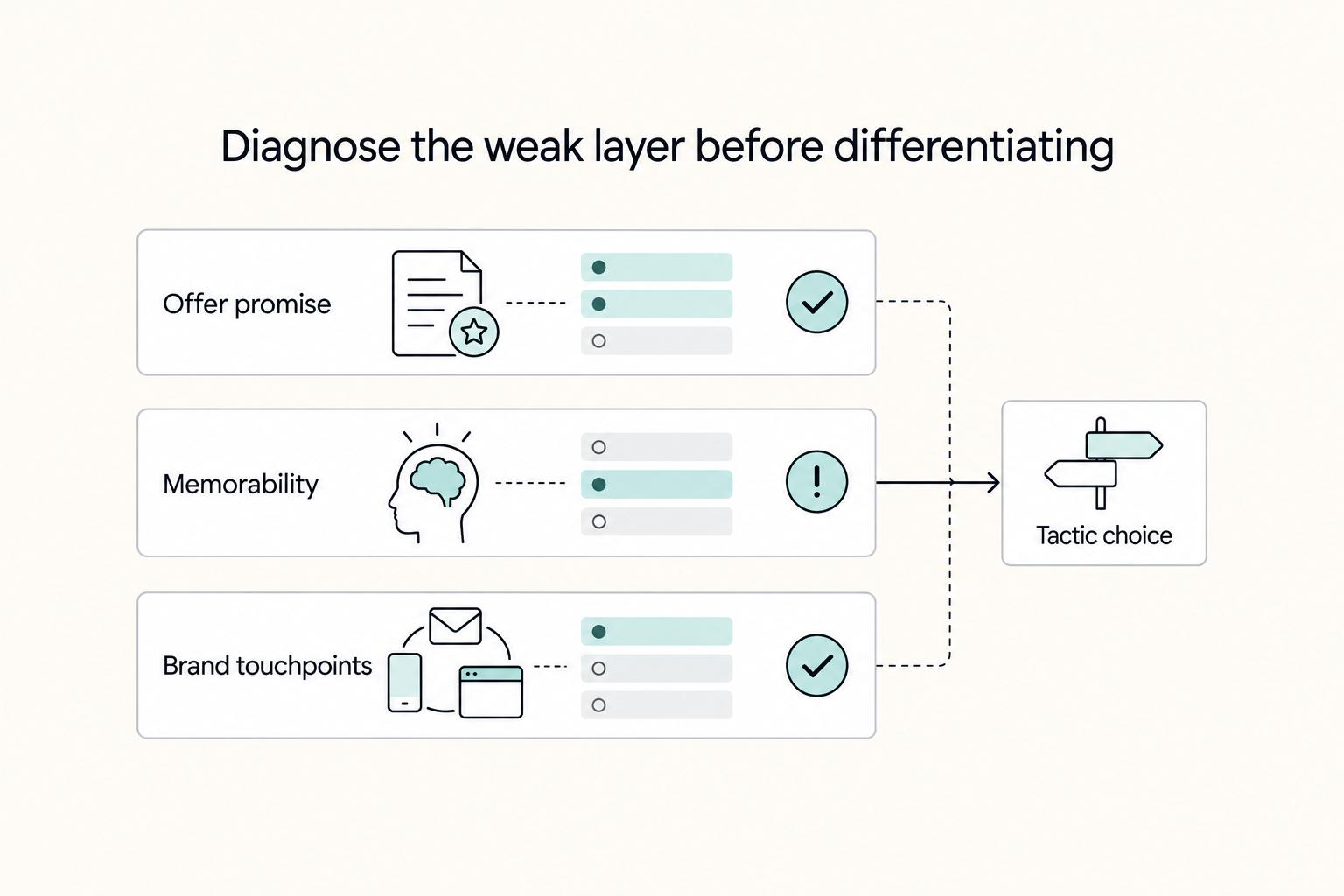
That distinction matters because your next move is not just a tactic choice. It is deciding which layer of the business is actually weak. Related: Permission Marketing for Freelancers Who Want Better-Fit Clients.
Compare Purple Cow, USP, and freelance branding before you choose tactics#
Choose tactics only after you identify which layer is weak: your offer promise, how memorable that promise is, or how clearly you present it. Use these as working labels: USP for the core promise, Purple Cow for the "worth talking about" test, and freelance branding for how that promise shows up across buyer touchpoints.
| Approach | Purpose | Proof needed | Common failure mode | Buyer signal |
|---|---|---|---|---|
| Unique Selling Proposition (USP) | Clarify what you promise and for whom | Consistent outcome, buyer type, and scope in calls and proposals | Broad language that still pushes buyers to compare on price | "I get what you do, and who it's for." |
| Purple Cow | Check whether your offer feels notable, not just clear | Prospects and clients repeat the same differentiator without prompting | Mistaking "different" for "flashy," which gets attention but not selection | "This is specific enough to mention to someone else." |
| Freelance branding | Make the promise easy to recognize everywhere buyers see you | Consistent wording, examples, and presentation across touchpoints | Polished presentation with unclear positioning | "You look credible and easy to hire." |
Use a quick decision rule. If people understand your offer but do not remember it, improve the offer mechanics first. If people value the work once they see it but keep misreading what you sell, improve branding and messaging second.
Pick a niche where your differentiation can be verified#
Your niche works only when a buyer can verify your difference quickly. Start with one client type, one problem scope, and one service package that creates proof early in onboarding.
The key move is choosing a solvable problem, not a broad label. "I do marketing" invites price comparison. "I improve onboarding emails for EU SaaS renewals" is easier to understand, easier to evaluate, and easier for clients to repeat by word of mouth.
Use a three-part filter before you commit#
Pick a niche only if it passes urgency, budget realism, and proofability during onboarding.
| Filter | What to ask | What good looks like | Red flag |
|---|---|---|---|
| Urgency of problem | Is this already costing time, revenue, or compliance effort? | Buyer feels the pain now and wants action this quarter | "Interesting, but not a priority" |
| Budget realism | Does this client type usually pay to reduce this problem? | Work ties to revenue protection, reporting, or handoff quality | You must teach the value from zero every time |
| Ease of proof in client onboarding | Can you capture a baseline in week one? | You can access current assets, records, or process steps quickly | Proof depends on data the client cannot provide |
If you cannot verify the "before" state in onboarding, proving the "after" state later gets hard. Before kickoff, ask for the current process or asset, one signoff owner, and one existing measure. If one is missing, narrow scope or add a paid diagnostic.
Tie the niche to a specific operating context#
Differentiation gets stronger when your offer sits inside a named process or rule set. That gives buyers a concrete frame for what you do and how success is checked.
For EU digital sellers, an offer tied to One Stop Shop (OSS) is clearer than broad "VAT content support." OSS includes concrete process points: registration in one Member State, VAT declaration and payment, record keeping, audits, and leaving OSS. The EU-wide threshold for certain cross-border B2C e-commerce treatment is EUR 10 000, and those rules changed from 1 July 2021. The cross-border SME scheme includes a EUR 100 000 turnover cap and prior notification through the Member State of establishment, with a process target that should not take longer than 35 working days. These details do not fit every client, but they show why regulation-linked niches are easier to verify.
Context also changes package design. If your buyer is a Business Process Outsourcing (BPO) team in the Philippines supporting EU clients, avoid broad "operations writing." A tighter package is process documentation and handoff assets for teams supporting EU sellers using OSS. Proof is clearer: current SOPs, escalation points, sample records, and specific handoff failures to reduce. If source documents from the EU client are missing, add a discovery phase or document checklist before delivery.
Build a service package clients can buy and refer#
Your package should make the buying decision obvious: what problem you handle, what you deliver, and how a client knows the work is complete. Turn your niche into a named offer with clear boundaries so a buyer can understand it quickly and repeat it accurately to someone else.
A narrow niche gives you direction, but the package is what makes the work purchasable and referable. If people can only describe you as "helpful" instead of naming a specific outcome, your offer is still too loose.
Name the parts buyers actually compare#
Use a simple structure buyers can scan in minutes:
| Package part | What to define |
|---|---|
| Scope | the problem you solve and what is out of scope |
| Deliverables | what the client receives |
| Timeline | key phases and client dependencies |
| Feedback process | how input is collected and incorporated |
| Completion standard | how both sides decide the work is done |
Keep these labels consistent across your site, proposal, onboarding, and contract. That consistency reduces friction before delivery starts.
A practical check: can each part be verified from real inputs and outputs? If you cannot name the documents, access, or approver needed to do the work well, tighten the package before selling it broadly.
Make tiers easy to compare#
If you offer tiers, keep the core promise stable and vary the depth of support.
| Tier | What changes | What stays stable |
|---|---|---|
| Diagnostic | Lighter analysis, recommendation-focused output | Same client type and same core problem |
| Core Delivery | Full deliverable with standard collaboration | Same promise and same scope boundary |
| Expanded Support | More implementation or follow-through support | Same outcome category and decision owner |
This helps buyers compare level of help instead of re-learning a different offer each time. It can also support stronger Lifetime Value through repeat work and referrals when clients can enter at the level that fits.
Put buying clarity into the freelance contract#
Your package is only real when the contract reflects it in plain language. Make sure the contract matches the offer terms you already presented, especially around completion, changes, payment flow, and handoff.
When pricing pushback appears, review packaging clarity before defaulting to discounts. In many cases, clearer scope and deliverables reduce objections because the buyer can see exactly what they are purchasing.
Use market analysis as an ongoing feedback loop. Repeated objections often point to a packaging bottleneck, and fixing it usually matters more than polishing other parts of the business first.
Engineer referral moments into client onboarding and delivery#
If you want more referrals, make onboarding and delivery easy to see, verify, and retell. Treat the first week as proof-building, not just setup.
Structure week one around proof, not admin#
Onboarding can get bloated fast, so keep the opening sequence clear and practical instead of form-heavy. Aim for one visible improvement and one checkpoint the client can verify.
- Kick off with boundaries: restate the package name, scope, out-of-bounds work, the client-side owner, and required inputs
- Capture a baseline: save the starting state before changes (asset, screenshot, export, process note, or draft)
- Ship one visible step and one checkpoint: make progress easy to notice and easy to confirm
Use the checkpoint to create shared clarity early. Confirm what was received, what was reviewed, and what acceptance standard is in place so delivery stays aligned.
Give clients something easy to retell#
Build delivery so clients can quickly explain what changed. Plan three shareable moments: a before/after artifact, a short result summary, and a low-pressure referral prompt.
Keep the summary tight: what the issue was, what changed, what improved or became clearer, and what happens next. After acceptance, use a simple prompt clients can forward if someone else has the same issue.
Use referral silence as a diagnostic#
If clients praise the work but referrals do not follow, treat that as a signal to sharpen distinctiveness and proof. Usually, the outcome is not clear enough to repeat, or the evidence is too hard to share.
Keep the same narrative from branding through delivery so promises match lived experience. Use consistent language from your site to your proposal, kickoff materials, and final summary. Related reading: The Best Antivirus and Malware Protection for Freelancers.
Protect your differentiation with compliance and payment reliability#
Your differentiation weakens fast when cross-border compliance and payment operations are inconsistent. Treat compliance and invoicing as part of the client experience, and when growth increases operational risk, tighten controls before adding new services.
| Item | Key details | Article note |
|---|---|---|
| One Stop Shop (OSS) | registration in one EU Member State for qualifying cross-border VAT declaration and payment flows; e-commerce changes took effect on 1 July 2021; EUR 10 000 EU-wide threshold in that context | check transaction type and scheme eligibility before promising invoice treatment |
| Cross-border SME scheme | one prior notification through their Member State of establishment; EUR 100 000 union turnover cap (current and previous calendar year); stated registration process should not exceed 35 working days | treat it as a separate path |
| VAT Cross-border Rulings (CBR) | advance rulings on VAT treatment for complex cross-border transactions | filed in the participating EU country where they are VAT-registered |
Put an EU handling lane in writing#
For EU clients, define your minimum handling lane in the proposal or contract before kickoff. State what data you will access, where files will live, who approves access, and what the client must confirm if GDPR-specific handling is needed. If consent-aware steps are relevant, note them, but confirm exact legal requirements before work starts rather than assuming them from a sales call. If helpful, use GDPR for Freelancers: A Step-by-Step Compliance Checklist for EU Clients.
Apply the same discipline to VAT treatment. One Stop Shop (OSS) allows registration in one EU Member State for qualifying cross-border VAT declaration and payment flows; the e-commerce changes took effect on 1 July 2021 and include a EUR 10 000 EU-wide threshold in that context. That still does not make OSS a default for every engagement, so check transaction type and scheme eligibility before promising invoice treatment.
If a client references the cross-border SME scheme, treat it as a separate path. Eligible enterprises file one prior notification through their Member State of establishment, with a EUR 100 000 union turnover cap (current and previous calendar year), and the stated registration process should not exceed 35 working days after that notification is received. "EU compliant" is too vague to rely on in proposals or invoices.
Make your contract and invoices prove what happened#
Your contract and invoicing flow should make disputes easy to resolve because the evidence is clear. Tie scope, acceptance criteria, change handling, billing triggers, and tax assumptions together so you can show what was agreed, delivered, and invoiced.
A practical evidence pack:
- signed contract or approved statement of work
- kickoff baseline artifact (source draft, screenshot, export, or file list)
- acceptance record (approval email or signed milestone note)
- invoice record (issue date, invoice ID, currency, terms, and payment status/proof)
Before the first invoice, run a pre-invoice check: legal entity name, billing address, tax/VAT number when used, purchase-order requirement, currency, and the payment approver. Many delays come from routing errors, not refusal.
Add tooling when volume makes mistakes expensive#
When international volume grows, use tools that provide traceable statuses, reconciliation visibility, and policy gates where supported. You should be able to see whether an invoice was sent, viewed, approved, paid, and matched to the correct client record without manual reconstruction.
For complex EU VAT ambiguity, there is a formal escalation route: VAT Cross-border Rulings (CBR) let taxable persons request advance rulings on VAT treatment for complex cross-border transactions, filed in the participating EU country where they are VAT-registered. The core operating rule is simple: resolve ambiguity before it affects pricing, promises, or delivery.
This work is not flashy, but it protects trust. Referrals last longer when outcomes are strong and paperwork never becomes the problem. For a step-by-step walkthrough, see Cognitive Dissonance for Freelancers and the Identity-Operations Gap.
Follow a 30-day execution sequence with pass or fail checkpoints#
Treat this as a 30-day pass/fail sprint: by day 30, your offer should be easier to choose, deliver, and refer. If prospects still compare you mostly on price, your differentiation is still ordinary.
| Week | Focus | Checkpoint |
|---|---|---|
| Week 1 | define the offer in buyer language; lock your Unique Selling Proposition (USP), niche, and one flagship package | if your one-sentence promise does not clearly imply scope, your package is still too loose |
| Week 2 | align delivery documents to the promise; rewrite client onboarding and update your freelance contract | onboarding should include explicit success checkpoints, required client inputs, timeline assumptions, and an early verifiable milestone |
| Week 3 | collect two proof artifacts and test one word-of-mouth trigger | if clients can say you were helpful but cannot explain why a peer should hire you, the offer is still too generic |
| Week 4 | run a self-audit for effectiveness, not just activity completion: clarity, differentiation, delivery consistency, compliance basics, and payment reliability | did price become less central in sales conversations? If not, tighten the niche, sharpen the package, and make the proof easier to verify |
Week 1 and Week 2#
- Week 1: define the offer in buyer language. Lock your Unique Selling Proposition (USP), niche, and one flagship package so a prospect can repeat your value in one sentence and see a concrete reason to choose you.
- Checkpoint: if your one-sentence promise does not clearly imply scope, your package is still too loose.
- Week 2: align delivery documents to the promise. Rewrite client onboarding and update your freelance contract so they match what you sold.
- Checkpoint: onboarding should include explicit success checkpoints, required client inputs, timeline assumptions, and an early verifiable milestone.
- Contract minimum: scope of work (what is and is not included), payment terms, deliverables, timelines, and handoff conditions should match the package to reduce misunderstandings.
Week 3. Collect two proof artifacts prospects can verify#
- Collect two proof artifacts. Use evidence tied to delivery (for example, a milestone approval, a result summary, or a documented before/after outcome) so future prospects can verify what changed.
- Test one word-of-mouth trigger. Give clients something specific to share, because recommendations from people they know are highly trusted.
- Checkpoint: if clients can say you were helpful but cannot explain why a peer should hire you, the offer is still too generic.
Week 4. Run a self-audit on clarity, delivery, and compliance basics#
Run a self-audit for effectiveness, not just activity completion: clarity, differentiation, delivery consistency, compliance basics, and payment reliability.
For GDPR, do not assume "I am outside the EU" is enough. If you offer services to individuals in the EU or monitor their behavior, GDPR can still apply. Review your data-handling assumptions and client promises; if needed, use GDPR for Freelancers: A Step-by-Step Compliance Checklist for EU Clients.
End with one hard test: did price become less central in sales conversations? If not, tighten the niche, sharpen the package, and make the proof easier to verify.
Conclusion#
The reason purple cow for freelancers matters is simple: it only works when it changes how you operate. If it stays at the slogan level, buyers still experience a generic service, just wrapped in better language.
A practical sequence is straightforward: pick a narrow problem, turn it into a clear service package, deliver it consistently, and give clients something easy to repeat to a peer. That can make you more believable, and believability matters because a clever marketing story on its own is not enough. If your message promises a focused result but your onboarding, contract, and delivery still feel custom and loose, clients can notice the gap.
A good place to stop yourself from overbuilding is here: start with one package and one onboarding flow. Name the offer, define the scope, decide what counts as done, and make the first checkpoint easy for the client to verify. Then collect the evidence that shows the offer is working, such as a before-and-after artifact, a short result summary, or an approval email tied to a milestone. Those proof points can support word of mouth better than broad claims.
Two red flags are worth watching. The first is when prospects compliment your site, your tone, or your personal brand, but still ask the same price-driven questions they ask everyone else. The second is when clients say you were great to work with, yet referrals stay weak because they cannot explain exactly what changed. In both cases, the issue may not be visibility first. The offer may still feel ordinary, or the result may not be specific enough to retell.
That is also why pushy "buy from me" messaging tends to underperform. If only a small slice of the market is ready to buy right now, you are often better served by making your offer easier to understand, trust, and recommend than by pushing harder. Remarkable does not mean louder. It means your service stands out because the buyer can see what it is, how it works, and why it is easier to choose.
If you take one next step from this article, make it small and concrete: rewrite one service package and one onboarding sequence so they match each other exactly. Then watch for the real bottleneck. If referrals are unclear, improve the outcome and proof. If sales calls are confused, tighten the package. Improve from evidence, not opinion, and the Purple Cow idea becomes a business discipline instead of a branding exercise.
Frequently Asked Questions
What is Purple Cow for freelancers in practical terms?
In this framing, purple cow for freelancers means being remarkable by making your offer easier to choose and lower-friction to buy in a crowded market. That often comes from a clear problem focus, a defined service package, clear scope, and proof a client can explain to someone else.
How is Purple Cow different from a Unique Selling Proposition?
A Unique Selling Proposition states your core promise in one sentence. Purple Cow asks whether that promise is remarkable enough that a client would actually mention it to a peer. If your USP is clear but forgettable, the promise may be accurate and still too ordinary.
How do I know whether my freelance offer is truly differentiated?
Use two practical checks: the explanation test and the proof test. Can a client explain who you help, what you fix, and what result you aim to produce without your help? Can you back that up with proof artifacts such as a before-and-after asset, a result summary, or an approval email tied to a milestone? If feedback stays generic while prospects still compare mainly on price, your differentiation may not be clear yet.
Can I apply Purple Cow without a large audience?
Yes. Differentiation can matter in one-to-one sales and word of mouth, not only in public visibility. A small client base can be enough if each project creates something shareable, such as a concise result summary, a visible quick win, or a clean handoff that makes you easier to recommend.
How do I stand out without lowering my rates?
Reduce buyer risk before you touch pricing. Tighten the package, state what is included and excluded in your freelance contract, and make the first milestone easy for the client to verify. One useful rule is that some larger buyers prefer the vendor who creates the least internal work and the lowest perceived risk, so smoother onboarding can matter more than being cheaper.
What does a remarkable service package look like for solo professionals?
It is specific enough that a buyer can compare it against alternatives without guessing. Include scope, deliverables, timeline, revision limits, success criteria, required client inputs, and handoff conditions, then make sure client onboarding and the contract say the same thing. If your sales message promises a focused package but your paperwork still reads like open-ended retainer work, the differentiation can break during delivery.
How do I keep differentiation consistent as I grow and add clients?
Keep the promise narrower than your capacity, then standardize the parts clients rely on most: first-week onboarding, milestone checkpoints, approval method, and evidence collection. Review every new project against the same package rules so you do not drift back into custom work by default. When growth increases exceptions, protect clarity and delivery consistency before you add more services.
Try a related tool
Researched and edited by the Gruv editorial team. Gruv builds cross-border billing, payouts, and finance-operations software for global businesses.
Sources
- azahcccs.gov/Resources/guidesmanualspolicies/eligibilityp...trusted
- charlottenc.gov/files/sharedassets/cats/v/2/cats-docs/transi...trusted
- commission.europa.eu/law/law-topic/data-protection/rules-business...trusted
- hbsp.harvard.edu/product/H06YQY-PDF-ENGtrusted
- nist.gov/cyberframework/assessment-auditing-resourcestrusted
- nvlpubs.nist.gov/nistpubs/gcr/2016/NIST.GCR.16-917-39.pdftrusted
- sme-vat-rules.ec.europa.eu/sme-scheme/cross-border-sme-scheme_entrusted
- taxation-customs.ec.europa.eu/archives/taxable-persons/vat-cross-border-ru...trusted
Educational content only. Not legal, tax, or financial advice.
Related Posts

GDPR Compliance Checklist for Freelancers Working With EU Clients
Start by separating the decisions you are actually making. For a workable **GDPR setup**, run three distinct tracks and record each one in writing before the first invoice goes out: VAT treatment, GDPR scope and role, and daily privacy operations.

How to Create a Unique Selling Proposition (USP) for Your Freelance Business
Your USP needs to hold up in real buying conversations, not just look polished on a profile. When positioning is vague, clients often compare on price or choose arbitrarily. Start by naming one concrete benefit you can defend with work you already delivered.
How Small Teams Can Outsource to the Philippines Without Losing Control
You are not deciding whether the Philippines is "good for outsourcing" in the abstract. You are deciding what work you can hand off now, which type of provider fits that work, and what controls you need before the decision starts costing you time, margin, or client trust.