
Quick Answer
Teaching helps freelancers learn when it forces them to explain their scope, assumptions, decision points, and exclusions clearly enough to document and test. the protégé effect for freelancers matters less as a proven law and more as a practical loop: explain the work, turn it into checklists and examples, validate it with paid buyers, and keep only the assets that improve delivery.
Your Expertise Is Not Enough: A Protocol for Building a Defensible Business#
If your business only works when you personally show up, it can look stable day to day but still be hard to hand off. A sick week, an overloaded month, or a client asking for a clean record of what was agreed can surface the same issue: too much of your method lives in your head. Treat that as an operational warning, not a measured benchmark.
| Step | Stated outcome | Warning sign |
|---|---|---|
| Document the method | A one-page service map, a checklist, and 2 or 3 annotated examples | If a buyer or collaborator cannot follow your scope, inputs, and review logic without a live call, the method still depends too much on memory |
| Validate with real buyers | One paid test offer, such as a strategy session, workshop, or template pack | Attention, compliments, and unpaid advice requests may not tell you what a market will fund |
| Turn the survivors into assets | A small set of reusable materials that keep showing up in delivery: briefs, proposal language, review criteria, onboarding notes | Drifting into generic teaching or creator content instead of building assets that make the business easier to run |
Keep the premise modest. Explain your work clearly enough that it can be examined, repeated, and improved. I call that the Protégé Protocol, but it is best treated as a working model, not a proven law. The source material for this topic is explicitly framed as personal reflections, with a dated checkpoint of 31-01-2026, and one additional source was inaccessible, so stronger outcome claims are not justified here.
One grounded takeaway from the available material is that relationships can generate both positive outcomes, such as trust and care, and harmful ones, such as domination and exclusion, so collaboration design still matters.
| Model | What you control | Main exposure | Growth ceiling |
|---|---|---|---|
| Expert-only service | Your personal time and judgment | Delivery may stall when you are unavailable; price may be compared to effort | Often lower while output stays tied to you |
| Documented method | Scope, decision points, and proof of process | Time spent writing, updating, and testing the method | Moderate potential as parts of delivery become repeatable |
| Asset-backed business | Templates, training, diagnostics, and reusable materials | Quality drift if assets get vague or outdated | Higher potential when some value exists beyond live delivery |
-
Document the method. Aim for a one-page service map, a checklist, and 2 or 3 annotated examples. If a buyer or collaborator cannot follow your scope, inputs, and review logic without a live call, the method still depends too much on memory.
-
Validate with real buyers. Run one paid test offer, such as a strategy session, workshop, or template pack. The red flag is false validation: attention, compliments, and unpaid advice requests may not tell you what a market will fund.
-
Turn the survivors into assets. Keep a small set of reusable materials that shows up in delivery: briefs, proposal language, review criteria, onboarding notes. A common failure mode is drifting into generic teaching or creator content instead of building assets that make the business easier to run.
This is not about becoming an influencer or publishing for visibility alone. It is structured knowledge work for a freelance business that needs clearer continuity over time.
You might also find this useful: A guide to the 'Mere-Exposure Effect' for building your personal brand.
The Core Principle: Teaching as Business Insurance#
Use teaching as business insurance: when you can teach your method, you can inspect it before clients pay for your blind spots. This is practical, not motivational. Make hidden assumptions visible early.
The support here is directional, not proof of business performance. A 17 Mar 2026 arXiv preprint describes "bidirectional scaffolding," where people configuring agents learn through teaching, based on a month of daily qualitative observations across multiple platforms. The same paper explicitly says it is not presenting empirical findings, so treat this as a useful mechanism, not proof of better margins, pricing, or outcomes.
For your solo business, run a simple loop: explain, document, test, refine. In practice, that means knowledge-to-SOP conversion: move key decisions out of memory and into a format others can follow, review, and challenge.
| Business outcome | Method lives mostly in your head | Method is teachable and documented |
|---|---|---|
| Decision quality | Fast calls from habit, but limited review trail | Criteria are explicit, so choices can be reviewed and improved |
| Delivery consistency | Output shifts with workload, energy, or context switching | Checklists and examples make drift easier to catch |
| Client risk | Scope disputes are harder to resolve when rationale stayed verbal | You keep a clearer record of inputs, choices, and approvals |
| Pricing confidence | Pricing conversations drift toward hours and effort | You can point to process, decision points, and exclusions |
A practical loop:
- Explain the work. Write one plain-English page covering scope, required inputs, exclusions, and approval flow. If a key judgment only makes sense live on a call, the method still depends too much on instinct.
- Document decision points. Build one checklist and one annotated example. This creates traceability when a client asks why a choice was made.
- Test and refine in live delivery. Use the docs on the next project and revise where they break. A common miss is documenting outputs but not decision rules, so handoffs still fail and preventable mistakes repeat.
For imposter syndrome, use observable signals instead of pep talks: can you explain your scope clearly, can someone follow your checklist, and can a client follow your reasoning? Stronger signals mean your confidence is backed by something concrete.
If you want a deeper dive, read Digital Nomad Health Insurance: A Comparison of Top Providers.
Stage 1: Turn Your Judgment Into Checks, SOPs, and Reusable Records#
Stage 1 turns your expertise into repeatable operations inside real client work. Applied consistently, it helps reduce avoidable errors, rework, and decision drift by converting your judgment into checks, SOPs, and reusable records.
1. Rubber-duck pre-send check#
Use rubber-duck reasoning as a pre-send gate, not a reflection exercise. Before you send a proposal, quote, scope change, or recommendation, explain it out loud in plain English as if the listener knows the client problem but none of your assumptions.
Run the same five prompts every time:
- What problem am I solving, in one sentence?
- What am I assuming is true?
- What would make this estimate or recommendation change?
- What is excluded?
- Where could the client read this differently than I mean it?
If you cannot explain your pricing logic cleanly without repeatedly checking your own notes, the logic is still too implicit. One common failure mode is clear deliverables with vague approval rules, which is how "quick revisions" become unpaid extra rounds.
2. Successor SOPs#
Write SOPs so another competent person could step in next week and deliver without you in the room. Keep each SOP operational by documenting five parts: trigger, steps, quality checks, handoff notes, and version control.
| SOP part | What to document |
|---|---|
| Trigger | What starts the task |
| Steps | Which inputs are required and the step order |
| Quality checks | "Scope matches pricing table," "assumptions named," and "approval path stated" |
| Handoff notes | Which files matter, what typically blocks progress, and which example to reuse |
| Version control | Version number plus a short note on what changed and why |
For a proposal SOP, define what starts the task, which inputs are required, the step order, and the exact checks before send. Quality checks can include "scope matches pricing table," "assumptions named," and "approval path stated." Handoff notes should show which files matter, what typically blocks progress, and which example to reuse. Version control can stay simple: version number plus a short note on what changed and why.
If you document only the final deliverable and skip decision points, the SOP may look complete but still fail under pressure.
3. Knowledge base with reusable decisions#
A useful knowledge base captures decisions, not just information. For each project, log five fields: problem, context, decision, reusable asset, and outcome.
| Notes style | What it usually contains | What happens later |
|---|---|---|
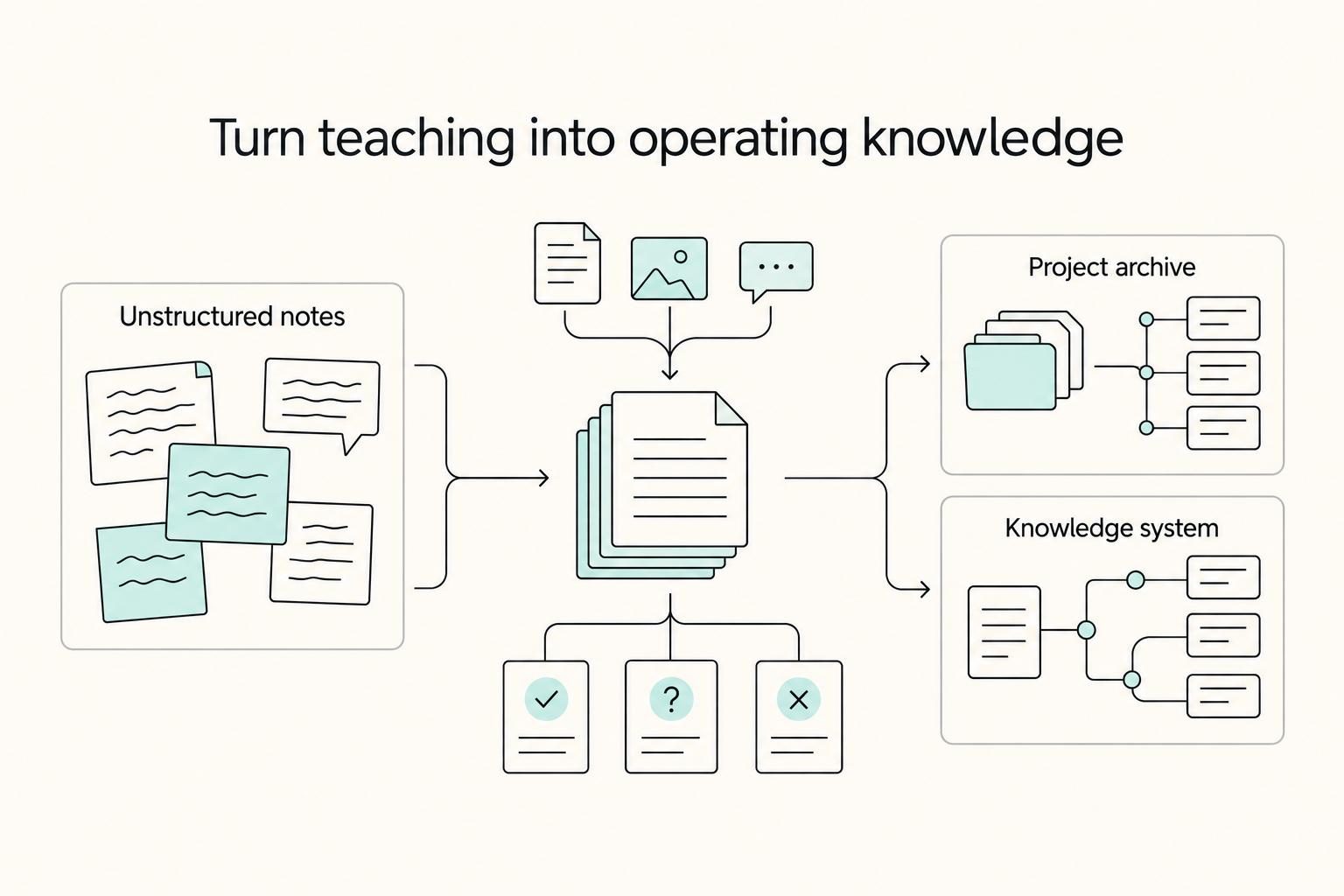
| Unstructured notes | Fragments, links, screenshots, meeting scraps | You remember something useful exists, but cannot find the exact answer quickly |
| Project archive only | Final files and deliverables | You can see what shipped, but not why choices were made |
| Operational knowledge system | Problem, context, decision, reusable asset, outcome | You can reuse logic, templates, examples, and warnings on the next job |
Add a reusable asset whenever one exists: a checklist, email draft, proposal paragraph, intake form, or comparison table. If you handle regulated client data, link the relevant compliance note, such as your GDPR checklist for EU clients. Related: How to Write a Book to Establish Your Freelance Expertise.
Stage 2: Controlled Monetization - Get Paid to Deepen Your Expertise#
Once your internal system is stable, treat this stage as a controlled test: launch one paid teaching offer, validate repeatable outcomes, then expand.
Before you sell, define the offer in six lines so you can inspect it:
| Offer element | What to write |
|---|---|
| Problem | One specific problem the buyer wants solved |
| Audience | Who this is for (and who it is not for) |
| Promise | The practical outcome you will deliver |
| Format | Session, workshop, or product |
| Delivery asset | What the buyer receives (memo, checklist, template, etc.) |
| Feedback loop | How you confirm implementation follow-through |
If any line is vague, do not scale yet.
- Start with one paid session.
Use a fixed-format session around one defined problem: pre-session intake, clear time box, and one stated output, for example, an action memo or prioritized next steps. Keep it distinct from open-ended mentorship.
Use intake to protect boundaries. If a buyer cannot clearly state the problem, current situation, and decision needed, pause instead of turning the call into free diagnosis.
| Criteria | Unpaid mentorship | Paid session |
|---|---|---|
| Client fit | Broad, often curiosity-driven | Narrow, tied to one urgent problem |
| Prep burden | Hidden and inconsistent | Defined by intake and session scope |
| Delivery boundaries | Drifts into ongoing advisory support | Fixed duration, fixed output, explicit exclusions |
| Post-session accountability | Usually optional | Explicitly defined (one follow-up or none) |
- Add a small workshop only after sessions repeat cleanly.
Move to workshops when the same buyer problem, blockers, and teaching steps keep recurring across paid sessions. That is the signal that group delivery may work.
Check four operator signals before you launch: qualified inquiries around the same issue, scope you can teach in one sitting, visible implementation follow-through, and reusable assets such as slides, worksheets, examples, and checklists. If outcomes still depend on high-touch customization, stay 1:1 longer.
- Productize only proven delivery assets.
Package assets that already reduced mistakes or rework in live delivery, such as templates, checklists, and structured information products. Productization should follow proof, not guesswork.
One self-reported freelancer account describes building an information product after 8 years of freelancing, selling to US/UK clients, using software automation, and spending about 15-45 minutes per delivery at $75-$250. Treat that as an example of model shape, not a benchmark. The same account also notes ongoing operational work, including listing and client handling, which reinforces the core point: simple is not easy.
Keep productization controlled: version assets, define support boundaries, and separate what is customized from what ships as-is. Insert current pricing or packaging details only after you verify demand, support load, and update effort. Expand only when outcomes stay consistent without constant manual rescue.
We covered this in detail in The 'Dunning-Kruger Effect' and imposter syndrome for freelancers.
Stage 3: Scaled Authority - Build Your Defensible Moat#
Scale only what Stage 2 already validated in paid delivery. If your offer still relies on fresh improvisation every time, you are not building a moat yet; you are increasing service load.
1. Turn the repeated offer into a signature product#
Build your signature offer from the same buyer problem and teaching path that already worked. Package it as a system with four parts you can maintain:
- Curriculum asset
- Delivery workflow
- Feedback loop
- Update cadence
Use a hard checkpoint before you scale: review recent paid engagements and confirm the same lesson blocks, examples, objections, and worksheets keep repeating. If they do not, keep it in live delivery until the pattern is stable.
| Model | Revenue resilience | Lead quality | Delivery dependence on your time | Pricing power |
|---|---|---|---|---|
| Client work only | Usually tied to booked hours and near-term pipeline | More buyer education often happens during the sales conversation | High, because delivery is mostly your direct time | Easier for buyers to compare with alternatives |
| Scaled authority model | Can be less tied to any single project if the product system is reused consistently | Teaching assets can pre-educate buyers before contact | Lower for standardized parts, with ongoing maintenance still required | Can improve when your method and proof artifacts are clear |
2. Build authority from owned assets and proof artifacts#
Authority here means assets you can show and reuse: controlled distribution, reusable IP, client proof artifacts, and a clear point of view. If those pieces are not visible and organized, the moat is still weak.
Treat proof as an operating file set: sanitized examples, decision notes, workshop FAQs, sample lessons, and permission records for client-derived material. Check reuse rights before publishing anything.
A practical red flag is rights language like "All rights reserved" and restrictions on content being "reproduced, distributed, or transmitted" without prior written permission, aside from brief quotations in critical reviews. If you publish your own long-form IP, clear edition labeling and identifiers can help with management; one published example shows a first printing edition (2022) and an e-book ISBN (979-8-218-00387-6).
3. Add community only if you can operate it#
Community is optional, and it only helps if you run it like a product, not an always-on inbox. If every useful thread requires your direct response, you are creating support debt.
Define these before launch:
- Moderation standards: what gets removed, redirected, or escalated
- Participation rules: who it is for, what belongs, and what is out of scope
- Value design: recurring formats that work without constant founder posting
A smaller, well-scoped member space tied to your signature offer is usually more defensible than a high-volume chat with weak boundaries. This pairs well with The Best Online Courses for Freelancers.
Conclusion: Stop Trading Time for Money, Start Building an Asset#
If your income drops the moment you stop delivering hours, treat that as a fragility signal. The point here is not status. It is to leave you with clearer documents, steadier delivery, and work that someone else could follow, audit, or hand off if needed.
| Stage | Practical proof | Key differentiator |
|---|---|---|
| Stage 1: Documented method | You have a current checklist, template, or decision note that another person could follow without guessing | You are reducing delivery risk before you try to sell teaching |
| Stage 2: Paid validation signal | A paid session, workshop, or module with notes showing where people got stuck | You are testing demand with money and evidence, not compliments |
| Stage 3: Scalable offer format | An offer with defined support rules, update cadence, and a delivery path that stays consistent across buyers | You are building handoff readiness and operational durability, not chasing prestige |
-
Stage 1: Documented method. Turn repeated client explanations into a named asset you can review, update, and reuse. The practical proof is simple: you have a current checklist, template, or decision note that another person could follow without guessing. The key differentiator is that you are reducing delivery risk before you try to sell teaching.
-
Stage 2: Paid validation signal. Run one bounded teaching format around one recurring problem, then check whether buyers understand what is included, what is excluded, and what completion looks like. The practical proof is a paid session, workshop, or module with notes showing where people got stuck. The key differentiator is that you are testing demand with money and evidence, not compliments.
-
Stage 3: Scalable offer format. Package the most stable lesson into a repeatable format that does not require live improvisation every time. The practical proof is an offer with defined support rules, update cadence, and a delivery path that stays consistent across buyers. The key differentiator is that you are building handoff readiness and operational durability, not chasing prestige.
Use the same discipline formal document sets use: identify what is in the asset, then state how it can be modified. FAR Part 52 names those checks directly in 52.103 and 52.104. For freelance work, what matters is the checkpoint logic and clarity, not adopting FAR clauses.
Next steps
- Stage 1: Create one reusable document from a repeated task, then verify it against current work.
- Stage 2: Offer one paid teaching session with scope boundaries and a completion note.
- Stage 3: Convert the most repeated lesson into one offer format with support limits and update rules.
Act like an operator: define the work, verify what repeats, and turn that evidence into a reusable business asset.
For a step-by-step walkthrough, see How to Leverage Guest Posting for Freelance Brand Building.
Frequently Asked Questions
How can you monetize teaching without guessing at the format?
Start with the format your current proof supports, not the one that seems most scalable. Define what is included, what is excluded, and what counts as completion, then begin with one scoped paid session around a recurring problem. Move to a workshop only when the same blockers and teaching steps repeat, and productize only assets that already worked in live delivery.
How do you find people to teach without getting trapped in unpaid mentorship?
Use channels where demand already exists, such as past clients, warm leads, partner platforms, or application-based offers from your own content. Pre-screen for a current problem, live constraint, and clear decision, and pause if someone cannot explain them. That keeps the work focused on implementation instead of drifting into free diagnosis.
Can the protégé effect for freelancers help with imposter syndrome?
Maybe, but the article does not claim a measurable effect. Judge progress by observable signals: whether people can apply your guidance, whether your explanation stays consistent, and whether your teaching assets reduce repeat confusion. If results stay unclear, tighten the method or scope instead of turning it into a self-worth issue.
What is the rubber duck method in business terms?
Use it before proposals, pricing changes, scope decisions, or new offer launches. Explain the decision out loud and check for undefined terms, hidden assumptions, and missing evidence. If you cannot state what is included, what is excluded, and what would change your mind, it is not ready.
How much time should you allocate to teaching activities?
Match the cadence to your stage and review it against your goals. In Stage 1, focus on documenting and reusing explanations inside client work; in Stage 2, test one paid offer tied to a recurring problem; in Stage 3, protect time for updates, proof artifacts, and support rules. Increase time when assets get reused and reduce it when nothing repeats or the offer still needs constant manual rescue.
Try a related tool
Researched and edited by the Gruv editorial team. Gruv builds cross-border billing, payouts, and finance-operations software for global businesses.
Sources
- acquisition.gov/far/part-52trusted
- acquisition.gov/sites/default/files/archives/far/pdf/2021-07...trusted
- chicago.gov/content/dam/city/depts/dps/Outreach/City%20o...trusted
- commons.erau.edu/cgi/viewcontent.cgitrusted
- digitalcommons.odu.edu/cgi/viewcontent.cgitrusted
- documents.coastline.edu/Distance%20Learning/Open-Edu-Resources/MCOM%...trusted
- mn.gov/admin/assets/MN_MetCouncil_FinalReport_07212...trusted
- ninercommons.charlotte.edu/record/1218/files/McCrowre_uncc_0694D_12801.pdftrusted
Educational content only. Not legal, tax, or financial advice.
Related Posts

GDPR Compliance Checklist for Freelancers Working With EU Clients
Start by separating the decisions you are actually making. For a workable **GDPR setup**, run three distinct tracks and record each one in writing before the first invoice goes out: VAT treatment, GDPR scope and role, and daily privacy operations.

Digital Nomad Health Insurance Comparison for Long-Stay Moves
Use focused time now to avoid expensive mistakes later. Start with a practical `digital nomad health insurance comparison`, then map your route in [Gruv's visa planner](/tools/visa-for-digital-nomads) so we anchor policy checks to your real plan before pricing pages pull you off course.

How to Write a Book as a Freelancer Without Scope Drift
The book needs a defined job and a defined boundary before you draft. In this cycle, give it one job: either support your client book services, or strengthen your own authority book so your niche, offer, and sales conversations become clearer.