
Quick Answer
A strong digital product launch checklist starts with validating demand and building a simple go or no-go business case. Before promotion, confirm pricing logic, document scope, tax and checkout structure, payment-to-delivery handoffs, support ownership, and launch messaging by audience intent. Then test the full purchase, access, onboarding, refund, and support flow before opening the cart.
Treat the Launch as a Risk-Aware Business Rollout#
Most digital product launch checklists focus on visible tasks like launch emails, a sales page, and launch-day posting. What they can leave out is the business layer underneath: proof of demand, financial logic, compliance checks, and clear ownership when something breaks. That gap can cost you in rework, avoidable risk, and last-minute stress.
A stronger approach is to treat launch as a risk-aware business rollout, not just a marketing push. That does not guarantee results, but it does give you a cleaner order of operations before your offer goes live across channels, geographies, and partner ecosystems. Use this article in three layers:
| Criterion | Basic launch checklist | Business-operator checklist |
|---|---|---|
| Finance readiness | Price and promo dates | Validation, revenue assumptions, break-even logic |
| Legal and compliance readiness | Generic terms page | Open compliance checks tracked by market/program |
| Operations readiness | Tool setup | Integrated delivery, support, and approval owners |
| Post-launch control | Launch day tasks | Monitoring, issue handling, and iteration plan |
- Strategic Foundation: confirm the offer is worth launching by validating demand early and pressure-testing the business case before full buildout.
- Operational Engine: connect payments, delivery, support, and internal approvals so execution does not depend on your inbox or memory.
- Go-to-Market Playbook: promote only after the first two layers are stable enough to handle volume, refunds, questions, and updates.
Two practical rules will keep the rest of the checklist honest. First, if you have not validated demand with a landing page, mockup, or pre-sales interviews, do that before you keep building. Second, keep one launch brief that records the offer, channels, owners, and any unresolved compliance checks awaiting source verification. If that brief is incomplete, the gaps will show up everywhere else.
Start with the foundation, then build the operating pieces. Only then turn up promotion. You might also find this useful: Pre-Departure Checklist: 25 Essential Legal and Financial Tasks Before Leaving the US to Become a Digital Nomad.
The Strategic Foundation: Four Decisions Before You Launch Marketing#
Before you touch launch marketing, make four decisions: whether the offer is financially viable, whether your price logic is defensible, whether your core documents are launch-ready, and whether your tax and checkout path is clear. If you skip these, you are not moving faster; you are delaying risk.
Treat this as a simple first 90-day plan. Use your first 30 days as the foundation phase: review financial health, review current systems and processes, identify gaps, and set priorities. That keeps decisions moving and helps you avoid analysis paralysis from too many open choices.
Build the launch case before you build the campaign#
Build a mini P&L first. It does not need accounting polish; it needs to support clear go/no-go decisions.
- Separate fixed and variable costs. Fixed costs stay even at low sales volume; variable costs increase with each sale. Include unresolved line items in plain language, such as current fee structure pending provider/source verification.
- Model three scenarios. Run conservative, expected, and optimistic cases. For each, map revenue, variable costs, total costs, and remaining contribution.
- Pressure-test operations once. Verify checkout, delivery, refund flow, and support ownership. If handoffs still rely on manual work, your model is cleaner than your real execution.
If other people touch delivery, finance, legal, or operations, bring them in early. Early review catches assumption gaps before customers do.
Price for value, then set re-check triggers#
Start with buyer value, not creation time. Use this decision lens:
| Pricing factor | What to assess |
|---|---|
| Outcome value | What meaningful result the buyer gets |
| Implementation effort saved | What work, time, or complexity you remove |
| Risk/cost of inaction | What it costs the buyer to do nothing |
Then define your re-check triggers before launch:
- refund or objection patterns suggest unclear value
- you add meaningful implementation assets or support
- your buyer profile shifts
- conversion changes after stronger positioning or proof
Pricing is not a one-time pick; it is a decision with pre-defined review triggers.
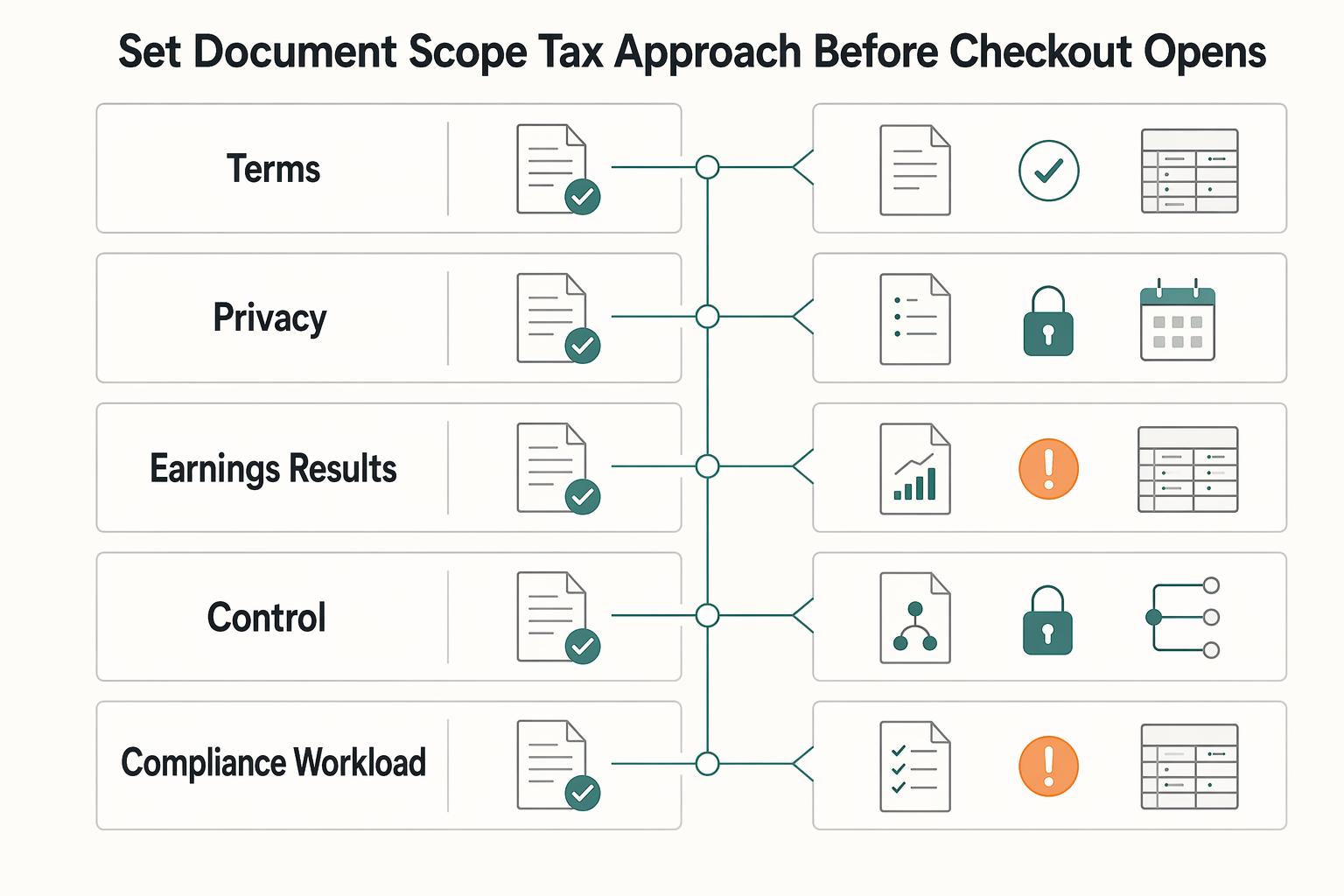
Set document scope and tax approach before checkout opens#
Start with scope: your documents should align with how the transaction actually works. They reduce misunderstandings and set expectations, but they do not replace product quality, support, or professional legal/tax advice for your situation.
| Document | What to cover |
|---|---|
| Terms | Offer scope, usage/license boundaries, refund terms, contact route, and limits on promises |
| Privacy | What data you collect, where it comes from, how you use it, and contact method for privacy requests |
| Earnings/results language | Remove guarantees, separate examples from promises, and check for implied outcomes in sales copy |
For tax and checkout structure, compare options by what you still need to verify:
| Decision criterion | If you sell under direct registration | If you use a Merchant-of-Record |
|---|---|---|
| Control | Verify contract ownership, checkout control, and policy presentation | Verify retained control over branding, pricing, and customer communication |
| Compliance workload | Verify which registrations, calculations, filings, and records remain with you by location | Verify which compliance tasks are handled by provider contract and which remain with you |
| Payout flow | Verify payout timing, fee structure, reporting detail, and reconciliation steps | Verify payout timing, fee structure, reporting detail, and reconciliation steps |
| Support burden | Verify ownership for payment failures, refunds, chargebacks, and tax-related questions | Verify ownership for payment failures, refunds, chargebacks, and tax-related questions |
Do not assume either path removes all responsibility. Mark unresolved items clearly and verify them before launch.
Once your financial model, pricing logic, document scope, and tax approach are set, you can build the operational engine with fewer downstream surprises.
For a step-by-step walkthrough, see Digital Nomad Pre-Travel Checklist for Long-Stay Moves.
The Operational Engine: How to Build Your Automated Launch System Like a COO#
Your launch is not operationally ready until payment consistently turns into delivery, onboarding, and support without manual cleanup. If any core handoff still depends on copying data between tools, treat that as a launch blocker.
Choose your stack by role, not by brand#
Define the roles first, then map tools to those roles: site and checkout, payments, email CRM, delivery, and support. Keep the setup simple enough to explain on one page, test end to end, and maintain when something fails.
Before you add custom pages, automations, or code, run a basic gate: confirm role owner, handoff path, and fallback process. Teams often build before they are ready.
| Decision point | All-in-one | Best-of-breed |
|---|---|---|
| Speed to launch | Faster when needs are standard | Slower because more parts must be connected |
| Flexibility | Lower, but simpler to run | Higher, but easier to overbuild |
| Failure surface | Fewer moving pieces | More handoff risk between tools |
| Best fit | First launch, small catalog, low admin tolerance | Specific delivery needs, deeper CRM logic, or custom support flows |
If this is your first launch, use the fewest moving pieces you can operate confidently. Choose best-of-breed only when the gain is clear enough to justify extra handoffs.
Map the required handoffs before launch#
Document the handoffs before launch. A short SOP plus a QA checklist is enough, as long as it defines the expected path and how you verify it.
| Handoff | What must happen | Requirement note |
|---|---|---|
| Purchase event | Payment activity is captured and passed to the right records | Integration requirement pending payment and records-system verification. |
| Access provisioning | Paid customer gets the correct product or member access | Provisioning requirement pending product and access-system verification. |
| Onboarding trigger | Welcome/onboarding sequence starts after purchase | Trigger requirement pending email/CRM and checkout verification. |
| Tagging and segmentation | Buyers, waitlist contacts, and non-buyers are separated correctly | Segmentation requirement pending CRM and checkout-source verification. |
| Refund/cancellation sync | Access, email status, and support records stay aligned | Sync requirement pending payment, access, and support-system verification. |
The biggest risk is usually ownership, not automation depth. If you cannot name who handles failed orders, missing welcome emails, or refund-related access issues, launch-week problems are unmanaged by default.
Build the three flows and the support SOP#
Before launch, set up three flows, each with entry conditions, trigger logic, and failure checks.
| Flow | Entry condition | Trigger logic | Failure state |
|---|---|---|---|
| Waitlist flow | A pre-launch sign-up | Moves the contact into launch messaging and keeps them out of generic newsletter sends | Launch tag or segmentation does not apply, so intent gets lost |
| Checkout drop-off flow | Checkout started without completed purchase | Sends recovery only until a completed order is recorded | Recovery continues after payment and reaches buyers |
| New-customer onboarding flow | A successful paid order | Sends purchase confirmation, access instructions, and the first action step | Payment succeeds without access, or access is granted without the onboarding email |
Keep support lightweight but explicit: one intake channel, one response owner, and one escalation path for payment, access, and refund exceptions. Before launch, run a full test pass with a test or real transaction: click every delivery link, confirm access, verify tags, and check that refund/cancellation actions do not leave broken access or messaging gaps.
When this system passes QA, your marketing runs on a stable base instead of a fragile one. Related: How to Create Your Own Online Course.
Go-to-Market: Message Order, Channel Roles, and Your Scorecard#
Once your operational handoffs work, your go-to-market job is clear: move the right people through the right message in the right order. If the product or buyer experience is not ready, pause the launch, because promotion cannot fix a weak offer.
Build intent before you open the cart#
Before you sell, make your messaging sequence explicit: problem, outcome, then offer.
- Problem framing
Name the specific problem in the language your Ideal Customer Profile already uses so you attract buying intent, not vague curiosity.
- Outcome framing
Show the before/after clearly so the reader can picture what changes in their work, week, or results.
- Offer framing
Position the product as the path from that problem to that outcome, including who it is for and what it does not do.
Then split your path by intent. For warm leads, move faster into offer details, objections, and decision support. For newer leads, spend more time on problem and outcome context before pushing the ask. Use one narrative across email, social, and the sales page so buyers get a consistent story across touchpoints.
Run launch week by channel role, not by habit#
During launch, each channel needs a defined job. Use one funnel, one scorecard, and one operating cadence so execution stays aligned.
| Channel role | Objective | Primary message | Fallback action if engagement is weak | Timing note |
|---|---|---|---|---|
| Email to warm segment | Convert existing intent | Offer framing, clear CTA, top objections, proof | If clicks are healthy but purchases lag, tighten objections and checkout flow before sending more reminders | Sequence timing pending audience and launch-calendar verification |
| Email to newer leads | Move from awareness to intent | Problem framing, then outcome, then offer | If opens or clicks stay soft, reduce ask complexity and send one clearer problem-led message | Sequence timing pending lead-source and launch-calendar verification |
| Sales page | Turn intent into purchase | Consistent promise, scope, proof, FAQs, checkout path | If traffic is steady but orders are weak, revise headline clarity, scope language, and objection handling before adding traffic | Live throughout launch |
| Social/community posts | Reinforce narrative and answer objections in public | One message focus at a time: problem, outcome, proof, or objection | If response stays shallow, use real audience questions to reshape posts instead of increasing volume | Posting timing pending channel and launch-calendar verification |
| Live Q&A / webinar / office hours | Reduce friction in real time | Fit clarification and objection handling | If attendance is weak, repurpose top questions into email and sales page updates | Session timing pending audience availability and launch-calendar verification |
Use simple execution triggers to protect momentum:
- Escalate reminders when operations are stable and warm-lead engagement is strong, but decisions are stalling.
- Pause pushes when support shows payment, access, or pricing confusion.
- Address objections directly when the same concern repeats across replies, comments, and support tickets.
Read the numbers as decisions, not as a report#
After launch, keep one scorecard and use each metric to pick your next test.
| Metric | What it tells you | What issue it can reveal | What to test next |
|---|---|---|---|
| Traffic by source | Which channels generate intent, not just visits | Channel mix may be driving low-intent traffic | Re-sequence channels by intent so higher-intent channels carry more conversion work |
| Sales-page conversion | How well offer framing matches visitor expectations | Message mismatch between pre-launch promise and page content | Test headline clarity, scope language, proof placement, and FAQ order |
| Checkout completion | Whether demand survives the payment step | Checkout friction or payment-path issues | Re-test checkout on desktop/mobile, confirm payment alerts, review failed-order logs |
| Support themes and refunds | Whether delivery matched launch promise | Objection handling gaps or overpromising in messaging | Without a verified benchmark, treat a visible rise in objections or refunds as a prompt to adjust promise clarity and objection handling first |
Run this as a cycle: message, launch, feedback, adjustment. That cycle sets up a stronger FAQ, a cleaner close, and a better next launch.
If you want a deeper dive, read How to Create a Productized Service for Your Freelance Business.
Conclusion: Make a Clear Go or No-Go Decision#
If any answer in the FAQ still feels fuzzy, do not cover that uncertainty with more promotion. Your next job is not just to finish the product. It is to make a clear go or no-go decision with your eyes open.
A solid checklist reduces omission risk, but only if you use it as a decision tool instead of a pile of tasks. Readiness means defining your limits, your go/no-go triggers, and the point where you pause promotion if support load or early signals look wrong. If your policy, checkout, and delivery steps conflict, fix that first.
Operational readiness is where many solo launches wobble. For digital products, test every feature and confirm the handoffs actually happen: payment, receipt, access, tagging, and support routing. Launch execution readiness is simpler, but just as important: clear timelines, clear expectations, and named owners if anyone besides you is involved. Even a small kickoff to assign roles can prevent the usual launch-day confusion.
Use this next-step check before you open the cart:
- Confirm the gaps under four headings: financial, policy/legal (where relevant), operational, and launch execution.
- Assign an owner to each open item, even if the owner is you.
- Set one launch-readiness review on the calendar before you take payment.
- Schedule your first post-launch review now so you can analyze performance and identify what failed first.
One more caution: pre-launch research goes stale. If buyer feedback, conversion signals, or support questions contradict your assumptions, update both the checklist and the offer. Treat this checklist as a repeatable operating tool for future launches, not a one-time exercise.
We covered this in detail in How to Build a Waitlist for Your SaaS Product Launch.
Frequently Asked Questions
What legal documents do you need before launch?
Treat legal documents as a verification task, not a template you copy blindly. The exact documents and wording depend on your jurisdiction, your offer, and the data you collect. Review your checkout, email opt-in, and delivery flow end to end so your disclosures match what actually happens.
How should you handle VAT or similar digital sales taxes?
Keep this as a checklist of unresolved jurisdiction checks until you confirm the rules that apply to your setup. Verify registration and filing triggers, customer-location evidence, and the responsibility split in your setup. Do not assume any provider model removes all compliance responsibility.
What is the practical way to accept international payments?
Focus on end-to-end reliability before scale. Choose a payment setup you can operate consistently, then run a live test purchase and confirm currencies, payout timing, refund handling, customer-support routing, and recordkeeping work as expected. If responsibilities are shared with a provider, verify the exact split in writing.
How should you forecast a launch?
Build forecasts from inputs you can inspect, such as user interviews, survey feedback, and behavior from your current audience journey. Add pre-launch checkpoints like landing-page sign-ups or expressions of interest, then release a small MVP to gather feedback before full launch. After launch, review which assumption failed first and adjust quickly.
How should you price a digital product?
Set an initial price as a testable hypothesis, then validate it with real behavior. Watch for signals like sign-ups without purchases, objections in replies, and refunds after delivery. Adjust based on what you learn.
What tech stack should you use?
Choose tools by role and tradeoff, not by brand list. Keep the setup as simple as possible because tool choices can directly affect customer outcomes. Run a live test purchase to verify every handoff before you add traffic.
Try a related tool
Researched and edited by the Gruv editorial team. Gruv builds cross-border billing, payouts, and finance-operations software for global businesses.
Sources
Includes 2 external sources outside the trusted-domain allowlist.
- azre.gov/sites/default/files/2025-11/Oct%202025%20ADR...trusted
- commerce.mt.gov/_shared/business/SBDC/docs/StartUpGuides/Tri...trusted
- mn.gov/deedtrusted
- nepis.epa.gov/Exe/ZyPURL.cgitrusted
- pmc.ncbi.nlm.nih.gov/articles/PMC6473731trusted
- pmc.ncbi.nlm.nih.gov/articles/PMC8215946trusted
- arielsoftwares.com/build-ai-saas-product-checklistexternal
- aventigroup.com/blog/product-launch-checklistexternal
Educational content only. Not legal, tax, or financial advice.
Related Posts

How to Create a Productized Service for Your Freelance Business
If your recent client work produces similar results from similar inputs, you may be ready to turn it into a defined offer. The shift is operational, not cosmetic. You are deciding what you sell, what the client gets, what it costs, and how delivery happens, instead of rebuilding every job from scratch.

How to Create Your Own Online Course
If you want this to become a real revenue line, treat it like a product decision, not a content project. This guide helps you make the important calls in the right order: define the offer, choose the platform that fits it, and move from outline to published course without avoidable rework.

The Freelance Payment Penalty: A Modeled Audit of Platform Fees, FX Spreads, and Payout Delays
The money rarely disappears through a single, easy-to-spot fee. The real loss is stacked. A marketplace takes its commission, a processor adds a charge for international cards, a bank or payment company converts the currency at a spread, a platform holds the funds before release, and a wire sheds a little to intermediaries on the way in. Each layer looks defensible on its own, but the worker feels the combined result as a smaller deposit and a later payday.