
Quick Answer
If your client contact seems overpromoted, treat it as a delivery-risk pattern first, not a character judgment. Look for repeated process fixation, routine decisions that keep moving upward, lost context between teams, and retreat into old specialist work. Then protect delivery with one shared decision log, one named approver per item, confirmation notes, and clear change classification before work starts.
Is Your Client a Victim of the Peter Principle? A Field Guide for Consultants#
Treat this as a delivery-risk diagnosis, not a character verdict. When your main client contact creates delay, rework, or approval churn, first work out what you're actually seeing.
It may be normal client-side friction, temporary overload, unclear decision rights, or a real role-fit problem. The fix depends on that distinction.
The practical idea behind the Peter Principle in agency growth is simple. Someone can be strong in one role and still struggle in the next because the job changed. Research on promotion patterns across 131 firms supports that basic risk, and the cost can show up in operations. For you, it shows up as missed decisions, dropped context, and unstable execution, not as a moral judgment about the person.
Normal friction or role-fit mismatch#
Start with observable behavior, because vibe is a bad diagnostic tool.
| Normal leadership friction | Possible role-fit mismatch pattern | What to log |
|---|---|---|
| Pressure spikes around launches, budget reviews, or reorgs, then eases | The same issues repeat across calmer periods and ordinary milestones | Date, project stage, what triggered the delay, whether the pattern eased after pressure dropped |
| Questions stay tied to outcomes, tradeoffs, priorities, and business impact | Attention keeps returning to templates, status rituals, meeting cadence, and who must be copied | Exact question asked, exact answer given, whether success criteria were defined or avoided |
| High-stakes calls take time, but routine decisions still move | Even low-risk decisions stall, get reopened, or bounce upward without a clear owner | Decision requested, risk level, named approver, turnaround time, reopen count |
| Communication gets messy in busy weeks, but key context eventually lands | Important context regularly disappears between teams or levels | What was sent, to whom, when, what was missing later, where the context broke |
Signal 1: process fixation over outcomes. If you ask for a decision or success metric and get back a template request, meeting format, or reporting ritual, pay attention. This is how projects drift from producing results to producing signs of order. It is also where scope creep can start hiding in plain sight. Next, ask one written outcome question that process alone cannot answer: what decision is needed, what result defines success, and who signs off.
Signal 2: routine decisions keep moving upward. A budget exception may need executive review. A copy tweak or low-risk sequencing call usually should not. If small calls keep escalating or coming back as "not aligned yet," your project now depends on a bottleneck. That bottleneck may be role strain or unclear authority. Start a decision log with request date, requested owner, actual approver, and turnaround time. If no one can state who decides what, governance is your first suspect.
Signal 3: context goes in, but does not travel. You send updates, risks, and dependencies, yet other stakeholders still act surprised later. That creates rework, conflicting instructions, and timeline slips that better production alone will not fix. Send short written recaps after material calls and note where the context fails: upward to leadership, downward to implementers, or sideways across teams.
Signal 4: your contact retreats into old specialty work. Instead of making directional calls, they start rewriting copy, reviewing line items, or correcting task detail. Sometimes that is useful expert input. Repeatedly, it can mean they are more comfortable in their prior specialist mode than in a role that now requires prioritization, delegation, and decision ownership. Separate review input from approval authority in writing and record which leadership decisions still have no owner.
A quick triage before you label it#
Do not rush to the Peter Principle label. Temporary overload can look the same. The CDC's framing on job stress is useful here. When job demands do not match capability or available resources, even capable people can struggle for a period. Burn-out can also coincide with similar slowdown patterns. WHO classifies burn-out in ICD-11, in effect from 1 January 2022, as an occupational syndrome tied to chronic unmanaged workplace stress.
| Evidence item | What to capture |
|---|---|
| Decision delays | Date, requested owner, turnaround time |
| Reopened calls | Calls previously treated as closed |
| Dropped context | Between meetings, teams, or leadership layers |
| Ownership gaps | No named approver for a material choice |
Another false positive is role ambiguity. If nobody can clearly name who approves scope, budget, priorities, or acceptance, your problem may be governance, not promotion failure. Decision bottlenecks can come from confusion about who gets to decide what, so test decision rights before you blame role fit. Use a simple working rule here. If the pattern clears up once ownership is named, governance was likely the main issue. If it persists after ownership is named and pressure drops, role mismatch becomes more plausible. Keep an evidence pack, not a story:
- decision delays with date, requested owner, and turnaround time
- reopened calls that were previously treated as closed
- dropped context between meetings, teams, or leadership layers
- ownership gaps where no named approver exists for a material choice
Once you can show the pattern cleanly, move from diagnosis to protection. The next step is keeping delivery moving without making the client's internal problem your liability.
If you want a deeper dive, read GDPR for Freelancers: A Step-by-Step Compliance Checklist for EU Clients.
Protect Delivery With Process: Ownership, Decisions, and Scope Controls#
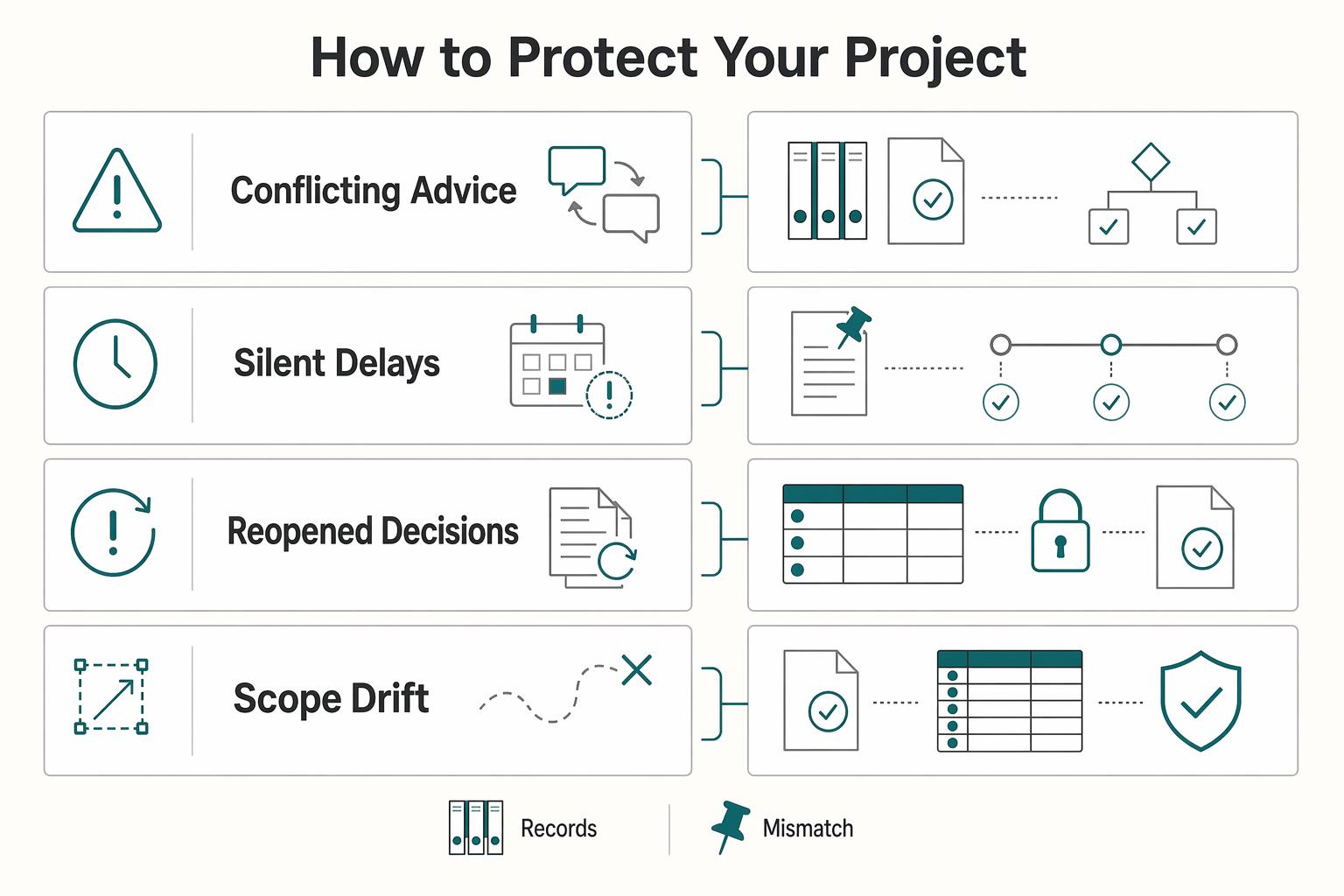
When this pattern is real, protect delivery with process, not confrontation. Put one system in place that makes ownership clear, decisions searchable, and scope explicit so work can keep moving without undermining your day-to-day contact.
| Symptom you see | Control you implement | Artifact that proves it |
|---|---|---|
| Conflicting approvals | Keep one decision log entry per material decision, with one named approver | Decision log row with decision ID, approver, status, due date, impact, outcome |
| Silent delays | Assign one responsible owner and one accountable approver per item | RACI row plus task record with owner, approver, due date, status |
| Reopened decisions | Record what changed before execution changes | Decision-log update or confirmation note showing change, owner, timeline effect |
| Scope drift from "small asks" | Classify every request before work starts | Change log entry with classification and status (pending, approved, rejected, deferred) |
Build one source of truth#
Run the project from one shared record (doc, sheet, or project tool) and update it on a fixed cadence. Use it as the current reference for decisions, dependencies, and approvals.
Minimum fields: decision ID, topic, date raised, requester, responsible owner, accountable approver, consulted, informed, due date, dependency, status, impact, outcome, latest note. Pair this with a lightweight governance rule: use RACI for execution roles and keep decision rights explicit (for example, who drives versus who approves). The key control is simple: one accountable approver per item.
If a material item has no named approver, no due date, or no status, treat it as unresolved. Do not execute on assumed approval.
Confirm decisions and widen visibility without undermining your contact#
After each material call, send a short confirmation note while corrections are still easy. Include: decision or action, owner, due date, dependency, and what happens next if no correction is raised.
| Step | Action | When to use |
|---|---|---|
| 1 | Tell your day-to-day contact you want to unblock the project, not bypass them | When you need to widen visibility |
| 2 | Escalate the issue, not the person | When there is a decision at risk, date impact, or blocked dependency |
| 3 | Involve sponsor/adjacent owner | When the decision is outside agreed authority or tolerances |
Use neutral language. Example: "To keep timeline risk visible, I'm confirming the open decision on X, the blocked dependency Y, and the approval needed from Z." That keeps escalation factual and focused on delivery.
Escalate in sequence:
- Tell your day-to-day contact you want to unblock the project, not bypass them.
- Escalate the issue (decision at risk, date impact, blocked dependency), not the person.
- Involve sponsor/adjacent owner when the decision is outside agreed authority or tolerances.
Control scope before work moves#
Classify each request before execution. This is the control that separates managed scope change from scope creep.
| Classification | Use it when | What you do next |
|---|---|---|
| Included now | Fits current deliverables/assumptions and does not materially change schedule/resources/approvals | Log it as included and execute |
| Deferred | Useful, but not required for current milestone or acceptance | Log it as deferred with a review point |
| Paid change | Alters scope, timeline, resources, review load, stakeholder count, or dependencies | Document impact, then request approval before work starts |
Keep a change log with request date, requester, classification, impact, status, and decision date. If work starts before classification, you are absorbing risk without agreement.
Put this protocol in place and you get two outcomes: steadier execution now, and a clean record you can use in the next section.
Related: Digital Nomad Health Insurance: A Comparison of Top Providers.
From Liability to Leverage: Turning a Power Vacuum into Your Strategic Advantage#
Use your process to improve decision quality without taking decision authority. Your role is to make approvals easier for the right person, not to become the decision-maker. When execution stalls, the issue is usually unclear accountability, so your influence comes from clearer decision roles and cleaner decision inputs.
A status update informs. A decision-ready update enables a decision.
| Weak update pattern | Better rewrite | Immediate decision impact for the client team |
|---|---|---|
| "Design is 80% done. Waiting on feedback." | "Homepage revision B is ready. Risk: launch date slips if approval is not given by 15 April. Recommendation: approve revision B or name changes today. Approver: Sam. Dependency: final product pricing." | The team sees the exact decision, decision owner, and timing. |
| "We had a few blockers this week." | "Two blockers remain: product pricing and legal copy. Risk: development cannot start on schedule. Recommendation: confirm pricing owner and route legal review today." | Blockers convert into named decisions and next actions. |
| "Client asked for a few extra changes." | "Three new requests were raised. One fits current scope, one should be deferred, one changes review rounds and needs formal approval before work starts." | Scope-impacting changes reach the decision-right holder before work shifts. |
Turn the log into a decision artifact#
Treat the decision log from the prior section as your system, and each update as the stakeholder-facing output. If your note does not include the decision needed, risk, recommendation, owner, dependencies, and approval ask, it is still just status.
Reusable decision update template:
- Issue
- Business risk
- Recommendation
- Owner
- Dependencies
- Approval ask by date
If any field is unverified, label it as unconfirmed instead of guessing. If no approver is named in the log, treat the note as informational only. In DACI terms, one person is the Approver; if that role is unclear, authority is unclear.
Know what you can own and what must be signed off#
Use a decision-rights lens so support does not become unauthorized control.
| Decision area | You can own now | Requires formal sign-off | Must stay with client leadership |
|---|---|---|---|
| Decision hygiene | Maintain decision log, prep agendas, track dependencies, draft decision-ready updates | Confirm role assignments for cross-team decisions | Final authority structure |
| Delivery coordination | Summarize options, chase factual clarifications | Resequence delivery across teams, run cross-functional forums | Priority tradeoffs across business units |
| Scope and commitment | Flag scope impact and classify requests | Approve changes affecting review cycles or delivery plan | Scope authorization, budget changes, legal acceptance, go/no-go calls |
If a decision is outside your control or agreed boundaries, escalate the decision, not the person.
Bring a proof pack, not adjectives#
In renewals or scope conversations, show evidence of control and clarity:
| Proof item | What it shows |
|---|---|
| Decision-log entries | What was decided, by whom, and when |
| Before/after examples | Scattered approvals vs one current record |
| Confirmation notes | Owner, due date, dependency, and outcome |
| Change-log entries | Included, deferred, approved, or rejected |
| Short stakeholder comments | Tied to a specific handoff or decision |
That is the ethical way to grow an agency: you strengthen governance quality with timely, relevant, reliable inputs while keeping authority with the client.
You might also find this useful: Agency Career Pathing With Clear Promotion and Lateral Move Rules.
Conclusion: You Aren't Just a Vendor; You're the Solution#
Your job is not to diagnose a person. It is to make decisions traceable, approvals visible, and authority explicit so delivery keeps moving even when a client contact is stretched.
If you suspect the Peter Principle in agency growth is showing up on an account, start by confirming signals, not motives. Look for repeated approval drift, ownership that changes midstream, dropped context between meetings, or requests that reopen settled priorities. A practical checkpoint is simple: if a live item has no named approver, no current status, or no correction note after a meeting, treat it as potentially unresolved until clarified.
Then keep the controls running across the whole engagement, not just during a flare-up. Change control only works if you keep reviewing requests as they arise, because uncoordinated changes create risk against the wider plan. In practice, that means one current decision log, visible approval status, disciplined version control on key documents, and a clear escalation path set early enough that you are not inventing it during a miss. If the latest brief, estimate, or acceptance draft does not show which version is current, expect a higher risk of rework and blame loops.
This becomes most valuable when your role expands. Step up by drafting decision-ready options, surfacing tradeoffs, and making approvals easy to give. Do not cross the red line: budget, scope, and cross-team priority calls should stay with named client approvers. If you start making those calls informally, you may gain speed for a week and inherit accountability for months. Use this at kickoff and again at renewal review:
- confirm named approvers, escalation route, and who can decide what
- maintain one shared record for decisions, changes, owners, and status
- number versions on proposals, briefs, and approval artifacts
- classify new asks as included now, deferred, or change request
- escalate decision risk early, with dated examples and timeline impact
If you want a related operating pattern for role clarity across distributed delivery, see How to Manage a Global Team of Freelancers. For a step-by-step walkthrough, see Build a Product-Led Growth System for Your SaaS Startup.
Frequently Asked Questions
What are the main risks if your client contact looks overpromoted?
Treat it as a delivery-risk pattern first, not a diagnosis. The main risks are slower decisions, communication gaps, and scope confusion. Over a longer account cycle, the pattern can erode confidence and create account friction. Log dated, observable examples and send a decision-ready update with the issue, risk, recommendation, owner, dependency, and approval ask.
How do you give feedback without triggering defensiveness?
Use observable delivery facts and support asks, not labels about competence. Frame the conversation around role demands, support, training, and next steps. If your note does not invite input, address likely questions, and leave room for dissent, it will sound like blame instead of problem-solving.
When should you escalate, and how do you do it without undermining your client?
Escalate when the same decision gap keeps hurting delivery after you have already clarified asks directly. Bring dated examples, concrete delivery impact, and notes showing what remains unresolved. Describe the project risk and support needed, escalate the decision problem instead of the person, and keep your day-to-day contact informed.
How do you stay helpful without quietly taking over?
Support decision quality, but do not take authority you were not given. Keep updates decision-ready, document unresolved decisions, and ask for explicit approval when scope or priorities change.
Try a related tool
Researched and edited by the Gruv editorial team. Gruv builds cross-border billing, payouts, and finance-operations software for global businesses.
Sources
- cdc.gov/niosh/stress/about/index.htmltrusted
- cdc.gov/children-and-school-preparedness/infection-p...trusted
- csuci.edu/oe/documents/self-serve-raci.pdftrusted
- dhs.gov/sites/default/files/2022-03/Action%20Memo%20...trusted
- ecfr.gov/current/title-2/subtitle-A/chapter-II/part-2...trusted
- en.wikipedia.org/wiki/Peter_principletrusted
- federalregister.gov/documents/2024/04/03/2024-06551/short-term-l...trusted
- hbsp.harvard.edu/product/R0601D-PDF-ENGtrusted
Educational content only. Not legal, tax, or financial advice.
Related Posts

GDPR Compliance Checklist for Freelancers Working With EU Clients
Start by separating the decisions you are actually making. For a workable **GDPR setup**, run three distinct tracks and record each one in writing before the first invoice goes out: VAT treatment, GDPR scope and role, and daily privacy operations.

Digital Nomad Health Insurance Comparison for Long-Stay Moves
Use focused time now to avoid expensive mistakes later. Start with a practical `digital nomad health insurance comparison`, then map your route in [Gruv's visa planner](/tools/visa-for-digital-nomads) so we anchor policy checks to your real plan before pricing pages pull you off course.
How to Manage a Global Freelance Team Without Compliance Gaps
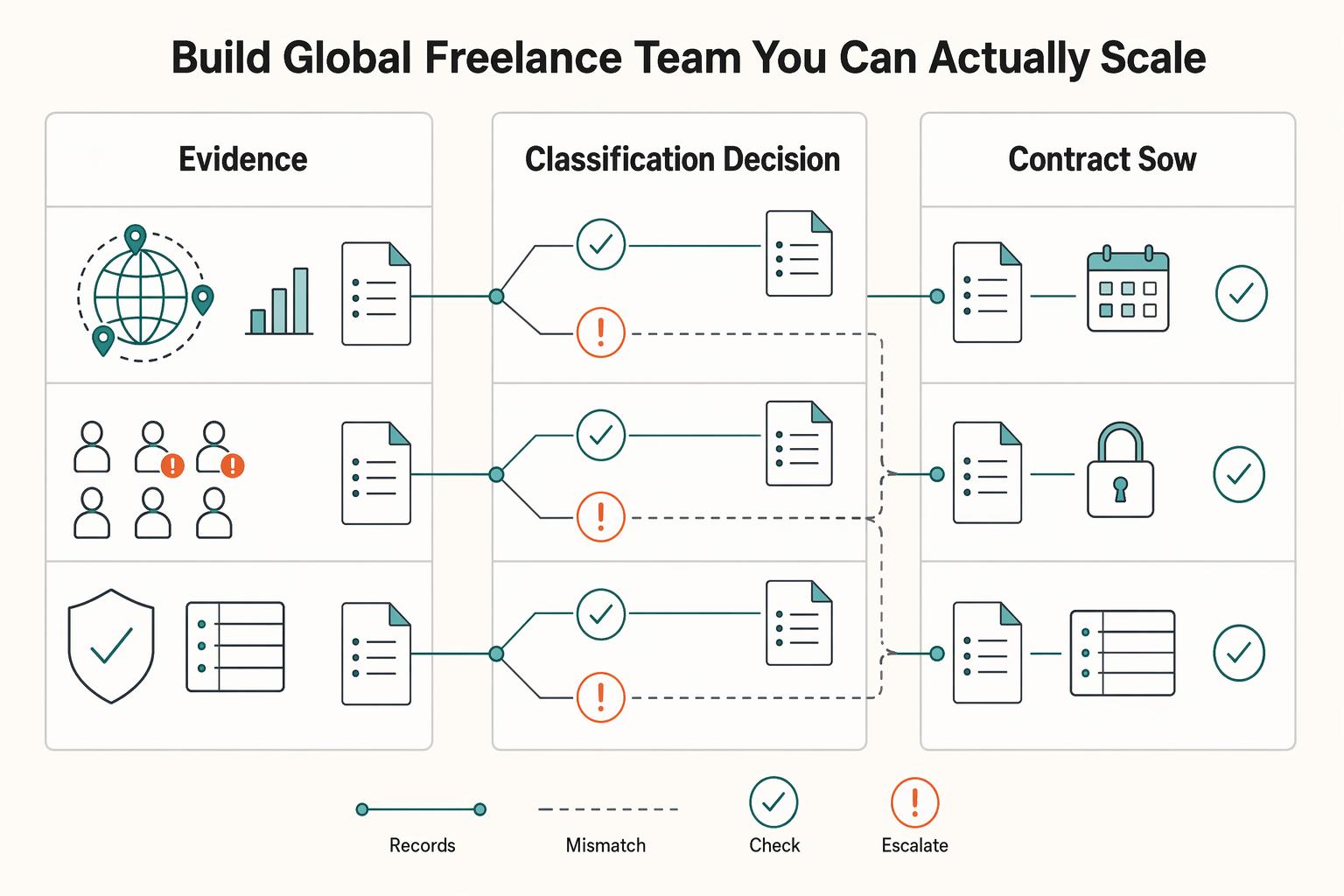
If you want to manage a global freelance team without constant cleanup, use the same intake-to-payout process for every engagement and save an artifact at each gate. Common failure points are instinct-based classification, vague scope, and payments approved in chat with no audit trail.