
Quick Answer
Use the peak-end rule for client experience as a process rule: design the moments clients remember most. In practice, that means tightening kickoff documents, handling project issues with written impact-and-next-step updates, and running invoice closeout through the client’s required channel. For independent professionals, this shifts attention from being likable to being verifiable, which reduces scope conflict, approval drift, and payment friction.
Introduction: Stop Chasing Client Delight. Start Engineering Client Certainty.#
If you do higher-stakes client work, delight is usually not the job. Clients are not mainly judging you on charm, surprise gifts, or a polished personality. They are judging whether you make the work feel clear, controllable, and low-drama when the stakes are real.
You see it in ordinary failure points you already manage. A vague scope can turn into rework. An approval bottleneck can stall delivery. An invoice can bounce between procurement and finance. A compliance handoff can fail because someone relied on a web summary instead of the official document. That last point matters more than it sounds. Even FederalRegister.gov tells users doing legal research to verify against the official edition on govinfo.gov. The practical lesson is simple: trust rises when your process includes checks, not just reassurance. It falls when a handoff depends on assumptions, missing documents, or "close enough" admin.
So use a mental model as a working guide, not a promise of magic. A mental model is a simplified explanation of how something works. For client experience, treat the work as a sequence you can examine and improve. Methods like sequential incident laddering were developed as an approach to measuring customer service experiences, and that mindset helps you design key moments on purpose. Focus on the start, when expectations harden, the difficult middle, when problems test confidence, and the finish, when paperwork, payment, and closure shape the final impression.
This article applies that approach as a practical framework for risk-aware, trust-building execution across onboarding, issue handling, and offboarding. The goal is not to make the work feel theatrical. It is to make it feel certain, documented, and professionally controlled. Related: Thailand's Long-Term Resident (LTR) Visa for Professionals.
What Is the Peak-End Rule (And Why Most Advice Misses the Mark)?#
Treat the peak-end rule here as an operating lens: prioritize high-tension moments and the closeout, then remove friction there first. In client work, that is usually more useful than trying to optimize every touchpoint equally.
Most advice misses the mark because it borrows low-stakes consumer examples built around delight. In professional engagements, your client is usually managing risk, approvals, and internal accountability, so "good" feels like clarity and control, not surprise.
| Dimension | Lower-stakes consumer context (typical) | Higher-stakes client work (practical focus) |
|---|---|---|
| Emotional goal | Enjoyment, convenience | Certainty, control, reduced risk |
| Primary risk | Mild disappointment | Rework, approval delays, payment friction, compliance handoff issues |
| Good delivery | Easy, pleasant, low effort | Clear scope, constrained choices, documented decisions, predictable updates |
| Good closeout | Simple finish, minimal hassle | Complete handoff, correct paperwork, smooth internal processing |
The costly failure points are usually ordinary: unclear scope, scattered change-request communication, invoice packet friction, or a compliance handoff with missing required documentation. Choice overload makes this worse. If you present too many options, decision quality can drop, and people are more likely to default, delay, or avoid deciding.
Treat this as a process design task, not a personality task. If you want to improve it, collect short measurable feedback after kickoff and closeout with a few multiple-choice questions so you can spot where people got stuck and simplify the next cycle.
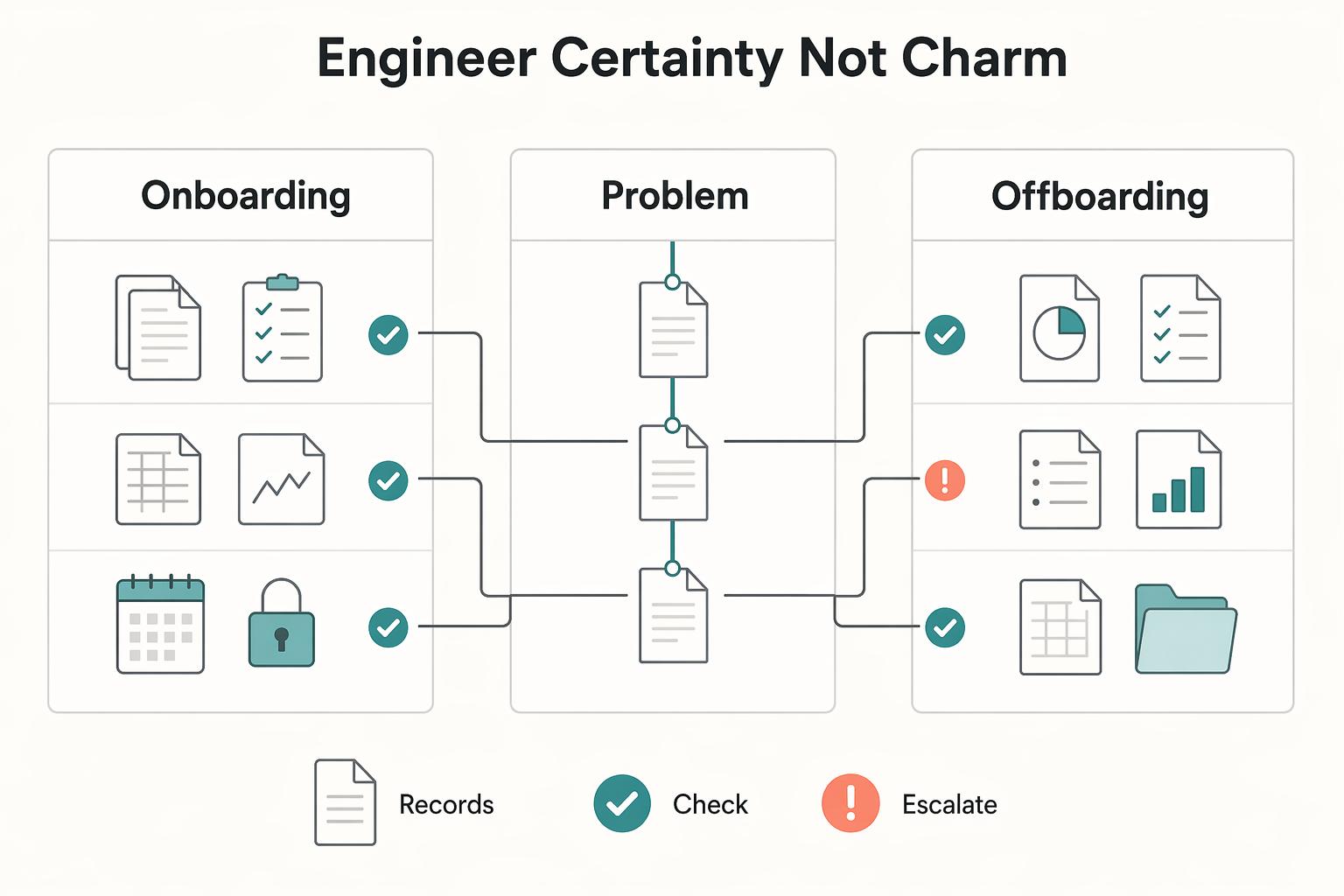
That leaves you with three controllable moments: the onboarding peak, the crisis-response peak, and the offboarding end. Design those moments for clarity, and you make approvals, handoffs, and payment processing easier to complete.
You might also find this useful: How to Fire a Freelance Client and End the Contract Professionally.
The First Peak: Remove Ambiguity in the Contract, SOW, and Kickoff#
If you want fewer scope disputes later, make onboarding your first control point. Use the contract, SOW, and kickoff to remove ambiguity before work starts.
Start with a contract that controls ambiguity#
Use plain language and confirm the boundaries in writing before kickoff:
| Contract area | What to define |
|---|---|
| Deliverables | What is being delivered, in what format, and how much |
| Revisions and change requests | What is included, and what moves into new scope |
| Dependency ownership | What the client must provide, and how delays are handled |
| Acceptance criteria | How approval is confirmed |
| Payment triggers | What event releases each invoice or final payment |
If you review external templates or official guidance, verify that you are on the real secure site (https/lock), and do not treat database indexing alone as endorsement of content quality.
Use the SOW to remove "I assumed" from the project#
Your SOW should make scope decisions easy when requests come in.
| Included in SOW | Excluded from SOW |
|---|---|
| Explicit, named outputs | Requests not listed in scope |
| Defined revision process | Open-ended refinements |
| Agreed milestones and timeline | New rush items added midstream |
| Stated approval/documentation path | Side-channel requests outside the agreed path |
Before kickoff, do one boundary check: if a reasonable reader could interpret a line more broadly, rewrite it now.
Turn kickoff into a scope-control protocol#
Run kickoff as an operating setup, not a warm-up call:
- Confirm decision-makers and final approvers.
- Set communication cadence and response expectations.
- Define the escalation path for urgent blockers.
- Name the single documentation channel for scope and decisions.
- Lock the first milestone and what "done" means for it.
Send one written recap right after kickoff with the contract/SOW references, roles, channel, escalation contact, and first milestone. That gives you a shared record when pressure increases.
This first peak is prevention, not perfection. In the next section, the focus shifts to crisis handling when prevention is not enough.
If you want a deeper dive, read GDPR for Freelancers: A Step-by-Step Compliance Checklist for EU Clients.
The Trough: Handle Project Issues with One Repeatable Workflow#
A project issue does not break trust on its own; an unclear, reactive response does. The practical goal is to run the same incident-response workflow every time so the client sees control, not confusion.
| Issue type | Main concern |
|---|---|
| Scope change | Concern about boundaries, budget, and what is still included |
| Client-side dependency delay | Concern about timeline ownership, since delays on their end can extend delivery |
| Stakeholder churn | Concern that settled decisions are now unstable |
| Delivery defect | Concern about quality control and acceptance readiness |
The service recovery paradox is useful as context, not a guarantee. A well-managed failure can strengthen confidence compared with a vague response, and research on customer relationships shows that recency and peak moments can shape how the relationship moves next. In real projects, that means your response right after the issue matters most.
Use the same five-step response every time#
- Acknowledge the issue clearly. State what happened without blame.
- Confirm impact. Explain the effect on timeline, budget, deliverables, or review flow.
- Present options with a recommendation. Give tradeoffs and your advised path.
- Agree owner and next update. Assign each open item and set the next check-in time.
- Document decisions in writing. Capture scope, deadlines, and fees in one shared record.
If the full fix is not confirmed yet, say that directly and commit to a specific update time. A weak response tries to reassure before facts are stable; a strong response narrows uncertainty and keeps one source of truth both sides can access, whether that is a secure client portal, a shared project workspace, or one controlled email thread.
| Weak response | Strong response |
|---|---|
| "We hit a snag, but we're on it." | Names the issue plainly and summarizes the impact on timeline, budget, deliverables, or review flow |
| Asks, "What do you want to do?" | Presents options, tradeoffs, and a recommendation |
| Leaves next steps verbal | Sends written recap after the call |
| Lets approvals float | Names approver, owner, and next update date |
Send a recap your future self can defend#
After the call, send a short written summary with four blocks:
- Decision log: Record the date and the decision both sides agreed to.
- Changed assumptions: State which prior assumption changed and why it matters.
- Revised acceptance path: Name the deliverable, reviewer, checklist, and target review date.
- Pending approvals: Name the person or role responsible, the due date, and the revised timeline if approval does not arrive.
Before you send it, verify the recap against contract/SOW language for deliverables, revision limits, approval steps, and fee impact. That check helps prevent accidental promises that conflict with signed scope.
Handle the trough well and you protect trust mid-project, but the final memory is still shaped by how you close, which is why invoicing and offboarding need the same discipline.
For a step-by-step walkthrough, see A guide to the 'Ben Franklin Effect' for building client relationships.
The Final, Most Critical Peak: Why Your Invoice Is the Lasting Memory#
Your delivery is not the only thing the client remembers. In many engagements, the ending is shaped during financial closeout, and that final interaction can carry outsized weight in how the whole project is recalled.
Use the peak-end rule here as an operating filter: reduce avoidable friction at the end. The goal is not a "perfect" invoice. The goal is a closeout that is easy for your client to route, verify, and process.
Invoice friction vs invoice confidence#
| Invoice friction | Invoice confidence |
|---|---|
| PO number missing, outdated, or hard to find | PO number is placed where the client asked for it and checked against current instructions |
| Service lines are vague or do not match project documents | Line items map clearly to the signed SOW, approved change, retainer period, milestone, or acceptance note |
| Tax treatment is unclear | Tax treatment is labeled clearly, with client tax ID and reverse-charge notation included only when verified and applicable |
| Payment details are incomplete or inconsistent | Payment instructions are complete and current, with due date and invoice reference easy to locate |
| Sent only to a relationship contact | Submitted through the client's stated AP/procurement channel with routing details confirmed |
Pre-send invoice QA checklist#
Before you submit, run a short check:
| Check area | What to verify |
|---|---|
| Entity details, client name, and client tax ID | Confirm your entity details, client name, and client tax ID against the latest client record |
| Contract, SOW, approved change, milestone, or retainer period | Match each billed line to the contract, SOW, approved change, milestone, or retainer period |
| PO number, vendor number, cost center, or other required client reference fields | Verify PO number, vendor number, cost center, or other required client reference fields |
| Tax labeling and reverse-charge notation | Check tax labeling and reverse-charge notation; keep jurisdiction-specific fields or thresholds unresolved until verified |
| Payment instructions, currency, due date, and remittance contact | Confirm payment instructions, currency, due date, and remittance contact |
| Client's stated channel | Submit through the client's stated channel |
Close out the full payment workflow#
Treat closeout as a workflow, not a single document:
- Submit in the required channel (portal, AP mailbox, or other stated path).
- Confirm receipt and routing with a short, low-friction message.
- Keep a dispute packet ready: invoice, SOW/contract, approved changes, and acceptance evidence.
- Follow up on the client's AP cadence and contacts, not a fixed universal timeline.
A smooth close does not guarantee re-engagement or referrals. It does improve something you control: you are easier to buy from again.
We covered this in detail in A guide to creating 'Interfaces' in Airtable for client portals.
Your New Mandate: Engineer Certainty, Not Charm#
Run this as your default: when style and clarity compete, choose clarity with written checkpoints. Your goal is simple: make the next step explicit, documented, and easy to verify.
Treat each peak as an operator move you control:
- Onboarding: set the written baseline (
contract,SOW, approver, and change-order path). - Problem moment: send the first clean written update (what happened, what it affects, what happens next, and when you will update again) so the work does not drift into rabbit holes.
- Offboarding: execute a clean handoff (invoice aligned to the working paper trail, sent through the agreed AP route, with support docs ready if requested).
| Moment | Charm-led behavior | Certainty-led behavior | Observable output |
|---|---|---|---|
| Onboarding | Friendly kickoff, verbal alignment | Contract + SOW + owners + change path confirmed in writing | One source of truth for scope and approvals |
| Problem | Reassuring language, partial detail | Written impact summary + next action + next update time | Clear checkpoint instead of fragmented updates |
| Offboarding | Casual invoice send, open-ended follow-up | Invoice handoff checklist + agreed submission route + docs ready | Complete submission trail |
Run this operating model every time: document the agreement, document the exception, document the handoff. This pairs well with A Guide to the '80/20 Rule' (Pareto Principle) for Your Freelance Business.
Frequently Asked Questions
What is the peak-end rule for client work?
It is a memory bias. People tend to remember the most intense moment and the ending more than the full sequence of events. In practice, your client is not replaying every email or meeting. They are keeping a few snapshots, so your job is to make the high-stakes moments feel clear, calm, and well handled.
Where do peak moments usually show up in a client engagement?
In many engagements, memorable peaks show up around onboarding, during a problem, and at closeout. That means your kickoff, your response under pressure, and your invoice or offboarding process deserve more care than lower-stakes touches in the middle. | Moment | Weak handling | Stronger handling | | --- | --- | --- | | Onboarding | Vague scope, no source-of-truth document, unclear approvals | Clear written scope, kickoff confirms owners, approvals, and change process | | Project problem | Late notice, partial facts, no written next step | Early notice, plain explanation of impact, next action and update time confirmed in writing | | Invoice and offboarding | Invoice details do not match the project record or go to the wrong channel | Invoice matches agreed scope and approved changes, sent through the stated billing route, key details checked before submission |
What counts as a “peak” if nothing dramatic went wrong?
A peak is not always a crisis. It can be the first kickoff where your client realizes you are organized, or a tense decision point where you reduce confusion instead of adding to it. If a moment carries emotional weight, uncertainty, or risk, assume it will be remembered more than a routine weekly update.
How should you handle a negative peak once it happens?
Respond early and concretely. State what happened, what it affects, what you are doing next, and when you will update them. Then send that summary in writing so the client does not have to reconstruct the situation from memory. Do not end a shaky interaction with a broad closing prompt that invites fresh disappointment before you have stabilized the issue. If scope, timing, or deliverables changed, attach the revised plan or change note so the recovery is documented, not just explained.
Does project length matter as much as those moments?
Usually less than you think. Research on the peak-end effect suggests duration has only a slight effect on retrospective judgment, so a long, mostly solid engagement can still be remembered badly if the crisis response or final close is messy. Do not rely on "overall good work" to cancel out a painful ending.
How do you make invoicing and offboarding feel clean instead of risky?
Start by matching the invoice to the agreed scope and any approved changes before you send it. Then verify the billing details the client actually uses, such as PO number, AP mailbox, portal route, service description, and payment instructions. Keep a small evidence pack ready in case AP or your client asks questions. A practical version is the invoice, the agreed scope document, written change approvals, acceptance or milestone signoff, and proof of submission such as a portal receipt or screenshot.
What is one simple rule for ending well?
End with confirmation, not ambiguity. After final delivery, submit the invoice through the client’s stated channel, then ask one low-friction question: whether it is correctly routed and whether any supporting documents are needed. That gives you a clean final checkpoint without reopening the whole engagement.
Try a related tool
Researched and edited by the Gruv editorial team. Gruv builds cross-border billing, payouts, and finance-operations software for global businesses.
Sources
- ada.gov/law-and-regs/regulations/title-ii-2010-regul...trusted
- bulletin.du.edu/graduate/schoolscollegesanddivisions/profess...trusted
- caloes.ca.gov/wp-content/uploads/PSC/Documents/Executed-ST...trusted
- dspace.mit.edu/bitstream/handle/1721.1/67569/761733575-MIT.pdftrusted
- en.wikipedia.org/wiki/Peak%E2%80%93end_ruletrusted
- fda.gov/media/166830/downloadtrusted
- federalregister.gov/documents/2025/01/15/2025-00636/framework-fo...trusted
- files.consumerfinance.gov/f/documents/cfpb_section-1071_nprm_2021-09.pdftrusted
Educational content only. Not legal, tax, or financial advice.
Related Posts

GDPR Compliance Checklist for Freelancers Working With EU Clients
Start by separating the decisions you are actually making. For a workable **GDPR setup**, run three distinct tracks and record each one in writing before the first invoice goes out: VAT treatment, GDPR scope and role, and daily privacy operations.

Thailand's Long-Term Resident (LTR) Visa for Professionals
For a long stay in Thailand, the biggest avoidable risk is doing the right steps in the wrong order. Pick the LTR track first, build the evidence pack that matches it second, and verify live official checkpoints right before every submission or payment. That extra day of discipline usually saves far more time than it costs.

The Freelance Payment Penalty: A Modeled Audit of Platform Fees, FX Spreads, and Payout Delays
The money rarely disappears through a single, easy-to-spot fee. The real loss is stacked. A marketplace takes its commission, a processor adds a charge for international cards, a bank or payment company converts the currency at a spread, a platform holds the funds before release, and a wire sheds a little to intermediaries on the way in. Each layer looks defensible on its own, but the worker feels the combined result as a smaller deposit and a later payday.