
Quick Answer
Build the mental game of freelancing blueprint around three operating layers: control, compliance, and growth. Start by making scope, invoices, and records easy to verify; then move compliance into one tracker for residency days and foreign-account reviews; finally use a Value Evidence Dashboard before pricing or renewal decisions. The goal is practical consistency under pressure, not motivation spikes.
Treat mental noise as an operations signal#
If freelancing feels mentally noisy, treat that noise as an operations signal. In practice, pressure can feel worse when your process is unclear, compliance tasks are undefined, and cash only gets attention when something breaks.
The practical issue is visibility, not capability. When basic answers are hard to find, like what was signed, what is due, what is unpaid, and where records live, too much of the business is still sitting in your head.
A better question is not, "What is wrong with me?" but, "What is undocumented, untracked, or unverified?" When there is no visible next action, doubt can fill the gap. If scope, payment status, and admin records are spread across inboxes, chats, notes, and memory, you can feel behind even when delivery is on track.
This blueprint organizes the work into three pillars:
- Control System: makes work, money, and commitments visible so day-to-day decisions are easier.
- Fortress System: gives records, open questions, and deadlines one clear home so admin and compliance work is trackable.
- Growth System: turns your outcomes into usable evidence for pricing, sales, and planning.
| Area | Reactive Freelancer Mindset | Systems-Led CEO Mindset |
|---|---|---|
| Client work | "I think I remember what we agreed." | Scope, next step, and owner are easy to verify. |
| Cash operations | Reviews invoices only when cash feels tight. | Can quickly see sent, paid, late, and follow-up items. |
| Compliance/admin | Delays it until a deadline forces action. | Maintains a document hub, question list, and status checklist. |
| Self-trust | Relies mostly on mood. | Relies on records and visible checkpoints. |
Start with the Control System. Make the business legible before you optimize anything else.
If you want a deeper dive, read How to Deal with Imposter Syndrome as a Freelancer.
Build a Control System for requests, reviews, and records#
Your first line of defense is a control loop, not motivation. Standardize how requests are captured, reviewed, approved, and recorded so you are not relying on memory when pressure rises.
A useful model here is the process discipline behind Mississippi's Uniform Course Numbering System: adopted in 2005, implemented in 2006-2007, and revised each year. The lesson is process control, not a direct policy template. Use consistent identifiers, require a formal request for changes, log each request, route it for review, and update core records deliberately instead of ad hoc.
What control should make obvious#
A working control layer should help you confirm quickly what was requested, what is approved, what changed, and what is still open.
| Common failure state | Control System fix | Expected operational outcome | Owner |
|---|---|---|---|
| Work items are labeled inconsistently | Use one naming convention for active work | Easier retrieval and fewer labeling conflicts | You |
| Changes arrive informally and are hard to trace | Require one change-request path before updates are accepted | A visible change trail instead of silent updates | Shared |
| Requests are made but not visibly reviewed | Log each request and route it to a defined reviewer | A clearer review trail for approvals | Shared |
| Records are updated only when something breaks | Run scheduled record updates and reviews | More current records and fewer stale entries | You |
| Exceptions are treated like normal work | Add an explicit approval gate for exceptions | Exceptions are visible before they are included | Shared |
One tradeoff from the source is worth keeping: rules can stay consistent within a period, then be revised in a planned cycle. In the source, groupings are consistent within a year but not from year one to year two. If you rename, reroute, and relabel every week, you recreate the same noise you were trying to remove.
Minimum viable Control System#
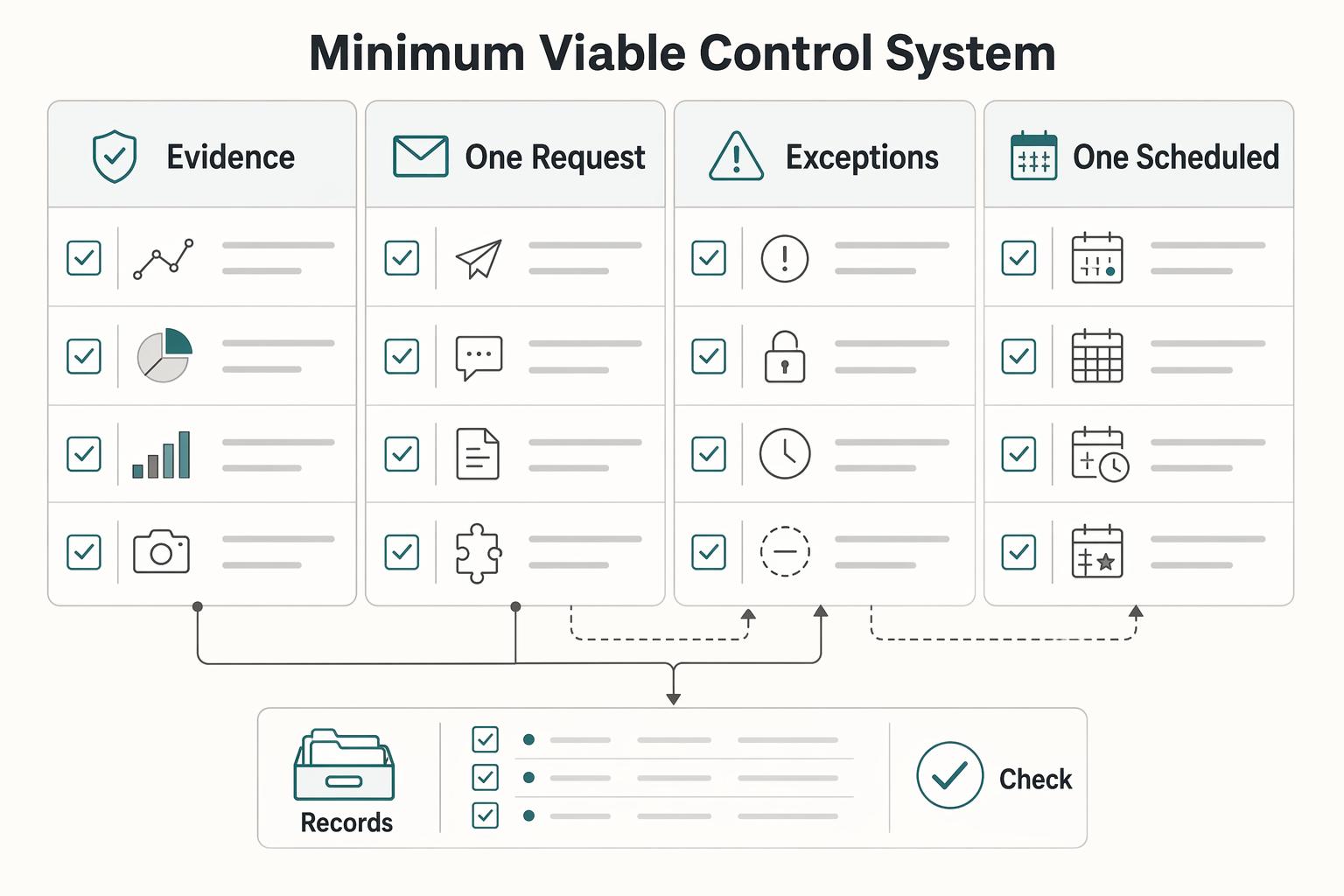
Keep the starting version simple enough to maintain under pressure. Before you move to the next pillar, set up this baseline:
| Element | Details |
|---|---|
| Naming format | One standard naming format for requests and records |
| Request form | One request form for any new item or change |
| Request log | One request log with clear status steps: submitted, logged, forwarded for review, record updated |
| Approval path | One explicit approval path for exceptions |
| Review cycle | One scheduled review cycle to update the system deliberately |
Same baseline, in checklist form:
- One standard naming format for requests and records.
- One request form for any new item or change.
- One request log with clear status steps (submitted, logged, forwarded for review, record updated).
- One explicit approval path for exceptions.
- One scheduled review cycle to update the system deliberately.
Related: How to Learn a New Language as a Digital Nomad.
Keep compliance records in one system and check them on a cadence#
Once work and cash are visible, the next pressure point is compliance. Compliance stress is often an operations problem, not a personal flaw. The goal is simple: keep records in one system, run repeat checks on a clear cadence, and use guardrails so automation handles data movement while legal judgment stays in human review.
When records are scattered across apps, inboxes, and memory, you lose a clean view of the business. A Fortress System helps by making evidence complete, findable, and reviewable before issues pile up.
| Reactive Compliance Behavior | Fortress System Behavior |
|---|---|
| You review compliance only when pressure spikes | You log key events as they happen and review one tracker on a fixed cadence |
| You notice reporting or account risk late | You run a recurring review register and record the outcome every cycle |
| You re-enter data from old copies | You use rule-based automation to move verified data from one system to another |
| You store files wherever they land | You file to one taxonomy, with consistent names and retrieval checks |
Build a residency tracker you can actually maintain#
Keep one tracker in your primary compliance folder, not split across notes and screenshots. Track country, relevant dates, source record, and a notes field.
For each relevant jurisdiction, keep a plain-language rule note marked as unverified until a reliable source confirms the current rule. Then review the tracker on your set cadence and after material travel changes. If you cannot explain your current position from one file with linked evidence, tighten the system.
Turn foreign-account reporting into a cadence#
Use one account register with institution name, country, account owner, account type, and a recurring review log. Keep the reporting-rule field marked as unverified until the current rule has been reviewed against a reliable source.
This keeps you out of guesswork. Build a documented review rhythm so reporting questions are handled early, not discovered late. If you automate exports or reminders, keep the guardrails clear: tools can collect and move data, but legal treatment stays with human review.
Use a compliance-first invoice checklist#
Before sending an international invoice, confirm:
| Checkpoint | Requirement |
|---|---|
| Client tax status and billing entity details | Verified |
| Location-specific requirements | Checked against verified guidance |
| Supporting documents | Prepared for handoff |
| Final template wording | Validated locally |
Use automation for narrow, rule-based steps, such as moving verified billing data from intake into invoicing, and keep final compliance decisions in manual review.
Make document storage audit-ready#
Audit-ready storage is less about complexity and more about consistency. Use a structure you can explain and repeat:
- Folder taxonomy: one clear home for compliance, client, and finance records
- Naming convention: one format applied consistently (for example,
YYYY-MM-DD_Client_DocumentType_Version) - Capture routine: file documents immediately on receipt or on a fixed weekly batch
- Retrieval test: run a recurring spot-check to confirm records are easy to find quickly
That is the fortress layer in this blueprint. You do not need every rule in memory; you need a system that keeps the right evidence ready when you need it.
You might also find this useful: The Dunning-Kruger Effect and Imposter Syndrome for Freelancers.
Turn your compliance checklist into a repeatable routine with the Tax Residency Tracker.
Turn your outcomes into evidence for pricing and decisions#
Control and compliance can buy you breathing room. The next job is to use that room well: turn your outcomes into evidence, choose a pricing model you can defend, and run a CEO review that ends in decisions.
Build your Value Evidence Dashboard#
Start with a private dashboard you can check before proposals, pricing decisions, renewals, and high-pressure client conversations. Use one sheet or doc, and log each entry with five fields: category, claim, source, date, and link or file path.
One workable set of categories is client results, delivery reliability, commercial signals, and outside proof. Pull evidence from real artifacts: before-and-after reports, client emails, approved deliverables, repeat bookings, referrals, on-time payments, and call notes tied to a specific business problem solved.
Use a simple rule: if a claim has no retrievable source, do not include it. "Client loved it" is weak. "Client approved the revision and requested phase two" is usable because it is specific and documented.
If you use AI summaries, keep human review in the loop before you treat the output as evidence. The supporting evidence here comes from automated employment decision tools under Local Law 144 of 2021, not freelancer-growth studies, but the process lesson is transferable: automation can improve efficiency, and weak safeguards or review can create harmful or biased outcomes. For your dashboard, check summaries against original notes or recordings before you rely on them.
Compare pricing models before you switch#
Do not change pricing models because one sounds more advanced. Choose the model you can explain clearly, scope tightly, and defend in writing.
| Aspect | Time-Based Pricing | Value-Based Pricing |
|---|---|---|
| Price anchor | Hours worked and your hourly/daily rate | Defined scope, constraints, and inclusions |
| Scope control | Time tracking, overage approvals, and extra-hour rules | Explicit boundaries, exclusions, assumptions, and change triggers |
| Client conversation | Tasks, effort, and estimated hours | Stakes, priorities, decision criteria, and success definition |
| Documentation focus | Time logs and change approvals | Assumptions, exclusions, and acceptance criteria |
Use this checkpoint: if you cannot describe the client problem, decision owner, and acceptance criteria in one short paragraph, stay with time-based or tightly fixed-scope pricing for now.
Run a business review that ends in decisions#
A CEO review is most useful when it produces decisions. Set a fixed cadence you can sustain, such as every [X weeks] for [Y minutes], and keep one repeatable agenda. Review dashboard evidence, check revenue and effort by client or service line, identify one delivery friction point, decide one commercial change, and select one asset to build or continue.
End every meeting with fixed outputs: one decision note, one action with owner and deadline, and one follow-up date on your calendar. At the next meeting, start by marking prior actions as done, not done, or blocked, with one sentence of context.
If a meeting produces reflections but no dated decisions, treat it as incomplete. Keep CEO notes in the same folder as your dashboard so trends in pricing, positioning, and asset choices stay visible.
Choose one scalable asset#
Do not build a long idea list. Pick one asset path and make a clear choice. Score options against four filters: fit, effort, reuse potential, and revenue pathway.
| Filter | Question |
|---|---|
| Fit | Does it match problems clients already pay you to solve? |
| Effort | What are the true build and maintenance costs? |
| Reuse potential | Can it support sales, delivery, or onboarding repeatedly? |
| Revenue pathway | Is the mechanism clear (direct sale, lead capture, upsell, retention, or faster delivery)? |
If two options score similarly, choose the one closest to your current service. A diagnostic template, workshop outline, or onboarding guide can be simpler to test than a large product build.
Take one next action this week: create the dashboard file and add ten evidence entries with source links. That single move can improve your inputs for pricing, CEO reviews, and asset selection.
For a step-by-step walkthrough, see Why High-Earners Choose Freelancing for the Autonomy Premium.
Conclusion: The Mental Game Is Won with Systems, Not Feelings#
If you want more consistent execution, run clearer systems instead of relying on day-to-day momentum. Use this blueprint to make your work visible, repeatable, and easier to verify.
One practical example: in the September 2025 Ask HN freelancer thread, people are asked to lead with SEEKING WORK or SEEKING FREELANCER, then state location and whether remote work is possible. Freelancer posts in that thread can include a CV or portfolio link. The takeaway for your own materials is simple: make your offer, location, remote status, and proof easy to find, and avoid vague positioning.
Your three pillars in operating terms:
- Control system you run: one reusable template with your label, location, remote status, and proof link. Issue it addresses: missing key details. What to track: whether every post/profile uses the same core fields.
- Fortress system you run: one short checklist for where you post and what is on-topic (for example, agencies, recruiters, and job boards are off-topic in that thread). Issue it addresses: thread-fit mistakes. What to track: whether posts are complete and on-topic for the channel.
- Growth system you run: dated portfolio/CV updates and scheduled reviews. Issue it addresses: stale proof. What to track: the date of your last proof update.
| Operating contrast | Ad hoc behavior | System behavior |
|---|---|---|
| Client-facing details | Generic pitch, key details missing | Clear label, location, remote status, proof link |
| Posting discipline | Ad hoc posting without thread rules | Quick checklist for required fields and on-topic fit |
| Proof of capability | Claims without concrete examples | CV/portfolio links updated on a schedule |
Do the handoff now: standardize one posting template, schedule one profile-and-proof review routine, and lock one quarterly update habit. That is how this blueprint becomes an operating model, not a slogan.
We covered this in detail in How to Manage Your Mental Health as a Solopreneur.
When you are ready to put this blueprint into daily execution, choose your next workflow in Gruv Tools.
Frequently Asked Questions
How does imposter syndrome affect freelance pricing?
It can push you to price for emotional safety instead of the problem you solve, which can pull you toward low-dollar work that is draining and hard to sustain. Your growth system helps by replacing self-doubt with evidence: clients hire a specific skill, but communication and sales still affect outcomes. Build your value dashboard with retrievable proof before changing pricing models. Next step: add source-backed entries, then review pricing only after you can state scope and acceptance clearly.
What is the difference between freelancer burnout and founder burnout?
There is no strict clinical line here, so use these labels as a practical diagnosis tool. Check whether your pressure is mostly operational (delivery/admin load) or mostly strategic (pricing, positioning, reinvestment decisions). Then apply the matching system: tighten control for operational load and use a recurring growth review for strategy decisions. Next step: label your recent stress spikes as operational or strategic, then fix the pattern that appears most.
How do I create a financial safety net as a freelancer?
Treat your safety net as a policy you set and review, not a fixed public number. Write three rules: your buffer target (your personal buffer amount), your tax set-aside rule (the percentage or amount appropriate for your jurisdiction), and your reinvestment budget (the amount you allocate each month or quarter). If your buffer is still in progress, keep reinvestment modest but explicit so upskilling does not get skipped. Next step: add these three rules to your next review and check them quarterly.
What systems keep admin work visible?
Admin anxiety rises when no one is accountable except you, and unmanaged admin can lead to missed tax obligations. Your control system should make work visible: one source of truth, recurring admin time, and consistent filing habits for key records. Keep it simple enough to maintain during busy weeks. Next step: schedule one weekly admin block and use it to clear open items and confirm deadlines.
How do I manage the mental load of global compliance?
You reduce compliance stress by moving from memory to repeatable checks in your fortress system. Keep one written checklist, review it on a schedule, and verify it against your documents when obligations or work context change. This keeps uncertainty from compounding into avoidable risk. Next step: create a one-page compliance tracker and run a monthly document-based review.
Try a related tool
Researched and edited by the Gruv editorial team. Gruv builds cross-border billing, payouts, and finance-operations software for global businesses.
Sources
- gearup.wa.gov/sites/default/files/resources/gear_up_games_...trusted
- liu.edu/registration-and-financial-aid/registration/...trusted
- mccb.edu/about/publications/ucnstrusted
- monroeccc.edu/sites/default/files/catalog/2018-2019/2018-2...trusted
- nyc.gov/assets/dca/downloads/pdf/about/PublicComment...trusted
- osuit.edu/academics/files/25-26-catalog-osuit-11-13.pdftrusted
- publishing.vt.edu/books/33/files/b85e4a8e-a61c-4878-955c-d5e34...trusted
- westmoreland.edu/resources/2024-2025-college-catalog-5-3-24.pdftrusted
Educational content only. Not legal, tax, or financial advice.
Related Posts
How to Deal with Imposter Syndrome as a Freelancer
**Freelance impostor feelings can flare when your work lacks clear, documented boundaries-even when you *do* have talent.** You're the CEO of a business-of-one, and your job is to turn shaky moments into repeatable operations.

How to Learn a New Language as a Digital Nomad
If you want to **learn language while traveling** without winging it, aim for reliability before fluency. Your first job is not to sound impressive. It is to get through early daily interactions when the conversation speeds up and reading skills stop helping.

The Freelance Payment Penalty: A Modeled Audit of Platform Fees, FX Spreads, and Payout Delays
The money rarely disappears through a single, easy-to-spot fee. The real loss is stacked. A marketplace takes its commission, a processor adds a charge for international cards, a bank or payment company converts the currency at a spread, a platform holds the funds before release, and a wire sheds a little to intermediaries on the way in. Each layer looks defensible on its own, but the worker feels the combined result as a smaller deposit and a later payday.