
Quick Answer
Yes - when evaluating licensing vs assigning ip, license by default if you may reuse the work, and assign only when the client has a real ownership need. A license grants defined permission while you keep title; an assignment transfers title and is often harder to unwind. Your strongest protection is contract precision: exclusivity, territory, field of use, duration, derivative-work permissions, and transfer timing tied to full payment and signed paperwork.
Are You Renting or Selling? The Fundamental IP Decision for Your Business#
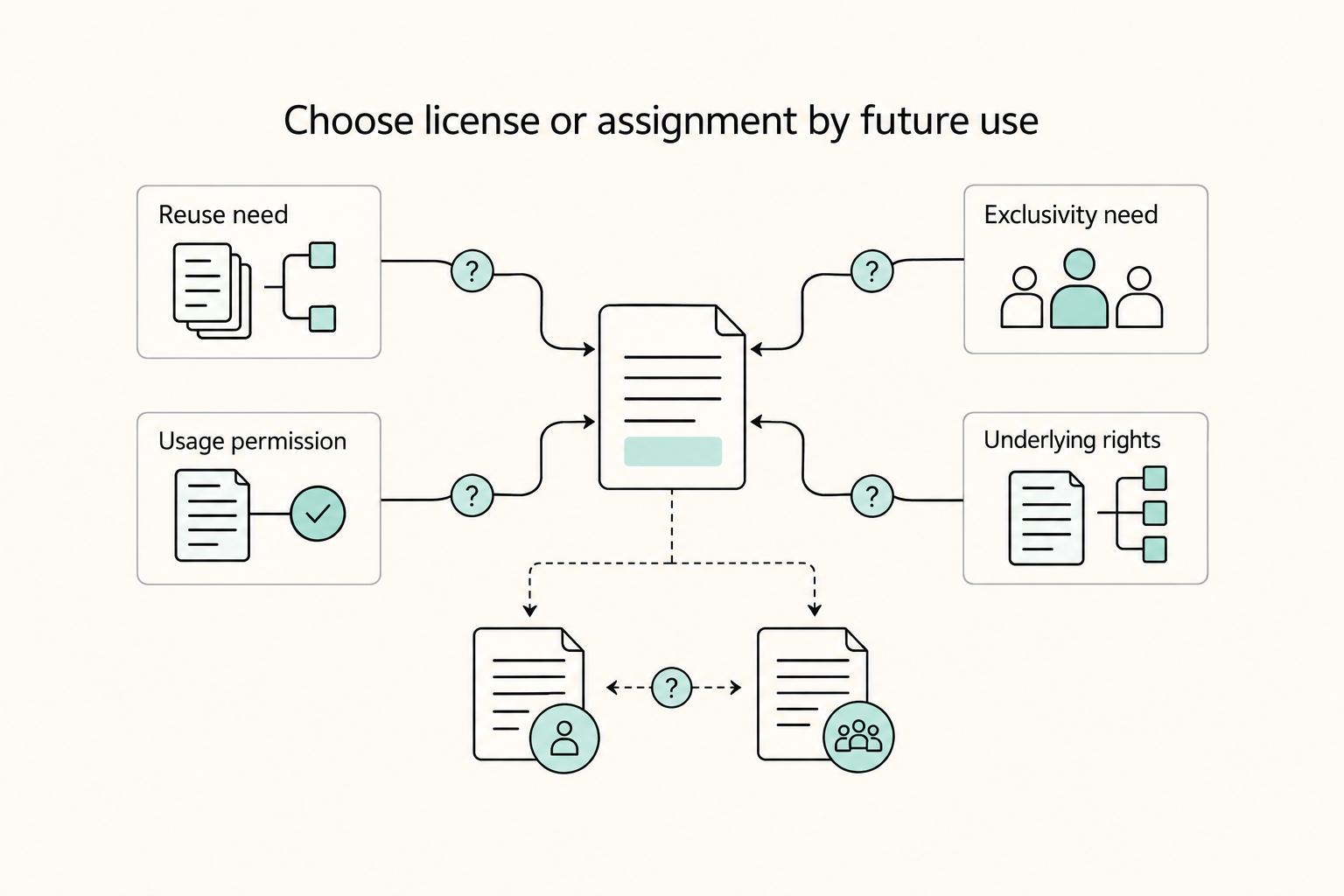
Before you price the deal or touch the contract, answer one question: are you giving permission to use your IP, or are you transferring ownership of it? That choice drives reuse rights, control, and the shape of the whole agreement. A license gives someone permission to use IP while you keep ownership. An assignment transfers ownership of the IP asset.
If you may want to reuse, adapt, or productize the work later, start from a license. If the client truly needs to own the asset itself, assignment may be the better fit.
Use a fast decision filter#
Answer these four questions before you go further:
- Will you want to reuse this work, or a version of it, later?
- Does the client actually need exclusivity, or are they using ownership language by default?
- Are they buying permission to use deliverables, or full control of the underlying rights?
- Does this deal support your long-term model, or does it sell off reusable IP you will need again?
One edge case deserves extra care. In U.S. copyright practice, an exclusive license is treated as a transfer category, while a nonexclusive license is not. That means a license labeled "exclusive, perpetual, worldwide" can operate more like an ownership transfer than many people expect.
The operational differences#
| Factor | License | Assignment |
|---|---|---|
| Ownership | You keep ownership and grant use rights. | Ownership transfers to the buyer/client. |
| Reuse by you | Often possible if rights granted are limited or nonexclusive. | Typically not available unless rights are expressly reserved back to you. |
| Exclusivity | Can be nonexclusive, sole, or exclusive. If exclusivity is not expressly stated, do not assume it. | Buyer generally expects exclusivity through ownership. |
| Territory and field of use | Can be narrow or broad; these are key control levers. | Defined by transfer terms; check scope carefully. |
| Revocability | Depends on contract terms and applicable law; do not assume it is freely revocable. | Usually intended to be final. |
| Modification and derivative works | Must be stated clearly if the client can edit, adapt, localize, or build on the work. | The new owner's modification rights follow the transferred rights and contract terms. |
| Enforcement burden | If you keep ownership, enforcement responsibility typically stays with you unless contract shifts duties. | Enforcement responsibility generally follows ownership unless contract terms or law allocate duties differently. |
| Common negotiation pressure points | Scope expansion: longer term, more territories, broader fields, late exclusivity asks. | Overbroad asset descriptions and informal assumptions that payment alone settles ownership transfer. |
If you want optionality, licensing gives you more control. Assignment is cleaner when a true ownership transfer is required, but it usually means giving up control over the transferred rights.
Treat signed terms as mandatory risk control#
The label on the document is not enough. A contract called a "license" can still give away most of the commercial value if it is exclusive and broad. A deal described as "client owns it" can still fail if the transfer formalities are not completed correctly.
| Context | Requirement |
|---|---|
| U.S. copyright transfers | Writing and signature requirements apply |
| UK copyright assignment | Assignment is ineffective unless in writing and signed by or on behalf of the assignor |
| UK exclusive licence | Must also be in writing and signed by or on behalf of the copyright owner |
| U.S. patent assignments | Must be in writing |
| Recordation or registration | Check steps where relevant, because formal requirements vary by country and timing can affect priority and notice outcomes |
In practice, the formalities vary by IP type and jurisdiction. For U.S. copyright transfers, writing and signature requirements apply. In UK copyright law, assignment is ineffective unless in writing and signed by or on behalf of the assignor, and an exclusive licence must also be in writing and signed by or on behalf of the copyright owner. U.S. patent assignments must be in writing. Also check recordation or registration steps where relevant, because formal requirements vary by country and timing can affect priority and notice outcomes.
Before signing, confirm in the contract:
- the exact IP being licensed or assigned
- whether ownership stays with you or transfers
- whether rights are exclusive, sole, or nonexclusive
- territory, field of use, and term
- whether the client can modify, adapt, or create derivative works
- who handles enforcement, and who is responsible for any required filing or recordation steps
If you may reuse or build on the work, keep ownership and grant only the rights the client needs. Assign only when the client has a real ownership requirement and the signed terms and any required filing steps are fully handled.
When to License Your IP and How to Set the Terms#
License when the client needs access to your IP, but you still need to keep the asset for future use. If the same asset could support another engagement later, keep ownership and license the permission to use it.
Find the asset you can reuse#
The first practical step is to split your offer into two buckets: your reusable core asset and the client-specific deliverable. Your core asset might be a template library, design system, code module, research method, training material, naming framework, or internal process documentation. The client-specific deliverable is the final output built for that client.
That split is what makes licensing scalable. A non-exclusive license lets you grant the same asset to multiple clients, which spreads risk. One illustrative model is licensing the same asset to 10 companies in 10 different regions or industries. The point is not the number. It is the reuse logic.
Draft permission as a rights bundle#
A license is permission, not an ownership transfer. State that ownership stays with you, then spell out exactly which rights are granted. Use a rights-bundle checklist so nothing gets implied:
| Right | Contract action |
|---|---|
| Use | State who can use the asset, and for what purpose |
| Modify | State whether edits or adaptations are allowed |
| Distribute | State whether they can share externally and in what channels |
| Sublicense | State whether they can pass rights to affiliates, partners, or resellers |
If a right is not clearly granted, treat it as unresolved and clarify it in writing before signing. Before signing, attach a clear asset description, including component, version, and exclusions. If relevant, keep evidence-of-use reports so scope is easier to verify later.
Negotiate the terms that actually control value#
Most of the value in a license sits in scope, not in the title of the deal. These are the terms that usually matter most:
| Term | What clients may request | What protects you |
|---|---|---|
| Scope | Broad use across products and teams | Limit to the use case you are pricing |
| Exclusivity | Broader or exclusive rights | Keep non-exclusive unless exclusivity is worth the flexibility tradeoff |
| Duration | Longer or perpetual use | Set a defined term if you want review and renewal points |
| Territory | Multi-region or worldwide rights | Limit by country/region if you plan to monetize elsewhere |
| Derivative works | Broad freedom to adapt | State exactly what changes are allowed |
| Termination triggers | Minimal or vague triggers | Define clear triggers (for example, nonpayment, misuse, or out-of-scope use) |
| Post-termination obligations | No clear wind-down | State whether use stops and what happens to materials/copies |
Be especially careful with exclusivity. It can support premium pricing, but it reduces your flexibility. If the exclusive partner underdelivers, monetization can stall. If exclusivity is required, narrow it by territory or field of use.
Package the money in the right order#
A practical way to structure pricing is:
| Component | Details |
|---|---|
| Base license fee | Charge for access and permission to use the asset |
| Usage-linked component (optional) | Add this only when usage scales and can be measured |
| Support or maintenance add-on | Price updates, troubleshooting, approvals, or compatibility work separately |
Start with a base license fee for access and permission to use the asset, add a usage-linked component only when usage scales and can be measured, and price support or maintenance separately.
This keeps the economics clear. Access is paid for first, scale is paid for when it happens, and ongoing labor is not buried inside the license fee.
Keep brand control enforceable#
Brand control only works when the contract gives you real levers. If market use matters, include approval rights, attribution rules, quality standards, and misuse remedies. Before signature, run one diligence check: is the licensee growing, expanding into new markets, and likely to steward your brand well? If not, narrow the grant, tighten the controls, or walk away.
Before you sign, confirm the contract includes:
- ownership stays with you
- exact rights granted, including any modify, distribute, and sublicense rights
- exclusivity status
- territory, field of use, and term
- termination triggers and post-termination obligations
- approval rights, attribution rules, quality standards, and misuse remedies
If your asset is reusable and you want future monetization options, license it with a precise, bounded grant.
You might also find this useful: A Motion Designer's Guide to Licensing Music and Sound Effects.
When to Assign Your IP and What to Settle Before Transfer#
Assign only when you want a true one-off exit. The client genuinely needs ownership, you do not plan to reuse the asset, and the price reflects what you are giving up. If any of those points is uncertain, licensing is often the safer move.
Assignment transfers ownership, not just permission to use. That changes your control, reuse rights, and risk exposure. Formalities matter too. In the U.S., copyright transfers generally require a signed writing to be valid, and patent and trademark assignments also require a written instrument.
| Decision factor | Assign | License |
|---|---|---|
| Client must own the IP outright | Strong fit if the requirement is real and paid for | Poor fit if ownership is non-negotiable |
| You may reuse the asset, method, template, or derivative later | Bad fit | Strong fit |
| The work has downstream product or derivative value | Often too costly to transfer cheaply | Better, because you keep future options |
| You can accept permanent or near-permanent loss of control | Possible fit, subject to jurisdiction-specific limits | Not required |
| You want a clean one-off exit after delivery and payment | Strong fit | Less clean, because ongoing permissions require management |
Use a practical assignment screen#
Before you agree to an assignment, run four checks:
- Does the client truly need ownership, or is this default procurement language?
- Do you want to reuse any part of the work, including methods, templates, or derivatives?
- Could the asset become future product, training, or reusable IP value?
- Can you accept losing approval rights and future control?
Two warning signs are worth catching early. The first is a demand for full ownership at standard service pricing. The second is broad "all right, title, and interest" wording that does not clearly separate your background IP from new deliverables. If reusable materials are bundled in, carve them out and license them instead of assigning them.
Price the exit by opportunity cost#
Do not price an assignment as your normal project fee plus a vague premium. Base it on inputs you can actually audit:
| Input | Details |
|---|---|
| Base project value | For creating the deliverable |
| Expected future reuse or licensing value | You are giving up |
| Exclusivity or control premium | The client is asking for |
In practice, that means separating the base project value for creating the deliverable, the expected future reuse or licensing value you are giving up, and any exclusivity or control premium the client is asking for.
That gives you a defensible commercial number for internal approval and negotiation. If you use multipliers, treat them as business judgment, not a legal rule.
Make ownership pass only when the deal is fully complete#
Your main protection is transfer timing. State exactly when the assignment becomes effective, and what happens if payment is delayed or disputed before ownership passes. If acceptance is part of the deal, define what counts as acceptance. Also note that payment-triggered assignment language can be interpreted differently across jurisdictions, so draft the trigger carefully.
Use this checklist to make transfer timing and scope explicit:
- if negotiated, ownership transfers only after full and final payment
- deliverables are defined precisely, including versions and excluded background IP
- if acceptance is used, criteria or a review period is defined so acceptance cannot stay open-ended
- if payment is delayed or disputed, ownership stays with you and any temporary evaluation rights are narrowly stated
- a signed assignment instrument is required where the IP type or jurisdiction requires it
Execution detail matters. Keep the signed writing, final asset list, invoice trail, and payment confirmation together. For U.S. patent assignments, delayed recordation can affect priority against later purchasers if not recorded within 3 months. For conflicting U.S. copyright transfers, recordation timing can also matter (1 month after U.S. execution, or 2 months if executed outside the U.S.).
Close the liability loop#
A clean exit is not just about moving title. It also requires clear post-transfer risk allocation. State where your responsibility ends, except for obligations that expressly survive. Narrow indemnity to defined claim types, set a negotiated liability cap, and exclude indirect or consequential loss where appropriate.
Also define the closing mechanics: which clauses survive, how claims must be notified, and which governing law and dispute forum or arbitration process applies. If those terms stay vague, a "clean exit" deal can become expensive to enforce.
Bottom line: assign only when ownership transfer is truly required, formalities are handled, transfer is payment-gated, and the price matches the opportunity cost. If reuse, derivative value, or future control still matters, license instead.
For a step-by-step walkthrough, see A Guide to Music Licensing for Video Projects.
Before you sign, turn your assignment-vs-license decision into clear contract language you can negotiate line by line with this freelance contract generator.
Navigating Global Complexities: Cross-Border IP Considerations#
In cross-border IP deals, insolvency treatment is often the first major uncertainty. If those outcomes are still unclear at signature, pause.
| Risk lane | What to verify before signing | Common failure mode | Minimum control |
|---|---|---|---|
| Fragmented legal market | Which jurisdictions could control insolvency outcomes and how each treats IP licenses | Teams assume one rule applies everywhere, then face conflicting outcomes | Document jurisdiction-by-jurisdiction assumptions before final terms |
| License continuity in insolvency | Whether a license could be rejected, disclaimed, or otherwise disrupted in the relevant forum | Operations rely on rights that may be interrupted during insolvency | Add contingency terms and an operational fallback plan upfront |
| Unsettled reform scope | Whether current reforms are still debated (for example, scope or revocation questions) | Draft or disputed rules are treated as settled law | Record open issues explicitly and revisit before execution or renewal |
Start with insolvency as a verification flow, not an assumption#
Do not infer continuity of IP rights from contract labels alone. In insolvency, treatment can still vary across jurisdictions. Start with verification:
- Identify the jurisdictions that could govern insolvency outcomes.
- Check how each jurisdiction treats IP licenses in insolvency, including rejection or disclaimer risk.
- Flag disputed or unsettled rules and capture them as explicit deal risks.
- Reflect those verified risks in contract controls and operating plans.
Handle cross-border uncertainty as a decision framework#
Treat insolvency risk as an ongoing review, not a one-time drafting task. If a key point is uncertain, stop and verify before signing or renewal. Keep a short checklist:
- jurisdiction-by-jurisdiction insolvency assumptions documented
- known interpretation gaps and disputed scope issues recorded
- legal and operational contingency plans aligned to those risks
Contract drafting helps, but insolvency risk can still override expectations#
Negotiate governing law and dispute forum deliberately, but assume local insolvency law may still affect IP rights. Cross-border treatment is fragmented, not uniform, and that uncertainty can raise legal and operational costs for both sides.
In the insolvency context, treatment differs by jurisdiction:
- U.S. treatment is described as allowing rejection of executory contracts, including IP licenses, under Section 365.
- UK treatment is described as generally more protective of licensees, but still subject to interpretation differences.
- In India's IBC context (2016 reform), insolvency actors are described as having meaningful discretion affecting outcomes.
- In Europe, Proposal 2022/0408/COD is still unsettled, including disputes over scope and controversy around revocation conditions.
Before you sign, confirm:
- insolvency-treatment assumptions are documented for each relevant jurisdiction
- license continuity risk is assessed if the counterparty enters insolvency
- known uncertainty points (including disputed scope terms) are recorded in the deal file
- contract, IP schedules, and key decision records are stored as one file set
- long-term license insolvency exposure is reviewed for the counterparty's jurisdiction
We covered related contract-risk planning in How to Use a Kill Fee to Protect Your Time and Income.
Conclusion: Default to Licensing and Assign Only When Ownership Must Transfer#
For your next deal, default to licensing and use assignment only when full ownership transfer is genuinely necessary. Licensing lets you keep control; assignment gives that control away.
If you might reuse the work, adapt it, or build on it, keep ownership and grant permission through a license. Your leverage sits in scope: define field of use, geography, and time period clearly. When scope is vague, disputes and enforcement problems can become harder to manage.
Use assignment when the other side has a real ownership need, such as operating independently with a clean ownership structure. Before you sign, verify chain of title in writing instead of assuming it is clean. If contractors or collaborators contributed, confirm you have written agreements that assign those rights to the right entity, because ownership gaps are a due-diligence risk.
Use this decision rule in negotiation: if the client cannot clearly justify full ownership, move back to license terms.
Before signature, confirm:
- Ownership status: who created each component, and whether chain of title is complete
- Scope of use: field, geography, and duration limits
- Assignment documentation: if contractors or collaborators contributed, whether written assignments are in place
For clause-level drafting, use the license and assignment sections above. For edge cases on authorship and default ownership, see Work for Hire vs. Assignment of Rights: A Freelancer's Guide to Owning Your IP.
Related: A UX Researcher's Guide to IP Clauses and Owning Your Research Data.
Once your IP terms are settled, align how you get paid across borders with Payouts.
Frequently Asked Questions
What are the risks of assigning IP?
The main risk is loss of control: assignment transfers ownership, not just permission to use your work. Before you sign, make sure the agreement identifies the exact asset being transferred, and if U.S. copyright rights are involved, use a written instrument signed by the right party; if U.S. patent rights are in scope, use an instrument in writing. If the asset is core to your business, covers multiple IP types, or is part of a cross-border deal, escalate to counsel before signature.
Is licensing or assigning IP better for a solo professional?
If you might reuse the work, licensing is often the safer default because you keep ownership and control how the IP is used. In your contract, define scope clearly: territory, field of use, exclusivity, and other permission terms. If a client asks for exclusivity, get legal review on cross-border deals because local formalities and transfer rules can change the risk. | Point | Licensing | Assigning | | --- | --- | --- | | Control | You keep ownership and grant defined permission | Ownership moves to the buyer | | Reuse rights | You can license to one or several parties unless you agreed exclusivity | You should not assume reuse unless rights are expressly preserved | | Payment structure | Set by the agreement and license scope | Set by the agreement for the ownership transfer | | Tax handling | Characterization can trigger jurisdiction-specific withholding and should be verified | Sale/transfer treatment also varies by jurisdiction and must be verified | | Reversibility | Depends on contract terms and applicable law | May be harder to unwind |
What are the tax implications of licensing vs. assigning IP?
Do not set pricing on tax assumptions. Verify characterization and withholding before the numbers are final. For U.S.-source income paid to foreign persons, NRA withholding can be 30% unless a different result is properly supported, and the payer may request Form W-8BEN. For other jurisdictions, verify local requirements before final pricing, and escalate cross-border deals to counsel when tax treatment changes your net pricing.
Do I need a lawyer to license my IP?
Consider legal review when terms could block future use or create foreign-law exposure. Use a confidentiality clause or NDA before sharing sensitive deal details, then have counsel review cross-border agreements. Also verify whether local law requires specific wording, writing, signatures, or recordation.
Can a license be revoked?
Sometimes. Reversibility depends on contract terms and applicable law, so avoid absolute assumptions. Assignment can be harder to unwind, and U.S. copyright grants can have statutory termination mechanics for some grants made on or after January 1, 1978. Get counsel before treating statutory termination as your exit plan.
Try a related tool
Researched and edited by the Gruv editorial team. Gruv builds cross-border billing, payouts, and finance-operations software for global businesses.
Sources
- cjil.uchicago.edu/print-archive/territorial-independence-intel...trusted
- copyright.gov/recordationtrusted
- copyright.gov/title17/92chap2.htmltrusted
- ecfr.gov/current/title-37/chapter-I/subchapter-A/part-3trusted
- europa.eu/youreurope/business/running-business/intelle...trusted
- guidelines.euipo.europa.eu/1803468/1787612/trade-mark-guidelines/1-1-de...trusted
- irs.gov/individuals/international-taxpayers/nra-with...trusted
- irs.gov/forms-pubs/about-form-w-8-bentrusted
Educational content only. Not legal, tax, or financial advice.
Related Posts

Work for Hire vs Assignment of Rights for Freelancers
A freelance agreement is not just about price and scope. It decides who controls the rights in the work. If the ownership language is loose, rights can move earlier than you expect, cutting down your control once the work is delivered or used.

Germany Freelance Visa Application Path for Freiberufler and Gewerbe
Choose your track before you collect documents. That first decision determines what your file needs to prove and which label should appear everywhere: `Freiberufler` for liberal-profession services, or `Selbständiger/Gewerbetreibender` for business and trade activity.

The Freelance Payment Penalty: A Modeled Audit of Platform Fees, FX Spreads, and Payout Delays
The money rarely disappears through a single, easy-to-spot fee. The real loss is stacked. A marketplace takes its commission, a processor adds a charge for international cards, a bank or payment company converts the currency at a spread, a platform holds the funds before release, and a wire sheds a little to intermediaries on the way in. Each layer looks defensible on its own, but the worker feels the combined result as a smaller deposit and a later payday.