
Quick Answer
Choose subcontracting when one party must own client commitments and final acceptance; choose a joint venture when both sides will share governance and project economics. For a joint venture vs subcontractor decision, test privity first: subcontractors usually enforce rights against the prime, not the end client, and FAR 49.108-1 reflects that pattern in a federal termination context. Then confirm whether payment is fixed for defined scope or tied to overall project profit and loss.
Choosing Your Alliance: The Strategic Difference Between a Joint Venture and a Subcontractor#
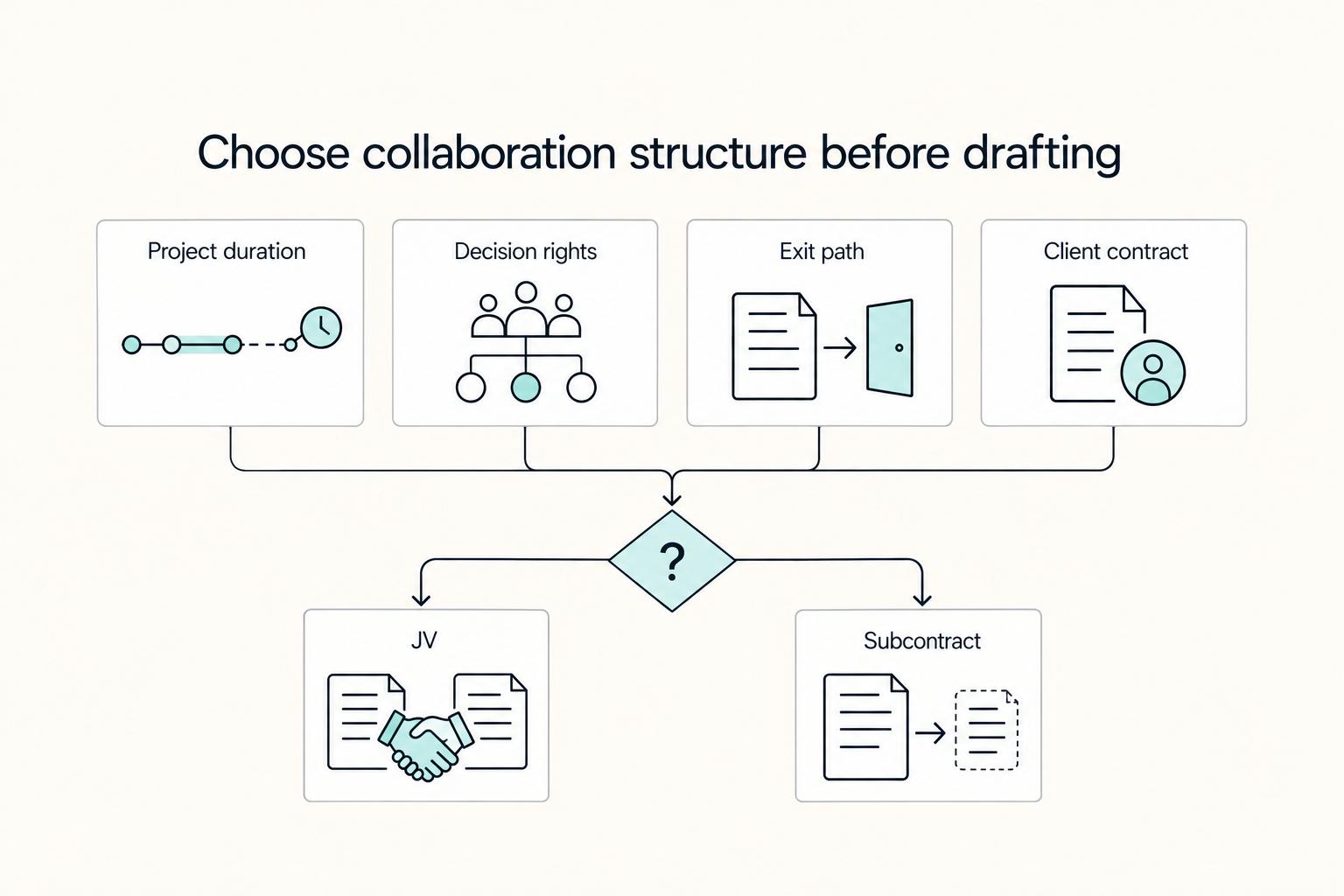
Choose the legal structure before you negotiate scope, price, or timeline. Shared project profit and meaningful shared control point toward a joint venture; one business hiring another to perform part of its client commitment points toward subcontracting. These are drafting indicators. Legal classification also depends on the agreement, actual conduct, entity form, and applicable law.
The difference starts with how the relationship is designed. A joint venture commonly involves a collaboration between two or more parties on a single enterprise or project for profit, with shared risk and some joint control. A subcontract is a downstream contract where the subcontractor provides services or supplies so the prime can perform its own contract. Those structures lead to different drafting choices, so do not treat them as interchangeable labels.
Use privity as your first checkpoint. Who is bound to the end client, and who can enforce rights against whom? In a standard subcontract structure, the subcontractor's rights run against the prime, not the client. In U.S. federal contracting, FAR 49.108-1 states a subcontractor has no contractual rights against the Government after termination of the prime contract. That is why payment and liability paths in subcontracting usually run through the prime.
Use economics as your second checkpoint. If compensation is negotiated for defined services or supplies under the prime's contract, you are usually in subcontract territory. If the agreement includes a profit and loss sharing mechanism tied to the overall project, that points toward a joint venture. Also, do not assume a JV must be a new entity. In the U.S. small-business contracting context, 13 CFR 121.103(h)(1) says it may be a partnership-style arrangement or a separate entity, so confirm the form in the agreement.
| Decision point | Joint venture | Subcontractor relationship |
|---|---|---|
| Control | Some joint governance, with operational authority allocated by agreement. In SBA mentor-protégé small-business set-aside JVs, the small-business managing venturer controls day-to-day contractual performance. | Prime leads the client commitment, with subcontracted scope performed under that contract. |
| Liability path | Risk follows the shared enterprise and should be allocated in the JV agreement. | Client-contract responsibility usually remains with the prime; downstream recovery depends on the subcontract. In U.S. federal procurement, FAR 9.604 preserves the Government’s right to hold the prime fully responsible. |
| Payment logic | Profit and loss sharing tied to the overall project outcome. | Negotiated compensation for defined services or supplies under the prime contract. |
| Client ownership and contact | Set in the JV agreement and lead structure; it may be shared or lead-designated. | Usually routed through the prime unless contract terms say otherwise. |
| IP default position | Do not assume pooled ownership. Set assignment and license terms explicitly. | For U.S. copyright, the author normally owns the work initially, subject to valid work-made-for-hire treatment or transfer. Specify assignment or license rights; other IP and jurisdictions can differ. |
| Operational overhead | Can be higher, especially where governance, economics, roles, and exits are documented. In SBA-regulated federal work, the JV agreement must be in writing. | Often simpler contract administration centered on prime-subcontract terms. |
A common failure is a label mismatch. You call it a subcontract but draft shared profit and shared governance. Or you call it a JV when one side is only buying specialist capacity. Before you sign, verify four points in the draft: who signed the client contract, who controls day-to-day delivery, how money is calculated, and whether IP transfer is written.
When should you use each structure?#
- Use a joint venture when both sides are combining resources for one defined project, expect to share upside, and need meaningful governance input.
- Use a subcontract when you want one lead, client-facing business and a specialist partner delivering under a defined scope for negotiated pay.
- If the draft includes shared profit and loss and shared control, do not frame it as a simple vendor arrangement.
- If your goal is added capacity or specialist execution, start with subcontracting unless you have a real need to share governance.
Consider a JV for a combined project that needs shared governance and project economics; consider subcontracting for specialist delivery under one prime’s client commitment. That gives you a workable first classification. Test it against control, liability, and economics together, not one factor at a time.
Related: How to Structure a Joint Venture Agreement for a Software Product.
The Control Pillar: Who Owns the Brand and the Client?#
If you need to keep final control of the client relationship, scope commitments, and release decisions, a subcontractor structure is usually the better fit. If both sides need real authority over client-facing decisions and delivery outcomes, you are likely in joint venture territory.
In practice, the control model turns on four questions: who talks to the client, who can approve changes, who owns the quality gate, and who gives final sign-off. A joint venture includes shared control over the project and a mechanism for sharing profits or losses. A subcontractor setup keeps one party in the prime role and the other furnishing services under that prime.
| Control surface | Joint venture | Subcontractor relationship |
|---|---|---|
| Client interface | Often shared or coordinated. You should name any lead role explicitly. | Usually managed by the prime, even if the subcontractor is introduced. |
| Decision authority | Shared on agreed project decisions. | Prime typically controls decisions under the client contract and directs subcontracted scope. |
| Quality gate ownership | Must be allocated clearly in the JV agreement. | Prime typically reviews, accepts, rejects, or requests revisions before delivery. |
| Visibility to end client | Often visible as a collaborating party. | Can be visible or not. Visibility alone does not change the structure. |
Federal teaming rules also treat JV and prime-subcontractor models as separate structures. Name who can authorize changes in the contract. Otherwise, people make informal commitments in calls and messages that are hard to unwind later.
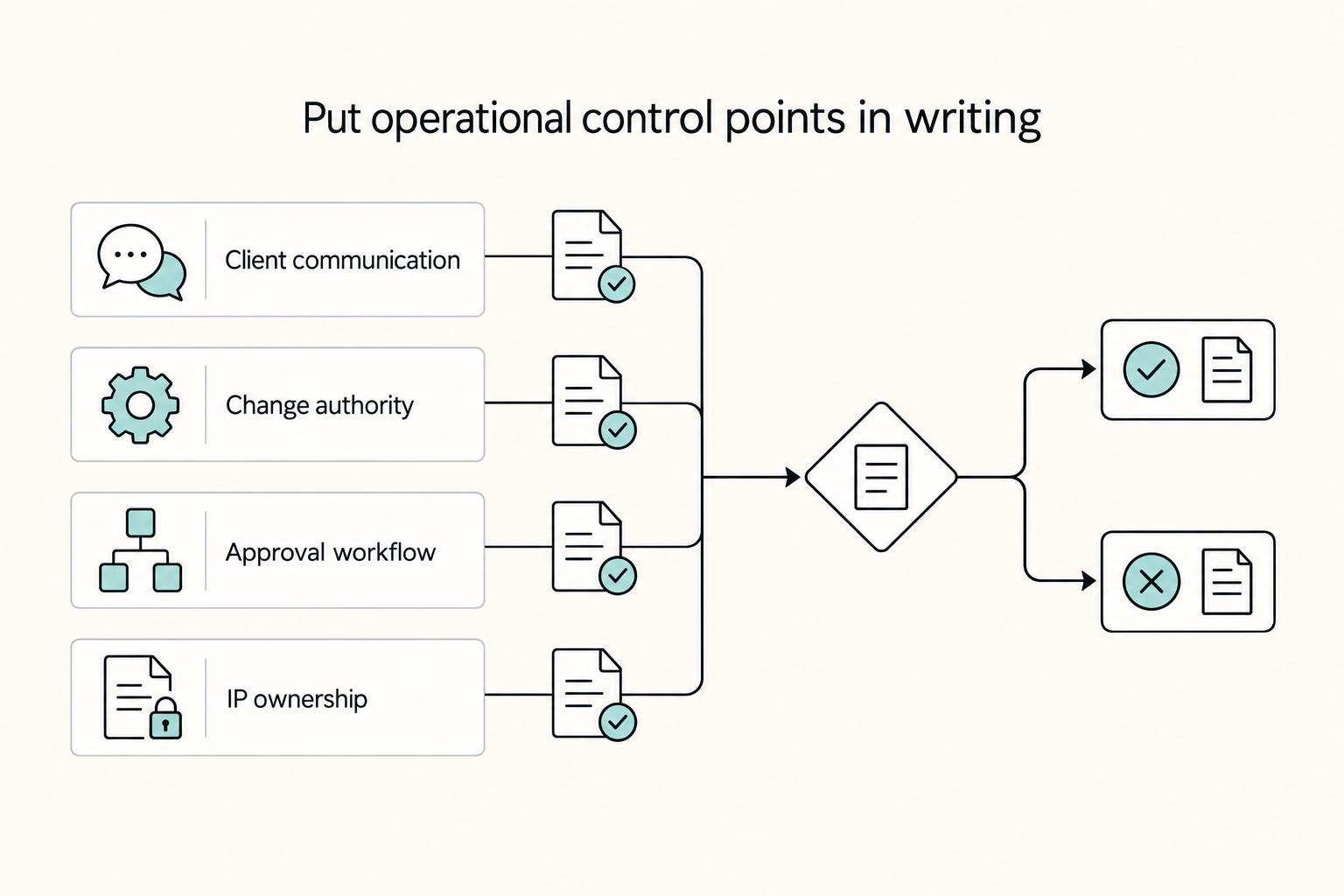
Put control points in writing#
Control can break down quickly when approval rights are implied instead of written. Use the contract to pin down the points that teams otherwise improvise under pressure.
| Control point | What to state in the contract |
|---|---|
| Client communication protocol | State who may contact the client, for what topics, and whether anyone can make delivery commitments. |
| Change-order authority | Name the specific person or role that can approve scope, fee, timeline, or specification changes. |
| Approval workflow | Define submission, review window, revision rounds, and final release approval. If you are the prime, keep final sign-off with you unless shared authority is intentional. |
| Non-solicitation | If client ownership matters, include a non-solicitation clause, verify enforceability before relying on it, and keep any jurisdiction-specific limits visible for legal review. |
| IP ownership wording | For U.S. copyright, commissioned work made for hire needs both an eligible statutory category and an express agreement signed by both parties. Use an assignment where ownership must transfer and work-for-hire treatment does not apply; Section 204 generally requires the rights owner’s signed writing. |
If those points are not written down, teams tend to invent them mid-project.
A cross-border caution#
A governing-law clause is not enough in a cross-border deal. Forum-level mandatory rules can still apply, so keep jurisdiction-specific enforceability questions visible for legal review. If you need deeper drafting help on shared governance, read How to Structure a Joint Venture Agreement Between Two Freelancers.
Which model fits when control is the deciding factor?#
If control is the deciding factor, the choice is usually straightforward. Choose a JV when both sides need a defined voice in client communications, change approval, and release decisions. Choose subcontracting when you need one relationship owner, one final quality gate, and one party with clear authority to approve client changes. If those rights are still blurry after drafting, treat that as a warning before you move on to liability allocation.
You might also find this useful: The legal difference between 'licensing' your IP and 'assigning' your IP.
The Liability Pillar: How to Avoid Inheriting a Catastrophe#
Liability is often the tie-breaker. A subcontract can keep client-contract responsibility with the prime and allocate specified losses downstream, but indemnity is not automatic and the label does not bar separate statutory or tort claims. For a JV, check governing law, entity form, client-contract wording, and insurance: some structures can expose one member to the full loss.
In a JV, an outside claimant may have a direct path to multiple participants. Where joint-and-several liability applies, each liable party can be pursued for the full loss. The party that pays then seeks contribution from the others. In practice, that second step is often where recovery friction shows up.
In a prime-subcontractor chain, the end client's main contract claim is usually against the prime, and the prime then pursues the subcontractor under the subcontract. The core mechanic is privity. Who has the contract relationship to enforce claims directly? A federal example shows the pattern. FAR 42.505 recognizes no privity between the Government and subcontractors and routes direction affecting the prime contract to the prime in writing. That is a federal contracting example, not a universal rule for all private or non-U.S. deals.
| Liability point | Joint venture | Subcontractor chain |
|---|---|---|
| Claim direction | A client or employer may have a direct path against multiple JV members where governing law and contract structure support it. | The end client's primary contract claim is usually against the prime. Subcontractor liability usually runs to the prime. |
| Fault attribution | Where joint-and-several liability applies, one liable member may face full recovery first, then seek contribution internally. | Prime usually handles its client-contract claim first, then may pursue the subcontracted portion under enforceable subcontract terms. |
| Indemnity flow | Cross-indemnities can reallocate losses between members, but do not prevent third-party claims from landing first. | An enforceable downstream indemnity can allocate specified losses from sub to prime; scope, statutory limits, and fault rules still matter. |
| Practical recoverability | Collection risk can shift to post-payment contribution claims. | Recovery depends on indemnity wording, notice and defense process, and whether the sub can pay. |
What should your indemnity clause say?#
An indemnity clause only helps if it is specific enough to use under pressure. Define covered losses, defense duties, claim notice, applicable carve-outs and limits, and survival after the work ends. Do not stop at "Party B indemnifies Party A." Make these points explicit:
| Indemnity element | What to make explicit |
|---|---|
| Covered losses | Define claims, damages, settlements, judgments, and defense costs, tied to the subcontracted scope or specified misconduct. |
| Duty to defend | State whether the indemnifying party must defend covered claims on request. California Civil Code 2778 provides interpretation defaults, unless a contrary intention appears, covering good-faith defense costs and defense on request for matters embraced by the indemnity. |
| Claim notice process | Specify who must be notified, timing, and required claim documents. |
| Carve-outs and limits | Check limits for the work and jurisdiction. For California design-professional services contracts and amendments entered on or after January 1, 2018, Civil Code 2782.8 limits indemnity to claims related to the design professional’s negligence, recklessness, or willful misconduct. It covers defined licensed architects, landscape architects, engineers, and land surveyors—not every software or graphic designer. Defense costs generally cannot exceed proportionate fault; the duty/cost-of-defense provisions have exceptions for specified project-wide insurance and written design-build JVs. Check those conditions before relying on its nonwaivable limits. |
| Survival | State that indemnity survives termination, expiration, or completion if you need post-project recovery. |
Procedural misses can weaken recovery even when the concept is right. Keep the signed agreement, scope documents, notice records, defense tender, and settlement approvals organized in one file.
How insurance affects the final call#
Insurance is the financial backstop, but only if it matches the work. Require proof of coverage before work starts where required, confirm the policy fits the actual services, and require coverage to remain in place through performance. If the exact coverage expectation is still unverified, keep it marked as unresolved in the contract checklist.
Use this practical test before you choose the structure. For a JV with potential joint-and-several exposure, assess whether you could pay first and recover contribution from solvent, insured partners. For subcontracting, compare your client obligations with the subcontract’s indemnity, liability cap, exclusions, and insurance. A narrow subcontract does not cap the prime’s separate client obligations, so test the gap before moving to scalability.
The Scalability Pillar: Structuring for Long-Term Growth#
Decide the growth structure before you accept the work. The useful signal is not the label; it is whether you can support the operating load the deal will require over time.
Consider a hypothetical software studio and localization specialist. If the studio sells a fixed client package and buys defined localization deliverables, a subcontract can organize the handoff. If both parties build and sell a combined product, contribute resources, and share project economics and governance, a JV may fit. The growth question is which obligations they want to run together, and which they can keep within a delivery boundary.
Run a practical growth filter before you sign#
Before you quote or commit to a start date, run these five checks. They help you see whether the work needs a heavier shared structure or a narrower delivery setup:
| Check | Question to ask |
|---|---|
| Capability gap | Are you closing a short-term production gap, or building a combined offer you expect to run repeatedly? |
| Market-entry need | Does this work require sustained local relationships, cross-sector partnership, or policy dialogue, or only limited local support? |
| Delivery bandwidth volatility | Is demand likely to spike and drop, or stay steady enough to justify heavier coordination? |
| Margin pressure | Can the commercial model absorb coordination, reporting, and rework without eroding the deal? |
| Long-term integration | Do you actually want ongoing integration of methods, stakeholders, and operating routines, or a narrower delivery boundary? |
Run those checks before you quote or commit, not after the scope starts moving.
Compare the build-out, not the label#
Scalability lives in the operating details. Define the setup before kickoff, then monitor whether the real work still matches that design:
| Growth checkpoint | What to define before kickoff | What to monitor during delivery |
|---|---|---|
| Capability gap | Who contributes which core capability and where handoffs occur | Whether scope is drifting beyond the agreed capability split |
| Market-entry need | Who owns external stakeholder engagement and policy dialogue tasks | Whether external-facing obligations are growing beyond plan |
| Delivery bandwidth volatility | Expansion and contraction process for workload and approvals | Cycle-level capacity pressure and response time |
| Margin pressure | Commercial assumptions, approval triggers, and reporting cadence | Whether execution costs are outpacing agreed economics |
| Long-term integration | Boundaries for shared methods, materials, and collaboration depth | Whether integration is increasing without explicit agreement |
| Onboarding time | Required setup steps, signoffs, access, and kickoff dependencies | Open setup blockers that can delay delivery |
| Repeatability | Reusable process, templates, and exception handling | How many custom exceptions are required per cycle |
| Governance burden | Meeting rhythm, decision log, escalation path, reporting owner | Missed decisions, late reports, unresolved escalations |
| Knowledge transfer risk | Minimum necessary information-sharing rules and handling process | Accumulation of access beyond operational need |
| Exit complexity | Handoff, closeout, and transition checklist | Open obligations at closeout and unresolved transfers |
If you cannot name who owns monitoring, evaluation, and reporting, you are not ready to scale that model. A common risk is accepting a "strategic" setup without an operating schedule, then discovering mid-delivery that the parties were working from different assumptions.
Before kickoff, set operating requirements you can document and monitor#
Scale a shared structure only if you are ready to run it like a shared build, not a loose collaboration. Before kickoff, set contribution responsibilities, a reporting cadence, a decision and escalation process, and a clear issue path. Where outside stakeholders are affected, define a named mechanism for raising and resolving concerns instead of handling issues informally.
If you choose a narrower delivery setup, keep the work package explicit. Before kickoff, lock scope boundaries, acceptance steps, handoff format, and operating checkpoints. Then run regular monitoring and reporting so changes show up early and move through the agreed process.
Rule of thumb: do not assume one label is automatically more scalable. Use the setup whose operating requirements you can document clearly, monitor consistently, and close out cleanly. We covered this in detail in Hiring a Subcontractor for the First Time Without Costly Surprises.
Your Decision Framework at a Glance#
Make the structure choice by control and risk, not labels. If the deal does not truly require shared governance and shared upside and downside, use a subcontractor structure.
| Decision point | Joint venture | Subcontractor |
|---|---|---|
| Legal frame | A project-specific collaboration with joint economics and agreed governance. Consider this when both sides need material decision rights and accept project risk; confirm classification and entity form under applicable law. | A prime-led downstream contract where one party furnishes services under the prime's contract. Choose this if yes: one party should control scope, client handling, pricing, and acceptance. |
| Control authority | Choose if yes: you want shared governance over delivery, budget, or strategy, and you can document approval rights. Red flag: calling it a JV when one side controls everything in practice. | Choose if yes: you want one lead party to direct the work and control change orders. Check: name who approves scope changes and who communicates with the client. |
| Risk sharing appetite | Choose if yes: both sides are willing to share exposure tied to venture debts or liabilities. Failure mode: sharing reward language without clear liability allocation. | Choose if yes: you want risk allocated by contract as far as law and facts allow, with clear terms on who is accountable to the client for performance. In federal contracting, prime responsibility remains with the prime, and subcontractors generally lack privity with the Government. |
| Growth objective | Choose if yes: you are building a combined offer, entering a market together, or pursuing repeat work that needs shared ownership. | Choose if yes: you are filling a skill gap, adding capacity, or keeping delivery under one brand and one contract lead. |
| Operational complexity tolerance | Choose if yes: you can run heavier governance, joint reporting, and a more involved exit. | Choose if yes: you want cleaner handoffs, simpler administration, and tighter delivery boundaries. |
Practical starting point: A common default is subcontracting unless the collaboration truly requires shared governance and shared upside and risk. Before signing, run the right pre-sign checks. For a JV, lock governance, contribution duties, liability allocation, IP and client-relationship rights, and a clear exit and dispute process. For a subcontract path, lock prime control over client communications and acceptance, define scope and liability boundaries, and put IP terms in writing. For commissioned U.S. copyright work, work-made-for-hire treatment requires an eligible statutory category as well as an express agreement signed by both parties. Where that test is not met, document the assignment or license the project actually needs. The Copyright Office’s Circular 30 explains the categories; Sections 201 and 204 cover initial ownership and signed transfers.
For more on operating a prime-led model, see The Solo Agency Blueprint for Productized Services and Subcontractor Control. Once you choose JV or subcontractor, turn that decision into clear scope, IP, and liability language with this freelance contract generator.
Conclusion: Architecting Your Enterprise#
Choose the structure based on how the work will run in practice. FAR 9.601 distinguishes a partnership or JV acting as potential prime from a prime-subcontractor team under a specified Government contract. For private or cross-border collaborations, the control, liability, and scalability framework helps you draft the relationship; applicable law and actual conduct determine its legal effect.
Use the three-pillar check to reach a final answer:
- Control: who owns the client, pricing, scope changes, and final acceptance.
- Liability: how risk is assigned in real operations, not just on paper.
- Scalability: whether you want a repeatable lead-party model or a shared model with heavier coordination.
Use this mini-framework for the choice:
- Collaboration goal: Are you adding capacity, or building a combined offer together?
- Risk tolerance: How do you want responsibility and risk allocated in the contract?
- Client ownership: Who will handle client communications, change decisions, and acceptance?
- Delivery model: Do you need repeatable staffing under one lead, or shared control each time?
Before your next contract draft, confirm these four items:
- Define the relationship type and make sure the facts match it.
- Assign responsibility boundaries for scope, approvals, and performance.
- Set client communication rules and change-approval authority.
- Confirm IP, confidentiality, and exit and dispute terms in writing.
If the deal involves U.S. small-business federal procurement, check the applicable solicitation and SBA program before using a generic JV template. For example, 13 CFR 125.8(b)(2) specifies management, ownership, profit, account, and responsibility terms for a protégé–SBA-approved-mentor JV performing a small-business set-aside or reserved contract; its rules differ from those for a JV of independently small entities. Match those requirements to the actual offer. For private or cross-border work, get jurisdiction-specific review of unclear classification, liability, and IP terms before signing.
For a step-by-step walkthrough, see Confidentiality vs Non-Disclosure in Freelance Contracts. When your agreement is signed and you need controlled cross-border disbursements, review Gruv Payouts.
Frequently Asked Questions
When should you use each structure?
Consider a JV for a combined project that needs shared governance and project economics; consider subcontracting for specialist delivery under one prime’s client commitment. That gives you a workable first classification. Test it against control, liability, and economics together, not one factor at a time. Related: How to Structure a Joint Venture Agreement for a Software Product.
Which model fits when control is the deciding factor?
If control is the deciding factor, the choice is usually straightforward. Choose a JV when both sides need a defined voice in client communications, change approval, and release decisions. Choose subcontracting when you need one relationship owner, one final quality gate, and one party with clear authority to approve client changes. If those rights are still blurry after drafting, treat that as a warning before you move on to liability allocation. You might also find this useful: The legal difference between 'licensing' your IP and 'assigning' your IP.
What should your indemnity clause say?
An indemnity clause only helps if it is specific enough to use under pressure. Define covered losses, defense duties, claim notice, applicable carve-outs and limits, and survival after the work ends. Do not stop at "Party B indemnifies Party A." Make these points explicit: Procedural misses can weaken recovery even when the concept is right. Keep the signed agreement, scope documents, notice records, defense tender, and settlement approvals organized in one file.
Try a related tool
Researched and edited by the Gruv editorial team. Gruv builds cross-border billing, payouts, and finance-operations software for global businesses.
Sources
- acquisition.gov/far/44.101trusted
- acquisition.gov/far/42.505trusted
- copyright.gov/circs/circ30.pdftrusted
- copyright.gov/title17/92chap2.htmltrusted
- ecfr.gov/current/title-13/section-121.103trusted
- ecfr.gov/current/title-13/section-125.8trusted
- leginfo.legislature.ca.gov/faces/codes_displaySection.xhtmltrusted
- leginfo.legislature.ca.gov/faces/codes_displaySection.xhtmltrusted
Educational content only. Not legal, tax, or financial advice.
Related Posts
How to Structure a Joint Venture Agreement Between Two Freelancers
Treat the **freelance joint venture agreement** as a working document you can use day to day, not a ceremonial signature page. Put it in place before work starts so everyone involved is working from the same written terms.

The Freelance Payment Penalty: A Modeled Audit of Platform Fees, FX Spreads, and Payout Delays
The money rarely disappears through a single, easy-to-spot fee. The real loss is stacked. A marketplace takes its commission, a processor adds a charge for international cards, a bank or payment company converts the currency at a spread, a platform holds the funds before release, and a wire sheds a little to intermediaries on the way in. Each layer looks defensible on its own, but the worker feels the combined result as a smaller deposit and a later payday.

How to Respond to a Subpoena for Business Records
Move fast, but do not produce records on instinct. If you need to **respond to a subpoena for business records**, your immediate job is to control deadlines, preserve records, and make any later production defensible.