
Quick Answer
Use double trigger acceleration as a two-event clause in your services agreement: a Change of Control event plus a post-deal adverse action your contract recognizes. Put core definitions in the MSA, tie project economics to the SOW or order form, and state what evidence qualifies, such as written notice or revised scope documents. This setup protects revenue when documented disruption happens, not when ownership changes by itself.
What Double-Trigger Acceleration Means for a Freelancer or Consultant#
Double trigger acceleration means a protection turns on only after two separate events happen, not one. For a freelancer or consultant, it matters when a client gets acquired and the deal is followed by a cancellation, fee cut, or another contract event that knocks out expected income. A sale alone does not automatically trigger a payout, but a sale plus a defined adverse action might.
In corporate equity documents, the first trigger is usually a Change of Control, and the second is a Qualifying Termination. You can adapt that logic for a services agreement even though your contract is about revenue, not vesting or stock options.
The two triggers in contract terms#
A Change of Control is a defined contract term, not a universal phrase. Depending on the agreement, it might include a merger, a sale of substantially all assets, or a share transfer that gives a new party control. That definition needs to be written down clearly because there is no standard wording. If your contract just says "acquisition" and stops there, you may end up arguing later about whether a deal structure counts.
A Qualifying Termination is the second trigger. In executive agreements, this often means termination without cause or resignation for good reason, sometimes within a stated post-transaction window such as twelve (12) months in sample clauses.
For a business-of-one, the practical translation is narrower and more contractual. It can cover termination that is not based on your uncured breach, or a client-imposed change that your agreement says counts, such as a material scope removal or fee reduction. In practice, your master services agreement should define both the event and the remedy, along with any notice requirement and time window.
Single-trigger vs double-trigger for an independent professional#
| Structure | Continuity incentive | Payout or remedy condition | Your risk exposure |
|---|---|---|---|
| Single-trigger | Weaker incentive for the new owner to keep the relationship going | Change of control alone can trigger the protection | Better immediate protection, but more likely to face pushback in negotiation |
| Double-trigger | Stronger incentive to preserve continuity after a sale | Change of control must be followed by a qualifying termination or defined adverse action | More balanced, but only works if the second trigger is drafted tightly |
| No trigger clause | No special continuity protection tied to ownership change | Ordinary termination terms only | Highest exposure if a buyer resets vendors after closing |
That balance is one reason the two-step design appears frequently in corporate deals. In Alvarez & Marsal's November 18, 2025 report covering 100 S&P Composite 1500 companies, 90% applied double-trigger vesting to CEO equity awards. That does not mean freelancer contracts use it by default, but it does show why buyers and investors often prefer a structure tied to both ownership change and termination.
When to prioritize it#
Prioritize this clause when one client represents a meaningful share of your revenue, your work is embedded in their operations, or a competitor acquisition would create obvious risk. Another red flag is a client with broad termination-for-convenience rights and no ownership-change language at all.
If the engagement is short, low-dependency, and easy to replace, a simpler protection may be enough: longer notice, a kill fee, or prepaid transition work. One common failure mode is assuming a generic assignment clause solves the same problem. It may not. You want a specific change-of-control definition, a specific second trigger, and a specific payment or wind-down right.
You might also find this useful: What is a 'Vesting Schedule' for Founder and Employee Equity?.
Defining Trigger 1, Trigger 2, and the Payoff in Your Contract#
Treat this clause as a contract system, not just a concept: define Trigger 1, Trigger 2, and the Payoff so each part is verifiable in your MSA or SOW. If any one piece is vague, the protection is harder to enforce and easier to challenge.
Identify the open items before legal review, but do not fill them with generic numbers. Timing windows, reduction thresholds, and assignment treatment are jurisdiction-sensitive, so keep the fee-reduction threshold, notice window, and assignment treatment pending governing-law review before you finalize.
| Clause part | What it means in your contract | What you should explicitly define |
|---|---|---|
| Trigger 1 | A defined Change of Control affecting your client | Event definition, acceptable evidence, whether client notice is required, whether related assignments require your consent |
| Trigger 2 | A defined Adverse Action affecting your engagement after Trigger 1 | Qualifying event, exclusions, written notice process, cure process (if any), deadline to assert the claim |
| Payoff | The remedy if both events happen | Fee formula or continuation right, payment due date, invoice mechanics, interaction with termination rights and unpaid amounts |
Trigger 1#
Define Change of Control by event category, not labels like "sale" or "acquisition." A useful drafting frame is ownership change, effective-control change, or ownership change of a substantial portion of assets; use that structure, then tailor it to your services agreement.
| Element | What to define | Examples named |
|---|---|---|
| Event category | Define Change of Control by event category, not labels like "sale" or "acquisition" | ownership change; effective-control change; ownership change of a substantial portion of assets |
| Evidence | State what counts as proof | public announcement; SEC filing; merger document; similar formal transaction record |
| Notice | Say whether client notice is required | client notice can be required |
| Assignment treatment | Address transfer and consent separately if counterparty identity matters | non-assignment language requiring your consent to transfer |
State what evidence counts. You can require client notice and/or allow objective proof such as a public announcement, SEC filing, merger document, or similar formal transaction record. If you want asset deals included, say so explicitly, since "all or substantially all assets" is fact-specific and not a bright-line test.
If counterparty identity matters, pair this with non-assignment language requiring your consent to transfer. Do not assume every ownership change automatically counts as assignment under all state laws.
Trigger 2#
Make the second trigger specific and documentable. The standard model is a qualifying post-transaction adverse event, such as termination without cause or a defined "good reason"-type event, so your contract should translate that into concrete events tied to records.
| Item | Included or excluded | Qualifier/example in text |
|---|---|---|
| Termination without cause | Can qualify as Trigger 2 | termination notice |
| Client-imposed fee reduction above a contract-specific threshold pending review | Can qualify as Trigger 2 | revised SOW or written client instruction |
| Removal of a material scope component | Can qualify as Trigger 2 | revised SOW or written client instruction |
| Your uncured material breach | Excluded example | uncured |
| Mutually signed scope changes | Excluded example | mutually signed |
| Routine project administration | Excluded example | does not materially impair the engagement |
Use measurable triggers such as termination without cause, a client-imposed fee reduction above a contract-specific threshold pending review, or removal of a material scope component. Tie each one to evidence you can produce, such as a termination notice, revised SOW, or written client instruction.
Also define exclusions. Common exclusions are your uncured material breach, mutually signed scope changes, and routine project administration that does not materially impair the engagement.
If appropriate for your governing law and deal context, include written notice plus cure mechanics. SEC-filed agreements show examples like 30 days to cure after notice and sixty (60) days to give notice of a good-reason event, but those are drafting examples, not default rules.
Payoff#
State the remedy in operational terms. Specify whether the payoff is a wind-down fee, fixed transition package, continued payment during a notice period, or a combination. Then define exactly when it is triggered and how invoicing works.
Pressure-test the clause against a realistic transition scenario: ownership changes, sponsor turnover, scope reduction, and payment delays. If the contract does not clearly tell you what to invoice and what documentation supports it, the payoff language is still too loose.
Use a stronger version when dependency and continuity risk are high, for example, high revenue concentration in one client or deeply embedded work. Use a lighter version when replacement risk is low and standard notice or termination protections already cover most downside. The stronger the protection, the more precisely you should define events, evidence, and exclusions.
If you want a deeper dive, read Sole Proprietorship vs. LLC: The Definitive Guide for Global Freelancers.
The Strategic Advantage: Why This Approach Works#
Think of this as a risk-allocation choice: single-trigger pays on the deal event itself, while double trigger pays only if two events occur, typically a change of control followed by a defined adverse action.
| Decision point | Single trigger | Double trigger |
|---|---|---|
| Who bears more post-deal risk | Client/acquirer bears payout risk at close, even if work continues | Risk shifts to the party causing post-deal harm, because payout is tied to a second event |
| When payment activates | At transaction close (one event) | After two events (change of control + qualifying adverse action) |
| Continuity effect after close | Can feel disconnected from actual disruption | Better aligned to continuity because payment is tied to real post-deal impact |
This framing also clarifies incentives. For you, it targets the disruption you actually need to hedge against after a deal. For current client leadership, it reduces windfall concerns when services continue. For an acquirer or investor, it can support continuity goals during integration because protection is tied to what happens after close, not just the close itself.
A single trigger can still be used, but it may create more deal friction when payment is not linked to post-deal disruption. In startup equity discussions, single-trigger terms are often described as less common in deal settings, but market signals vary by segment. Verify any market-practice signal from current source records before using it in negotiation materials.
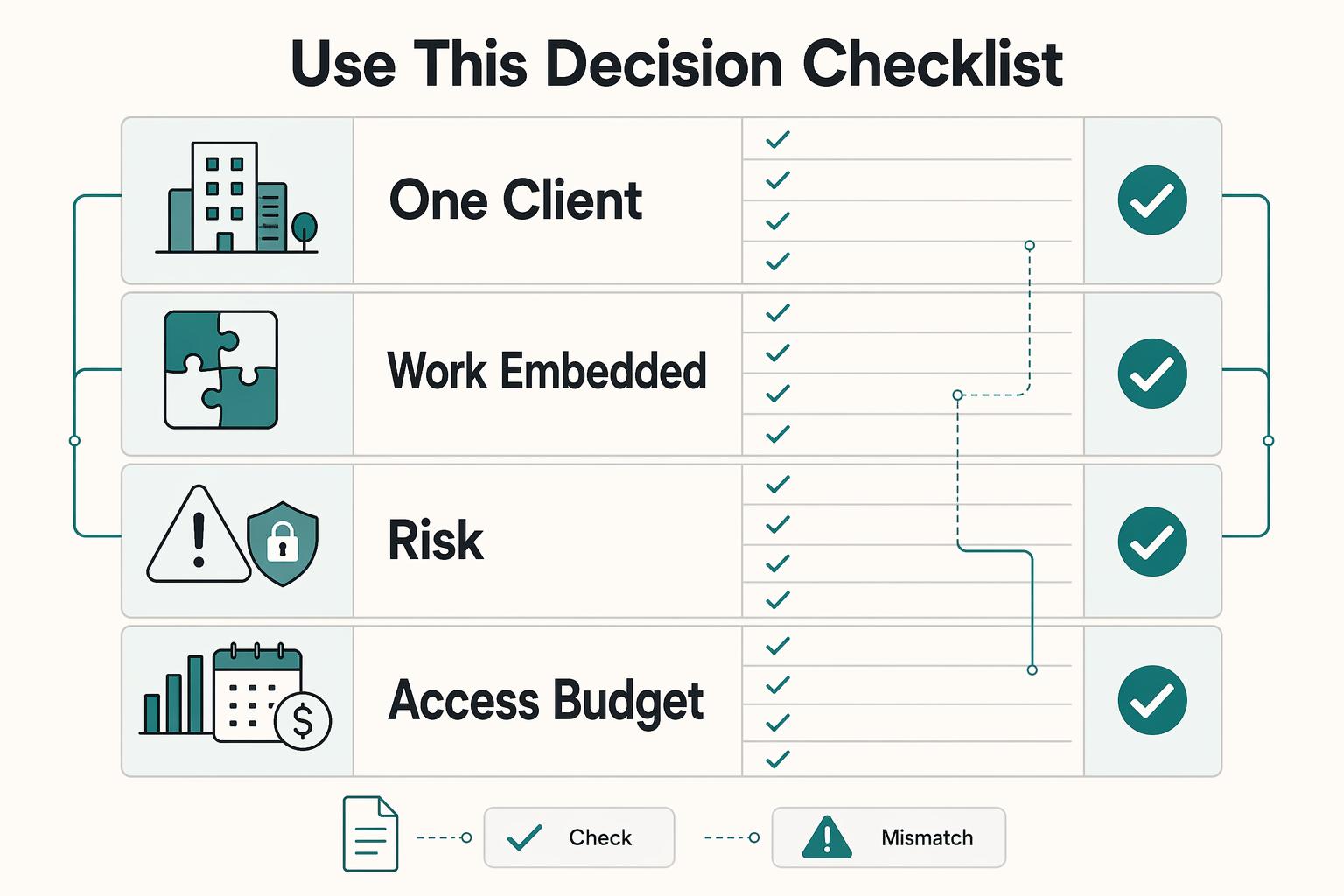
Use this decision checklist#
Use this checklist before you push for the clause:
- One client represents a meaningful share of your revenue
- Your work is embedded in operations, product, compliance, or customer delivery
- Handoff risk is high because key context sits with you
- Access, budget authority, or sponsor continuity could change after the deal
- Your main risk is post-deal scope, org, or termination changes, not the deal announcement itself
When most of these are true, double-trigger protection is usually the stronger fit. Position it this way: "This is a continuity and governance mechanism for change-of-control scenarios, with payment only if the transaction is followed by a defined adverse action, subject to jurisdiction-specific drafting and enforceability review."
For a step-by-step walkthrough, see How to Handle the Integration Phase After an Acquisition.
Your Action Plan: How to Negotiate and Implement This Clause#
Treat this as a business continuity clause: you are asking for a clear process if a change event happens and a defined adverse action follows. The goal is not a payout on the transaction alone, but a pre-agreed rule for disruption.
1) Prepare your rationale before drafting#
Write one plain-language paragraph you can reuse in negotiations:
- Continuity is the purpose
- Payment activates only if both events occur
- The clause helps both sides avoid ad hoc conflict during integration
2) Choose the right contract location#
If you use a master agreement plus project documents, place core trigger logic in the master agreement and keep project economics in the SOW/work order. If terms are already signed, use a bilateral amendment signed by both sides.
| When to introduce it | Outcome to ask for |
|---|---|
| New engagement | Add base clause in the main services agreement before signature |
| Renewal | Add or refine terms while commercial terms are open |
| Scope expansion | Keep trigger framework in the master; align remedy mechanics in the project document |
| Procurement/legal review | Confirm definitions, precedence, notice mechanics, and signatory authority |
3) Align internal red lines first#
Decide in advance:
- what counts as Trigger 2
- what remedy structure you can accept
- what you will not concede
Avoid vague Trigger 2 language. If the second trigger is unclear, the clause becomes hard to apply.
4) Present a modular template, not one dense paragraph#
| Block | What to include | Verification note or example named |
|---|---|---|
| Definition block | Define the change event | Current ownership threshold pending governing-law and contract review if you need one |
| Trigger block | Define Trigger 2 with specific, testable language | termination without cause or resignation for good reason; current post-transaction window pending legal review |
| Remedy block | State formula, payment timing, and any transition expectations | Current fee formula and payment timing pending contract review |
| Notice/process block | Require written notice, specify notice recipients, and state document precedence | terms control unless expressly superseded |
- Definition block
Define the change event. If you need an ownership threshold, keep the threshold pending governing-law and contract review until it is verified.
- Trigger block
Define Trigger 2 with specific, testable language, for example, termination without cause or resignation for good reason. If needed, keep the post-transaction window pending legal review until it is verified.
- Remedy block
State formula, payment timing, and any transition expectations. Keep the fee formula and payment timing pending contract review until the underlying economics are verified.
- Notice/process block
Require written notice, specify notice recipients, and state document precedence so it is clear which terms control unless expressly superseded.
5) Handle objections by category#
- Scope concern
Narrow definitions so only clearly defined adverse actions qualify.
- Fee concern
Tie remedy to documented disruption using a formula, not a punitive framing.
- Fairness concern
Reconfirm the two-trigger structure: no payment on change event alone.
- Enforceability concern
Route to legal review under the governing jurisdiction and adjust mechanics while keeping continuity intent.
6) Execute cleanly and keep a usable file#
Before signature, confirm who is authorized to bind each party. After signature, keep a complete record set: signed agreement, signed modifications, approval trail, and legal review notes, so you can use the clause in practice if a change event occurs.
Related: How to Structure an Employee Stock Option Plan (ESOP) for a US Startup.
From Anxious Contractor to Indispensable Partner#
You operate more like a partner when you treat ownership-change risk as a documented process, not a private worry. In this context, "indispensable partner" means you use written continuity terms, pre-agreed transition mechanics, and a predictable response if a change in control is followed by a qualifying adverse action.
In a services agreement, that keeps the clause mechanical instead of emotional. You are not asking for payment just because an acquisition happens. You are defining two events: first, a change in control, often defined to include a majority ownership change or sale of substantially all assets, and second, a qualifying event such as termination without cause or a document-defined Good Reason event.
| Reactive contractor behavior | Partner-level operator behavior |
|---|---|
| Waits to see whether the new owner keeps the work | Defines a change-of-control workflow in the MSA or order form |
| Assumes acquisition automatically changes the contract | Reviews anti-assignment and change-of-control wording before negotiating |
| Treats any disruption as unfair | Lists qualifying adverse actions, notice rules, and response steps |
| Scrambles after post-close confusion | Maintains continuity records: signed amendments, precedence terms, and notice contacts |
Anti-assignment language is a key checkpoint. A change in control is not always an assignment unless the contract says so, and whether consent is required depends on the exact wording and governing law. Some Delaware-focused commentary also notes that "by operation of law" language can apply to certain mergers when the original contracting entity is not the survivor. Read assignment, amendment, and precedence clauses together before you redline.
To make the clause operational, define the post-acquisition process: who gives notice, where notice goes, what documents count as proof, and what happens after a qualifying adverse action. If you use a timing window for the second trigger, write it explicitly. Equity documents often use 9-18 months after closing and sometimes include a short pre-closing window of 3 months or shorter, but your service agreement has no automatic default.
A quick decision check#
- Propose the full clause when this client is important to your pipeline, your work is embedded in ongoing operations, or an acquirer could reduce the engagement after close.
- Keep it light when the engagement is short, self-contained, or easy to replace; stronger notice, transition support, and payment-for-committed-work terms may be enough.
- Escalate to legal review when anti-assignment wording is dense, governing law is cross-border, affiliate substitution rights are broad, or amendment mechanics are unclear.
Your professionalism shows up in operations: clear terms, aligned incentives, and smoother ownership-change handoffs. Want to confirm what's supportable for your specific situation? Talk to Gruv.
Frequently Asked Questions
Can you add this clause to an existing contract?
Yes, but treat it as a formal amendment, not an informal side email. Raise it when the parties are already reopening commercial terms. If the agreement says changes must be in writing and signed, oral approval is not enough.
Is this only for retainers, or can project work use it too?
You can draft it for either model, but define both triggers clearly. Double-trigger terms require two events, so a change of control alone should not create payment. | Engagement model | Trigger design | Remedy format | Proof you should keep | |---|---|---|---| | Ongoing retainer | Change of control plus termination without cause, or contract-defined Good Reason | A contract-specific amount reviewed before signing | Signed amendment, notice trail, release documents if required | | Fixed project | Change of control plus contract-defined termination or scope reduction | An amount tied to remaining committed work under the SOW/order documents | Signed SOW, milestone records, acceptance records | | Deliverable-heavy project | Change of control plus a contract-defined event tied to accepted deliverables | A contract-defined amount tied to accepted deliverables or committed milestones | Acceptance criteria, approvals, written change documentation |
What is a reasonable termination amount?
Do not start with a generic month count or percentage. Draft it as a defensible estimate based on your contract structure and documented commitments. Keep the current termination amount pending contract and legal review until the number is validated.
What does not qualify as an adverse action?
Do not assume every post-acquisition inconvenience counts. If your contract uses "without cause" or "Good Reason," only the defined events should qualify, such as a defined relocation threshold or other explicitly listed adverse changes. The acquisition itself should stay outside the trigger unless your document says otherwise.
Try a related tool
Researched and edited by the Gruv editorial team. Gruv builds cross-border billing, payouts, and finance-operations software for global businesses.
Sources
Includes 2 external sources outside the trusted-domain allowlist.
- acquisition.gov/far/part-43trusted
- acquisition.gov/far/subpart-4.7trusted
- ecfr.gov/current/title-26/chapter-I/subchapter-A/part...trusted
- irs.gov/pub/irs-drop/n-05-01.pdftrusted
- sec.gov/Archives/edgar/data/1170723/0001193125051824...trusted
- sec.gov/Archives/edgar/data/913885/00011931250724738...trusted
- lawinsider.com/clause/double-trigger-accelerationexternal
- scaleup.mofo.com/guidance/equity-fundamentals-single--vs-doub...external
Educational content only. Not legal, tax, or financial advice.
Related Posts

Sole Proprietorship vs LLC for Global Freelancers in 2026
For most freelancers in 2026, the practical default is still simple: use the simplest structure you can run cleanly, then formalize when risk actually rises. If your work is still in validation mode and the downside is contained, a sole proprietorship is often the practical starting point. When contract exposure, delivery stakes, or dispute risk starts climbing, forming an LLC deserves earlier attention.
How to Structure an Employee Stock Option Plan (ESOP) for a US Startup
If you searched for **employee stock option plan esop**, stop and sort out the label first. In startup conversations, people often say "ESOP" when they mean a stock option plan or option pool. A formal **Employee Stock Ownership Plan (ESOP)** is different. It is often discussed as a business transition option for owners, while startup stock options are commonly used to give employees a stake in the business.
What Is a Vesting Schedule for Founder and Employee Equity?
Your equity grant is not a perk. It is a high-stakes financial asset, and it may become a meaningful part of your net worth. Most guides explain what you were given. This one is about what to do with it.