
Quick Answer
Classify your conduct before you file anything: non-willful situations usually reflect mistake-level behavior, while willful exposure increases when records suggest reckless disregard or willful blindness. Review your filed return package, especially Schedule B Part III, alongside account statements and a dated timeline of what you knew and when. If those records conflict, pause self-directed corrections and get qualified guidance before selecting delinquent or streamlined procedures.
For modern global professionals, FinCEN Form 114, or the FBAR, creates a familiar kind of stress. You use platforms like Wise, Deel, and Revolut because they make your work easier and your finances more flexible. That flexibility is useful, but it also creates compliance complexity and, with it, the risk of a serious mistake. The line between an honest error and a willful violation can feel uncomfortably thin, and the penalties are not something to take lightly.
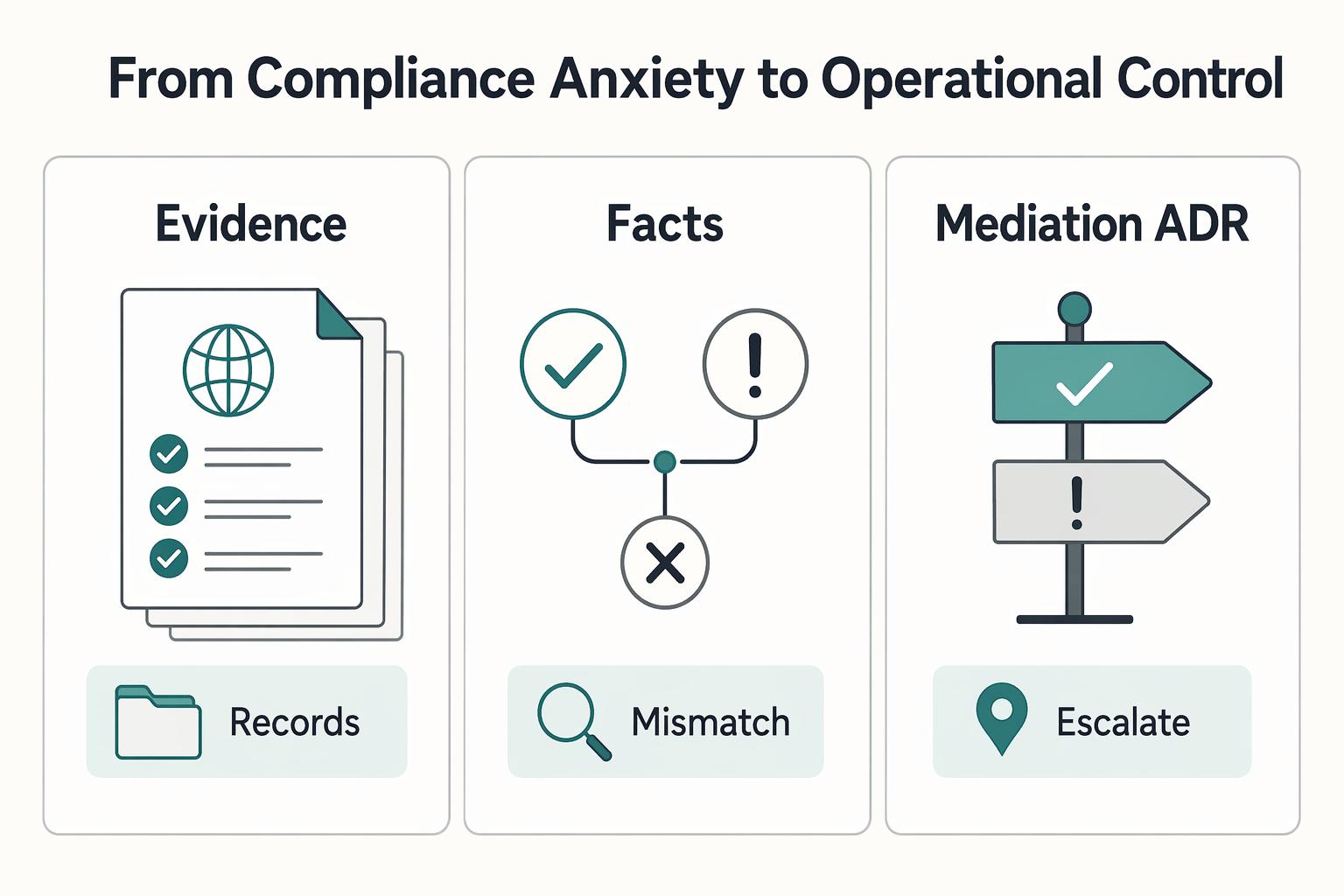
Most of that anxiety comes from ambiguity. The practical fix is to replace ambiguity with a repeatable process. This guide does that in three steps. First, understand how the rules frame your risk. Second, audit your own facts before you act. Third, build a simple control system so FBAR compliance stops being a yearly scramble and becomes a routine decision.
Step 1: Assess the Landscape - Understanding the Rules of the Game#
Start by classifying your conduct. FBAR penalty exposure turns on intent-related facts, not just account count or balance size.
If the aggregate value of your foreign financial accounts exceeded $10,000 at any point during the year, an FBAR was due by April 15 with an automatic extension to October 15. Once that trigger is met, the IRS says penalty assertion depends on the facts and circumstances.
How to classify your conduct#
Non-willful: conduct due to negligence, inadvertence, or mistake. In practice, you missed the rule or made an honest error rather than trying to avoid the filing duty.
Willful (civil standard): evaluated under a civil willfulness standard, based on the facts. In practice, facts can support willful treatment when they indicate intentional noncompliance, reckless disregard, or willful blindness.
Reckless disregard (within willful): you clearly should have recognized a grave risk of noncompliance. In practice, ignoring obvious prompts to check foreign-account reporting can be treated as willful-level behavior.
Willful blindness (within willful): conscious effort to avoid learning a legal duty. In practice, this is not just "I didn't know," but "I avoided finding out."
Side-by-side comparison#
| Violation type | How enforcement is evaluated | Potential consequence range | Mitigation may be available? |
|---|---|---|---|
| Non-willful | Facts support negligence, inadvertence, or mistake | Statutory cap is $10,000 per report before inflation adjustments. Verify the current cap before relying on it. | Yes. A reasonable-cause pathway may be available if statutory conditions are met. |
| Willful | Civil willfulness standard, based on facts | Statutory formula is the greater of $100,000 or 50% of the account balance, before inflation adjustments. Verify the current cap before relying on it. | Possible, but usually not a DIY path. |
| Reckless disregard | Treated within civil willfulness when facts show grave-risk disregard | Same willful formula if sustained | Typically needs professional analysis. |
| Willful blindness | Treated within civil willfulness when facts show conscious avoidance | Same willful formula if sustained | Typically needs professional analysis. |
Why Bittner still matters#
The Supreme Court held that non-willful FBAR penalties accrue per report, not per account. The case involved 272 accounts and a $2.72 million government calculation before the Court resolved that penalty-unit issue.
Your 2026 takeaway is narrow and practical. If your conduct is truly non-willful, the penalty unit is the report. IRS exam procedures currently incorporate interim guidance tied to Bittner, but before you act on this in a live matter, verify current IRS enforcement posture.
Use burden of proof as a practical decision rule#
For civil FBAR willfulness, IRS Chief Counsel states the burden is preponderance of the evidence. The Taxpayer Advocate Service has recommended a higher standard, but that is not the IRS position.
Use that as a triage rule. If your records could suggest you were on notice and still did nothing, escalate to a qualified tax professional now. If you believe your facts are non-willful, build your file early. Gather an account list, statements, prior returns, preparer communications, and a dated timeline of when you learned about the FBAR duty.
If you want a deeper dive, read What is 'Willful Blindness' in the Context of FBAR Penalties?.
Step 2: Conduct a Self-Audit - Gauging Your Personal Risk#
Once you understand the framework, test your own facts against it. Use this self-audit to classify your facts before you choose any remediation path. In a willful vs non-willful FBAR penalty situation, the key issue is evidence of conduct and intent, not your current stress level.
Work year by year:
- Confirm whether an FBAR year existed: did your foreign accounts exceed $10,000 aggregate at any point in that calendar year?
- Build a fact file from records, not memory: account list, ownership or signature authority, highest balances, filed return package, and what you knew at the time.
- Classify conduct based on documented behavior patterns.
| Behavior pattern | Likely intent category | Evidence to gather now | Immediate next action |
|---|---|---|---|
| You did not know about FBAR, gave complete foreign-account info to your preparer, and filing was still missed | Likely non-willful (mistake/inadvertence) | Organizer responses, disclosure emails, engagement records, filed return package, account statements | Preserve the disclosure trail and build a dated timeline before corrective filing |
| You had general awareness of foreign-account reporting but did not verify balances or review signed returns carefully | Non-willful argument is weaker; facts may be viewed as reckless depending on details | Signed returns, threshold-crossing statements, missing follow-up after prompts | Tighten documentation and timeline; do not overstate preparer reliance |
| You were asked about foreign accounts (software/preparer/Schedule B context) and answered "No" without verifying | Reckless-disregard risk | Schedule B Part III, interview screens, questionnaires, statements showing foreign accounts | Pause DIY remediation and get professional advice before amendments or certifications |
| You suspected reporting might apply but avoided checking, or withheld account facts | Willful-blindness or knowing-conduct risk | Contradictory communications, incomplete organizer answers, signed returns inconsistent with known facts | Escalate immediately to a qualified cross-border tax professional |
This is a triage tool, not a legal conclusion. IRS penalty assertion is fact-specific, and a willfulness finding must be supported by evidence.
Schedule B decision checkpoint#
Start with what you actually filed for each affected year, then compare that return package to the underlying account facts:
| Mismatch | Underlying fact | Record source |
|---|---|---|
| Schedule B says "No" | Records show foreign accounts and aggregate balances over $10,000 | Form 1040 + Schedule B Part III |
| Filed return reflects a contradictory answer | You disclosed foreign accounts to a preparer | Exact signed or e-filed return copy; preparer communications |
| Return package does not align with the fact pattern | You had signature authority over a foreign account | Return package |
Pull these records first:
- Form 1040 + Schedule B Part III
- The exact signed or e-filed return copy
- Tax organizer or software interview responses
- Preparer communications
Then check for contradictions such as:
- Schedule B says "No," but records show foreign accounts and aggregate balances over $10,000
- You disclosed foreign accounts to a preparer, but the filed return still reflects a contradictory answer
- You had signature authority over a foreign account, but the return package does not align with that fact pattern
Preserve records now. FBAR-related account records must be retained for 5 years and kept available for inspection.
Reasonable-cause documentation checklist#
If your facts still point to negligence, inadvertence, or mistake, build a coherent reasonable-cause file. The IRS materials summarized here do not provide an exhaustive FBAR-only list of acceptable reasonable-cause evidence, so treat this as a practical worksheet, not a guarantee of relief. Start with the documents that show what happened and when:
| Category | Item | Detail |
|---|---|---|
| Support | Advisor or preparer communications | Show what you disclosed and when |
| Support | Filing history | Shows your normal compliance pattern |
| Support | Disruption records | Serious illness, emergency, or periods when records were unavailable |
| Support | Account statements or opening documents and a dated timeline | Show when you learned of the FBAR duty and what you did next |
| Weakener | Vague explanations | Without documents |
| Weakener | Storyline that conflicts with filed return answers | Can weaken a reasonable-cause narrative |
| Weakener | Evidence you were directly prompted but did not verify | Can weaken a reasonable-cause narrative |
| Weakener | Delay after learning about the requirement | Can weaken a reasonable-cause narrative |
At minimum, gather:
- Advisor or preparer communications showing what you disclosed and when
- Filing history showing your normal compliance pattern
- Disruption records, for example serious illness, emergency, or periods when records were unavailable
- Account statements or opening documents and a dated timeline of when you learned of the FBAR duty and what you did next
If you use delinquent FBAR procedures, your late-filing explanation should match this documentation set. What can weaken a reasonable-cause narrative:
- Vague explanations without documents
- A storyline that conflicts with filed return answers
- Evidence you were directly prompted but did not verify
- Delay after learning about the requirement
Escalation triggers#
Some fact patterns are not good candidates for self-handling. Involve a qualified cross-border tax professional if any of these apply:
| Trigger | Action | Procedure note |
|---|---|---|
| Return-package contradictions you cannot reconcile cleanly | Involve a qualified cross-border tax professional | Some fact patterns are not good candidates for self-handling |
| Facts suggesting reckless disregard or willful blindness | Involve a qualified cross-border tax professional | Penalty exposure differs materially across categories |
| IRS has already contacted you about delinquent FBARs | Involve a qualified cross-border tax professional | Delinquent FBAR procedures require no prior IRS contact about delinquent FBARs |
| You are under IRS civil examination or criminal investigation | Involve a qualified cross-border tax professional | Streamlined filings are unavailable once a civil exam has started; delinquent FBAR procedures require no current exam or investigation |
Also remember the procedure limits. Streamlined filings are unavailable once a civil exam has started. Delinquent FBAR procedures require no current exam or investigation and no prior IRS contact about delinquent FBARs. Penalty exposure differs materially across categories, so finish this classification step before you file anything.
Related: VAT MOSS and Non-Union OSS for UK Freelancers Selling to the EU.
Before you classify your exposure, document your account highs in one place and run a clean threshold check with the FBAR Calculator.
Step 3: Run an Annual Routine and Know When to Stop Self-Filing#
Once you know how to classify risk, the practical move is to make future years boring.
Treat FBAR compliance as an operating routine, not a once-a-year scramble. Keep one reliable account inventory, run the same threshold check on a set cadence, and stop self-filing when the facts move beyond a clean non-willful profile.
Build one account inventory you can trust#
Your inventory should let you answer, quickly, what existed and why it was or was not reportable.
| Field | What to record |
|---|---|
| Institution details | Foreign bank or financial institution name and address |
| Account identifier | Account number or other designation |
| Account profile | Account type |
| Reporting value | Maximum value during the reporting period |
| Authority flags | Financial interest, joint ownership, signature or other authority |
| Lifecycle note | Opened or closed during year |
| Evidence link | Folder path or document link to supporting records |
Use account-type tags that match your records, for example checking, savings, brokerage, or other financial account. If you cannot pull the supporting document for a row in under a minute, your setup is not ready.
Use a folder convention that mirrors the inventory, such as /FBAR/[year]/[institution]_[last4]/, and keep statements, opening or closing records, filed FBAR copy, and filing confirmation together. Retain these records for 5 years.
Tie reviews to your filing cycle#
The easiest way to stay compliant is to tie the review to your normal filing rhythm. Run it on a cadence tied to your actual filing cycle:
- Set a review checkpoint in [month]: confirm new or closed accounts, authority changes, and missing statements.
- Add new accounts when opened, not at tax time.
- After year-end, update each row with its maximum value and attach supporting records.
- Run final filing prep by [date after verification].
- File by April 15. Treat the automatic extension to October 15 as a backstop, not your default plan.
Check the threshold the same way every year#
Consistency matters more than cleverness here. The filing trigger is aggregate: you file when foreign accounts exceed $10,000 in aggregate at any point during the calendar year.
| Input | Conversion approach | Verification note |
|---|---|---|
| Individually owned account max value | Use a documented USD conversion approach that aligns with current FBAR instructions | Save the statement showing the peak value and note the approach used |
| Jointly owned account max value | Use the same documented approach | Each owner reports the full account value |
| Signature-authority account max value (if in scope) | Use the same documented approach | Keep a record showing why authority existed |
Then total the converted maximum values across reportable accounts. Keep a threshold-note field in your template: "Aggregate trigger: over $10,000 at any point during the year."
Know when annual filing ends and remediation begins#
If you find a missed year, do not file reactively. Classify first, then choose the lane.
- If facts are non-willful and you are not under IRS civil exam or criminal investigation, and IRS has not contacted you about delinquent FBARs: pause self-filing and evaluate corrective options with qualified tax or legal counsel.
- If you have contradictory return answers, ignored foreign-account prompts, withheld facts, or conscious-avoidance indicators: stop and escalate immediately; willfulness can include willful blindness.
- If potential willfulness exists, counsel may need to assess whether streamlined is unavailable and whether IRS CI Voluntary Disclosure should be considered.
Before any corrective filing, assemble your evidence pack. Include relevant tax-return records, account statements, account opening or closing records, prior FBAR copies or confirmations, and a dated timeline of what you knew and when. Bittner still leaves non-willful exposure on a per-report basis, so remediation quality matters as much as remediation speed.
You might also find this useful: Child Tax Credit for U.S. Expats: Eligibility, FEIE, and Filing Checks.
The Control Loop: Confirm Scope, Classify Risk, Choose the Path#
The goal is not perfect certainty. It is a repeatable control loop: confirm account scope, classify conduct risk, and choose the right path before you file. That is how you turn the willful vs non-willful FBAR penalty question into a documented decision instead of a recurring worry.
Run the same three steps each filing cycle. First, confirm whether your foreign accounts exceeded the $10,000 aggregate threshold at any point in the calendar year. Second, self-audit any missed filing or incorrect assumption and determine whether your facts are clearly non-willful or need professional review. Third, either file the annual FBAR on time or choose a remediation path before filing late forms.
A strong loop gives you clearer decisions, cleaner records, and a faster handoff when professional support is needed. A weak loop usually shows up in missing statements, no support for maximum account values, or late filing before you verify whether delinquent or streamlined procedures fit your facts.
| Control point | What you confirm | Decision rule |
|---|---|---|
| Account scope | Inventory is current, maximum values documented, threshold check completed | If aggregate value exceeded $10,000, prepare the annual FBAR due April 15, with October 15 as the automatic extension |
| Conduct risk | Self-audit completed, with returns, statements, and a dated timeline organized | If facts are not clearly non-willful, stop self-filing and escalate |
| Remediation path | Corrective lane selected before acting on past years | If you are eligible for delinquent procedures (including not being under IRS civil examination or criminal investigation), file late FBARs electronically through FinCEN BSA E-Filing and include a late explanation; streamlined requires certification that conduct was not willful |
Control checklist#
Use this as your final pre-filing check:
- Confirm your account inventory is current.
- Confirm your self-audit is complete.
- Confirm your remediation path is chosen before any corrective filing.
Keep your evidence pack together and retain account records for generally 5 years from the FBAR due date. If you use delinquent procedures, penalty relief can apply when income from the foreign accounts was properly reported and tax was paid. If you have a missed year, use the FAQ below to sort out edge cases before you file or escalate.
For a step-by-step walkthrough, see How to Document 'Reasonable Cause' for IRS Penalty Abatement.
If your facts still sit in a gray area, get a second set of eyes on your compliance next steps through Contact.
Frequently Asked Questions
What is the difference between a willful and non-willful FBAR violation?
In practice, the key distinction is whether a violation is treated as willful or non-willful, because civil penalty exposure differs materially. The classification should be based on documented facts, not labels alone. | Category | Practical framing (not a legal test) | Common evidence signals | Penalty exposure | Safest immediate action | | --- | --- | --- | --- | --- | | Non-willful with strong reasonable-cause support | Mistake or misunderstanding with support that you acted reasonably | Account income reported, consistent records and timeline, prompt corrective action before IRS contact | Non-willful category; potential no-penalty result if income was reported and reasonable cause existed | Build and preserve your evidence pack, then confirm the non-willful correction path | | Non-willful without strong support | Non-willful position may be available, but support is incomplete | Gaps in records, unclear timeline, inconsistent return support | Non-willful category; statutory maximum is $10,000 (adjusted for inflation), and outcomes depend on facts | Pause filing decisions until you close key evidence gaps | | Willful or high-risk facts | Facts suggest deliberate disregard or similarly elevated risk | Unresolved warning signs, major unexplained omissions, repeated gaps | Higher civil exposure, including 50% of the maximum account balance or $100,000 (adjusted for inflation) per violation, if greater | Stop self-filing and get professional review before any submission |
What does “willful blindness” mean in practice?
Treat it as a practical risk signal, not a definitive legal test. If you had reason to verify whether foreign accounts exceeded the $10,000 aggregate threshold and did not verify, risk may be higher. If you ran the balance check, kept statements, and documented your process, a non-willful explanation is easier to evaluate.
What is “reasonable cause” here?
In this context, reasonable cause matters in the non-willful lane and is not automatic. The grounded rule is that no non-willful penalty may be imposed if you reported all account income and had reasonable cause. Your support should be concrete: filed returns, account records, a dated timeline, and a clear explanation of what failed and why.
What should you do if you realize you missed an FBAR?
Do not start with reactive late filing. Start with fact classification. Use this order: (1) stop reactive filing, (2) gather statements, prior returns, and account inventory, (3) classify conduct risk, (4) document timeline and income-reporting support, then (5) choose the correction path. Timing is critical because some non-willful correction procedures may be available only before IRS contact, and may be unavailable after contact. If you already know you have prior-year gaps, read What to Do If You've Never Filed an FBAR (Delinquent FBAR Procedures).
Do court cases affect your penalty risk?
They can affect how penalties are interpreted, but they do not replace a facts-first review of your own file. Your practical risk still turns on conduct classification, evidence quality, and tax-year specifics. Use case updates as a prompt to re-check your position, not as a shortcut decision rule.
What should you verify before relying on any deadline or penalty figure?
Verify the current FinCEN due-date page each year, since event-specific relief can change timing for affected filers. Verify the filing artifact itself: FBAR is filed on FinCEN Form 114. Verify current inflation-adjusted penalty figures before acting on any checklist or article.
Try a related tool
Researched and edited by the Gruv editorial team. Gruv builds cross-border billing, payouts, and finance-operations software for global businesses.
Sources
- bsaefiling.fincen.gov/docs/XMLUserGuide_FinCENFBAR.pdftrusted
- bsaefiling.fincen.gov/resources/FinCENFBARHelp.pdftrusted
- fincen.gov/report-foreign-bank-and-financial-accountstrusted
- fincen.gov/reporting-maximum-account-valuetrusted
- irs.gov/businesses/small-businesses-self-employed/re...trusted
- irs.gov/individuals/international-taxpayers/delinque...trusted
- taxpayeradvocate.irs.gov/wp-content/uploads/2021/01/ARC20_PurpleBook_...trusted
- taxpayeradvocate.irs.gov/wp-content/uploads/2024/12/ARC24_PurpleBook_...trusted
Educational content only. Not legal, tax, or financial advice.
Related Posts

Portugal NHR vs Spain Beckham Law for High-Earning US Expats in 2026
Start with documentation, not tax projections. In the portugal nhr vs spain beckham law decision, the safer first move is to choose the path you can prove from end to end before you optimize for headline outcomes.

Missed an FBAR Filing? When Delinquent FBAR Procedures Fit and When They Do Not
Finding a missed FBAR filing is unsettling, especially if you are usually careful. In most cases, though, this is a sequencing problem, not a guessing game. The cleanest fix is to classify the facts, choose the right IRS path, and file a record that stays consistent from start to finish.

The Freelance Payment Penalty: A Modeled Audit of Platform Fees, FX Spreads, and Payout Delays
The money rarely disappears through a single, easy-to-spot fee. The real loss is stacked. A marketplace takes its commission, a processor adds a charge for international cards, a bank or payment company converts the currency at a spread, a platform holds the funds before release, and a wire sheds a little to intermediaries on the way in. Each layer looks defensible on its own, but the worker feels the combined result as a smaller deposit and a later payday.