
Quick Answer
For a freelancer, accounts receivable is money clients owe you, while accounts payable is money you owe vendors. You manage AR by invoicing, tracking open invoices, and following up on unpaid work. You manage AP by reviewing bills and scheduling payments under agreed terms.
Treat AP and AR as Two Cash Flow Levers#
Treat AP and AR as two cash flow levers. Accounts receivable (AR) is money clients owe you for credit sales. Accounts payable (AP) is money you owe vendors for credit purchases. In practical terms, AR affects how cash comes in, and AP affects when cash goes out.
You manage AR when you invoice clients, track what is outstanding, and follow up on unpaid work. You manage AP when you review vendor bills and schedule payments that are coming due. On your balance sheet, AR is a current asset because you expect to convert it to cash within one year. AP is a current liability because it is generally due within 12 months.
| Operating view | Accounts receivable | Accounts payable |
|---|---|---|
| What it tracks | Money customers owe you for credit sales | Money you owe vendors for credit purchases |
| Balance sheet role | Current asset, expected to convert to cash within one year | Current liability, generally due within 12 months |
| Your timing focus | Collecting as close to the agreed due date as possible | Paying on time without paying earlier than needed |
| Typical window | Often 30- or 60-day invoice terms | Often due within 30 to 90 days |
| Primary owner in a solo business | Usually you as seller, biller, and collector | Usually you as buyer and payer |
| Main risk if unmanaged | Overdue invoices, weaker real cash availability, possible bad debt | Missed due dates, possible default under agreed terms |
| First action to take | Check what is outstanding and follow up on the oldest invoices first | List all upcoming bills by due date and confirm cash coverage |
Use this mental model: one credit transaction creates two entries in two different ledgers. When you issue a credit invoice, you record AR. Your client records AP for the same amount. Your invoice is both a payment request and part of their payables process.
So reduce friction before the invoice goes out. Make the amount, due date, and payment instructions clear, and make sure they match the agreed terms. If a client pays on 30- or 60-day terms, plan cash around that timeline, not the send date.
If cash feels tight, start by checking overdue AR. Large overdue receivables can make cash look stronger than it is, and they can eventually turn into bad debt. Then tighten AP so your own bills do not slip past supplier terms. The rest of this playbook breaks that work into two jobs: speed up collection on the money coming in, and control the money going out without slipping past agreed terms.
You might also find this useful: The Best Bank Accounts for Kids and Teens.
Mastering Your Revenue Engine (AR)#
AR is your cash-in control, and many collection problems start before collections. Late payment and invoice rejection are different risks, so treat them separately.
Map each risk to where it starts#
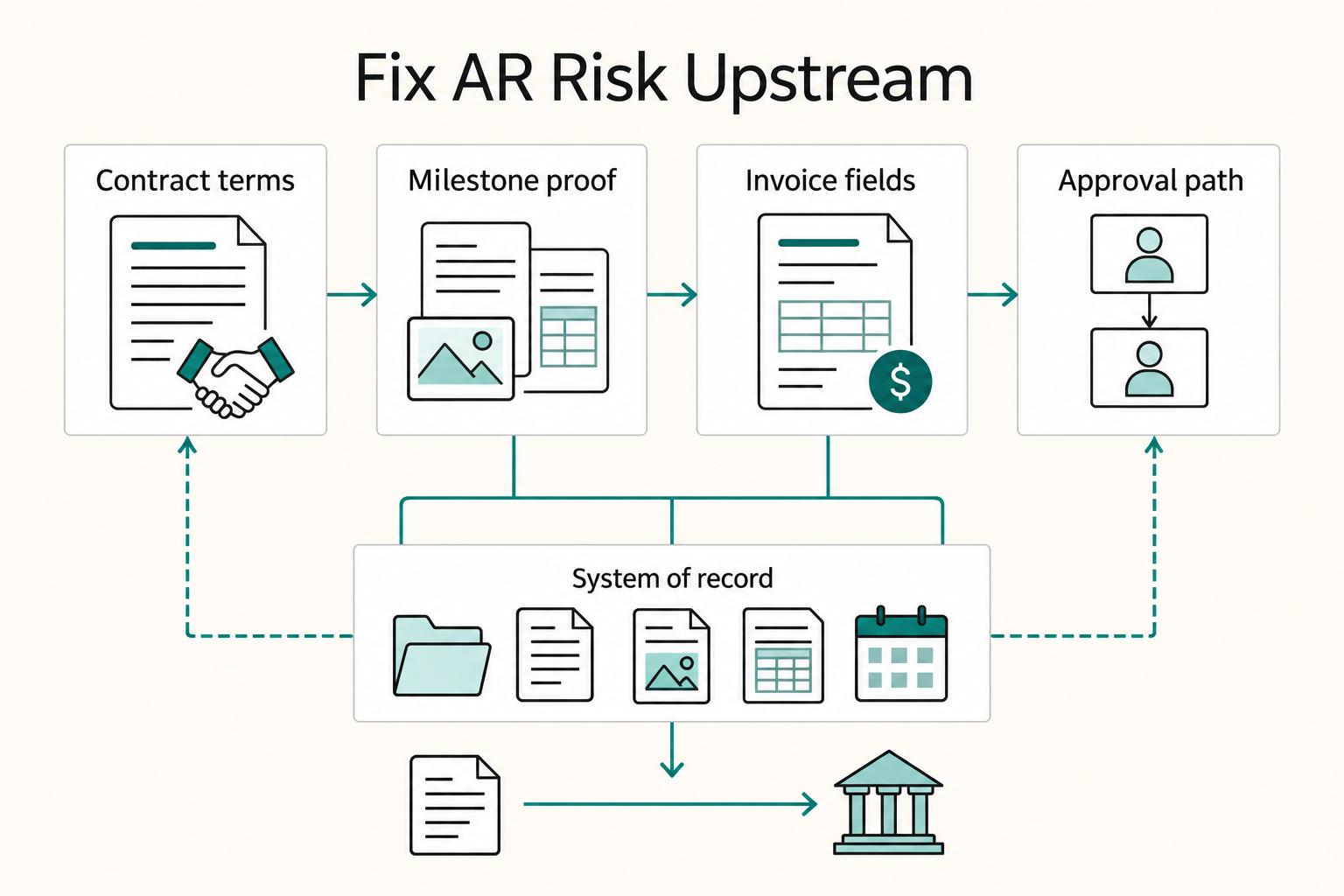
Many AR issues start upstream, not in collections. A vague contract can create room for timing disputes. Weak milestone language can invite "not complete yet" pushback. Missing invoice fields can send billing back for correction.
Your first job is to make invoices easy to approve. Keep one system of record for contracts, SOWs, approvals, and invoice backup. That lets you quickly show the signed terms, the matched deliverable, and the approval trail. In the Department of Commerce BAS context, Unison PRISM is used as the contracts tool and records repository. The practical takeaway for you is process discipline, not tool matching.
Set approval checkpoints early. In the University of Minnesota workflow, chief financial manager approval appears before billing is entered. Your version can be lighter, but you still want the approver path confirmed before work starts.
Set terms that fit the engagement#
The right billing structure can reduce avoidable delay later. Use staged billing that matches how the work is delivered, with clear triggers for each invoice. Keep your template terms flexible, then adjust them based on your actual collection performance.
| Situation | Adjustment |
|---|---|
| Client wants longer terms | Tighten milestone and acceptance language |
| Work is custom | Avoid leaving most of the value to the final invoice |
| Client finance team has strict processing requirements | Confirm submission requirements before the first invoice |
| Final files, access, or rights transfer matter | Tie release to the payment event defined in your contract |
Match the adjustment to the situation instead of forcing the same terms onto every engagement.
Payment gates are operational controls. In the UMN process, payment occurs before the purchaser collects the item. For services, your equivalent can be final asset transfer or access release after payment, where your contract allows it.
Run one repeatable invoice cycle#
A repeatable invoice cycle supports steadier cash flow than ad hoc follow-up. The goal is simple: by the time an invoice hits the client, the terms, support, and delivery proof are already lined up.
- Contract fields
Confirm legal names, billing entity, terms, approver, and acceptance or completion trigger.
- SOW alignment
Match invoice line wording to the SOW so project and finance reviewers see the same scope.
- Billing trigger evidence
Attach proof that the trigger occurred, such as delivery confirmation, an acceptance note, or an approved change.
- Tax and compliance fields
Check required invoice fields and tax handling. Where location affects treatment, confirm where the buyer takes possession.
- Approval path and issuance
Confirm whether submission means email delivery or entry into the client's finance system, then issue accordingly.
| Control area | Primary failure mode | What to verify | Expected outcome |
|---|---|---|---|
| Contract record | Scope or timing disputes with incomplete backup | Signed terms, SOW references, and supporting documents in one record | Faster resolution when questions arise |
| Approval checkpoint | Billing starts without approver alignment | Required approver and approval evidence before billing | Fewer late-cycle approval surprises |
| Invoice issuance | Invoice is sent through the wrong channel or missing required info | Submission route (email vs finance-system entry) and required fields | Cleaner intake into the client's payables process |
| Tax and compliance fields | Tax handling is corrected late | Required tax fields and possession location where relevant | Lower tax-related rework risk |
| Payment gate | Handoff before payment confirmation | Contract-defined release condition and payment confirmation | Clearer release control and fewer avoidable disputes |
A practical rule: fix AR at the contract and invoice checkpoints first, then use follow-up for exceptions. Once inflow is under control, you can apply the same discipline to outflow in AP. If you want a deeper dive, read Hiring Your First Subcontractor: Legal and Financial Steps.
Before you send the next invoice, use the free invoice generator to tighten payment terms and reduce preventable payment delays.
Optimizing Your Operational Toolkit (AP)#
Once AR is steady, turn to AP. The goal is not sophistication; it is predictability. AP should feel boring because that gives you better visibility, ownership, and fewer avoidable leaks.
Make AP boring on purpose#
For a freelancer or small team, AP means receiving, entering, and approving invoices before payment. The payoff is practical: clearer records and less month-end cleanup. Use one simple workflow to keep it that way:
| Step | What to do |
|---|---|
| Intake | Log each new subscription, invoice, or reimbursement in one place with vendor, purpose, amount, renewal date if recurring, and receipt or invoice |
| Owner assignment | Assign one owner to every expense so renewals and usage stay accountable |
| Approval | Approve only when the charge is legitimate and supported. Release payment after a proper invoice and satisfactory performance, not before |
| Payment | Pay from business accounts, typically your business checking account and one business card tied to it |
| Monthly review | Reconcile transactions against receipts, invoices, and terms, then resolve exceptions while the details are still fresh |
If every charge moves through the same path, month-end gets easier. You spend less time untangling charges you cannot explain.
Use one decision rubric for every expense#
A software stack review only works if every recurring charge gets a real decision. Do not keep line items by inertia.
| Decision | When it applies |
|---|---|
| Keep | Current business value and clear usage evidence |
| Consolidate | Another tool can cover the same job |
| Downgrade | The tool is useful but your plan is oversized |
| Cancel | There is no current purpose, no owner, or no support for keeping it |
The point is to make a deliberate choice on every recurring charge.
A quick check helps. Mark recurring charges from your latest business statement. Require proof of current use, client dependency, or required business purpose before you keep each one.
Compare failure mode to control#
Many AP issues repeat, which is useful because a small set of controls can fix them. Use the table below to match what is going wrong to the control that can fix it.
| AP failure mode | What it looks like | Control that fixes it | What to verify |
|---|---|---|---|
| Tool sprawl | Overlapping subscriptions, unclear ownership | Scheduled stack audit with keep, consolidate, downgrade, or cancel decisions | Owner, purpose, usage, renewal date |
| Duplicate spend | Similar tools bought twice or duplicate billing | Centralized intake and approval before payment | Vendor match, plan overlap, duplicate receipts or invoices |
| Mixed personal and business charges | Personal spending appears in business activity | Separate business and personal accounts, with documented exceptions | Whether each charge belongs to the business |
| Missed renewals | Charges post without active review | Renewal tracking plus monthly reconciliation checkpoint | Renewal date, cancellation window, owner confirmation |
Centralize first, then review on a schedule#
If spending is split across personal cards, business cards, debit cards, and app stores, AP control gets harder. Centralize business spending into one hub, use tagged categories such as software, contractors, banking fees, travel, and education, and document exceptions immediately when personal cards are used.
Then keep one monthly reconciliation checkpoint. You do not need institutional deadlines, but you do need a fixed internal date and consistent follow-through. If you are solo, start with centralization and monthly review. If anyone else spends, add owner assignment and documented exceptions right away. We covered this in detail in The Best Bank Accounts for College Students.
The Strategic View: AP, AR, and Your Balance Sheet#
After you tighten AR and AP, use your balance sheet to check whether the process is holding. Keep the classification clear. Accounts receivable is a current asset because it is money you expect to collect within a year. Accounts payable is a current liability because it is money you owe suppliers for billed goods or services.
Think of the balance sheet as one connected view of what is coming in and going out. Then track what each common action changes. When you invoice a client on credit, AR rises. As that client pays, AR falls.
When you receive and approve a vendor invoice, you record the expense and create AP before payment is issued. When you pay under agreed terms, such as net-30, net-60, or 30-, 60-, or 90-day terms, AP falls and cash goes out. Keep one guardrail in place: cash sales are not AR, so do not include them in receivables aging.
| Item | What it signals | What can go wrong | Weekly check to prevent surprises |
|---|---|---|---|
| AR | Revenue earned but not yet collected | Older invoices build up and expected cash does not arrive on time | Review aging and flag invoices that slipped past agreed terms |
| AP | Obligations you owe for business expenses | Approved bills sit unpaid, which can hurt stability and credit | Review open bills by due date, owner, and payment terms |
| Working capital | Whether near-term collections and near-term payments stay in balance | Inflow and outflow timing drift apart | Compare expected collections against scheduled payments for the next few weeks |
After that weekly check, use this short operating checklist:
- Review receivables aging weekly, not only at month-end.
- Schedule payables from invoice receipt date and agreed terms.
- Feed your updated AR and AP view into cash planning so collections and payments sit in one forecast.
This is the bridge between the two workflows. AR controls protect money coming in. AP controls the pace of money going out. The balance sheet shows whether both are improving resilience. Related: How to Read a Balance Sheet.
The Final Word: Take Control of Your Levers#
Use AR to protect cash coming in, and AP to control cash going out on every cycle. When you run both deliberately, day-to-day operations become more predictable: clear terms, timely invoices, reviewed bills, and a clear view of what is owed and due.
| Lever | What you are controlling | What "in control" looks like | Checkpoint that matters most | Common failure mode |
|---|---|---|---|---|
| Accounts receivable | Incoming cash from clients | You send invoices promptly with clear terms, such as net 30, and each open invoice has a due date and follow-up owner | Confirm the invoice is correct, sent, and tracked through payment | Late invoicing or weak follow-up can delay incoming cash |
| Accounts payable | Outgoing cash to vendors and providers | Bills are recorded, validated, approved, and paid to agreed terms, such as 30, 60, or 90 days | Check the invoice against purchase order and delivery documentation before approval | Paying too early can pressure cash |
| Both together | Short-term cash flow | You can quickly see what customers owe you and what you owe others | Review open receivables and payables together from one working view | Mismanaging either side can disrupt cash flow |
For receivables, set terms early, invoice when amounts become due, and follow up when a due date passes. If a client needs credit terms, put them on the invoice clearly.
For payables, do not default to "pay now." Validate each bill first, approve it, then schedule payment to the agreed term. Keep one operating cadence: set terms, invoice, follow up, approve and pay, then review both sides together. On your next client cycle, run those five steps once, then repeat them the same way each time.
For a step-by-step walkthrough, see The 'Profit First' Method Part 2: Setting Up Your Bank Accounts. When you finalize your AP and AR workflow, run your collection options through the payment fee comparison tool so your margins stay predictable.
Frequently Asked Questions
What is the difference between accounts payable and accounts receivable for your business?
Accounts payable is what you owe vendors for purchased goods or services, and accounts receivable is what clients owe you for credit sales. AP is a current liability on your balance sheet, while AR is a current asset you expect to collect within a year. Immediate cash sales are not AR.
Is an invoice accounts payable or receivable?
It depends on whose books you are looking at. If you send the invoice to a client, it is accounts receivable for you and should be tracked through payment. If you receive an invoice from a vendor, it is accounts payable for you and should be verified, recorded, approved, and paid on terms.
How can you improve your accounts receivable process?
Issue invoices correctly and promptly for credit sales. Keep contract terms, invoice details, approvals, and billing trigger evidence aligned so invoices are easy to approve. Track open invoices, follow up when due dates pass, and reconcile payments to the right invoice.
Why is managing accounts payable important for a solo business?
Managing AP helps you control cash flow and reduce avoidable risk. When a valid bill arrives, record it as an expense, approve it, and pay under the agreed terms. Keep approval and payment records current, and review AP and AR regularly so inflow and outflow do not drift out of balance.
Try a related tool
Researched and edited by the Gruv editorial team. Gruv builds cross-border billing, payouts, and finance-operations software for global businesses.
Sources
- acquisition.gov/far/32.905trusted
- azauditor.gov/sites/default/files/2023-11/USFR102323%282%2...trusted
- bu.edu/tech/files/2020/12/Process-Guide-Accounts-Pa...trusted
- cdtfa.ca.gov/taxes-and-fees/manuals/cpm-07.pdftrusted
- cgcc.ca.gov/documents/enabling/2020/REGULATIONS_TEXT_061...trusted
- congress.gov/bill/113th-congress/house-bill/83/text/enrtrusted
- controller.umn.edu/processestrusted
- docs.legis.wisconsin.gov/statutes/statutes/196.pdftrusted
Educational content only. Not legal, tax, or financial advice.
Related Posts

Hiring a Subcontractor for the First Time Without Costly Surprises
**Start with a risk-control sequence, not an ad hoc handoff.** As the Contractor, your goal is simple: deliver cleanly, control scope, and release payment only when the work and file are complete.

Freelance Bookkeeping for Faster, Safer Client Payments
Control over cash starts with records you trust. When entries are current, categorized, and easy to trace, you spot risk earlier and make calmer decisions about follow-up, spending, and month close.
How to Read a Balance Sheet for Freelancers and Small Teams
Use your balance sheet as a dated decision dashboard, not an accounting exercise. It shows what your business owns, what it owes, and what is left on that date. Use it to make better calls on cash safety, client risk, tax readiness, and growth timing.