
Quick Answer
Build your process around one standard package and one approved fallback, then execute the same turnover flow every time. The best welcome gift ideas for airbnb are useful in the first 12 hours, match the listing promise, and can be verified with placement proof. Keep only sealed, labeled consumables, escalate allergy or diet conflicts to a written host decision, and handle alcohol in a separate host-only lane after legal and insurance confirmation.
The best welcome gift ideas for Airbnb are the ones guests will actually use and your team can deliver the same way every time. For a professional short-term rental operator, a welcome gift matters only if it confirms the guest booked the right property. Done well, it sharpens the first impression. Done badly, it creates clutter, inconsistency, and avoidable risk.
This guide treats the arrival offering as part of operations, not decoration. The goal is not generic local flair. It is to build an arrival protocol that fits your listing, can be delivered consistently, and does not create unnecessary exposure. That is how a small expense becomes a useful part of the guest experience and, over time, supports better reviews.
I. The Strategy: Designing a Brand-Aligned Offering#
The right arrival offering fits your listing promise, helps on night one, and can be delivered the same way every turnover. If an item misses any of those three tests, it is not adding hospitality. It is adding drift.
That matters because guests already book around practical needs. Airbnb's own host resources show that guests frequently search for useful features like Wi-Fi, kitchen, self check-in, and air conditioning or heating. That is based on search data from 1 January to 31 December 2024. So when you evaluate welcome gift ideas for Airbnb, start with the booking decision the guest already made, not what looks generous on a counter.
| Offering lane | Booking context | Immediate friction to solve | Good default items | Main risk if you overdo it |
|---|---|---|---|---|
| Lean practical | One-night stay, solo travel, work trip, late arrival | Thirst, caffeine, quick snack, no first-stop shop run | Water, tea or coffee, one packaged snack | Random extras that create clutter and inconsistent restocking |
| Comfort cue | Weekend couple, short city break, mixed travel | Easier first evening or next morning | Water, breakfast-friendly packaged item, one small local edible | Turning baseline pantry items into an implied premium promise |
| Signature stay | Design-led unit, celebration stay, longer leisure booking | A memorable first 12 hours without confusion | One distinctive packaged local consumable plus one practical arrival item | Staff substitutions, stock gaps, and guest expectations you cannot repeat |
Use the table to keep the package tight. A higher-priced property does not need more objects. It needs a closer match between the stay it sells and the first experience it delivers.
Define the promise before you pick the item#
Start by writing one sentence that answers: what did the guest think they booked? Pull it from your listing title, lead photo, and the first lines of the description. If the promise is quiet, efficient, and self-serve, your arrival offering should feel clean and functional. If the promise is cozy weekend reset, you have room for one small comfort cue.
Be strict about the line between essentials and gifts. Airbnb defines essential amenities as basics like toilet paper, soap, towels, pillows, and linens, and it can penalize listings that claim essentials but do not actually provide them. One towel per guest, one pillow per guest, and bed linens are part of the stay. They are not your gift.
That separation protects you from expectation mismatch. If coffee, tea, or toiletries are presented in the listing as normal amenities, do not relabel them as a special welcome surprise. Guests can read that as repackaging what they were already owed.
Route the choice through guest intent#
A simple decision path works better than trying to personalize every booking. Check the arrival pattern first: late self check-in, early evening arrival, or daytime arrival. Then check trip purpose: work stay, short leisure trip, celebration, family visit. From there, choose only items most guests would use in the first 12 hours or the next morning.
This is also where execution can slip. Self check-in is one of Airbnb's top 10 amenities, and guests often filter search results for it. Airbnb review prompts also ask guests about check-in. Positive signals include "Easy to find" and "Personal welcome." Negative ones include "Hard to locate" or "Unclear instructions." If your entry instructions are messy, a larger basket will not rescue the first impression.
Keep gift messaging brief too. If you mention the arrival item in a pre-arrival note or quick reply, remember Airbnb caps messages at 4,000 characters, and check-in instruction timing is not fully uniform across Airbnb documentation. One page says 48 hours before check-in, another says 24 to 48 hours. That is another reason to avoid anything that needs a long explanation.
Apply a go or no-go filter#
Before you approve a package, run one final check:
- Does it reinforce the listing promise?
- Will most guests use it on arrival or the next morning?
- Is every edible item packaged with a readable ingredient label?
That last point is not minor. The FDA requires ingredient listing on packaged foods and beverages, and sesame has counted as a major food allergen since January 1, 2023. If you cannot verify the label, skip the item. A practical failure mode is choosing something "local" that turnover staff cannot source consistently or guests cannot identify easily.
If you want the gift and the arrival information to work together, pair this section with your welcome book. The package should be small, useful, and easy to explain. Once that is set, the next job is making sure your team delivers it the same way every time. If you want a deeper dive, read Thailand's Long-Term Resident (LTR) Visa for Professionals.
II. Run every booking through the same turnover routine with proof#
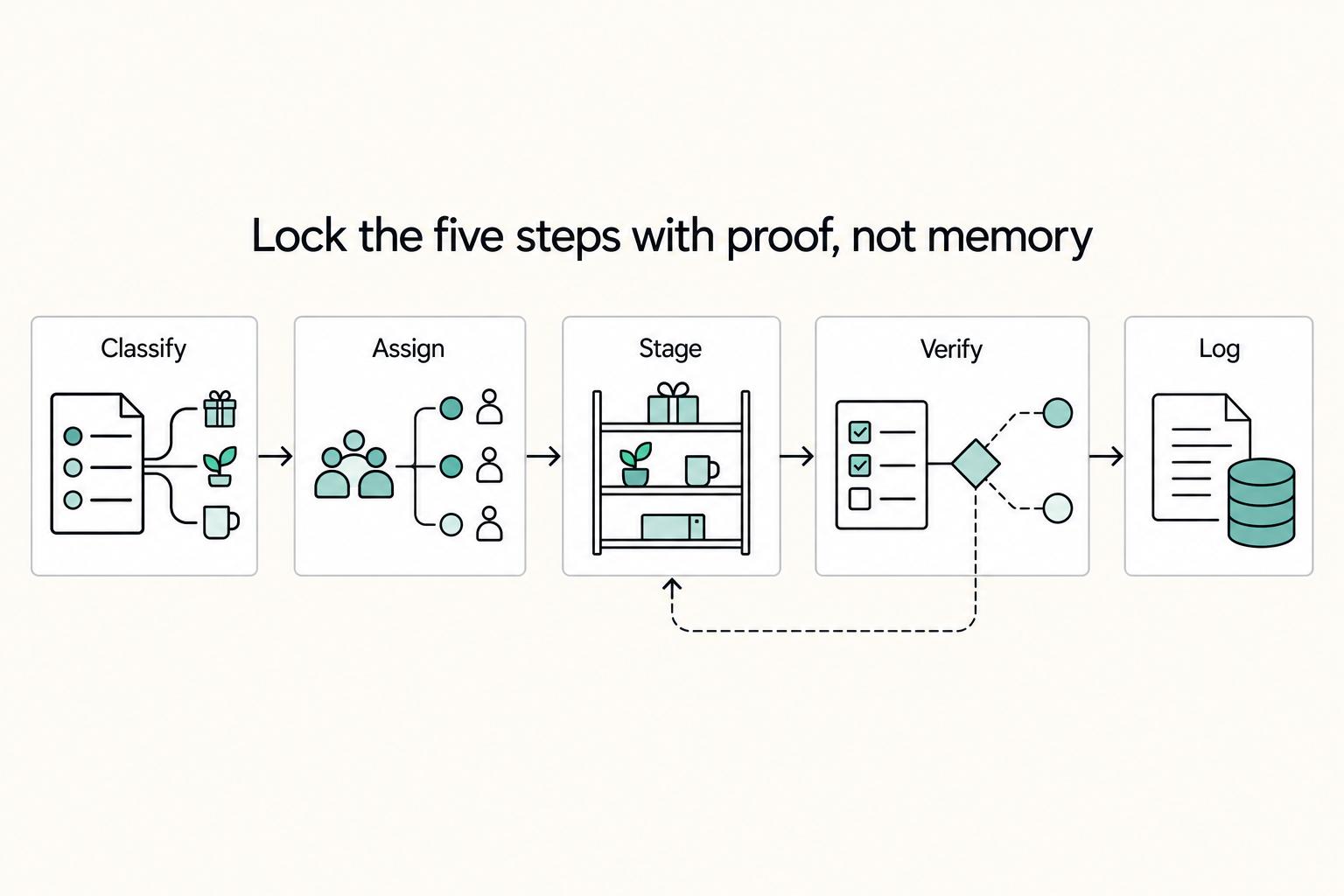
Consistency beats creativity at turnover. Once the package is set, run every booking through the same five-step flow with clear proof: classify, assign, stage, verify, and log.
Lock the five steps with proof, not memory#
Write this so turnover staff can complete it without judgment calls.
| Step | Action | Done evidence |
|---|---|---|
| Classify | Apply one scenario tag only: standard arrival, late check-in, guest-note conflict, or active issue flag. | Tag saved in your PMS, task app, or Airbnb notes before turnover starts. |
| Assign | Attach the approved package for that scenario and one documented fallback only. | Package name and fallback name recorded on the reservation. |
| Stage | Pull approved stock only. If an item is damaged, open, out of date, or missing a readable label, do not place it. | Staged items match the reservation note, and packaged food/drink labels are readable. |
| Verify | Place the package in one fixed location, then capture photo proof before closing the task. If you include a printed note, confirm guest name and stay dates. | One time-stamped placement photo uploaded; label side visible if a substitute pack was used. |
| Log | Record what was placed, whether fallback was used, and whether an exception was handed off. | Reservation record includes final package note and proof link. |
- Classify
Apply one scenario tag only: standard arrival, late check-in, guest-note conflict, or active issue flag. Done evidence: tag saved in your PMS, task app, or Airbnb notes before turnover starts.
- Assign
Attach the approved package for that scenario and one documented fallback only. Done evidence: package name and fallback name recorded on the reservation.
- Stage
Pull approved stock only. If an item is damaged, open, out of date, or missing a readable label, do not place it. Done evidence: staged items match the reservation note, and packaged food/drink labels are readable.
- Verify
Place the package in one fixed location, then capture photo proof before closing the task. If you include a printed note, confirm guest name and stay dates. Done evidence: one time-stamped placement photo uploaded; label side visible if a substitute pack was used.
- Log
Record what was placed, whether fallback was used, and whether an exception was handed off. Done evidence: reservation record includes final package note and proof link.
If a guest reports an issue later, this log is what keeps the response factual instead of guesswork.
Set ownership before exceptions happen#
Exception handling should be assigned in advance, not decided in chat. Airbnb co-host permissions let you enforce this: full-access co-hosts can message guests and update the calendar, while payout and taxpayer controls stay with the listing owner.
| Trigger | Primary owner | Allowed action | Stop and hand off when |
|---|---|---|---|
| Reservation confirmed | Turnover staff | Apply standard scenario package and approved fallback | Assigned package is out of stock |
| Late self check-in | Turnover lead or co-host | Use late-arrival variant if already approved | Delivery timing may miss check-in |
| Guest allergy, diet, or conflicting note | Host or full-access co-host | Decide in writing in the Airbnb thread | No written decision exists |
| Active maintenance or service issue | Host | Hold, modify, or remove placement decision | Guest communication or reservation change is needed |
Use three hard stop triggers: inventory mismatch, guest-note conflict, and active issue flag. When one appears, pause at stage and hand off. If the reservation is already active (24 hours before check-in), and cancellation is needed, contact Airbnb support. If nights, guest count, or pet count must change, use Airbnb's Change reservation flow, not the Resolution Center.
Keep automation minimal and clean#
Automation works only when required fields are complete. At minimum, store: guest name, listing name, check-in date, scenario tag, assigned package, fallback package, placement location, and issue flag.
Airbnb quick replies and scheduled quick replies are useful for repeatable messaging, but keep templates short and structured. Messages (including quick replies) have a 4,000-character cap, placeholders can show as unavailable when fields are missing, and guest-facing messages are auto-translated.
Use two timing rules:
- Trigger internal turnover tasks at reservation confirmation so stock gets assigned early.
- Send guest-facing arrival messages near the check-in-details window (usually about 48 hours before check-in).
If you use printed instructions, keep them synced with reservation notes and templates from one source of truth, such as your welcome book.
Before using any external runner, cleaner, or supplier in live turnovers, gate them on delivery-window reliability, substitution discipline, verification quality, and service-level criteria. Record unresolved pass criteria as service-level criteria pending operations verification. If you cannot define the pass line, the partner is not ready for your check-in path. Related: The Best Smart Home Devices for an Airbnb.
III. The Safeguard: A Checklist for Mitigating Risk#
Use a strict pass/fail gate: if the item, label, or source cannot be verified quickly, do not place it.
| Item lane | Accept criteria | Reject triggers | Required evidence | Escalation owner |
|---|---|---|---|---|
| Sealed drinks | Original, intact commercial package; unbroken seal; readable label | Open, leaking, bulging, torn, punctured, or split seams | Photo of package condition and label; supplier record | Turnover uses approved fallback; host reviews repeated stock mismatches |
| Packaged snacks or treats | Intact commercial packaging; readable ingredient panel; visible allergen labeling where present | Repackaged, unlabeled, damaged, expired, or unclear source | Front/back photos; product identifier (SKU/UPC); supplier invoice or record | Host decides when guest notes mention allergy, diet, or preference conflict |
| Single-use toiletries | Manufacturer packaging intact; traceable product identifier | Decanted, relabeled, damaged, or missing identifier | Front/back photos; product identifier; supplier record | Host approval required before first use and after supplier/formula/pack changes |
| Alcohol exception lane | Place only after local-rule verification for your jurisdiction and insurance-scope verification are documented | Any unclear legal rule, unclear coverage, or guest-specific concern | Local-rule note, including local-rule threshold pending official/provider verification when unresolved; product record; insurance confirmation; supplier record | Host only; turnover does not improvise |
Verification before placement for new or changed products#
Treat any supplier change, formula change, or pack-format change as a new approval event.
| Step | Verification | Outcome |
|---|---|---|
| 1 | Collect front/back package photos. | Front/back package photos collected. |
| 2 | Confirm ingredient panel and allergen statement are readable. | Readable ingredient panel and allergen statement confirmed. |
| 3 | Record product identifier and supplier invoice/reference. | Product identifier and supplier invoice/reference recorded. |
| 4 | Add jurisdiction/compliance note where required. | Jurisdiction/compliance note added where required. |
| 5 | If any threshold or document is unverified, mark the threshold or document status as pending official/provider verification in the SOP and hold the item out of the unit. | Item held out of the unit. |
- Collect front/back package photos.
- Confirm ingredient panel and allergen statement are readable.
- Record product identifier and supplier invoice/reference.
- Add jurisdiction/compliance note where required.
- If any threshold or document is unverified, mark the threshold or document status as pending official/provider verification in the SOP and hold the item out of the unit.
Route allergy ambiguity to host decision#
If a guest note is unclear on allergy or diet, pause placement and route it to the host for a written decision in the reservation record or Airbnb thread. Turnover places only the standard pack (no conflict) or the written host decision (conflict present).
Keep a claim-ready evidence bundle#
Keep one current listing-level folder with approved pack photos, supplier records, verification notes, and insurance notes, then add reservation-level proof of what was placed and where. Review at launch, after any product change, and on a recurring schedule.
If an incident happens, use the Resolution Center and submit complete documentation (photos/videos, estimates, receipts). Airbnb states hosts have 14 days after checkout to file, and guests have 24 hours to respond. For coverage decisions, confirm current policy terms, exclusions, and contribution rules for your listing profile, and document the result in your record before you rely on an exception lane.
From Gesture to Asset: Institutionalizing Your Arrival Protocol#
Run your arrival gift as a pass/fail control, not a nice-to-have: if it fails any checkpoint, do not place it until the assigned owner closes the issue.
| Checkpoint | Pass evidence | Fail trigger and owner |
|---|---|---|
| Brand fit | One line in your setup sheet ties the package to the listing promise, and contents match what guests were told to expect. | If the pack conflicts with listing accuracy or feels off for the stay type, the turnover lead pauses placement, logs the conflict, and hands the decision to the listing owner/host. Only the listing owner/host can approve placement or removal. |
| Execution consistency | Same items, same location, one completion record, and one approved fallback when stock is out. | If there is any ad hoc swap, missing photo proof, or a substitution in the final 48 hours before check-in instructions release, staging stops. The turnover lead escalates to the host, and the host decides approve fallback or remove the item. |
| Risk control | Every item is sealed, supplier-traceable, and easy to identify at a glance. | If packaging is damaged, sourcing is unclear, or an item cannot be verified quickly, do not place it. The host owns final go/no-go and updates the do-not-stock list when needed. |
For consumables, keep only controls you can verify in seconds: commercially packaged items, intact packaging, and readable ingredient labels. If a label is missing or unclear, move the item to do-not-stock. For U.S.-labeled products, ingredients should appear on-pack, and sesame allergen labeling applies as of January 1, 2023. Keep homemade, repackaged, and improperly preserved foods out of scope.
Do not force a calendar-only review cadence. Review when patterns repeat: guest feedback trends inside Airbnb's 14 day review window, issue reports inside the 72 hour discovery window, or recurring completion misses by your cleaner/co-host. Track one reliability KPI in your sheet; while the metric is unresolved, label it as service-level criteria pending operations verification, then adjust the pack, fallback, or do-not-stock list based on what keeps recurring.
To keep arrival notes and placement steps aligned with this protocol, tighten your documentation in How to Write a Welcome Book for Your Airbnb. For a tax-related edge case that can affect gift decisions, review Gift Tax for US Expats Without Filing Surprises. If you need country/program confirmation before rollout, Talk to Gruv.
Frequently Asked Questions
How much should you spend on a welcome gift?
Use a simple rule: fund your baseline amenities first, then spend only what you can deliver consistently on every qualifying booking. If an item is part of the stay guests reasonably expect, it belongs in your essentials budget, not your gift budget. That matters because Airbnb treats essential amenities as basics, and claiming them without actually providing them can trigger penalties, including removal.
What should you leave out?
Leave out anything you cannot verify quickly, especially food or drink with unclear condition or ingredient information. For food and drinks, the label is the checkpoint because packaged products should list ingredients, and allergy reactions can be severe. If a guest note mentions an allergy or diet issue and the fit is unclear, route it to a written host decision.
How do you automate this without losing control?
Automate the message, not the judgment. Airbnb quick replies can be scheduled for triggers like a new reservation, check in, or checkout, and each message is capped at 4,000 characters, so keep the note short and standard. Pair that with one approved gift pack and one controlled fallback, then require a host signoff when the reservation has a conflict note or stock mismatch.
Is alcohol worth adding?
Treat alcohol as a host-only exception lane, not a standard extra. Airbnb’s alcohol guidance is jurisdiction-sensitive, and local licensing or other rules can differ by country, state, and city. If your local rule or insurance position is unclear, mark the local-rule threshold as pending official/provider verification in your SOP and do not place it.
Do gifts help reviews?
They may improve the arrival experience, but do not treat them as a review tactic. Airbnb reviews sit in a 14 day window, and review manipulation through value exchange or pressure is not allowed. Use the gift to support the booking promise, then handle review performance through the broader stay experience and clear communication. If you want that piece tighter, read A Guide to Getting Your First Five-Star Review on Airbnb.
What is the difference between a gift and an amenity?
A baseline amenity is something guests expect for a comfortable stay. A gift is an optional extra beyond that baseline. If you advertise it, guests start expecting it, so operationally it stops being a gift and becomes part of your standard promise.
Try a related tool
Researched and edited by the Gruv editorial team. Gruv builds cross-border billing, payouts, and finance-operations software for global businesses.
Sources
Includes 1 external source outside the trusted-domain allowlist.
- ecfr.gov/current/title-21/chapter-I/subchapter-B/part...trusted
- fda.gov/food/food-allergies/faster-act-sesame-ninth-...trusted
- fda.gov/consumers/consumer-updates/allergic-sesame-f...trusted
- foodsafety.gov/blog/food-allergy-safety-treatment-education...trusted
- airbnb.com.au/resources/hosting-homes/a/the-amenities-gues...external
Educational content only. Not legal, tax, or financial advice.
Related Posts

Thailand's Long-Term Resident (LTR) Visa for Professionals
For a long stay in Thailand, the biggest avoidable risk is doing the right steps in the wrong order. Pick the LTR track first, build the evidence pack that matches it second, and verify live official checkpoints right before every submission or payment. That extra day of discipline usually saves far more time than it costs.
How to Get Your First Five-Star Review on Airbnb
If you want better Airbnb reviews, reduce surprises first. For many high-achievers, managing a property creates a familiar kind of anxiety: the low-grade fear that one missed detail will turn into a visible, costly problem. In a career role, that might mean a missed deadline or a flawed report. In short-term rentals, it often shows up as a negative review that sits in public and affects both reputation and revenue.
Write an Airbnb Welcome Book Guests Can Use Without Messaging You
Treat your **airbnb welcome book** as an operating document, not a hospitality extra. Its job is simple: put stay-critical answers in one place so guests can handle common tasks without waiting on your messages.