
Quick Answer
Choose a licensed route that supports your sender type, purpose and destination. Wise now supports eligible personal THB sending for Thailand-address profiles, while business profiles are excluded. Compare the live recipient amount, retain source records and verify the destination credit before closing the transfer.
Treat repeat transfers out of Thailand as a finance process#
If you need to transfer money out of Thailand more than once, treat it like a finance process, not a one-off errand. The goal is simple: fewer delays, cleaner approvals, and records that still make sense months later.
Thailand requires foreign-exchange transfers to use licensed institutions. The Bank of Thailand's exchange-control summary distinguishes purposes and customer categories; a provider's app limit is a separate constraint. Identify whether you are moving your own earnings, paying a supplier, making a gift or investing before selecting the form's purpose.
The useful comparison is which eligible route delivers the required currency and net amount, with a record you can reconcile. A complete file helps answer questions, but it does not guarantee approval or make an unsupported purpose permissible.
1. Documentation readiness#
Good preparation reduces approval friction. Build one evidence pack that answers three questions clearly: where the funds came from, why the money is leaving Thailand, and how the transfer amount maps to the underlying income.
Your invoices, receipts, account credits, and purpose statement should all line up. SCB's outward-remittance flow shows the pattern. Thai customers are asked for purpose-supporting documents, and foreign customers may be asked for source-of-income documents. SCB also states that at USD 50,000 or equivalent, that channel requires an FCT form plus purpose-based supporting documents. Before you send, do one quick check: do the amount, sender account, and stated purpose match cleanly?
2. Channel selection#
Start with your sender eligibility, actual purpose and destination account. Then compare the available channels and prepare the evidence that the selected channel requests. A polished document pack cannot overcome a product restriction.
| Route example | Stated requirement | Trigger or qualifier |
|---|---|---|
| KBank branch-based Global Outward | Purpose-dependent supporting documents | Selected branches; confirm availability and checklist before visiting |
| K PLUS | Normally no document upload; bank can request evidence | Individuals only; facial verification from THB 50,000; Thai nationals cannot send to their own overseas account using this product |
| SCB personal SWIFT | Purpose/source records; FCT form from USD 50,000 equivalent | Personal channel requirement; not a universal Thailand cap |
K PLUS is for individual senders and reserves the right to request supporting documents. It requires facial verification from THB 50,000 per transaction and excludes Thai nationals sending to their own overseas bank account through this product. Its partner route and SWIFT route also differ in currencies, charges and receipt evidence. Check the selected product's conditions before using a saved beneficiary.
Prepare your document packet before you open the transfer form#
Use this packet as a practical filing template. Your bank or transfer provider determines its required documents; the profile sheet and ledger below are ways to organize the evidence, not compulsory Bank of Thailand forms.
Obtain the current checklist through the provider's official site, app or verified support contact. If a page is inaccessible, use another official channel. HTTPS protects a connection but does not establish that a provider is licensed or that a page's instructions apply to your account.
| Briefcase document | Purpose | Preferred format | Why include it |
|---|---|---|---|
| Self-employed profile sheet | Summarizes who you are and what income activity you run | One-page signed PDF | Gives a quick identity and activity overview |
| Source-of-funds ledger | Connects transfer amount to identifiable incoming payments | Spreadsheet export as PDF plus supporting files | Shows how the payout amount maps to incoming funds |
| Tax status pack | Keeps your tax position records together | Filing/payment evidence in PDF | Organizes tax documentation for the relevant period |
| Transfer purpose note | Keeps transfer reason consistent across forms and messages | One-sentence note saved and reused | Reduces wording conflicts across your own records |
1. Self-employed profile sheet#
Keep it short and factual. It should help a reviewer understand who you are and why this income pattern makes sense.
- Include: full legal name, business or trade name if used, what you do, where you operate, and one live professional profile or website.
- Answers: "Who are you, and does this income profile make sense?"
- Avoid: marketing language that does not match your account name or invoice identity.
2. Source-of-funds ledger#
Use this document to tie the transfer amount back to incoming payments. If deductions, refunds, or conversions changed the final number, show that directly instead of leaving the reviewer to infer it.
- Include: client name, invoice or project reference, payment date, amount received, receiving account, and amount allocated to this transfer.
- Answers: "Where did this specific transfer amount come from?"
- Avoid: unreconciled totals.
3. Tax status pack#
Keep income-tax records that actually apply to these funds and their filing period. A legitimate recent receipt can precede the annual tax filing deadline. Record that timing and any tax reserve; do not invent a filing confirmation or assume that moving your own money settles the underlying income-tax obligation.
- Include: available filing/payment evidence and a note of the relevant income period, tax reserve and filing deadline.
- Answer: Which tax records apply to this income, and which are already available?
- Share only records requested for the review through the provider's secure channel; retain the fuller tax file privately.
4. Transfer purpose note#
Describe the real transaction. For example, a foreign freelancer moving earned funds to their own account could describe the relevant income period and self-transfer, subject to the bank's accepted purpose code. Reuse that description only while the facts remain the same; a supplier payment is a different purpose.
- Include: one specific sentence you can reuse in the transfer form, ledger note, and support chat.
- Answers: "Why is this money leaving, and does the destination account fit that reason?"
- Avoid: vague wording that conflicts with your own documentation.
Before you submit, run one final consistency check:
- The sender account belongs to the person or business entitled to move these funds; source invoices identify that income earner.
- The ledger explains how incoming payments, reserves, fees and the transfer amount reconcile.
- Beneficiary name and account details match verified receiving-bank instructions. For a third-party payment, retain the contract or invoice explaining that recipient.
- Purpose wording describes the actual transfer consistently; do not relabel a business payment as personal to fit a product.
If you want a deeper dive, read Separating Business and Personal Finances: An Important Step for LLCs.
Compare eligible routes by delivered cost and records#
Compare the same debit budget, destination currency and recipient account across providers. Include conversion, sending charges and potential receiving deductions. A digital provider can use SWIFT too: the provider category alone does not tell you the underlying rail.
| Transfer tier | When it fits | Priority |
|---|---|---|
| Everyday transfers | Routine transfers | Corridor support, clear pricing, and a repeatable process |
| Mid-size transfers | Same checks as everyday transfers, but with more verification friction | Confirm limits in advance |
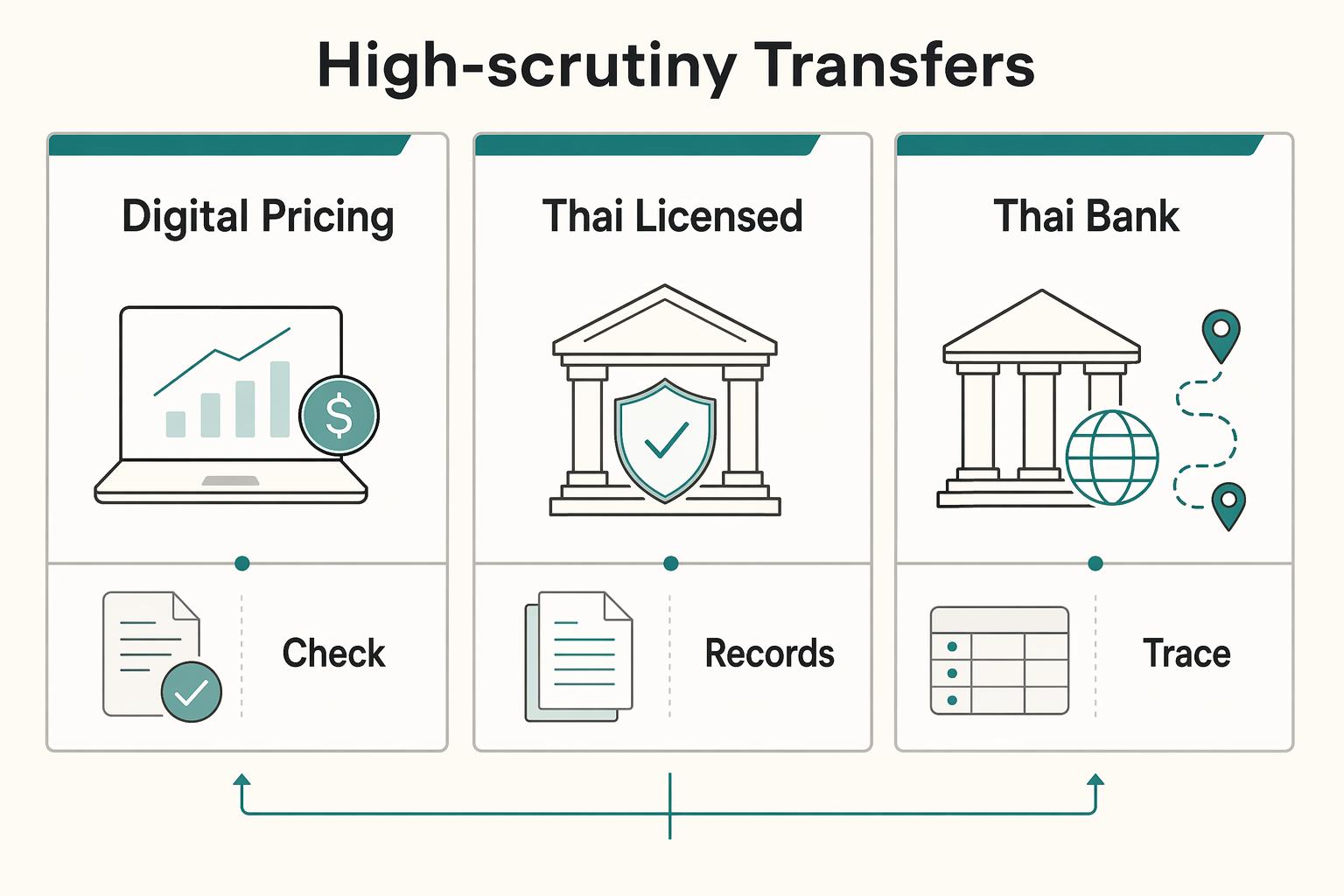
| High-scrutiny transfers | Unusually large, unusual for your pattern, or near a provider threshold | Use the most defensible documentation route and confirm the current threshold with your provider before sending |
A routine transfer can still need review, and an unusual transfer is not automatically better served by a bank. Choose an eligible provider that supports the purpose and gives the necessary payment evidence, then compare cost and timing. Provider restrictions matter more than the labels in this planning table.
Use this tiered rule before you submit:
- Everyday transfers: prioritize corridor support, clear pricing, and a repeatable process.
- Mid-size transfers: use the same checks, but expect more verification friction and confirm limits in advance.
- High-scrutiny transfers: if the transfer is unusually large, unusual for your pattern, or near a provider threshold, use the most defensible documentation route. Confirm the current threshold with your provider before sending.
1. Everyday and mid-size transfers#
For everyday transfers and many mid-size transfers, start with a licensed digital transfer provider if your recipient corridor and payout method are supported. That can be a good fit when the provider offers clear fee visibility and a simpler operating flow.
Start with verification. Check published corridor support and limits before you fund the transfer.
- DeeMoney's USD SWIFT guide lists individual limits of THB 500,000 per transaction and THB 800,000 per day; business customers have THB 800,000 for both. These are that product's limits, subject to verification and review—not all DeeMoney corridors.
- Wise's THB guide now permits sending for personal profiles with a Thailand address, funded from a local Thai bank by QR or Biller ID, up to THB 800,000 daily. Business profiles cannot send from THB. Confirm the live destination and quote before funding.
2. High-scrutiny transfers#
A bank branch or SWIFT channel can be useful when the amount, customer type or purpose falls outside an app's conditions, or when you need detailed remittance advice. Ask the bank to confirm eligibility, required source evidence and the fee option before authorizing the transfer; SWIFT is not a guarantee of approval or final credit.
SCB's personal SWIFT checklist illustrates a channel-specific documentation trigger. Its published USD 50,000-equivalent FCT requirement does not mean smaller transfers are exempt from review. Ask which purpose code and supporting records apply to your actual payment; don't choose a code merely because it allows submission.
| Provider type | Fee visibility | Exchange-rate behavior | Speed expectation | Transfer limits / coverage | Compliance friction | Best use case for freelancers and small teams |
|---|---|---|---|---|---|---|
| Wise personal THB sending | Live quote includes rate and fee | Compare quoted recipient amount | Use the route's current estimate; review can delay it | Thailand-address personal profiles; local Thai bank funding; THB 800,000/day | Eligibility and transaction checks still apply | Eligible personal transfers; unavailable for business-profile THB sending |
| DeeMoney USD SWIFT | Live fee option and quote | Provider conversion plus possible bank deductions | Provider estimates 1–3 business days; not guaranteed | Published individual/business limits differ; supported destination required | Verification and purpose checks | Supported USD recipient accounts, including business routes when approved |
| Thai bank SWIFT | Sending and intermediary/recipient charges | Bank quote; compare delivered currency | Cutoff, review and receiving-bank hours affect timing | Account/channel/purpose-specific | Purpose/source records and channel-specific forms | Transfers outside an app's conditions or needing detailed advice |
If your first option fails, switch cleanly instead of retrying blindly:
- For a delay, check whether the provider has received funding, requested verification, or released the payment. Submit requested evidence securely and obtain a case/reference number. Ask the sending provider to trace a released payment; give the recipient the bank reference to investigate their side.
- Before switching providers, confirm the original transfer is cancelled, returned or otherwise unable to pay. A delayed transfer can still settle; a second funded request can pay twice.
- For a rejection or return, confirm the reason, correct beneficiary account/IBAN/SWIFT fields using verified receiving-bank instructions, and reconcile the actual returned amount. Fees and conversion may change the refund; a recall request is not a guaranteed recovery.
Before funding, run this tool-selection check:
- Confirm the exact recipient corridor and payout bank are supported.
- Confirm required sender documents for your selected route, including source-of-income evidence where requested.
- Keep transfer-purpose wording consistent across form fields, notes, and supporting files.
- Make sure your supporting-document pack is ready before the transfer enters review.
For a step-by-step walkthrough, see The Best International Money Transfer Services (Beyond Wise). Before you choose your transfer route, run your own scenario in the payment fee comparison tool.
Reconcile each transfer so you can trace it end to end#
A transfer is not really finished when the money leaves your account. It is finished when you can trace it end to end: source income, the licensed provider trail in Thailand, the destination bank entry, and your books.
| Step | What to do | Key detail |
|---|---|---|
| Build a record package | Store the provider receipt, transaction reference, payout confirmation, sending-account debit, receiving-account credit, and source documents that support the payment | Keep the provider name and reference exactly as issued |
| Capture reporting obligations while facts are fresh | Store the account holder, provider or bank name, masked account number, statement snapshots, and tax-residency notes in an annual compliance folder | Confirm the current reporting threshold that applies to your case before filing |
| Separate FX movement from income accounting | Record income under your accounting method, then record the transfer as a separate cash movement, with the FX difference tracked separately | Keep the rate support you actually used |
1. Build a record package#
Create one complete file per transfer, or per month, and keep it in one place. At minimum, store the provider receipt, transaction reference, payout confirmation, sending-account debit, receiving-account credit, and the source documents that support the payment.
For higher-friction cases, also keep the exact purpose text you submitted, compliance emails, and any trace or return notices. Use a repeatable folder pattern like 2026-03 Thai outbound transfer / receipt / bank statements / source docs / compliance so you can answer questions quickly later.
Keep the provider name and reference exactly as issued. In Thailand, foreign-exchange purchase, sale, exchange, and transfer activity runs through authorized licensees under Bank of Thailand oversight, so that licensed-entity trail belongs in your audit record.
2. Capture reporting obligations while facts are fresh#
Do this right after the transfer, not at year-end. Cross-border payment rules are fragmented across regions, and a common failure mode is trying to reconstruct overlapping obligations later.
For each account touched, store the account holder, provider or bank name, masked account number, statement snapshots, and your tax-residency notes in an annual compliance folder. Add reminders for country-specific filing triggers and update them against current regulator guidance. Confirm the current reporting threshold that applies to your case before filing.
Keep inbound credit advice with the transfer file. BOT's summary requires foreign-currency receipts from abroad of USD 1 million equivalent or more to be repatriated within 360 days of the export or transaction date, then sold to or deposited with an authorized bank within 360 days of receipt. It also permits using such receipts for specified obligations to non-residents without repatriation; excluded purposes have different treatment. If this rule applies, retain the original receipt dates and evidence of handling or the permitted-use exception, rather than starting the clock again when you send funds out.
3. Separate FX movement from income accounting#
Do not assume the final received home-currency amount should be treated as revenue on its own. In many workflows, you record income under your accounting method, then record the transfer as a separate cash movement, with the FX difference tracked separately.
Keep the rate support you actually used, whether that is a provider confirmation, bank conversion detail, or bookkeeping rate support. This can reduce false swings in profitability and help avoid mismatches across invoices, receipts, and bank statements.
| Area | Clean reconciliation workflow | High-risk workflow |
|---|---|---|
| Documentation completeness | Receipt, debit, credit, source docs, purpose text, and provider reference stored together | Receipt only, scattered support docs, weak link to bank entries |
| Accounting treatment | Income and transfer recorded separately, FX difference tracked distinctly | Final received amount treated as revenue, fees and FX effects obscured |
| Tax and compliance impact | Faster responses to accountant, bank, or regulator with one evidence pack | Higher risk of inconsistent filings, missed disclosures, and repeat reviews |
Worked example: a THB 100,000 transfer budget#
Assume a foreign individual is eligible to send to their own overseas account and allocates THB 100,000 of documented earnings. In this hypothetical quote, the sender fee is THB 500 and THB 99,500 converts at THB 35 per USD. The instructed amount is USD 2,842.86. If a confirmed USD 20 receiving deduction applies, the bank credits USD 2,822.86. These are illustrative figures, not a provider quote.
| Record | Amount | Reconciliation |
|---|---|---|
| Thai account debit | THB 100,000 | THB 99,500 conversion + THB 500 fee |
| Provider instruction | USD 2,842.86 | THB 99,500 / 35, rounded |
| Destination credit | USD 2,822.86 | USD 2,842.86 minus confirmed USD 20 fee |
Compare a second provider using that same THB 100,000 total budget. A lower sending fee can still deliver less if its exchange rate is worse or receiving deductions are higher. Save both quotes with their timestamps and fee assumptions. If the actual credit differs from the selected quote, investigate the difference before marking the transfer reconciled.
When both accounts belong to the same person or entity, this is a cash transfer, not a second client-income receipt. Record the original income once under the applicable accounting method, the transfer between accounts, and supported fees/FX effects. If the destination belongs to a supplier or a different entity, classify the underlying payment instead of posting it as an internal transfer.
Use this monthly close routine. If you do it every month, year-end becomes a review, not a reconstruction.
- Match each outbound transfer to the invoice or income batch that funded it.
- Reconcile send amount, fees, FX conversion, and received amount against both sides' bank or provider records.
- Flag mismatches in amount, date, or purpose wording before month-end.
- Archive the full transfer file and update your annual reporting tracker the same day.
You might also find this useful: our guide to digital nomad tax residency in Thailand.
Repeat the same transfer and reconciliation routine#
Keep a reusable ledger and document template, then update the recipient, purpose, quote and eligibility for each payment. Close the file only after you have matched the debit, provider record and destination credit, or reconciled a confirmed return.
- Prepare the source and recipient records
Link each transfer to its underlying income or obligation, retaining actual tax records and any filing deadline still ahead. Verify new or changed beneficiary instructions through a trusted contact method. Keep sensitive documents in restricted storage and send only the required subset to the provider.
- Choose the rail by transfer context, not habit
Choose an eligible product using the live quote and its sender, purpose and destination conditions. Ask for the payment reference, fee option and expected arrival. If an app does not support your case, consult another licensed provider about the actual purpose instead of changing the purpose wording.
- Close the loop after funds arrive
Keep the credit confirmation and evidence used for the transfer. U.S. persons with a financial interest in or signature authority over reportable foreign financial accounts generally need FBAR if their aggregate value exceeds $10,000 at any time in the calendar year, subject to exceptions. The filing is due April 15 with an automatic extension to October 15; moving the balance out before year-end does not erase the earlier maximum.
For another corridor-focused example, see The Best Way to Send Money to the Philippines from the US.
If you want one workflow to invoice clients, track payment status, and keep audit-ready records, review Gruv for freelancers.
Frequently Asked Questions
What documents should you have ready?
Prepare the income record, matching Thai bank credit, recipient details and the selected channel's required purpose or source evidence. Add relevant tax records that are already available, and retain the eventual receipt or remittance advice. Sender and beneficiary names need to match their respective accounts; they need not be identical for a legitimate third-party payment.
How do you prove source of funds?
Prove source of funds with an unbroken documentation chain, not a longer narrative. Link the income document to the Thai bank credit, then to the outbound transfer record and any relevant tax evidence. Also confirm account ownership in your proof of payment and keep your purpose text specific, because banks may request both remittance-purpose and source-of-income documents.
What changes on larger transfers?
Separate the bank's document trigger from the product's sending limit. SCB's personal SWIFT page requires an FCT form and purpose documents from USD 50,000 equivalent. BOT's general bank-document rule uses USD 200,000 equivalent, with a KYB exception. Either can coexist with additional bank checks; confirm the requirements for the actual account and channel rather than treating either figure as an approval-free allowance.
Does Thai withholding tax apply to your transfer?
Moving your own money is not, by itself, a payment of income to a foreign company. For an actual payment of covered Thai-source income to a foreign company not carrying on business in Thailand, Revenue Code section 70 requires withholding and remittance with the prescribed return within seven days after the payment month's end. The return is P.N.D.54 (also called CIT 54). Establish income category, recipient status and applicable treaty relief first, and check the filing calendar for the chosen channel; do not interpret this as seven days after every personal transfer.
Should you use Wise, DeeMoney, or a Thai bank SWIFT transfer?
Use Wise only if your personal THB profile is eligible; use DeeMoney or a bank when its product supports your sender type, purpose and destination. Compare the final recipient amount and evidence, not only the advertised sending fee. The table separates availability from timing and review risk.
What are the transfer limits?
The limit depends on sender type, purpose, provider and product. Wise's eligible personal THB route currently lists THB 800,000 per day; DeeMoney's USD SWIFT product has distinct individual/business limits. Check your selected channel's current allowance and any purpose restriction before funding. A limit or hold is a reason to clarify the transaction with the provider, not to split or relabel it to evade checks.
Try a related tool
Researched and edited by the Gruv editorial team. Gruv builds cross-border billing, payouts, and finance-operations software for global businesses.
Sources
Includes 6 external sources outside the trusted-domain allowlist.
- irs.gov/businesses/small-businesses-self-employed/re...trusted
- wise.com/help/articles/2932335/guide-to-thb-transferstrusted
- bot.or.th/en/our-roles/financial-markets/foreign-excha...external
- deemoney.com/promotions/complete-guide-to-usd-swift-trans...external
- kasikornbank.com/EN/International-Business/global-money-trans...external
- kasikornbank.com/en/international-business/global-money-trans...external
- rd.go.th/english/37764.htmlexternal
- rd.go.th/english/42379.htmlexternal
Educational content only. Not legal, tax, or financial advice.
Related Posts

How LLC Owners Separate Business and Personal Finances
For an LLC, separating business and personal money is best treated as a weekly habit, not a one-time bank setup. It keeps records cleaner, cuts month-end cleanup, and creates clearer boundaries as the company grows.

London, UK: A Guide for Expats and Remote Workers
Get two calls right early and the rest of the move gets easier: how you'll be in the UK, and where you'll work when conditions are less than ideal. Make those decisions before you lock dates or prepay a long stay. If you book first and sort the basics later, admin and work reliability usually collide in your first week.
Digital Nomad Tax Residency in Thailand for 2026
Low-stress compliance in Thailand comes from early decisions and clean records, not last-minute cleanup. Most costly problems start as small assumptions about visas, day counts, and money movement that stack up over time.