
Quick Answer
Use the payment route you can execute right now, then verify critical fields before release. If you do not have U.S. banking access, the IRS foreign electronic payment wire path is the direct option, but it depends on accurate worksheet entries. Confirm the Same-Day Taxpayer Payment Worksheet, correct Tax Type Code, tax period, RTN/ABA 091036164 US TREAS SINGLE TX, and USD currency at the bank. Save the wire confirmation and your submitted instruction details together so follow-up is faster if posting is delayed.
Pay IRS from abroad without avoidable fees or delays#
To pay the IRS from abroad reliably, treat it as an execution task. Pick a method you can actually complete, submit the right identifiers, and keep proof in case there is a posting delay or the payment is applied incorrectly.
This guide is for U.S. citizens and resident aliens abroad who still must report income and pay U.S. tax on worldwide income. It focuses on payment operations, not broader tax planning. Where exact fees, processor costs, or guaranteed posting timelines are not confirmed, this guide does not guess.
1. Start with the method you can complete now#
Start with the path your accounts and bank can support today, then worry about cost. The IRS confirms that foreign electronic payments can move funds from a foreign bank account directly to the IRS, even if you do not have a U.S. bank account. It also notes that international wires can be costly and suggests considering other options, including credit card payments.
Bank capability is the first real constraint. IRS guidance notes that some small local banks may not be able to execute an international wire transfer, so confirm that your bank can send a U.S. dollar wire using a U.S. destination RTN/ABA before you build the rest of your payment plan. Account reality and bank capability come first; fee optimization comes second.
2. Treat payment application as separate from sending money#
A wire going out is not the same thing as the IRS applying it correctly. For international wires, the IRS requires the Same-Day Taxpayer Payment Worksheet with the proper Tax Type Code and tax period so funds are applied to the right liability.
Before you release the payment, confirm routing and identifiers with your bank. The IRS page lists destination routing as 091036164 US TREAS SINGLE TX and 20092900IRS as an optional account number. Do not guess the Tax Type Code from memory. Use the IRS worksheet or table for your exact payment type and period. Worksheet accuracy, including Tax Type Code, tax period, and routing details, matters as much as sending the wire.
3. Build proof in case of delay or misapplication#
Create one evidence folder when you submit the payment. Include the completed Same-Day Taxpayer Payment Worksheet, bank wire confirmation, Tax Type Code used, tax period selected, routing details given to the bank, and a timestamped copy of your payment instruction. If your bank issues an internal reference number, keep that with the same records.
Two checks matter here. First, U.S. tax payments in this wire flow must be sent in U.S. dollars, so confirm the currency before approval. Second, do not assume penalty relief will fix every problem. IRS reasonable-cause relief is handled case by case and does not apply to certain penalties, including the estimated tax penalty. That evidence pack matters when "sent" and "properly applied" do not happen at the same time.
For related reading, see How to use Wise to pay yourself a 'salary' from your foreign corporation.
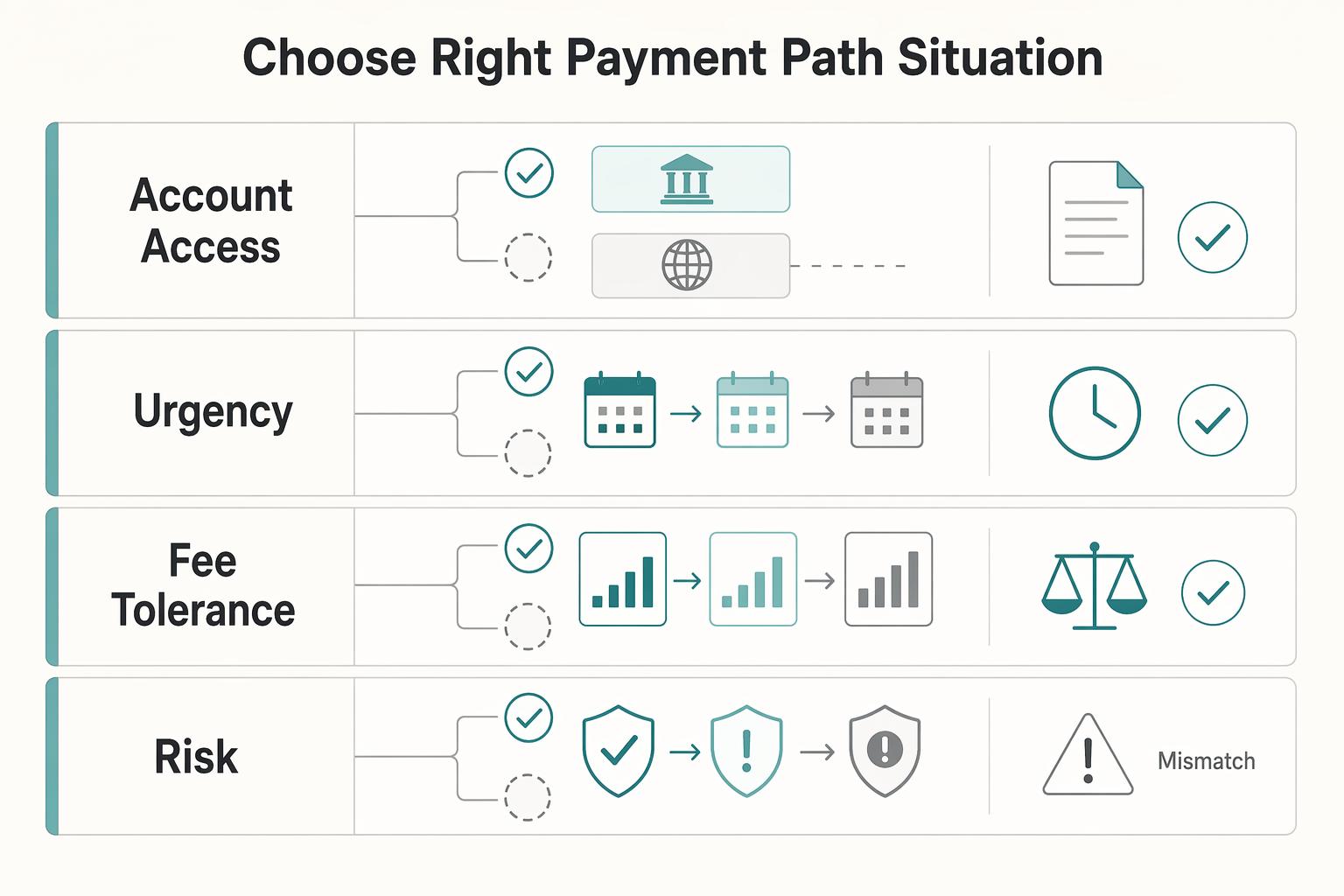
How to choose the right payment path for your situation#
Choose the payment path you can execute correctly today. If you do not have a U.S. bank account, start with Foreign electronic payments (international wire transfer) and focus on getting the payment details right before you try to save on fees.
| Factor | Article detail | Check |
|---|---|---|
| Account access | If you do not have a U.S. bank account, the IRS allows payments from a foreign bank account directly to the IRS through the foreign electronic payment wire path | Confirm your bank can send a U.S. dollar wire through a U.S. banking relationship; some small local banks may not be able to execute an international wire transfer |
| Urgency | When time is tight, use the method you can finish now | For a foreign-bank wire, complete the Same-Day Taxpayer Payment Worksheet before you go to the bank |
| Fee tolerance | International wire is a valid option, but the IRS notes that it can be costly and suggests alternatives, including card payments | Do not choose a lower-fee method if it creates delay or increases error risk |
| Accuracy risk | The correct Tax Type Code and tax period are required so funds are applied properly | Before release, verify the identifiers; banks may need RTN/ABA 091036164 US TREAS SINGLE TX, and 20092900IRS may be used as optional account information |
This section is for freelancers, creators, and small teams abroad who need to balance cost against payment certainty. It is not for treaty analysis, expatriation planning, or entity restructuring under the Internal Revenue Code.
1. Account access#
Your account setup decides more than your preferences do. If you do not have a U.S. bank account, the IRS allows payments from a foreign bank account directly to the IRS through the foreign electronic payment wire path. Confirm bank capability first. Your bank must be able to send a U.S. dollar wire through a U.S. banking relationship, and some small local banks may not be able to execute an international wire transfer.
2. Urgency#
When time is tight, use the method you can finish now. Do not rely on a path that still needs setup you have not confirmed. Execution readiness beats theoretical speed. For a foreign-bank wire, you need the Same-Day Taxpayer Payment Worksheet completed before you go to the bank.
3. Fee tolerance#
International wire is a valid option, but the IRS notes that it can be costly and suggests alternatives, including card payments. When options are limited or timing is tight, correctness comes first. A lower-fee method is not the better choice if it creates delay or increases error risk.
4. Accuracy risk#
A key risk is misapplication if payment details are wrong. The IRS requires the correct Tax Type Code and tax period, meaning year and/or quarter, so funds are applied properly. Verify identifiers before release. For wire setup, banks may need RTN/ABA 091036164 US TREAS SINGLE TX, and 20092900IRS may be used as optional account information.
Best ways to pay the IRS from abroad at a glance#
Use the method you can execute correctly today. If you do not have U.S.-based banking access, one direct route is Foreign electronic payments (international wire). If you already have working U.S.-based rails, EFTPS or another Make a Payment option may be easier to repeat.
| Method | Best for | Required accounts | Key inputs | Main cost risk | Main failure risk | Verification checkpoint |
|---|---|---|---|---|---|---|
| Foreign electronic payments via international wire transfer | Taxpayers abroad with no U.S. bank account who need a direct IRS path | Foreign bank account, and that bank must have a banking relationship with a U.S. bank | Same-Day Taxpayer Payment Worksheet, proper Tax Type Code, tax period, payment in U.S. dollars, RTN/ABA 091036164 US TREAS SINGLE TX, optional 20092900IRS | IRS warns this method can be costly | Payment can be misapplied if the Tax Type Code or tax period is wrong, and some small local banks may not execute international wires | Before release, have the bank read back the RTN/ABA, Tax Type Code, tax period, and confirm the wire is in USD |
| EFTPS | Repeat payments when you already have working U.S.-based payment access | IRS references Electronic Federal Tax Payment System (EFTPS) as a U.S.-based method, but you still need to confirm your own setup and eligibility | Payment details and tax period in EFTPS | Fee details are not stated in the provided IRS excerpt | Assuming setup is ready when it is not | Log in first and confirm you can schedule the payment now with the correct tax period |
| Make a Payment options including credit card and other U.S.-based rails | Cases where wire setup is not practical and you accept possible tradeoffs | A supported payment instrument through Make a Payment, which may include credit card and other U.S.-based methods | Correct payment category, tax period, taxpayer details, and any provider-specific fields | The provided IRS excerpt does not include fee details for these options | Choosing a route for convenience, then using the wrong payment category or period | Save confirmation details and verify the submitted payment category and tax period |
What the IRS excerpt confirms is narrower than what you still need to verify yourself. It confirms that a foreign bank account can be used for a direct wire, and that the worksheet and routing details matter. It also confirms that EFTPS and other Make a Payment routes exist. It does not confirm your exact setup status, your bank's execution path, local compliance limits, or provider fees. Treat those as live checks, not assumptions.
What usually decides this#
In practice, account access usually decides the method. If your only working account is a foreign bank account, wire is the supported direct route. If you already have working U.S.-based rails, EFTPS or another Make a Payment route may be easier to repeat. Do not assume setup details, fees, or timing are confirmed for these IRS payment methods.
If you want less rework, focus on the specific checks before you focus on fee assumptions. Confirm the Same-Day Taxpayer Payment Worksheet, Tax Type Code, tax period, and RTN/ABA 091036164 US TREAS SINGLE TX.
The operator rule to use#
If the deadline is close and EFTPS or card setup is still unconfirmed, do not switch based on possible savings. Use the method you can execute correctly now. The IRS also requires U.S. tax payments to be remitted in U.S. dollars, and wire execution depends on your bank's U.S. banking relationship.
Before you approve payment, run one final read-back. For wire, confirm the Tax Type Code, tax period, and ABA details with the bank. For U.S.-based methods, confirm the payment category and tax period on the final screen and keep the receipt.
The 3 best payment options and when each wins#
The best option is the one you can execute correctly now with the banking access you actually have. If you only have a foreign bank account, use the IRS foreign electronic payment wire path. If your U.S.-based payment access is already working, use EFTPS. If you can complete another supported method today, use a Make a Payment alternative.
| Option | Best for | Why it wins | Main tradeoff |
|---|---|---|---|
| Foreign electronic payments via international wire transfer | You do not have a U.S. bank account | IRS allows international taxpayers to transfer from a foreign bank account directly to the IRS | IRS warns it can be costly, and some small local banks may not be able to execute an international wire |
| EFTPS | You already have working U.S.-based payment access | IRS points to EFTPS through Make a Payment as a U.S.-based method | This does not confirm your setup status, eligibility, fees, or timing |
| Make a Payment alternatives, including card and other U.S.-based methods | You already have a supported payment method ready now | IRS says to consider other options, including paying by credit card, via Make a Payment | Method-specific setup, fees, and timing are not confirmed in this excerpt |
1. Foreign electronic payments via international wire transfer#
This is usually the practical choice if you do not have a U.S. bank account and your foreign bank has a U.S. banking relationship. It works when you complete the Same-Day Taxpayer Payment Worksheet with the proper Tax Type Code and tax period, meaning year and/or quarter, so funds are applied correctly.
For wire instructions, the IRS lists RTN/ABA 091036164 US TREAS SINGLE TX and optional account number 20092900IRS. Payment must be sent in U.S. dollars. Before release, have the bank read back the RTN/ABA, Tax Type Code, and tax period to reduce misapplication risk.
2. EFTPS#
Use EFTPS when your U.S.-based payment access is already working. The IRS points readers to Electronic Federal Tax Payment System (EFTPS) through Make a Payment.
Only rely on EFTPS if you can log in now and verify the payment details before you submit. Your specific setup, eligibility, fees, or timing are not confirmed, so verify those before you use it for a due date.
3. Make a Payment alternatives including card and other U.S.-based methods#
This path makes sense when you already have a supported payment instrument ready through Make a Payment. The IRS explicitly says to consider other options, including paying by credit card.
Choose this route because it is executable now, not because you assume it will be cheaper or faster. Before you submit, verify the payment details on the final confirmation screen and save the confirmation records immediately. For related reading, see Separating Business and Personal Finances: An Important Step for LLCs.
If you use international wire transfer, follow this exact order#
If you are using an international wire, sequence matters. Complete the worksheet first, confirm bank and currency constraints next, ask for a read-back before release, and save proof immediately after sending.
| Step | Action | Key details |
|---|---|---|
| Prepare the worksheet | Complete the Same-Day Taxpayer Payment Worksheet before going to the bank | Use the correct Tax Type Code and tax period; bring RTN/ABA 091036164 US TREAS SINGLE TX and optional 20092900IRS |
| Confirm constraints | Confirm the payment will be sent in U.S. dollars and that your bank can execute this route | The foreign bank must have a banking relationship with a U.S. bank, and some small local banks may not be able to process this type of international wire |
| Read back the fields | Have the banker read back the payment details before release | Read back the Tax Type Code, tax period, RTN/ABA 091036164 US TREAS SINGLE TX, and 20092900IRS if they entered the optional account number |
| Save the record | Keep the wire confirmation and completed Same-Day Taxpayer Payment Worksheet together after sending | Keep the amount in USD, submission date, Tax Type Code, and tax period for reconciliation |
- Prepare the worksheet before going to the bank
Complete the Same-Day Taxpayer Payment Worksheet with the correct Tax Type Code and tax period, meaning year and/or quarter, so funds can be applied to the right liability. Bring the exact destination details from the IRS instructions: RTN/ABA 091036164 US TREAS SINGLE TX and the optional IRS account number 20092900IRS.
- Confirm execution constraints early
Confirm your payment will be sent in U.S. dollars, since this method requires remittance in USD. Also confirm that your foreign bank can execute this route. It must have a banking relationship with a U.S. bank, and some small local banks may not be able to process this type of international wire.
- Ask for a read-back before release
A read-back is a practical control before funds move. Have the banker read back:
- Tax Type Code
- Tax period with the correct year and/or quarter
- RTN/ABA 091036164 US TREAS SINGLE TX
- 20092900IRS if they entered the optional account number
- Save the payment record immediately after sending
Keep the wire confirmation and your completed Same-Day Taxpayer Payment Worksheet together. It also helps to keep the key payment details in the same record set, including amount in USD, submission date, Tax Type Code, and tax period, for easier reconciliation if questions come up later.
International wire can be the right option when you do not have U.S. banking access, but it can be costly and requires complete, accurate payment details.
If you use U.S.-based methods, confirm these dependencies first#
U.S.-based options can look simpler than they are. If EFTPS or Make a Payment is not fully executable from where you are, use the method you can complete correctly now, especially when a deadline is close.
| Dependency | What to verify | Article note |
|---|---|---|
| Account reality | Confirm what access you have today and that you can complete the required funding and submission steps | The IRS excerpts do not fully show all eligibility details for EFTPS or every Make a Payment path from abroad |
| Deadline rule | If enrollment, verification, linking, or authorization is still not complete, use the method you can submit accurately now | Near a due date, unresolved setup risk matters more than theoretical convenience |
| Filing guidance vs. payment execution | Keep filing timeline guidance separate from payment setup | Publication 501 (2025) and IRS international notices help with filing context, but they do not confirm that your payment path is fully set up |
| Unknowns log | Record the chosen method, what is verified, what is still unknown, the fallback method, and the proof to save after payment | The IRS excerpts do not fully show exact processor fees, method-specific posting times, or complete abroad-eligibility details for EFTPS and Make a Payment |
- Account reality
Confirm what access you have today, not what you expect to have later. Do not assume you have full eligibility details for EFTPS or every Make a Payment path from abroad, so treat assumed access as a risk.
Before you commit, verify the full path you plan to use. Confirm you can complete the required funding and submission steps. If any step is still uncertain, keep a fallback method active.
- Deadline rule
Near a due date, unresolved setup risk matters more than theoretical convenience. If enrollment, verification, linking, or authorization is still not complete, use the method you can submit accurately now.
Practical rule: execute the payment path that works today, then optimize next cycle. If you may need to switch, keep your fallback details ready so the switch is immediate.
- Filing guidance is not payment execution
Keep filing timeline guidance separate from payment execution. Publication 501 (2025) includes a subsection for "U.S. Citizens or Resident Aliens Living Abroad," and IRS international notices guidance also covers return due dates and extensions for international returns.
Those sources help with filing context, but they do not confirm that your payment path is fully set up. Treat "filing guidance applies to me" and "payment is executed and traceable" as two separate checks.
- Unknowns log
Do not assume exact processor fees, method-specific posting times, or complete abroad-eligibility details are settled for EFTPS and Make a Payment. Write these unknowns down before choosing a method.
Use a short planning note. Record the chosen method, what is verified, what is still unknown, the fallback method, and the proof to save after payment. IRS processing manuals include categories like unprocessable submissions, unpostables, and failure-to-pay penalties, so keep records that show how and when you submitted.
Choose in 60 seconds with scenario-based rules#
When the choice is not obvious, do not overthink it. Use the electronic method you can complete correctly today, and if execution is uncertain, switch early instead of forcing a path that is not fully workable.
- No U.S. bank account, direct path needed
Use the electronic wire route if that is the method your bank can execute now. Treasury and the Internal Revenue Service (IRS) are moving toward electronic payments, and electronic methods are described as faster and lower-error than paper instruments.
- You have U.S. banking access and expect repeat payments
Keep any account-based electronic option on your shortlist only after you verify live access from your current location. If you cannot sign in and reach payment authorization now, do not rely on it for this deadline.
- Deadline pressure is the main problem
Use the fastest executable electronic route you can complete accurately today, then optimize cost next cycle. IRS and Treasury guidance explicitly includes "same-day wire where appropriate," while paper instruments like checks and money orders are more likely to be lost, stolen, altered, or delayed.
- Your bank cannot clearly support the required payment details
Treat that uncertainty as a stop signal and switch methods early. Keep proof of what you submitted, including method, timestamp, amount, and confirmation, and keep filing guidance separate from payment execution. Publication 54 includes "Filing and Payment Due Dates," but that is not proof your payment path is complete and traceable.
If fee tradeoffs are close, run a quick side-by-side before you commit. Choose the path you can execute correctly today: Compare your payment costs.
Avoid the payment errors that create expensive rework#
The expensive mistakes usually show up after you think the hard part is done. The question is not only whether money was sent, but whether the payment can be applied to the right IRS liability and documented clearly for follow-up.
- Wrong identifiers on a wire that still goes through
IRS guidance for foreign electronic payments requires the proper Tax Type Code and tax period (year and/or quarter) so funds are properly applied. If you are using an international wire transfer, complete the Same-Day Taxpayer Payment Worksheet before you go to the bank. Keep more than a generic wire receipt. Retain the worksheet details, the Tax Type Code used, and the tax period entered so the payment can be matched to the intended liability.
- Assuming your bank can handle the U.S. routing path
IRS says your foreign bank must have a banking relationship with a U.S. bank, and that small local banks may not be able to execute an international wire transfer while most large banks can. Confirm capability before deadline week. Ask whether they can process a U.S. dollar tax wire with IRS routing details, including RTN/ABA 091036164. Also ask whether they require their own international wiring application. If the bank cannot clearly confirm the U.S.-bound routing setup, consider another payment method early.
- Letting currency settings default away from USD
IRS states that U.S. tax payments must be remitted in U.S. dollars. Before authorizing, verify the wire is denominated in USD on both the application and the final receipt.
- Treating filing guidance as payment proof
Eligible taxpayers abroad may have an automatic 2-month extension to file, moving the filing date from April 15 to June 15. That extension is about filing timing, not a bank confirmation for wire payment. Keep a separate payment proof set with the method, timestamp, amount, bank confirmation, and the identifiers submitted with the wire. IRS international FAQs can help with process context, but the IRS says those FAQs are informational and not citable as legal authority. For a step-by-step walkthrough, see The Best Way to Pay an Indian Development Agency from the US.
Keep an audit-ready payment evidence pack#
A clean evidence pack makes later reconciliation easier. Keep payment proof in its own file, separate from foreign-asset compliance records, so asset-reporting files and payment documentation do not get mixed.
- Keep one complete payment record per submission
Store each payment's confirmation details together so the record is easy to trace later. Fragmented records across folders are harder to verify later.
- Do not mix payment proof with Form 8938 or FBAR compliance files
Form 8938 is for reporting specified foreign financial assets, and it must be attached to your annual return by that return's due date, including extensions. FBAR is separate: filing Form 8938 does not remove the requirement to file FinCEN Form 114. Even when a Form 8938 threshold test applies, including the base $50,000 trigger cited for certain taxpayers, that is asset-reporting logic, not payment-proof documentation.
- Review payment records on a regular reconciliation cadence
Review payment proof during your normal reconciliation cycle instead of leaving it for year-end cleanup. A simple operating rule can keep this manageable: one payment, one evidence set, one ledger match.
Put this payment decision inside your annual expat tax system#
This payment decision works best when it sits inside your annual tax process instead of floating on its own. Keep separate but connected lanes for the U.S. return, the payment action, and other reporting streams so one task does not get mistaken for another.
1. Anchor your filing position first#
Being abroad does not remove the need to file correctly. For FEIE, the IRS is clear: the exclusion applies only to qualifying individuals with foreign earned income, and you still file a U.S. return reporting that income.
Set your annual file with one clear line for filing status, expected path, and whether you are relying on the physical presence test or bona fide residence test. If you use physical presence, the threshold is 330 full days in a 12-month period, and a full day is 24 consecutive hours. If you use bona fide residence, do not assume that simply living abroad for a year automatically qualifies you.
2. Use FEIE and FTC to calculate tax, not as filing shortcuts#
FEIE and the Foreign Tax Credit are tax-calculation tools. For FEIE, the stated maximum exclusion is $130,000 for tax year 2025 and $132,900 for 2026, per qualifying person.
If you claim FTC on Form 1116, build the mechanics in early. You generally need a separate Form 1116 for each income category, and amounts are generally reported in U.S. dollars. If your records mix categories or currencies, separate them before finalizing the return.
3. Keep one annual map with clear lanes#
Use a one-page annual map with columns for return preparation, payment action, Publication 54 guidance context, and separate reporting streams. Publication 54 is a reference point for additional international taxpayer details.
Keep other reporting streams on separate lines from payment tracking. Add one more checkpoint: track the year income was earned, not only when cash arrived, because IRS FEIE guidance ties income to when the work was performed.
4. Escalate qualification and documentation edge cases early#
Some issues should stop you from making casual assumptions. If you cannot clearly support whether you meet the physical presence test or the bona fide residence test, pause and confirm that filing position first.
A practical trigger is simple: if you cannot map foreign taxes to the correct Form 1116 income category or convert amounts to U.S. dollars correctly, resolve that before changing payment planning.
Choose the method you can execute correctly the first time#
The best choice is still the one you can submit correctly now. Match the method to your account access, your deadline, and the exact IRS payment type, then save clean proof before you move on.
- Start with execution reality, not theory.
Pick the path you can actually complete in this payment window. An option is not better if you cannot finish it correctly before the deadline.
- If Direct Pay fits your setup, treat payment type as the control point.
Direct Pay is an IRS service for paying from a bank account, and it includes payment types such as 1040-ES, 4868, and 1040-X. It is for making tax payments, not receiving refunds. Verify the exact payment option or type before you submit.
- Avoid known Direct Pay misuse cases.
Do not use Direct Pay to pay one spouse's share when spouses were assessed separate amounts for the same return. If you file a business return separate from your individual return, use the business-payment path rather than assuming the individual path applies.
- Keep an evidence pack for follow-up.
Save the confirmation, amount, date, and exact option you selected as soon as the payment is accepted. Clean records make reconciliation and any correction process faster.
IRS international individual tax FAQs are general guidance and not legal authority, so do not stretch a short FAQ answer into a decision it does not clearly support.
Complete the selection table, run your pre-flight checklist, and save your evidence pack before the payment window tightens. If you manage cross-border client income, use systems with clear status tracking and reconciliation so tax payments are less likely to disrupt operating cash flow.
Frequently Asked Questions
Can I pay the IRS from a foreign bank account if I do not have a U.S. bank account?
Yes. The IRS provides a foreign electronic payment path for people who do not have a U.S. bank account and need to transfer funds directly from a foreign bank account. Your foreign bank must have a banking relationship with a U.S. bank, and some small local banks may not be able to execute the wire.
Is international wire transfer always the best option for paying U.S. taxes from abroad?
No. The IRS notes that international wires can be costly and suggests considering other options, including credit card payments. If you can use a U.S. bank account, compare available options instead of defaulting to a wire.
What details do I need before asking my bank to send an IRS payment wire?
Complete the Same-Day Taxpayer Payment Worksheet before you go to the bank. Include the correct Tax Type Code, the correct tax period, meaning year and/or quarter, and destination RTN/ABA 091036164 US TREAS SINGLE TX. 20092900IRS is listed as optional account information. Accuracy on those entries is what helps the IRS apply the payment correctly.
Do IRS payments from abroad have to be sent in U.S. dollars?
Yes. The IRS says U.S. tax payments must be remitted in U.S. dollars. Confirm your bank is sending in USD before the transfer is released.
What is the difference between sending a payment and having it applied correctly to my tax liability?
A sent payment confirms your bank sent the transfer. Correct application at the IRS depends on the worksheet details, especially the Tax Type Code and tax period, meaning year and/or quarter. Bank confirmation alone may not confirm that the IRS applied the payment the way you intended.
Does an automatic filing extension for taxpayers abroad change when I need to pay?
Qualifying U.S. citizens and resident aliens abroad get an automatic 2-month extension to file. For calendar-year filers, that moves filing from April 15 to June 15. The IRS also says estimated-tax rules are generally the same whether you are in the U.S. or abroad. Treat filing timing and payment timing as separate until you confirm your specific obligation.
What should I keep as proof in case my IRS payment is delayed or misapplied?
Keep your completed Same-Day Taxpayer Payment Worksheet and the bank wire confirmation together. Also retain the exact Tax Type Code and tax period submitted with that payment. Those records can support follow-up if the payment is delayed or applied to the wrong liability.
Try a related tool
Researched and edited by the Gruv editorial team. Gruv builds cross-border billing, payouts, and finance-operations software for global businesses.
Sources
Educational content only. Not legal, tax, or financial advice.
Related Posts

Digital Nomad Taxes in 2026 With a Defensible Filing Plan
With digital nomad taxes, the first move is not optimization. It is figuring out where you may be taxable, where filings may be required, and what proof supports that position.

How LLC Owners Separate Business and Personal Finances
For an LLC, separating business and personal money is best treated as a weekly habit, not a one-time bank setup. It keeps records cleaner, cuts month-end cleanup, and creates clearer boundaries as the company grows.

The Freelance Payment Penalty: A Modeled Audit of Platform Fees, FX Spreads, and Payout Delays
The money rarely disappears through a single, easy-to-spot fee. The real loss is stacked. A marketplace takes its commission, a processor adds a charge for international cards, a bank or payment company converts the currency at a spread, a platform holds the funds before release, and a wire sheds a little to intermediaries on the way in. Each layer looks defensible on its own, but the worker feels the combined result as a smaller deposit and a later payday.