
Quick Answer
Choose a payment rail based on operating load, then lock a repeatable monthly flow. For small recurring teams, simpler routes like Wise or Payoneer can work; for one-to-few high-control cases, direct bank wire can fit; and for larger approval-heavy operations, Gruv Payouts plus Virtual Accounts can add stronger traceability. Define net vs gross terms up front, set one FX decision point, verify recipient details on new or changed accounts, and keep a per-transfer evidence packet so holds or returns do not become cashflow disruptions.
Stop guessing salary lists and choose a payment system that actually works#
If you need to pay developers in Ukraine every month, the real risk is usually execution, not finding one perfect salary number. You need a setup that pays on time, makes FX cost visible, and leaves records you can defend later.
For freelancers, creators, and small teams, this is an operations problem first. The rail you choose affects timing, traceability, conversion cost, and how painful cleanup becomes if a bank, client, or tax authority asks questions.
- Use salary lists for context, not for payment decisions.
nCube, Glassdoor, Levels.fyi, and Reddit can help you sanity-check compensation, but they do not tell you how to run payouts. They also disagree. nCube shows $1,500 to $2,500 monthly (updated 14 Jan 2026), Glassdoor shows $3,114 per month, and Levels.fyi shows $33,346 to $69,000 (last updated 3/25/2026). Reddit is the weakest source here, and one cited survey says responses are not vetted or verified.
- Choose the rail for the job, not by habit.
Different rails behave differently on speed, visibility, and cost. SWIFT is used for official cross-border company payments, but traditional transfer chains can still take up to 5 business days. If the invoice currency does not match the account currency, an exchange margin is added.
- Create audit-ready records from day one.
Keep records for each transfer that support the income, deductions, or credits you report on your tax return. The IRS says you generally must keep records supporting income, deductions, or credits on your return. A common baseline is 3 years, and some bad-debt or worthless-securities cases extend to 7 years.
That is the lens for the rest of this article. Do not guess at one "true" salary figure. Build a payment setup that still works when timing slips, currencies differ, or someone asks you to prove what happened.
Who this list is for and how the options are scored#
This shortlist is for teams paying developers in Ukraine on a recurring basis and who care more about dependable monthly execution than salary-list guesswork. Score each option on continuity, cost visibility, engagement-model fit, and risk handling limits.
- Ongoing contractor teams, not one-off gigs
This list is built for recurring contractor payments, especially dedicated-team setups where people function as a direct extension of your organization. It may be less useful for a single fixed-invoice, project-based engagement.
- Reliability first, then convenience or headline price
Prioritize options that stay usable when operations are stressed and that are easy to reconcile. The source material describes shelling and blackout disruption alongside fallback delivery practices, so continuity under delays should outweigh a cheaper-looking headline cost.
- Use a practical operating rule for scoring depth
As an operating heuristic, simple flows can work for smaller recurring recipient groups when confirmations and invoice-to-transfer matching stay clear. As recipient counts or approval layers grow, controls, reconciliation, and exception handling matter more than send-screen simplicity.
- Scope: payment operations for IT outsourcing, not legal or tax advice
Engagement model still matters. Project-based outsourcing and dedicated-team relationships create different recurring payment needs. Also treat market-size figures as context, not precision guidance, since cited 2024 export totals conflict ($6.45B vs USD 6.2 billion). Related: IP Protection When Outsourcing Software Development to Eastern Europe.
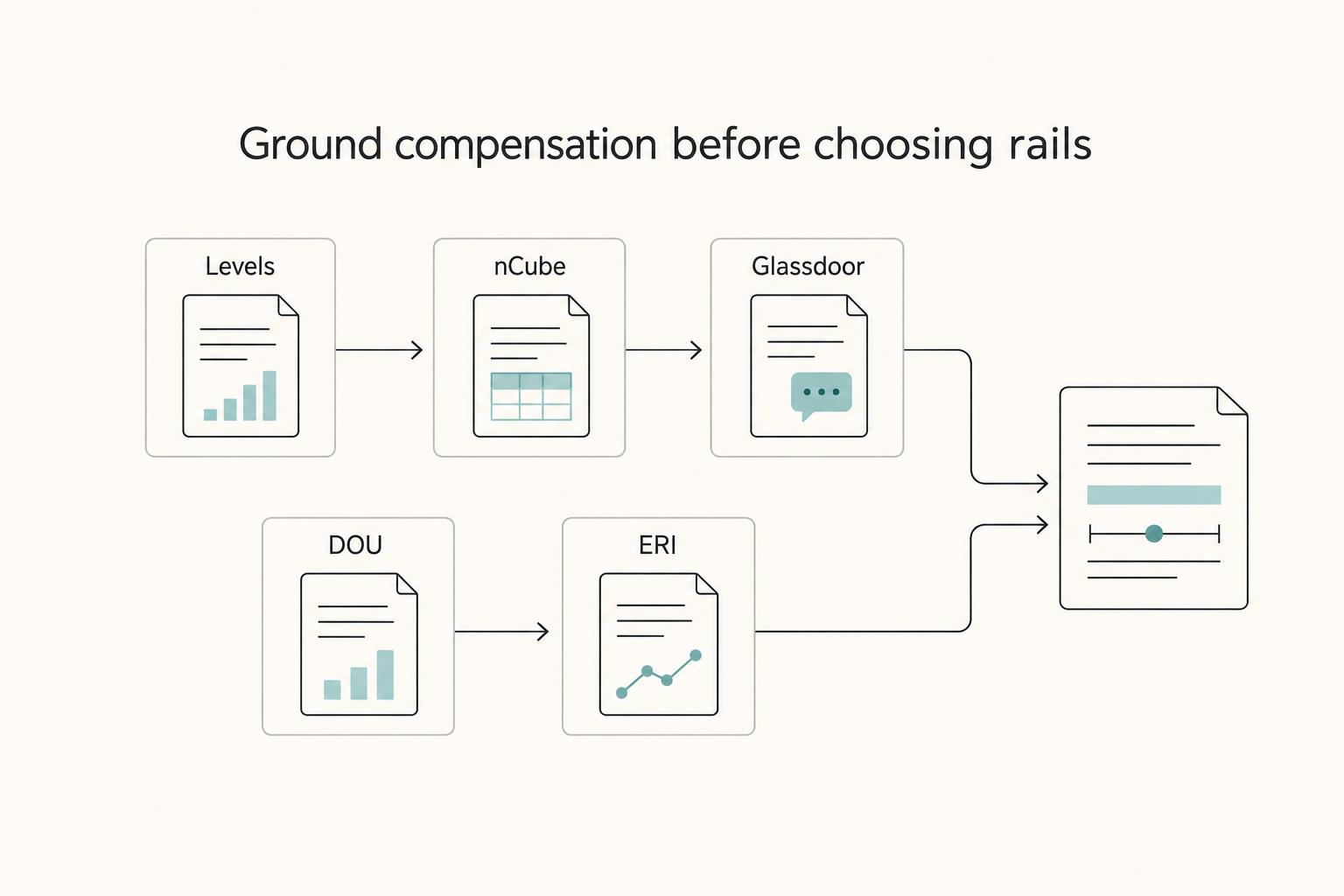
Ground truth on compensation before you pick a rail#
Set compensation assumptions first, then choose the payment rail. If the pay baseline is off, payout operations get harder to run cleanly month after month.
| Source | Figure | Basis or note |
|---|---|---|
| Levels.fyi | $33,346 to $69,000 | Software engineer range; Kyiv $62,400, Odessa $57,915, Lviv $41,413; last updated 3/25/2026 |
| nCube | $1,500 to $2,500 monthly | Directional band for a skilled engineer; up to $6,000 for rare-skill specialists; updated 14 Jan 2026 |
| Glassdoor | $3,114 per month | Used as context, not as a payout-system guide |
| DOU | $2400 for middle software engineer | Salary figures are net |
| ERI | 1 001 073 ₴ average software engineer salary | Gross average; updated March 19, 2026 |
1. Use ranges, not one "market salary"#
Ukraine compensation sits in a wide band, so one headline number is not enough. Levels.fyi shows a software engineer range of $33,346 to $69,000. It also shows a location split of Kyiv $62,400, Odessa $57,915, and Lviv $41,413 (last updated 3/25/2026). nCube also ties variation to stack, seniority, and city, with a directional monthly band of $1,500 to $2,500 for a skilled engineer and up to $6,000 for rare-skill specialists.
Use multiple inputs before you lock a monthly offer. nCube, Mobilunity, Glassdoor, and Levels.fyi are directional signals, not a single source of truth.
2. Downweight anecdotal posts hard#
Forum-style reports are fine as a quick smell test, but they are weak pricing evidence. Anecdotal evidence is non-systematic personal reporting, so it should not carry a fixed monthly commitment on its own.
A better approach is triangulation. Combine one crowd signal, one structured salary range, and one recruiter- or employer-oriented source before setting contractor payout terms.
3. Decide net or gross before the contract is drafted#
Do not leave this ambiguous. Label compensation as net or gross before you finalize payment terms. Gross pay is before deductions. Net pay is the amount after withholdings.
DOU states its salary figures are net ($2400 for middle software engineer). ERI reports a gross average software engineer salary of 1 001 073 ₴ (updated March 19, 2026). If you do not label the basis, invoice and payout expectations can diverge fast. In the contractor agreement, make payment structure, schedule, and net or gross basis explicit in both compensation and invoice terms.
Quick comparison of the best ways to pay developers in Ukraine#
Once payout policy is settled, choose the rail based on operational load, not just send capability. For low-volume recurring payouts, simple tools can work well. As payout count grows, tracking, exception handling, and reconciliation usually decide when you need something stronger.
For most teams paying on a recurring cadence, the practical split is simple. One low-friction platform can be a strong starting point. Direct wires fit tightly controlled one-off or low-count payments. A recipient-led platform fits when payees already use it. Gruv fits teams that want compliance-gated flows and audit-ready operations from day one.
| Method | Onboarding friction | FX visibility | Payout status tracking | Failure recovery path | Reconciliation exports | Scaling from single payout to batch | Best for | Breaks first when volume grows |
|---|---|---|---|---|---|---|---|---|
| Wise | Low to medium. Single sends are straightforward. Batch can be file-based (.CSV/.XLSX) with no mandatory API. | Review conversion terms before release. | It provides transfer progress updates, including delays. | Verify beneficiary details and transfer references before retrying failed or delayed payouts. | Transfer lists can be downloaded for up to a 365-day period. | Supports growth from single payouts to batch, with up to 1,000 transfers per batch file. | Lean teams paying recurring contractor invoices. | Approval and reconciliation work can become spreadsheet- and inbox-heavy as volume grows. |
| Payoneer | Medium. Mass payout setup includes payee registration and account approval. | Route- and setup-dependent. Review payout terms before release. | Payment history includes statuses such as processing, completed, and pending review. | "Pending review" can surface issues early, but follow-up may still be needed to clear payee or account checks. | Use account history, and confirm available fields match your ledger requirements. | Built for scale: 190+ countries and territories and 70 currencies. | Teams with recipients already operating in the platform. | Payee-specific exceptions and approval overhead can become harder to standardize. |
| Direct bank wire from your LLC | High. You typically need SWIFT/BIC, sometimes IBAN, plus country-specific fields. | Cost visibility can be mixed. Some banks waive outbound wire fees in foreign currency but still apply FX markups. | Tracking depends on bank tooling. For some wires, UETR helps trace payments. | Hardest recovery profile. Banks warn mistaken wires are hard to recover, and accepted Fedwire credits are final and irrevocable. Missing required fields can also cause failures. | Bank statements and confirmations are available, but internal matching is often manual. | Works for low count, but scaling is usually people-intensive without treasury tooling. | Finance-owner-controlled payouts with manual review per payment. | Data-entry errors, exception follow-up, and rework after incorrect beneficiary details. |
| Gruv Payouts + Virtual Accounts | Medium to high upfront. Compliance and policy checks apply, and coverage/timelines vary by corridor. | Structured FX and funding controls. Virtual accounts provide dedicated receiving details in 30+ currencies where supported. | Gruv positions payouts as compliance-gated with a clear audit trail. | Gruv states payouts are idempotent by design, which supports safer retry behavior. | Gruv explicitly includes audit-friendly records, exports, and integration patterns. | Designed for scale, including payout coverage to talent in 40+ countries. | Teams moving from ad hoc payouts to controlled, traceable batch operations. | Upfront corridor and policy configuration is the main implementation lift. |
What matters most in practice#
Pick the rail where your monthly risk is easiest to control. Wires give you maximum manual control but demand exact banking data. Platform routes can reduce setup burden, but manual ops work can still grow with volume. Gruv adds more upfront policy and corridor setup, with idempotent retry behavior and audit-friendly records.
Before your first live cycle, test recipient-data readiness, status visibility, and retry handling. For wires, validate SWIFT/BIC, IBAN if required, and country-specific fields. For the platform routes, confirm the recipient path and, for the recipient-led option, make sure payee and account approvals are complete before payout day.
When to switch rails#
Switch when reconciliation and exception handling, not sending money, become the monthly bottleneck. Common signs include repeated manual status checks, off-platform approval trails, and retry decisions made without clear provider references.
The method-specific signals are straightforward: wire failures caused by missing bank or country fields, rising manual cleanup in platform flows, or policy and corridor mismatches during Gruv rollout planning.
Before you commit to a rail, run your own corridor assumptions through this payment fee comparison tool and keep the output with your payout policy notes.
Wise for lean teams that want low-friction recurring payouts#
Wise can be a practical first rail when you pay the same Ukraine contractors on a recurring schedule from one LLC operating account. It works best when your process is predictable: approve the invoice, choose the FX moment, and release payment on a fixed cadence.
- Best fit
Use it when payout patterns are stable and not heavily exception-driven. Wise publicly markets USD-to-UAH transfers, and its business product supports batch payouts. Batch payments can cover up to 1,000 international payments, and it says you can fund a batch with a single pay-in. That gives lean teams a clear path from a few monthly payouts to more volume without changing rails right away.
- Why lean teams like it
The main operational benefit is FX visibility. It says it uses the mid-market rate and highlights fee transparency, with sending fees starting from 0.57% depending on currency. That makes it easier to document conversion timing between invoice approval and payout release. It also reports 74% in under 20 seconds and 95% in less than a day as platform-wide speed stats, but those are not guarantees for every Ukraine transfer.
- Where limits appear
The business product supports payment approvals, but availability depends on the regions where it allows account opening and balance holding, and teams can set 1 or 2 approvers per member. That can cover basic separation of duties, but you should test your real approval flow before committing long term. It offers a business audit report and a QuickBooks connection for bill reconciliation, but you still need internal naming and invoice-matching discipline.
- How to run it without monthly cleanup
Keep one sequence: approve invoice, lock FX decision, then send payout. Before each first payout and after any bank-detail change, re-verify beneficiary details with the contractor. For Ukraine payouts, confirm corridor availability for the specific recipient setup, and account for listed restrictions in Crimea, Donetsk, Luhansk, Kherson, and Zaporizhzhia. For each payout, keep a compact evidence pack: invoice, contract payout term, approved amount, FX note, transfer confirmation, and the related export or audit report.
Choose this route when your main need is recurring payouts with clear FX visibility. If approval logic, exception handling, or reconciliation depth is already the bottleneck, do not assume batch capability alone will fix it.
Payoneer for recipients who prefer platform-style payout intake#
Payoneer is a practical choice when recipients already want to get paid inside Payoneer. Use it when recipient familiarity and mixed payout preferences matter more than running every step through your bank, and do not choose it on fee assumptions alone.
- Best fit
It can fit IT outsourcing teams paying mixed recipients across Ukraine and nearby markets, especially when part of the roster already invoices through the platform. It says businesses can pay both account holders and recipients who are not using it, which supports split recipient preferences. If recipients already use its receiving accounts in USD, EUR, GBP, and more, adoption can be easier than changing rails mid-engagement. Still, it also says payment-method availability can change and is not guaranteed.
- Why teams pick it
The main upside is platform-native intake for recipients who already use it. It defines payments between its own accounts as direct account-to-account transfers and describes them as instant and secure. It also presents broad footprint signals, including over 190 countries and territories, plus workforce messaging of 160+ countries and 70 currencies, but treat that as network breadth, not proof that your exact Ukraine route is available right now.
- Where tradeoffs show up
Fee predictability can be a friction point. It says fees can vary by marketplace, platform, and network, and fee updates can differ by country and date. If you need tight monthly cost control, validate current route terms and recipient type before you lock contract language. Approval controls also need validation in your own setup. The platform documents user management with role-based permissions and role-dependent transaction approval setup, so the risk is usually configuration mismatch with your internal policy rather than a complete lack of controls.
- How to run it without payout confusion
Before first payment, confirm the recipient method: account-to-account transfer or payout to a bank account. That choice changes speed expectations and how you communicate timing.
Keep the process tied to business transactions only, with invoice and contract records attached. Because the coverage map is non-contractual and availability can change, verify the live route before cutoff day. For each payout, store the invoice, contract payout clause, recipient method confirmation, approval record if used, and transaction confirmation.
Related reading: The Best Way to Pay a Team of Contractors in Latin America.
Direct bank wire from your LLC for high-control one-to-few payments#
Direct bank wire can be a fit when you pay one or a few Ukraine-based contractors and want manual, bank-to-bank control over each transfer.
Where it fits#
Use this route when payment volume is low and each payout needs explicit review before release. One case is a founder-led team paying one senior DevOps contractor in Kyiv against milestone acceptance. In that setup, your LLC can keep instruction, approval, and payment records inside your bank workflow.
What to verify before the first wire#
Treat this as a compliance and operations check, not just a banking step. Start with worker classification. Guidance updated June 3, 2025 places this at Step #1 for Ukraine. Ukraine distinguishes employees from independent contractors, and if someone is an employee, employer obligations such as tax withholding and social security contributions apply.
| Item | What to keep |
|---|---|
| Signed contract | Payout clause, currency, and milestone or invoice terms |
| Approved invoice | Tied to the contract milestone |
| Beneficiary details | Confirmed directly with the contractor, especially after any account-change request |
| Contractor tax information | On file |
| Internal approval note | Shows who authorized the wire |
If the person is an independent contractor, align payment setup to that status and confirm tax information before transfer, listed as Step #4 in the same guidance. Keep the package above in place before the first payment.
The tradeoff you are accepting#
The main downside is manual exception handling. If a payment is delayed or returned, follow-up and investigation may sit with your team.
Also account for corridor risk. Some payment methods for Ukrainian contractors have been affected by the ongoing war with Russia. For direct wire, verify details carefully and set realistic payout-timing expectations in your contract and payment communication.
For one high-trust contractor relationship, this can be a workable control-first choice. As monthly volume grows, reassess whether the same manual process still fits.
Gruv Virtual Accounts and Payouts for teams that need traceability at scale#
If you are paying multiple Ukraine-based developers on a recurring cycle, this route can be a strong fit when your priority is traceability, approvals, and reconciliation, not one-off transfer convenience. Gruv is positioned for scaled payouts with built-in controls, status tracking, and reconciliation support, which can be a better fit than ad hoc sends once payment operations involve multiple people.
Where it fits#
Use this when your team has outgrown manual monthly sends and needs a repeatable payout process with clear checkpoints. A common trigger is moving from a few transfers on mainstream platforms to batch payouts that require clear approval ownership and month-end reconciliation.
Gruv describes two rollout paths:
- API + webhooks if engineering needs payout events in internal systems
- File imports and exports for a faster finance-led pilot
Virtual accounts can also make operations cleaner. Gruv says virtual IBANs and local account details are available in 30+ currencies where supported, which can help with funding and payout matching for finance workflows.
What the extra structure actually buys you#
The main gain is an audit-friendly flow from request through release and reconciliation, with compliance gates inside the payout workflow. That can reduce reliance on screenshot-based proof and manual spreadsheet tracking by giving teams clearer operational records.
Gruv also describes lifecycle status visibility across funding, routing, and delivery. That helps your team separate questions like:
- Was the batch funded?
- Was the payout routed?
- Was delivery completed?
Duplicate prevention is another practical control. Gruv says it uses idempotency keys for every transaction and describes payouts as idempotent by design. In practice, that works best when each approved invoice or instruction maps to one transaction reference and retries stay tied to that same reference.
What to verify before rollout#
Treat setup as policy and operations work, not a plug-and-play switch. Before launching a Ukraine contractor batch, confirm:
- corridor specifics for your case: methods, timelines, and policy constraints, since Gruv states coverage, methods, and timelines vary by market and compliance checks
- approval design: who creates, reviews, releases, and handles retries
- reconciliation mapping: whether exported files map cleanly to your accounting fields and payment statuses
- failure handling in pilot: what your team sees when a payout fails, retries automatically, or remains pending
Automatic retry helps, but it does not replace exception ownership. Keep one clear owner for payout exceptions so you do not end up with duplicate or conflicting actions.
The tradeoff you are accepting#
The upside is stronger control at volume, and the cost is upfront setup discipline.
If you only pay one or two contractors and do not need approval gates, this may be more structure than you need today. You will spend time on permissions, process mapping, and exception rules before you see the operational payoff.
Also avoid treating global coverage as one fixed number. Gruv materials reference different scopes across products and programs, including 40+ and 190+ country claims. The decision point is narrower: what is supported for your Ukraine corridor, entity, payout method, and compliance profile.
For a step-by-step walkthrough, see The Best Way to Pay Filipino Virtual Assistants from the US.
Contractor status and contract setup before first payout#
Get contractor status and contract terms right before first payout, because a clean payment flow will not fix a weak legal setup.
1. Choose the contractor form first#
Confirm that you are engaging an independent contractor and document the form they use in Ukraine. In the grounded sources, contractors commonly operate as FOPs (individual entrepreneurs) or legal entities, and one legal-practice source says direct cooperation may require private entrepreneur status.
Before you send money, verify that operating form and sign the contract that defines rights and obligations. Keep your internal records consistent with how the contractor is actually invoicing.
2. Pause if the setup starts looking like employment#
If the working relationship starts looking like employment in practice, pause before you scale recurring payouts. The grounded guidance is clear that misclassification and labor-law noncompliance can create expensive legal consequences.
Address classification risk early, especially before expanding to multiple contractors.
3. Write payout mechanics into the contract#
Once status is clear, make payment mechanics explicit so disputes are easier to prevent. Define the working terms you plan to use, for example currency, invoice timing, acceptance criteria, late-payment handling, and who absorbs FX slippage between approval and payout.
This is practical risk control. The direct, lower-cost model can work, but the sources stress careful contract drafting. Also, one legal-practice source here is dated 17.10.2018, so treat older Ukraine-specific details as items to re-verify before execution.
FX and timing rules that reduce leakage and payout disputes#
A practical way to reduce FX drift, cutoff misses, and payout disputes is to use one consistent sequence every cycle.
| Rule | Grounded detail | Timing or risk note |
|---|---|---|
| Sequence | Run invoice approval, FX decision, payout initiation, confirmation, then a short exception window | Keep the payment reference plus the UETR for SWIFT wires; after-cutoff instructions may be treated as next-business-day instructions |
| FX timing | Use a rate-lock feature when available; one provider describes a guaranteed rate for a limited window and may route at a live rate instead | NBU announced FX policy changes on 9 May 2025 effective 10 May 2025 |
| Beneficiary changes | Re-verify every new recipient and every account-change request; on one platform saved bank details are not editable and require deleting and re-adding the recipient | On the recipient-led platform, the account-holder name must match; review can take up to 3 business days |
| Timing slippage | Set clear internal cutoffs, automate reminders, and account for cross-country holidays | Beneficiary banks may receive funds 1 to 2 days after processing in some bank workflows |
- Lock the sequence before the month starts
Run the same order each time: invoice approval, FX decision, payout initiation, confirmation, then a short exception window. That keeps you from approving in one currency context and paying in another after conditions change. Timestamp each step in your records, and for SWIFT wires keep the payment reference plus the UETR for tracking. If funds are late, that audit trail matters because delays are not always failures. Some banks treat instructions sent after cutoff as next-business-day instructions, and wires can still be held for security or compliance review.
- Choose the FX timing rule deliberately
If FX movement keeps creating variance, use a rate-lock feature when available. One provider describes a guaranteed rate for a limited window, and when volatility is higher it may route transfers at a live rate instead. Document your rule so no one improvises month to month. That matters in Ukraine-related flows, where the NBU announced FX policy changes on 9 May 2025 effective 10 May 2025, with some restrictions eased and others tightened, and the IMF notes that restrictions have complicated market normalization.
- Treat beneficiary changes as a fresh approval
Re-verify details for every new recipient and every account-change request. On one platform, saved bank details are not editable. Changed bank information requires deleting and re-adding the recipient, and wrong details can cause rejection and return delays. Apply the same discipline on the recipient-led platform. For individual accounts, the account-holder name must match the name on the account, and inaccurate details can delay approval. It says review can take up to 3 business days, so last-minute account changes are a real timing risk.
- Fix recurring timing slippage before adding another rail
When payouts slip repeatedly, tighten process controls first. Set clear internal cutoffs, automate reminders, and account for cross-country holidays, which one provider flags as a common delay driver. Keep expectations realistic on wire timing too. Beneficiary banks may receive funds 1 to 2 days after processing in some bank workflows. Stabilize one calendar rule first, then decide whether adding another payment rail is actually necessary.
The failure modes that actually hurt cashflow and how to contain them#
When a payout goes off path, cashflow damage often comes from the response, not just the first alert. If you are paying developers in Ukraine, contain the exception first, then decide whether a retry is needed.
- Treat holds as a control event, not an automatic failure
A paused transfer does not always mean funds are lost. Treasury says de-risking can delay international transfers, so start by freezing any re-send and opening one case record with status, reference ID, send time, amount, and recipient.
- Verify recipient details before any retry
Before you send again, confirm the current recipient details against the latest invoice and recipient confirmation. This helps you avoid compounding one exception with a second mismatch.
- Check fee and FX evidence before labeling a shortfall a failure
If the recipient reports a lower net amount, verify pricing and FX first. One provider states pricing is upfront, fees vary by currency, send-money pricing can start from 0.57%, and it provides a regulator-standardized fee view you can save in the payout record.
- Retry once, with one owner, tied to the original case
Under pressure, use one first-response sequence: pause re-send, verify details, collect all reference IDs, then run one controlled retry if needed. One owner and one retry path help reduce duplicate-payment risk.
- Keep a dispute folder per payout
Keep one folder per payout with the invoice, relevant contract excerpt, transfer proof, provider reference, and recipient acknowledgment. Fast retrieval can keep a small exception from turning into a long dispute.
If exceptions repeat, diagnose the pattern before you change rails. Is it transfer review friction, recipient-data quality, fee or FX expectation mismatch, or resend discipline? That diagnosis tells you what to fix first.
The minimum evidence pack every payout should leave behind#
A payout is only complete when the record is complete. You should be able to prove what happened, why, and how it ties to your books without relying on memory.
- One transfer packet tied to one ledger entry
As an internal control, keep one packet per payout with the invoice, relevant contract payout terms, provider confirmation, and the reconciliation entry in your books. This aligns with IRS expectations to retain supporting documents, such as invoices and other payment records, long enough to substantiate return entries. The practical test is simple: if someone cannot trace the payout from invoice to bank confirmation quickly, the packet is not complete.
- Business account hygiene that survives scrutiny
Keep business and personal money flows in separate accounts once your business starts accepting or spending money. SBA guidance supports opening a business bank account early and using separate accounts to avoid mixing funds. For operations, use a searchable filing method, for example by contractor and month. That filing method is not a legal requirement, but it makes reviews and reconciliations much faster. If your setup is still mixed, fix that before you scale contractor payouts.
- Cross-border notes for FX, returns, and holds
For U.S. reporting, keep FX evidence with each payout because return amounts must be in U.S. dollars, and the IRS says to use the exchange rate at the time you receive, pay, or accrue the item. Save hold and return workflow details too. On Wise, bounced_back is not the same as funds_refunded (a final state), and Payoneer asks users to report suspected transfer errors within 60 days. If a payout is held or returned, store the case reference, corrected details, and final resolution in the same packet.
Choose the lightest setup that still protects your downside#
The right setup is the lightest one that still protects your downside: one recurring rail, clear cutoffs, a pre-checked corridor, one FX decision point, and an audit-ready record trail.
- Start with one recurring rail
If you pay only a few contractors each month, one rail, one approval cutoff, and one payout day may be enough. That keeps operations focused on invoice checks, confirmation matching, and exception handling instead of tool sprawl. If your provider offers a quoted recipient-amount window, use it so approval and conversion happen in the same step. One service says you can lock what the recipient gets for up to 24 hours.
- Verify corridor support before you standardize
Do not assume a rail that worked once will work for every Ukraine transfer type or location. One provider says destination support varies, including whether business transfers are supported, and lists unsupported Ukraine regions: Crimea, Donetsk, Luhansk, Kherson, and Zaporizhzhia. It also warns transfers linked to unsupported locations may be cancelled and refunded without further notice. Another provider says its coverage map may change and does not guarantee the availability of any particular payment method. Check live support before rollout, then save what you checked in your onboarding records.
- Control FX at one clear moment
Decide up front whether you want a fixed recipient amount, a fixed sender cost, or a lower average conversion cost over time. If the contractor expects a specific net receipt, consider converting at approval and sending the same day to help reduce rate-move disputes. One provider says send-money volume savings start at 25,000 USD. The other says exact fees depend on region and transaction volume and are shown in-account. Use actual monthly friction and cost data as your switch trigger, not generic claims.
- Build the exception path and evidence pack up front
A setup is only reliable if returns, holds, and beneficiary-detail changes are handled without guesswork. For direct wires, Federal Reserve Services says international Fedwire messages need proper routing details for the Intermediary Agent, if any, and the Creditor Agent. Keep a supporting document packet per payout, such as the invoice, payout terms, transfer confirmation, FX decision note, and any hold or return resolution notes. The IRS allows any recordkeeping system that clearly shows income and expenses, and records must be kept long enough to prove return items.
Keep your current method if you can answer four questions quickly: Was the corridor supported? What FX rate decision was used? Where did the money go? Which document proves it? If those answers still require digging through chat threads and bank emails, upgrade the setup.
If your payouts are moving from ad hoc sends to approvals, retries, and reconciliation, use Gruv Payouts to review whether your corridor and controls are supported.
Frequently Asked Questions
How much does it usually cost to pay developers in Ukraine each month?
There is no single monthly cost because the published benchmarks use different samples and methods. One DOU snapshot lists monthly averages of $2,400 for Middle Software Engineer, $2,200 for QA, and $3,000 for Data Scientist. DOU states these are net monthly USD and exclude office, admin, and other expenses. nCube publishes a broader vendor-guide range of $1,500 to $2,500 per month for a skilled engineer, with specialized roles reaching $6,000. Treat benchmarks as directional and add payment and FX costs in your budget.
Why do salary numbers for Ukraine developers differ across nCube, Mobilunity, Glassdoor, Reddit, and Levels.fyi?
Mostly because the data is collected differently. Glassdoor is anonymous user-posted data. Levels.fyi includes a verified stream with proof documents. Reddit is user-generated community content, and DOU describes an anonymous survey of full-time employees at top IT companies in Ukraine. nCube and Mobilunity are vendor-side market guides, so large gaps are a signal to triangulate, not to anchor on one source.
What is the difference between knowing salary benchmarks and building a reliable payment process?
Salary benchmarks help you set offers, but they do not cover payout execution. Payment rails differ on FX pricing, limits, and setup requirements, so you still need a repeatable process for invoice timing, approval cutoff, payout currency, FX timing, and transfer records.
What should I decide before I send the first payout to a Ukraine-based contractor?
Set payout terms in writing before the first invoice is sent. Confirm the payout currency, whether the amount is net or gross, whether invoices are in USD or UAH, and who carries FX movement between invoice and payout. Ukraine's currency code is UAH with numeric code 980. Before sending, verify beneficiary details directly; for Payoneer batch payouts, recipient bank accounts must be added and approved first.
Is Wise or Payoneer better for small recurring payouts?
It depends on your corridor, currencies, and recipient setup, so compare with a live test instead of assuming one winner. Wise states it uses the live mid-market rate with an upfront fee and shows pricing from 0.33% depending on currency. Payoneer states a currency conversion charge of up to 3.5% may apply. Compare the recipient's landed amount and your operational fit before you standardize.
Can I rely on one payment rail forever, or should I switch as my team grows?
Start with one rail if it works, but plan for scale limits early. Wise supports batch payments and allows up to 1,000 payments per CSV or XLSX upload, yet it also states send limits vary by corridor and payment method. If you add Payoneer as a backup or expansion rail, set it up ahead of time because recipient bank accounts must be added and approved before batch payouts.
Try a related tool
Researched and edited by the Gruv editorial team. Gruv builds cross-border billing, payouts, and finance-operations software for global businesses.
Sources
- congress.gov/115/plaws/publ31/PLAW-115publ31.htmtrusted
- docs.legis.wisconsin.gov/misc/lc/hearing_testimony_and_materials/2025...trusted
- ecfr.gov/current/title-12/chapter-X/part-1005/subpart...trusted
- ecfr.gov/current/title-12/chapter-X/part-1005/subpart-Btrusted
- en.wikipedia.org/wiki/Anecdotal_evidencetrusted
- gac.illinois.gov/content/dam/soi/en/web/gac/las/documents/Men...trusted
- home.treasury.gov/system/files/136/Treasury_AMLA_23_508.pdftrusted
- imf.org/en/publications/technical-assistance-reports...trusted
Educational content only. Not legal, tax, or financial advice.
Related Posts

How LLC Owners Separate Business and Personal Finances
For an LLC, separating business and personal money is best treated as a weekly habit, not a one-time bank setup. It keeps records cleaner, cuts month-end cleanup, and creates clearer boundaries as the company grows.

What to Do If You've Been Misclassified as an Independent Contractor
Treat this as a protection problem first, not a label debate. If your work was treated as an independent contractor arrangement even though the relationship functioned differently, your first goal is to protect pay, rights, and records while you choose the least risky escalation path. You can do that without making accusations on day one, which often keeps communication open while you document what happened.

IP Protection When Outsourcing Software Development to Eastern Europe
If you hire a developer in Eastern Europe, can you prove you own the code, keep control of access, and recover everything quickly if the relationship breaks down? That is the core risk in **ip protection outsourcing eastern europe**. In practice, it is often less about abstract theft and more about the practical mess where features get delivered, credentials live in a contractor's accounts, and the contract never clearly transfers ownership.