
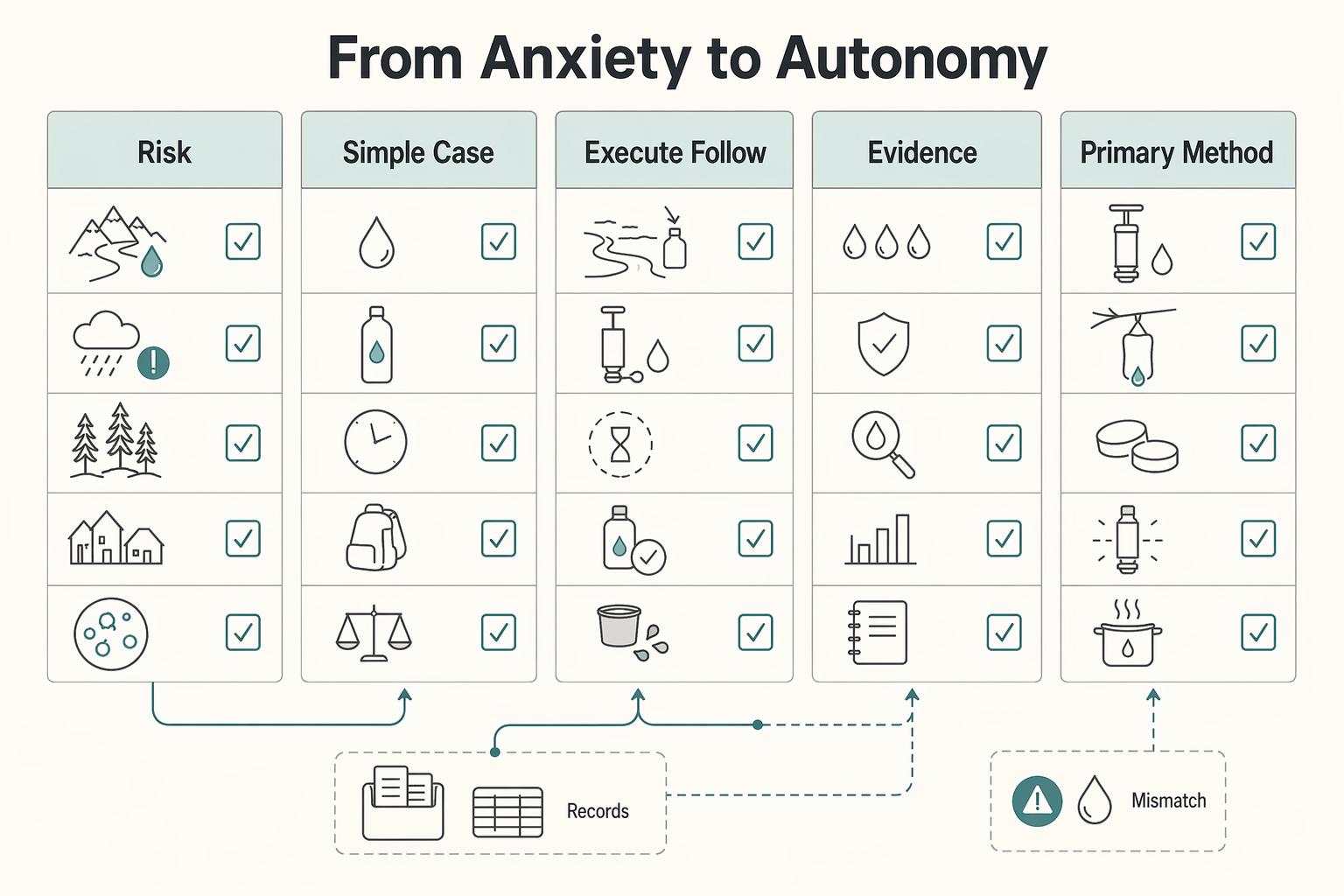
Quick Answer
Start with risk classification, then choose treatment class. For remote headwaters with low uncertainty, a microfilter can fit; below huts, farms, villages, or unclear sanitation, move to a purifier-class option or filter plus disinfectant. Verify the product label and disinfectant contact time before departure, keep dirty and clean containers separate, and use the CDC boil fallback: 1 minute, or 3 minutes above 6,500 feet.
Choosing a water filter is not really a gear decision. It is an operating decision. Most backcountry water problems start the same way: someone gets stuck comparing specs, treats the choice like ordinary shopping, and never defines the actual risk they need to manage.
A better approach is simpler and more useful. You are not just buying equipment. You are building a water-treatment system around a critical point of failure on the trip. This guide uses a practical three-part protocol - Assess, Design, and Execute - so you can make a clear call based on route, source, and consequence.
Step 1: Threat Assessment & Jurisdiction Analysis#
Make this call before you compare products. If the source has credible upstream human or animal waste exposure, or you cannot judge sanitation conditions upstream, do not plan around a single treatment step. The CDC's unknown-water default is straightforward: if you are not sure the water is safe, treat it before drinking.
| Check | What to assess | Why it matters |
|---|---|---|
| Source type | Spring, headwater stream, lake edge, river, stock pond, or runoff-fed drainage | Exposure time and mixing before the water reaches you |
| Upstream human impact | Camps, huts, roads, farms, villages, grazing, or heavy day traffic above your fill point | Fecal input risk is a primary contamination path |
| Sanitation and land-use uncertainty | What you know versus what you are assuming about upstream water or waste handling | If it is unclear, treat that uncertainty as real risk |
| Consequence if you are wrong | Illness, dehydration, a forced route change, or dependence on a backup you did not really plan to use | Recovery cost changes the decision |
Your practical jurisdiction is not the map boundary. It is everything upstream of your bottle. You can sort that quickly with four checks:
- Source type
Start with what you are actually collecting from: spring, headwater stream, lake edge, river, stock pond, runoff-fed drainage. What matters is how much exposure time and mixing the water has had before it reaches your bottle.
- Upstream human impact
Look for camps, huts, roads, farms, villages, grazing, or heavy day traffic above your fill point. The main issue is fecal input risk, because human or animal waste is a primary contamination path.
- Sanitation and land-use uncertainty
Separate what you know from what you are assuming. If upstream water or waste handling is unclear, treat that uncertainty as real risk, not a minor gap. Where untreated surface or well water is used and sanitation infrastructure is weak, CDC guidance treats infection risk as high.
- Consequence if you are wrong
A bad call on day 1 near the trailhead is different from a bad call three days from an exit. What changes the decision is the recovery cost: illness, dehydration, a forced route change, or dependence on a backup you did not really plan to use.
| Context | Likely contamination profile | Treatment direction | Common decision error |
|---|---|---|---|
| Remote spring or fast headwater stream with little upstream traffic | Lower apparent microbial risk, but still not safe by appearance alone | Filter-only can be reasonable if the route is truly low uncertainty; verify the product label first | Treating clear water as safe and skipping treatment |
| Popular corridor with camps, stock use, or heavy upstream traffic | Higher chance of fecal contamination and microbial exposure | Filter plus disinfectant is the stronger field direction when you are not boiling | Assuming wilderness status means low risk |
| Water below huts, villages, farms, roads, or unclear sanitation | Broader pathogen profile, including virus concern | Purifier-needed or filter-then-disinfect; verify the current label-based distinction first | Assuming all treatment labels mean the same thing |
| Lowland river, flood runoff, or geothermal-affected source | Mixed microbial load plus possible chemical contamination | Avoid source if possible; boiling and disinfectants do not fix harmful chemicals | Trying to solve a source problem with a better gadget |
Two verification details matter here. First, check the current label and instructions, especially disinfectant contact time. Second, confirm whether your device is labeled as a filter or purifier before you trust it for higher-uncertainty water. A typical 0.3 micron or smaller microfilter targets bacteria and parasites, not viruses. Before you shop, use this two-minute pre-trip prompt set:
- What are my planned source types?
- Who or what is upstream of each likely fill point?
- Where is sanitation or land-use knowledge weak?
- If my first assumption is wrong, what is the consequence that same day?
- Which sources would I simply skip?
If you cannot answer "what is upstream?" in one sentence, escalate your treatment plan. That decision sets up Step 2, where you build a layered carry system that still works when the first method stops being trustworthy.
Step 2: System Design for Absolute Resilience#
Build this before departure: one primary method, one independent backup, and one boil fallback. The goal is simple handoffs under stress, so one failure does not force a bad water decision.
Build the stack before you leave#
| Layer | Use when | If it fails |
|---|---|---|
| Primary method | Match device class to your Step 1 call; use a microfilter only when source uncertainty is low; if Step 1 flagged upstream human impact, unclear sanitation, or virus concern, use a purifier-class option | If flow becomes unreliable, the label no longer matches route risk, or source conditions change, switch to your backup immediately |
| Independent backup | Carry an in-date disinfectant backup with readable instructions; when boiling is not possible, filter first, especially for cloudy water, then use another treatment method | If you cannot verify dose or contact time on the current label, do not guess; boil or skip the source |
| Boil fallback | Bring clear water to a rolling boil for 1 minute, or 3 minutes above 6,500 feet | If fuel, weather, or time removes boiling as an option, your fallback is source selection |
- Primary method (chosen from Step 1 risk)
Match device class to your Step 1 call, then verify the current label and manual. A microfilter is designed to remove protozoa and bacteria, not viruses, so use it only when source uncertainty is low. If Step 1 flagged upstream human impact, unclear sanitation, or virus concern, use a purifier-class option and confirm the exact virus-removal language or standard listed for that model (for example, NSF Protocol P248 where shown). If this fails, use this: if flow becomes unreliable, the label no longer matches route risk, or source conditions change, switch to your backup immediately.
- Independent backup (different mechanism)
Do not duplicate the same failure mode. CDC's direction when boiling is not possible is to filter first, especially for cloudy water, then use another treatment method. In practice, carry an in-date disinfectant backup with readable instructions. If this fails, use this: if you cannot verify dose or contact time on the current label, do not guess; boil or skip the source.
- Boil fallback (biological baseline)
Treat this as a working layer, not a theoretical one. CDC guidance is to bring clear water to a rolling boil for 1 minute, or 3 minutes above 6,500 feet. If this fails, use this: if fuel, weather, or time removes boiling as an option, your fallback is source selection. Boiling does not remove chemicals.
Before you leave, make the "3-2-1" check operational:
- 3 = carry capacity: confirm your route-specific carry target from your route and water-source records.
- 2 = treatment methods: pack one primary plus one independent backup. Confirm the product dose and contact time on the product label.
- 1 = boil option: carry stove, pot, ignition, and enough fuel to execute the boil rule above.
Operator checks that prevent common failures:
- Keep dirty and clean containers physically separate and clearly marked.
- Run the full setup at home once to confirm threads, adapters, and flow.
- Carry model-specific freeze-response or integrity-check instructions on your phone or on paper.
Freeze rules are model-specific. MSR states integrity-test instructions differ by model, and Sawyer's guidance for a wetted filter that froze is replacement.
Compare primaries by decision value#
Use this table to shortlist, then re-check current product pages and manuals before purchase or field use.
| Option | Class and listed coverage | Listed flow | Listed capacity | Best-fit scenario |
|---|---|---|---|---|
| Katadyn BeFree 1.0L | Filter; bacteria, cysts, sediment via 0.1 micron filtration | Up to 2 L/min | 1000L (water-quality dependent) | Solo or fast-moving routes with low upstream uncertainty |
| Platypus GravityWorks | Filter; bacteria and protozoa claims | Up to 1.75 L/min | Up to 1,500 L | Pairs/groups needing higher camp volume and clean/dirty separation |
| LifeStraw Peak gravity purifier | Purifier; explicit virus, bacteria, parasite removal | 30L/hr | 18,000 L | Higher-uncertainty routes where gravity treatment plus virus coverage is preferred |
| MSR Guardian Purifier | Purifier; virus, bacteria, protozoa, sediment removal under P248 framing | 2.5 L/min | 10,000+ L | High-uncertainty or poor-looking sources where purifier-class coverage is the priority |
Switch early, not late#
If performance is in doubt, switch now. Sudden flow loss, suspected freeze exposure, or damaged housings, hoses, or seals means the primary is not trusted until cleaned, checked, or replaced for that model.
If coverage no longer matches the source, escalate treatment now. A functioning microfilter can still be the wrong tool below huts, villages, farms, or other unclear-sanitation sources. Use purifier-class treatment, or filter plus backup instructions verified from the product label or manual before use.
If source uncertainty spikes, treat that as an action trigger. If you cannot explain what is upstream in one sentence, escalate treatment or move to another source. With the stack and handoffs set, Step 3 becomes a repeatable on-route SOP. Related: How to Pack Light for Long-Term Travel (One Bag Guide).
Step 3: Execution via Standard Operating Procedures (SOPs)#
Step 2 built your stack; Step 3 makes your switches automatic. When trust drops, switch early instead of pushing one more bottle through an untrusted setup.
| Phase | Mandatory | Optional |
|---|---|---|
| Pre-trip | Test the exact trail setup you will carry; save the current manual steps you will need in the field; check backup treatment packaging for expiration and readable instructions; pack dirty and clean components separately | Pre-filter silty water or let sediment settle when practical; note expected flow for your unit |
| On route | Use the cleanest available source; if flow drops, service immediately; if source certainty drops, escalate treatment early; if freeze is suspected after use, isolate that unit as untrusted and switch methods immediately | Keep one container dirty-only and one clean-only for the full trip; if one maintenance attempt only partially restores flow, try once more on lower-risk water; if still off, switch methods |
| Post-trip | Clean before storage; follow model-specific post-trip disinfection and storage guidance; dry and store components so next trip starts with trusted gear | Keep a short kit note with last service date, any freeze suspicion, and last integrity-check status |
Use this trigger-action-fallback table in the field. If you cannot verify safety, do not improvise.
| Phase | Trigger | Do this now | If trust is not restored |
|---|---|---|---|
| Pre-trip | You have not tested the full kit since the last outing | Run clean water through your full setup, confirm expected flow, check seals, threads, and hoses, and keep dirty-side parts away from filtered water to prevent cross-contamination | Service before departure, or plan around your independent backup and boil option |
| On route | Source risk rises, water is cloudy, or you cannot explain upstream conditions in one sentence | Treat before use. Filtration alone does not purify water, and most filters do not remove viruses. If you are not boiling, filter first, then disinfect filtered water using the current label contact time | Skip the source, or boil clear water for 1 minute (3 minutes above 6,500 feet) |
| On route | Flow drops, squeeze pressure jumps, or output changes suddenly | Service on trigger, not delay. Confirm the model-specific maintenance step in the owner's manual. | If performance does not recover, retire the primary for this trip and switch to your independent backup immediately |
| Any time after use | Suspected freeze event, hard impact, or cartridge damage | Treat the primary as untrusted: isolate it, label it, and switch to independent backup treatment immediately. Return to primary use only after completing the model-specific integrity guidance in the owner's manual | Keep the primary out of service; use backup treatment or boiling only |
Pre-trip checklist#
Mandatory safety steps
- Test the exact trail setup you will carry: bottle, bag, hose, cap, and adapters.
- Save the current manual steps you will need in the field. Confirm the model maintenance and integrity-check steps in the owner's manual.
- Check backup treatment packaging for expiration and readable instructions. Confirm the backup treatment instructions on the product label.
- Pack dirty and clean components separately so they cannot be mixed by mistake.
Optional optimization
- Pre-filter silty water or let sediment settle when practical to reduce clogging.
- Note expected flow for your unit so you can spot a real performance change quickly.
On-route checklist#
Mandatory safety steps
- Use the cleanest available source.
- If flow drops, service immediately.
- If source certainty drops, escalate treatment early. Filtration by itself is not full purification.
- If freeze is suspected after use, isolate that unit as untrusted and switch methods immediately.
Optional optimization
- Keep one container dirty-only and one clean-only for the full trip.
- If one maintenance attempt only partially restores flow, try once more on lower-risk water; if still off, switch methods.
Post-trip checklist#
Mandatory safety steps
- Clean before storage.
- Follow model-specific post-trip disinfection and storage guidance. Confirm the post-trip disinfection and storage steps in the owner's manual.
- Dry and store components so next trip starts with trusted gear.
Optional optimization
- Keep a short kit note with last service date, any freeze suspicion, and last integrity-check status.
Use the FAQ next for troubleshooting when a trigger fires. Related reading: A Guide to Wilderness First Aid.
Use one repeatable method before, during, and after each trip#
Use a repeatable method, not a gear bet. You are aiming to make the same clear call before the trip, in the field, and after you get home.
- Assess. Write one plain sentence about likely water risk on your route and what is uncertain. If water quality is unknown, treat before drinking. Base your choice on source conditions and consequences, not marketing claims or someone else's trip report.
- Design. Pack a primary method, a different backup method, and a boiling fallback when your trip allows it. Keep the system simple enough to use consistently, but layered enough that one failure does not force a bad decision.
- Execute. Follow one routine every time: collect, treat, store, reassess. If performance changes, stop improvising. Clean only per model instructions, switch to backup when reliability is unclear, and retire gear for that trip if damage is suspected and integrity cannot be verified.
Pre-trip readiness checklist
- Route risk note: confirm the upstream-impact summary from your route records.
- Primary method: confirm your model and its coverage on the product label.
- Backup method: confirm the backup type, instructions, and expiration status on the product label.
- Dirty/clean separation: confirm container marking and packing status in your kit.
- Maintenance step: confirm the model maintenance and integrity-check step in the owner's manual.
- Damage rule: confirm the action for suspected freeze, impact, or crack in the owner's manual.
- Boiling fallback: confirm your stove and fuel status and the elevation-specific boil rule from official guidance.
After each trip, run a short feedback loop: what failed, what friction tempted shortcuts, and what you will change next time. Keep those notes with your gear list and update your checklist before the next departure. That habit turns uncertainty into a system you can trust.
Frequently Asked Questions
How do you decide between clean now, switch to backup now, or retire the filter right now?
Use a conservative triage. One user's approach is to clean or backflush first when flow drops, then switch to backup if performance still seems abnormal. If the unit is damaged, reliability is unclear, or you cannot verify what changed, treat it as untrusted for this trip. | Situation | Do this now | Common mistake | |---|---|---| | Flow drops, but no other warning sign | Follow manufacturer cleaning steps (for example, backflushing when applicable), then retest | Squeezing harder and calling it fine | | Performance stays abnormal after cleaning | Move to your backup treatment immediately | Assuming improved flow means restored safety | | Coverage is unclear for the water you have | Do not assume coverage; use backup treatment or another trusted source until you verify your device guidance | Guessing that any water filter covers every threat |
Can you use a backpacking filter on tap water when traveling internationally?
Not as a blanket rule. This guide does not provide country- or city-specific tap-water safety rules, so verify destination guidance and your device instructions before relying on one method.
When do you need a purifier instead of one of the best backpacking water filters?
This guide does not establish official filter-vs-purifier standards. Practical rule: if your filter coverage is unclear for the risk you may face, use backup treatment or another trusted source until you can verify your device guidance.
What should you verify before you rely on any setup?
Given this pack is a single anecdotal source and includes an interrupted scrape, verify before reliance: Your device instructions clearly describe intended use and limits.. Your backup treatment instructions are readable and available in the field.. You understand the failure modes noted here: tablets are slower, UV depends on battery power and is less suitable in cloudy water, and dirty water may need a bandanna pre-filter first.. Your water carry has redundancy, such as 2 x 1 liter containers instead of one 2 liter container, so one puncture does not end your day.
Try a related tool
Researched and edited by the Gruv editorial team. Gruv builds cross-border billing, payouts, and finance-operations software for global businesses.
Sources
Includes 2 external sources outside the trusted-domain allowlist.
- cdc.gov/drinking-water/prevention/water-treatment-hi...trusted
- cdc.gov/healthywater/pdf/drinking/backcountry_water_...trusted
- epa.gov/ground-water-and-drinking-water/emergency-di...trusted
- fs.usda.gov/visit/know-before-you-go/responsible-recreationtrusted
- nps.gov/articles/2wayspurifywater.htmtrusted
- usgs.gov/observatories/yvo/news/it-safe-drink-water-y...trusted
- cascadedesigns.com/en-ca/products/guardian-purifierexternal
- cascadedesigns.com/products/gravityworks-water-filter-systemexternal
Educational content only. Not legal, tax, or financial advice.
Related Posts
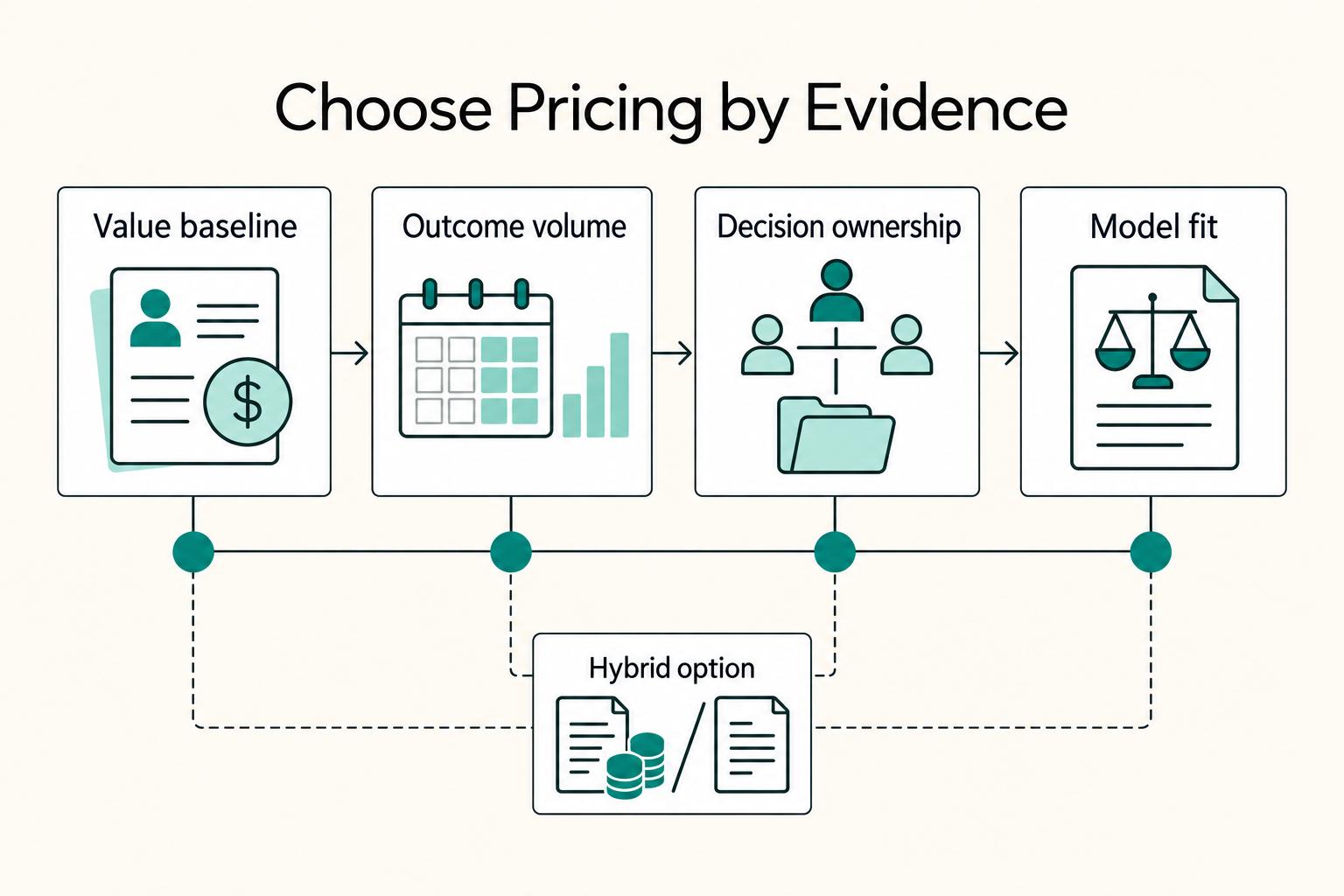
Value-Based Pricing for Freelancers Under Real Payment Risk
Value-based pricing works when you and the client can name the business result before kickoff and agree on how progress will be judged. If that link is weak, use a tighter model first. This is not about defending one pricing philosophy over another. It is about avoiding surprises by keeping pricing, scope, delivery, and payment aligned from day one.
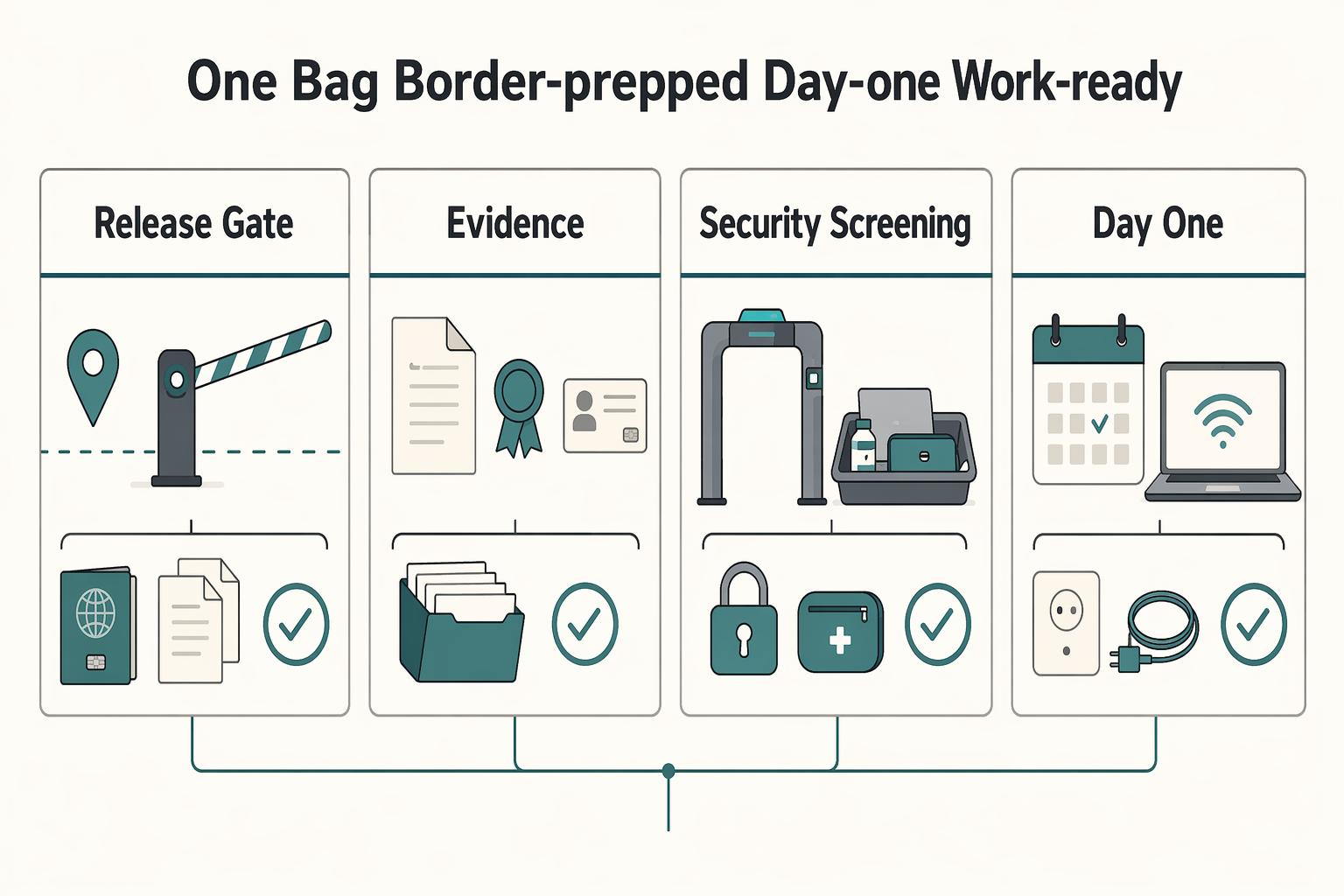
How to Pack Light for Long-Term Travel Without Work Disruptions
The rule is simple: pack light only if losing your main bag would not break identity, payments, health essentials, or your first work session. If those four still work from your personal item, you can travel much lighter without turning arrival day into a recovery exercise.
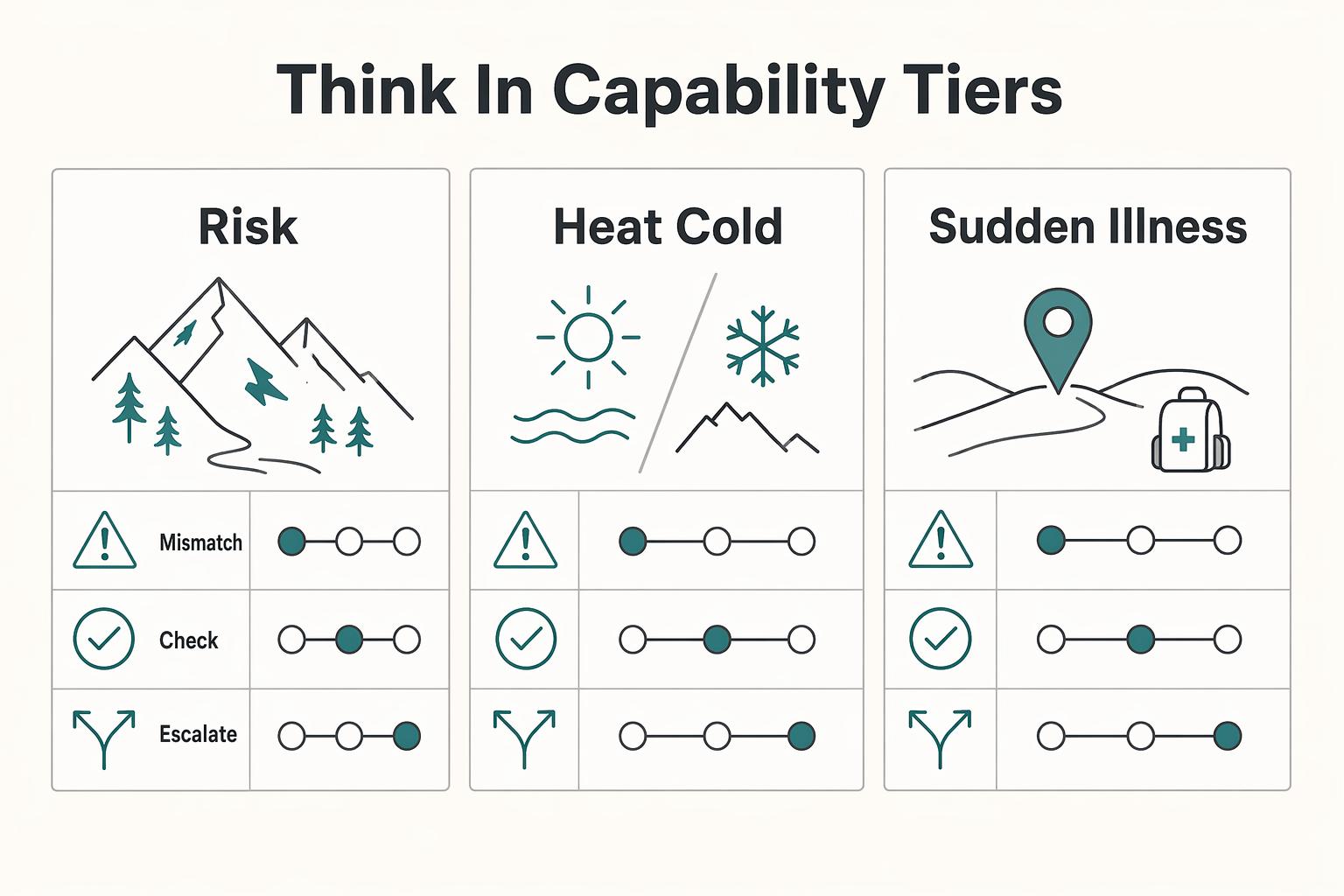
Wilderness First Aid for Remote Professionals
Your business is built on freedom: the freedom to work from anywhere, serve clients globally, and set your own terms. That freedom also removes the layers that usually absorb disruption before it turns into a business crisis. Your office might be a villa in rural Spain, a research site in Costa Rica, or a temporary base in a developing nation. In any of those places, you are also the security lead, risk manager, and first responder.