
Quick Answer
Shortlist Traveling Mailbox for an explicit $4.95 per-check fee plus postage, VirtualPostMail for quoting several checks in one request to one bank account, and a participating Anytime Mailbox location when its address and local operator fit. Confirm your bank’s accepted method. None of the services turns a mailbox scan into instant available bank funds.
Choose a mailbox service that can deliver checks to your bank#
VirtualPostMail and Traveling Mailbox publish mail-in check-deposit workflows. Anytime Mailbox offers check depositing through participating locations. Start with the bank account and the address you need, then compare the provider’s handling fees and dispatch process. None of those facts establishes which provider has the lowest loss rate or fastest bank clearance.
A virtual mailbox receives physical mail and lets you request actions online. For these services, depositing a check involves moving the original to a bank rather than uploading its scan through your own mobile banking app. Anytime Mailbox’s operator guidance allows local bank delivery or mailing, so confirm the method at the selected location.
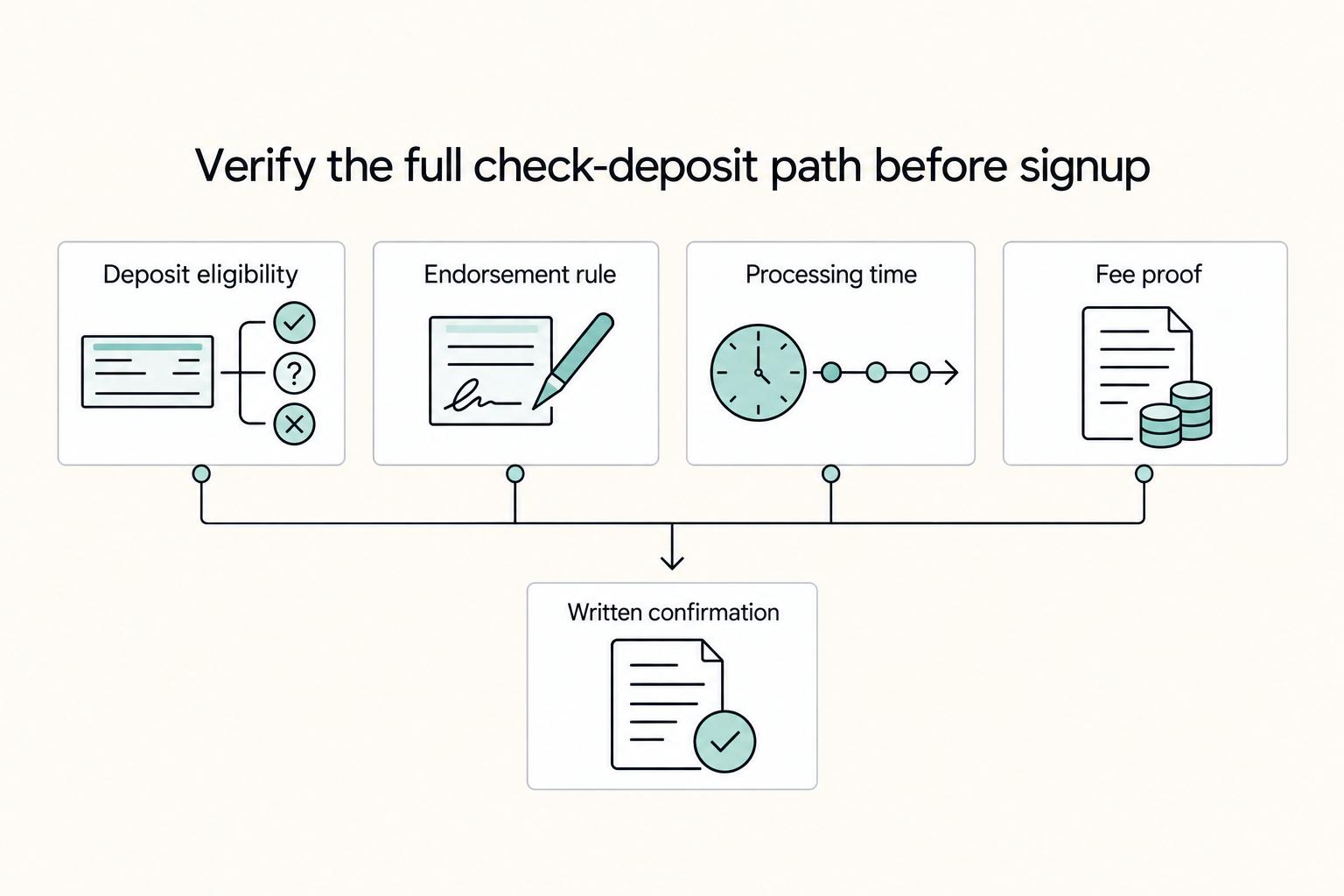
Check-deposit availability is different from bank acceptance. A mailbox operator may offer the service while your particular account has restrictions on mailed checks, payees or delivery addresses. Confirm the bank’s instructions before sending a live item; a provider’s broad “all banks” statement is not an account-specific approval.
This comparison uses provider pages checked on October 3, 2026. It evaluates published features and operating instructions, not hands-on tests or independently measured reliability. Prices are in U.S. dollars and may change. Use the selected address’s checkout and applicable terms for the actual purchase.
For the separate question of which address receives business mail, see How to Get a US Business Address as a Non-Resident. A convenient mailing address does not automatically satisfy a bank’s physical-address requirements.
Who this list is for and how to choose#
These services are useful when a U.S. customer sends paper checks and you cannot conveniently collect them yourself. They can also support an LLC receiving checks in its business name, provided the bank account and mailbox recipient setup match the intended payee.
If cash must arrive on a particular day, consider whether the client can use a bank-supported electronic payment instead. Paying for faster shipping shortens one leg of a paper-check process; it does not remove the bank’s processing, hold or returned-check risk.
Choose according to your constraint#
- Occasional checks: compare the full subscription and a few deposits, not just an advertised starting price.
- Several checks arriving together: compare per-request versus per-check fees and the waiting time required to batch.
- Specific address needed: check the selected operator’s capabilities and quote before applying a network-wide claim.
Check the account before buying#
- Verify mail-in acceptance and the destination for your account.
- Check that the payee and account names meet the bank’s requirements.
- Separate using an address for mail from satisfying the bank’s physical-address or identity checks.
Compare the complete monthly cost#
| Cost component | What changes the total |
|---|---|
| Mailbox subscription | Plan, address, recipients and monthly versus annual billing |
| Opening and scanning | Plan allowance and overages |
| Deposit handling | Per-check, per-request and additional-check fees |
| Shipping | Number of shipments, service and bank destination |
| Extras | Any quoted special handling or bank fees |
Published procedures are useful evidence of what a provider offers. They do not establish its actual support response time, delivery success rate or rejection rate. Ask about the exception that matters to your bank or check type rather than requiring a bespoke document for every routine step.
Here is the practical shortlist. The deposit workflow and price structure are different enough that the lowest mailbox subscription is not necessarily the cheapest option for your checks.
| Provider | Published deposit path | Fee structure | Best reason to shortlist |
|---|---|---|---|
| VirtualPostMail | Original mailed to a U.S. bank that accepts mail-in deposits | Base request fee, first check included; extra checks and shipping charged; obtain dollar quote | Several checks for the same bank account |
| Traveling Mailbox | Original mailed with deposit slip and tracking | Mailbox plan plus $4.95 per check and postage | Clear per-check price and tracked dispatch |
| Anytime Mailbox | Participating local operator delivers or mails the original | Location-specific mailbox and deposit charges | A particular address with a suitable operator |
Do not compare Traveling Mailbox’s annual-plan monthly equivalent with another service’s month-to-month price without labeling the billing term. The subscription and deposit charge are separate, and address upgrades or scan overages can change the total.
VirtualPostMail: useful when batching checks to one bank account#
VirtualPostMail’s check-deposit page describes a mailed deposit service for U.S. banks that accept it. A deposit request can contain several checks for one account; requests to different accounts are billed separately. This makes it worth pricing when several customer checks arrive close together.
What the published workflow establishes#
- A VPM mailbox in good standing and an opened/scanned mail item are required.
- The bank must accept mail-in deposits and the check’s payee name must match the bank account.
- VPM describes a deposit-only endorsement, a printed slip and dispatch usually within one business day.
- Its service page lists First-Class delivery with tracking as the default, with other methods costing extra. Confirm the actual service on the deposit quote.
How to submit the request#
VPM’s request instructions say to open and scan the mail first, then email the mailbox and item details, check amounts, total, bank information and destination. Use the provider’s verified support channel and current instructions for sensitive account information. Check the totals and destination before submitting.
- Identify each item and amount; ensure the sum equals the requested deposit.
- Use the bank’s accepted mail-in destination; a courier may need an address different from a postal lockbox.
- Keep the request and shipment reference so you can identify the physical checks later.
Who should shortlist it#
Choose VPM for its documented batching structure if its quote works for your volume and bank. The first check is included in each deposit’s base service fee, with extra-check and shipping charges applying. Obtain the actual dollar quote for your selected plan and shipment; do not treat “no monthly check-deposit fee” as a free mailbox subscription.
Traveling Mailbox: clear per-check pricing and tracked dispatch#
Traveling Mailbox’s deposit-service page describes opening and scanning the envelope, requesting the deposit online, endorsement, a custom deposit slip and tracked shipment. It publishes a $4.95 charge per check plus postage, separate from the mailbox plan.
Budget from the published plan and deposit fees#
The pricing page lists monthly Basic, Extended and Small Business plans at $15, $25 and $55 respectively. Premium addresses and usage over the plan allowance can add costs. Pick the plan by incoming envelopes, scanned pages and recipients as well as checks.
Its subscription listings show Basic at $150 per year. That equals $12.50 per month only when dividing the annual price by twelve; the standard monthly Basic price is $15. State the term when comparing costs.
Dispatch and batching#
- Deposit-only endorsement and a custom deposit slip are part of the described service.
- The deposit page specifies tracked USPS Priority Mail or FedEx shipping.
- Several checks can be consolidated to save postage; the handling fee remains per check.
The provider says it mails checks within 24 hours of a request and supplies tracking. This is a dispatch commitment, not a promise that usable funds arrive within 24 hours. Carrier transit and bank processing follow. Ask support how the dispatch window operates around closures or an incomplete request if timing is critical.
Who should shortlist it#
Traveling Mailbox is a straightforward option to price for a small number of checks because its per-check charge is explicit. Consolidating checks can reduce postage, but the $4.95 charge still applies to each check. It is not a per-envelope deposit fee.
Use the current address and plan quote. Do not assume general mail-forwarding consolidation prices govern a check-deposit shipment. Its deposit page specifies USPS Priority Mail or FedEx for tracked delivery; confirm the quote for the bank’s accepted destination.
Anytime Mailbox review when location coverage is the top priority#
Anytime Mailbox is worth considering when a particular local address is important. Its network uses local operators, so the selected location’s service listing and terms are the meaningful comparison. A check-deposit badge at one address does not establish the same service at every other address.
For a concrete example, the Dallas–Illinois Avenue listing shows a $9.99 monthly mailbox, 30 mail pieces and check-deposit availability. The Miami–84th Street listing shows $11.89 and the same availability badge. Those are location-specific mailbox prices; neither listing supplies a numeric check-deposit fee.
The platform’s operator training describes obtaining the renter’s bank details, endorsing the check for deposit and either delivering it to a bank or mailing it. That establishes a supported workflow, but not what a particular operator will charge or which delivery method it will use.
Before choosing a location for frequent checks, ask the operator about the following particulars. Compare the answers with the bank’s requirements; a nearby bank branch is only useful if that branch can accept this deposit.
- Does this address currently accept a deposit request for your bank and check type?
- Does the operator deliver locally or mail it, and what is the charge?
- Which endorsement and bank details are needed, and how should you provide them?
- What request, delivery and rejection information will be available to you?
Choose Anytime Mailbox when the address and operator’s confirmed process fit your needs. Do not rank it as less reliable merely because its fees are quoted locally. For address selection beyond depositing, see The Best Virtual Mailboxes for Digital Nomads and LLCs.
Check the bank, instructions and failure path before the first deposit#
Save the bank’s current mailing instructions and the provider’s applicable terms. A published policy can answer routine questions; request clarification for missing details that could stop your specific check. You do not need a custom support letter that repeats every public feature.
| Handoff | Record or confirmation |
|---|---|
| Mailbox intake | Item reference, check amount and intended payee |
| Deposit request | Correct bank details, accepted destination and applicable fee |
| Dispatch or local delivery | Shipment reference or the operator’s delivery confirmation |
| Bank processing | Credit and availability checked at the bank, not inferred from a portal status |
Ask the bank which account types and check types it accepts by mail, the required payee and endorsement, and the destination. Make sure the mailbox recipient name covers the business receiving the check. A personal account is not a substitute for confirming how a check payable to an LLC will be accepted.
Price your actual pattern: how many checks, how many requests, which accounts and which shipment method. Include opening or scan overages if they apply. A provider that charges per request behaves differently from one charging per check; batching changes those components differently.
Use the mailbox provider’s deposit instructions rather than an IRS manual for government remittances. Confirm who endorses the original, which bank details go on the slip and whether your account requires extra wording. Resolve any conflict with the bank before the item is sent.
Record the item reference, amount, payee, request date, tracking or delivery evidence and the bank transaction. Store sensitive details with restricted access. This is enough to investigate a missing or rejected item without circulating full bank account numbers in general project files.
A request marked completed may mean the operator finished its action. Check the bank separately before marking a customer payment reconciled. Delivery to the bank, account credit and funds availability are different events.
Work a monthly cost example before choosing#
Suppose you receive four checks for the same account and select Traveling Mailbox’s $15 monthly Basic plan. If the plan’s mail and scan allowances cover those items, subscription plus check handling is $15 + (4 × $4.95) = $34.80 before postage. This calculation uses its published monthly plan and per-check fee; it is not a full checkout quote.
One shipment versus four shipments#
For illustration only, assume each shipment costs $10 in postage. Four separate shipments would bring that example to $74.80; a single consolidated shipment would bring it to $44.80. The $30 difference is postage, not a reduction in check fees. Actual postage depends on the service and destination.
Compare the waiting cost#
Batching may delay the first check while you wait for the fourth. If you need that money promptly, compare the postage saved with the practical cost of waiting. You can send an urgent check separately and batch the rest; there is no requirement to choose one policy for every item.
Apply the same model to another provider#
For VPM, request a quote for four checks in one deposit versus four separate requests, including postage and the selected mailbox subscription. For an Anytime Mailbox location, ask whether its fee is per check, per request or another structure. Substitute the actual quote into the model instead of guessing a low introductory total.
Try the workflow with a routine check#
After bank compatibility is confirmed, use a routine check you can afford to have delayed and follow it through the whole chain. One successful deposit verifies that setup on that occasion; it does not measure long-term reliability. If it stalls, locate the last confirmed handoff before paying for another shipment.
If tracking shows no delivery, ask the provider and carrier to investigate. If the bank received the shipment but no credit appears, ask the bank about the item. If it is rejected, establish the reason and the location of the original before requesting a replacement. Do not deposit the same check through a scan and a mailed original.
Choose the provider for your actual check pattern#
For occasional checks, clear per-check pricing may matter more than a small subscription discount. For clustered checks, a request-based fee and consolidation can matter more. For an essential local address, compare that operator’s terms. Finish by confirming the bank’s accepted path and keeping the first deposit traceable.
Frequently Asked Questions
Can a virtual mailbox deposit checks directly like a mobile banking app, or is it usually mail-in deposit?
VirtualPostMail and Traveling Mailbox document mailing the original to your bank. Anytime Mailbox’s operator guidance also allows local bank delivery. Confirm the selected operator’s method. An online request or a check scan is not itself a deposit through your own bank’s mobile app.
What does check depositing usually cost once you include service fees, per-check fees, and shipping?
Add the mailbox subscription, applicable opening or scan charges, deposit handling and shipping. Traveling Mailbox publishes $4.95 per check plus postage. VPM describes a base request fee, extra-check fees and delivery charges; obtain the dollar quote. Anytime Mailbox’s selected operator supplies the deposit fee. Annual-plan equivalents and monthly billing should be labeled separately.
How fast is check depositing in practice from request to posted funds at a U.S. bank?
Count mailbox processing, carrier transit, bank processing and any hold separately. Traveling Mailbox publishes dispatch within 24 hours; VPM publishes processing and mailing within one business day. Neither is a guaranteed funds-availability date. Ask your bank about its applicable timing before relying on the money.
What are the most common reasons a check deposit request gets blocked or delayed?
Possible blockers include a bank that does not accept this mailed item, a payee/account mismatch, missing instructions, an incorrect destination or delivery delay. These are checks to investigate, not a ranked frequency study. Use tracking and the bank’s response to locate the problem before resending or replacing the original.
Can I bundle multiple checks into one shipment, and when does that save money versus add delay?
Yes. Traveling Mailbox explicitly allows consolidation to save postage while keeping its per-check fee. VPM allows several checks for one bank account in one request, with extra-check fees after the first. Confirm the selected Anytime Mailbox operator’s policy. Waiting for more checks can defer the first check’s arrival at the bank.
Which provider is best for an LLC that needs predictable operations more than lowest headline pricing?
There is no independent reliability ranking in this comparison. Traveling Mailbox is easy to price per check; VPM is worth quoting for batching to one account; Anytime Mailbox can fit a particular address with a suitable operator. Choose the service whose method, quote and exception support fit your bank and expected volume.
Try a related tool
Researched and edited by the Gruv editorial team. Gruv builds cross-border billing, payouts, and finance-operations software for global businesses.
Sources
Includes 7 external sources outside the trusted-domain allowlist.
- cdn.anytimemailbox.com/portals/operator/guides/ATMB-Operator-Traini...external
- help.virtualpostmail.com/article/90-article-how-to-submit-a-check-dep...external
- lp.anytimemailbox.com/locations/united-states/texas/dallas/27382-d...external
- lp.anytimemailbox.com/locations/united-states/florida/miami/27349-...external
- travelingmailbox.com/check-deposit-servicesexternal
- travelingmailbox.com/pricingexternal
- virtualpostmail.com/virtual-mailbox/check-depositexternal
Educational content only. Not legal, tax, or financial advice.
Related Posts

How to Get a US Business Address as a Non-Resident
The cheapest path is to verify first, then buy. You want an address setup that survives filings, onboarding, and daily operations, not just a clean signup screen.
The Best Virtual Mailboxes for Digital Nomads and LLCs
If you are looking for the **best virtual mailbox for nomads**, the useful question is not who offers the cheapest scans. It is which service will still work when you are moving between countries, receiving packages, updating business records, and relying on the address for real admin.

The Freelance Payment Penalty: A Modeled Audit of Platform Fees, FX Spreads, and Payout Delays
The money rarely disappears through a single, easy-to-spot fee. The real loss is stacked. A marketplace takes its commission, a processor adds a charge for international cards, a bank or payment company converts the currency at a spread, a platform holds the funds before release, and a wire sheds a little to intermediaries on the way in. Each layer looks defensible on its own, but the worker feels the combined result as a smaller deposit and a later payday.