
Quick Answer
Yes, pack a travel mat if it reliably supports your practice and still fits your bag setup. Use a profile-first filter, then check decision evidence on the product page: packed size, weight, care instructions, and recent customer photos. Manduka eKO Superlite, Jade Voyager, and YOGO Ultralight are useful shortlist examples, but none should be treated as an automatic pick. Confirm signs of edge curl, bunching, and fold-line wear before checkout so the mat works beyond first use.
Your Body is Your Business's Most Critical Asset. Invest in It.#
You are not looking for a generic winner. You are looking for one of the best travel yoga mats for the way you actually practice and pack. That distinction matters because yoga is a low-impact practice that usually requires very little equipment. In most cases, a mat is enough, so the one you buy has to earn its place.
| Filter | What it covers | Key question |
|---|---|---|
| Performance fit | Whether the mat feels consistent and confident during normal sessions | Will you feel good using it on a normal day, not just in a first try? |
| Practical fit | Whether it fits the way you actually travel and practice | Will this fit the way you actually travel and practice? |
| Decision cost | Sticker price plus return friction, interruption, and replacement time | If this is the wrong pick, what will it cost you in time and momentum? |
A roundup can help, but it should not make the decision for you. A Forbes list published on Jul 29, 2025 presents 7 mats, and the author says the top pick came after months of testing 10 mats. The page also says selections are made independently while outbound links may generate commission. Treat lists like that as useful context, not a universal answer.
- Performance fit
Start with the mat you will actually trust under you. In practice, that means a feel that stays consistent during normal sessions. Key question: Will you feel good using it on a normal day, not just in a first try? Look for specific, repeated-use feedback, not only first impressions.
- Practical fit
A mat can look good on paper and still be wrong for your routine. If it is inconvenient to handle, your routine can break before you build consistency. Key question: Will this fit the way you actually travel and practice? If product details are thin, treat that as uncertainty and verify before buying.
- Decision cost
This is not just about sticker price. It is also about return friction, interruption, and the time cost of replacing a poor fit. Key question: If this is the wrong pick, what will it cost you in time and momentum? Before you buy, check return terms and whether you can easily get the same model again if it works for you.
Step 1: Define Your Global Operational Profile#
Start by choosing your profile, because the right mat depends on what is most likely to fail in your real routine: packing friction, comfort over repeated use, or slipping during sweaty practice.
Across large test sets used at home, in studios, and on the road, the same criteria keep deciding outcomes: grip, cushioning, and lifespan. Your decision here is which one is non-negotiable for how you travel.
- Carry-On Purist
Pick this if packability is your hard limit. If a mat is awkward to carry or store, you will stop bringing it. Decision cue: How tightly do you pack, and how often do you relocate? What to verify: listed weight, clear folded/packed dimensions, and storage photos. If those details are missing, treat that as a warning.
- Extended Stay Specialist
Pick this if you stay put long enough that daily comfort and durability matter more than minimal transit load. Decision cue: Are you setting up a regular practice base for weeks or longer? What to verify: repeated-use feedback, cushioning notes, and clear care instructions.
- High-Intensity Practitioner
Pick this if your sessions are consistently sweat-heavy or dynamic. Your main failure point is traction loss. Decision cue: How often do sweaty hands and feet change your stability? What to verify: review comments about grip in sweaty conditions, not just dry-use impressions.
| Profile | First priority | Likely compromise | Best-fit traits to verify |
|---|---|---|---|
| Carry-On Purist | Easy packing and low carry burden | Less cushioning or a more minimal feel | Listed weight, folded/packed dimensions, and stowability |
| Extended Stay Specialist | Comfort and lifespan over repeated use | More bulk in transit | Cushioning feedback, repeated-use durability signals, and care guidance |
| High-Intensity Practitioner | Reliable grip in sweaty sessions | Extra maintenance, weight, or a less plush feel | Sweaty-practice traction notes and slip-risk comments under heat or intensity |
If you are between profiles, choose based on the highest-risk failure point. If bulk makes you leave the mat behind, choose Purist. If thin support cuts sessions short, choose Extended Stay. If slipping breaks trust fastest, choose High-Intensity.
Once this profile is clear, Step 2 gets simpler: you can evaluate material, grip behavior, and hygiene tradeoffs against your actual use case. You might also find this useful: How to Integrate Calendly with Your Website.
Step 2: Mitigate Performance & Hygiene Risk#
After Step 1, your next job is risk control: pick a mat you can trust in real travel conditions and maintain without added friction. Most misses happen when grip changes outside a studio setup or when cleaning and drying become harder than expected on the road.
Grip has two separate checks, and you need both:
- Top-surface traction for hands and feet during practice.
- Bottom-surface stability on the floors you actually use, especially hotel tile, laminate, and thin carpet.
Match grip to your real conditions#
Use your own context, not generic "good grip" claims. Screen each option against practice intensity, sweat level, climate humidity, and your usual floor surface.
| Your condition | Material families to compare first | What to verify before buying |
|---|---|---|
| Mostly dry, controlled sessions | Rubber-family surfaces | Verify current performance details. Confirm both dry-hand traction and bottom-surface stability on hard floors. |
| Sweat-heavy or humid sessions | Cork-surface and microfiber-surface builds | Verify current performance details. Prioritize reviews that explicitly mention sweat, humidity, and slip behavior. |
| Mixed conditions across trips | Multiple material families, tested for consistency | Verify current performance details. Look for evidence across dry, damp, and different floor types. |
Before you commit, build a quick evidence pack from the product page: care guidance, material description, thickness, weight, and user photos or video on hard flooring. If these basics are missing, treat grip claims as unproven.
Choose a maintenance burden you will actually keep up with#
Pick maintenance fit first, then surface preference. Travel hygiene is operational: it affects next-day usability, repacking speed, and whether damp gear spreads into the rest of your bag.
| Material type | Absorbency behavior | Cleaning effort | Drying practicality | Best-fit traveler profile |
|---|---|---|---|---|
| Closed-cell style surface | Check whether the brand clearly states wipe-clean or non-absorbent behavior. | Lower effort when care steps are explicit and realistic for travel. | Often easier for short repack windows; confirm the instructions. | Carry-On Purist |
| Open-cell style surface | Check whether the care page signals deeper cleaning or longer air-out needs. | Higher effort when quick wipe-only care is not recommended. | Less forgiving when you need to pack quickly. | Extended Stay Specialist |
| Cork-surface construction | Verify how moisture response and care limits are described. | Can be straightforward, but only if instructions are clear. | Practical when wipe-and-air steps are feasible in your routine. | High-Intensity or mixed-condition traveler, after verification |
| Microfiber-surface construction | Confirm whether moisture changes feel and drying requirements before packing. | Effort varies by build; verify from care instructions, not adjectives. | Practicality depends on full drying guidance. | High-Intensity or mixed-condition traveler, after verification |
If maintenance language is vague, treat that as a warning sign.
Check structural integrity before you buy#
Foldable vs rollable is also a reliability choice, not just a packing choice. Use these pre-buy checks:
| Check | What to look for |
|---|---|
| Stability on hard floors | User footage on hotel-style surfaces, not only studio setups |
| Bunching risk in transitions | Terms like bunches, shifts, or frequent resetting |
| Edge curl after unpacking | Customer photos, not polished brand images |
| Compression behavior | Comments about support flattening under knees, wrists, or hands |
These checks set up Step 3, where you weigh durability and maintenance friction against long-term ROI. For a step-by-step walkthrough, see The Best Travel Backpacks for Digital Nomads.
Step 3: Calculate Long-Term ROI#
Your ROI decision is practical: compare what you pay now, how long the mat keeps performing, and how much care you will realistically maintain while traveling. Upfront price matters, but replacement risk and maintenance friction are usually what drive total ownership cost.
One quick anchor: one 2026 market page lists budget foldable fitness mats under $40, with many around $20 to $30. Use that range as a screening signal, not a quality guarantee.
Use this pre-purchase failure checklist#
Before you buy, check these four failure points directly:
| Failure point | What to check | Where to look |
|---|---|---|
| Crease wear | Cracking, whitening along fold lines, or folds that stop lying flat | Customer photos of repeated use |
| Surface breakdown | Abrasion, peeling, or top-layer wear | Reviews from regular users with use-context detail |
| Material aging | Limits tied to heat, sun exposure, and cleaners | Care page |
| Edge curl | Edge lift on hard floors | Customer images on hard floors |
- Crease wear
If the mat folds, review customer photos of repeated use, not only unboxing shots. Watch for reports of cracking, whitening along fold lines, or folds that stop lying flat.
- Surface breakdown
Look for abrasion, peeling, or top-layer wear in reviews from regular users. Prioritize use-context detail, for example testing across hot yoga, Vinyasa, and restorative sessions, over generic durability claims.
- Material aging
Read the care page for limits tied to heat, sun exposure, and cleaners. If handling requirements are strict, that raises ownership effort during travel.
- Edge curl
Check customer images on hard floors. Edge lift can make transitions less stable, and foldable designs need extra scrutiny here.
| Material archetype | Lifespan risk to check | Upkeep burden | Who should accept the tradeoff |
|---|---|---|---|
| Open-cell rubber style | Higher wear risk from abrasion and moisture handling; verify with current user reports. | Higher if deeper cleaning and longer drying are needed. | High-intensity practitioners who prioritize grip and will maintain it |
| Closed-cell style surface | Lower absorbency can reduce some wear risk; confirm with travel-use reviews. | Usually lower when wipe-clean guidance is clear. | Travelers who want simpler upkeep and steadier ownership effort |
| Cork-surface construction | Performance can vary with moisture and construction quality; check for top-layer wear or bonding issues. | Moderate, depending on cleaning limits. | Mixed-condition travelers when review evidence supports both grip and upkeep |
| Microfiber-surface construction | Feel and wear vary by build; verify aging after washing and packing. | Moderate to higher if full drying is required before repacking. | Sweat-heavy or humid-condition travelers who can handle drying time |
Read the warranty like a restriction page#
Treat warranty language like a restriction page, not a trust signal. You should verify what is excluded as normal wear, whether fold damage is excluded, and whether travel use is covered at all. If you only see wording like "lifetime warranty," treat it as incomplete until full terms are available. Verify the current warranty terms before you buy.
Use sustainability as a tie-breaker after performance, durability, and maintenance fit are confirmed. If a brand offers sample swatches or a visualizer tool, use that to sanity-check texture and finish before purchase. Related: How to Stay Healthy and Fit While Traveling.
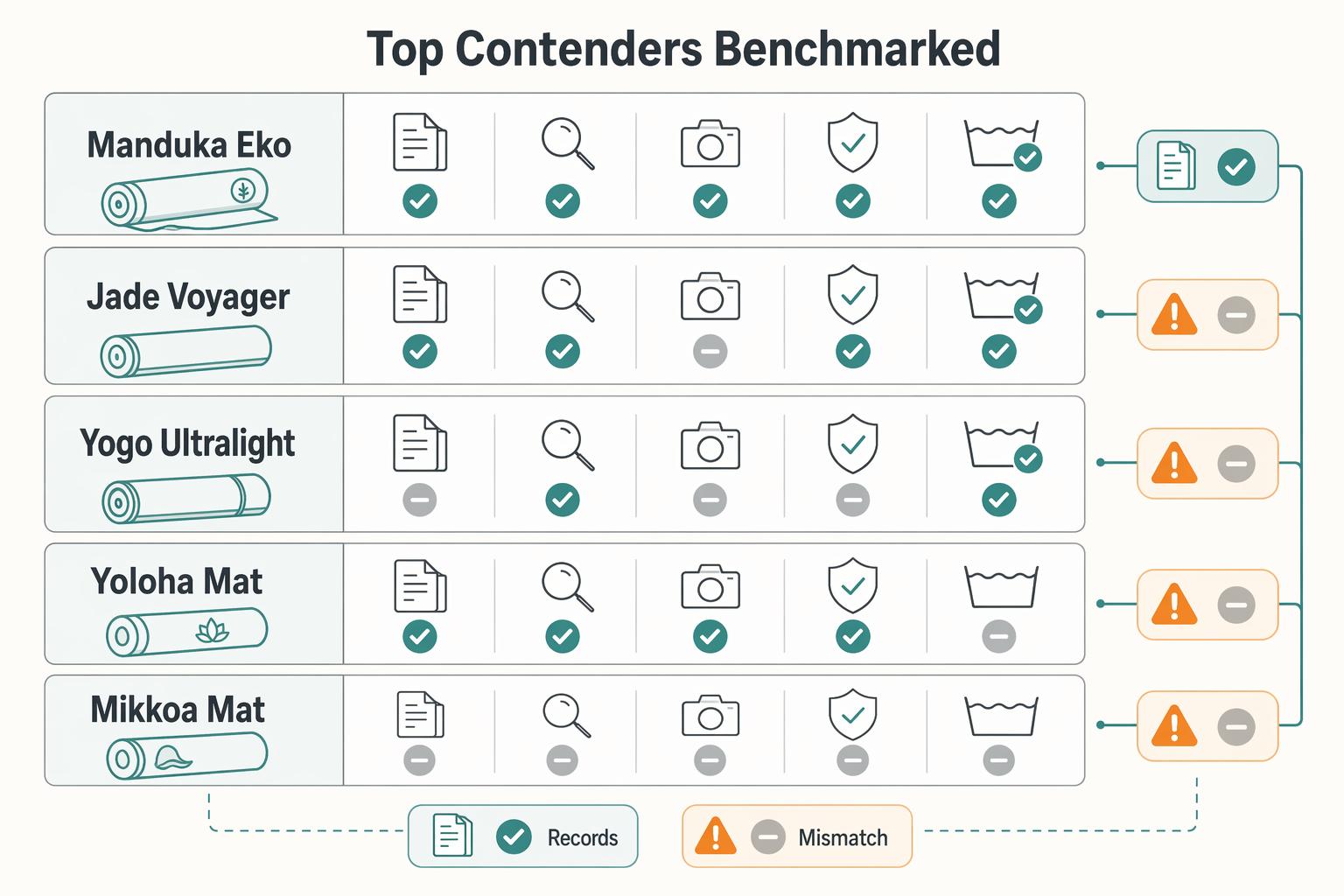
The 2024 Asset Analysis: Top Contenders Benchmarked#
Use this as a shortlist workflow, not a winner list. Live mat specs or performance outcomes aren't validated here, so treat every row as a checklist before you buy.
| Contender | Best-fit profile to confirm | Standout strength to verify | Primary trade-off to pressure test | Maintenance burden to verify | Packing behavior to verify |
|---|---|---|---|---|---|
| Manduka eKO Superlite | Confirm the profile fit | Confirm the current standout strength | Check for mismatch between older reviews and the current version | Confirm current cleaning steps | Confirm current roll/fold behavior |
| Jade Voyager | Confirm the profile fit | Confirm the current standout strength | Check crease wear, edge lift, and comfort trade-offs in recent user photos | Confirm current cleaning steps | Confirm current packed size and fold behavior |
| YOGO Ultralight | Confirm the profile fit | Confirm the current standout strength | Check stability and comfort trade-offs versus portability | Confirm current cleaning steps | Confirm current folded footprint |
| Yoloha mat options | Confirm the profile fit | Confirm the current standout strength | Check whether surface feel matches your real practice conditions | Confirm current cleaning steps | Confirm current fold/roll behavior |
| MIKKOA mat options | Confirm the profile fit | Confirm the current standout strength | Check drying and care friction for your travel routine | Confirm current cleaning steps | Confirm current fold/roll behavior |
Your decision quality depends on documentation, not positioning. Before you commit, confirm the current product page, care instructions, warranty terms, and recent customer photos that show fold lines, edge curl, and surface wear after use. If that evidence is missing, treat the option as unverified.
If your practice gets slippery#
Let sweat level, climate, and cleaning tolerance decide your priority order. If you mostly practice in dry, climate-controlled spaces and need fast wipe-downs before packing, prioritize packability and low-maintenance care. If you regularly slip once sessions heat up, or you practice in humid or non-AC environments, move grip risk to the top, then confirm the required cleaning and drying routine fits your schedule.
When two mats look similar#
Choose based on the first failure point that would make you skip practice:
- Grip risk first if slipping has interrupted sessions before.
- Packability first if frequent moves make awkward gear a recurring problem.
- Durability first if you need consistent use over long stays.
If two options still tie, pick the one with clearer current documentation and terms. We covered this decision style in The Best Power Adapters and Converters for Global Travel. This benchmark gives you the shortlist; the FAQ next addresses common buying and usage objections.
The Verdict: Your Mat is Your Foundation#
There is no universal winner. Choose the mat that matches how you travel, how you practice, and what your bag can actually carry.
Use this final checklist, then make one clear decision:
- Travel profile first
Start with verified specs, not marketing language. Confirm current material, thickness, weight, and folded size on the product page. For example, specs like 1.5mm, 2.2 lbs, or 12"x5" are useful; vague "compact" claims are not.
- Grip and comfort based on your failure point
If slipping breaks your session, prioritize options with credible grip evidence in demanding conditions, including humid testing. If joint comfort is the issue, treat very thin builds carefully, since minimal thickness can feel harsher in longer holds.
- Durability vs packability tradeoff
If you move often, a smaller packed format can make your routine easier to maintain between stops. If you stay longer in one place, comfort and durability are usually the better priority. Before checkout, also verify delivery timing, especially if your departure is close; some listings report 7-14 days, varying by region.
Quick fit summary:
- Carry-on-first: pick the smallest verified folded option.
- Humid or sweaty practice: pick the option with the strongest grip evidence under moisture.
- Long-stay routine: prioritize comfort and durability over the thinnest travel format.
Next step: choose one primary mat and one backup, then verify current specs in the comparison section before you buy.
This pairs well with our guide on The Best Anti-Theft Backpacks for Digital Nomads.
Want help thinking through the shortlist? Talk to Gruv.
Frequently Asked Questions
Is a travel mat actually worth packing?
Yes, if bringing your own mat helps you keep a consistent practice when you travel. The quick filter is simple: if a mat is sticky and sturdy enough for practice while still being packable and lightweight, it earns the bag space. If you usually stay put for weeks and have easy studio access, portability may matter less than practice feel.
How should you choose quickly between packing formats?
Start with your bag, not the brand. A travel yoga mat has to balance grip and stability with packability and low weight, so the fastest filter is whether it truly fits the way you travel. | packing setup | best mat format | tradeoff | example use case | | --- | --- | --- | --- | | Strict carry-on with structured luggage | Foldable mat | You need to verify the current folded size, and compact packing can still change how the mat feels in practice | You want something that compresses small; one source says a foldable mat can pack down to about the size of a pair of jeans | | Hygiene-first packing | Folding design that keeps top and bottom separate | This narrows your shortlist fast, because not every fold design separates surfaces | You often repack soon after practice; the YOGO Ultralight is described as using this kind of sanitary folding system | | Brand line with multiple variants | The most compact option in that line | “Compact” is relative, so check the current listing instead of assuming every version travels well | Within the Manduka excerpt reviewed, the eKO Superlite is described as the most compact option in that range | Use the table to narrow the format first. Then verify the current listing before you buy.
What should you verify before you buy?
Check the current listing for packed shape and current size/weight details, then compare that to your own bag constraints. If you cannot confirm those basics, treat the listing as unverified. One red flag is recommendation bias: at least one source openly discloses affiliate commissions, so use roundups as a starting point, not final proof.
Can you use one mat for both travel and daily practice?
Usually yes, if you accept the main tradeoff. The more a mat is built around compact packing, the more you should pressure-test comfort and stability for longer sessions. If you move often, the compact option may be the right compromise. If you stay in one place for extended stretches, repeat-use feel should probably outrank the smallest packed format.
How do you pick if your practice tends to get sweaty or fast-moving?
Use your actual failure point, not the marketing copy. If slipping or bunching is what ruins a session, prioritize user evidence from similar practice styles, especially Vinyasa. One reviewer says MIKKOA stayed firmly in place during Vinyasa without slipping or bunching, which makes it worth testing, not blindly trusting.
Which examples are worth shortlisting first?
Use examples as fit checks, not automatic winners. YOGO Ultralight is described as lightweight, compact, and built around a dedicated folding system, while Manduka eKO Superlite is described as the most compact Manduka option. For the best travel yoga mats, that is enough to build a shortlist, but not enough to skip verification.
Try a related tool
Researched and edited by the Gruv editorial team. Gruv builds cross-border billing, payouts, and finance-operations software for global businesses.
Sources
- asub.edu/images/uploads/20240812/2024-25-college-cata...trusted
- catalog.cecil.edu/mime/media/7/572/24-25+Catalog+PDF+Final.pdftrusted
- catalog.franklinpierce.edu/current/courses/course-list-all.htmltrusted
- cottey.edu/wp-content/uploads/2025/11/Catalog_2022-2023...trusted
- gbcnv.edu/_migrated-binaries/catalog-1/catalogs/catalo...trusted
- macc.edu/wp-content/uploads/2025/07/2025-2026-MACC-Ca...trusted
- mcm.edu/app/uploads/2022/01/McMurry-Catalog-12-13.pdftrusted
- my.chatham.edu/documents/getfile.cfmtrusted
Educational content only. Not legal, tax, or financial advice.
Related Posts

Value-Based Pricing for Freelancers Under Real Payment Risk
Value-based pricing works when you and the client can name the business result before kickoff and agree on how progress will be judged. If that link is weak, use a tighter model first. This is not about defending one pricing philosophy over another. It is about avoiding surprises by keeping pricing, scope, delivery, and payment aligned from day one.

How Remote Professionals Stay Healthy During Long Stays Abroad
Use this sequence before workload, housing, and travel friction make health tasks harder to execute. If you are traveling for months, treat this as four pass-fail gates. A gate is closed only when you have a written output you can verify.

How to Integrate Calendly with Your Website
Start with a simple three-step launch sequence: choose the embed path that fits the page, lock in your real availability, then validate the booking flow before you publish. That turns a Calendly embed into a client-facing booking process, not just a design element on the page.