
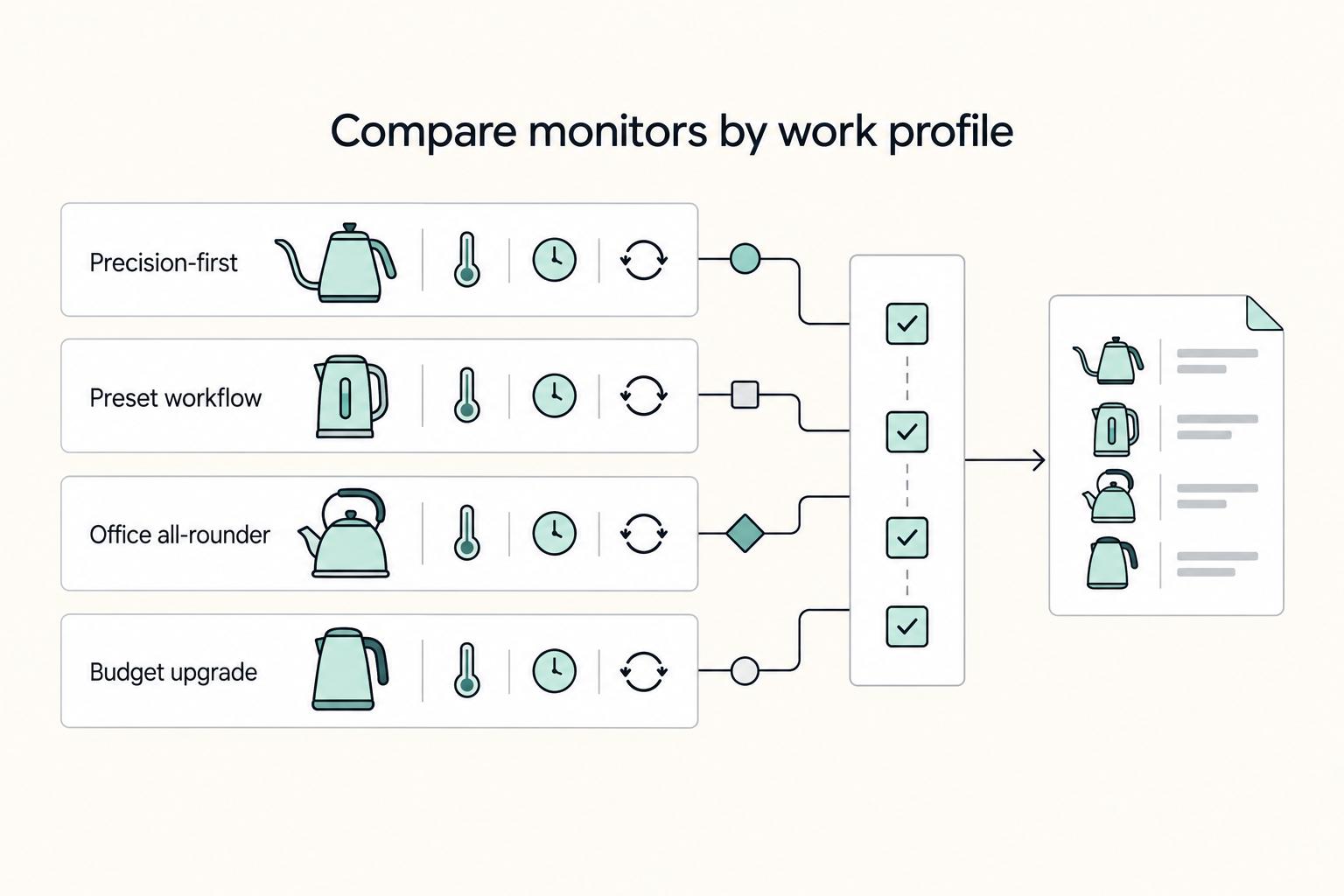
Quick Answer
Choose an electric model that reduces daily friction: dependable temperature control, automatic shut-off, and simple repeat use. For the best tea kettles for home office setups, shortlist options that also handle interruptions well with keep-warm or fast heating, then verify real-world boil audio if you take calls. If you switch teas across the day, favor broader control; if your routine is fixed, practical presets can be enough.
Why Your Kettle Is a Mission-Critical Tool, Not a Kitchen Appliance#
If your kettle feels slow or awkward during the workday, it is not just a kitchen appliance. It is either helping your routine or adding friction to it. The useful question is simple: does it match how you actually work?
| Check | What to look for | Why it matters |
|---|---|---|
| Evaluation quality | Recommendations that explain how products were tested and which criteria were used | Give more weight to reviews that clearly explain their testing |
| Efficiency vs ritual | Quick, automated prep vs a more deliberate tea ritual | Electric can fit efficiency; a classic stovetop kettle can fit a ritual-first experience |
| Disclosure check | Compensation disclosures | Its compensation disclosure is worth noting when you compare recommendations |
You can answer that with a few practical checks. Give more weight to reviews that explain how products were tested and which criteria were used, including effectiveness, ease of use, aesthetics, design, features, and ergonomics. If call-noise performance matters in your setup, treat it as something to verify yourself, not a settled fact from this source.
Everyday Health's January 13, 2026 review says it tested over a dozen products for at least two weeks. It also says it assessed effectiveness, ease of use, aesthetics, design, features, and ergonomics. Its compensation disclosure is also worth noting when you compare recommendations.
| Feature | If missing in your setup | Why it matters in a home office |
|---|---|---|
| Efficiency fit (quick, automated prep) | Breaks take more effort than you want during busy blocks | The review frames efficiency as a core decision criterion |
| Ease of use and ergonomics | Controls or handling feel awkward when you are rushed | Better usability can reduce routine friction |
| Feature fit | The kettle lacks functions you rely on | Feature match affects day-to-day practicality |
| Ritual fit (stovetop or infuser style) | The process feels purely transactional when you want a pause | The review also highlights ritual-oriented tea making |
The broader tradeoff is straightforward: if you want efficiency, an electric option can fit better; if you prefer a ritual-first experience, a classic stovetop kettle can be a better match. Before you upgrade, do a quick self-audit of your routine:
- Evaluation quality: Prefer recommendations that explain how products were tested and which criteria were used.
- Efficiency vs ritual: Decide whether you want quick, automated prep or a more deliberate tea ritual.
- Disclosure check: Note compensation disclosures when comparing recommendations.
We covered this in detail in The Best Air Purifiers for a Home Office.
The Precision Control Engine: How to Brew for Peak Cognitive Performance#
Use temperature control to remove decision friction, not to chase perfect brewing theory. A variable temperature kettle helps you get a more repeatable cup, so your break stays predictable and you can transition back to work faster.
If you default to a full boil every time, you often add extra steps: waiting, cooling, reboiling, or restarting. A better approach is to set one repeatable temperature path per work block and stop re-deciding each session.
| Work block goal | Beverage type | Temperature approach | What to avoid |
|---|---|---|---|
| Deep focus block | Your focus tea | Start with a lower preset or custom setting. If your kettle includes 175°F, use it as a test point, not a rule. | Full boil by default, then guessing with cooldown time |
| Steady mid-day energy | Your mid-day tea | Use a mid-range preset. If your kettle includes 195°F, treat it as a starting point and adjust. | Reboiling repeatedly or changing multiple variables at once |
| Late-day wind-down | Your end-of-day tea | Use a gentler preset that fits this block. | Using the same setting you use for early-day work blocks |
| Fast reset between meetings | Your default workday tea | Save one repeatable preset and pair it with keep-warm when interruptions are common. | A boil-only flow if you regularly get pulled away |
In practice, this is a workflow tool: one button, steep, return to task. That supports consistency and helps you avoid the break-and-reboil pattern that can interrupt concentration.
Before you lock in your routine, calibrate your baseline over a short trial window:
- Pick one beverage for morning work and one for afternoon work.
- Keep cup, water amount, steep time, and kettle setting consistent.
- Log only three items: taste, reboil frequency, and fit for the work block.
- Adjust one variable at a time, starting with temperature.
That is the practical value of variable temperature control: a repeatable input you can trust under real work pressure.
If you want a deeper dive, read Value-Based Pricing: A Freelancer's Guide. Want a quick next step? Try the home office deduction calculator.
The TCO of Tea: Why a $150 Kettle is a Smarter Investment Than a $30 One#
Treat this as an operating-equipment decision: total cost of ownership matters more than sticker price. Your goal is not the lowest checkout total, but the lowest disruption to daily work.
Use this quick method before you compare models:
- Verify the current price band.
- Verify the expected service life range.
- Verify your replacement-cycle assumption.
- Then compare hassle cost: downtime to replace, time to re-learn controls, and routine disruption during busy weeks.
| Cost Component | Budget Model Risk | Investment Model Benefit | How to Verify Before Buying |
|---|---|---|---|
| Upfront price vs ownership cycle | Lower entry cost can hide earlier replacement and extra buying cycles. | Higher upfront spend can be more stable if it reduces replacement events and workflow disruption. | Verify current listing prices and compare against the same feature set. Record the price band and replacement-cycle assumption you used before comparing ownership cost. |
| Build quality signals | Vague material language and light construction can shift failure risk to you. | Clear material disclosure and stronger build cues are better signs for daily use. | Check manufacturer specs for explicit materials and construction details. Avoid relying on product photos alone. |
| Warranty and serviceability | Thin warranty language or unclear support path can increase failure downtime. | Multi-year warranty and clear support channels reduce ownership risk. | Read the full warranty page, confirm claim steps, and check whether service or parts support is documented. |
| Workflow interruption risk | Missing keep-warm or weak heating flow can cause reboils and context switching. | Keep-warm and rapid-boil features help protect focus between work blocks. | Confirm both features in the manual/product page and check whether repeat use is simple under pressure. |
| Noise and desk-workflow fit | Loud boil noise can bleed into calls; awkward handling adds friction. | Quieter operation, practical footprint, and easy handling fit desk-first routines better. | Check dimensions, handle/base design, and usage demos. If calls matter, validate noise behavior in real-use reviews. |
The hidden cost is hassle. When a kettle fails, you do not just replace hardware; you lose time sourcing a new unit, wait through delivery or shopping, re-learn controls, and rebuild your default routine.
That productivity framing matters because distractions can take 23 minutes and 15 seconds to recover from, and brief mental blocks can affect up to 40% of productive time. That is why reliability and repeatability belong in your buying decision.
Pre-purchase checklist:
- Verify material disclosure in manufacturer specs.
- Read full warranty terms and claim process.
- Confirm serviceability signals (support path, parts/service language).
- Check desk fit: footprint, handling, and one-pass repeat use.
- Confirm keep-warm and rapid-boil if your day includes interrupted work blocks.
Related: A Digital Detox Routine for Freelancers.
The Shortlist: Vetting Top Kettles Through the Investment Framework#
Shortlist by disruption control first, then by total cost of ownership. You are not buying the longest feature list; you are choosing the model that creates the least friction in your workday.
| Evidence | What it checks | Use |
|---|---|---|
| Product manual/spec sheet | Current feature support | Use the same evidence pack for every candidate |
| Warranty page | Current warranty terms | Keep warranty comparisons consistent across candidates |
| One demo video | Control flow and boil noise | Use one demo video to judge control flow and boil noise |
Use the same evidence pack for every candidate before you decide: product manual/spec sheet, warranty page, and one demo video to judge control flow and boil noise.
- Verify current feature support.
- Verify current warranty terms.
- Verify current price band.
Compare the four shortlist profiles the same way#
| Shortlist profile | Best for | Noise profile | Temperature control style | Keep-warm behavior | Build/warranty signals | Tradeoffs |
|---|---|---|---|---|---|---|
| Precision-first | Choose this if you brew for specific outcomes and want repeatable targets like 175°F for green tea or 195°F for oolong. | Prioritize near-conversational operation (conversation is around 60 dB; standard kettles can run 70-95 decibels). Verify with video, not copy. | Full variable temperature control. | Best if it holds your selected temperature so you avoid reboils. | Clear materials disclosure, clear warranty terms, clear support path. | Higher upfront cost and potentially slower inputs if controls are complex. |
| Pragmatic preset model | Choose this if you want fast, repeatable one-touch use without managing temperature every time. | Acceptable only if boil noise is brief and meeting-safe near your mic. | Preset temperatures with clear labels. | Strong when easy to activate during short work breaks. | Published warranty details and straightforward service support. | Less precise if presets do not match your usual brew targets. |
| All-around office model | Choose this if you want balanced performance for calls, quick breaks, and mixed drinks. | Aim for low perceived noise to reduce call disruption risk. | Variable control or practical presets, as long as repeat use is low-friction. | Important because waiting and reboiling interrupt deep work. | Durable build signals plus non-vague warranty language. | Middle-of-the-road performance across priorities rather than category-leading in one. |
| Budget-discipline upgrade | Choose this if your first goal is to stop avoidable reboils and move beyond a basic on/off kettle. | Treat noise as the likely compromise; verify before you buy if calls matter. | Preset or variable can work if repeatable in real use. | Useful only if simple enough to use consistently. | Red flag if warranty/support details are hard to find. | Lowest sticker price can still create the highest hassle cost over time. |
Do not treat every "temperature control" claim as equal. Confirm the controls are easy under pressure, keep-warm is practical in your routine, and repeat use will not add extra steps when you are mid-task.
That matters because disruptions are expensive in focus terms: the earlier framing cites 23 minutes and 15 seconds to fully refocus after distraction, with brief interruptions affecting as much as 40% of productive time.
Narrow it to one#
| Priority | Decision rule | Required check |
|---|---|---|
| Meeting-safe noise | Choose the profile with the strongest evidence of quiet operation | Evidence of quiet operation |
| Precision | Choose full variable control | Confirm it supports your real brew targets |
| Budget discipline | Only pick the lowest-cost option after checks pass | Warranty/support credibility checks |
- If meeting-safe noise is your first priority, choose the profile with the strongest evidence of quiet operation.
- If precision is first, choose full variable control and confirm it supports your real brew targets.
- If budget discipline is first, only pick the lowest-cost option after warranty/support credibility checks pass.
That is the TCO filter: if a cheaper unit raises the odds of reboils, call noise, or early replacement, it is not the lower-cost choice in practice.
For a step-by-step walkthrough, see The Best Coffee Makers for a Home Office.
The Final Verdict: Your Kettle is a Strategic Asset#
Your decision is straightforward: buy the kettle that removes friction from your workday, not the one with the most marketing features. For most home-office setups, that means an electric kettle with temperature control, automatic shut-off, and easy repeat use.
- Call professionalism: treat noise as a buying filter, because kettle sound can carry on live calls. A previously cited source in this article framed some kettles at
70-95 dBversus about60 dBfor normal conversation, so verify real boil audio, alert tones, lid clatter, and start flow before you buy. - Brew consistency: if you drink multiple teas, temperature control is the practical upgrade. This guide's working examples stay the same:
175°Ffor green tea and195°Ffor oolong, so choose presets for repeat drinks or variable temperature if your tea rotation changes. - Day-to-day reliability: focus on avoiding reboils, awkward controls, and early replacements. Prioritize keep-warm + rapid boil, durable materials, and a multi-year warranty, then confirm current support details before checkout.
Who this is for (quick split)
- Mostly tea: prioritize precise temperature control first.
- Mixed tea + pour-over coffee: pick standard vs gooseneck based on how often you need precision pouring.
- Frequent calls: prioritize verified noise behavior and simple controls over appearance.
Before you purchase, run this checklist:
- Must-have features: automatic shut-off, presets or variable temperature, keep-warm or rapid boil
- Build quality: comfortable handle, secure lid fit, clear water-level visibility, stable base
- Usability: readable controls and easy one-hand start
- Noise behavior: real-world boil video, not "quiet" marketing copy
- Support: current warranty and return terms
Choose the model that best matches your use case from the shortlist/table. If two options are close, pick the one you can use confidently between meetings without extra steps.
You might also find this useful: How to Stay Productive While Working from a Cafe.
Frequently Asked Questions
Is a pricier kettle worth it for your home office?
It can be, if the extra cost buys repeatable controls you will use and fewer small interruptions during the day. Prioritize exact-temperature control or usable presets, automatic shut-off, and easy repeat use before you care about a premium finish. Ignore outlet badges on their own, since rankings are not uniform: Allrecipes named a Cosori gooseneck its top pick, while America's Test Kitchen labeled an OXO model the winner.
What should you look for if meetings make noise the main issue?
Do not buy on "quiet" copy alone, because the published comparisons here do not provide model-specific noise claims or decibel rankings. Your check is simple: watch a real video for boil sound, alert tones, lid clatter, and start-button flow, then confirm whether the handle stays comfortable and the kettle has automatic shut-off. If you cannot verify those basics, treat that as a red flag and move on.
How does a variable temperature kettle help your productivity?
If you drink more than one kind of tea, temperature control can remove guesswork. Food & Wine notes that electric kettles can heat to an exact temperature, and Allrecipes reports that presets can save time and energy in practice. The decision rule is simple: if you mostly make one drink, presets may be enough. If you switch between teas, a variable temp kettle is usually the better fit.
Should you choose a gooseneck or a standard kettle?
Pick based on how you actually pour at your desk, not on aesthetics. Food & Wine's useful dividing line is precision: gooseneck for controlled pours, standard when you do not need that level of pour control. | Factor | Standard kettle | Gooseneck kettle | |---|---|---| | Main strength | Straightforward general tea prep and pouring | More precise pouring control, especially for pour-over | | Best fit | Tea bags, infusers, French press, quick breaks | Deliberate brewing where pour rate matters | | Tradeoff | Less control over the stream | Usually a slower, more intentional pour | | Meetings and handling | Can feel simpler for quick use; shape alone does not predict noise | Better stream control; confirm the handle does not get hot to the touch |
Are smart kettles with app control worth considering?
Only if app control removes a real step for you instead of adding one. The comparisons here do not directly evaluate app features, so treat them as optional rather than a default requirement. If the app adds setup, notifications, or account friction, skip it.
Should you buy glass or stainless steel?
The comparisons here do not establish one material as universally better. Use material as a secondary choice, then verify the handle and automatic shut-off first, because those checks are explicitly tied to day-to-day safety and usability.
Try a related tool
Researched and edited by the Gruv editorial team. Gruv builds cross-border billing, payouts, and finance-operations software for global businesses.
Sources
- cs.ucf.edu/courses/cop3502/fall2023/material/23-11-07/d...trusted
- energy.gov/sites/default/files/2022-06/beto-13-Systems-...trusted
- fda.gov/media/110822/downloadtrusted
- medfordoregon.gov/files/assets/public/v/2/planning/documents/n...trusted
- palea.cgrb.oregonstate.edu/svn/Poc/branches/beta/ontology/standard.dicttrusted
- philos.nmu.edu/NMUCONTEST17/prob5.intrusted
- rucore.libraries.rutgers.edu/rutgers-lib/44747/TXT/3trusted
- sarahlawrence.edu/undergraduate/2025-2026-catalogue.pdftrusted
Educational content only. Not legal, tax, or financial advice.
Related Posts
Value-Based Pricing for Freelancers Under Real Payment Risk
Value-based pricing works when you and the client can name the business result before kickoff and agree on how progress will be judged. If that link is weak, use a tighter model first. This is not about defending one pricing philosophy over another. It is about avoiding surprises by keeping pricing, scope, delivery, and payment aligned from day one.

A Digital Detox Routine for Freelancers Who Need to Stay Reachable
Use your devices as operating tools, not open doors to constant interruption. The goal is not to quit screens. It is to control when they get to interrupt your work.

How to Stay Productive While Working from a Cafe
Treat a café session like a shipment, not a mood. Before you order, write down one deliverable and one proof-of-completion artifact. If you cannot name both, you are setting up a busy session, not a useful one.