
Quick Answer
Choose the best sleeping pads for backpacking by starting with your trip conditions and sleep profile, then matching insulation, comfort, and failure risk to that plan. Use current live specs as checkpoints, not old labels, and verify return terms before checkout. If you want a lower-guesswork starting point from this piece, begin with the Nemo Tensor All-Season Ultralight Insulated for balanced use, then compare it against your own priorities.
Your Sleep System: A High-Stakes Investment, Not an Expense#
If you are choosing a pad, put reliable warmth, comfort, and durability ahead of price and packed size. Cost and grams matter, but a sleep setup that looks efficient on paper is a bad bargain if it leaves you cold, uncomfortable, or less confident in how it will hold up on a trip.
That matters because your pad is not a standalone purchase. In backpacking, your sleep system is the bag plus the pad, treated as one working unit because you do not really use them separately for sleep. It also sits inside the Big 3, along with your backpack and shelter, which are usually the heaviest categories in your kit. So yes, this is one of the first places to cut weight. It is also one of the easiest places to make a bad trade.
What to prioritize before price#
Start with what the pad has to do in the field, not what it costs in a browser tab. Then check four things:
| Priority | What to check | Grounded detail |
|---|---|---|
| Reliable warmth | Check whether the pad and bag work together for the conditions you expect | 3-season benchmark: bag or quilt rated to 20 degrees F, bag under 32 ounces, pad under 16 ounces |
| Comfort | Choose a pad you can actually sleep on, not just tolerate | Ultralight options are sometimes less comfortable and less durable |
| Durability risk | Include the consequence of early failure in the decision | A low weight target is not useful if it creates an obvious durability compromise |
| Measurement discipline | Verify actual weight once the gear is in your hands | Published weights do not always match real measured weights |
- Reliable warmth
First, check whether the pad and bag work together for the conditions you actually expect. One practical benchmark from the Big 3 approach is a 3-season bag or quilt rated to 20 degrees F, with the sleep setup kept light enough that the bag stays under 32 ounces and the pad under 16 ounces. The point is not the number alone. The point is whether the whole sleep unit still works for your conditions.
- Comfort you can actually sleep on
The right pad is the one you will actually sleep on, not just tolerate for six hours. Ultralight options are sometimes less comfortable and less durable, and that is a real tradeoff, not a moral failure. Be honest here. If a thinner or lighter pad means poor sleep, the weight savings may not be worth it for you.
- Durability risk
A low weight target is useful, but not if the gear choice creates an obvious durability compromise for your use. If you are deciding between options, include the consequence of early failure in the decision, not just the spec-sheet weight.
- Measurement discipline
Do not rely on listed numbers alone. Manufacturers' published weights do not always match real measured weights, and real-world values can differ significantly. If you are comparing pads, verify actual weight once the gear is in your hands.
A good operator checkpoint comes before any shopping: weigh all your current gear and build a gear list first. That is the starting point for reducing base pack weight, and it keeps you from solving the wrong problem. If you have not measured your actual pad, bag, and shelter, you are still shopping from guesses.
This matters even more if your goal is to get the Big 3 under 9 pounds total, or roughly under 3 pounds each.
Buyer signals that usually tell the story#
| If you catch yourself doing this | It usually signals | Better move |
|---|---|---|
| Sorting by lowest price first | You may be treating the pad like an accessory, not part of your sleep unit | Check warmth, comfort, and durability tradeoffs before cost |
| Sorting by lowest listed weight first | You may be chasing a spreadsheet target without testing the tradeoff | Compare measured weight, not just published specs |
| Looking at the pad in isolation | You may miss how it changes the rest of the sleep setup | Evaluate pad and bag together |
| Unsure what to do next | You need technical criteria, not more marketing | Go to the next sections for warmth, pad types, and risk tradeoffs |
One practical rule: if your current sleep kit works, measure it before replacing it. If your bag alone is more than 40 ounces, the Big 3 guidance says replacement is worth considering. Make that call as part of the whole sleep setup, not as a one-item vanity upgrade.
We covered this in detail in The Best Tents for Backpacking.
The Sleep System Trinity: An Engineer's Approach to Warmth#
Treat your sleep setup as one system, not three separate purchases: your pad handles ground loss, your bag or quilt holds body heat, and your shelter protects that warm air from wind and moisture.
| System part | Primary role | If mismatched |
|---|---|---|
| Pad insulation | Handles ground loss; choose it for the ground you expect, not just the air forecast | An under-insulated pad can leave you cold even with a warm bag |
| Bag or quilt rating | Match likely overnight temperatures and your personal sleep profile | A warmer pad can reduce bag insulation needs, while a thinner pad may push you toward a heavier, bulkier bag |
| Shelter protection | Protects warm air from wind and moisture | Drafts or condensation can undermine sleep even with a good pad and good bag |
- Pad insulation (start here)
Choose pad insulation based on the ground you expect, not just the air forecast. Cold or wet ground can pull heat fast, so an under-insulated pad can leave you cold even with a warm bag.
- Bag or quilt rating (match expected lows)
Once pad insulation is set, match your bag or quilt to likely overnight temperatures and your personal sleep profile. A warmer pad can reduce how much bag insulation you need, while a thinner pad may push you toward a heavier, bulkier bag. Since insulation under your back is compressed, pad warmth carries more of the load. If you use a Big Agnes integrated system, the retailer description says an insulated pad is required for intended performance.
- Shelter protection (preserve what you built)
Your shelter does not generate heat, but it can keep or lose it. Drafts can strip warm air, and internal moisture can make insulation feel colder by morning. Treat draft and condensation control as part of sleep planning. In Backpacker's severe-weather testing (four inches of rain and 40-mph wind gusts), a tent that flattened did not make the cut.
Use R-value as a planning lever, not a badge. Start from likely ground conditions, then balance pad insulation against bag weight and pack bulk. OutdoorGearLab's sleeping-pad review (updated November 11, 2025) frames this tradeoff clearly across 17 side-by-side tested pads: keep gear light and packable, but not so minimal that comfort collapses.
| Pad insulation band | Trip context | Sleep profile | Failure tolerance |
|---|---|---|---|
| Lower insulation | Warm-weather trips on milder ground | Warm sleepers who already know thin pads work for them | Low margin if conditions turn colder |
| Mid insulation | General 3-season use and mixed conditions | Most sleepers balancing comfort, weight, and bulk | Moderate margin for weather drift |
| Higher insulation | Cold ground, shoulder season, frozen camps, or conservative packing | Cold sleepers, lighter sleepers, or anyone protecting recovery | Higher margin when conditions are uncertain |
Quick mismatch check before you buy:
- Warm bag + thin pad: You still get cold from below. Upgrade pad insulation first.
- Warm pad + optimistic bag rating: Works until nighttime air drops below plan.
- Good pad + good bag + weak shelter setup: Drafts or condensation can still undermine sleep.
- System bag without insulated pad: Higher risk if you rely on a pad-sleeve design.
For a step-by-step walkthrough of the bag side of the system, see The Best Sleeping Bags for Backpacking.
Three Pad Types and the Compromise Each One Carries#
Start with one question: if sleep goes wrong overnight, which failure mode are you most prepared to handle? Use the three paths below as a practical framework, then verify current model specs before you buy.
- Air pads
Start here if your priority is comfort and tight pack space. Therm-a-Rest NeoAir and NEMO Tensor are common examples in this path. The tradeoff to pressure-test is leak risk: this option fits best if you are willing to protect the pad at camp and carry repair materials you can use.
- Self-inflating pads
Pick this path if you want a middle ground between comfort and fallback behavior when air loss happens. The usual compromise is carry bulk and reduced packing flexibility. This is often the better fit when you accept extra volume for a steadier overnight setup.
- Closed-cell foam pads
Choose foam if you want the simplest setup with fewer moving parts. A model like the NEMO Switchback represents this path. The typical compromise is sleep comfort and external carry convenience, so this works best if you already know you sleep well on firmer support or you want an optional backup layer under an inflatable.
| Technology | Best use case | Key compromise | Most likely failure mode | Who should skip it | Verify before buying |
|---|---|---|---|---|---|
| Air pad | Comfort-first, pack-space-constrained setup | More risk sensitivity to leaks/punctures | Overnight air loss disrupts sleep | Anyone unwilling to manage repair risk | Current R-value, weight, packed size, included repair kit |
| Self-inflating | Balanced comfort with some fallback behavior | More bulk in your pack | You carry more volume than planned | Strict ultralight/low-volume packers | Current packed volume, valve design, repair process |
| Closed-cell foam | Simplicity, durability, or backup layering | Firmer sleep feel and awkward carry | Sleep quality drops from firmness/bulk carry friction | Sleepers who already know they need more cushion | Current dimensions, carry method, stack compatibility |
For colder or higher-consequence trips, combining pad types can be an optional risk-management strategy. There is no single cutoff that applies to every route, so set the trigger from your forecast, terrain, and tolerance for a poor night of sleep.
One practical filter before checkout: verify that a page is real product evidence. Listing-style metadata dated January 8, 2025 and an unrelated "Luxury Hotel Results" page are not pad-tech evidence.
If this sounds like you:
- You want comfort and low packed volume, and you will actively manage leak risk: choose air.
- You want a steadier middle ground and can accept extra bulk: choose self-inflating.
- You want the simplest system, or an optional backup layer under an inflatable: choose closed-cell foam.
The Risk Mitigation Matrix: Choosing Your Pad Based on Mission-Critical Factors#
Your pre-trip pad decision is a risk decision: choose based on likely damage, failure consequence, and whether backup is worth carrying.
1. Read durability as a risk signal, not a guarantee#
Use denier as an early filter, not a promise. It can help you compare fabric robustness, but it does not tell you everything about valve performance or full pad reliability.
Treat any model-specific durability claim as time-sensitive. If you name a specific pad, verify current top/bottom fabric specs on the manufacturer page before you buy. Product lines do change; one published update on September 4, 2025 flagged revisions after XT-series changes.
| Terrain and use pattern | Your habits | Repair readiness | Recommended construction | Escalation trigger |
|---|---|---|---|---|
| Mostly smooth campsites, low abrasion | You clear debris before setup | You carry and can use patch materials | Lightweight air pad | Escalate when forecast, terrain, or trip length leaves little margin for a leak |
| Mixed campsites, occasional rough ground | You are careful, but not perfect | You can handle small leak fixes | Self-inflating pad or a more durable air pad | Escalate when site quality is uncertain or repeated abrasion is likely |
| Repeated rough/abrasive campsites, higher exposure | You expect imperfect sites | You want backup if the main pad degrades | Air pad + foam layer, or foam-only if comfort works for you | Escalate when a pad failure would make the trip unsafe or impractical |
2. Classify failure by consequence, then act#
Use a simple severity framework before your trip:
| Failure level | Meaning | Action |
|---|---|---|
| Manageable in field | You can stabilize the issue and still sleep adequately | Single-pad setup can be reasonable |
| Trip-disrupting | Repeated air loss or poor sleep affects the next day | Move to sturdier construction or add foam backup |
| Non-repairable in field | The pad no longer functions as intended | Do not rely on one vulnerable pad for this trip profile |
Redundancy is conditional, not automatic. A foam-under-inflatable setup is most useful when terrain is rough, your exposure is higher, or you want backup insulation and puncture protection.
3. Turn the decision into a field-ready routine#
Before you leave, confirm this checklist:
- Site prep: Clear sharp debris before placing the pad.
- Leak-check routine: If firmness drops, check obvious causes early and monitor whether loss continues.
- Repair kit readiness: Carry pad-compatible patch materials and confirm they are actually packed.
- Backup plan: Decide your fallback now (foam layer, shared options, or accepted comfort tradeoff).
Specs can still look good while risk stays high. For example, one cited air pad listing showed about $70, 2 inches of cushion, 1.1 lbs, and R-value 1.5; those details help, but failure consequence and warmth fit still decide if it is right for your trip.
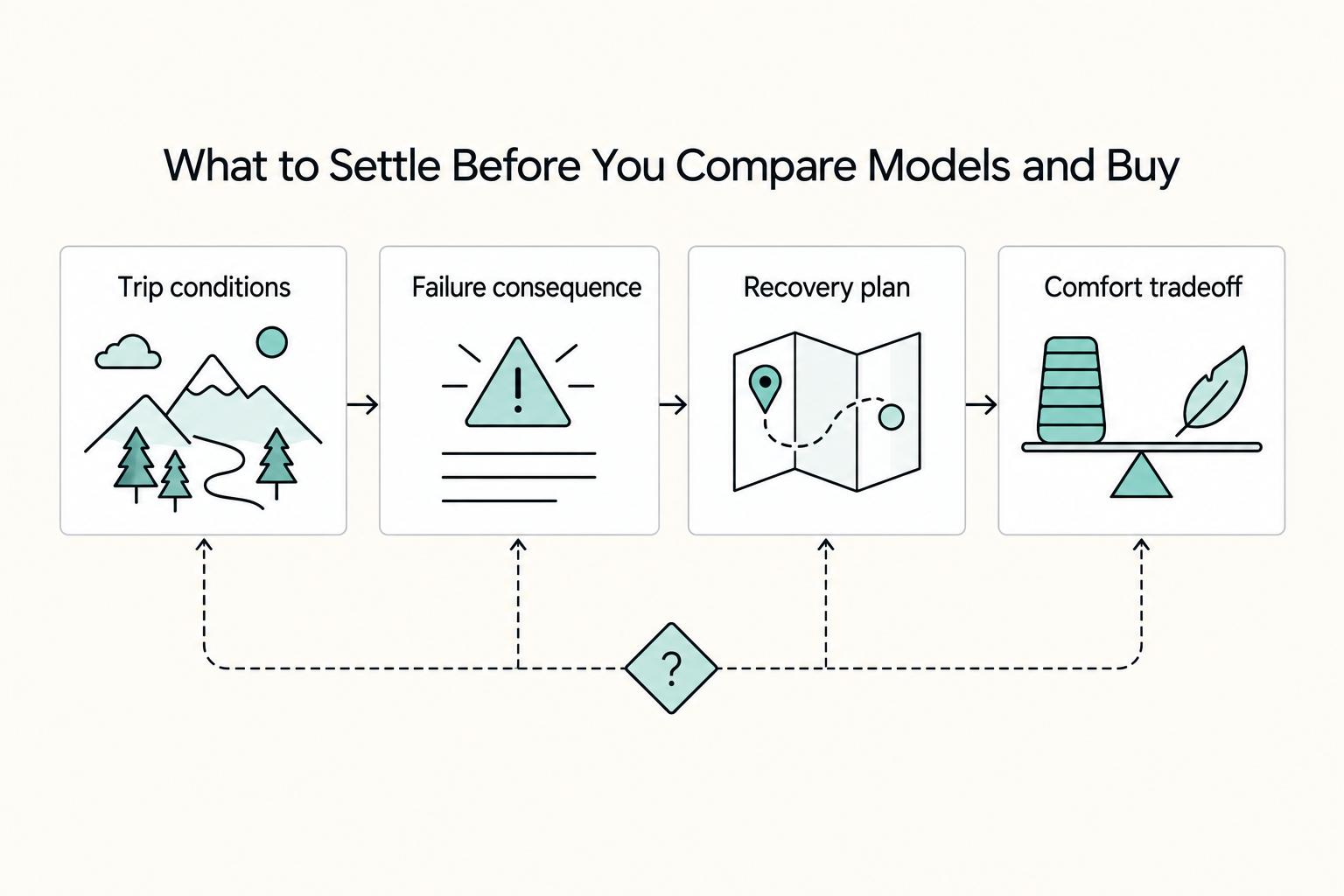
What to Settle Before You Compare Models and Buy#
Use this as a pre-purchase filter: decide your trip conditions, failure consequence, recovery plan, and comfort tradeoff before you compare models.
| Decision prompt | What to decide before buying | What to verify now |
|---|---|---|
| Trip conditions | Are you planning for predictable camps or variable, imperfect sites? | Confirm your expected site conditions and the level of setup care you will realistically maintain |
| Failure consequence | Would one bad night be acceptable, or would it change the trip outcome? | Set your threshold now: manageable, trip-disrupting, or unacceptable |
| Recovery plan | If the pad underperforms, what is your backup action? | Name the fallback in advance so the plan is usable under stress |
| Comfort tradeoff | What are you intentionally giving up for lower weight or bulk? | Confirm the tradeoff is explicit, not just a reaction to marketing or stale comparisons |
Run this checklist before checkout:
- Define your trip profile first. Write down expected terrain, camp variability, and how important next-day performance is.
- Choose pad category second. Match your choice to the failure consequence you already set.
- Verify seller and policy checkpoints on the listing. For example, one listing for the Sea to summit Comfort Light Self inflatable mat shows Sold and shipped by, Free shipping, and Return of order.
- Check account-recovery friction before purchase. The same flow shows failure states like "The email or password is incorrect." It also notes reset email timing (up to 5 minutes), reset-link validity (24 hours), and minimum password length (at least 6 characters).
If you still have edge-case questions, focus next on where single-pad risk is acceptable, when backup is worth it, and how to break ties between close options. You might also find this useful: How to Plan a Multi-Day Hiking Trip.
Frequently Asked Questions
What is a good R-value for 3-season use?
Use the current listed R-value as your checkpoint, not a vague "3-season" label or an old review table. If you sleep cold, camp high, or expect shoulder-season nights, give yourself margin rather than buying to the minimum. What to do next: Write down your coldest realistic overnight conditions, then record the current listed R-value for each pad on your shortlist.
How do you prevent a sleeping pad from puncturing?
A conservative approach is to reduce risk before bedtime: clear the site, keep sharp items away from the pad, and do not rely only on a tent floor on rough ground. What to do next: Before your first trip, confirm you have the repair kit, know where it is packed, and do a quick campsite sweep every night.
Is a Therm-a-Rest NeoAir worth it?
This article does not provide NeoAir-specific performance conclusions, so treat any decision as model-by-model. What to do next: Pull up the live brand page and retailer listing side by side, then verify the exact model name, current specs, and return terms before checkout.
What if durability matters more than shaving grams?
If durability is your priority, stop comparing only by weight and start checking failure points. This article does not name a durability winner, so verify details on live product pages. What to do next: Check valve details, repair-kit inclusion, and any care instructions you know you will or will not follow.
Air pad or foam pad for a longer trip?
It depends on your comfort priority and your failure tolerance. When the consequences of a leak are high, carrying both can make sense. What to do next: Decide now whether you are comfortable finishing the trip on foam alone if the inflatable fails.
What matters most if you sleep on your side?
Focus on whether your hip and shoulder stay off the ground and whether the pad feels stable when you roll. Comfort can be hard to predict from specs alone. What to do next: Inflate the pad on a hard floor, lie on your side for 10 to 15 minutes, and see whether you bottom out or slide around.
Does pad noise really matter?
It can, especially if you are a light sleeper or share a small shelter. What to do next: Search recent owner reviews for words like "crinkle" or "noisy," then do one overnight home test before your return window closes.
Which current models are the safest starting points if you want less guesswork?
For broad balance, the cited starting point is the Nemo Tensor All-Season Ultralight Insulated. For comfort-first buying, it is the Therm-a-Rest NeoLoft. For warm-weather budget use, it is the Klymit Static V2. Those are starting points, not automatic winners for every trip. What to do next: Shortlist one balanced option and one comfort or budget option, then compare only the live specs that matter for your trip.
Try a related tool
Researched and edited by the Gruv editorial team. Gruv builds cross-border billing, payouts, and finance-operations software for global businesses.
Sources
Includes 6 external sources outside the trusted-domain allowlist.
- home.treasury.gov/system/files/136/Fort-Wayne-City-Indiana-202...trusted
- backpackinglight.com/inflatable-sleeping-pads-backpacking-ultrali...external
- littlelifehappy.com/2018/04/torso-length-sleeping-pads-my-experi...external
- nytimes.com/wirecutter/reviews/best-sleeping-pads-for-ba...external
- outdoorgearlab.com/topics/camping-and-hiking/best-sleeping-padexternal
- sectionhiker.com/lighten-up-your-backpack-the-big-threeexternal
- tradeinn.com/trekkinn/en/sea-to-summit-comfort-light-self...external
Educational content only. Not legal, tax, or financial advice.
Related Posts
Value-Based Pricing for Freelancers Under Real Payment Risk
Value-based pricing works when you and the client can name the business result before kickoff and agree on how progress will be judged. If that link is weak, use a tighter model first. This is not about defending one pricing philosophy over another. It is about avoiding surprises by keeping pricing, scope, delivery, and payment aligned from day one.

The Best Travel Backpacks for Digital Nomads
Start by ruling out bad fits, not by chasing a universal winner. If a bag does not match how you move, how you work, or what you can comfortably carry, drop it early. That matters far more than one extra pocket or a slick product page.
How to Plan a Multi-Day Hiking Trip
If you want to plan a multi-day hiking trip with fewer avoidable mistakes, treat it like something you build on purpose, not something you improvise the night before. By the end, you should have a practical phase-by-phase plan and a checklist mindset you can use right away.