
Quick Answer
Start with books for behavior, then run a three-tier workflow for execution and risk. For the best personal finance books for young adults who freelance across borders, use reading to improve judgment, but verify filing details in IRS Publication 54, confirm W-9 and TIN data before billing, and maintain a residency-day log. That combination turns good advice into decisions you can document when payments, taxes, or records are reviewed.
Use Books for Principles, Then Run Your Finances in Three Tiers#
If you run a global business-of-one, standard personal finance advice helps, but it does not cover the whole job. You are not just budgeting. You are also managing tax documents, cross-border payment friction, and records that may need to hold up later.
These issues often come from ordinary workflow gaps, not dramatic mistakes. A client asks for a Form W-9 and your TIN details are outdated. You invoice in one currency, get paid in another, and fee or exchange-rate drag shows up at settlement. You try to rebuild travel days from memory, even though the IRS physical presence test looks for 330 full days in a 12-month period. Those days do not need to be consecutive.
| Area | Employee finance | Business-of-one finance |
|---|---|---|
| Income predictability | Wages are reported on Form W-2, with payroll withholding handled by the employer | Revenue can swing month to month across clients, projects, and currencies |
| Tax responsibility | Taxes are withheld through payroll | You generally file annually and pay estimated taxes quarterly because no employer is withholding for you |
| Legal exposure | The employer is the operating entity | A sole proprietorship is not a separate legal entity, so personal liability can attach to business debts and obligations |
| Payment operations | Payroll is standardized | You manage contracts, invoices, payout rails, fee drag, and client tax forms |
That is why this topic still belongs next to a search for the best personal finance books for young adults. Good books sharpen judgment and behavior, but they may not show you how to connect a signed contract, a W-9 check, a multi-currency invoice, and a travel-day log into one workable system.
Use books for principles, then run your finances in three tiers. Start with Tier 1 because good judgment matters, but it only gets you so far.
- Mindset: make steady decisions when income is uneven.
- Operations: tighten contracts, invoicing, and tax-document handling. Verify W-9 details early because incorrect TIN data can trigger backup withholding.
- Risk control: keep the records that matter, especially residency day counts and documentation tied to payments, contracts, and filings.
If you want a deeper dive, read the six-month Japan digital nomad visa runbook.
Tier 1: The Foundation - Master Your Financial Mindset (But Know Its Limits)#
Mindset-focused finance books can sharpen how you think about money, but on their own they are not much of an operating guide.
A practical way to use them is to read through three lenses, then turn each lens into one repeatable rule.
| Book or lens | Core lesson | What it helps you do | What it does not solve for a global business-of-one |
|---|---|---|---|
| The Psychology of Money | Money psychology matters, even when it feels less practical | Stay steady instead of reacting to short-term swings | It does not, by itself, define contract terms, invoicing controls, or payment operations |
| The Millionaire Next Door | Highlights 7 common wealth-accumulation traits | Focus on consistent accumulation over visible spending | It does not choose your legal structure or manage compliance workflows |
| ESBI quadrants lens | Employee, self-employed, business, investor | Think beyond only current earnings and include owner/investor thinking | It does not set up multi-currency operations, payout rails, or recordkeeping systems |
The point is not more motivation. It is operating discipline. Use each lens as a decision check before major money moves.
Why this still is not enough#
That is the limit of mindset-focused book advice: it can improve behavior, but it is not a full operating playbook. These books do not give you an authoritative legal, contract, multi-currency, or compliance workflow for a global business-of-one. That is where Tier 2 and Tier 3 take over. If you want a payment-specific example, you might also find this useful: Stripe vs. PayPal for International Freelancers.
Tier 2: The Engine - Operate as a Profitable "Me, Inc."#
Tier 2 is where income stops feeling random. Price clearly, document the deal properly, and route surplus cash into retirement accounts that fit uneven earnings.
Price for clarity first, upside second#
Choose the pricing model that matches the uncertainty in the work. Use hourly pricing when scope or duration is genuinely hard to estimate at the start. Use fixed pricing when you can define the deliverable clearly.
| Fixed-price item | What to confirm | Article note |
|---|---|---|
| Outcome | Confirm the outcome in writing | Fixed pricing works when the deliverable can be defined clearly |
| Inclusions | Confirm what is included in writing | Before you quote a fixed fee, confirm what is included |
| Revision count | Confirm the revision count in writing | Before you quote a fixed fee, confirm the revision count |
| Payment due | Confirm when payment is due in writing | Before you quote a fixed fee, confirm when payment is due |
| If the client is buying | Pricing model that usually fits | What you need to lock down to protect cashflow |
|---|---|---|
| Exploration, debugging, open-ended support | Hourly / time and materials | Written cap, narrow task list, and a checkpoint before extra work starts |
| Defined deliverable with clear boundaries | Fixed-price | Outcome, inclusions, revision rounds, and payment timing in writing |
Hourly can be the right call when the work is uncertain, but it creates weak incentives for cost control. That makes boundaries matter more. Fixed pricing works better when specifications are clear enough and the fee is not meant to adjust based on actual cost experience.
Before you quote a fixed fee, confirm four points in writing: the outcome, what is included, the revision count, and when payment is due.
Use the right entity, then tighten the contract#
Pick an entity for liability separation and operating clarity, but do not mistake it for protection on its own. Contracts and insurance still do real work.
| Clause | What to state |
|---|---|
| Scope control | Define deliverables, assumptions, exclusions, and revision cycles so extra work stays billable |
| Milestones and payment dates | Tie payment to dated milestones or acceptance events |
| Late-fee handling | State late-fee terms separately from statutory remedies |
| IP transfer timing | State exactly when IP transfers and require signed writing |
| Dispute process | Name escalation steps, notice method, and venue or governing process where appropriate |
| Decision point | Sole proprietorship | Single-member LLC |
|---|---|---|
| Liability separation | Not a separate legal entity from you, and you can be personally liable for business debts and obligations | LLC status can protect personal property from lawsuits, but that protection has limits |
| Admin burden | Verify local setup and compliance requirements | Verify local formation and ongoing compliance requirements |
| Tax handling | Verify federal and state tax treatment for your situation | By default, one-owner LLCs are disregarded for federal income tax unless you elect otherwise |
If you work with New York clients, written terms matter even more. NYC requires written contracts at $800+, including aggregated agreements over a 120-day period, and New York State added Article 44-A on August 28, 2024. Those rules are jurisdiction-specific, but the broader lesson travels well: payment rights depend on exact terms and local law. In practice, keep these clauses non-negotiable if you want to reduce payment risk early:
- Scope control: Spell out deliverables, assumptions, exclusions, and revision cycles so extra work stays billable.
- Milestones and payment dates: Tie payment to dated milestones or acceptance events. If payment timing is missing, some frameworks default to post-completion timing, for example 30 days under NYC guidance.
- Late-fee handling: State late-fee terms separately from statutory remedies.
- IP transfer timing: State exactly when IP transfers and require signed writing. File delivery alone does not transfer copyright.
- Dispute process: Name escalation steps, notice method, and venue or governing process where appropriate.
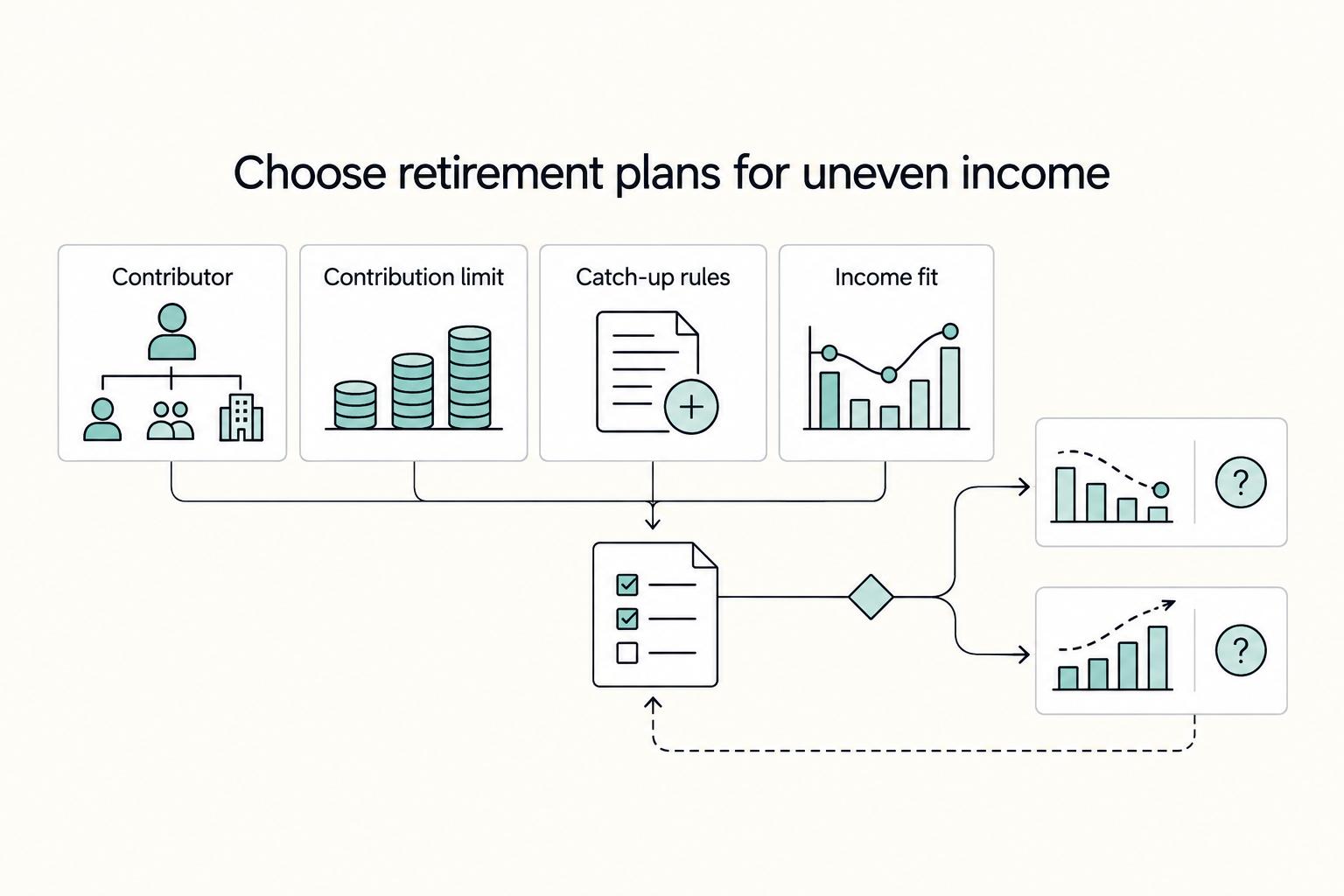
Choose a retirement plan that matches uneven income#
Once pricing and contracts are steady, choose the retirement plan that fits your income pattern and tolerance for admin. The right plan is the one you can use consistently in weak years and strong years.
| Feature | SEP-IRA | Solo or one-participant 401(k) |
|---|---|---|
| Who contributes | Employer only | Employee plus employer |
| Current limit | Verify the current contribution limit for your tax year | Verify the current contribution limit for your tax year |
| Catch-up contributions | Not permitted in SEP plans | Available after verification if eligible |
| Fit for variable income | Useful when you want simpler employer-side flexibility | Useful when you want more contribution paths in stronger years |
For 2026 context, the basic elective deferral limit is $24,500, and the general age-50+ catch-up is $8,000. SEP uses the lesser of 25% of compensation or $72,000.
Tier 2 improves profitability and operating control. It does not replace compliance or jurisdiction risk management. That is where Tier 3 starts. Related reading: The Best Personal Finance Apps for Australians.
Tier 3: The Shield - Mitigate Catastrophic Global Risk#
Cross-border work turns recordkeeping into risk control. Tier 2 stays profitable only if your filings, account records, and day counts are clean enough to support what you report.
1. Know which obligations follow you#
If you are a U.S. citizen or resident alien abroad, core filing rules generally still apply, and you are still taxed on worldwide income. In practice, foreign clients, offshore accounts, or time abroad do not make U.S. reporting obligations disappear.
Foreign account reporting can apply even when an account produces no taxable income. If the aggregate value of your foreign financial accounts exceeds $10,000 at any point in the calendar year, review FBAR (FinCEN Form 114). Keep FBAR and Form 8938 separate in your process. FBAR covers foreign account interest or signature authority, while Form 8938 applies when specified foreign financial assets exceed the relevant threshold.
2. Use a living resource stack, not static book advice#
For cross-border filing decisions, books are not enough. Use them for habits, then move to primary authorities for the current rules. Start with IRS Publication 54 and use it as a living reference, because IRS guidance can be updated after publication, and the cited revision here is December 2025.
Then add current regulatory context. Cross-jurisdiction reporting is active: under the OECD Common Reporting Standard, participating jurisdictions collect account information from financial institutions and exchange it annually. You do not need to master every regime, but you should assume account information can move across jurisdictions.
3. Run this compliance workflow every year#
Use a yearly workflow instead of a year-end scramble:
| Workflow step | Key detail | Action |
|---|---|---|
| Residency-day tracking | 330 full days during any period of 12 consecutive months | Track whether you can support the physical presence test |
| Account/reporting inventory | Review FBAR and Form 8938 applicability | Maintain a complete list of foreign financial accounts |
| Filing calendar | FBAR due April 15; automatic extension October 15 | Track the annual due date and extension |
| Document retention | Five years from the due date | Keep supporting FBAR records |
| Escalation triggers | Multiple-country moves, expanding foreign accounts, signature authority changes, or day-count gaps | Move to professional review when facts become complex |
4. Escalate early when complexity rises#
Once the fact pattern stops being straightforward, get advisor support in place before filing. Form 2848 can authorize IRS representation, but it does not transfer your responsibility for filing accuracy.
Keep FBAR risk handling practical: verify current enforcement details before relying on summaries. The point of this shield is not extra admin. It is to protect cashflow by reducing filing friction and avoidable downside risk.
For a step-by-step walkthrough, see The Best Personal Finance Books Every Freelancer Should Read. Before you lock in your compliance workflow, map your travel and filing exposure in one place with the Tax Residency Tracker.
Build Your Empire, Not Your Paperwork#
This framework only works if it shows up in your calendar. The aim is not more admin. It is steadier cashflow, cleaner payment operations, and lower compliance risk.
- Foundation
Keep one weekly or monthly money check-in and one automatic transfer. Treat your budget as a working plan for spending and saving, then confirm what came in, what must go out, and whether the transfer actually ran. This habit helps keep irregular income from turning into avoidable payment stress.
- Engine
Run your client-payment process from records, not memory. Each month, reconcile your business account, match invoices to deposits, and file the supporting documents for income, deductions, and credits. This helps keep operations usable and reduces year-end reconstruction from scattered receipts and account history.
- Shield
Track compliance dates and evidence in one place, then review on a set schedule. For U.S. readers abroad, start with Publication 54 for foreign-income context, and remember FBAR is due April 15 with an automatic extension to October 15. Keep your evidence pack current: filed returns, foreign account inventory, and records tied to return items.
For the next step, do three things:
- Pick one gap: budget drift, messy payment records, or missing compliance dates.
- Assign an owner: you or your advisor.
- Set a review cadence you will actually keep.
That is how you standardize decisions so paperwork does not end up running your schedule. If you need a related contract-side example, see How to Protect Your Intellectual Property as a Strategic Consultant.
When you are ready to turn this framework into a repeatable system, pick the next practical step from Gruv's Tools Library.
Frequently Asked Questions
Are the best personal finance books for young adults enough once you start freelancing abroad?
No. Use books for habits, vocabulary, and decision quality, but not as your final source for filing rules, residency tests, or contribution limits. If a book gives you a number, threshold, or deadline, treat it as a prompt to verify it in current official guidance before you act. | Resource | Best use | Watch-out | |---|---|---| | Books | Mindset, budgeting habits, pricing perspective, long-term investing basics | Rules age quickly, especially for tax, residency, and retirement limits | | Official guidance | Forms, filing obligations, tax-year-specific limits, cross-border reporting context | You still need to check for updates issued after publication | | Specialist | Ambiguous facts, multi-country moves, retirement setup tied to business structure, filing risk | Verify credentials first; do not assume expertise from marketing alone |
What should I use books for, specifically?
Use books for Tier 1 and part of Tier 2: spending behavior, saving habits, investing basics, and business-owner thinking. They are useful for routines and decision habits. They stop being enough when the question becomes, “What does the IRS require this year?”
What official source should come first for U.S. readers abroad?
Start with IRS Publication 54 for U.S. citizens and resident aliens who work abroad or earn foreign income. Then check the update trail, since the listing shows Revised: December 2025 and the overview page shows Page Last Reviewed or Updated: 23-Jan-2026. If a book conflicts with current IRS guidance, follow the IRS guidance and confirm whether newer updates were posted after publication.
How should I manage day-to-day money if my income is irregular?
Start by separating business and personal finances so your records stay usable. IRS recordkeeping guidance requires books that show gross income, deductions, and credits, and it treats the business checking account as the main source for business-book entries. A consistent owner-pay schedule and monthly reconciliation can help keep records current.
Should I open a SEP-IRA or a Solo 401(k)?
Choose based on eligibility, income pattern, and admin tolerance, not rankings. A one-participant 401(k) is for a business owner with no employees other than a spouse, while a SEP-IRA uses employer contributions and does not permit elective salary deferrals or catch-up contributions. Before opening either plan, verify the current contribution limit for your tax year.
When should I stop reading and hire a specialist?
Consider escalating when you face cross-border filing exposure, unclear residency, multiple-country moves, or retirement-plan decisions tied to business structure. For tax help, verify qualifications in the IRS preparer directory; for investment help, check Investor.gov and then BrokerCheck. Avoid advisors who quote limits without naming the tax year or who treat books as enough for compliance decisions.
What should I ask a specialist before I hire them?
Ask which jurisdictions and filing years they cover, what residency assumptions they are using, and what documents they need up front. Ask for a clear evidence checklist for your case and how they will verify key facts. If they cannot explain what they need to verify, keep looking.
What tools help before I pay for advice?
Start with government education tools that are designed to be impartial. The Consumer Financial Protection Bureau offers free tools and resources, and FDIC Money Smart for Young Adults is built for practical skills development. Use these for baseline money workflows, then switch to primary guidance for legal or tax decisions.
How do I keep compliance from turning into a year-end scramble?
A practical approach is to keep a lightweight evidence pack all year: business account records, income records, filed returns, and a running residency-day log with the relevant rule noted beside it. Review it quarterly instead of waiting for filing season. This can reduce deadline scrambling to reconstruct travel, account, and income records.
Try a related tool
Researched and edited by the Gruv editorial team. Gruv builds cross-border billing, payouts, and finance-operations software for global businesses.
Sources
Educational content only. Not legal, tax, or financial advice.
Related Posts

Japan Digital Nomad Visa 2026: Six-Month Planning Runbook
Treat this as your operating model: identify the right mission first, commit to one route, and keep dated records before you make irreversible plans. That is what keeps the rest of your timeline, paperwork, and decisions coherent.

How to Protect Your Intellectual Property as a Strategic Consultant
**Build a repeatable IP system that defines ownership scope, sets confidentiality rules, and makes governing law and dispute forum explicit before work starts.** As the CEO of a business-of-one, your IP is not "nice to have." It is core operating value. You are not trying to lawyer up every project. You are setting safe defaults so deals move fast and preventable disputes stay contained.

Stripe vs. PayPal for International Freelancers
**For an international Stripe or PayPal choice, pick the payment gateway that cuts your cashflow exposure first, then optimize fees.**